
Leave A Message
If you are interested in our products and want to know more details,please leave a message here,we will reply you as soon as we can.
Multicolor Chameleon Pigment: How Shade-Pair Families Differ in Color Travel
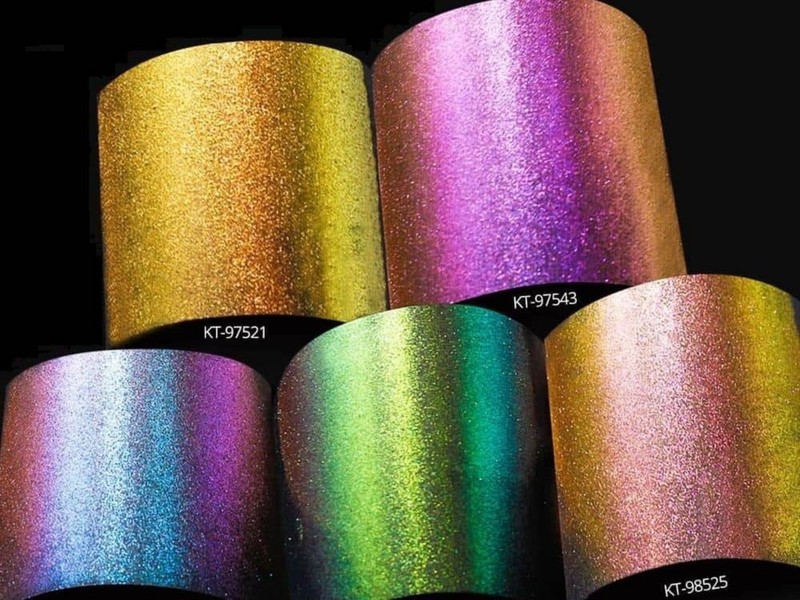
Multicolor chameleon pigment travels three or more hues. Compare shade-pair families by anchor hue, intermediate hue and available particle-size bands.
Item No. :
KT-9000 series (multicolor groups: KT-96xxx, KT-97xxx, KT-98xxx)Color Effect :
Multicolor — three-or-more-hue colour travelParticle Size :
5–55 μm to 50–500 μm (varies by family)Composition :
Natural mica, TiO₂, Fe₂O₃, SiO₂ (multilayer coated)Brand :
KolortekMOQ :
1 kgApplication :
Coatings, plastics, printing inks, cosmetics and nail art, decorative finishesA multicolor chameleon pigment is a goniochromatic effect pigment whose travel visits three or more hues; its families differ in their anchor hues, intermediate hues and available particle-size bands. The KT-9000 Magic Chameleon range groups options by those shade pairs. Pick the family that matches the two colours your design brief names, then confirm which sizes that family is produced in.
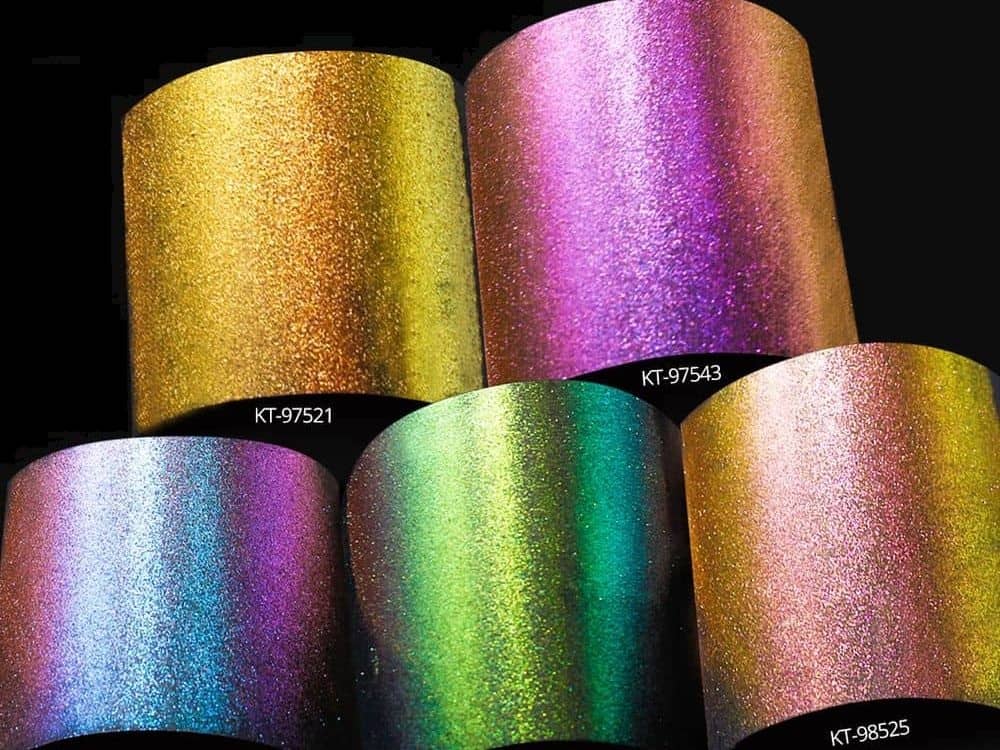
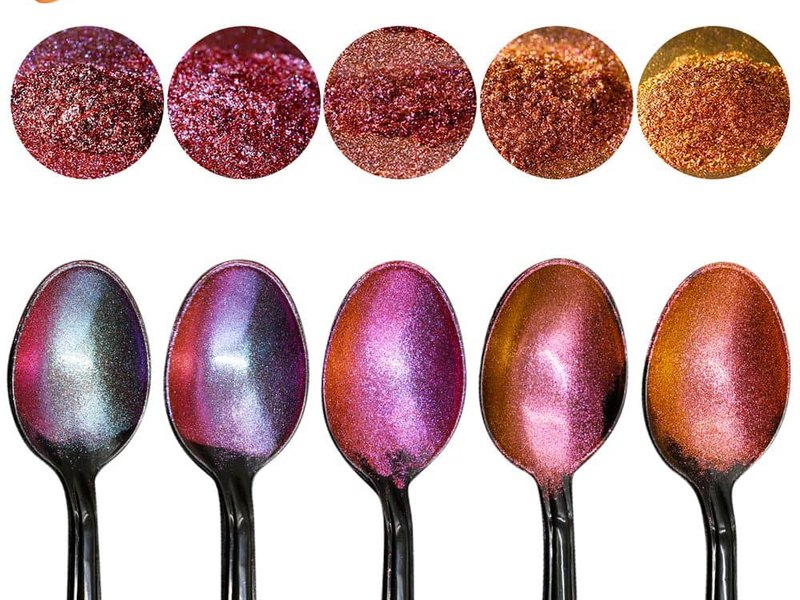
Fig. 1 — Magic Chameleon shade pairs over a dark base; each family travels a different arc (for reference only).
A chameleon pigment is goniochromatic: its apparent colour changes with the angle between the light source, the surface and the observer's eye. That behaviour comes from thin-film interference in a multilayer oxide stack on natural mica. The relevant point for this page is not the mechanism — it is the vocabulary.
Every code in the Magic Chameleon range is named by its travel: the hues you see at different viewing angles. A duoshift code visits two hues. A multicolor code visits three or more, passing through intermediate hues on the way. "Multicolor" describes the number of hues the travel visits, not the vividness of any single one.
The catalogue organises this as two groups: KT Multishift Duoshift Chameleon Series (two-hue) and KT Multicolor Magic Chameleon Series (three-or-more-hue). Both groups are represented in the table below.
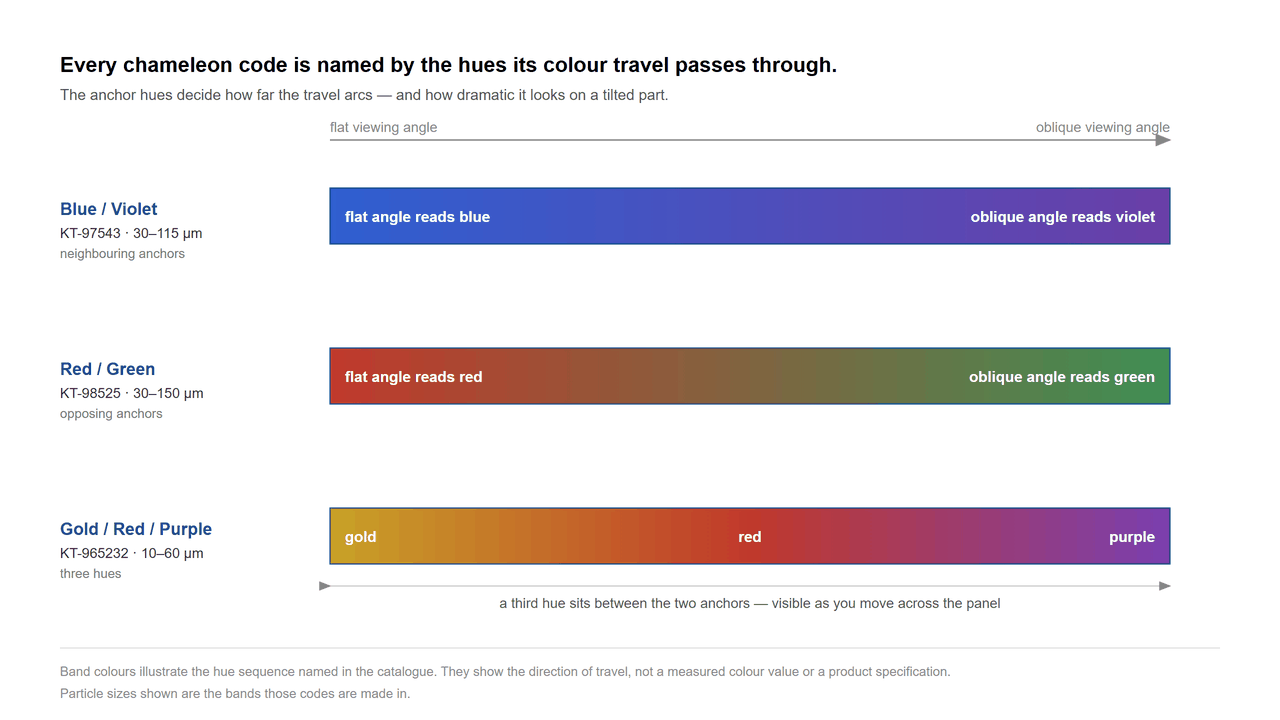
Fig. 2 — Anchor-hue pairs and the colour travel they produce, read across the viewing angle (illustrative).
The table below lists current families by their anchor hues. Read it as a selector: find the two colours your brief already names, and work from there.
| Anchor Hues | Representative Codes | Colour Travel | Sizes Made |
|---|---|---|---|
| Gold / Green | KT-97515 · KT-9622015 · KT-9222110B | Golden/Green | 30–115 μm · 20–100 μm |
| Red / Green | KT-98525 · KT-9555104B · KT-9633052 | Red/Green · Green-Red | 30–150 μm · 10–45 μm · 20–100 μm |
| Blue / Violet | KT-97543 · KT-97243 · KT-982455 | Blue/Violet | 30–115 μm · 25–155 μm |
| Red / Golden | KT-97521 · KT-97221 · KT-982255 | Red/Golden | 30–115 μm · 25–155 μm |
| Green / Blue | KT-97554 · KT-97254 · KT-982545 | Green/Blue | 30–115 μm · 45–215 μm |
| Orange / Cyan | KT-90507 | Orange/Cyan | 20–80 μm |
| Mauve / Green | KT-9852F | Mauve/Green | 50–500 μm |
| Gold-Red-Purple (3-hue) | KT-965232 · KT-965231 | Gold-Red-Purple | 10–60 μm · 10–100 μm |
| Purple-Blue-Yellow (3-hue) | KT-961342 · KT-961341 | Purple-Blue-Yellow | 10–60 μm |
| Blue-Violet-Gold (3-hue) | KT-9644431 | Blue-Violet-Gold | 5–55 μm |
| Golden Green / Red Golden / Violet Red / Blue Violet (3-hue) | KT-972106 · KT-972206 · KT-972306 · KT-972406 | Golden-Green · Red-Golden · Violet-Red · Blue-Violet | 10–60 μm |
| Yellow / Red / Purple (3-hue) | KT-982130 · KT-982245B | Yellow/Red/Purple | 30–115 μm · 45–215 μm |
| Red / Purple / Blue (3-hue) | KT-982345 | Red/Purple/Blue | 45–215 μm |
| Blue / Green / Yellow (3-hue) | KT-982545 | Blue/Green/Yellow | 45–215 μm |
How to read the table: families built on warm-to-cool opposites — Red/Green, Gold/Green, Mauve/Green — produce a high-contrast shift. Families built on adjacent cool hues — Blue/Violet, Green/Blue — produce a quieter, more continuous drift with a more metallic character. Red/Golden sits between those poles, with a warm colour travel.
Three-hue families do not simply shift more. Their appearance depends on where the observer stands in the viewing arc. That makes them harder to control on a small part, but effective on a large, slowly curving surface. There is no best family. The correct family is the one whose anchor hues match the two colours your design brief already names. Confirm it on your substrate before scaling up.
On a small flat part — a nail, a label, a small injection-moulded component — every viewer sees roughly the same angle, so the pigment appears as one of its anchor hues with a hint of the other. On a large, slowly curving surface — a car panel, a helmet shell, a cosmetic compact — different zones face the light at different angles simultaneously. The full arc from one anchor hue to the other is visible across the surface at once.
Three-hue families do not simply produce a wider shift than two-hue families. They produce a qualitatively different one: the observer passes through an intermediate hue — Purple in Gold-Red-Purple, Yellow in Purple-Blue-Yellow, Gold in Blue-Violet-Gold — that a two-hue travel never visits. On a small part, that intermediate hue may never be visible at all, because no common viewing angle puts the observer in the right arc position to see it. On a large curved surface, the intermediate hue occupies a band across the object, and the whole sequence from anchor to anchor is legible.
Families whose anchors sit on opposite sides of the colour wheel — Red/Green, Mauve/Green — produce the most dramatic single tilt. Families whose anchors are neighbours — Blue/Violet, Green/Blue — produce a subtler shift that reads more as a moving shimmer than a distinct colour change. Anchor opposition helps predict the strength of the visual contrast. If your brief calls for a strong, immediately readable shift, start with the wide-span families. If it calls for depth and refinement, start with the adjacent-hue families.
Particle-size grades available across the KT-9000 range are not uniformly available in every family. Size availability is set per family during production.
The duoshift families sit in mid-range bands. KT-975xx runs in 30–115 μm; the KT-985xx group runs in 30–150 μm. Within the Red/Green family, KT-98525 is made in 30–150 μm, while KT-9555104B is made in 10–45 μm.
Three-hue multicolor groups include finer bands. Gold-Red-Purple runs in 10–60 μm and 10–100 μm. Purple-Blue-Yellow runs in 10–60 μm. Blue-Violet-Gold runs in 5–55 μm. These sizes offer options where surface smoothness matters.
At the coarser end, KT-9852F Mauve/Green runs in 50–500 μm. The three-hue iridescent families KT-982345, KT-982545 and KT-982245B run in 45–215 μm.
The practical rule: choose the family first, then ask which sizes that family is produced in. A buyer who selects a particle size before selecting a family will often find the family they need does not exist at that size. The table above lists the sizes made in each family — use it before placing a sample request.
The interference stack reflects certain wavelengths and transmits the rest. Over a dark base, the transmitted wavelengths are absorbed, and the contrast between the flat-angle hue and the oblique-angle hue is at its maximum. Over a light base, scattered light from the substrate mixes with the transmitted wavelengths and reduces that contrast — the travel becomes subtle, sometimes nearly invisible. This is optics, not a defect, and it applies to every goniochromatic pigment on the market.
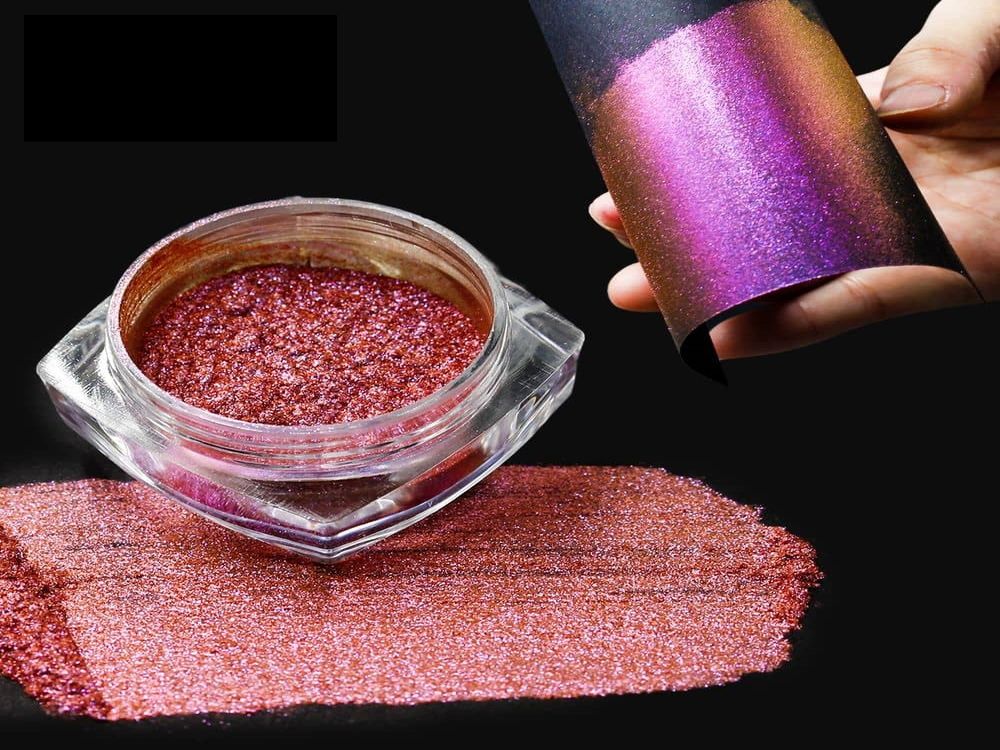
Fig. 3 — KT-97543 (Blue/Violet) as loose powder and on a curved part, over a dark base (for reference only).
MOQ for the Magic Chameleon series (KT-9000) is 5 kg. The Economy Chameleon groups — codes in the KT-95552xxB and KT-92222xxB series — carry a 1 kg MOQ. Custom sample packs are built around your application and dispatched within 5 working days. Stock items are available within 2 weeks. Made-to-order and custom colour matching take 3–4 weeks. Private-label packaging and OEM production to customer specification are available. Price is quoted per series and order quantity.
Payment is accepted by online bank payment, T/T, Western Union and PayPal. Download the Chameleon Collection catalog for the full code list with shade strings and size grids. For procurement questions, see the questions buyers ask before ordering.
Related multicolor and shade-pair grades:
The KT-9000 Magic Chameleon range is built on inorganic oxides and is free of heavy metals. That construction is light-fast, and heat stability follows the limits of the carrier system. Kolortek Co., Ltd. operates under an ISO 9001:2015 certified quality management system. REACH, RoHS, Halal, Kosher, US FDA registration and independent SGS test reports are provided on request. TDS, SDS and COA are available. See quality standards and testing for further detail on the documentation process.
To get the right sample pack, specify three things: the shade pair you are working toward (use the anchor hue names from the table), the particle-size band that family is produced in and that your process can handle, and the basecoat colour or substrate you intend to apply it over. Without the base coat, a sample comparison tells you very little. Kolortek builds the sample pack around your application and dispatches within 5 working days. Test on your own substrate — that result is the one that counts.
It describes how many hues the travel visits, not how saturated the pigment looks. Duoshift codes travel through two hues. Multicolor codes travel through three or more, passing through intermediate hues on the way. Both types are goniochromatic — the distinction is the number of hues on the travel.
Compare the anchor hues, not the code names. Red/Green and Gold/Green both span a wide arc; the one that matches the two colours your brief already names is the correct starting point. From there, confirm the choice on your substrate. No catalogue comparison replaces a trial on the actual base coat and application system you are using.
No. Particle-size availability is set per family. Choose the family first, then confirm which sizes that family is produced in. Fine bands such as 5–55 μm and 10–60 μm occur in three-hue multicolor groups. Coarse decorative sizes exist in specific families only.
It can, but the travel will be subtle. Scattered light from the light substrate reduces the contrast between the anchor hues. Families whose anchors oppose each other strongly — Red/Green, Mauve/Green — retain more of the travel on a light base than adjacent-hue families do. Test on your own substrate before deciding the basecoat is fixed.
A colour name crosses size bands; a code does not. Which range you need depends on substrate, film build and minimum order — three answers before price.
Read More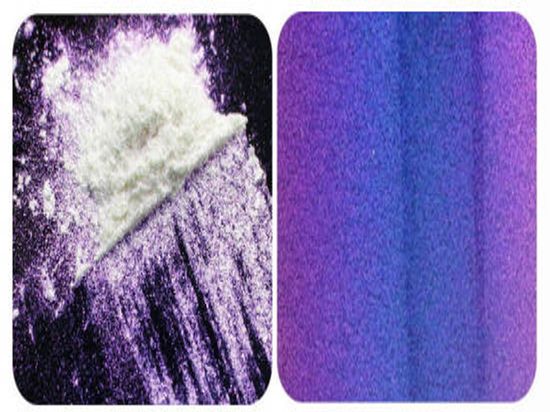
KT-92375 is a large-particle ghost chameleon pigment from Kolortek's KT-9000 Magic Chameleon Series, delivering a continuous five-stage color shift — indigo → purple → red → orange → yellow — as the viewing angle changes. Built on natural mica coated with titanium dioxide, silica, and tin oxide, it carries a particle size of 75–175 μm for maximum sparkle. We developed this grade specifically for high-impact automotive finishes, custom coatings, and luxury decorative applications where a dramatic, angle-dependent color shift is the primary design goal.
Read More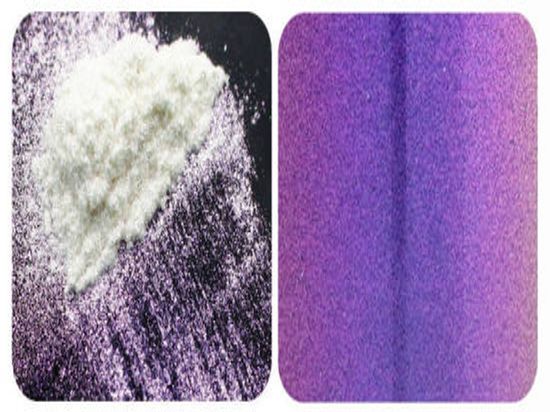
KT-92475 is a large-particle chameleon pigment from the KT-9000 Magic Chameleon Series, producing a continuous mauve → red → orange → yellow color shift that sweeps across the visible spectrum as the viewing angle changes. With a particle size of 75–175 μm and a natural mica substrate coated with titanium dioxide, silica, and tin oxide, it delivers the coarse, high-sparkle texture that nail art formulators need for maximum visual drama — particularly over a dark or black base coat.
Read More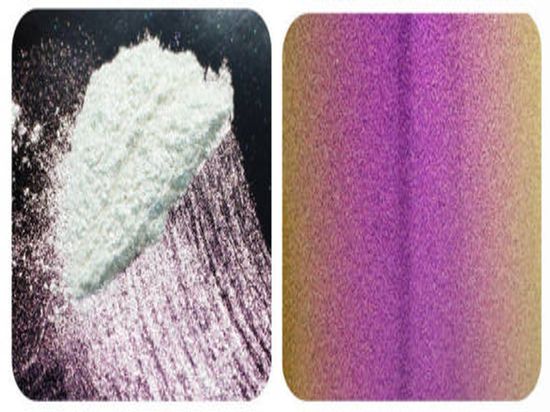
KT-92575 is a large-flake chameleon pearl powder from our KT-9000 Magic Chameleon Series, producing a dramatic angle-dependent color shift spanning red, orange, yellow, and kelly green on dark substrates. Built on a natural mica substrate with a multi-layer coating of titanium dioxide, silica, and tin oxide, it delivers an INCI composition suited to high-end cosmetic and nail art formulations. The 75–175 μm particle range gives it the high-sparkle, deep color-travel behavior that distinguishes it from finer cosmetic pearl grades.
Read More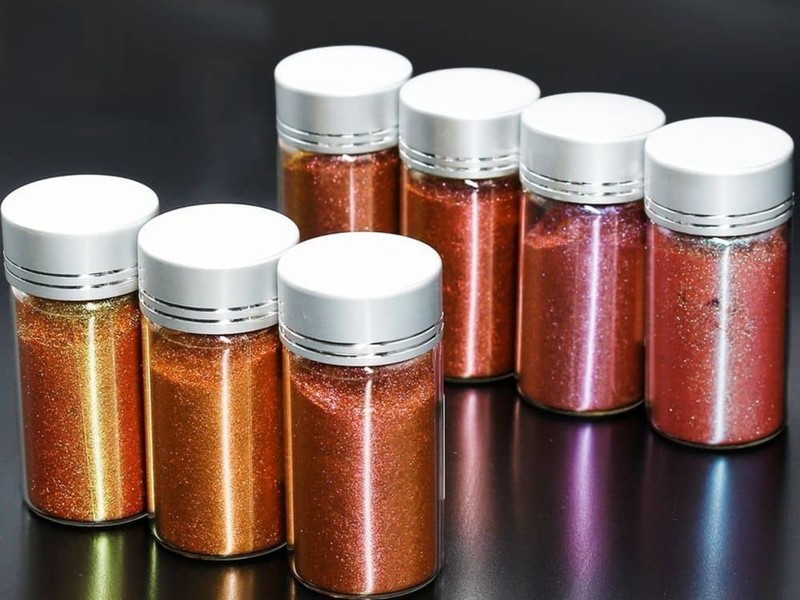
Magic Chameleon duochrome mica powder shifts to a second colour with the viewing angle. Six colour-travel options, nine size grades (5–250 μm), MOQ 5 kg.
Read More
Multicolor chameleon pigment travels three or more hues. Compare shade-pair families by anchor hue, intermediate hue and available particle-size bands.
Read More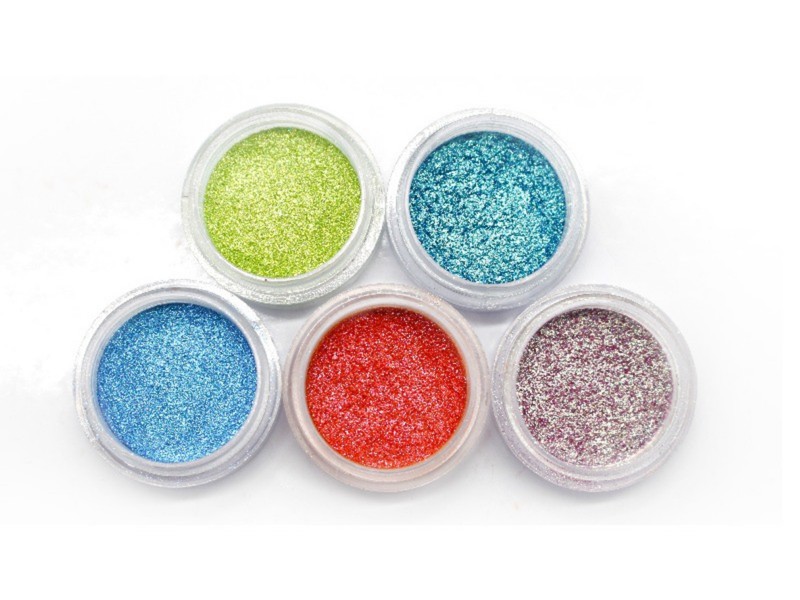
Chameleon mica powder reads differently in a coating film and in a moulded part. See why the orientation mechanism changes and which grade band to start with.
Read More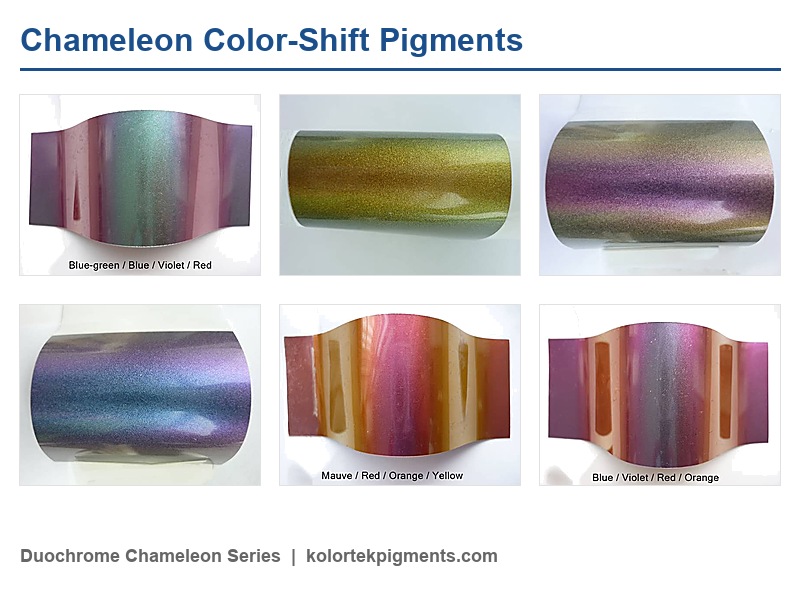
Colour shift mica powder reads as a different colour depending on where you stand. Fix light, tilt and viewing direction so lab, line and buyer agree.
Read More
 English
 Français
 Deutsch
 Русский
 Español
 Português