
Leave A Message
If you are interested in our products and want to know more details,please leave a message here,we will reply you as soon as we can.
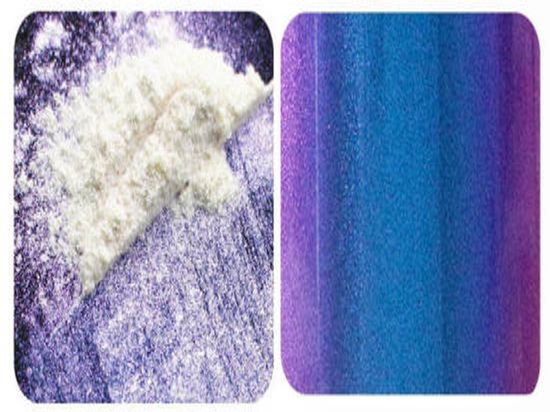
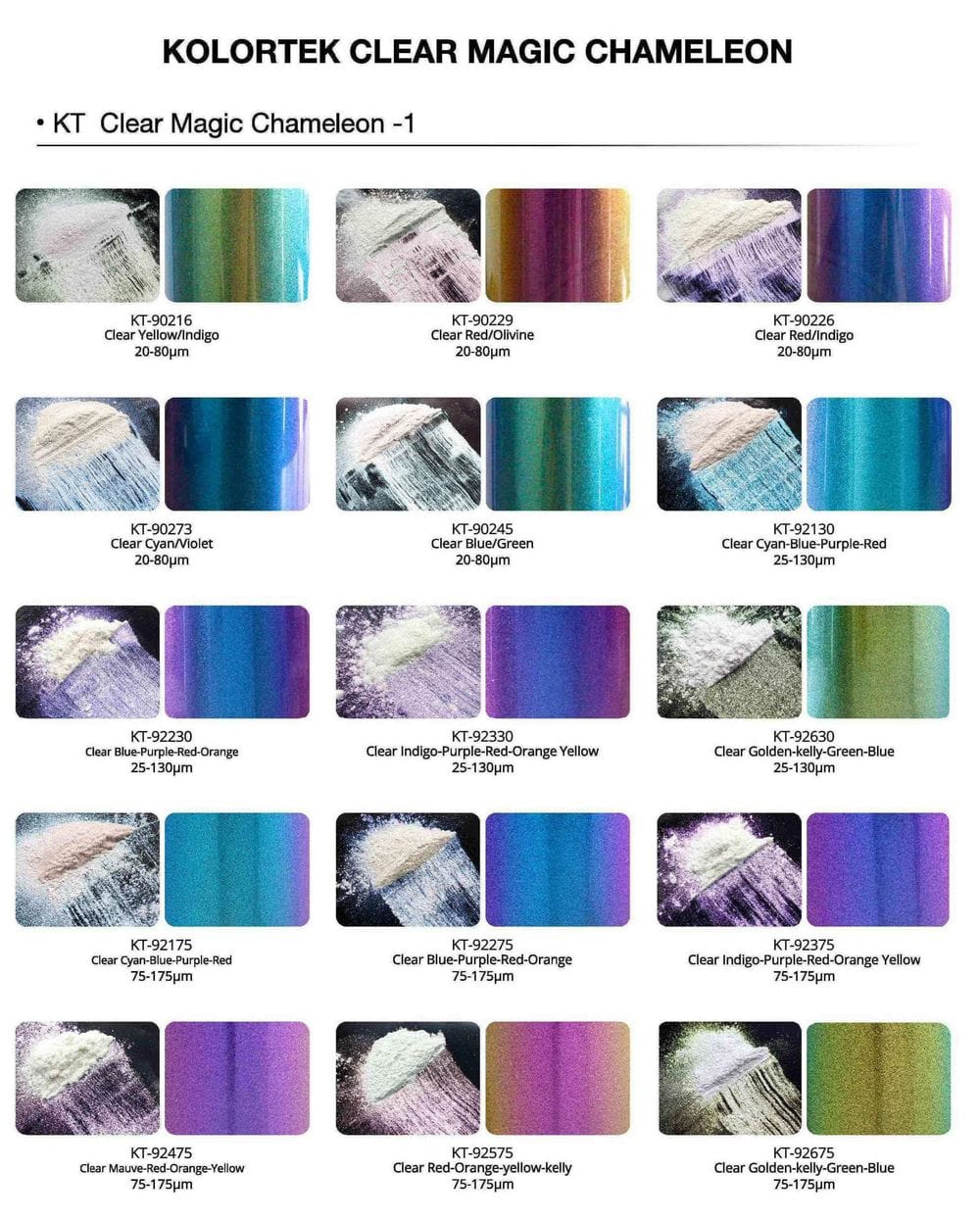
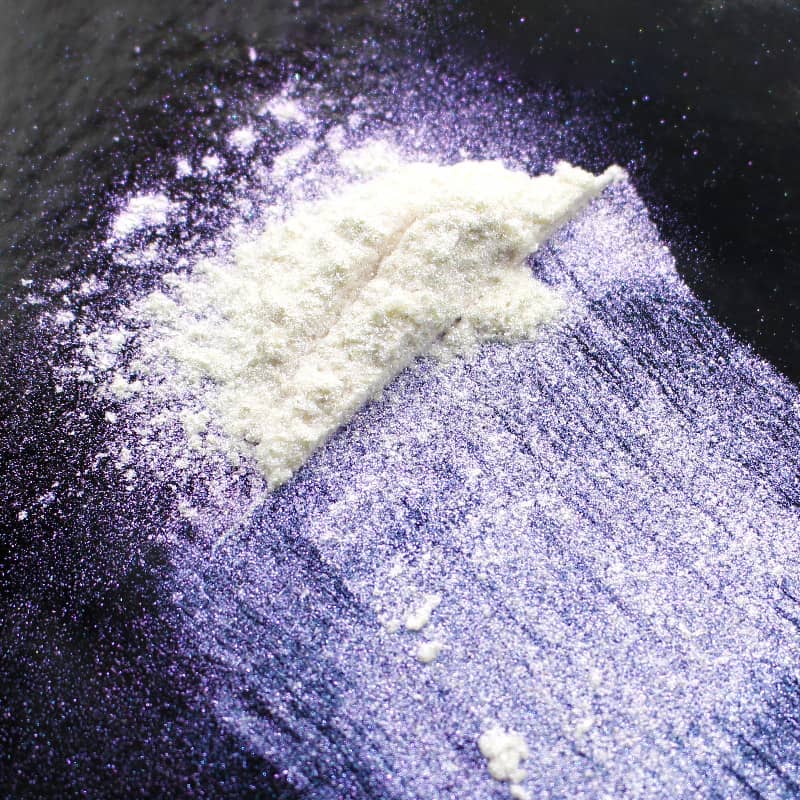
Most chameleon pigments cover a two-stop shift — green to purple, gold to red. The KT-92230 travels across four distinct hues in sequence, which means the color appearance changes noticeably over a wider sweep of viewing angles. In our application lab, we often see this described as a "wrap-around" effect: a surface coated with KT-92230 looks blue at near-perpendicular incidence, transitions through violet and red at intermediate angles, and lands on warm orange at grazing angles. The effect is most readable on dark or black substrates, where the inorganic interference colors read without interference from the ground color.
The multi-layer coating — TiO₂, Fe₂O₃, silica, and a small fraction of tin oxide — is what drives the breadth of that travel. Each layer contributes to the total optical path difference, and the combination produces the wide-angle chromatic range that single-layer interference pigments cannot match.
| Parameter | Value |
|---|---|
| Product code | KT-92230 |
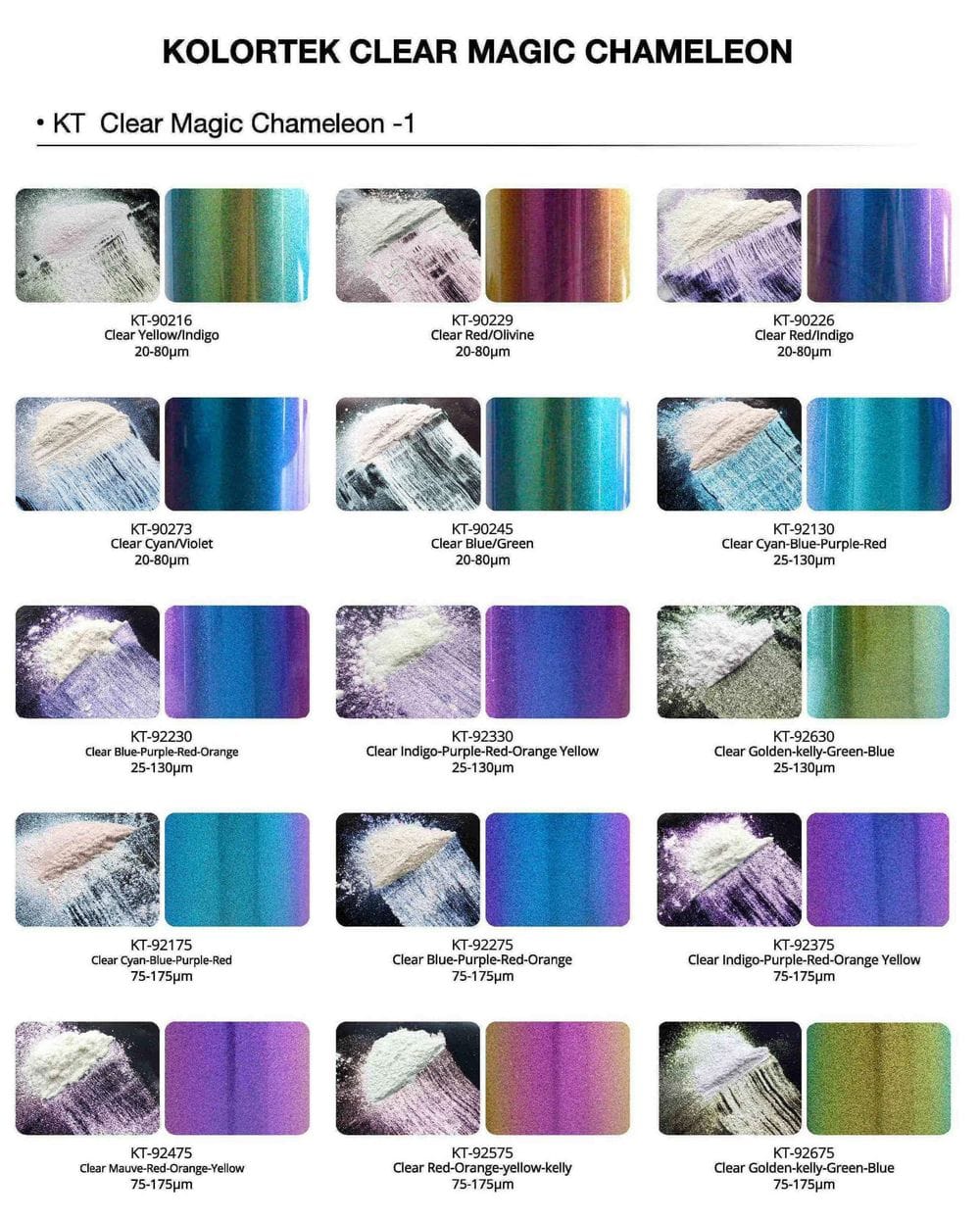
| Color shift | Blue → Purple → Red → Orange |
| Particle size | 25–130 μm |
| Form | Powder |
| Density | 2.6–3.1 kg/L |
| pH (4% H₂O) | 6.0–9.0 |
| Water solubility | Insoluble |
| Odor | Odorless |
| Hazard classification | Not classified (CLP/EC 1272/2008) |
| INCI | Mica, Titanium Dioxide, Silica, Tin Oxide |
| Component | C.I. Number | Content (%) |
|---|---|---|
| Mica | 77019 | 55.0–66.0 |
| Titanium Dioxide | 77891 | 14.0–19.0 |
| Silica | — | 20.0–25.0 |
| Tin Oxide | 77861 | 0–1.0 |
The blue-purple-red-orange color-shift formula is available across a range of particle sizes under the KT-922** code family. Particle size is the primary lever for balancing coverage, sparkle intensity, and substrate compatibility — a factor worth specifying carefully before placing a wholesale order.
| Suffix | Particle Size (μm) | Typical Use |
|---|---|---|
| KT-92202 | 5–25 | Satin finish; inks, cosmetics, good coverage |
| KT-92204 | 10–40 | Fine pearl |
| KT-92206 | 10–60 | Standard; most popular for coatings |
| KT-92207 | 10–70 | Medium effect |
| KT-92215 | 20–100 | Flash effects |
| KT-92225 / KT-92230 | 25–130 | High visual impact |
| KT-92275 | 75–175 | Large particle, maximum sparkle |
| KT-922100 | 100–250 | Extra large, decorative |
For most coating color shifting pigment applications — spray-applied solventborne or waterborne systems over dark primers — the KT-92206 (10–60 μm) is where formulators typically start. KT-92230 at 25–130 μm is the right call when maximum angular contrast and visual drama are the priority, accepting a slightly coarser texture in the film.
The KT-9000 series is designed for applications where angular color change is the functional requirement. Primary use cases include automotive custom finishes and wraps, motorcycle helmet coatings, sporting goods, luxury packaging, high-end cosmetics and nail art, security printing, and decorative lacquers. The pigment also appears in electrical appliance housings, synthetic leather, and specialty dispersion paints for accent walls and furniture.
From our experience supporting automotive coating customers, the four-stop shift of KT-92230 works particularly well over a deep black basecoat — the full blue-to-orange travel becomes visible as the panel curves away from the viewer, which is exactly what custom paint shops are after.
KT-92230 is compatible with most standard resin systems: acrylic, alkyd, epoxy, polyurethane, nitrocellulose, and UV-curable formulations. The product pH of 6.0–9.0 is stable in the majority of these systems. That said, if the formulation includes strong acid catalysts — common in certain baking enamels — test compatibility directly before committing to production. Surface treatments on effect pigments can be sensitive to conditions outside the pH window, and the multi-layer coating on KT-92230 is no exception.
The pigment can also be blended with transparent absorption pigments to shift the base undertone or adjust the starting color of the shift sequence. Tinting the ground with a deep blue or violet transparent dye, for example, can make the blue phase more saturated and push the orange endpoint warmer.
Dosage runs 1–20% by weight depending on the desired effect intensity. Higher loadings increase the perceived color shift depth but will affect film smoothness — something to balance against the surface-quality requirements of the end product. At Kolortek, we typically recommend bracketing trials around 5–10% for spray coatings before adjusting upward.
A clear topcoat is standard practice in automotive and decorative coating applications. It protects the pigment surface from mechanical and environmental exposure and adds optical depth to the shift effect. On white or light-colored substrates, the interference color shift reads weakly — a black or very dark ground is needed to see the full four-stop travel.
Handling effect pigments with a 25–130 μm particle distribution requires care at the dispersion stage. Never use bead mills, sand mills, or high-speed dispersers — the mechanical shear will fracture the mica platelets and destroy the optical coating alignment that produces the color-shift effect. Add KT-92230 at the final stage of mixing, under gentle low-speed stirring.
Pre-dispersing in a small portion of solvent or resin before incorporation into the full batch helps prevent agglomeration, particularly at the higher end of the loading range. For spray applications, adjust the thinner ratio and allow adequate flash time before force-drying — this supports proper platelet orientation in the film and reduces the risk of streaking.
From a handling standpoint: wear gloves, eye protection, and an approved dust mask when working with the powder. Avoid generating or accumulating dust. Provide adequate ventilation in the work area. In case of eye contact, flush thoroughly with fresh water; if irritation persists, seek medical attention.
Kolortek operates under ISO 9001:2015 quality management certification, covering production and sales of pigments and fillers. Heavy metal limits are controlled and stated in the TDS: As <2 ppm, Hg <1 ppm, Pb <10 ppm, Cd <3 ppm, Ni <10 ppm, Cr <100 ppm, and other trace elements within regulated thresholds. Full TDS and SDS documentation is available for KT-92230; additional regulatory packages can be arranged on request.
For cosmetic applications, EU Cosmetics Regulation (EC) No. 1223/2009-compliant grades and supporting composition documents are available — confirm the specific grade and intended use with our technical team before committing to a formulation. KT-92230 uses a natural mica substrate; buyers requiring synthetic mica (fluorphlogopite) grades for specific regulatory or ethical supply-chain reasons should request the corresponding KT-9000 variant.
What particle size should I specify when sourcing multichrome pigment wholesale for automotive spray coatings?
For spray-applied automotive coatings, the KT-92206 (10–60 μm) is the most common starting point — it balances angular color shift with film smoothness and sprayability. If maximum visual drama is the requirement and film texture is less critical, KT-92230 at 25–130 μm produces stronger angular contrast. Loadings typically run 1–20% by weight; a dark or black primer is necessary to read the full color-shift range.
Is KT-92230 suitable for UV-curable coating formulations?
Yes. KT-92230 is compatible with UV-curable resin systems, along with acrylic, alkyd, epoxy, polyurethane, and nitrocellulose systems. The pigment's pH range of 6.0–9.0 is stable in most UV formulations. If the system contains strong acid photoinitiators or acid-generating components, run a compatibility test before scaling — the multi-layer inorganic coating can be sensitive to extended exposure outside that pH window.
How does the color shift pigment for coating perform on light or white substrates?
The four-stop blue-purple-red-orange shift reads weakly on white or light-colored backgrounds. The interference color mechanism depends on contrast with a dark ground to suppress transmitted light — on white substrates, that contrast is absent and the effect is subtle at best. A black or very deep-toned basecoat is the standard approach for achieving the full angular color travel.
What mixing equipment should be avoided when dispersing KT-92230?
Bead mills, sand mills, and high-speed dispersers will fracture the mica platelets and degrade the optical effect. Add KT-92230 at the final mixing stage under low-speed stirring. Pre-disperse in a small portion of solvent or binder before adding to the full batch to prevent agglomeration. This applies to all particle sizes in the KT-922** series, and especially to the larger 25–130 μm KT-92230 grade.
Contact our technical team to discuss formulation requirements or to request TDS, SDS, and regulatory documentation for KT-92230.
KT-92230 is a multichrome pigment that shifts through a full blue-purple-red-orange sequence as the viewing angle changes — one of the broadest color-travel arcs we produce in the KT-9000 series. Built on a natural mica substrate with a multi-layer TiO₂/Fe₂O₃/silica/tin oxide coating, it comes in a 25–130 μm particle size that delivers strong angular contrast and high visual impact across automotive finishes, decorative coatings, and specialty printing.
Read More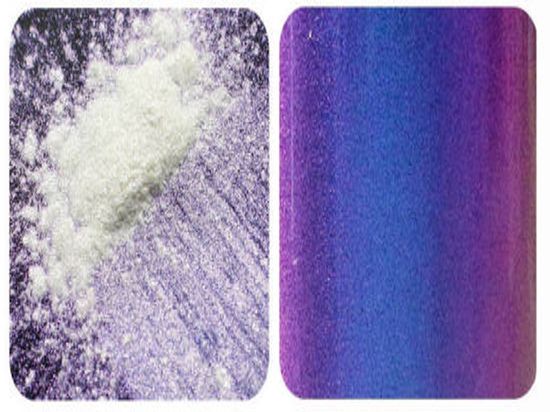
KT-92330 is a multi-layer interference pigment from Kolortek's KT-9000 Magic Chameleon Series, producing a continuous color shift sequence — indigo through purple, red, orange, and yellow — as the viewing angle changes. Built on natural mica coated with TiO₂, silica, and tin oxide, it delivers a high-mirror goniochromatic effect with a 25–130 μm particle size distribution engineered for maximum visual impact. This color shifting pigment powder performs best over dark or black substrates, where the full angular color travel is most legible.
Read More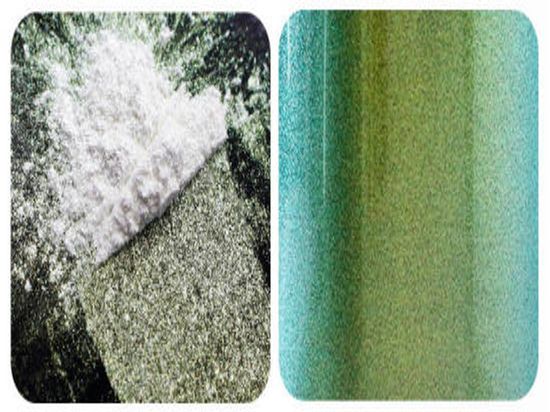
KT-92630 is a large-particle chameleon paint pearl from our KT-9000 Magic Chameleon Series, producing a sequential golden-to-kelly-green-to-blue color travel as the viewing angle shifts. With a 25–130 μm particle range, it delivers high visual impact in automotive custom finishes, decorative coatings, and specialty applications where a pronounced, multi-stop color flip is the goal. The substrate is natural mica with a multi-layer TiO₂/SiO₂/metal-oxide coating that generates the goniochromatic interference effect.
Read More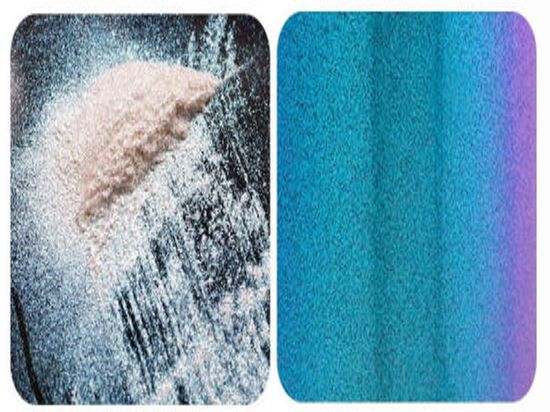
KT-92175 is the large-particle grade of our chameleon pigment for resin, built on a natural mica substrate with a multi-layer TiO₂, silica, and tin oxide coating that produces a continuous cyan-to-blue-to-purple-to-red angle-dependent color shift. At 75–175μm, it is the highest-sparkle option in the KT-9000 Magic Chameleon Series' KT-921** Cyan-Blue-Purple-Red range. Compatible with epoxy and UV resin at loadings of 1–10% by weight, the effect reads strongest on dark or black substrates where the goniochromatic shift has maximum contrast.
Read More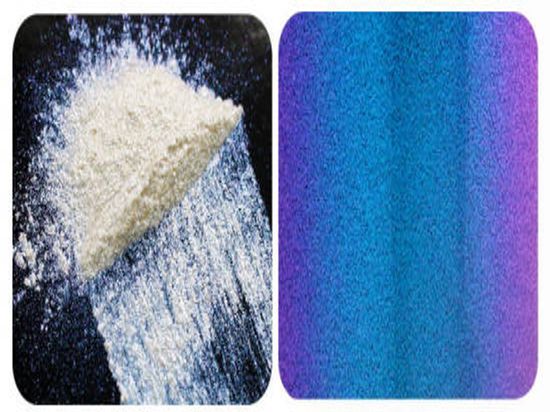
KT-92275 is a large-particle duochrome loose pigment from our KT-9000 Magic Chameleon Series, delivering a full blue-purple-red-orange color travel sequence that shifts continuously across the visible spectrum as the viewing angle changes. With a particle size range of 75–175 μm, this grade is engineered specifically for applications where maximum sparkle is the priority — loose eyeshadow, nail art toppers, and high-impact decorative cosmetics where the angular shift needs to read clearly against the skin or a dark base.
Read More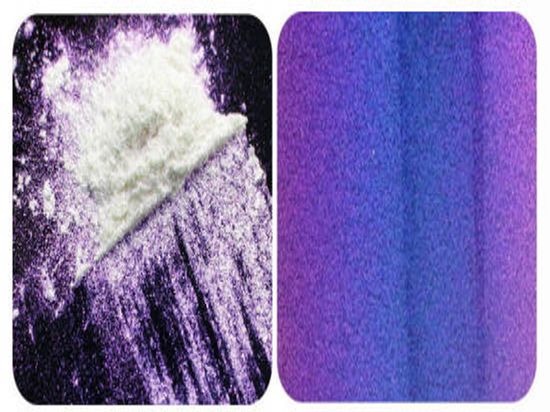
KT-92375 is a large-particle ghost chameleon pigment from Kolortek's KT-9000 Magic Chameleon Series, delivering a continuous five-stage color shift — indigo → purple → red → orange → yellow — as the viewing angle changes. Built on natural mica coated with titanium dioxide, silica, and tin oxide, it carries a particle size of 75–175 μm for maximum sparkle. We developed this grade specifically for high-impact automotive finishes, custom coatings, and luxury decorative applications where a dramatic, angle-dependent color shift is the primary design goal.
Read More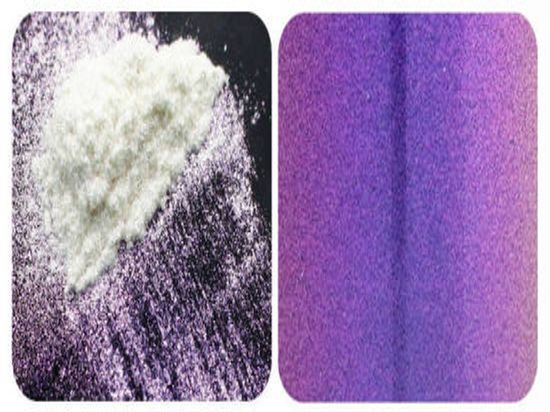
KT-92475 is a large-particle chameleon pigment from the KT-9000 Magic Chameleon Series, producing a continuous mauve → red → orange → yellow color shift that sweeps across the visible spectrum as the viewing angle changes. With a particle size of 75–175 μm and a natural mica substrate coated with titanium dioxide, silica, and tin oxide, it delivers the coarse, high-sparkle texture that nail art formulators need for maximum visual drama — particularly over a dark or black base coat.
Read More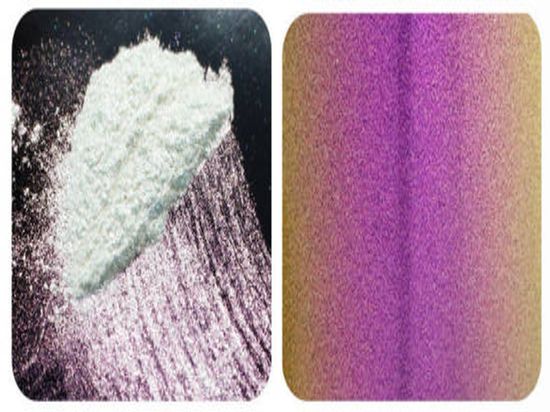
KT-92575 is a large-flake chameleon pearl powder from our KT-9000 Magic Chameleon Series, producing a dramatic angle-dependent color shift spanning red, orange, yellow, and kelly green on dark substrates. Built on a natural mica substrate with a multi-layer coating of titanium dioxide, silica, and tin oxide, it delivers an INCI composition suited to high-end cosmetic and nail art formulations. The 75–175 μm particle range gives it the high-sparkle, deep color-travel behavior that distinguishes it from finer cosmetic pearl grades.
Read More
 English
 Français
 Deutsch
 Русский
 Español
 Português