
Leave A Message
If you are interested in our products and want to know more details,please leave a message here,we will reply you as soon as we can.
Chameleon Mica Powder: Multi-Layer Interference Build for Coatings and Plastics
Chameleon mica powder reads differently in a coating film and in a moulded part. See why the orientation mechanism changes and which grade band to start with.
Item No. :
KT-9000 Magic Chameleon — KT Bright Chameleon Series (KT-9722130 / KT-9722230 / KT-9722330 / KT-9722430 / KT-9722530), 30–100 μmColor Effect :
Angle-dependent colour travel (goniochromatic) — duochrome and multicolour variants across the seriesParticle Size :
5–25 μm to 100–250 μm across the seriesComposition :
Inorganic multi-layer oxide coating on a natural mica substrateBrand :
KolortekMOQ :
5 kg (KT-9000 Magic Chameleon series)Application :
Coatings and moulded plastic parts, printing inks, packaging, cosmetics and nail art, security printingChameleon mica powder from the KT-9000 series carries the same multilayer oxide construction into both liquid coatings and polymer melts — but the two systems impose completely different conditions on how the platelets orient, and that single difference rewrites what you should specify, what result you should expect, and where a trial in one system tells you almost nothing useful about the other.
A coating film is an open, thin layer — wet when applied, then locked by solvent loss, crosslinking, or heat cure. The film forms against a surface it is pressed toward. A moulded or extruded plastic part is a closed, three-dimensional body: the pigment is dispersed through the entire polymer mass before it solidifies. These are not just different applications of the same idea. They are physically different situations, and each one imposes its own logic on the coatings pigments or plastic colourants inside them.
The KT-9000 Magic Chameleon series builds its colour travel from a multilayer stack of TiO₂, Fe₂O₃, silica, and various metal oxides deposited on natural mica — one sentence is enough on the structure, because what matters on this page is not how the stack is built but what happens to it once it enters each processing route. If you want the optical physics of multilayer interference versus single-layer pearl, that is covered separately in the duochrome colour-travel pigments page.
The table below maps the structural difference between the two systems. It is not about chemistry — the pigment is inorganic in both. It is about the mechanical environment the platelet encounters before it freezes in place.
| Parameter | Film-forming coating | Melt-processed plastic |
|---|---|---|
| Where the pigment lives | Suspended in liquid; deposited as an open thin layer against a substrate surface | Dispersed through a polymer melt that fills a closed mould or exits a die |
| System form | Open thin layer, a few to tens of micrometres thick | Closed three-dimensional body — the whole part |
| What orients the platelets | Film-formation dynamics: solvent loss, shrinkage, surface tension, and flow during application press the platelets toward parallel | Shear from melt flow aligns platelets along the flow direction; cooling freezes that alignment in place |
| What fixes the result | Film cure — the platelets lock at whatever angle the film froze them | Solidification — the platelets lock at whatever angle the flow field left them |
| Operator's lever | Application method, film thickness, drying profile, basecoat choice | Mould geometry, gate position, flow paths, cooling rate |
Compatible with most resin systems, the KT-9000 pigments are used across automotive finishes, plastic coatings, printing inks, packaging, cosmetics, security printing, and synthetic leather. The chemistry does not change between applications. The orientation outcome does.
There is one optical rule that holds in both systems: colour travel only reads cleanly when the platelets lie parallel to the surface and parallel to each other. When a platelet tilts, the angle at which light hits the interference stack shifts — and if many platelets tilt at different angles, their reflected wavelengths scatter across a range, the travel blurs, and what you see is a greyed-down, flattened effect rather than a crisp hue shift. This is not a product defect. It is geometry.
In a coating system, the platelets arrive in a liquid carrier and get their chance to orient during the brief window between application and cure. Spray atomisation gives a good initial spread; the platelets are light relative to the carrier and respond quickly to the forces that push them flat. As the film loses solvent and thins, shrinkage compresses the platelets toward the substrate plane. A film applied at the right thickness, with enough open time for the carrier to flow level, produces a well-oriented layer where nearly every platelet is reading the same reflected wavelength at a given viewing angle — and travel is clean. Push the film too thick, force-dry it too fast, or apply it to a surface where it cannot flow level, and the platelets freeze before they finish settling. The travel is still there, but it is softer, the colours at the travel endpoints feel muted, and no amount of increased pigment load recovers it.
In a plastic melt system, the platelets have no open-film stage at all. They enter a polymer already heated past its flow point, and from that moment the flow field is their only orientation mechanism. Shear at the mould wall — the thin layer of melt in direct contact with the cooled cavity surface — tends to align platelets with the flow direction, which at the wall is parallel to the surface. That is the ideal condition, and when it holds over a large area of a flat or gently curved part, the travel reads well. But the flow field is not uniform. Where the melt front turns a corner, passes through a narrow section, or collides with another flow front at a weld line, the local shear direction is no longer parallel to the surface. Platelets in those zones orient against the surface plane rather than with it, and they stay that way when the polymer solidifies around them.
For large-flake formats — and the considerations that apply specifically to curved surfaces — see the page on the large-flake format. On this page, the point is the source of orientation, not the flake-versus-powder distinction.
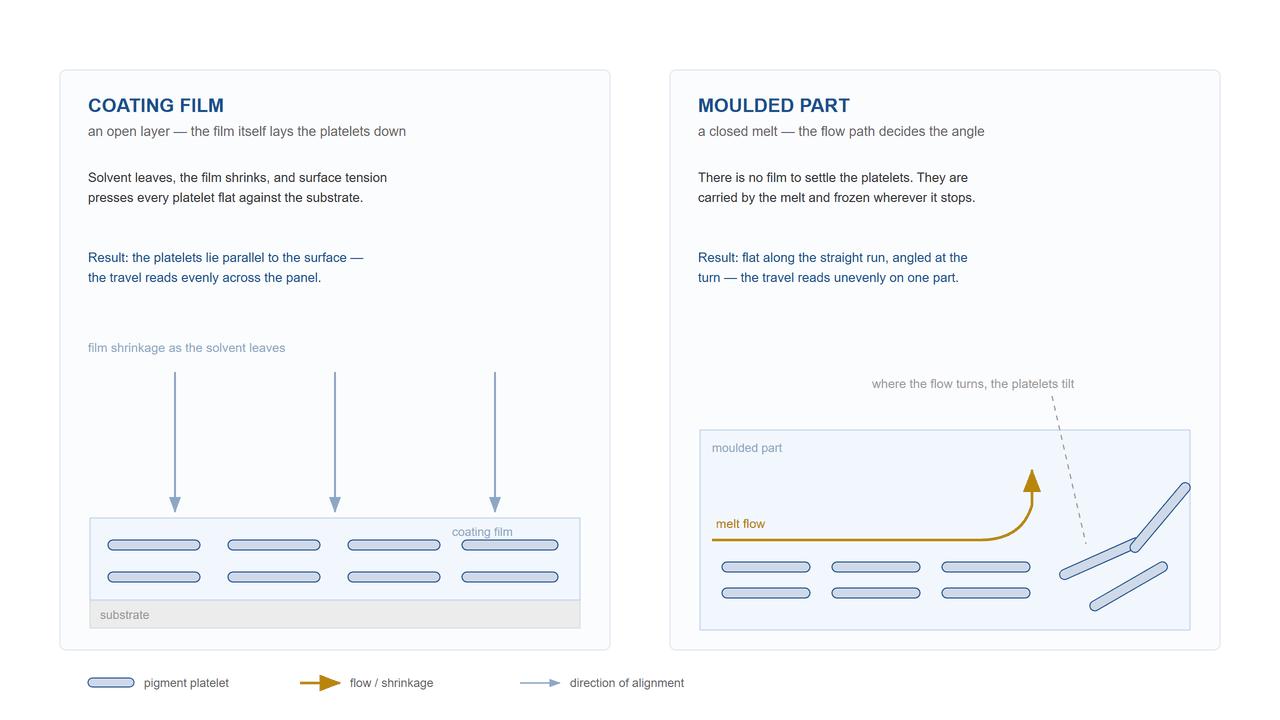
Figure 1. Two film systems, one pigment: how the platelets end up parallel to the surface in a coating film and in a moulded part.
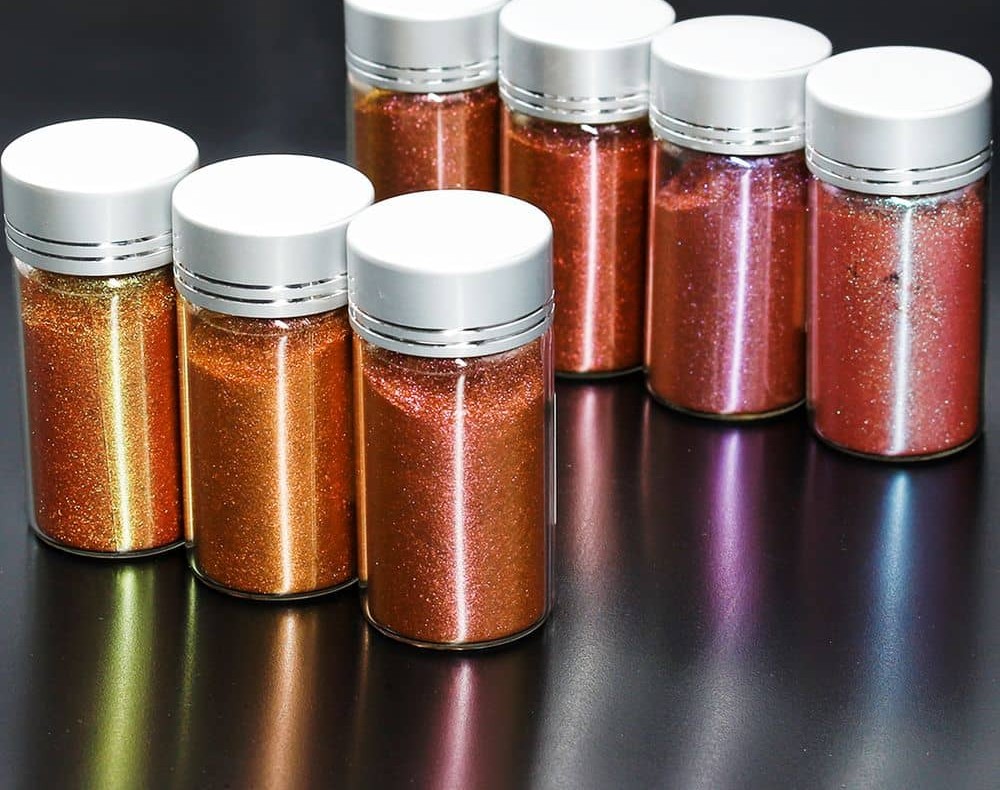
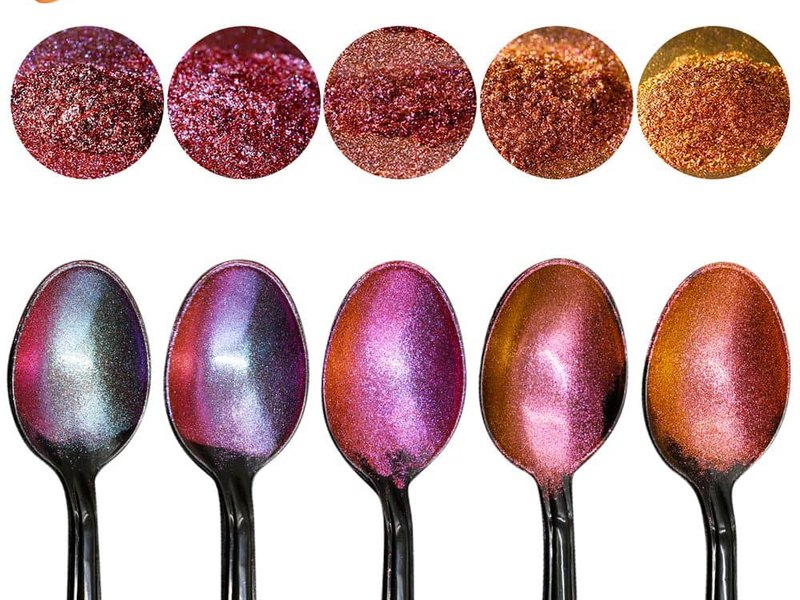
Figure 2. Colour travel across a chameleon series, shown as a set of reference bottles.
The first thing to accept is that the same code will not look the same in a coating and in a plastic part — and that is not a sign that something has gone wrong. The platelet orientation mechanism is different, the environment the platelet freezes in is different, and the geometry the observer sees the part from is different. A code that produces a vivid red-to-green travel in a sprayed basecoat may produce a more subdued, slower travel in a thick-wall injection-moulded part from the same resin. Both results are correct for their system.
This matters practically: a specification confirmed in a coating trial cannot be carried over to a plastic application without a separate trial in the actual plastic system. The mould geometry, resin viscosity, gate location, and cooling rate all contribute to where the platelets end up. Two different mould designs running the same grade at the same loading can produce noticeably different travel intensity on the finished part.
On a single moulded part, the travel may not be uniform across the whole surface. The area near the gate, where the melt enters fast and the flow lines are most turbulent, is where orientation is most likely to be disrupted. The far end of the fill, where the melt arrives slower and cooler, often reads better. A weld line — where two flow fronts meet — almost always shows a visible seam in the colour travel, because the platelets on either side of the join are pushing toward each other rather than laying flat. This is a flow-geometry problem, not a pigment problem, and it is addressed at the mould design stage, not by changing the grade.
The control available to a formulator also differs between the two systems in a fundamental way. In a coating system, you can use a dark basecoat layer to build depth and contrast under the chameleon layer — the basecoat and the colour-effect layer are separate films, and you can tune each independently. In a plastic part, there is no basecoat. The background visible through the pigment layer is the resin itself. If you want a dark background to bring out the travel, the resin must carry that colour, or a secondary process — co-extrusion, overmoulding, or a separate coating step — must provide it. Those are tools that exist, but none of them are as simple as choosing a different basecoat. The practical implication is that achieving the same perceived contrast in a plastic part requires more advance planning around the substrate than the equivalent coating job does.
A deep-coloured substrate improves travel visibility in both systems because the background does not compete with the reflected interference colour. In a coating, a black or dark grey primer is the standard starting point. In a moulded part, a dark resin or a heavily coloured compound serves the same function. The principle is the same; the route to achieving it is different.
The KT-9000 Magic Chameleon series spans a particle size range from 5–25 μm at the fine end through 100–250 μm at the coarse end. Choosing a starting grade is not about picking the one that sounds right from a datasheet — it is about knowing what the two systems reward differently.
In a coating system, mid-range particle sizes are a practical starting point. The film is thin, the observation distance for most applications is close, and the film-formation process is reasonably forgiving about orientation as long as the application conditions are controlled. Finer grades integrate smoothly into the film and reduce the risk of platelets protruding through a thin clear layer.
In a plastic part, the calculus shifts. The part is usually viewed from further away than a painted panel, there is no clear topcoat to seal the surface and add optical depth, and the orientation achieved inside the melt is generally less perfect than in a well-applied coating. Coarser grades carry more reflective area per platelet, which means each well-oriented platelet contributes more to the visible travel even when overall orientation is imperfect. This is why formulators working with plastic systems often find they need to move toward the coarser end of the range to get a travel that reads clearly at a normal viewing distance. The caveat is that coarser particles are more visible as individual flakes on close inspection and may influence the surface texture of a moulded part. The right starting point is a starting point — the final grade is always confirmed by trial in the actual system.
For formulators who want a single group that works across both systems as a starting reference, the KT Bright Chameleon Series at 30–100 μm sits in a practical middle range. It is coarse enough to produce readable travel in a plastic part with moderate orientation, and fine enough to integrate well into a standard coating film. The five codes in this group cover the main hue-shift directions:
These codes are two-hue shifts within what the catalogue calls the Bright group. The broader KT-9000 family also includes Clear, Multishift, Duoshift, Duochrome, and Multicolor sub-groups — the last including the 9661xxx and 9662xxx cosmetic-grade lines noted for eye-area and lip use. For three- and four-hue travel across a wider arc, see the page on the three- and four-hue shade pairs. The full particle-size range across all sub-groups and the full chameleon range is available in the catalogue.
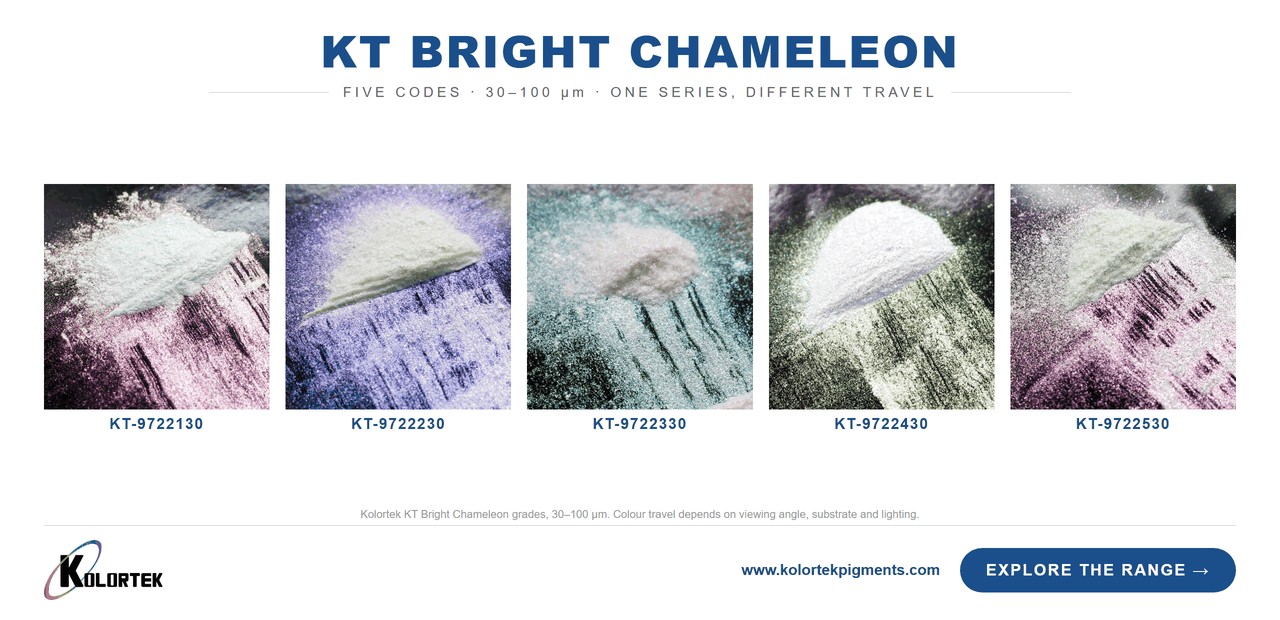
Figure 3. KT Bright Chameleon grades, 30–100 μm, shown as a colour-travel set.
MOQ for the KT-9000 Magic Chameleon series is 5 kg. Sample packs are put together around the application — the colour-shift direction, the particle size range, and the target system (coating or plastic) all go into deciding what to send. Samples dispatch within 5 working days of confirming the specification.
Lead times: stock items ship within 2 weeks. Made-to-order and custom colour matching or OEM production runs on a 3–4 week lead time. Pricing is quoted per series, order quantity, and packaging configuration. Payment is accepted by online bank transfer, T/T, Western Union, and PayPal.
OEM and ODM services cover custom colour matching to a target, private-label packaging, and production built to customer specification. If you are developing a proprietary travel for a branded plastic part or an automotive coating programme, the starting point is a conversation about the shade-pair target and the processing route — not a catalogue code.
Before placing a first order, download the Chameleon Collection catalogue for the complete range across all sub-groups and particle-size grades. For answers to common questions about ordering process, documentation, and lead times, the page covering the questions buyers ask before ordering covers the practical details.
KT-9000 chameleon pigments are inorganic and free of heavy metals. The interference colour comes from the oxide layer stack on the mica substrate. Light-fastness is inherent to the inorganic oxide composition. Heat stability is governed by the limits of the carrier system.
Kolortek Co., Ltd. is ISO 9001:2015 certified. Supporting documentation provided on request includes REACH compliance, RoHS compliance, Halal and Kosher certificates, US FDA registration, and independent SGS test reports. No certificate numbers or issue dates are published here. For the full compliance framework, see our quality standards.
Kolortek Co., Ltd. was founded in 2002 in Huaian, Jiangsu, and exports to more than 100 countries across automotive, industrial, cosmetics, and specialty applications.
Before requesting a sample, it helps to have three things clear: the colour-travel direction you are targeting (which hue shifts to which), the particle-size range that fits your process and observation distance, and the system you are working in — coating or plastic. Those three inputs are what determine which codes go into the sample pack and whether the trial will produce a useful result.
If you are developing for both systems simultaneously — a coated panel and a moulded part that need to match — say so when you request. The sample selection and the trial protocol will be different for each, and trying to use the same trial result for both will almost always lead to a mismatch in production.
Samples are configured around the application and dispatched within 5 working days of specification confirmation.
Chemically, yes. The pigment is compatible with most resin systems. But compatibility is not the same as equivalent result. The platelet orientation mechanism is different in each system — film-formation dynamics in a coating, melt flow shear in a plastic — and that difference changes how well the travel reads and how consistent it is across the part. A grade confirmed in a coating trial is a starting point for a plastic trial, not a confirmed specification for the plastic application. Each system needs its own trial in the actual substrate and process.
Uneven travel on a moulded part is almost always a flow-geometry issue. The melt flow field orients the platelets, and wherever that flow turns sharply — around a core, near a gate, at a weld line where two flow fronts meet — the local shear direction no longer runs parallel to the part surface. The platelets in those zones freeze at an angle, and at an angle they cannot reflect a clean interference colour. The rest of the part, where the flow was laminar and the wall shear kept the platelets flat, will read the travel correctly. The fix is at the mould design or process stage: gate repositioning, flow-balancing, venting. Changing to a different pigment grade rarely solves it.
The KT-9000 pigments are inorganic oxides on a mica substrate, and the interference colour comes from the layer stack rather than from organic dyes. The practical heat limit is set by the carrier system — the resin or coating formulation — not by a standalone pigment temperature specification. The actual formulation and processing conditions should therefore be evaluated in the customer’s system. The more common risk in plastic processing is not thermal degradation of the pigment but mechanical disruption of orientation from aggressive mixing or excessive shear, which pushes the platelets out of their flat-lying position. That is a process-setting issue, not a chemistry issue.
For a coating system, a mid-range particle size within the 5–25 μm through 100–250 μm range of the KT-9000 family is a practical starting point. The film is thin, the observation distance is usually close, and film-formation provides reasonable orientation across a range of grades. For a plastic part, the starting logic shifts toward the coarser end: the part is viewed from further away, there is no clear topcoat adding optical depth, and the orientation achieved inside the melt is less perfect than in a coating. Coarser platelets contribute more reflective area per particle, which helps the travel read at a normal viewing distance even when orientation is imperfect. The 30–100 μm KT Bright Chameleon codes are a workable starting range for both systems. All of this is a starting point — the final selection depends on the actual substrate, resin, process, and part geometry, and is confirmed by trial.
A colour name crosses size bands; a code does not. Which range you need depends on substrate, film build and minimum order — three answers before price.
Read More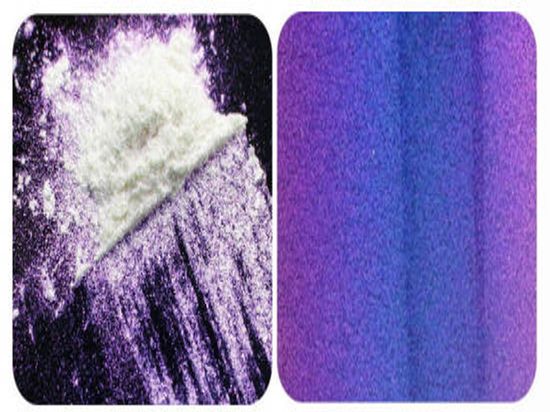
KT-92375 is a large-particle ghost chameleon pigment from Kolortek's KT-9000 Magic Chameleon Series, delivering a continuous five-stage color shift — indigo → purple → red → orange → yellow — as the viewing angle changes. Built on natural mica coated with titanium dioxide, silica, and tin oxide, it carries a particle size of 75–175 μm for maximum sparkle. We developed this grade specifically for high-impact automotive finishes, custom coatings, and luxury decorative applications where a dramatic, angle-dependent color shift is the primary design goal.
Read More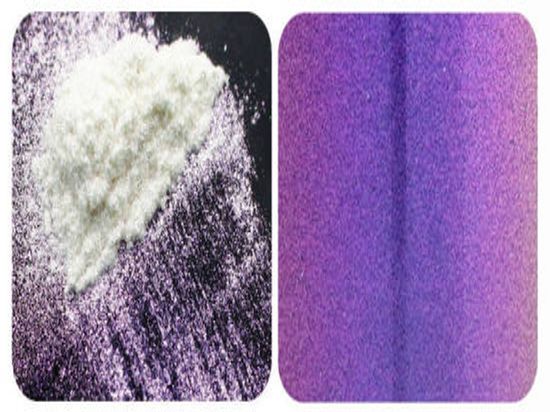
KT-92475 is a large-particle chameleon pigment from the KT-9000 Magic Chameleon Series, producing a continuous mauve → red → orange → yellow color shift that sweeps across the visible spectrum as the viewing angle changes. With a particle size of 75–175 μm and a natural mica substrate coated with titanium dioxide, silica, and tin oxide, it delivers the coarse, high-sparkle texture that nail art formulators need for maximum visual drama — particularly over a dark or black base coat.
Read More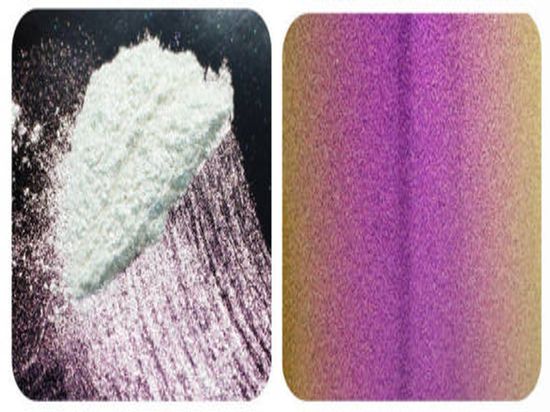
KT-92575 is a large-flake chameleon pearl powder from our KT-9000 Magic Chameleon Series, producing a dramatic angle-dependent color shift spanning red, orange, yellow, and kelly green on dark substrates. Built on a natural mica substrate with a multi-layer coating of titanium dioxide, silica, and tin oxide, it delivers an INCI composition suited to high-end cosmetic and nail art formulations. The 75–175 μm particle range gives it the high-sparkle, deep color-travel behavior that distinguishes it from finer cosmetic pearl grades.
Read More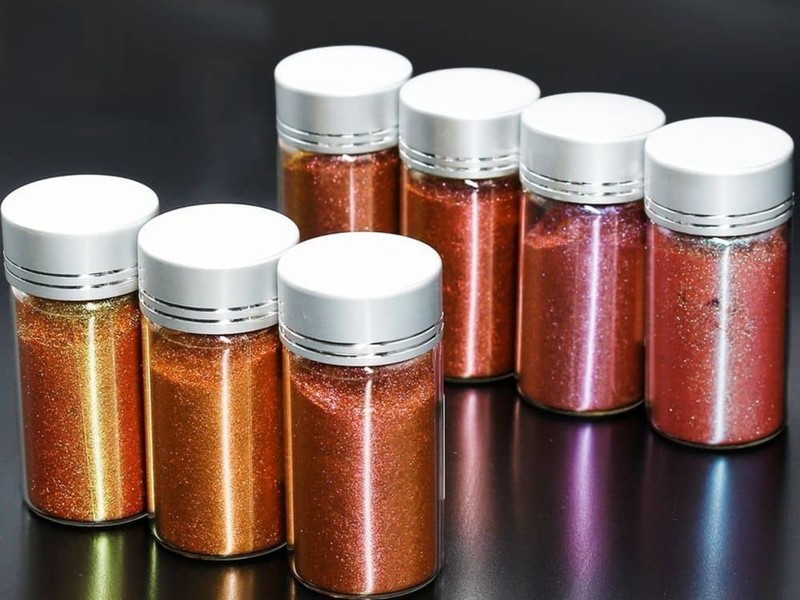
Magic Chameleon duochrome mica powder shifts to a second colour with the viewing angle. Six colour-travel options, nine size grades (5–250 μm), MOQ 5 kg.
Read More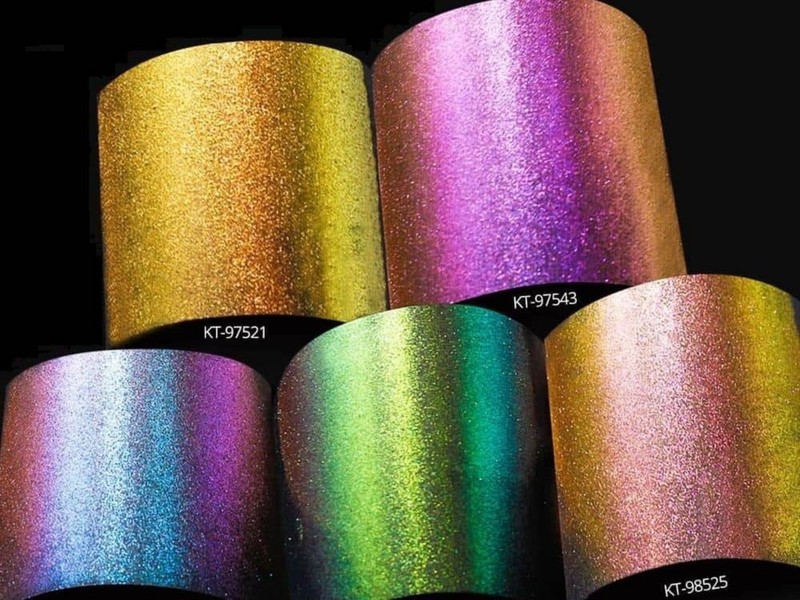
Multicolor chameleon pigment travels three or more hues. Compare shade-pair families by anchor hue, intermediate hue and available particle-size bands.
Read More
Chameleon mica powder reads differently in a coating film and in a moulded part. See why the orientation mechanism changes and which grade band to start with.
Read More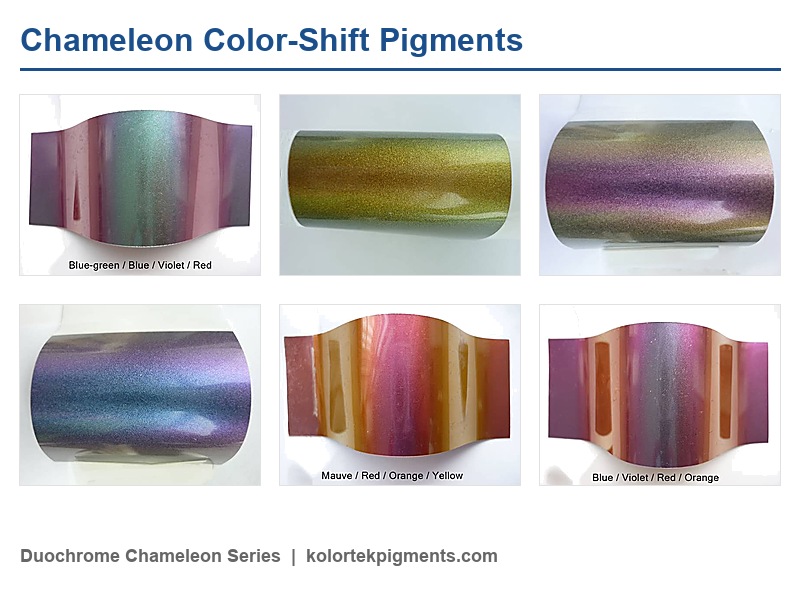
Colour shift mica powder reads as a different colour depending on where you stand. Fix light, tilt and viewing direction so lab, line and buyer agree.
Read More
 English
 Français
 Deutsch
 Русский
 Español
 Português