
Leave A Message
If you are interested in our products and want to know more details,please leave a message here,we will reply you as soon as we can.
Color Shift Mica Powder for Angle-Dependent Chameleon Effects on Coated Surfaces
Colour shift mica powder reads as a different colour depending on where you stand. Fix light, tilt and viewing direction so lab, line and buyer agree.
Item No. :
KT-9000 Magic Chameleon — nine particle-size grades from 5–25 μm to 100–250 μmColor Effect :
Angle-dependent colour travel (goniochromatic), read differently by the light–surface–eye angleParticle Size :
5–25 μm to 100–250 μm across the seriesComposition :
Inorganic multi-layer oxide coating on a natural mica substrateBrand :
KolortekMOQ :
5 kg (KT-9000 Magic Chameleon series)Application :
Coated surfaces — automotive refinish and custom finishes, decorative coatings, plastics, printing, cosmetics and nail artWhy does the same colour-shift powder look like one colour on your panel and another on your customer's desk?
Because the colour is not a fixed property of the powder. It is a reading — the value the light–surface–eye geometry produces at a particular moment. Change any one of those three, and the reading changes. The powder has not changed. The geometry has.
At a Glance
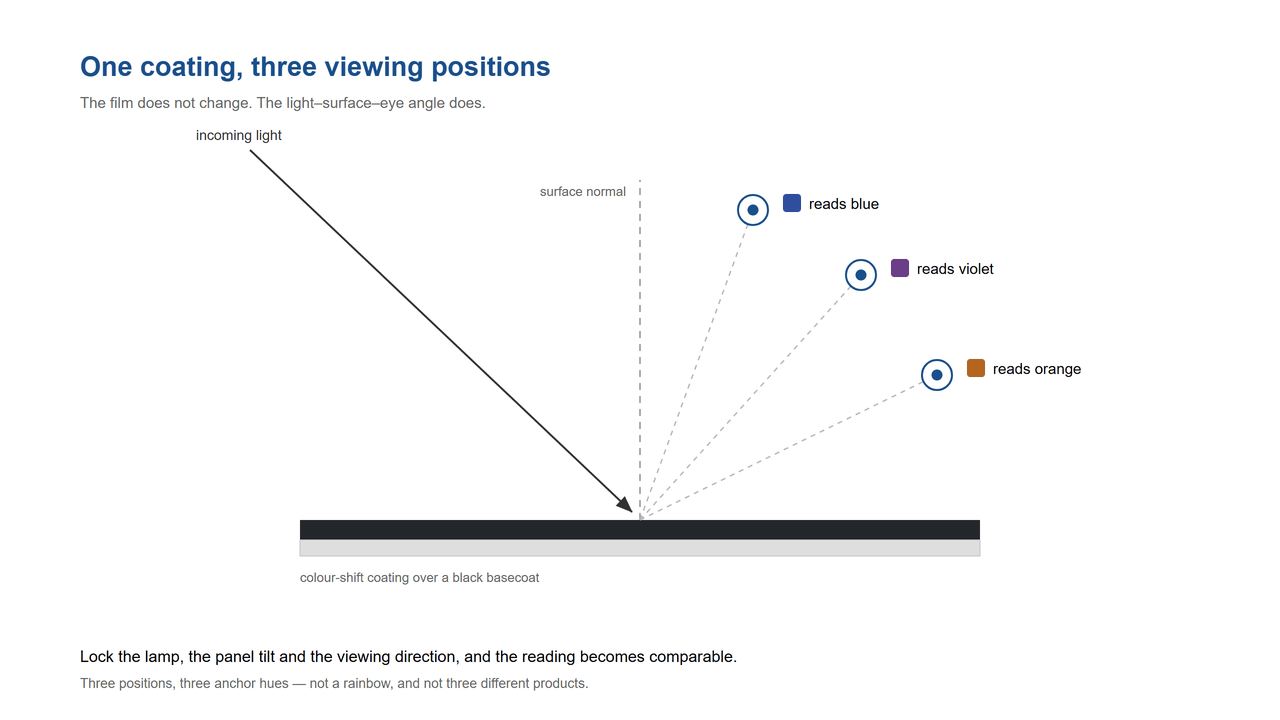
Figure 1. One pigment, three viewing positions: the geometry decides which part of the travel you read.
A goniochromatic pigment does not have a colour. It has a travel — a progression of hues that runs from one anchor tone through a transition and arrives at another as the light–surface–eye angle shifts. Any single reading is one point on that journey. It is accurate. It is also incomplete.
This is why two panels from the same batch can look like two different colours. If one is read near the specular reflection angle and the other is tilted toward a grazing angle, you have sampled two different points on the same travel. The instrument is not drifting. The batch is not off. The geometry is different.
The fix is straightforward. Before any reading — instrument or naked eye — fix three things: the direction the light comes from, the tilt of the panel, and the direction you are looking from. All three together define the geometry. Change one, and the reading is from a different point on the travel. The two readings are not comparable.
A useful way to think about it: photographs of the same scene taken head-on and from a low side angle are two different photographs. That is not the camera's fault, and it is not a sign the scene changed. The same logic applies here.
Near the specular reflection angle, you read one hue — typically the one the pigment is designed to lead with. Tilt the panel toward a grazing angle and you read the secondary hue at the far end of the travel. The middle tilt gives you the transition. All three are correct. None of them is the colour.
For a full description of what drives the two-hue travel, see the duochrome colour travel page. For the specific case of curved surfaces — where the tilt varies across the part and multiple points on the travel are visible at once — see the curved-surface case. This page stays with flat panels and controlled geometry.
One rule: lock the geometry first, then discuss whether the colour is right.
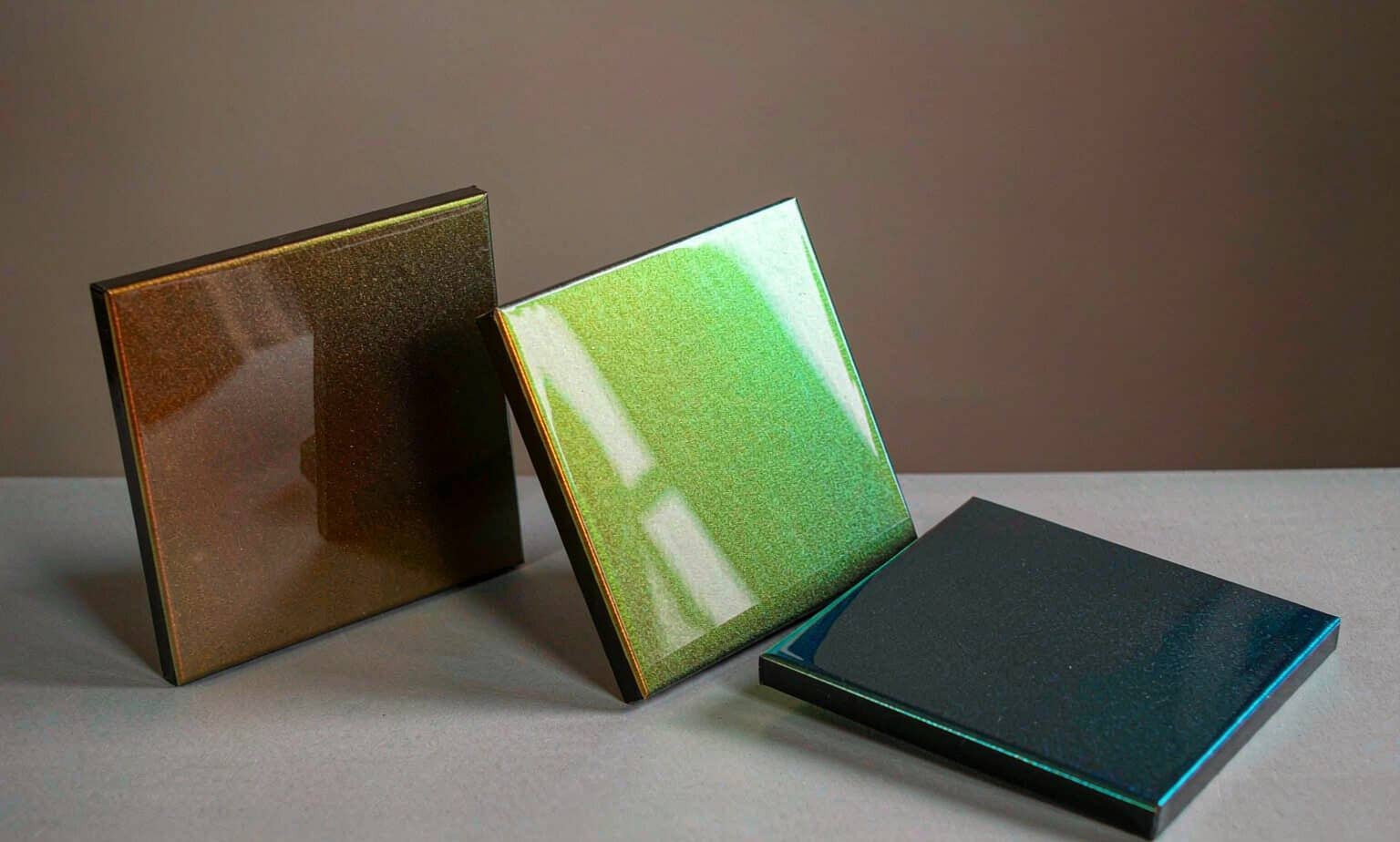
Figure 2. Three plates from the same batch, held at three angles: blue, violet and orange out of one coating.
KT-9000 colour shift mica powder runs across nine particle-size grades, from 5–25 μm at the fine end to 100–250 μm at the coarse end. The grade you specify changes not just the intensity of the effect — it changes how sensitive the effect is to the observation geometry.
Coarse grades carry their colour information in individual flakes. Each flake is large enough to be read as a discrete unit. When you step back, individual flakes merge into a field and the reading shifts. When you move close, individual flakes dominate and the reading shifts again. Coarse grades therefore respond strongly to viewing distance and tilt — two people at different distances from the same panel will report different things, and both will be right.
Fine grades carry their information across many small flakes that together form the surface. The effect reads more like a whole-surface colour change than a particle-level flash. This makes fine grades relatively stable across a range of distances and tilts — the reading shifts with angle, but less dramatically than with a coarse grade at close range.
For the full family of shift patterns across the range, see the three- and four-hue families. For broader coatings pigments context, the category page covers the wider portfolio.
What this means for production sign-off: having two colour inspectors looking at the same panel and reporting different results is not a productivity problem. It is a geometry problem. The solution is to write four things into the work instruction before the first batch goes through:
If the two readings still disagree after you have fixed all four, you have a real batch question. Before that, the disagreement belongs to the procedure, not the powder.
One thing worth saying plainly to the purchasing side: if the observation geometry is not standardised, the same powder from the same batch can look like it came from two different suppliers. It did not. You have two sets of geometry producing two points on the same travel.
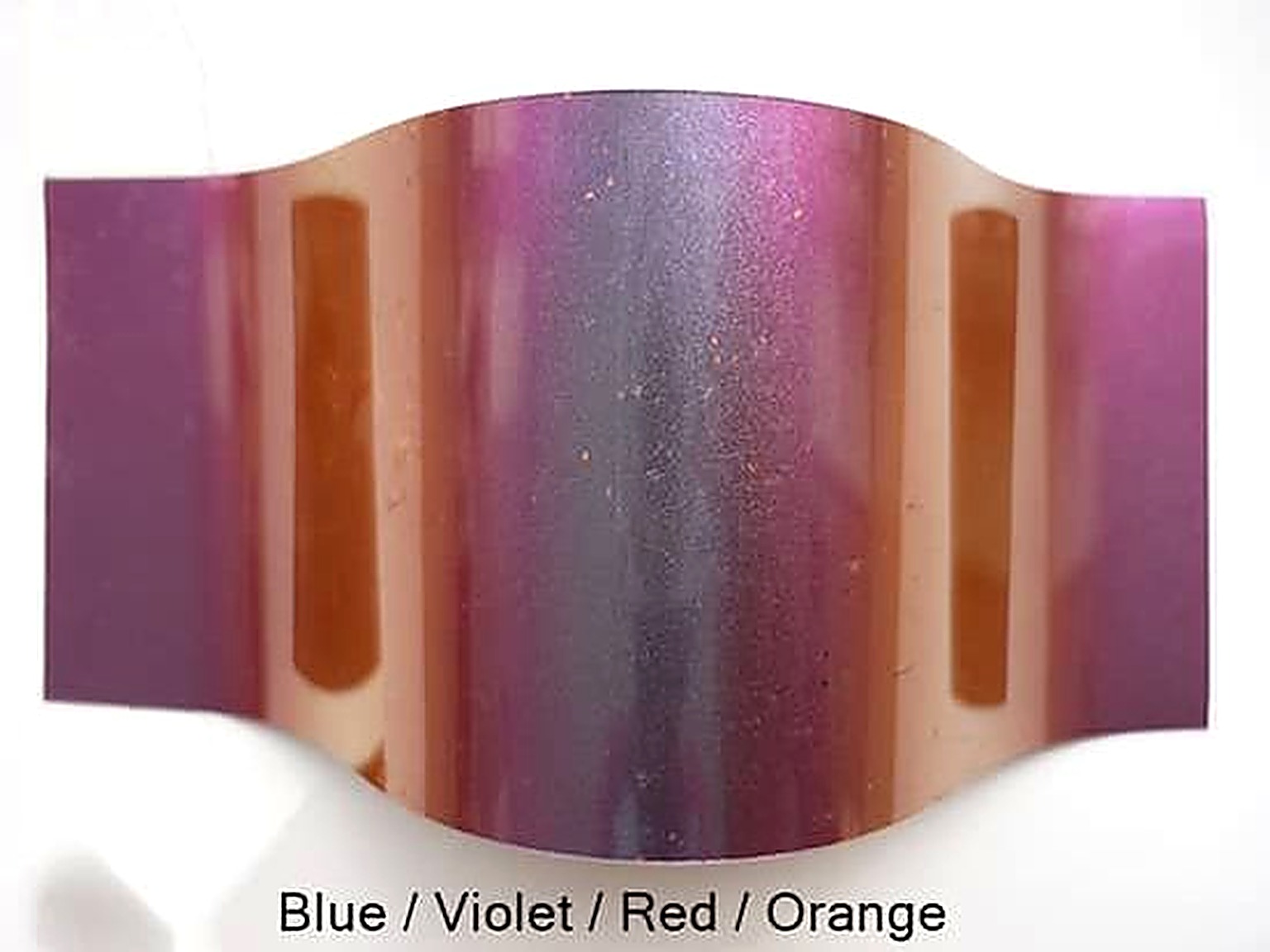
Figure 3. A curved coated test panel, photographed as-is: blue sits over the crest while violet, red and orange appear down the flanks. One panel, one light, four readings — only the angle changes.
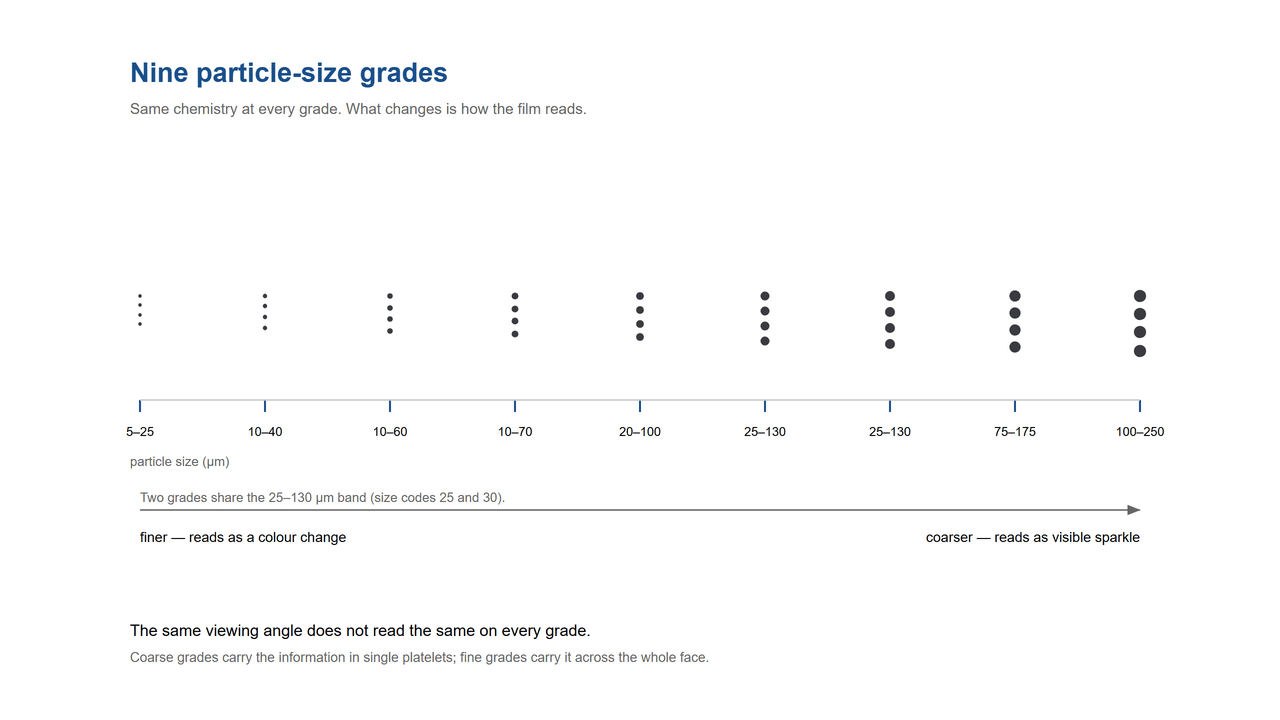
Figure 4. Particle-size grades across the range, shown as a graded set.
Your laboratory has controlled lighting, a fixed panel holder, and people who know how to hold a tilt. Your buyer's showroom, production floor, or retail shelf has none of those. The geometry your customer uses to evaluate the part you shipped will almost certainly differ from the geometry you used to approve it.
The light source alone is enough to shift the reading. A beam from a directional showroom spot produces a sharper specular peak than diffuse daylight from a north-facing window. The same panel, in the same hand, reads differently under each. Neither reading is wrong. They are at different points on the travel.
Photographs make this worse. A mobile phone camera applies automatic white balance and exposure compensation. Both operations flatten the colour range. What the camera saves as a JPEG is not what the eye saw. "The shift doesn't show up in the photo" is almost always a camera processing statement, not a product statement. Do not use photographs as the primary approval record for colour-shift work.
Three things that reduce buyer-side disputes:
Colour shift is designed to be seen by a person. The verification process needs to be built around the person's viewing conditions, not a single instrument reading taken under one geometry in one room.
For the full chameleon range, including flake formats and multi-hue families, the series category page has the full listing.
| Scene | Who is looking | Most common problem | Check first |
|---|---|---|---|
| Laboratory | Formulation engineer | Reading changes with tilt; suspected batch variation | Light source, panel tilt, and observation direction — are all three fixed? |
| Production line | Colour inspector | Two inspectors, two conclusions from the same batch | Lamp type, viewing distance, panel tilt, and inspector — are all four the same? |
| Buyer's site | Customer | "The shift doesn't show in the photo" | Light source, shooting angle, and camera auto white balance |
Before you sign off on a colour-shift sample, check these five things:
KT-9000 colour shifting mica powder is supplied across nine particle-size grades. The grade is encoded in the product code suffix.
MOQ and lead time are quoted per grade and per order quantity. Contact us with your grade selection and target volume for a specific quote.
We hold an ISO 9001:2015 certified quality management system. Certificates and compliance documentation covering REACH, RoHS, Halal, Kosher and US FDA registration are provided on request for the required grade and target market. See our quality standards page for the full scope.
Download the Chameleon Collection catalogue for the full grade listing, colour travel descriptions, and recommended application parameters across the KT-9000 range.
The most useful samples are the ones matched to how you will actually look at the finished part. Tell us your substrate, your target colour travel direction, and the observation conditions your customer will use — and we will select the grade most likely to read well under those conditions.
If you already have panels and are trying to explain a colour disagreement, send us a photograph of the panel with a brief description of how you are looking at it — light type, approximate tilt, distance. That context lets us give you a specific answer rather than a general one.
Three things to have ready before you place an order:
Check the geometry before you check the material. Light source, panel tilt, observation direction, and viewing distance — if any one of those four differs between your conditions and ours, the readings are from different points on the colour travel. They are not supposed to match. Standardise the four variables first, then compare.
Use photographs as a reference only, not as a primary approval record. Mobile phone cameras apply automatic white balance and exposure compensation, both of which reduce the apparent range of the shift. If the shift looks weak in a photo, that is usually a camera processing effect, not a product characteristic. For any decision that matters, judge against the physical panel under a shared, specified light source.
Yes, and the direction of the sensitivity matters. Coarse grades carry their information in individual flakes, so the reading changes more sharply with viewing distance and tilt. Fine grades spread the effect across a larger number of smaller flakes, which tends to produce a more uniform reading across a range of distances. Across the nine grades, your choice should be driven by your application method and the distance at which the finished part will actually be viewed.
Specify four things in the work instruction: lamp type by name or category, panel tilt position (use a physical jig or marked holder), observation direction (normal or offset — pick one), and viewing distance. Hold one sealed reference panel as the physical standard. With those four variables fixed and a reference panel in place, two inspectors running the same procedure will produce comparable readings. Without them, they will not.
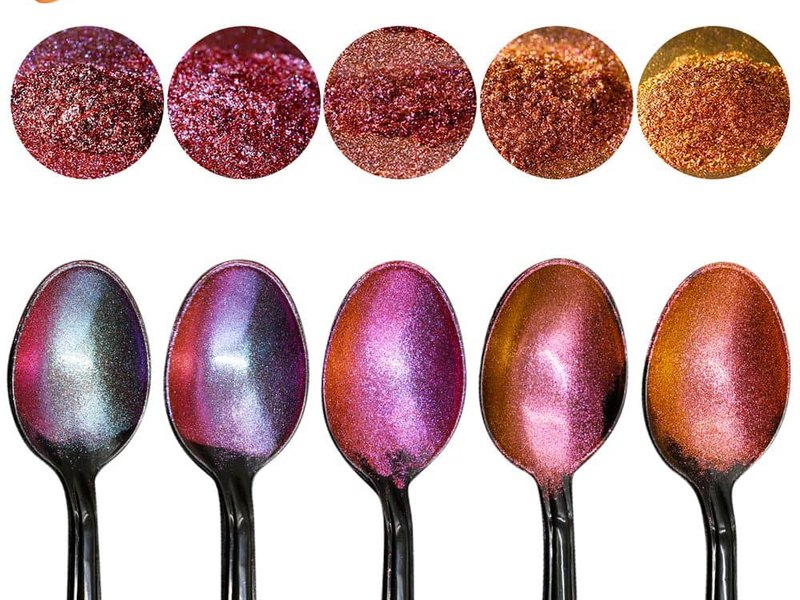
A colour name crosses size bands; a code does not. Which range you need depends on substrate, film build and minimum order — three answers before price.
Read More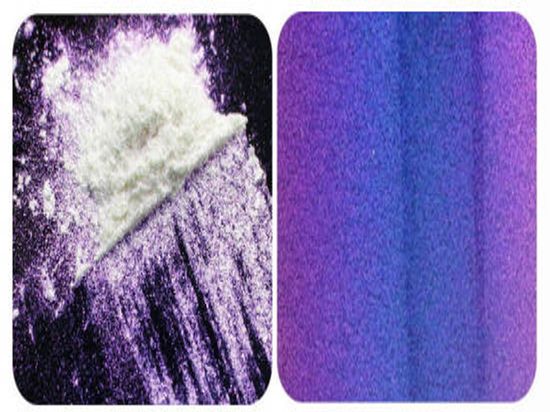
KT-92375 is a large-particle ghost chameleon pigment from Kolortek's KT-9000 Magic Chameleon Series, delivering a continuous five-stage color shift — indigo → purple → red → orange → yellow — as the viewing angle changes. Built on natural mica coated with titanium dioxide, silica, and tin oxide, it carries a particle size of 75–175 μm for maximum sparkle. We developed this grade specifically for high-impact automotive finishes, custom coatings, and luxury decorative applications where a dramatic, angle-dependent color shift is the primary design goal.
Read More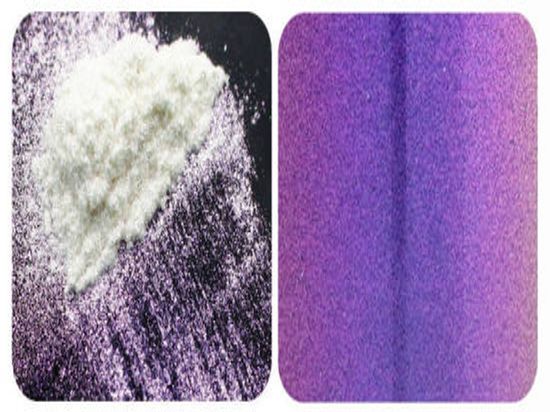
KT-92475 is a large-particle chameleon pigment from the KT-9000 Magic Chameleon Series, producing a continuous mauve → red → orange → yellow color shift that sweeps across the visible spectrum as the viewing angle changes. With a particle size of 75–175 μm and a natural mica substrate coated with titanium dioxide, silica, and tin oxide, it delivers the coarse, high-sparkle texture that nail art formulators need for maximum visual drama — particularly over a dark or black base coat.
Read More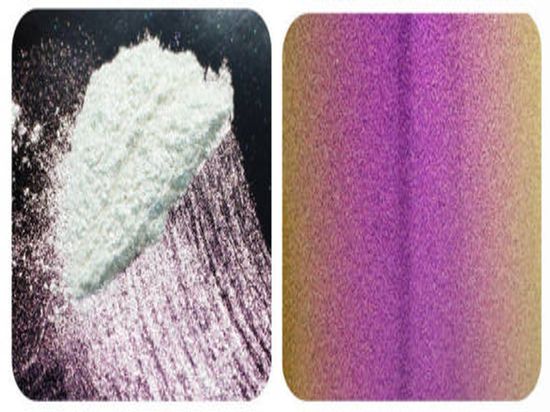
KT-92575 is a large-flake chameleon pearl powder from our KT-9000 Magic Chameleon Series, producing a dramatic angle-dependent color shift spanning red, orange, yellow, and kelly green on dark substrates. Built on a natural mica substrate with a multi-layer coating of titanium dioxide, silica, and tin oxide, it delivers an INCI composition suited to high-end cosmetic and nail art formulations. The 75–175 μm particle range gives it the high-sparkle, deep color-travel behavior that distinguishes it from finer cosmetic pearl grades.
Read More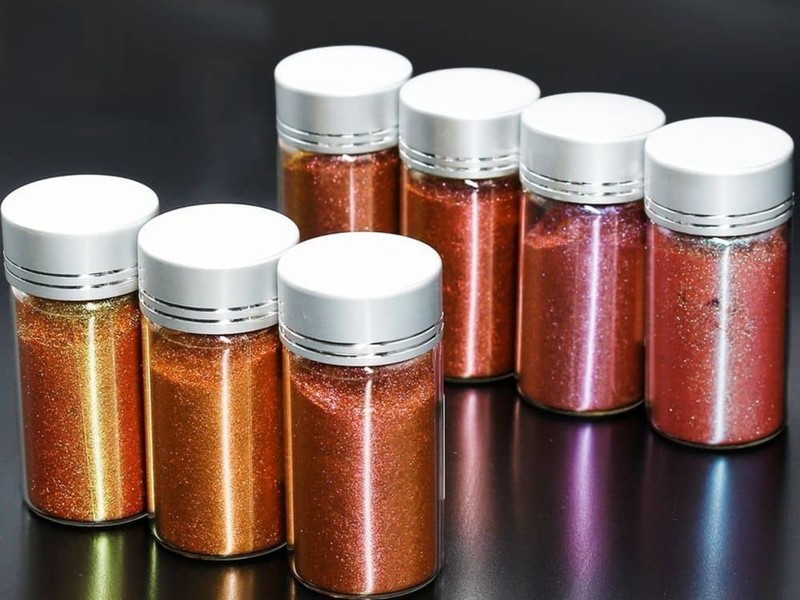
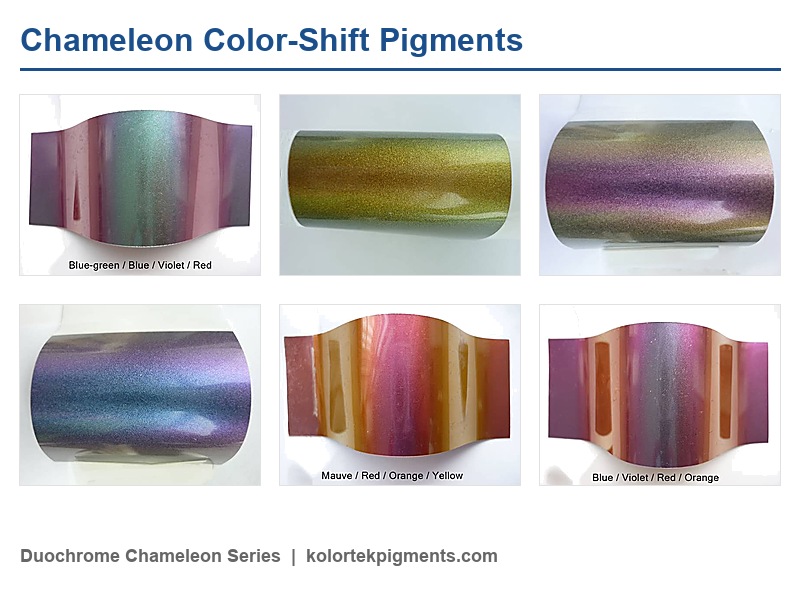
Magic Chameleon duochrome mica powder shifts to a second colour with the viewing angle. Six colour-travel options, nine size grades (5–250 μm), MOQ 5 kg.
Read More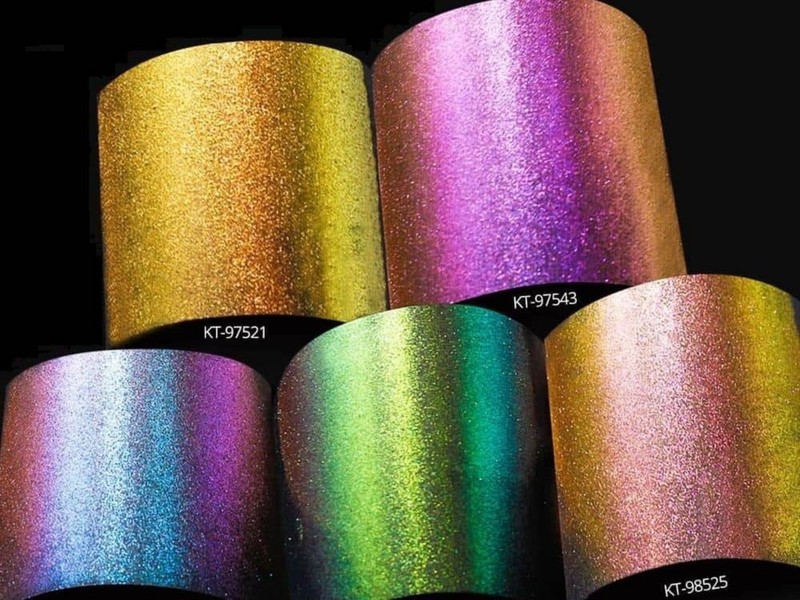
Multicolor chameleon pigment travels three or more hues. Compare shade-pair families by anchor hue, intermediate hue and available particle-size bands.
Read More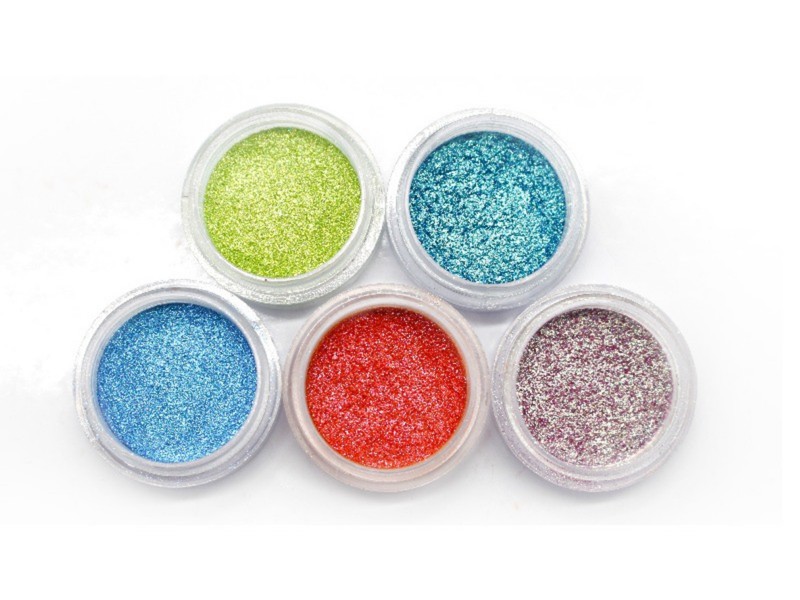
Chameleon mica powder reads differently in a coating film and in a moulded part. See why the orientation mechanism changes and which grade band to start with.
Read More
Colour shift mica powder reads as a different colour depending on where you stand. Fix light, tilt and viewing direction so lab, line and buyer agree.
Read More
 English
 Français
 Deutsch
 Русский
 Español
 Português