
Leave A Message
If you are interested in our products and want to know more details,please leave a message here,we will reply you as soon as we can.
KT-90245 Blue/Green Hypershift Pigments for automotive coatings
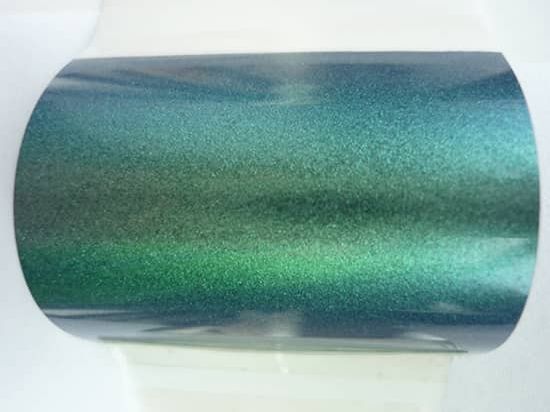
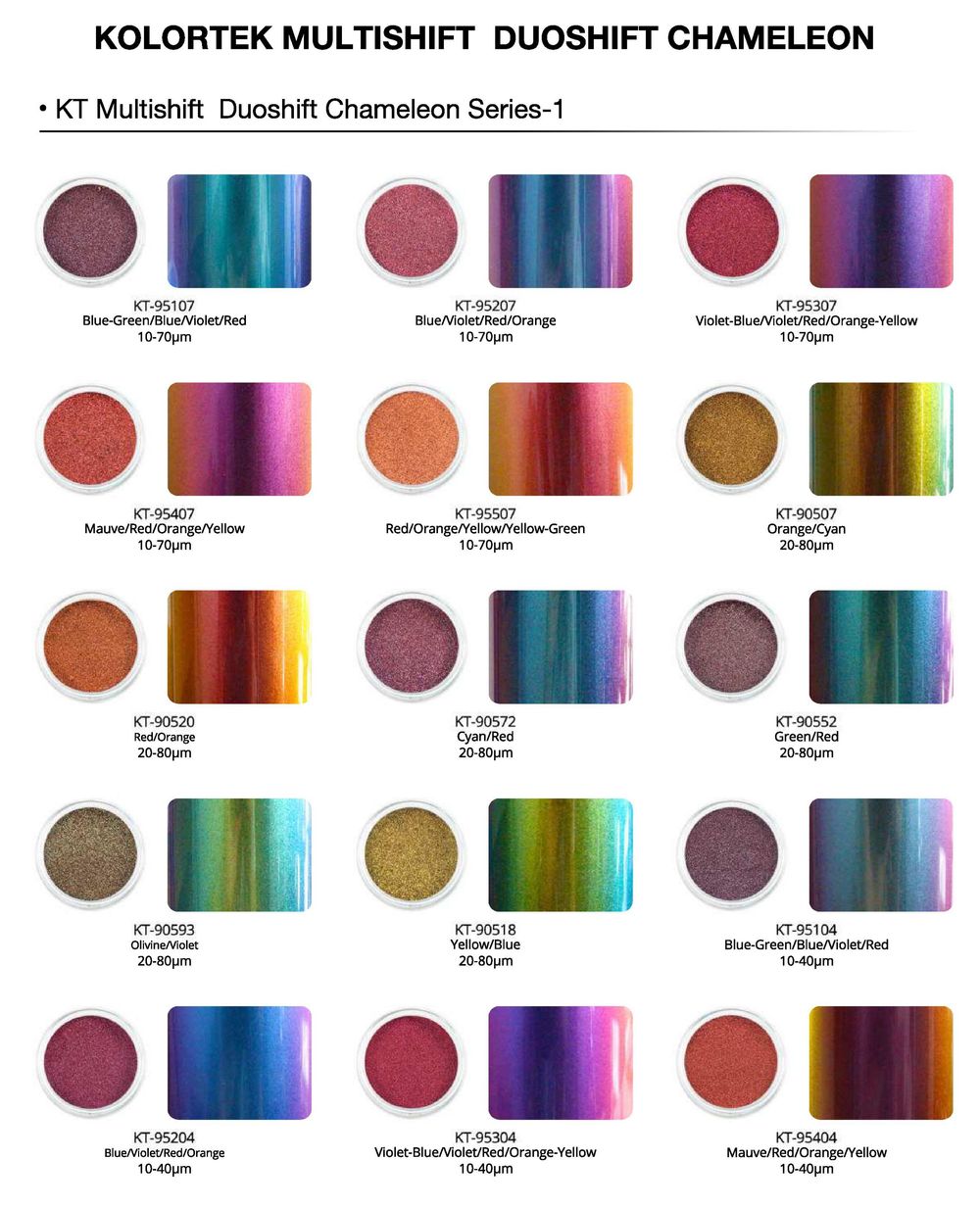
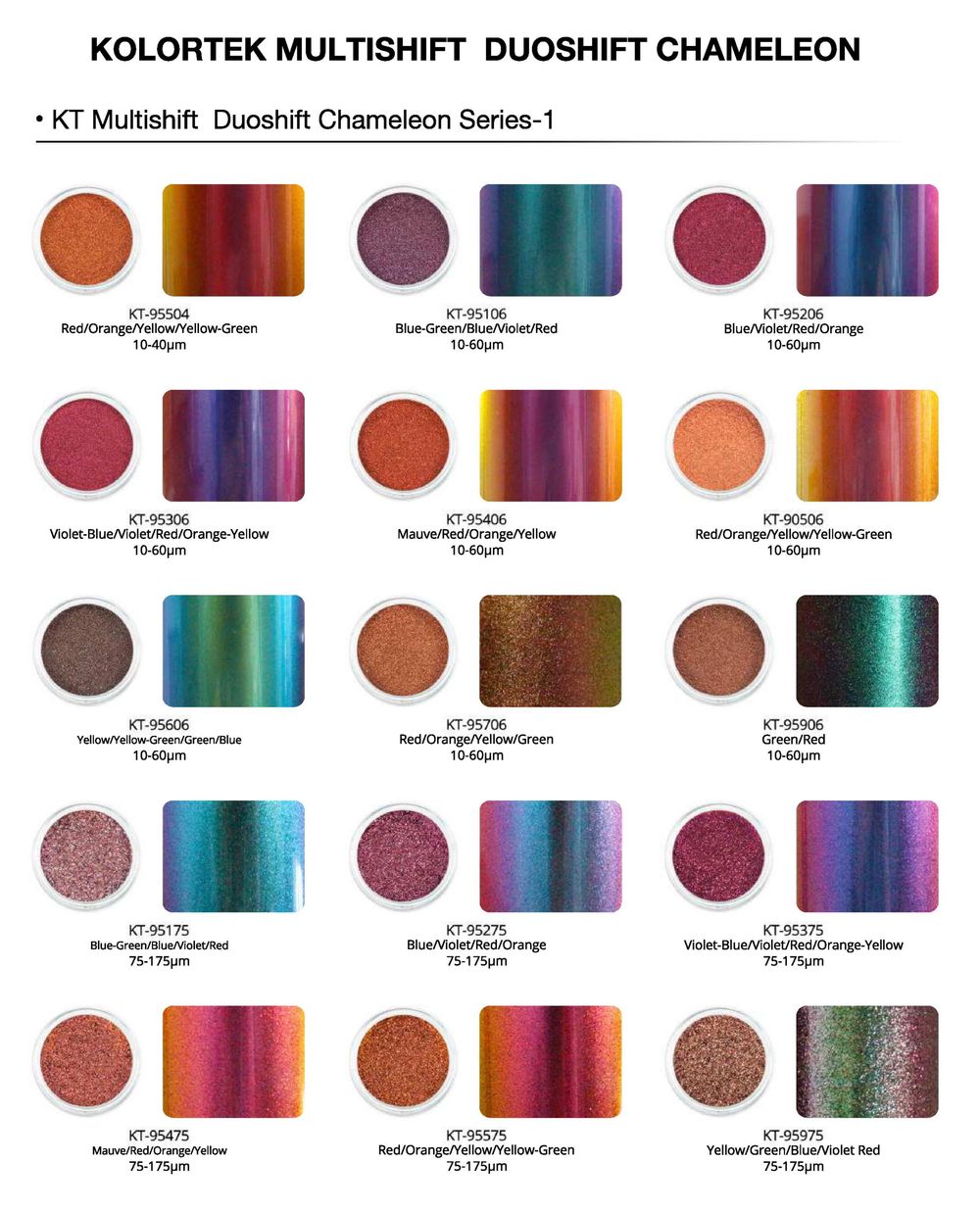
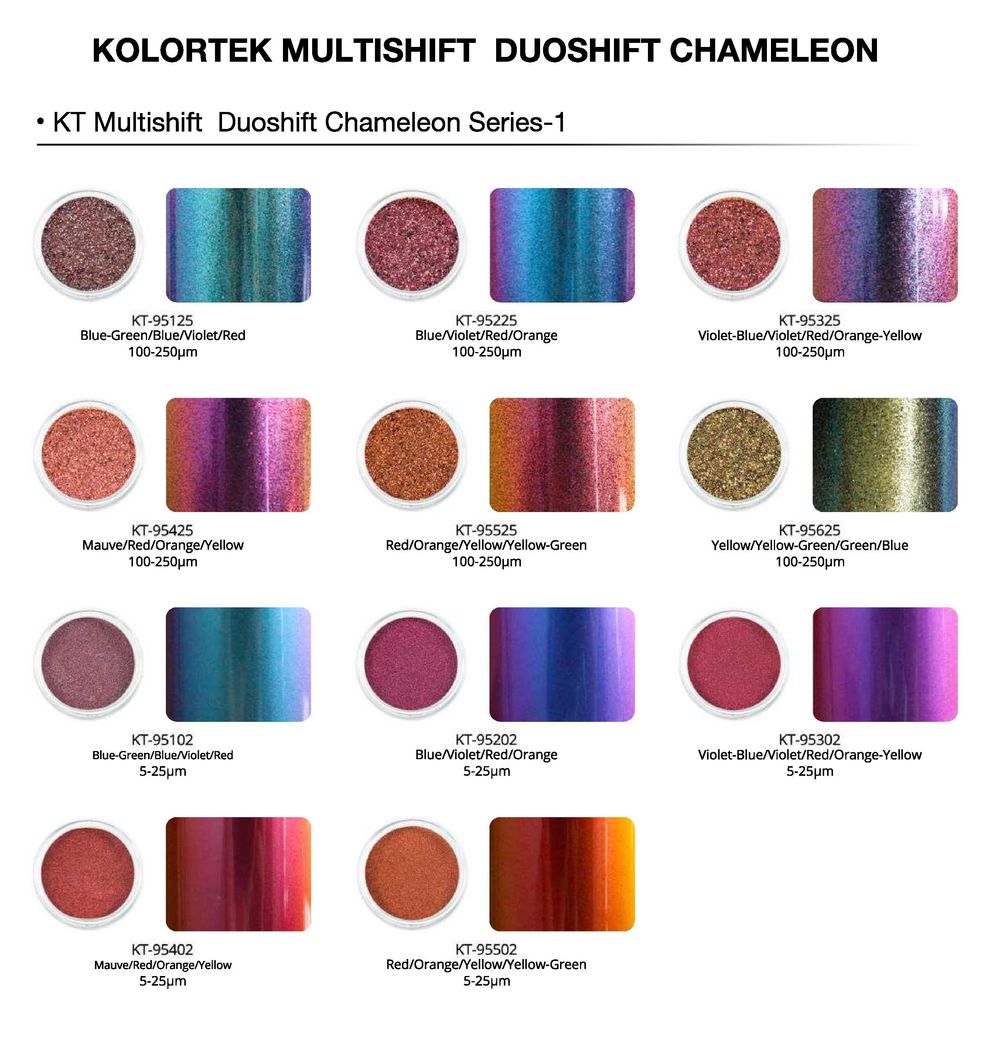
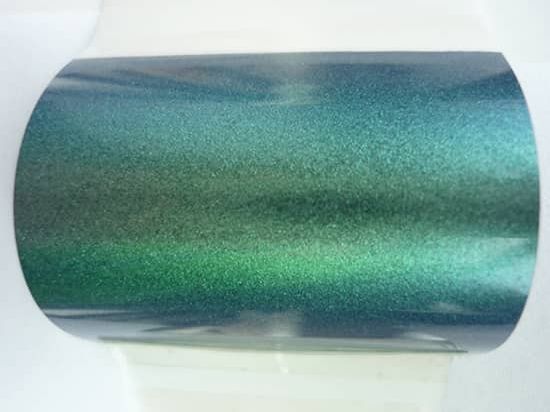
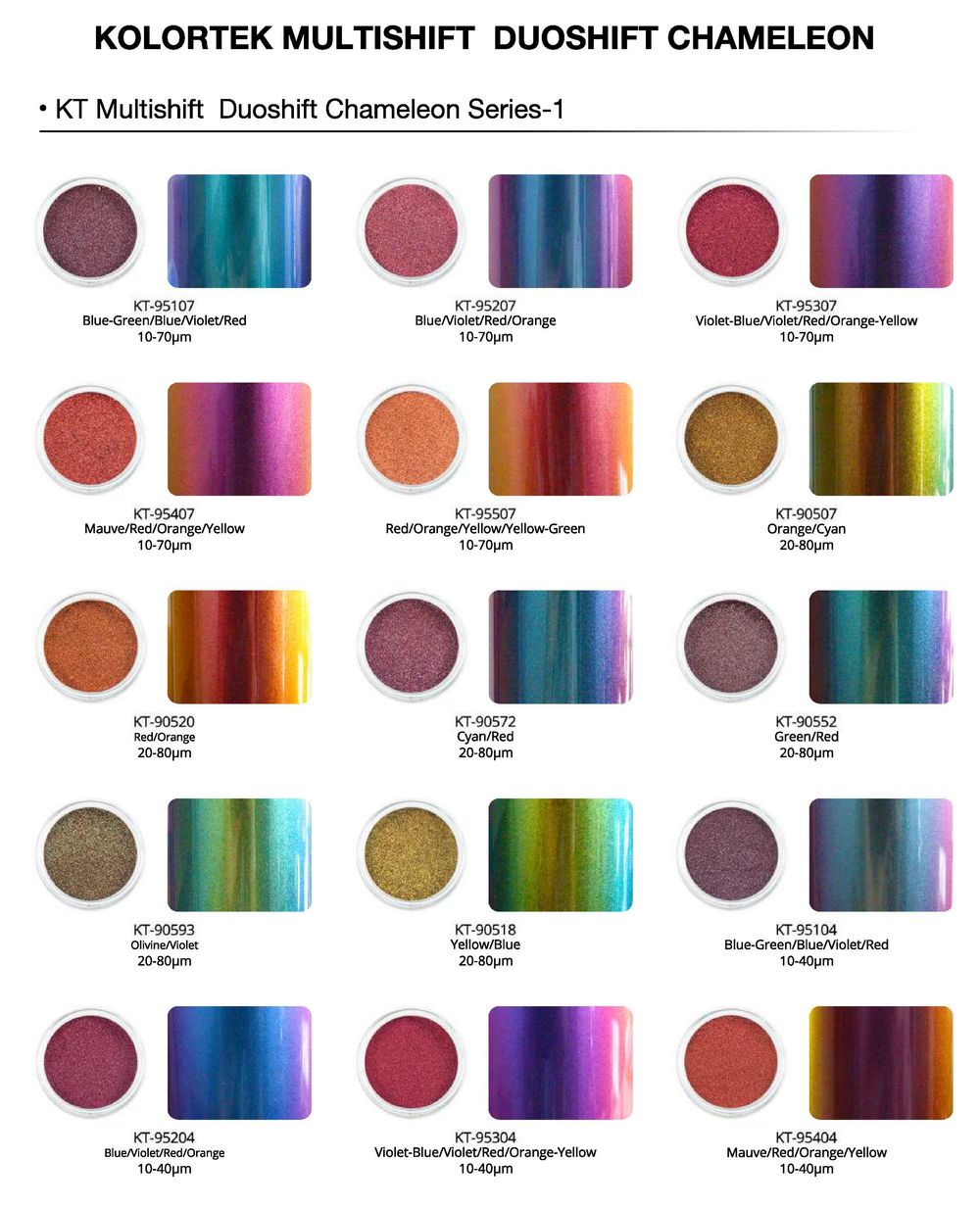
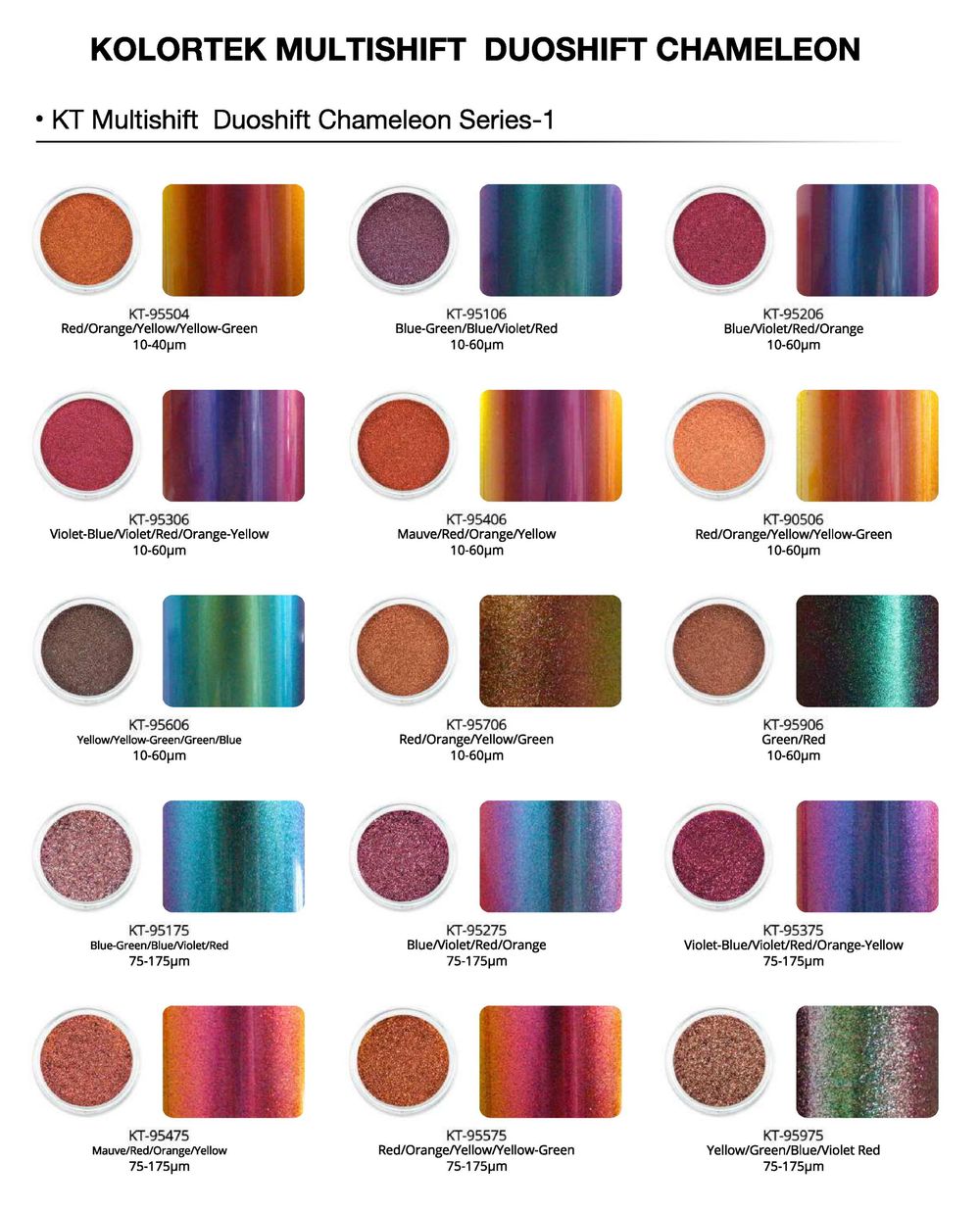
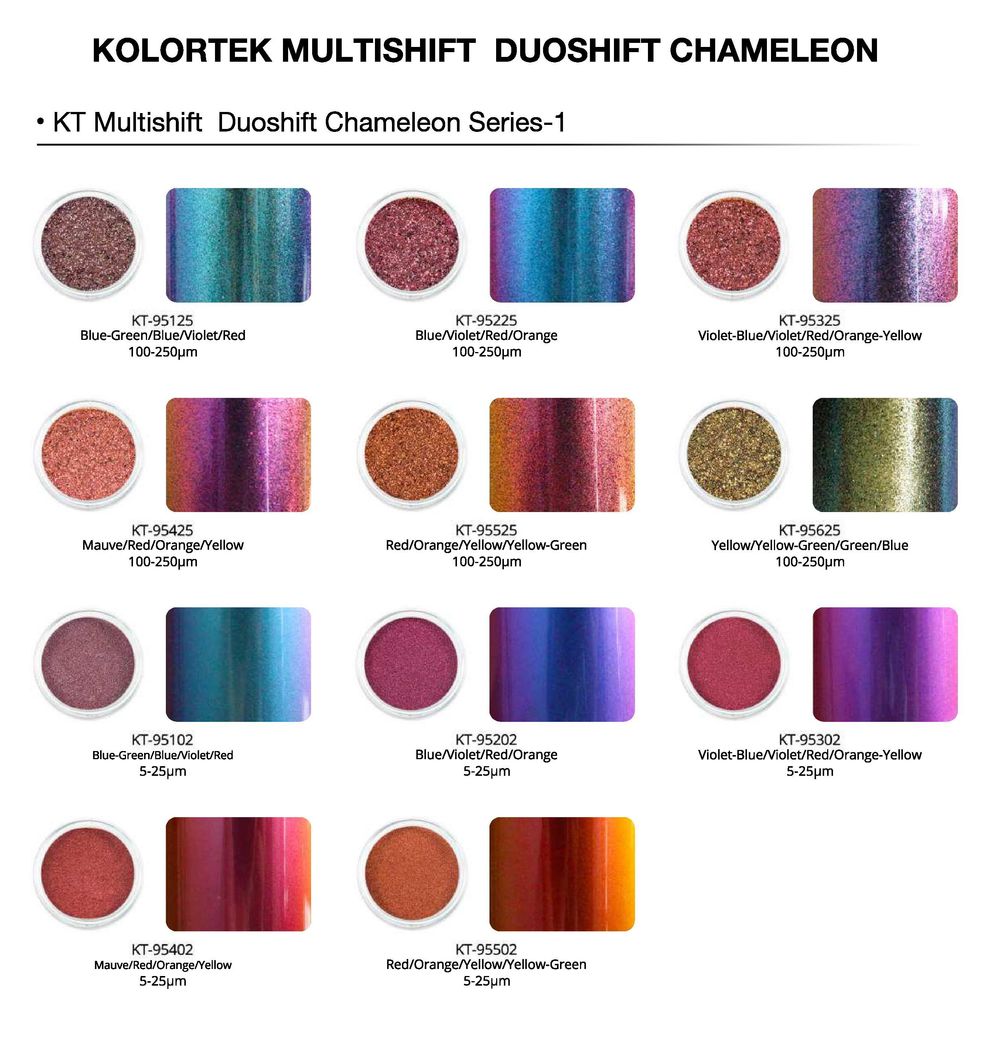
KT-90245 is a blue/green automotive color shift pigment from our KT-9000 Magic Chameleon series — a mica/titanium dioxide/silica multilayer powder that travels from blue to green as viewing angle changes, with a 20–80 μm particle range and a D50 of 25–35 μm. Formulators use it at 1–10% in automotive basecoats over dark or black substrates to build gonochromatic depth, then lock the effect in with a clear topcoat.
KT-90245 belongs to our KT-9000 Magic Chameleon family — multi-layer interference pigments built on natural mica, where the color is generated by thin-film interference rather than absorption. The stack here is mica, titanium dioxide and silica. Light reflects off the individual layers, and because the path length through those layers changes with angle, the reflected color shifts too. On KT-90245 that reads as blue rotating toward green as the panel angle changes.
A term you may see in the market is "hypershift" pigments. The reference data we hold does not use that naming — the series is catalogued as KT-9000 Magic Chameleon, alongside our Color Travel and Chromashift ranges. If you are matching a hypershift pigment powder sample to a specification, the practical route is to compare the interference stack, particle size band and angle colour sequence rather than the trade name.
Because the effect is angle-dependent, the substrate does a lot of the work. In our application lab, the biggest single gain we see on a blue/green chameleon is simply moving the base from a mid-tone to black. A dark base absorbs the transmitted light and lets the interference colour dominate; on a light base the same pigment looks washed out.
| Property | Value |
|---|---|
| Product code | KT-90245 |
| Series | KT-9000 Magic Chameleon |
| Appearance | Blue/Green powder, odourless |
| Particle size | 20–80 μm |
| D50 | 25–35 μm |
| pH (4% in water) | 6.0–9.0 |
| Density | 2.6–3.1 kg/L |
| Solubility in water | Insoluble |
| INCI name | Mica - Titanium dioxide Silica |
The KT-90245 specification carries the following limits, relevant when you are compiling compliance paperwork for a coating or a personal-care adjacent application: As < 2 ppm, Hg < 1 ppm, Ba < 50 ppm, Ni < 10 ppm, Cd < 3 ppm, Pb < 10 ppm, Cr < 100 ppm, Sb < 1 ppm, Cu < 50 ppm, Zn < 50 ppm.
The KT-9000 series is our workhorse platform for the custom and modified car market — color-shift wraps, bespoke panel finishes, and limited-run exterior trims. KT-90245's blue/green travel sits in the territory that reads as a factory-style pearlescent flip rather than an extreme multichrome, which makes it easier to pair with an existing base colour.
Beyond exterior body panels, the same series appears in motorcycle helmets, sporting goods, and decorative coatings where a dense clear film is practical. Outside automotive, the KT-9000 family extends into luxury packaging, security and anti-counterfeiting printing, and high-end cosmetics and nail art.
The numbers below come from our automotive application guidance for the KT-9000 series. They are starting points for trial work, not a substitute for your own panel testing.
One thing to note on the KT-9000 series generally: pigment and resin compatibility is broad, but the multi-layer stack does not respond well to aggressive solvent packages or long hold times in a recirculating line. If your process routes material back through a pump, we would rather you shorten the loop than raise the pigment loading to compensate.
The KT-90245 technical data sheet is dated 01.10.2021 and covers composition, particle size, pH, density and appearance. It does not carry a product-specific QUV or lightfastness rating, an oil absorption figure, a shelf life, or a specific recommended dosage for this grade alone — the 1–10% figure is the series-level automotive recommendation. If you need a weathering result to support an OEM submission, ask us for the current test position rather than working from a generic series claim.
We would also flag two things the data sheet does not settle. First, it does not confirm whether KT-90245 is a two-colour or four-colour shift variant — the series contains both. Second, we do not hold a specific Iriodin® cross-reference for this code. Our cross-reference programme aligns grades against major industry benchmarks including Merck Iriodin®, but no KT-90245 mapping is published, so treat any third-party equivalence claim with caution and test it.
Kolortek holds ISO 9001:2015 certification covering the production and sales of glitters, pigments and fillers. Our REACH registration certificate covers fluorphlogopite (synthetic mica); other grades need product-specific confirmation, so if you need a REACH statement for KT-90245, request it against the specific grade and application. The SGS sample test report we hold applies to Chromashift pigments, not the whole range. Halal and Kosher certifications are product-scope and apply to listed food-grade products, and our US FDA framework supports grades formulated to meet applicable US colour-additive requirements — establishment registration is not FDA approval. EU Cosmetics Regulation (EC) No 1223/2009 supporting documents are available where a cosmetic grade is selected.
KT-90245 is not classified under CLP Regulation (EC) No 1272/2008, nor under Directive 67/548/EEC and Directive 1999/45/EC. Standard powder handling applies: adequate ventilation, gloves, eye protection, and an approved dust mask if dust is generated. Store in a well-ventilated place.
What loading rate should I start with for KT-90245 in an automotive basecoat?
Start at 1–10% pearl pigment in the basecoat, applied to a 15–25 μm dry film thickness. That is the KT-9000 series automotive guidance rather than a KT-90245-specific figure. Higher loading increases the perceived shift but can affect substrate smoothness, so trial a ladder of loadings on black panels before locking the formula.
Why does KT-90245 look weak on a light-coloured car panel?
The blue/green travel comes from thin-film interference, so it competes with whatever light the base reflects. On black or very dark substrates the interference colour dominates and the shift is most dramatic. On light bases the effect washes out. Change the base before you increase pigment loading.
Can KT-90245 be used in a solvent-borne system with high-shear circulation?
Avoid it. The pigment is compatible with most resin systems, but high-shear recirculation and over-thinning damage the platelets, and once they are broken the gonochromatic effect is lost. If your line requires recirculation, keep the loop short and the pump gentle.
Is KT-90245 a two-colour or four-colour shift pigment?
The KT-9000 series contains both two-colour and four-colour shift variants, and our published data for KT-90245 states only the Blue/Green appearance — it does not confirm which category this grade falls into. If your specification depends on the full angle sequence, request a gonio reading for the grade before you commit it to a formula.
Contact our technical team to discuss formulation requirements for your specific application.
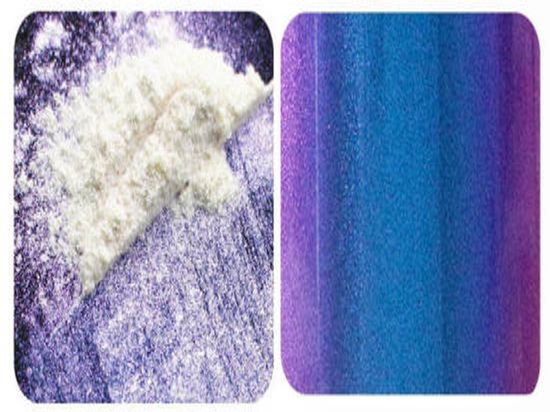
KT-92230 is a multichrome pigment that shifts through a full blue-purple-red-orange sequence as the viewing angle changes — one of the broadest color-travel arcs we produce in the KT-9000 series. Built on a natural mica substrate with a multi-layer TiO₂/Fe₂O₃/silica/tin oxide coating, it comes in a 25–130 μm particle size that delivers strong angular contrast and high visual impact across automotive finishes, decorative coatings, and specialty printing.
Read More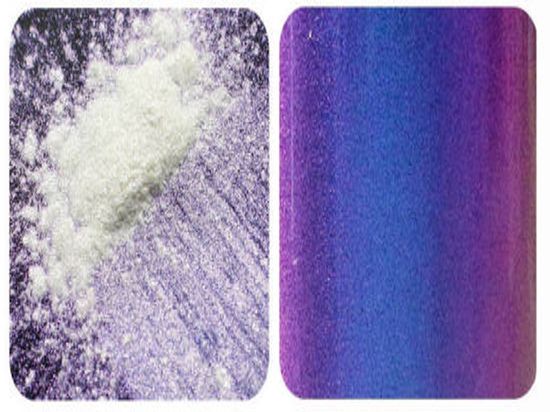
KT-92330 is a multi-layer interference pigment from Kolortek's KT-9000 Magic Chameleon Series, producing a continuous color shift sequence — indigo through purple, red, orange, and yellow — as the viewing angle changes. Built on natural mica coated with TiO₂, silica, and tin oxide, it delivers a high-mirror goniochromatic effect with a 25–130 μm particle size distribution engineered for maximum visual impact. This color shifting pigment powder performs best over dark or black substrates, where the full angular color travel is most legible.
Read More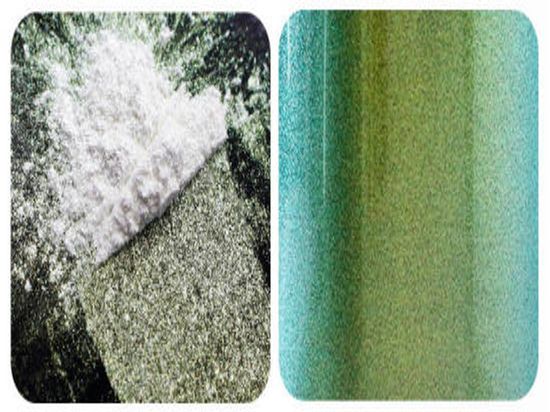
KT-92630 is a large-particle chameleon paint pearl from our KT-9000 Magic Chameleon Series, producing a sequential golden-to-kelly-green-to-blue color travel as the viewing angle shifts. With a 25–130 μm particle range, it delivers high visual impact in automotive custom finishes, decorative coatings, and specialty applications where a pronounced, multi-stop color flip is the goal. The substrate is natural mica with a multi-layer TiO₂/SiO₂/metal-oxide coating that generates the goniochromatic interference effect.
Read More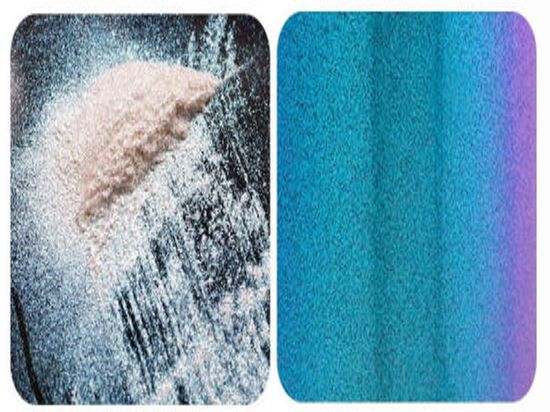
KT-92175 is the large-particle grade of our chameleon pigment for resin, built on a natural mica substrate with a multi-layer TiO₂, silica, and tin oxide coating that produces a continuous cyan-to-blue-to-purple-to-red angle-dependent color shift. At 75–175μm, it is the highest-sparkle option in the KT-9000 Magic Chameleon Series' KT-921** Cyan-Blue-Purple-Red range. Compatible with epoxy and UV resin at loadings of 1–10% by weight, the effect reads strongest on dark or black substrates where the goniochromatic shift has maximum contrast.
Read More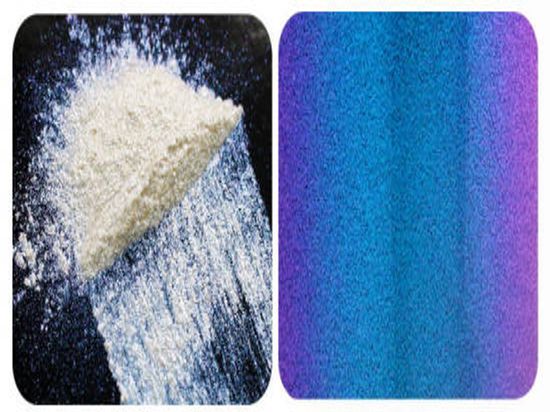
KT-92275 is a large-particle duochrome loose pigment from our KT-9000 Magic Chameleon Series, delivering a full blue-purple-red-orange color travel sequence that shifts continuously across the visible spectrum as the viewing angle changes. With a particle size range of 75–175 μm, this grade is engineered specifically for applications where maximum sparkle is the priority — loose eyeshadow, nail art toppers, and high-impact decorative cosmetics where the angular shift needs to read clearly against the skin or a dark base.
Read More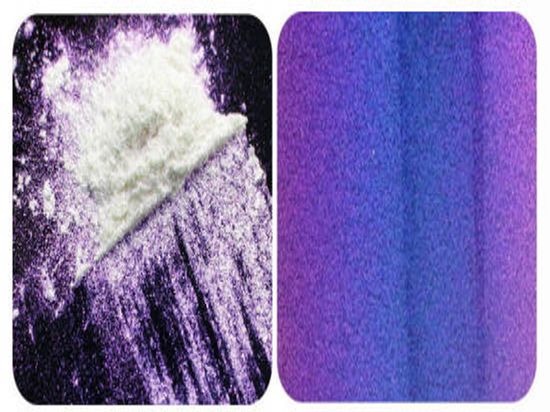
KT-92375 is a large-particle ghost chameleon pigment from Kolortek's KT-9000 Magic Chameleon Series, delivering a continuous five-stage color shift — indigo → purple → red → orange → yellow — as the viewing angle changes. Built on natural mica coated with titanium dioxide, silica, and tin oxide, it carries a particle size of 75–175 μm for maximum sparkle. We developed this grade specifically for high-impact automotive finishes, custom coatings, and luxury decorative applications where a dramatic, angle-dependent color shift is the primary design goal.
Read More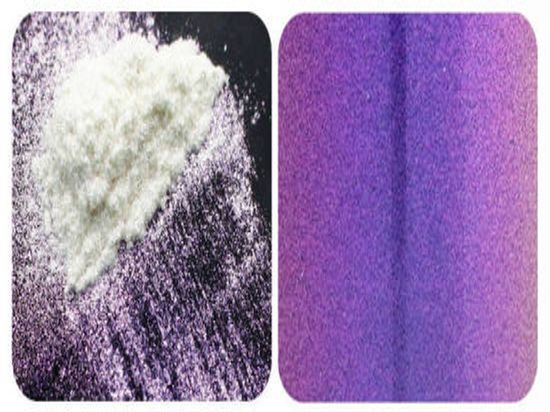
KT-92475 is a large-particle chameleon pigment from the KT-9000 Magic Chameleon Series, producing a continuous mauve → red → orange → yellow color shift that sweeps across the visible spectrum as the viewing angle changes. With a particle size of 75–175 μm and a natural mica substrate coated with titanium dioxide, silica, and tin oxide, it delivers the coarse, high-sparkle texture that nail art formulators need for maximum visual drama — particularly over a dark or black base coat.
Read More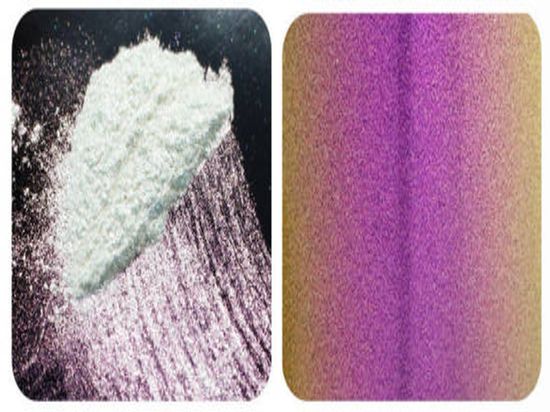
KT-92575 is a large-flake chameleon pearl powder from our KT-9000 Magic Chameleon Series, producing a dramatic angle-dependent color shift spanning red, orange, yellow, and kelly green on dark substrates. Built on a natural mica substrate with a multi-layer coating of titanium dioxide, silica, and tin oxide, it delivers an INCI composition suited to high-end cosmetic and nail art formulations. The 75–175 μm particle range gives it the high-sparkle, deep color-travel behavior that distinguishes it from finer cosmetic pearl grades.
Read More
 English
 Français
 Deutsch
 Русский
 Español
 Português