
Leave A Message
If you are interested in our products and want to know more details,please leave a message here,we will reply you as soon as we can.
KT-95606 Yellow/yellow-green/green/blue Multichrome Pigment
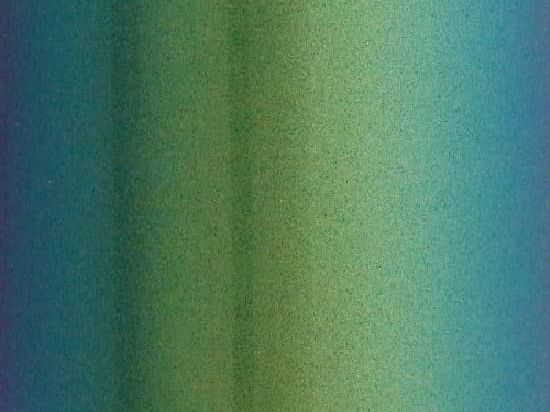
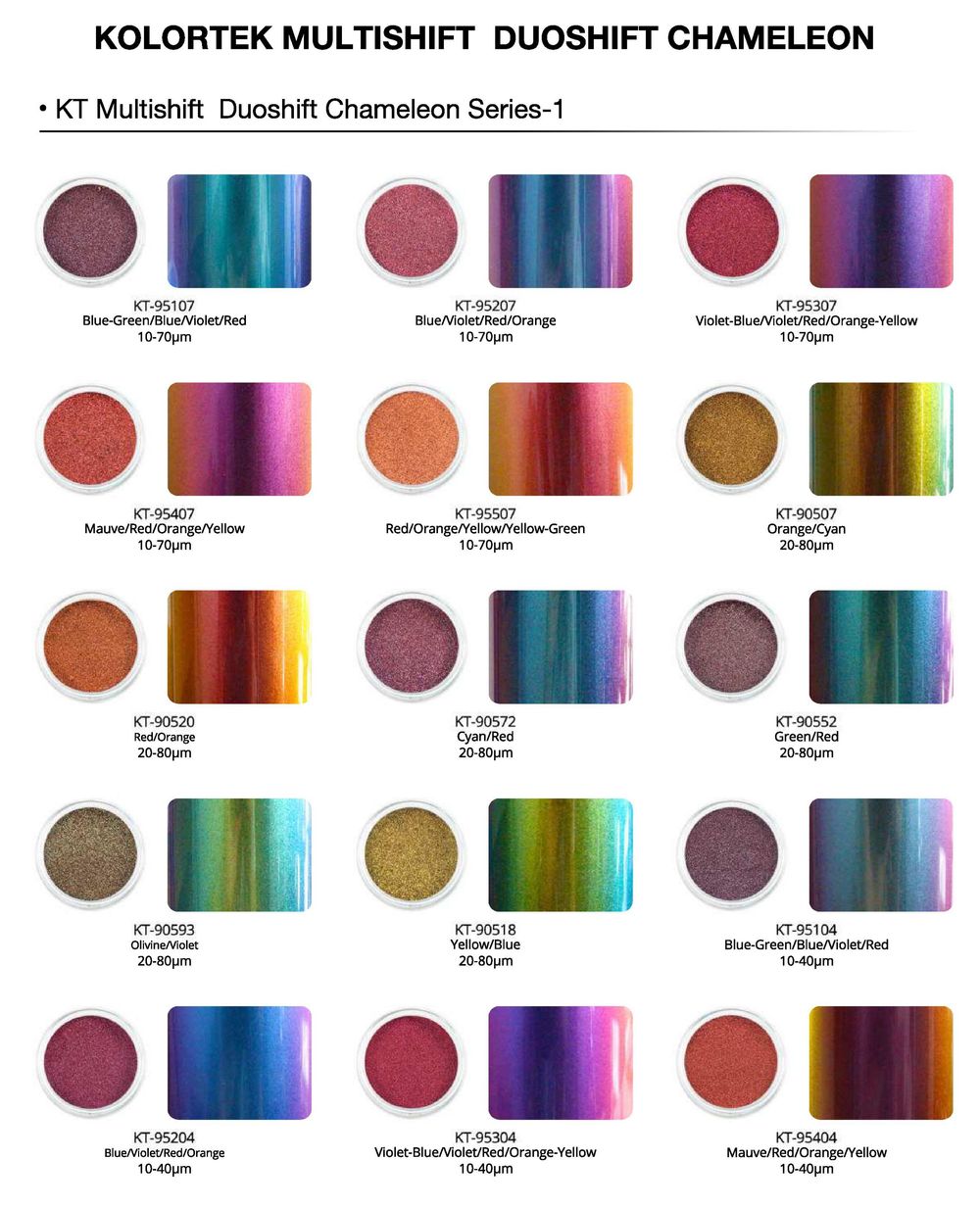
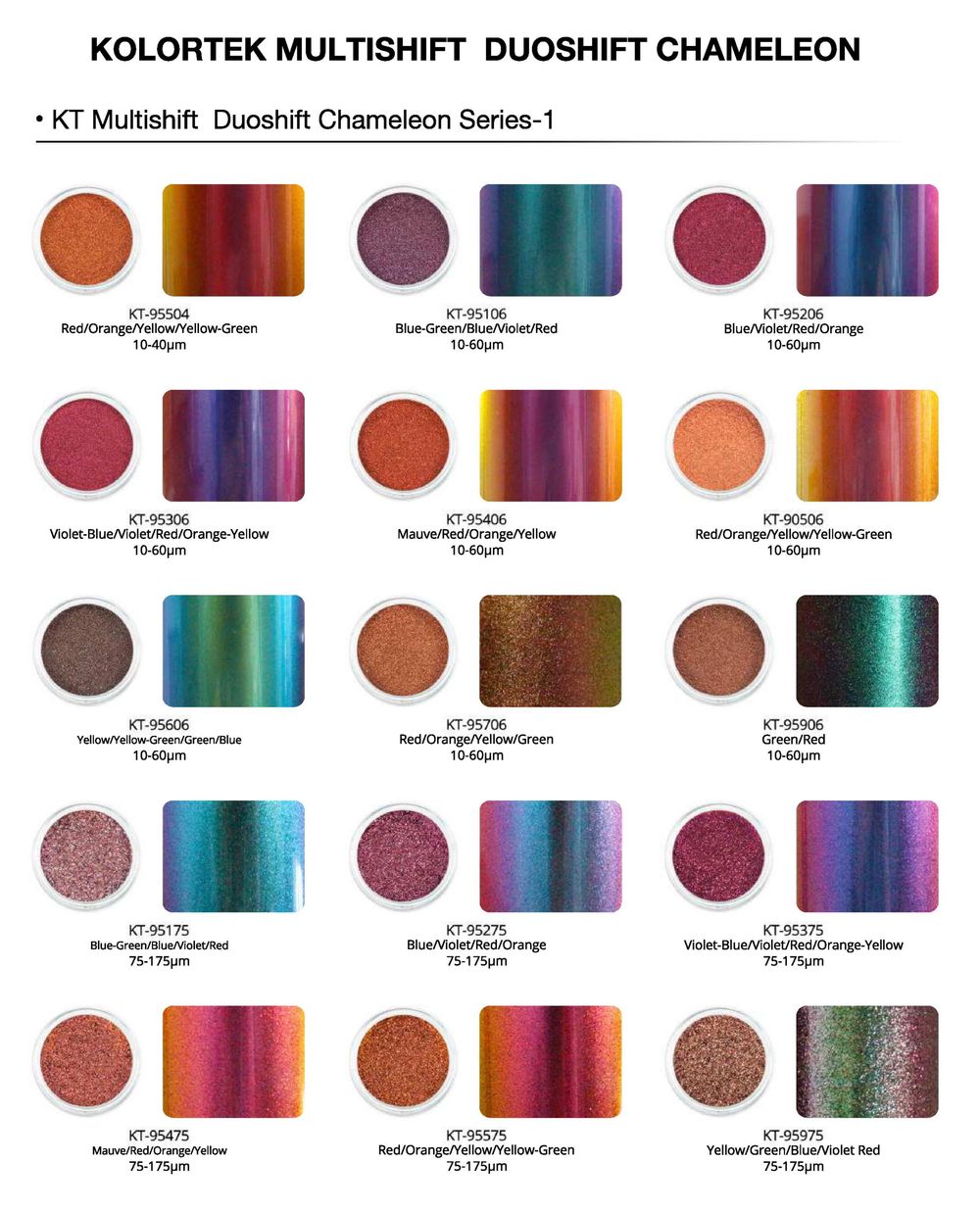
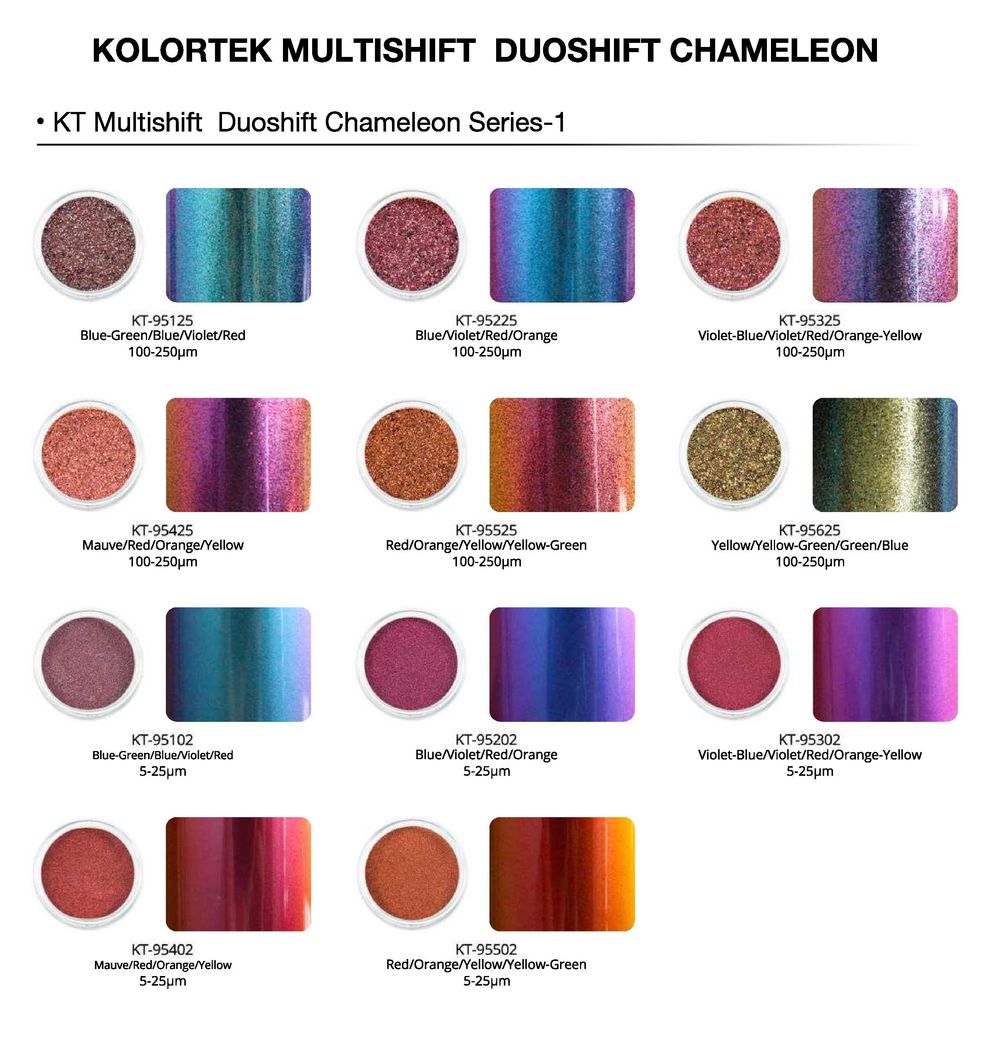
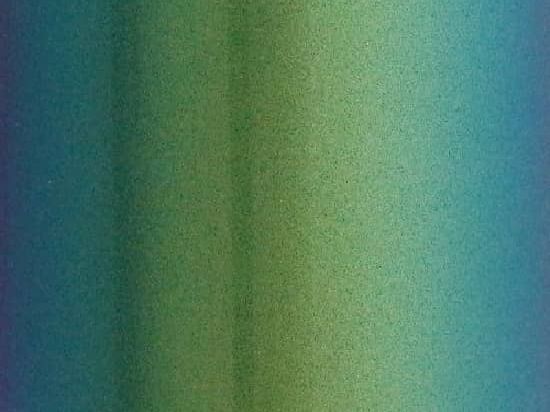
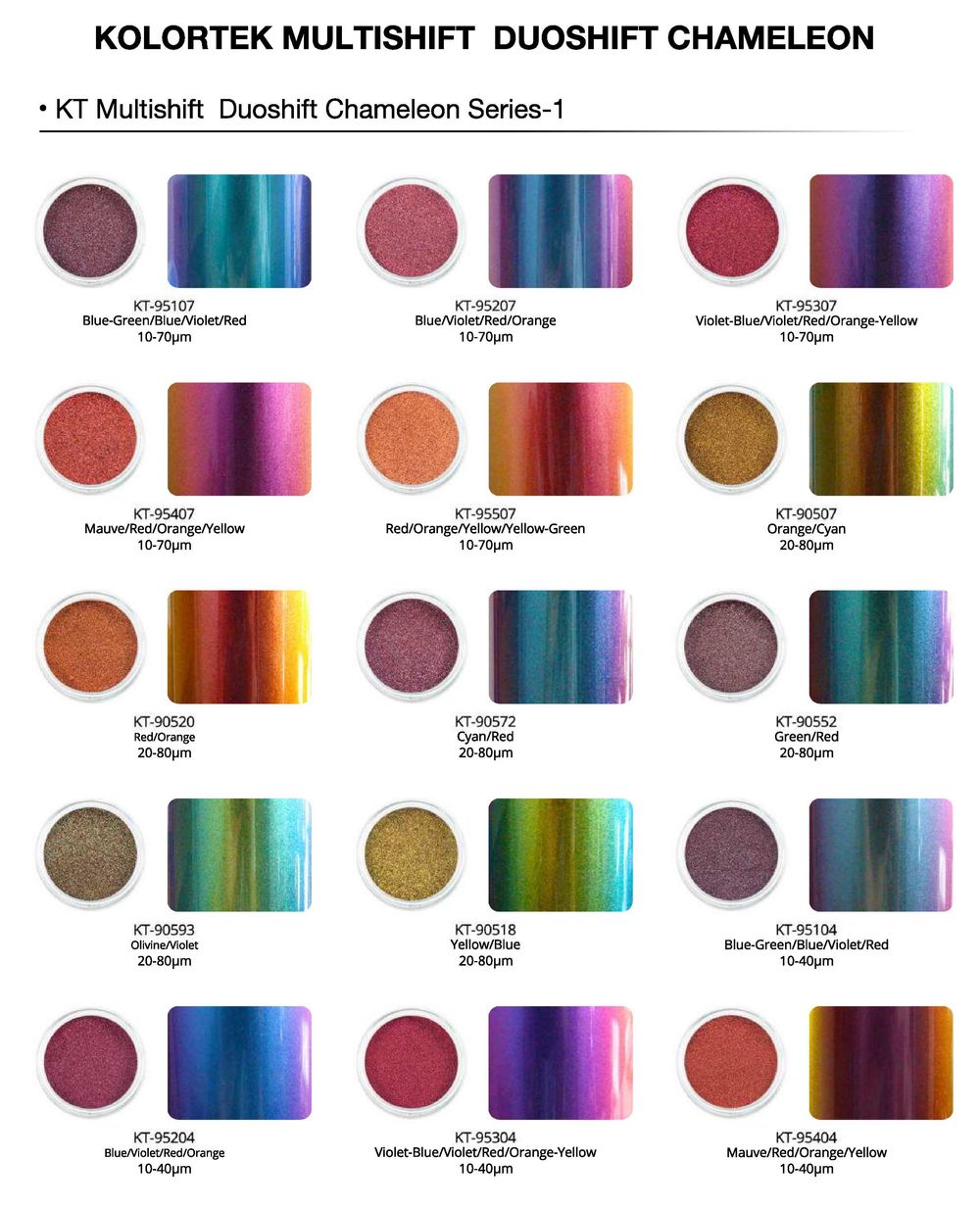
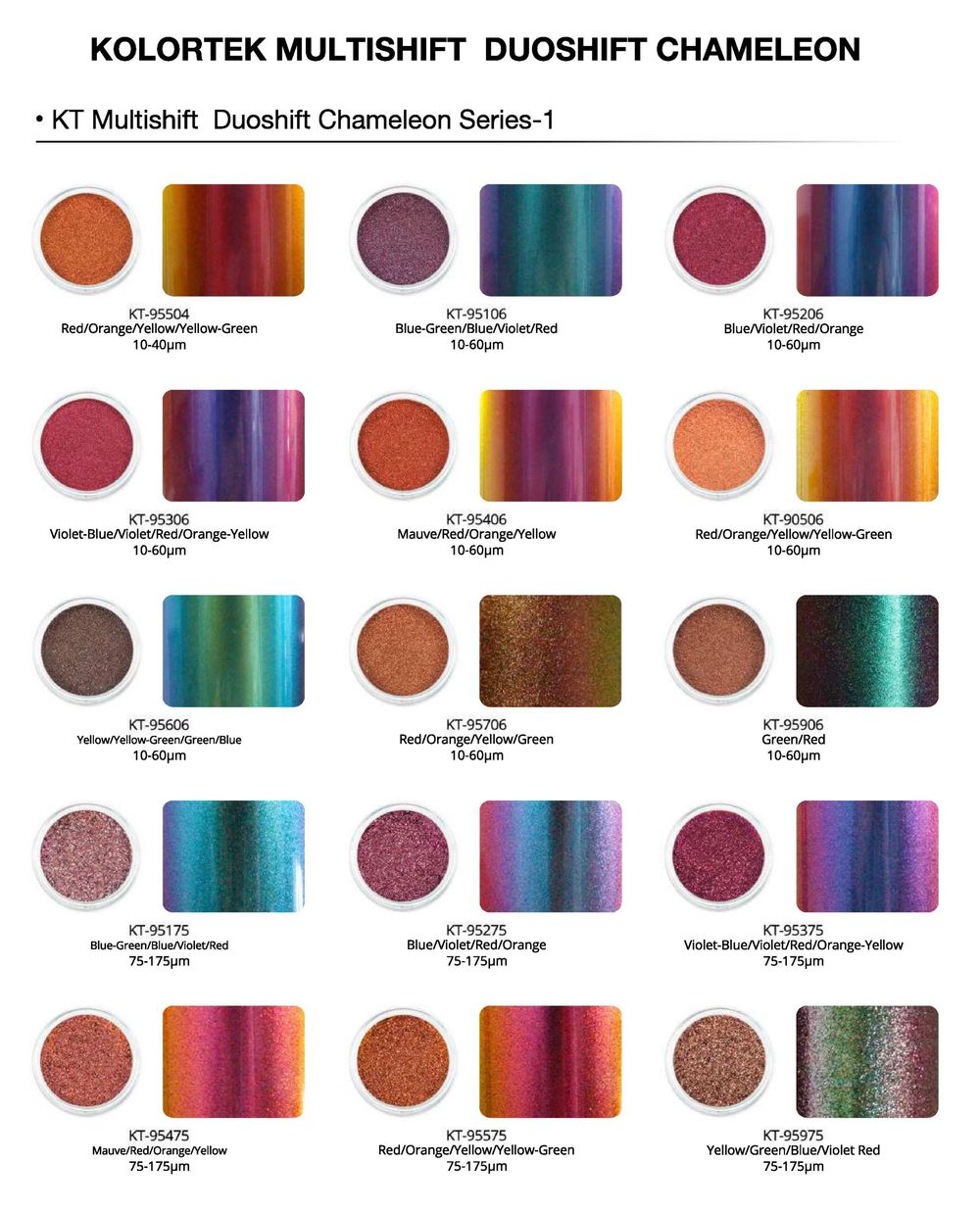
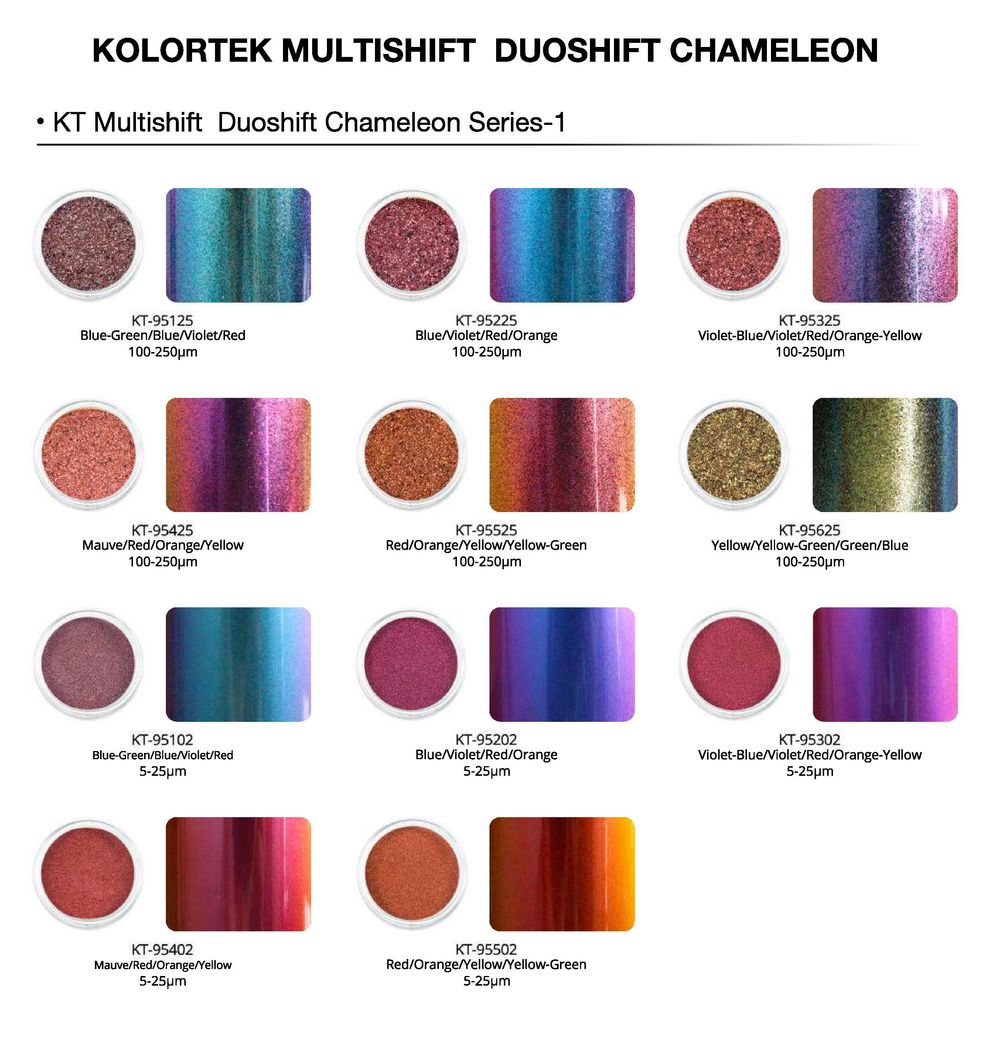
KT-95606 is a TiO₂-free multichrome pigment from our KT-9000 Magic Chameleon Series, delivering a continuous four-stage colour travel — yellow → yellow-green → green → blue — as the viewing angle shifts. Built on a natural mica substrate coated with Fe₂O₃ and silica, it spans a 10–60 μm particle range (D50: 21–26 μm) and works across automotive finishes, decorative coatings, cosmetics, plastics, and security printing. The effect is most dramatic over dark or black substrates.
The colour shift in KT-95606 is not a blend of two discrete hues — it is a smooth, continuous travel across four perceptual stages driven by thin-film optical interference. As light strikes the Fe₂O₃ + silica multilayer coating on the mica platelet at progressively shallower angles, the constructive interference wavelength shifts from the blue end of the visible spectrum toward yellow. The result is a pigment that reads differently depending on whether you are looking at a surface head-on or obliquely, and that change is consistent and reproducible batch to batch.
We classify KT-95606 within the TiO₂-free sub-range of the KT-9000 series (codes KT-95102 through KT-95706). Omitting TiO₂ from the coating stack is deliberate: it allows the iron oxide and silica layers to express their full interference chroma without the opacity penalty that TiO₂ introduces. In our experience, formulators who need a cleaner, more saturated colour travel — particularly in the green-to-blue register — find TiO₂-free grades easier to work with than standard chameleon pigments at comparable loading levels.
One thing to note about the KT-9000 series more broadly: four-colour shift variants like KT-95606 are primarily designed for paint, coatings, plastics, and leather applications. Two-colour shift variants in the same series tend to serve cosmetic end uses. That distinction matters when you are selecting a grade for a new formulation — the optical geometry of a four-stage shift requires adequate film build and a dark substrate to read correctly.
| Property | Value |
|---|---|
| Product Code | KT-95606 |
| Series | KT-9000 Magic Chameleon Series (TiO₂-Free sub-range) |
| Colour Shift | Yellow / Yellow-green / Green / Blue |
| Form | Powder |
| Substrate | Natural Mica |
| Coating | Fe₂O₃ + Silica |
| INCI Name | Mica – Iron Oxide – Silica |
| Particle Size Range | 10–60 μm |
| D50 | 21–26 μm |
| pH (4% H₂O) | 6.0–9.0 |
| Density | 2.6–3.1 kg/L |
| Bulk Density | 15–25 g/100 mL |
| Solubility | Insoluble in water |
| Odour | Odourless |
| CLP Classification (EC 1272/2008) | Not classified |
| Component | C.I. Number | Content (%) |
|---|---|---|
| Mica | CI 77019 | 31.0–41.0 |
| Iron Oxide (Fe₂O₃) | CI 77491 | 18.0–23.0 |
| Silica (SiO₂) | — | 41.0–46.0 |
The TDS for KT-95606 specifies the following maximum heavy metal concentrations, consistent with the limits we maintain across the TiO₂-free chameleon range:
| Element | Limit | Element | Limit |
|---|---|---|---|
| As | < 2 ppm | Pb | < 10 ppm |
| Hg | < 1 ppm | Cr | < 100 ppm |
| Ba | < 50 ppm | Sb | < 1 ppm |
| Ni | < 10 ppm | Cu | < 50 ppm |
| Cd | < 3 ppm | Zn | < 50 ppm |
KT-95606 is a four-colour shift grade, and within the KT-9000 series that puts it squarely in paint, coatings, plastics, and leather territory rather than the two-colour cosmetic variants. That said, it appears across a wide application range — below are the end uses we see it perform well in, drawn directly from our application and series data.
Automotive custom finishes and wraps are a primary use case. The 10–60 μm particle distribution provides enough face area for the interference layers to express the full four-stage shift under directional lighting, which is exactly what you want on a body panel or helmet. We consistently recommend applying a clear topcoat in automotive contexts — it protects the coating-mica interface from mechanical abrasion and moisture while adding optical depth that makes the colour travel appear more saturated. The series is also listed for motorcycle helmets, sporting goods, and weatherproof architectural coatings.
High-end cosmetics and nail art are listed application areas for the KT-9000 series. The inorganic composition — mica, iron oxide, silica — is consistent with cosmetic-grade formulations, and the INCI designation is straightforward for label compliance purposes. Cosmetic formulators working in the EU or US market should confirm grade suitability against EC No 1223/2009 cosmetic regulation requirements and applicable US colour-additive frameworks before finalising sourcing; we can provide supporting composition documentation on request.
In plastic compounding and injection moulding, the pigment's water insolubility and inorganic composition make it compatible with most thermoplastic processing environments. Security and decorative printing — including high-security applications such as banknotes and negotiable securities — are listed end uses, where the angle-dependent colour shift functions as a straightforward visual authentication feature. Synthetic leather and powder coatings round out the application profile.
Substrate colour is the single most important formulation variable. On black or very dark substrates, the yellow-to-blue colour travel reads clearly across all four stages. On white substrates, the shift is perceptually muted — the interference colours wash out against the high-reflectance background. If your formulation requires a light-coloured base, we generally recommend incorporating a dark interlayer or tinting the base resin.
KT-95606 can be combined with transparent absorption pigments to shift the perceived base colour or to narrow and modulate the colour travel range. This is a useful technique when you need the shift to register within a specific colour gamut defined by a brand or design brief. Avoid opaque pigments that will block the interference effect.
The series is described as compatible with most resin systems. For dusty handling conditions — during weighing, blending, or transfer — use adequate ventilation, a dust mask rated for particulate, and appropriate eye protection. Skin contact warrants washing with water; prolonged or repeated exposure without PPE is not recommended.
Specific recommended loading rates and dispersion protocols for KT-95606 are not published in our current data sheet. Contact our technical team for application-specific guidance — loading optimisation is something we work through with customers on a case-by-case basis depending on the resin, substrate, and film build target.
At Kolortek, our quality management system operates under ISO 9001:2015 certification, covering production and sales of pigments, glitters, and fillers. The MSDS for KT-95606 classifies it as not hazardous under both CLP Regulation (EC) No 1272/2008 and the earlier Directives 67/548/EEC and 1999/45/EC. REACH Regulation (EC) No 1907/2006 is referenced in the product documentation.
For cosmetic applications in regulated markets, supporting composition documents are available. Product-specific certification against EU Cosmetics Regulation EC No 1223/2009 or US FDA colour-additive requirements depends on the selected grade and intended use — we do not make blanket approval claims for the entire series. Buyers with specific regulatory requirements should request documentation at the point of inquiry so we can confirm suitability for the intended application.
What is the colour shift sequence of KT-95606, and over what angle range does it occur?
KT-95606 shifts through four stages — yellow, yellow-green, green, and blue — as the angle of illumination or observation changes. This is a goniochromatic, angle-dependent effect produced by multilayer optical interference in the Fe₂O₃ + silica coating on the mica platelet. The shift is continuous rather than stepped. Specific numerical angle data is not published in the current TDS; our application team can provide goniospectrophotometric characterisation data on request.
Does KT-95606 contain TiO₂, and why does that matter for formulation?
No — KT-95606 is a TiO₂-free grade within the KT-9000 Magic Chameleon Series, coated solely with Fe₂O₃ and silica. The absence of TiO₂ preserves the translucency of the coating stack, allowing the interference chroma to express more fully. For formulators, this means you get a more saturated colour travel at comparable loading compared to TiO₂-containing chameleon grades — but you also need a darker substrate to see the effect clearly, since there is less scattering to compensate for light-coloured bases.
What substrate colour is required to see the full multishift chameleon pigment effect?
A black or very dark substrate is required to see the full four-stage colour travel. On white or light-coloured substrates, the interference colours are substantially muted and the shift appears weak. If the intended application requires a light base, the most practical solution is incorporating a dark interlayer between the substrate and the pigment-containing topcoat, or tinting the binder resin to a mid-to-dark tone before adding KT-95606.
Is KT-95606 suitable for cosmetic applications, and what compliance documentation is available?
The KT-9000 series lists high-end cosmetics and nail art as application areas. The INCI composition — Mica, Iron Oxide, Silica — is consistent with cosmetic-grade inorganic pigment use. At Kolortek, supporting composition documents are available for customers working within EU Cosmetics Regulation (EC) No 1223/2009 or US FDA colour-additive frameworks. Product-specific suitability should be confirmed with our technical team before specification, as approval depends on the intended cosmetic use and final formulation.
Contact our technical team to discuss formulation requirements, loading optimisation, or regulatory documentation for your specific application.
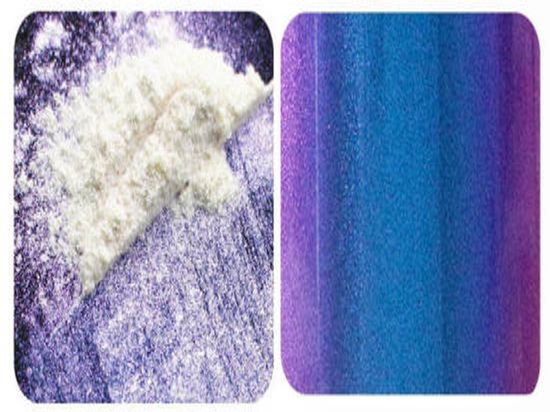
KT-92230 is a multichrome pigment that shifts through a full blue-purple-red-orange sequence as the viewing angle changes — one of the broadest color-travel arcs we produce in the KT-9000 series. Built on a natural mica substrate with a multi-layer TiO₂/Fe₂O₃/silica/tin oxide coating, it comes in a 25–130 μm particle size that delivers strong angular contrast and high visual impact across automotive finishes, decorative coatings, and specialty printing.
Read More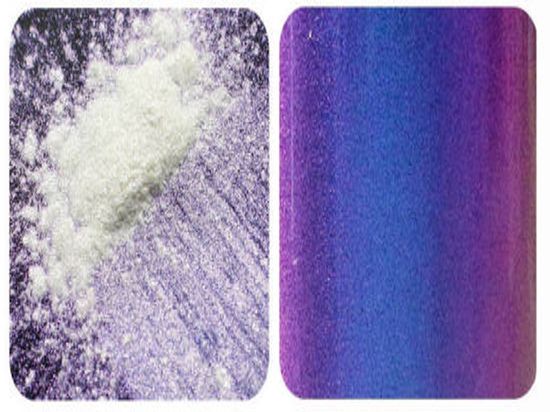
KT-92330 is a multi-layer interference pigment from Kolortek's KT-9000 Magic Chameleon Series, producing a continuous color shift sequence — indigo through purple, red, orange, and yellow — as the viewing angle changes. Built on natural mica coated with TiO₂, silica, and tin oxide, it delivers a high-mirror goniochromatic effect with a 25–130 μm particle size distribution engineered for maximum visual impact. This color shifting pigment powder performs best over dark or black substrates, where the full angular color travel is most legible.
Read More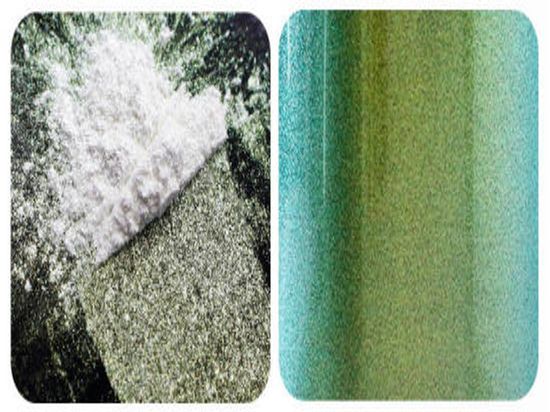
KT-92630 is a large-particle chameleon paint pearl from our KT-9000 Magic Chameleon Series, producing a sequential golden-to-kelly-green-to-blue color travel as the viewing angle shifts. With a 25–130 μm particle range, it delivers high visual impact in automotive custom finishes, decorative coatings, and specialty applications where a pronounced, multi-stop color flip is the goal. The substrate is natural mica with a multi-layer TiO₂/SiO₂/metal-oxide coating that generates the goniochromatic interference effect.
Read More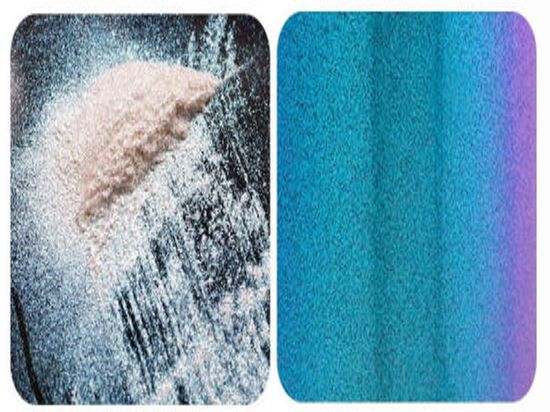
KT-92175 is the large-particle grade of our chameleon pigment for resin, built on a natural mica substrate with a multi-layer TiO₂, silica, and tin oxide coating that produces a continuous cyan-to-blue-to-purple-to-red angle-dependent color shift. At 75–175μm, it is the highest-sparkle option in the KT-9000 Magic Chameleon Series' KT-921** Cyan-Blue-Purple-Red range. Compatible with epoxy and UV resin at loadings of 1–10% by weight, the effect reads strongest on dark or black substrates where the goniochromatic shift has maximum contrast.
Read More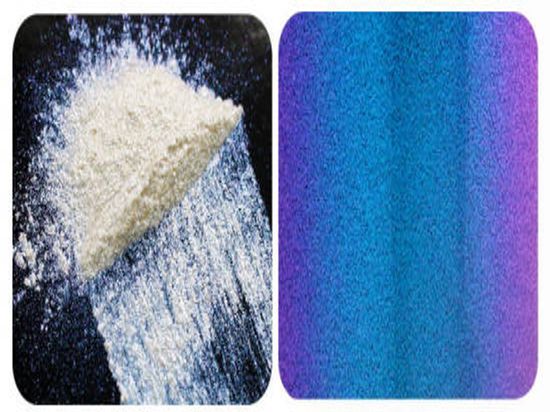
KT-92275 is a large-particle duochrome loose pigment from our KT-9000 Magic Chameleon Series, delivering a full blue-purple-red-orange color travel sequence that shifts continuously across the visible spectrum as the viewing angle changes. With a particle size range of 75–175 μm, this grade is engineered specifically for applications where maximum sparkle is the priority — loose eyeshadow, nail art toppers, and high-impact decorative cosmetics where the angular shift needs to read clearly against the skin or a dark base.
Read More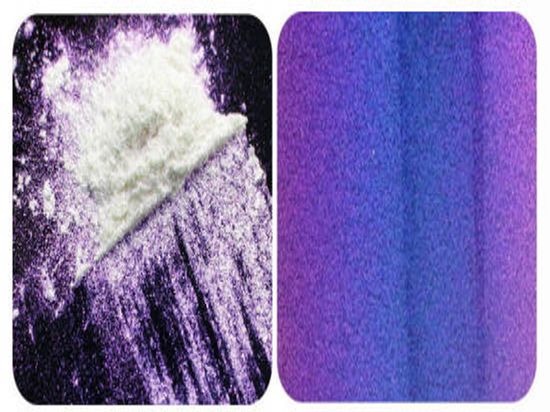
KT-92375 is a large-particle ghost chameleon pigment from Kolortek's KT-9000 Magic Chameleon Series, delivering a continuous five-stage color shift — indigo → purple → red → orange → yellow — as the viewing angle changes. Built on natural mica coated with titanium dioxide, silica, and tin oxide, it carries a particle size of 75–175 μm for maximum sparkle. We developed this grade specifically for high-impact automotive finishes, custom coatings, and luxury decorative applications where a dramatic, angle-dependent color shift is the primary design goal.
Read More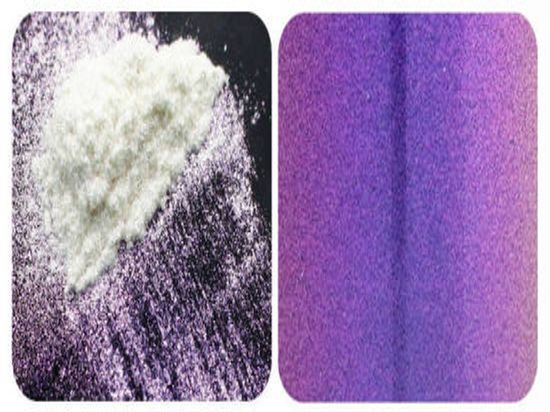
KT-92475 is a large-particle chameleon pigment from the KT-9000 Magic Chameleon Series, producing a continuous mauve → red → orange → yellow color shift that sweeps across the visible spectrum as the viewing angle changes. With a particle size of 75–175 μm and a natural mica substrate coated with titanium dioxide, silica, and tin oxide, it delivers the coarse, high-sparkle texture that nail art formulators need for maximum visual drama — particularly over a dark or black base coat.
Read More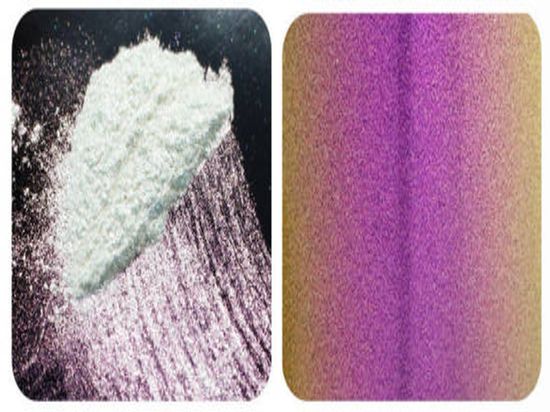
KT-92575 is a large-flake chameleon pearl powder from our KT-9000 Magic Chameleon Series, producing a dramatic angle-dependent color shift spanning red, orange, yellow, and kelly green on dark substrates. Built on a natural mica substrate with a multi-layer coating of titanium dioxide, silica, and tin oxide, it delivers an INCI composition suited to high-end cosmetic and nail art formulations. The 75–175 μm particle range gives it the high-sparkle, deep color-travel behavior that distinguishes it from finer cosmetic pearl grades.
Read More
 English
 Français
 Deutsch
 Русский
 Español
 Português