
Leave A Message
If you are interested in our products and want to know more details,please leave a message here,we will reply you as soon as we can.
KT-92330 Color Shifting Pigment Powder indigo-purple-red-orange yellow
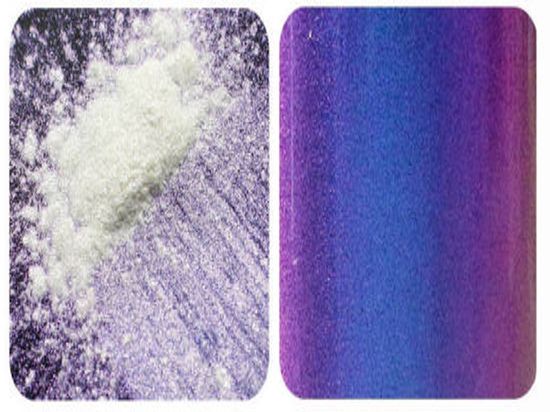
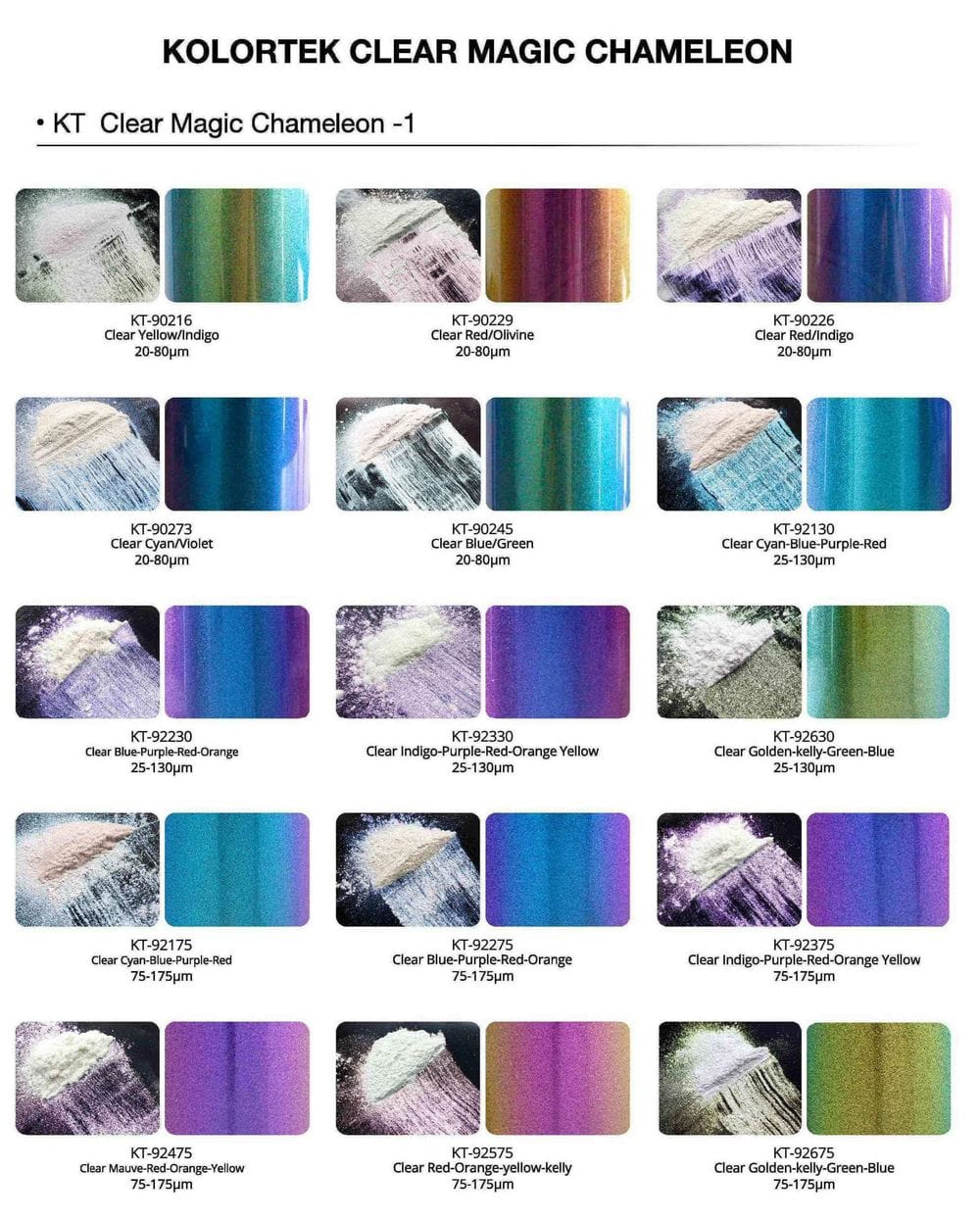
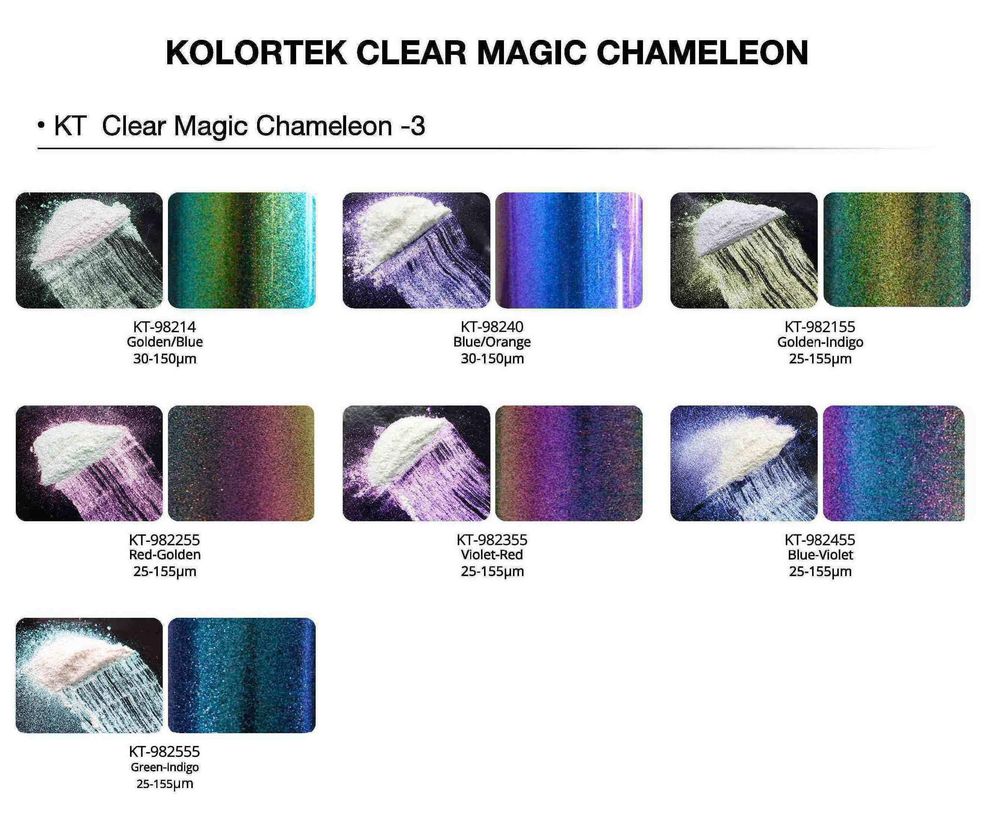
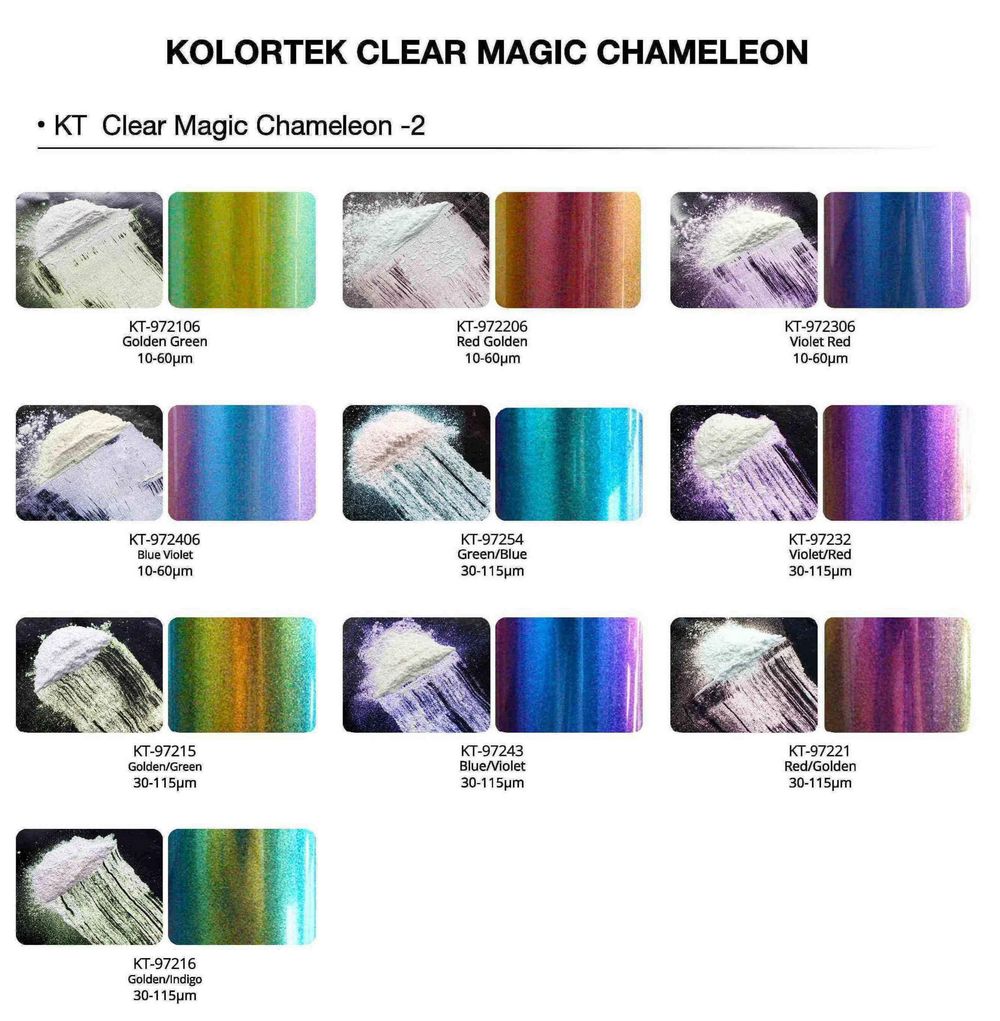
The KT-92330 belongs to the KT-9000 Magic Chameleon Series — Kolortek's dedicated line for angle-dependent color travel. Its optical behavior is driven by thin-film interference across multiple inorganic oxide layers deposited on a natural mica platelet. When light strikes the pigment at different angles, the destructive and constructive interference conditions shift, rotating the perceived color continuously from indigo through purple, red, orange, and into yellow. There is no dye involved; the effect is purely structural and inorganic, which is why it holds up under heat and UV exposure.
The 25–130 μm particle range puts KT-92330 in what we classify as the high visual impact tier. Larger platelets mean more mirror-like reflectance per particle, more dramatic angular flash, and a sparkle component that smaller grades cannot match. In our application lab, we typically recommend this size grade when the goal is a bold, unmistakable color play — automotive wraps, motorcycle helmet shells, and luxury decorative coatings where the viewer is in motion relative to the surface.
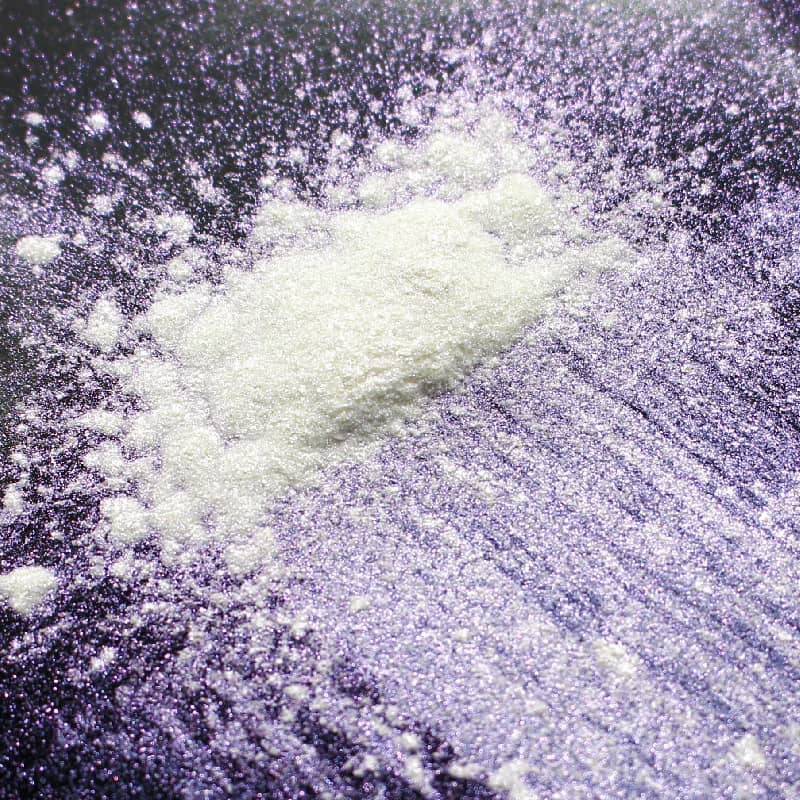
| Property | Value |
|---|---|
| Product code | KT-92330 |
| Series | KT-9000 Magic Chameleon Series |
| Form | Powder |
| Color shift | Indigo → Purple → Red → Orange → Yellow |
| Particle size | 25–130 μm |
| pH (4% H₂O) | 6.0–9.0 |
| Density | 2.6–3.1 kg/L |
| Bulk density | 15–25 g/100g |
| Solubility | Insoluble in water |
| Odour | Odourless |
| Hazard classification | Not classified (EC 1272/2008; Dir. 67/548/EEC & 1999/45/EC) |
| Component | C.I. Number | Content (%) |
|---|---|---|
| Mica (natural) | CI 77019 | 55.0–64.0 |
| Titanium dioxide | CI 77891 | 15.0–20.0 |
| Silica | — | 21.0–25.0 |
| Tin oxide | CI 77861 | 0–1.0 |
All values represent maximum limits per batch testing:
| Element | Limit | Element | Limit |
|---|---|---|---|
| As | < 2 ppm | Pb | < 10 ppm |
| Hg | < 1 ppm | Cr | < 100 ppm |
| Ba | < 50 ppm | Sb | < 1 ppm |
| Ni | < 10 ppm | Cu | < 50 ppm |
| Cd | < 3 ppm | Zn | < 50 ppm |
KT-92330 sits within the broader KT-923** size variant family. All grades share the same indigo-purple-red-orange-yellow color travel and inorganic oxide chemistry. The particle size suffix determines the visual character of the effect — finer grades cover more smoothly; coarser grades produce more pronounced sparkle and angular flash. The table below shows the full range:
| Grade | Particle Size (μm) | Effect Character |
|---|---|---|
| KT-92302 | 5–25 μm | Satin/fine; good coverage; suited to inks, cosmetics |
| KT-92304 | 10–40 μm | Fine pearl |
| KT-92306 | 10–60 μm | Standard; most popular for coatings |
| KT-92307 | 10–70 μm | Medium flash |
| KT-92315 | 20–100 μm | Flash effects |
| KT-92330 | 25–130 μm | High visual impact |
| KT-92375 | 75–175 μm | Large particle; maximum sparkle |
| KT-923100 | 100–250 μm | Extra large; decorative |
When a customer specifies KT-92330 specifically for nail art or cosmetic applications, we typically suggest also evaluating KT-92302 or KT-92306. The 25–130 μm range can create texture in thinner film builds. That said, for chunky glitter-style nail effects or direct decorative use, the 30-grade is a deliberate choice.
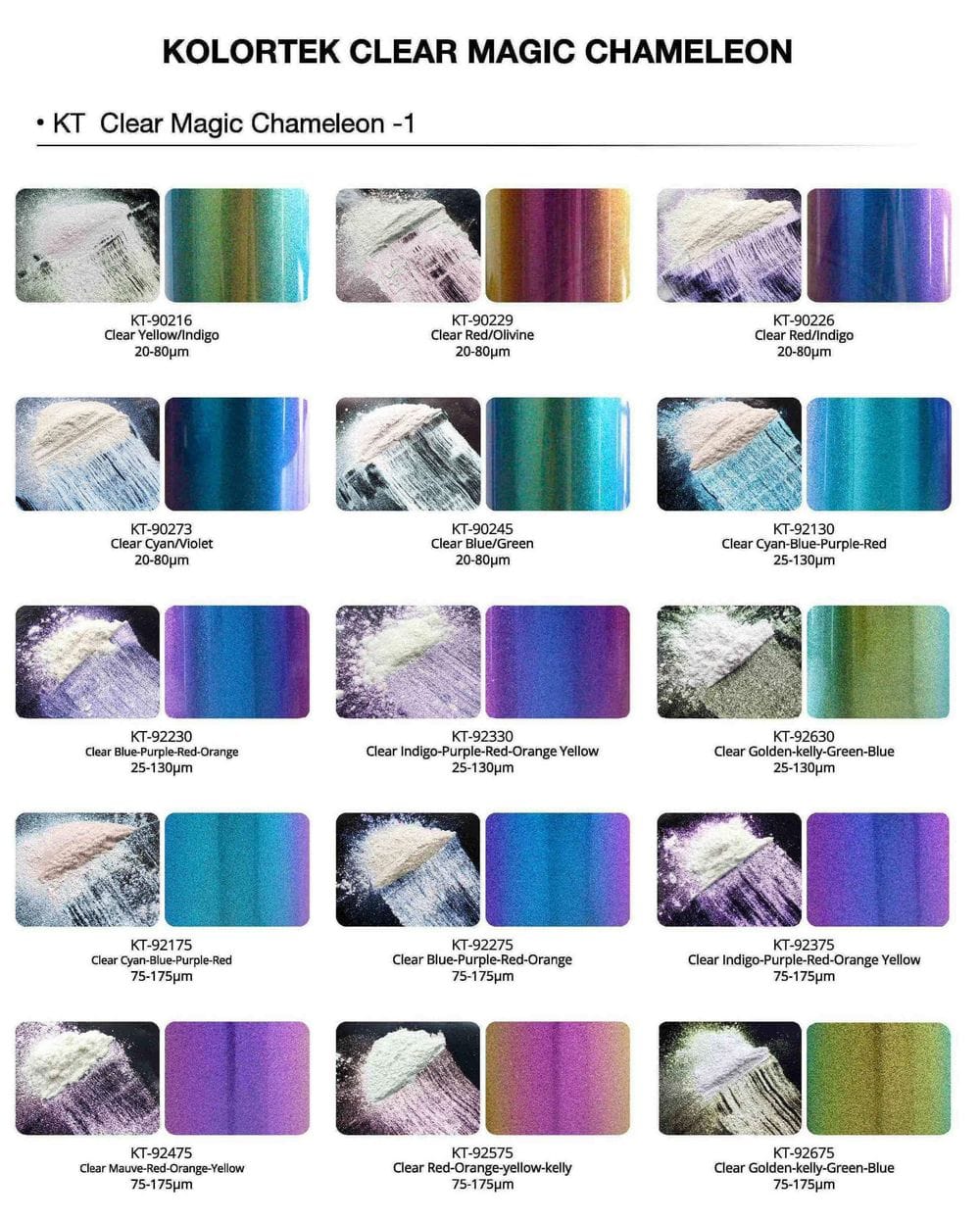
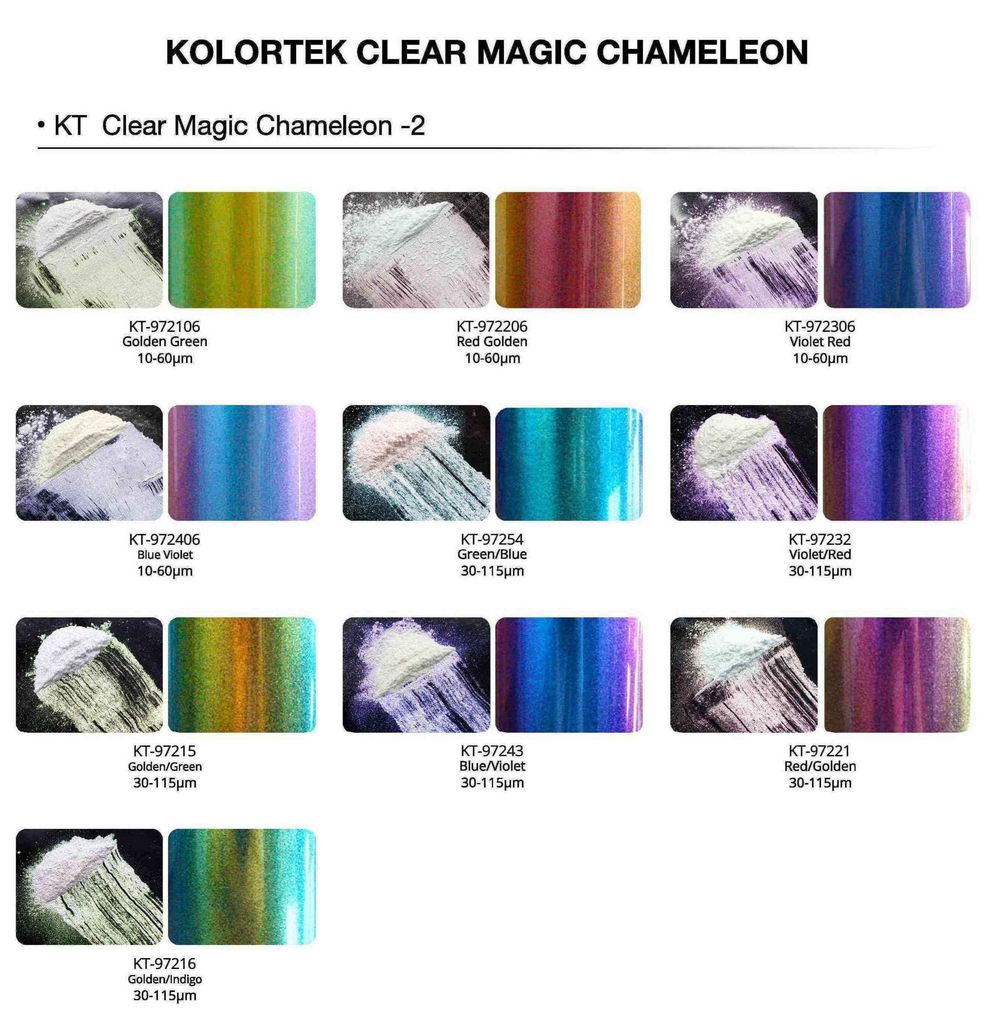
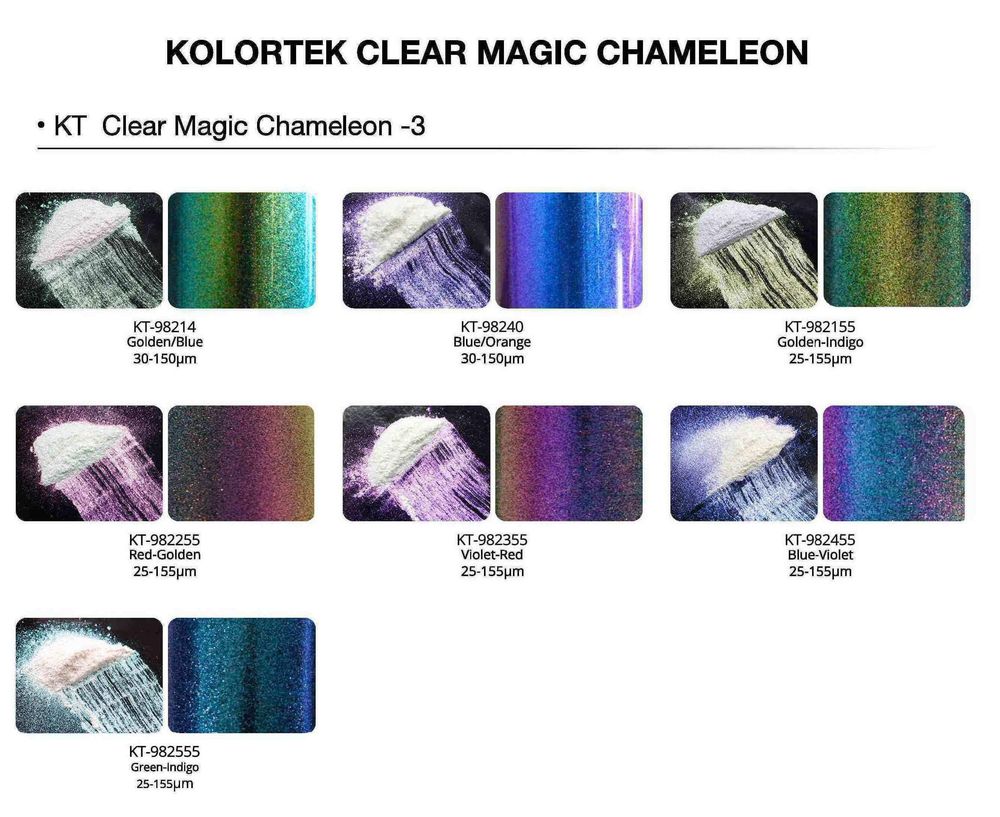
Substrate color is the single biggest variable in how KT-92330 reads in a finished application. The goniochromatic effect is most legible on black or very dark substrates — the dark background absorbs transmitted light and allows the interference colors to dominate. On white or pale substrates, the shift is present but considerably muted. For automotive basecoat-clearcoat systems, we always specify a black or dark grey undercoat when a customer wants the full indigo-to-yellow angular travel to be visible.
KT-92330 is compatible with most resin systems. One thing to note: because the interference effect depends on the orientation of mica platelets parallel to the substrate surface, excessive shear during mixing or dispersion can fracture particles and reduce the mirror-like reflectance. Use gentle, low-shear incorporation — stirring rather than high-speed dispersing, particularly with the 25–130 μm grade where particle integrity matters most.
The color travel range can be modified by combining KT-92330 with transparent absorption pigments. Adding a transparent blue or violet tint, for instance, can deepen the indigo anchor and shift the perceived color travel. We support customers in trialling these combinations, though specific loading rates and compatibility data for individual resin systems should be confirmed through lab trials — we don't publish a universal dosage figure because the optimum varies significantly with film thickness, resin optical properties, and substrate.
For automotive and protective coating applications, always apply a clear topcoat over KT-92330. The clear coat protects the platelet orientation layer, increases the perception of color depth, and provides the weathering resistance the exposed pigment layer alone cannot guarantee.
Kolortek operates under an ISO 9001:2015 quality management system covering production and sales of pigments and fillers. KT-92330 is classified as non-hazardous under both EC Regulation 1272/2008 (CLP) and the earlier Directive 67/548/EEC / 1999/45/EC. An MSDS/SDS is supplied with all shipments, referencing REACH Regulation (EC) No. 1907/2006.
For applications targeting cosmetic formulations under EU Cosmetics Regulation (EC) No 1223/2009 or US color-additive frameworks, cosmetic-grade options with supporting composition documentation are available — but final grade suitability depends on the specific intended use and should be confirmed before specification. We don't make a blanket cosmetic compliance claim for KT-92330 without knowing the target application details.
During handling, standard precautions apply: avoid breathing dust, use a dust mask where dust is generated, and provide adequate ventilation. Eye protection and gloves are recommended as a routine measure when handling any fine mineral powder at this particle size range.
What is the full color shift sequence of KT-92330, and what viewing conditions are needed to see it?
KT-92330 shifts continuously from indigo through purple, red, orange, and yellow as the viewing angle changes relative to the surface. The sequence is an interference-based goniochromatic effect and is most visible on black or very dark substrates. On white backgrounds the shift is present but noticeably reduced. Film thickness and the presence of a clear overcoat also influence perceived color saturation and travel range.
What particle size is KT-92330, and how does it compare to other grades in the KT-923** series?
KT-92330 has a particle size of 25–130 μm, placing it in the high visual impact tier of the KT-923** series. Finer grades like KT-92302 (5–25 μm) and KT-92306 (10–60 μm) produce smoother coverage suitable for inks and standard coatings. The 30-grade delivers more pronounced angular flash and sparkle, making it the preferred choice for automotive custom finishes, decorative coatings, and applications where a bold colour shift pigment powder effect is the primary design objective.
Is KT-92330 suitable for use in cosmetic formulations?
The KT-9000 series includes grades used in high-end cosmetics and nail art. KT-92330 is composed of natural mica, TiO₂, silica, and tin oxide — all components with established use in cosmetic contexts. That said, confirming suitability under EU Cosmetics Regulation (EC) No 1223/2009 or US FDA color-additive requirements depends on the specific grade, intended use, and formulation details. We provide supporting composition documentation and can advise on grade selection for cosmetic applications — contact our technical team with the application specifics.
What resin systems are compatible with chameleon pigment powders like KT-92330?
KT-92330 is compatible with most resin systems, including those used in automotive coatings, industrial coatings, decorative plastics, and printing inks. Specific solvent-based versus water-based compatibility data is not published for this grade — compatibility in a specific system should be confirmed by lab trial. The key handling consideration is to use low-shear dispersion to preserve the 25–130 μm platelets; high-speed dispersing equipment can fracture particles and reduce the mirror reflectance that drives the colour shift effect.
Contact our technical team to discuss formulation requirements or grade selection for your specific application.
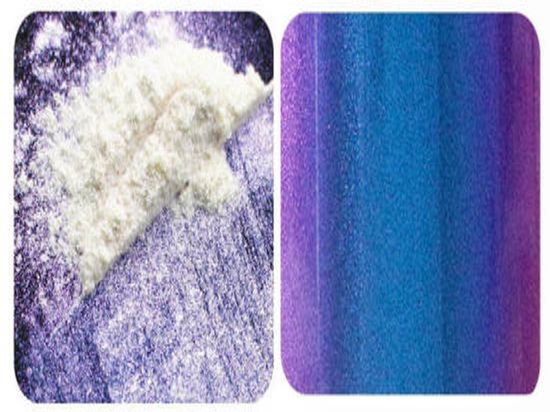
KT-92230 is a multichrome pigment that shifts through a full blue-purple-red-orange sequence as the viewing angle changes — one of the broadest color-travel arcs we produce in the KT-9000 series. Built on a natural mica substrate with a multi-layer TiO₂/Fe₂O₃/silica/tin oxide coating, it comes in a 25–130 μm particle size that delivers strong angular contrast and high visual impact across automotive finishes, decorative coatings, and specialty printing.
Read More
KT-92330 is a multi-layer interference pigment from Kolortek's KT-9000 Magic Chameleon Series, producing a continuous color shift sequence — indigo through purple, red, orange, and yellow — as the viewing angle changes. Built on natural mica coated with TiO₂, silica, and tin oxide, it delivers a high-mirror goniochromatic effect with a 25–130 μm particle size distribution engineered for maximum visual impact. This color shifting pigment powder performs best over dark or black substrates, where the full angular color travel is most legible.
Read More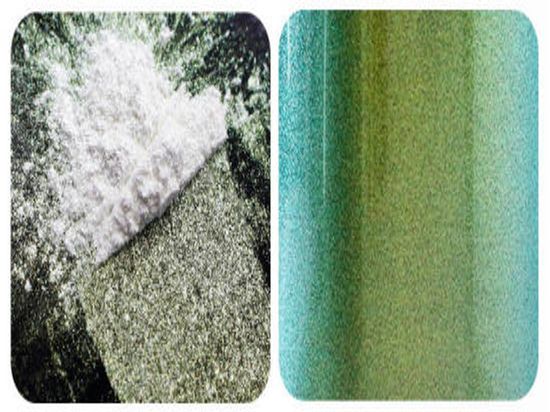
KT-92630 is a large-particle chameleon paint pearl from our KT-9000 Magic Chameleon Series, producing a sequential golden-to-kelly-green-to-blue color travel as the viewing angle shifts. With a 25–130 μm particle range, it delivers high visual impact in automotive custom finishes, decorative coatings, and specialty applications where a pronounced, multi-stop color flip is the goal. The substrate is natural mica with a multi-layer TiO₂/SiO₂/metal-oxide coating that generates the goniochromatic interference effect.
Read More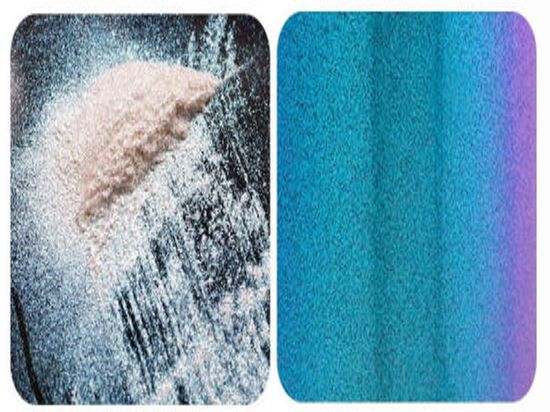
KT-92175 is the large-particle grade of our chameleon pigment for resin, built on a natural mica substrate with a multi-layer TiO₂, silica, and tin oxide coating that produces a continuous cyan-to-blue-to-purple-to-red angle-dependent color shift. At 75–175μm, it is the highest-sparkle option in the KT-9000 Magic Chameleon Series' KT-921** Cyan-Blue-Purple-Red range. Compatible with epoxy and UV resin at loadings of 1–10% by weight, the effect reads strongest on dark or black substrates where the goniochromatic shift has maximum contrast.
Read More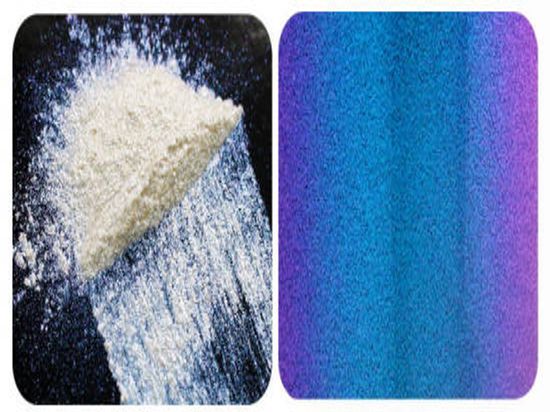
KT-92275 is a large-particle duochrome loose pigment from our KT-9000 Magic Chameleon Series, delivering a full blue-purple-red-orange color travel sequence that shifts continuously across the visible spectrum as the viewing angle changes. With a particle size range of 75–175 μm, this grade is engineered specifically for applications where maximum sparkle is the priority — loose eyeshadow, nail art toppers, and high-impact decorative cosmetics where the angular shift needs to read clearly against the skin or a dark base.
Read More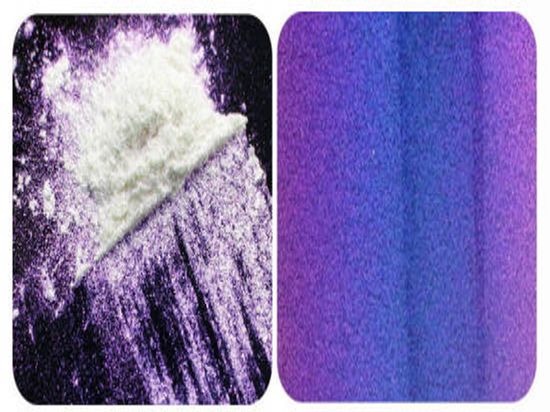
KT-92375 is a large-particle ghost chameleon pigment from Kolortek's KT-9000 Magic Chameleon Series, delivering a continuous five-stage color shift — indigo → purple → red → orange → yellow — as the viewing angle changes. Built on natural mica coated with titanium dioxide, silica, and tin oxide, it carries a particle size of 75–175 μm for maximum sparkle. We developed this grade specifically for high-impact automotive finishes, custom coatings, and luxury decorative applications where a dramatic, angle-dependent color shift is the primary design goal.
Read More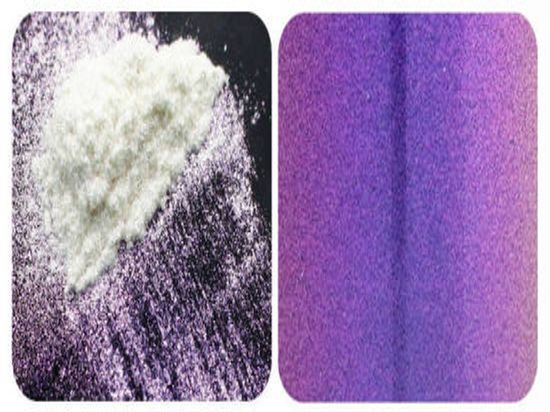
KT-92475 is a large-particle chameleon pigment from the KT-9000 Magic Chameleon Series, producing a continuous mauve → red → orange → yellow color shift that sweeps across the visible spectrum as the viewing angle changes. With a particle size of 75–175 μm and a natural mica substrate coated with titanium dioxide, silica, and tin oxide, it delivers the coarse, high-sparkle texture that nail art formulators need for maximum visual drama — particularly over a dark or black base coat.
Read More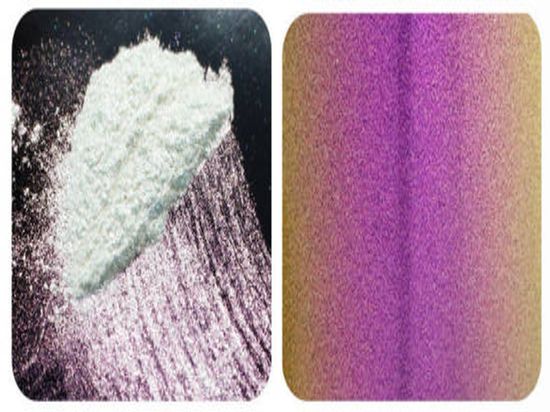
KT-92575 is a large-flake chameleon pearl powder from our KT-9000 Magic Chameleon Series, producing a dramatic angle-dependent color shift spanning red, orange, yellow, and kelly green on dark substrates. Built on a natural mica substrate with a multi-layer coating of titanium dioxide, silica, and tin oxide, it delivers an INCI composition suited to high-end cosmetic and nail art formulations. The 75–175 μm particle range gives it the high-sparkle, deep color-travel behavior that distinguishes it from finer cosmetic pearl grades.
Read More
 English
 Français
 Deutsch
 Русский
 Español
 Português