
Leave A Message
If you are interested in our products and want to know more details,please leave a message here,we will reply you as soon as we can.
KT-92175 cyan-blue-purple-red Chameleon Pigment for resin

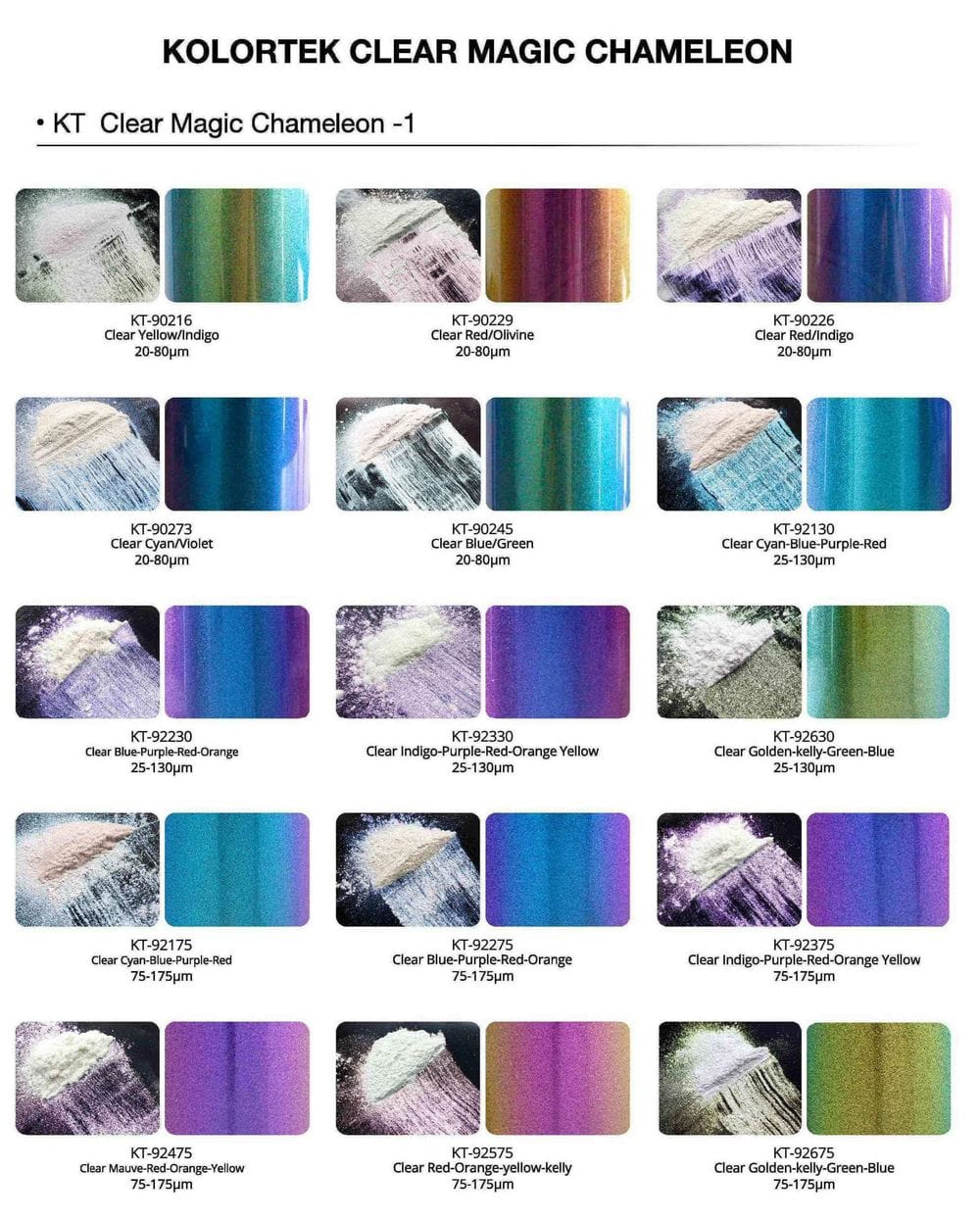
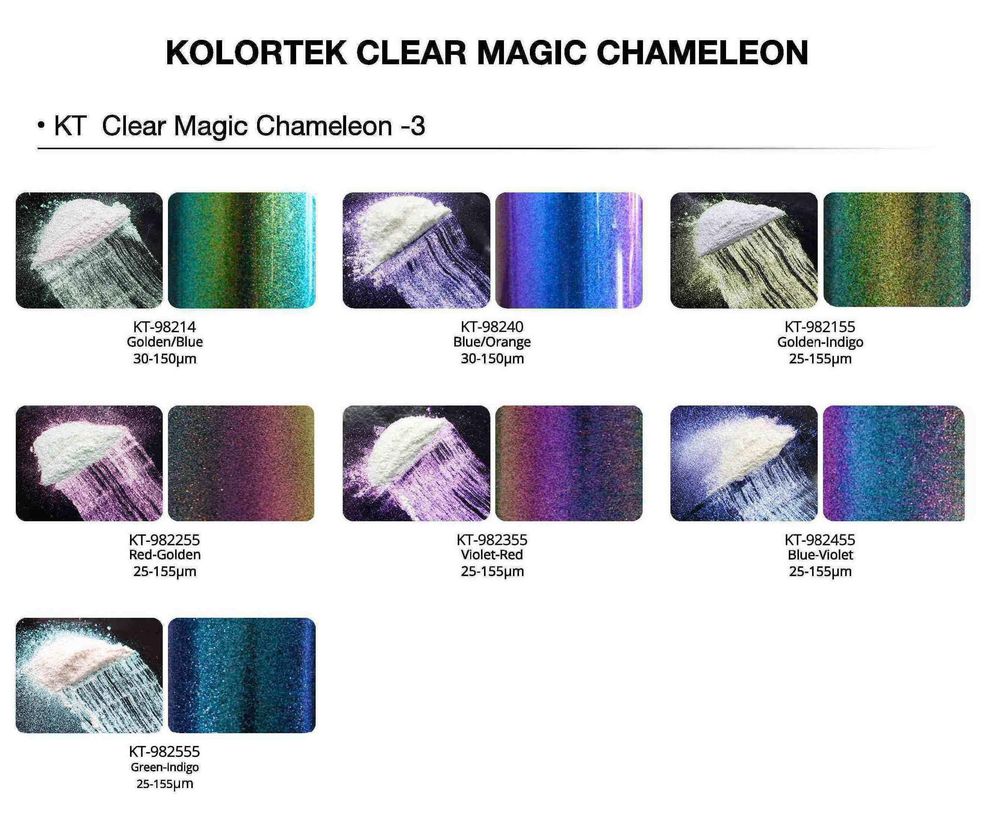
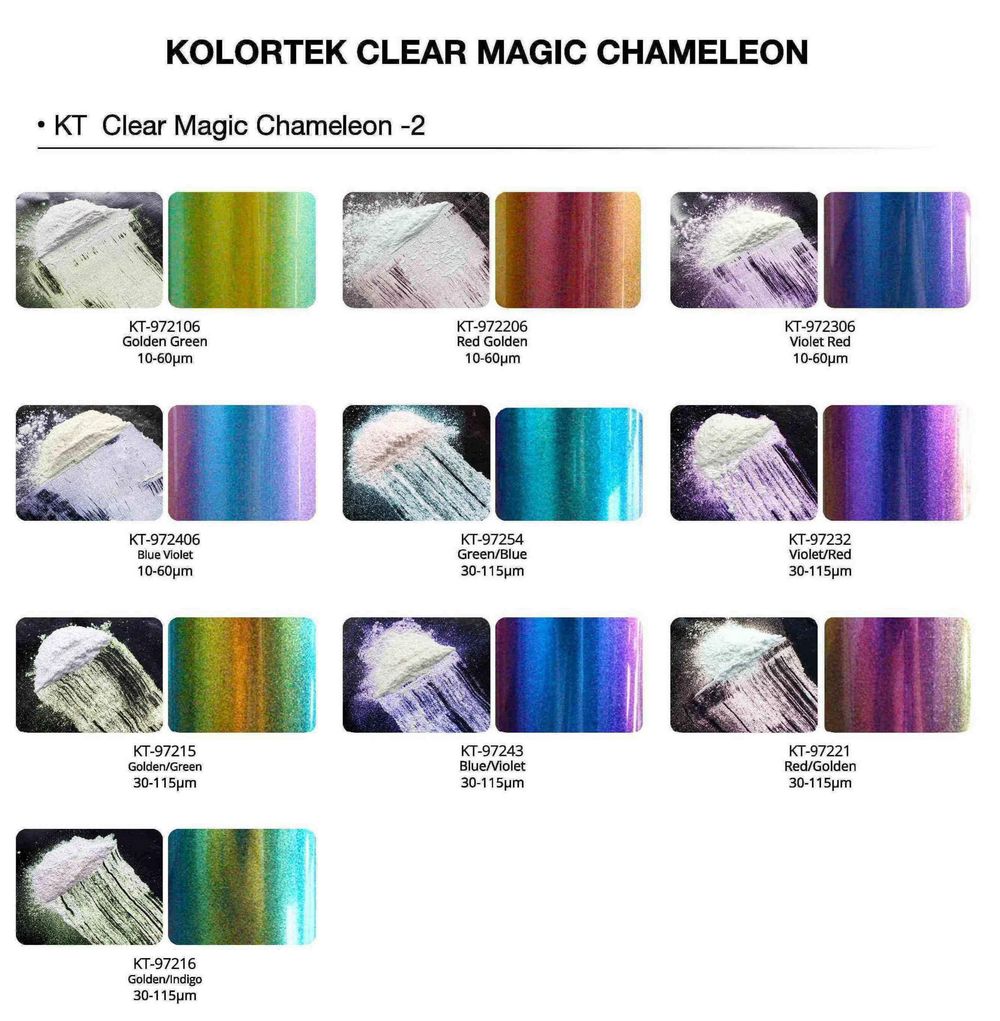
The shift sequence in KT-92175 — cyan at near-normal incidence, moving through blue, purple, and arriving at red as the viewing angle increases — is driven by thin-film interference across the multi-layer metal oxide coating deposited on the mica platelet. Each coating layer is calibrated to a specific optical thickness; at each viewing angle, a different set of wavelengths satisfies the constructive interference condition, producing the staged color rotation.
At 75–175μm, the individual platelets are large enough to behave as discrete mirrors inside a cured resin matrix. Rather than blending into a uniform tint across the casting, each platelet face reflects its own color point at its own angle — which is why this grade reads as sparkle-dominant. Formulators who need a smoother, more satin-like distribution in the same color sequence can step down to the 10–60μm grade (suffix 06) or the 5–25μm grade (suffix 02) within the KT-921** family.
Substrate color is the most consequential application variable. On a white or light background, transmitted light competes with the interference reflection, flattening the perceived shift. On a black or deeply pigmented dark substrate, there is no competing transmitted light, and the full cyan-blue-purple-red sequence becomes legible. In practice, pairing KT-92175 with a black pigmented base layer — whether in a layered resin pour or a dark primer coat — is the fastest route to the most dramatic result.
It is also worth noting that KT-92175 can be combined with transparent absorption pigments to shift the base color tone or compress/expand the visible color range. This is a useful lever when a formulator wants to bias the neutral-angle color toward a specific starting hue without switching to a different interference grade.
KT-92175 is one of nine particle size grades available in the KT-921** Cyan-Blue-Purple-Red product family. The trailing two-digit suffix on every model code indicates the particle size range, allowing direct grade selection based on application method, film thickness, and desired visual effect.
| Model Suffix | Particle Size | Effect Character |
|---|---|---|
| 02 | 5–25μm | Satin / fine; strong coverage; suited to inks and cosmetics |
| 04 | 10–40μm | Fine pearl |
| 06 | 10–60μm | Standard; most widely used grade for coating applications |
| 07 | 10–70μm | Medium |
| 15 | 20–100μm | Flash effects |
| 25 | 25–130μm | High visual impact |
| 30 | 25–130μm | High visual impact |
| 75 — KT-92175 | 75–175μm | Large particle, maximum sparkle |
| 100 | 100–250μm | Extra large, decorative |
| Property | Value |
|---|---|
| Product Code | KT-92175 |
| Series | KT-9000 Magic Chameleon Series |
| Color Shift Sequence | Cyan → Blue → Purple → Red (angle-dependent) |
| Form | Powder |
| Particle Size | 75–175μm |
| pH (4% H₂O) | 6.0–9.0 |
| Density | 2.6–3.1 kg/L |
| Bulk Density | 15–25 g/100g |
| Solubility in Water | Insoluble |
| Odour | Odourless |
| Substrate | Natural mica (C.I. 77019) |
| INCI Name | Mica, Titanium Dioxide, Silica, Tin Oxide |
| CAS Numbers | 12001-26-2 / 13463-67-7 / 7631-86-9 / 18282-10-5 |
| CLP Classification | Not classified under Regulation (EC) No. 1272/2008 |

| Component | C.I. Number | Content (wt%) |
|---|---|---|
| Mica | C.I. 77019 | 58.0–69.0% |
| Titanium Dioxide | C.I. 77891 | 13.0–18.0% |
| Silica | — | 18.0–23.0% |
| Tin Oxide | C.I. 77861 | 0–1.0% |
| Element | Limit | Element | Limit |
|---|---|---|---|
| As | < 2 ppm | Pb | < 10 ppm |
| Hg | < 1 ppm | Cr | < 100 ppm |
| Ba | < 50 ppm | Sb | < 1 ppm |
| Ni | < 10 ppm | Cu | < 50 ppm |
| Cd | < 3 ppm | Zn | < 50 ppm |
The KT-9000 Magic Chameleon Series — and KT-92175 specifically — is among the most requested product lines we supply. Resin art, custom phone cases, and nail art were early drivers of demand for this series, and they remain the most common craft and decorative applications. In those contexts the large platelet size of KT-92175 works in its favor: resin matrices tend to be thick and optically clear, which lets the individual platelet faces contribute sparkle points without the film thickness constraints that limit performance in thinner coating films.
Industrial and specialty applications for the same pigment include automotive custom finishes and wraps, motorcycle helmet and sporting goods coatings, luxury packaging, high-security and decorative printing, plastics, synthetic leather, powder coatings, leather coatings, and architectural applications. The angle-dependent color shift also has documented use in security and anti-counterfeiting printing, where the goniochromatic response functions as a visual authentication feature.
One application-specific note for automotive and protective coating contexts: applying a clear topcoat over the pigmented layer is strongly recommended. Beyond protecting the platelet surface from abrasion and weathering, the clear coat adds an optical depth layer that enhances perceived color saturation and shift contrast. This is standard practice in our coating application guidance and is particularly relevant when KT-92175 is used at higher film thicknesses.
For resin applications, a loading of 1–10% by weight is the working range. Lower loadings (1–3%) produce a more translucent result with individual sparkle points visible through the depth of the casting. Higher loadings (5–10%) increase the perceived color shift intensity but also increase the visual density of the matrix; at very high loadings, individual flakes near the surface may break the substrate's smoothness, which is a trade-off to consider for applications requiring a glossy, mirror-like top surface.
Pre-mixing KT-92175 with a small volume of resin before introducing it to the full batch ensures even distribution without agglomerates. Mix slowly — vigorous stirring traps air, and bubbles that form near large mica platelets are visually conspicuous in a cured, transparent resin casting. A slow, deliberate fold-and-scrape motion is preferable to rapid mechanical agitation in most resin art contexts.
When a black base layer is part of the design, let the base layer cure to a tack-free or fully cured state before pouring the KT-92175 layer on top. This prevents the dark pigment from migrating upward into the chameleon layer, which would dull the shift contrast.
Color modification is possible by combining KT-92175 with transparent absorption pigments. Adding a transparent blue or green pigment, for instance, shifts the neutral-angle perceived color and can bias the shift range without altering the underlying interference mechanism.
Kolortek operates under ISO 9001:2015 quality management certification, covering production and sales of pigments, glitters, and fillers. KT-92175 is not classified as hazardous under Regulation (EC) No. 1272/2008 (CLP) or the predecessor Directives 67/548/EEC and 1999/45/EC.
The heavy metal limits listed above are specified at the product level in the technical data sheet. For applications where cosmetic-grade compliance documentation is required — EU Cosmetics Regulation (EC) No. 1223/2009, US FDA color-additive frameworks, or specific regional requirements — contact us to confirm grade suitability and available documentation for your intended use. Not all grades across the KT-921** series carry identical regulatory status, and the appropriate compliance documents should be confirmed against the specific grade and application before specification.
What is the particle size of KT-92175, and how does it compare to other grades in the KT-921** series?
KT-92175 uses the 75-suffix particle range: 75–175μm. Within the nine-grade KT-921** Cyan-Blue-Purple-Red family, this is the second-largest available option, designated "large particle, maximum sparkle." It sits above the 25–130μm grades (suffixes 25 and 30) and below the 100–250μm extra-large decorative grade (suffix 100). For smoother films or finer print applications in the same cyan-blue-purple-red color shift, the 10–60μm grade (suffix 06) or 5–25μm grade (suffix 02) are the recommended alternatives.
How much chameleon resin pigment should I use per batch, and how do I mix it?
The recommended loading for KT-92175 in resin is 1–10% by weight, depending on desired intensity. Pre-mix the pigment with a small amount of resin before combining with the full batch to ensure even distribution. Mix slowly to avoid introducing air bubbles — at 75–175μm, individual platelets are large enough that bubbles forming near their surfaces become clearly visible in the cured casting.
Why does the cyan-blue-purple-red shift look weak or absent in my resin piece?
The most common cause is an insufficiently dark substrate or base layer. KT-92175's goniochromatic effect depends on the absence of competing transmitted light — on a white or translucent background, the interference reflection is washed out and the shift becomes difficult to read. The fix is to pour a black-pigmented base layer first, allow it to cure, then apply the KT-92175-loaded resin on top. A clear topcoat over the finished layer also deepens perceived color intensity.
Can I use KT-92175 as a chameleon mica powder for resin nail art or skin-contact applications?
KT-92175 is used in nail art applications and is part of a series with established demand in cosmetic and decorative beauty contexts. That said, skin-contact and nail use may require cosmetic-grade compliance documentation — including confirmation of suitability under EU Cosmetics Regulation (EC) No. 1223/2009 or applicable US FDA color-additive requirements. Contact us to confirm the correct grade and supporting regulatory documentation for your specific intended use before specification.
Contact our technical team to discuss formulation requirements or grade selection for your specific application.
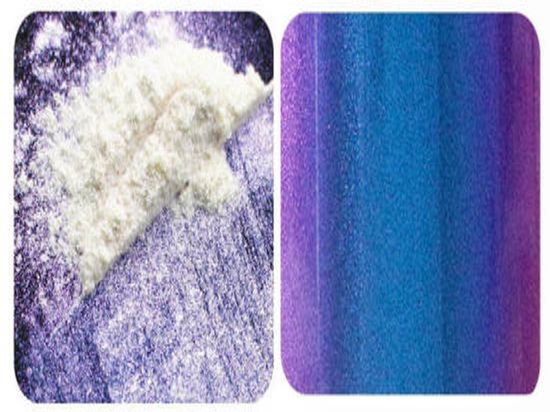
KT-92230 is a multichrome pigment that shifts through a full blue-purple-red-orange sequence as the viewing angle changes — one of the broadest color-travel arcs we produce in the KT-9000 series. Built on a natural mica substrate with a multi-layer TiO₂/Fe₂O₃/silica/tin oxide coating, it comes in a 25–130 μm particle size that delivers strong angular contrast and high visual impact across automotive finishes, decorative coatings, and specialty printing.
Read More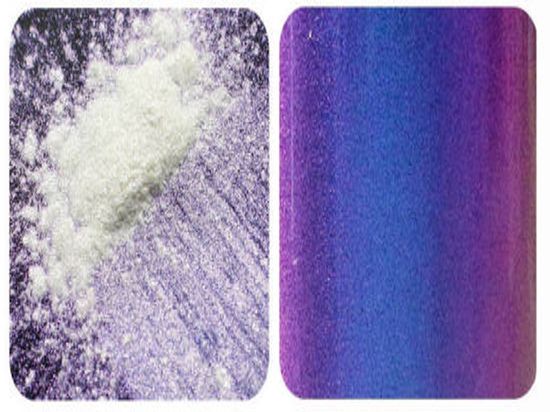
KT-92330 is a multi-layer interference pigment from Kolortek's KT-9000 Magic Chameleon Series, producing a continuous color shift sequence — indigo through purple, red, orange, and yellow — as the viewing angle changes. Built on natural mica coated with TiO₂, silica, and tin oxide, it delivers a high-mirror goniochromatic effect with a 25–130 μm particle size distribution engineered for maximum visual impact. This color shifting pigment powder performs best over dark or black substrates, where the full angular color travel is most legible.
Read More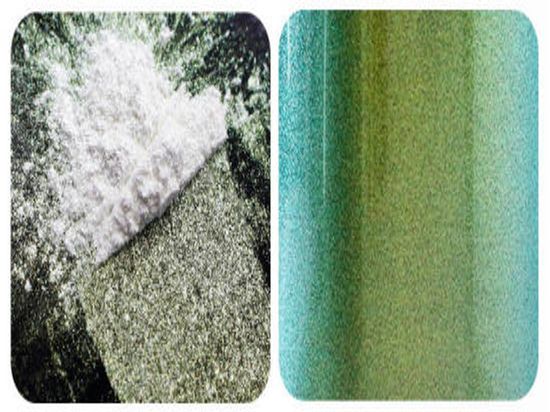
KT-92630 is a large-particle chameleon paint pearl from our KT-9000 Magic Chameleon Series, producing a sequential golden-to-kelly-green-to-blue color travel as the viewing angle shifts. With a 25–130 μm particle range, it delivers high visual impact in automotive custom finishes, decorative coatings, and specialty applications where a pronounced, multi-stop color flip is the goal. The substrate is natural mica with a multi-layer TiO₂/SiO₂/metal-oxide coating that generates the goniochromatic interference effect.
Read More
KT-92175 is the large-particle grade of our chameleon pigment for resin, built on a natural mica substrate with a multi-layer TiO₂, silica, and tin oxide coating that produces a continuous cyan-to-blue-to-purple-to-red angle-dependent color shift. At 75–175μm, it is the highest-sparkle option in the KT-9000 Magic Chameleon Series' KT-921** Cyan-Blue-Purple-Red range. Compatible with epoxy and UV resin at loadings of 1–10% by weight, the effect reads strongest on dark or black substrates where the goniochromatic shift has maximum contrast.
Read More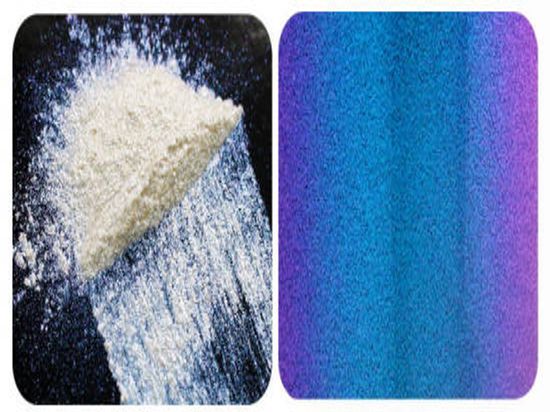
KT-92275 is a large-particle duochrome loose pigment from our KT-9000 Magic Chameleon Series, delivering a full blue-purple-red-orange color travel sequence that shifts continuously across the visible spectrum as the viewing angle changes. With a particle size range of 75–175 μm, this grade is engineered specifically for applications where maximum sparkle is the priority — loose eyeshadow, nail art toppers, and high-impact decorative cosmetics where the angular shift needs to read clearly against the skin or a dark base.
Read More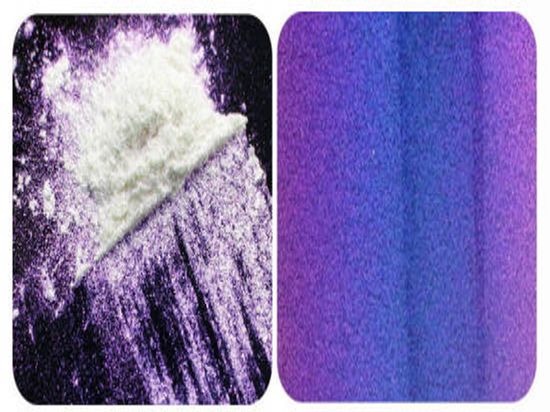
KT-92375 is a large-particle ghost chameleon pigment from Kolortek's KT-9000 Magic Chameleon Series, delivering a continuous five-stage color shift — indigo → purple → red → orange → yellow — as the viewing angle changes. Built on natural mica coated with titanium dioxide, silica, and tin oxide, it carries a particle size of 75–175 μm for maximum sparkle. We developed this grade specifically for high-impact automotive finishes, custom coatings, and luxury decorative applications where a dramatic, angle-dependent color shift is the primary design goal.
Read More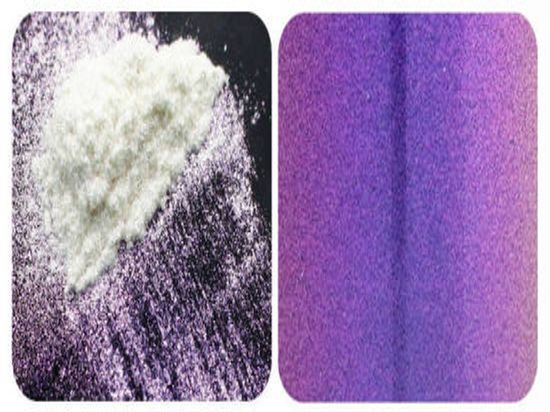
KT-92475 is a large-particle chameleon pigment from the KT-9000 Magic Chameleon Series, producing a continuous mauve → red → orange → yellow color shift that sweeps across the visible spectrum as the viewing angle changes. With a particle size of 75–175 μm and a natural mica substrate coated with titanium dioxide, silica, and tin oxide, it delivers the coarse, high-sparkle texture that nail art formulators need for maximum visual drama — particularly over a dark or black base coat.
Read More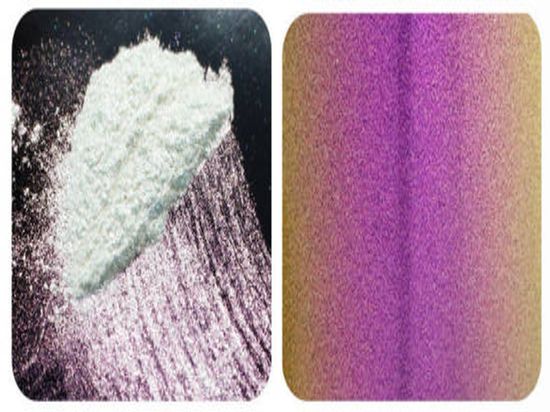
KT-92575 is a large-flake chameleon pearl powder from our KT-9000 Magic Chameleon Series, producing a dramatic angle-dependent color shift spanning red, orange, yellow, and kelly green on dark substrates. Built on a natural mica substrate with a multi-layer coating of titanium dioxide, silica, and tin oxide, it delivers an INCI composition suited to high-end cosmetic and nail art formulations. The 75–175 μm particle range gives it the high-sparkle, deep color-travel behavior that distinguishes it from finer cosmetic pearl grades.
Read More
 English
 Français
 Deutsch
 Русский
 Español
 Português