
Leave A Message
If you are interested in our products and want to know more details,please leave a message here,we will reply you as soon as we can.
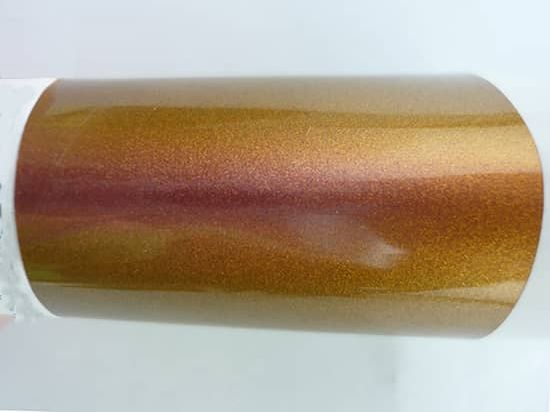
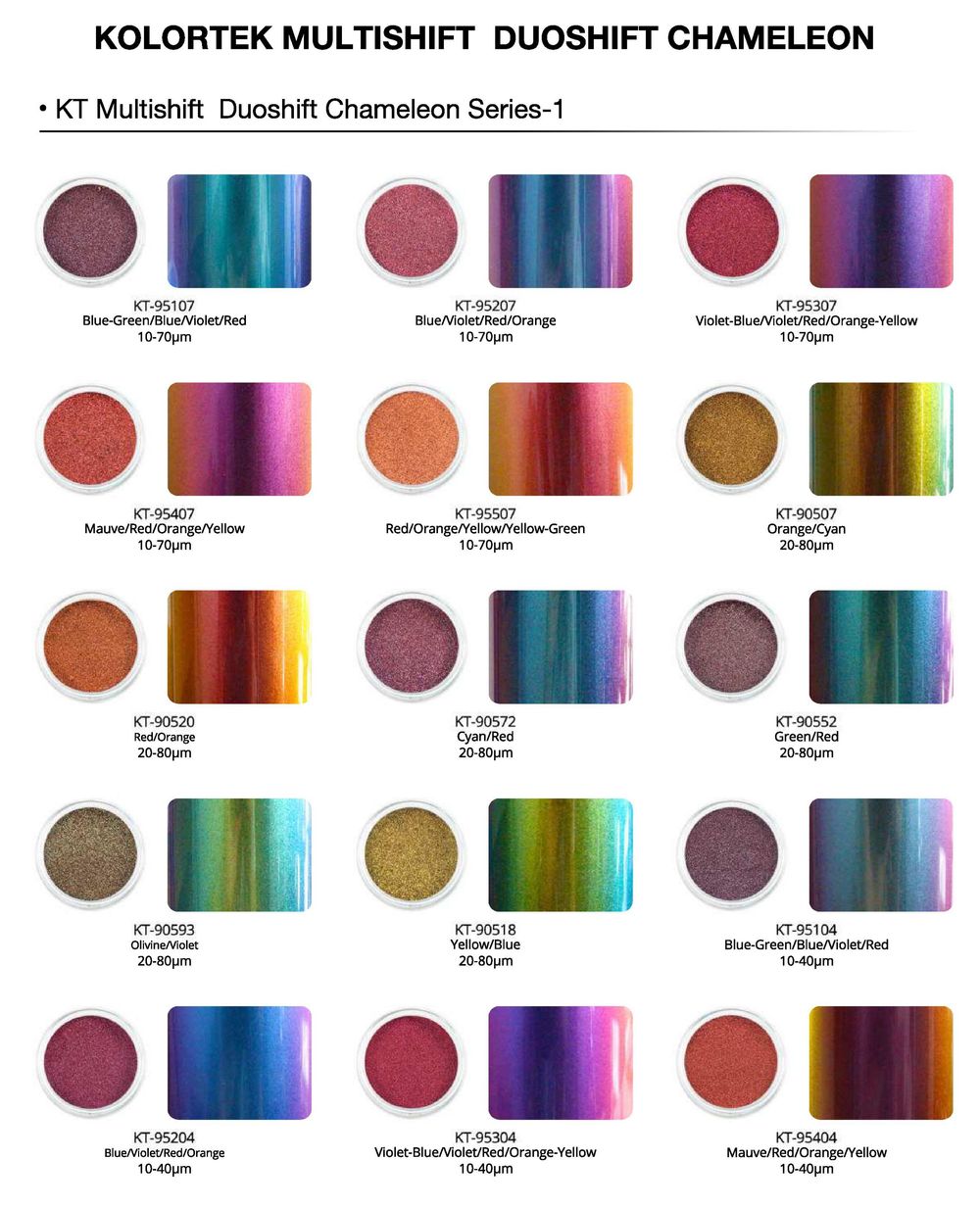
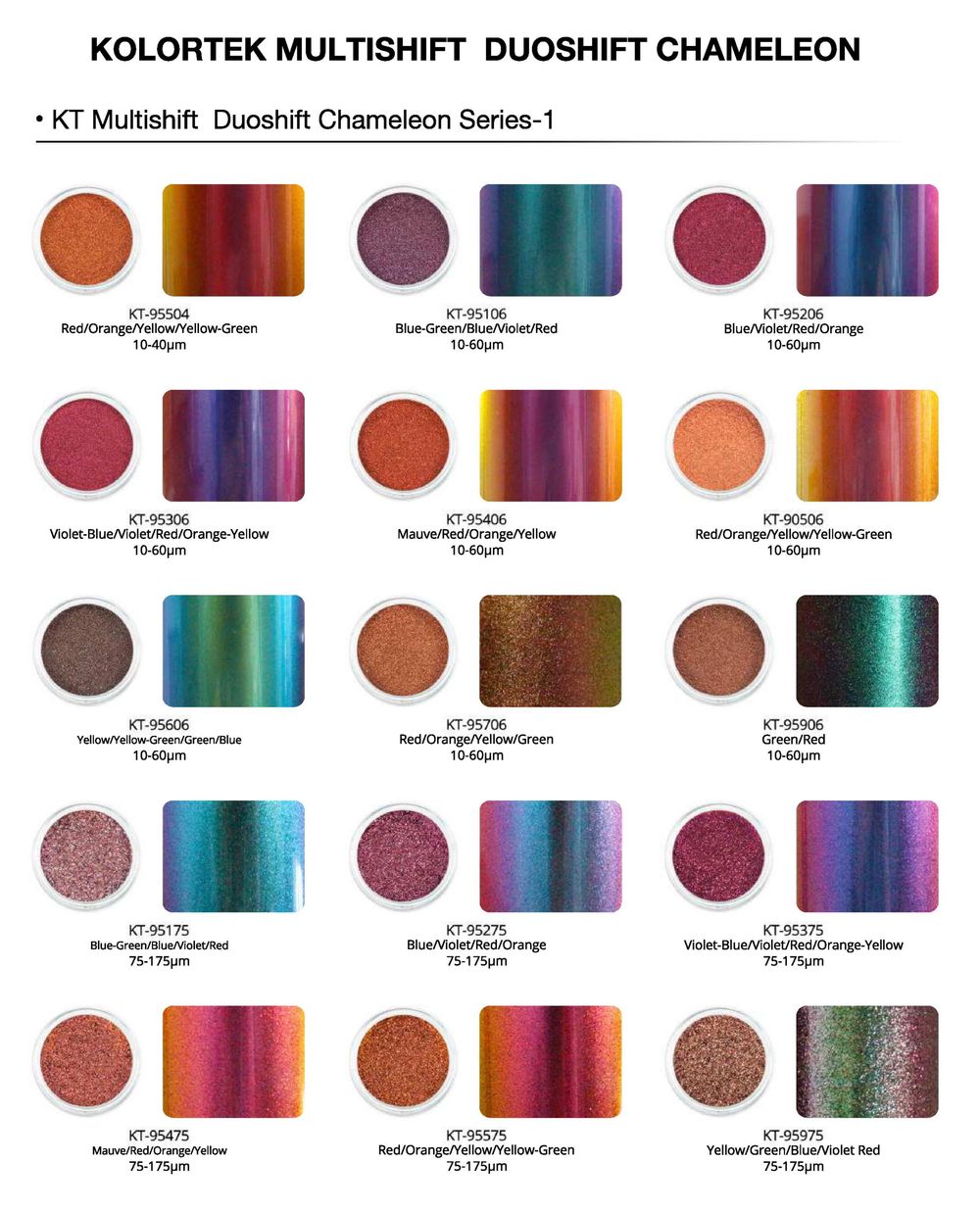
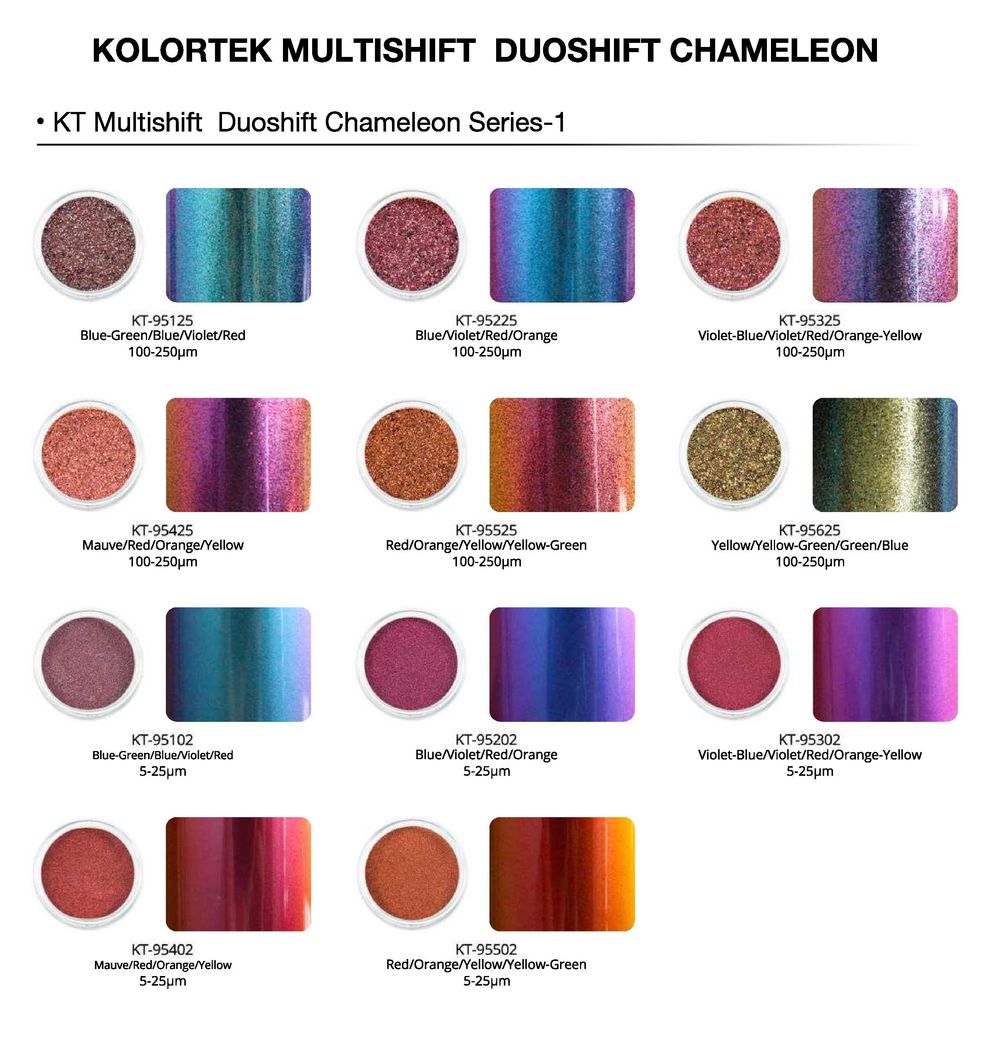
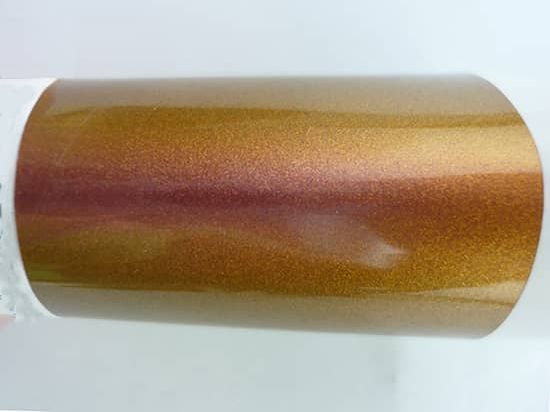
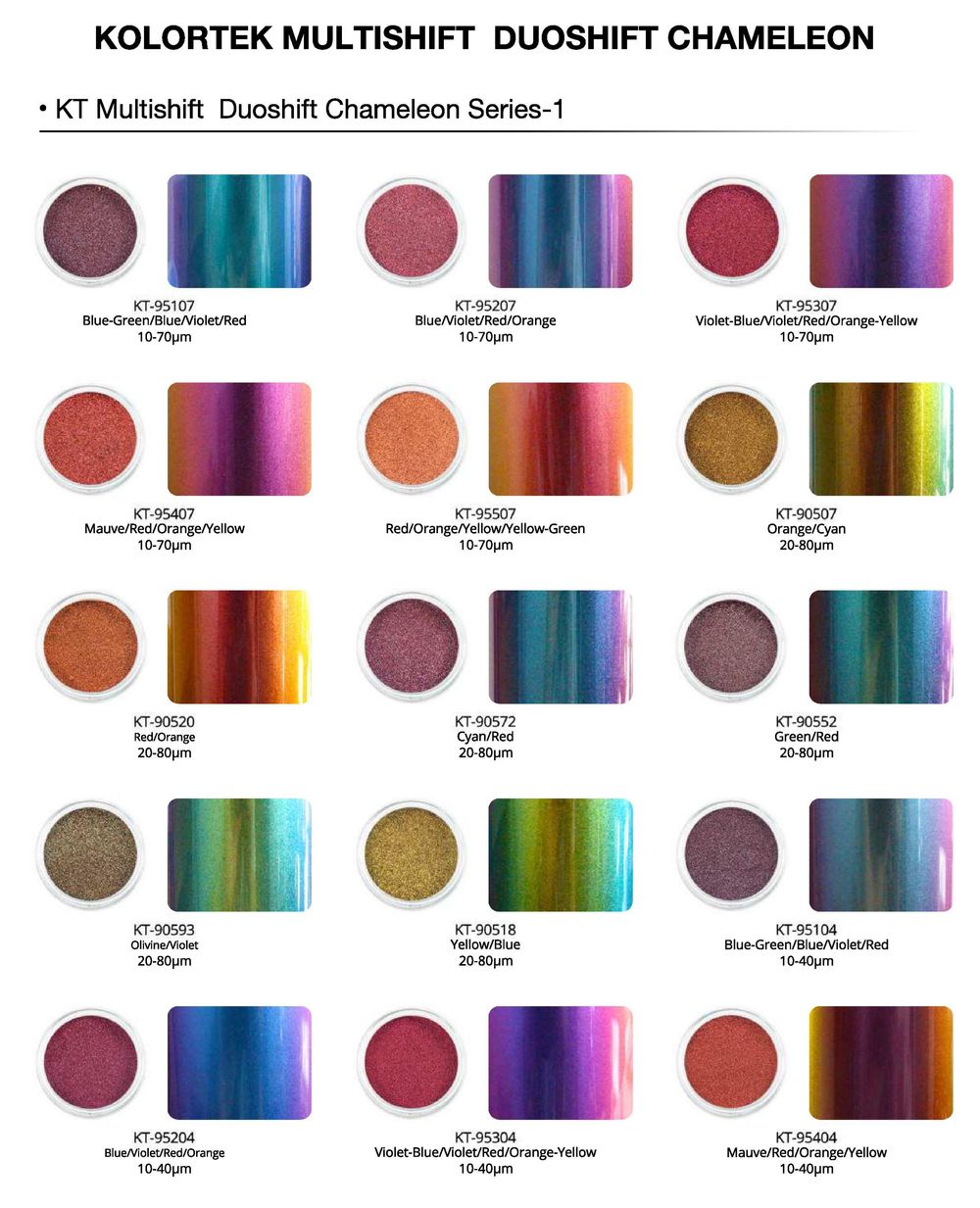
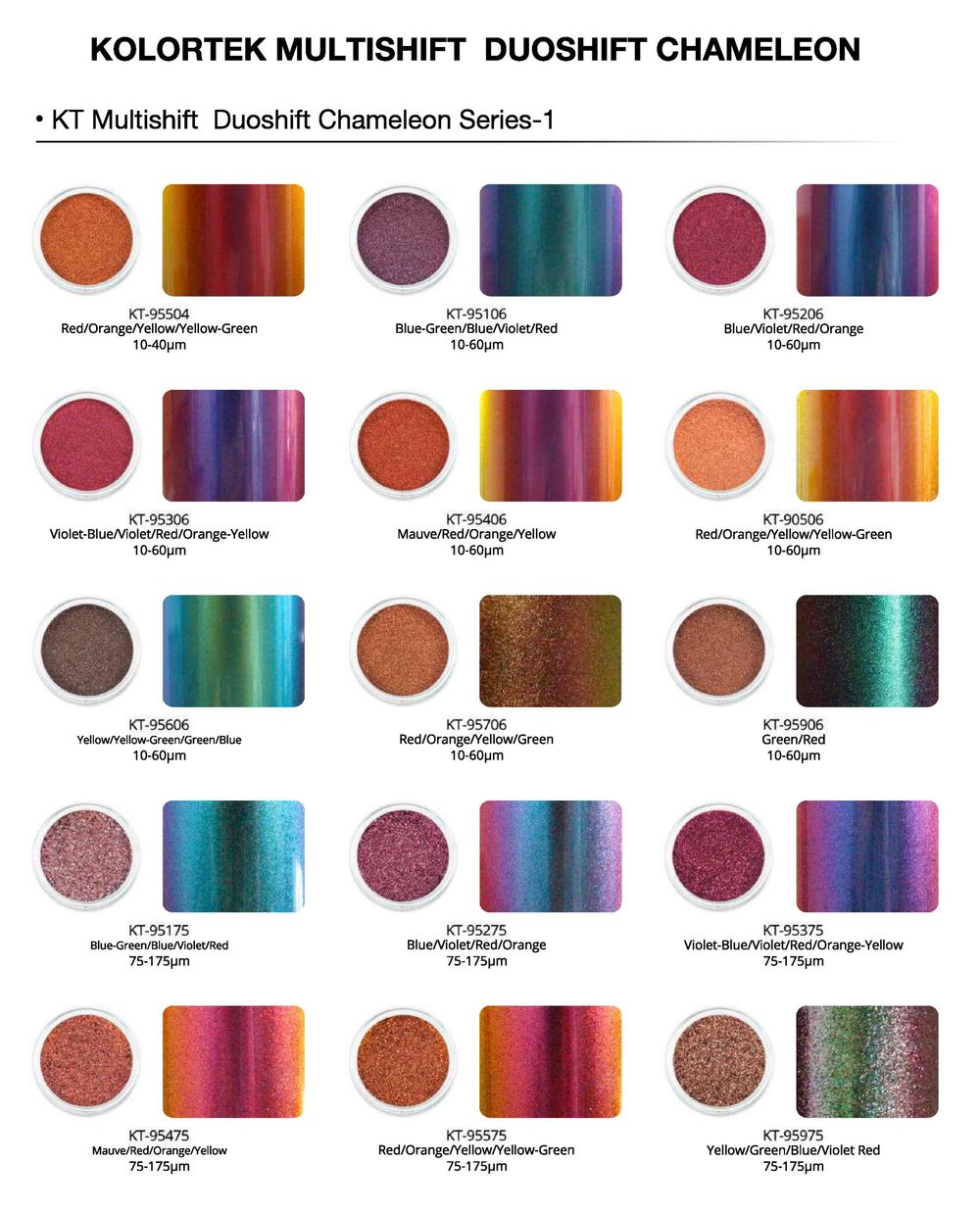
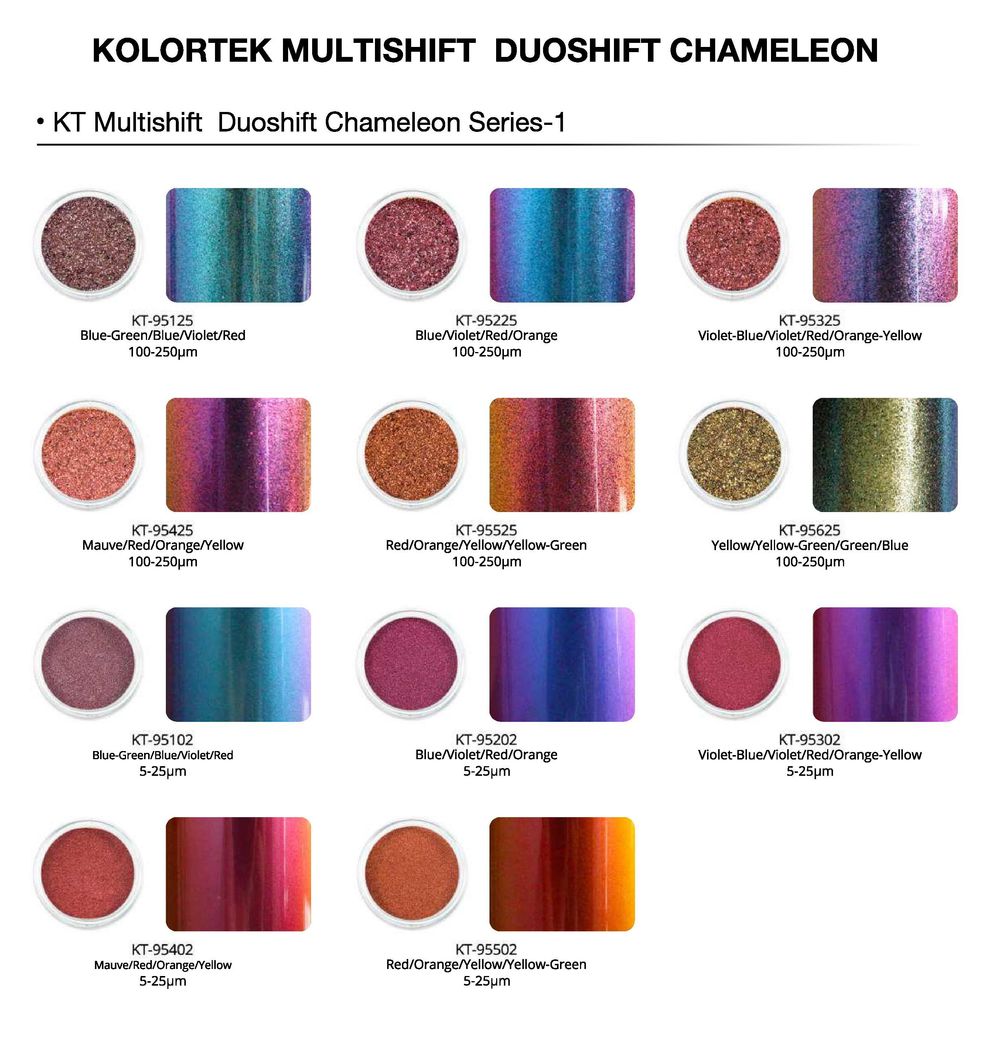
KT-90520 is a chameleon mica powder from our KT-9000 Magic Chameleon Series, producing a dramatic red-to-orange angle-dependent color shift on dark substrates. Built on a natural mica substrate with a multi-layer TiO₂, Fe₂O₃, and silica coating, it carries a particle size range of 20–80 μm (D50: 25–35 μm), an odourless powder form, and a pH of 6.0–9.0. It integrates cleanly into epoxy and UV resin systems at 1–10% by weight, making it a direct-to-use option for resin art applications.
The KT-9000 series operates on thin-film interference. As viewing angle changes, the optical path length through each coating layer shifts, producing a distinct color at each angle. KT-90520 expresses that shift across the red-to-orange range — a warm, high-chroma travel that reads clearly in direct light and across oblique viewing angles.
One thing we consistently tell formulators: substrate lightness is not a minor variable — it controls the entire perceived effect. On a white or pale background, the transmitted and reflected light mix, washing out the interference color. On a black or very dark base, the interference layers have nothing competing with them, and the red-to-orange travel becomes the dominant visual signal. In resin art, that typically means casting a black resin base layer first, or incorporating a black pigment directly into the lower pour.
The natural mica substrate contributes a baseline luster. The silica overcoat — 37–42% of total composition — serves as a stabilizing layer over the iron oxide chromophore, contributing to the chemical and mechanical durability the series is known for.
| Property | Value |
|---|---|
| Product Code | KT-90520 |
| Series | KT-9000 Magic Chameleon Series |
| INCI Name | Mica – Iron oxide – Silica |
| Form | Powder |
| Colour / Appearance | Red/Orange (goniochromatic) |
| Particle Size Range | 20–80 μm |
| D50 | 25–35 μm |
| pH (4% H₂O) | 6.0–9.0 |
| Density | 2.6–3.2 kg/L |
| Odour | Odourless |
| Solubility in Water | Insoluble |
| Component | C.I. Number | Content |
|---|---|---|
| Mica | C.I. 77019 | 46.0–51.0% |
| Iron oxide | C.I. 77891 | 7.0–17.0% |
| Silica | — | 37.0–42.0% |
The KT-9000 series — including KT-90520 — is one of the grades we see most often in resin art contexts, alongside nail art and automotive custom finishes. The particle size range of 20–80 μm gives the flakes enough surface area to produce a strong interference response without creating the settlement issues that heavier specialty pigments can introduce in low-viscosity resin systems.
A few practical points for resin art applications:
The pigment is water-insoluble, which is relevant if you are working with water-based or hybrid resin systems — it will not dissolve into the matrix, so orientation of the flakes at the surface determines the final visual result.
While resin art is the primary application context for this listing, the KT-9000 series has broader industrial reach. From our experience supporting customers across multiple segments, the same interference technology in KT-90520 maps across to:
Loading rates, dispersion methods, and topcoat requirements vary by application. The 1–10% guidance above is specific to resin art; contact our team for formulation support in other systems.
KT-90520 is manufactured to strict heavy metal limits, as detailed below.
| Element | Limit |
|---|---|
| As (Arsenic) | < 2 ppm |
| Hg (Mercury) | < 1 ppm |
| Pb (Lead) | < 10 ppm |
| Cd (Cadmium) | < 3 ppm |
| Ni (Nickel) | < 10 ppm |
| Cr (Chromium) | < 100 ppm |
| Ba (Barium) | < 50 ppm |
| Sb (Antimony) | < 1 ppm |
| Cu (Copper) | < 50 ppm |
| Zn (Zinc) | < 50 ppm |
KT-90520 is not classified as hazardous under CLP Regulation (EC) No. 1272/2008, nor under Directive 67/548/EEC and Directive 1999/45/EC. An MSDS/SDS is provided with all shipments.
Kolortek holds ISO 9001:2015 certification covering the production and sales of glitters, pigments, and fillers. For applications requiring specific regulatory documentation — REACH, EU Cosmetics Regulation (EC) No. 1223/2009 compliance, or US FDA framework alignment — product-specific confirmation is required, as these apply selectively by grade. Cosmetic-grade suitability for KT-90520 specifically is not confirmed in our current published data; contact us directly if skin-contact compliance is a formulation requirement.
When handling the powder, standard precautions apply: avoid generating and breathing dust, use adequate ventilation, and wear gloves plus eye protection. A dust mask covering nose and mouth is recommended if dust is generated during weighing or transfer.
What is the recommended loading rate for KT-90520 chameleon mica powder in epoxy resin?
For resin art, we recommend 1–10% by weight. Lower loadings (1–3%) produce a translucent, depth-effect result; higher loadings (7–10%) deliver a fuller color-shift coverage. Pre-disperse the powder in a small portion of resin before adding it to the full batch to ensure even distribution and avoid dry clumping.
Why does the color-shifting effect look weak in my resin pour?
The most common cause is a light or white substrate. KT-90520, like all grades in the KT-9000 Chameleon Series, requires a dark background for the goniochromatic shift to read clearly. Cast or paint a black base layer before your chameleon pour. Pale substrates scatter and mix reflected light, which suppresses the interference color shift entirely.
What is the particle size of KT-90520, and does it affect surface finish?
KT-90520 has a particle size range of 20–80 μm with a D50 of 25–35 μm. In resin systems, higher pigment loading can affect surface smoothness at the top of a pour. If surface texture is a concern, stay toward the lower end of the dosage range or apply a clear topcoat to level and protect the finished surface.
Can KT-90520 color changing mica powder be used in applications beyond resin art?
Yes. The KT-9000 Magic Chameleon Series is used in automotive custom finishes and wraps, nail art, luxury packaging, decorative coatings for helmets and sporting goods, and security printing. The multi-layer mica substrate is compatible with most resin systems and a range of coating formulations. Loading rates and processing parameters differ by application — reach out to our team for application-specific guidance.
Contact our technical team to discuss formulation requirements for your specific application.
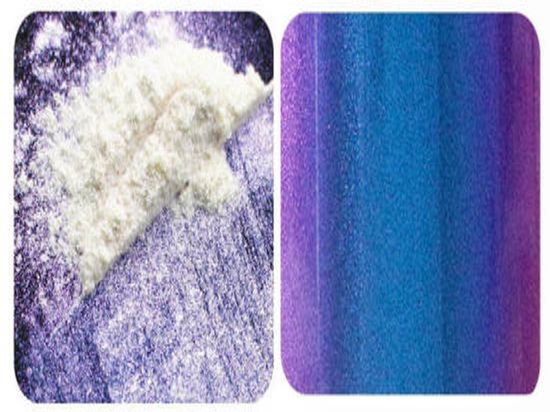
KT-92230 is a multichrome pigment that shifts through a full blue-purple-red-orange sequence as the viewing angle changes — one of the broadest color-travel arcs we produce in the KT-9000 series. Built on a natural mica substrate with a multi-layer TiO₂/Fe₂O₃/silica/tin oxide coating, it comes in a 25–130 μm particle size that delivers strong angular contrast and high visual impact across automotive finishes, decorative coatings, and specialty printing.
Read More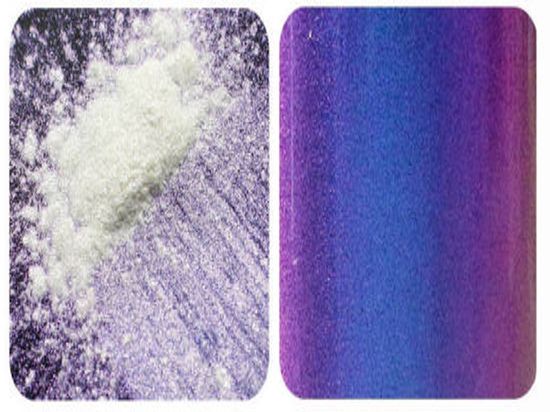
KT-92330 is a multi-layer interference pigment from Kolortek's KT-9000 Magic Chameleon Series, producing a continuous color shift sequence — indigo through purple, red, orange, and yellow — as the viewing angle changes. Built on natural mica coated with TiO₂, silica, and tin oxide, it delivers a high-mirror goniochromatic effect with a 25–130 μm particle size distribution engineered for maximum visual impact. This color shifting pigment powder performs best over dark or black substrates, where the full angular color travel is most legible.
Read More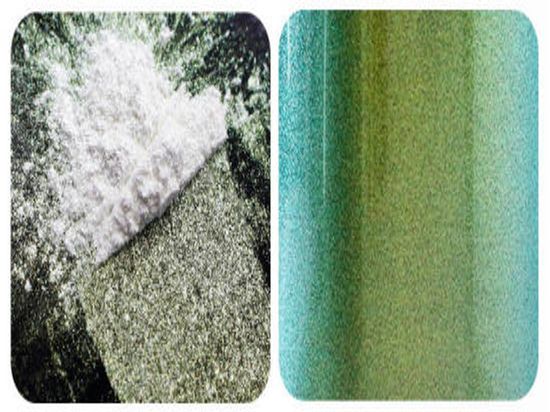
KT-92630 is a large-particle chameleon paint pearl from our KT-9000 Magic Chameleon Series, producing a sequential golden-to-kelly-green-to-blue color travel as the viewing angle shifts. With a 25–130 μm particle range, it delivers high visual impact in automotive custom finishes, decorative coatings, and specialty applications where a pronounced, multi-stop color flip is the goal. The substrate is natural mica with a multi-layer TiO₂/SiO₂/metal-oxide coating that generates the goniochromatic interference effect.
Read More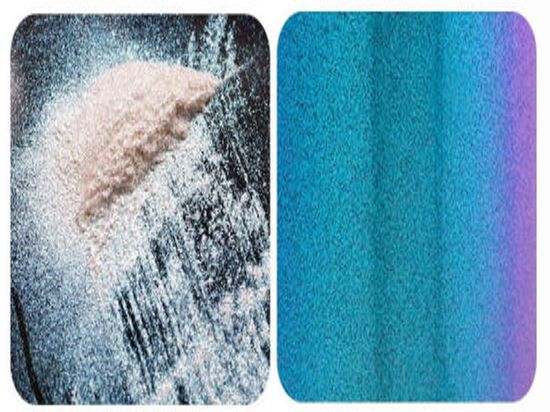
KT-92175 is the large-particle grade of our chameleon pigment for resin, built on a natural mica substrate with a multi-layer TiO₂, silica, and tin oxide coating that produces a continuous cyan-to-blue-to-purple-to-red angle-dependent color shift. At 75–175μm, it is the highest-sparkle option in the KT-9000 Magic Chameleon Series' KT-921** Cyan-Blue-Purple-Red range. Compatible with epoxy and UV resin at loadings of 1–10% by weight, the effect reads strongest on dark or black substrates where the goniochromatic shift has maximum contrast.
Read More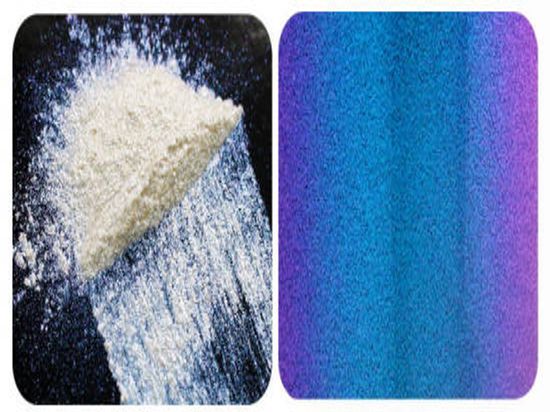
KT-92275 is a large-particle duochrome loose pigment from our KT-9000 Magic Chameleon Series, delivering a full blue-purple-red-orange color travel sequence that shifts continuously across the visible spectrum as the viewing angle changes. With a particle size range of 75–175 μm, this grade is engineered specifically for applications where maximum sparkle is the priority — loose eyeshadow, nail art toppers, and high-impact decorative cosmetics where the angular shift needs to read clearly against the skin or a dark base.
Read More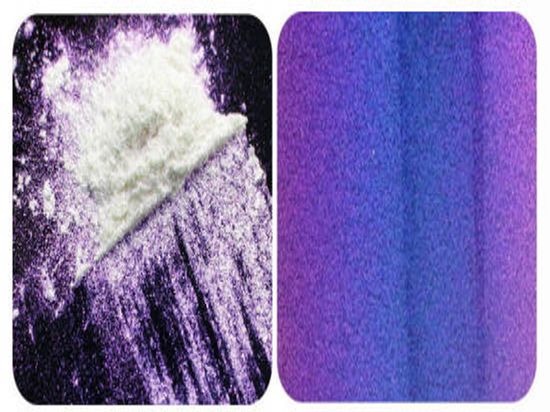
KT-92375 is a large-particle ghost chameleon pigment from Kolortek's KT-9000 Magic Chameleon Series, delivering a continuous five-stage color shift — indigo → purple → red → orange → yellow — as the viewing angle changes. Built on natural mica coated with titanium dioxide, silica, and tin oxide, it carries a particle size of 75–175 μm for maximum sparkle. We developed this grade specifically for high-impact automotive finishes, custom coatings, and luxury decorative applications where a dramatic, angle-dependent color shift is the primary design goal.
Read More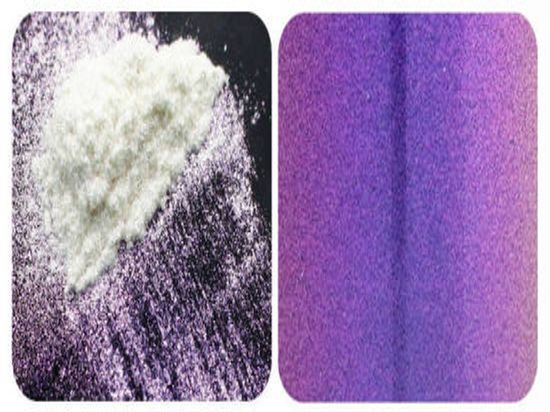
KT-92475 is a large-particle chameleon pigment from the KT-9000 Magic Chameleon Series, producing a continuous mauve → red → orange → yellow color shift that sweeps across the visible spectrum as the viewing angle changes. With a particle size of 75–175 μm and a natural mica substrate coated with titanium dioxide, silica, and tin oxide, it delivers the coarse, high-sparkle texture that nail art formulators need for maximum visual drama — particularly over a dark or black base coat.
Read More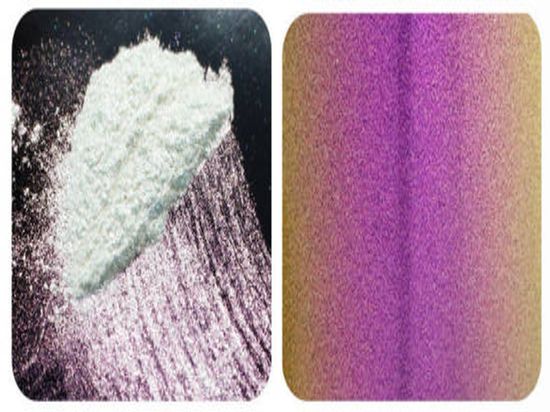
KT-92575 is a large-flake chameleon pearl powder from our KT-9000 Magic Chameleon Series, producing a dramatic angle-dependent color shift spanning red, orange, yellow, and kelly green on dark substrates. Built on a natural mica substrate with a multi-layer coating of titanium dioxide, silica, and tin oxide, it delivers an INCI composition suited to high-end cosmetic and nail art formulations. The 75–175 μm particle range gives it the high-sparkle, deep color-travel behavior that distinguishes it from finer cosmetic pearl grades.
Read More
 English
 Français
 Deutsch
 Русский
 Español
 Português