
Leave A Message
If you are interested in our products and want to know more details,please leave a message here,we will reply you as soon as we can.
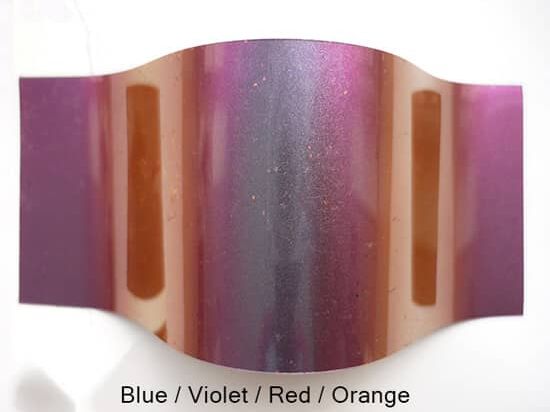
Blue/violet/red/orange Hypershift Pigments KT-95207 for automotive coatings, custom car paint
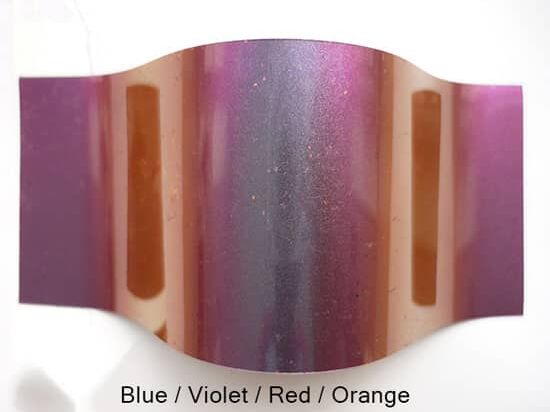
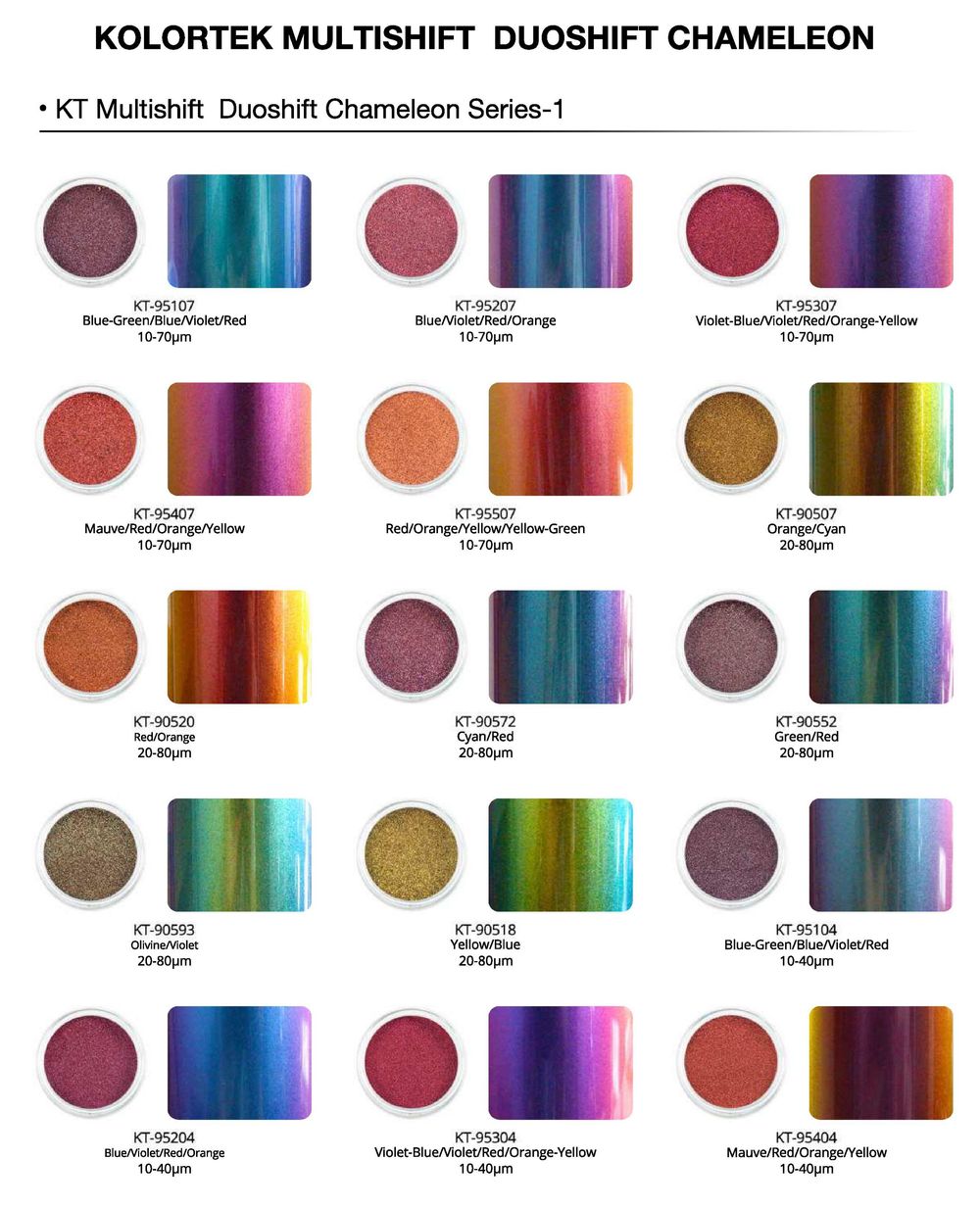
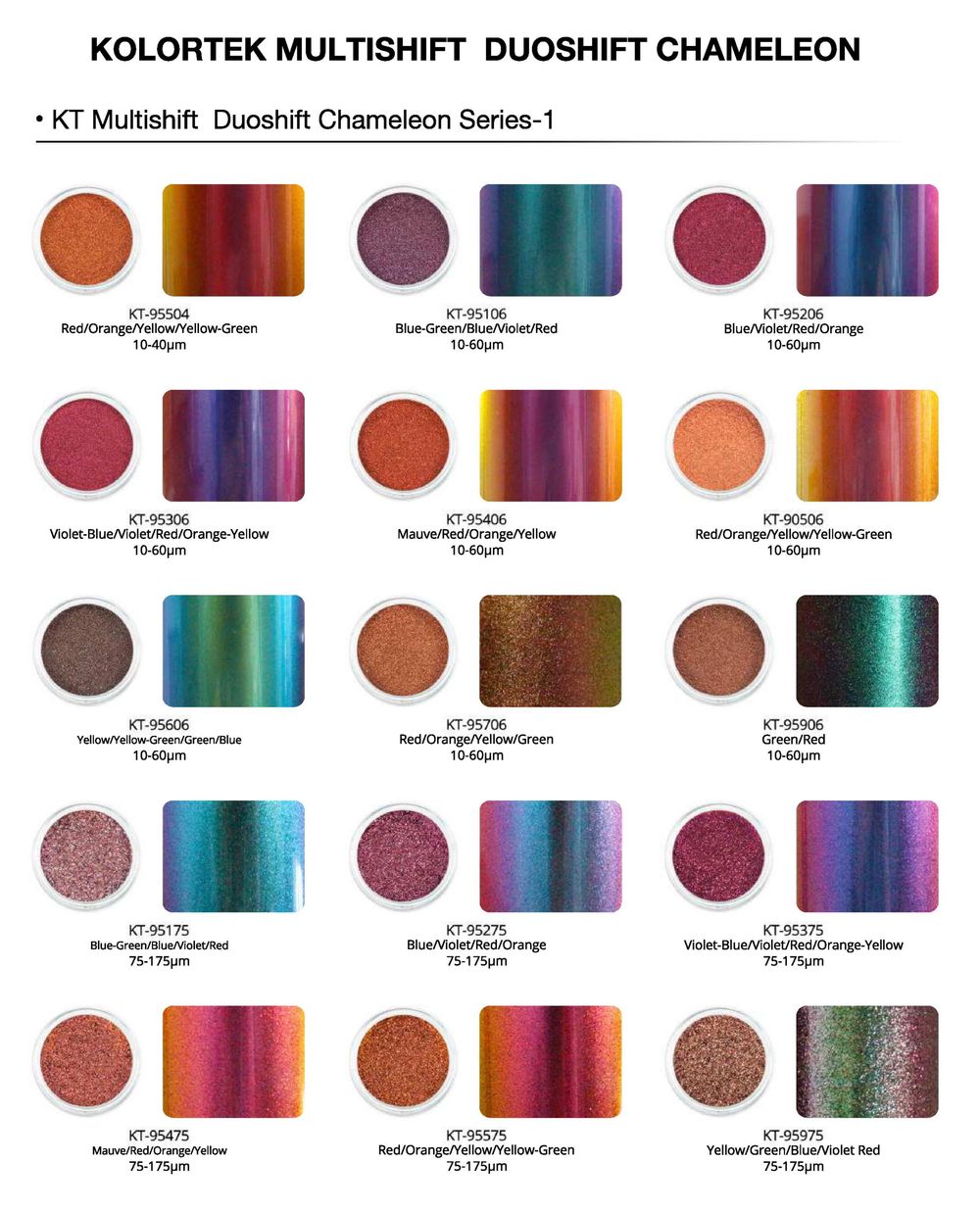
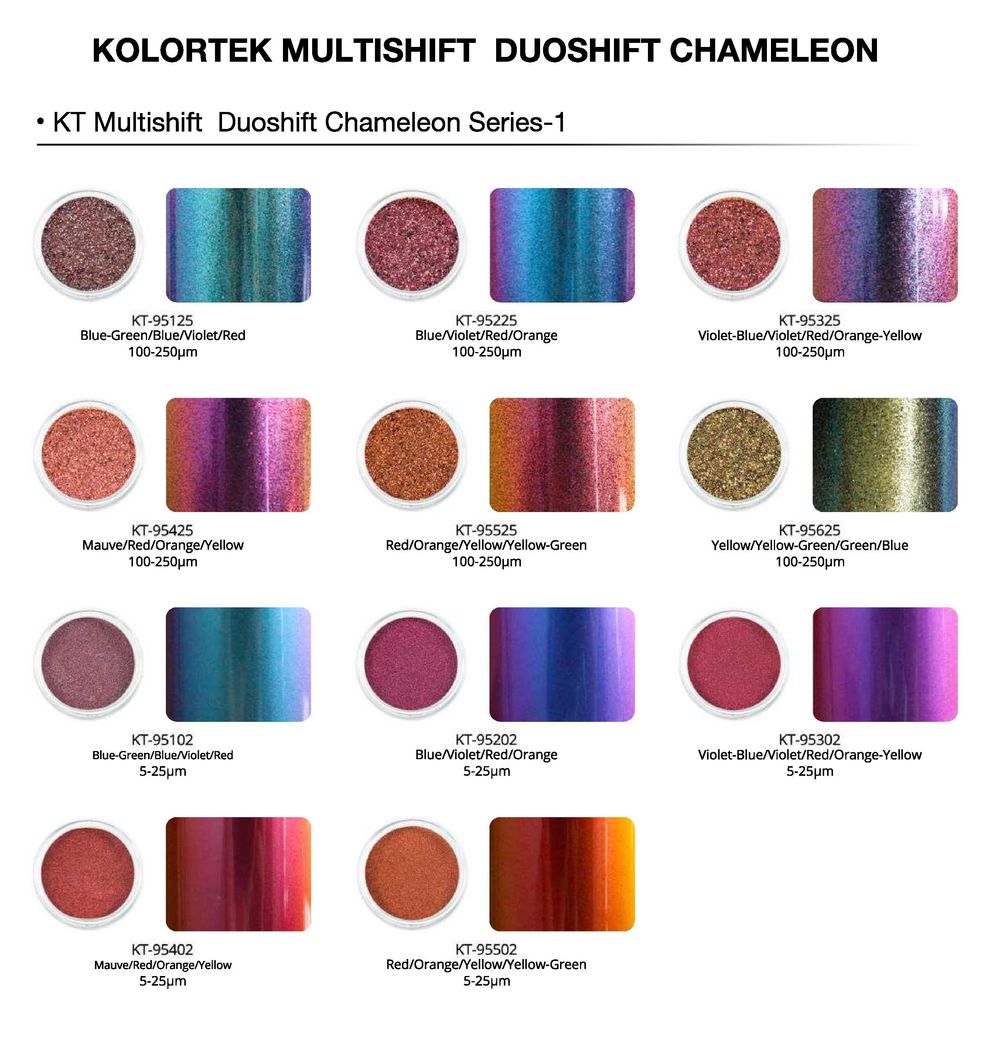
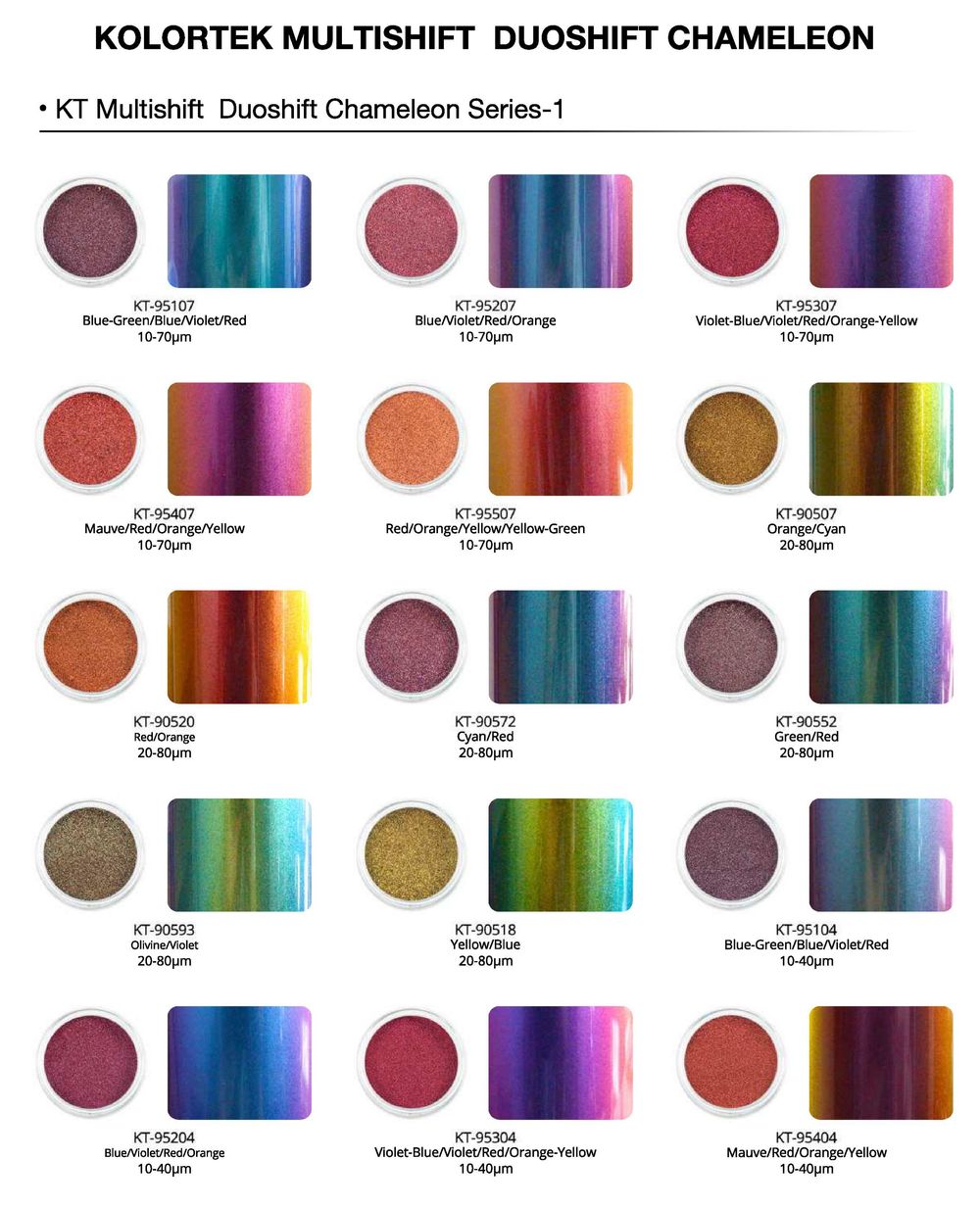
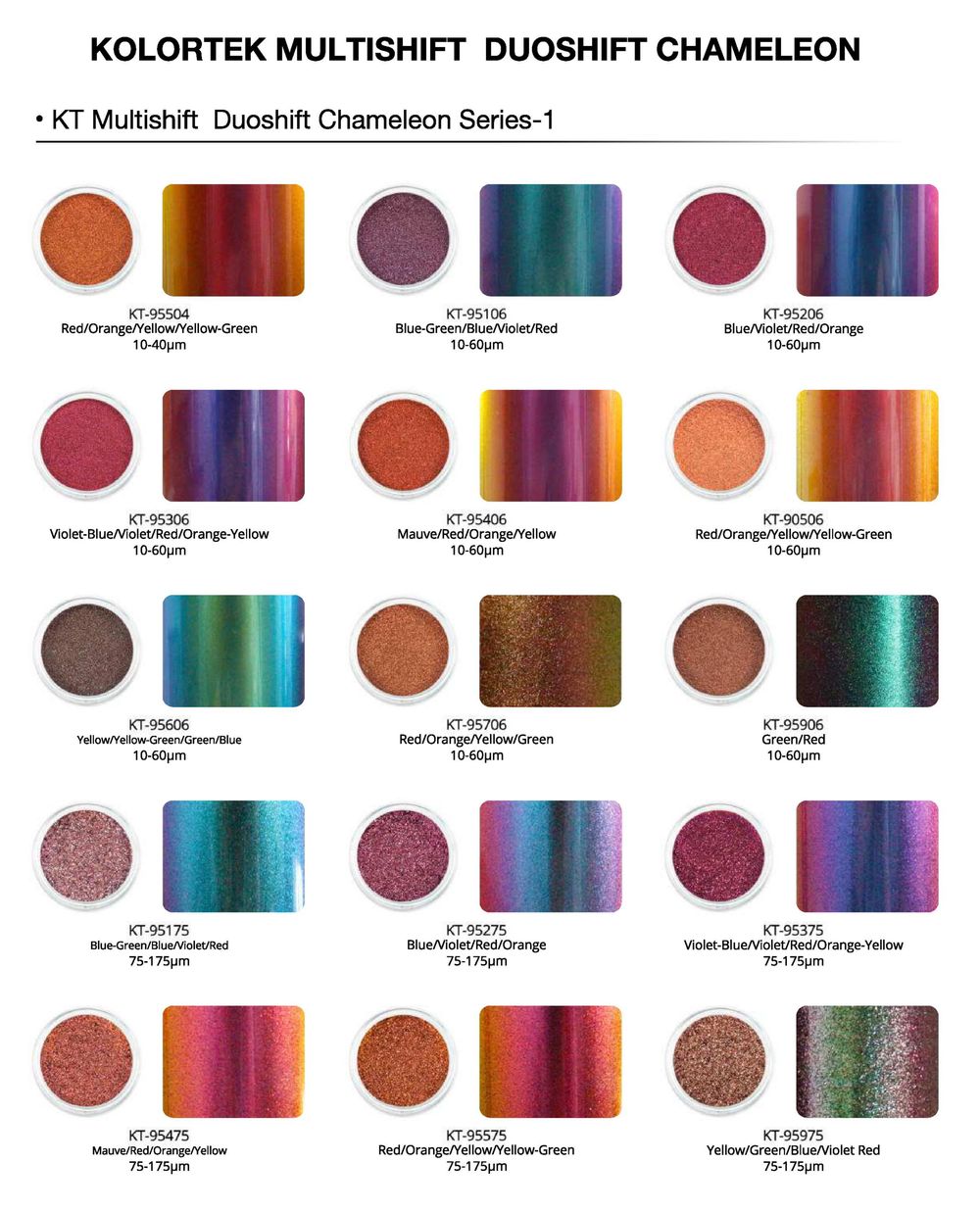
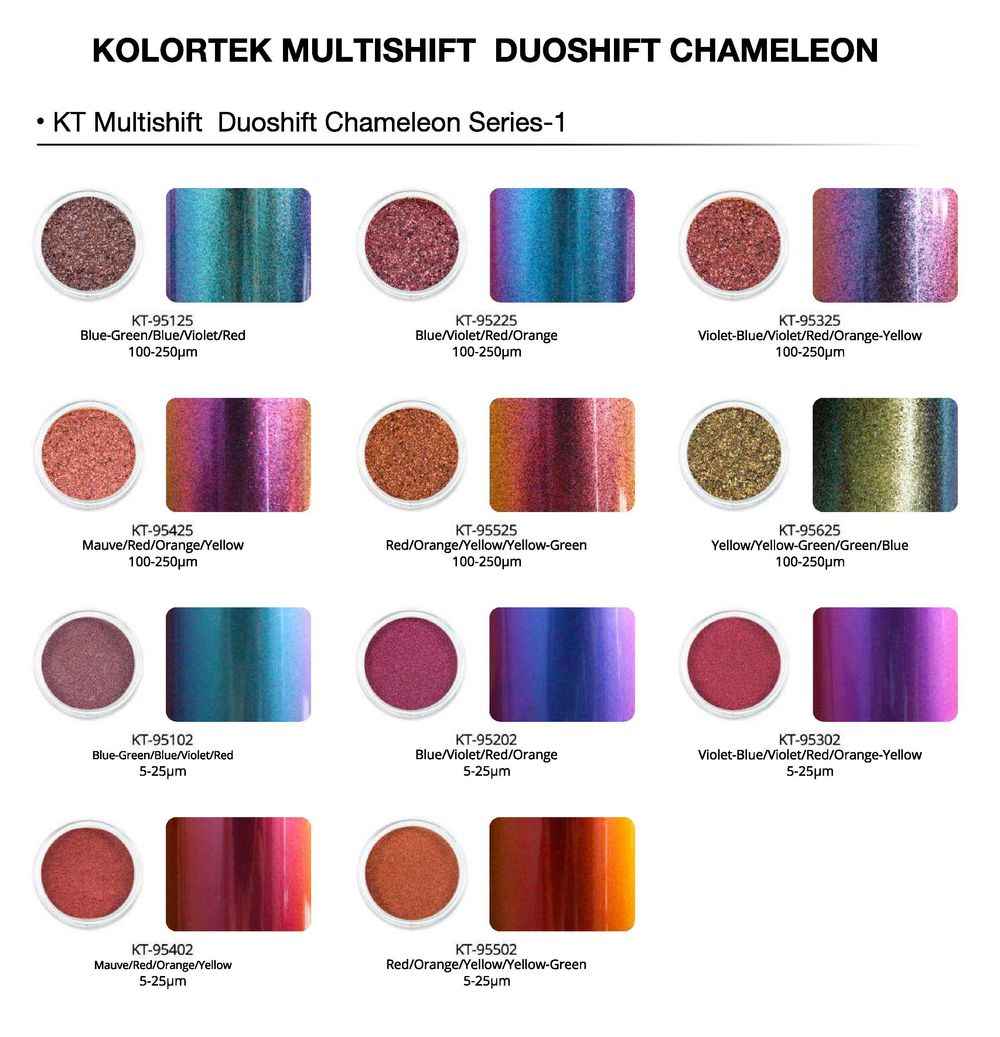
KT-95207 is a TiO₂-free hypershift pigment powder from Kolortek's KT-9000 Magic Chameleon Series, producing a continuous four-color travel — blue through violet, red, and orange — as the viewing angle shifts. Built on a natural mica substrate coated with Fe₂O₃ and silica in multiple inorganic layers, it delivers the deep goniochromatic effect that automotive custom finishes demand, with a particle size range of 10–70 μm and a D50 of 24–28 μm for consistent platelet distribution in spray-applied basecoats.
The color travel in KT-95207 comes from thin-film interference across multiple inorganic layers deposited on a natural mica platelet. As the angle of incident light changes relative to the observer, constructive and destructive interference shifts the reflected wavelength — producing the sequential blue-to-orange progression rather than a simple two-tone flip. The TiO₂-free formulation uses Fe₂O₃ and silica layers, which is a design choice that affects both the color character and the chemical profile: no titanium dioxide means a different refractive index stack, producing warmer undertones in the red-orange range compared to titanium-based systems.
Substrate matters significantly. On a black or deep-toned base, the interference colors read cleanly because there is no competing white reflectance from the substrate. On a white base, the shift is still present but substantially reduced in perceived intensity. In our application lab, we consistently advise customers targeting vivid color travel to apply over a dark primer or dark basecoat before introducing the chameleon layer.
| Property | Value |
|---|---|
| Product Code | KT-95207 |
| Series | KT-9000 Magic Chameleon / Color Travel |
| Color Shift | Blue / Violet / Red / Orange (four-color travel) |
| Particle Size Range | 10–70 μm |
| D50 | 24–28 μm |
| pH (4% H₂O) | 6.0–9.0 |
| Density | 2.2–3.0 kg/L |
| Form | Powder |
| Odour | Odourless |
| Solubility | Insoluble in water |
| INCI Name | Mica, Iron Oxide, Silica |
| CAS No. | 12001-26-2 / 1309-37-1 / 7631-86-9 |
| Hazard Classification | Not classified (CLP / EC 1272/2008) |
KT-95207 is an inorganic, TiO₂-free mixture. The silica layer constitutes the largest fraction by weight, serving both as a protective overcoat and as a refractive index modifier. Iron oxide drives the warm interference colors in the red-orange range, while mica provides the high-aspect-ratio platelet substrate essential for the mirror-like reflectance. All three components carry established C.I. and CAS numbers, which simplifies regulatory documentation for downstream users.
| Component | C.I. Number | Content (%) |
|---|---|---|
| Mica | 77019 | 27.0–37.0 |
| Iron Oxide | 77491 | 19.0–24.0 |
| Silica | — | 44.0–49.0 |
Heavy metal content is well within the limits required for industrial coating and decorative applications. The table below reflects maximum values from the TDS — typical production lots run considerably lower.
| Element | Maximum Limit | Element | Maximum Limit |
|---|---|---|---|
| As | <2 ppm | Pb | <10 ppm |
| Hg | <1 ppm | Cr | <100 ppm |
| Ba | <50 ppm | Sb | <1 ppm |
| Ni | <10 ppm | Cu | <50 ppm |
| Cd | <3 ppm | Zn | <50 ppm |
Custom car paint and full-vehicle wraps are the primary target for KT-95207, and this is the application where the four-color travel has the most visual impact. The pigment integrates into a conventional basecoat/clearcoat system: the chameleon layer sits in the basecoat over a black or very dark ground coat, and a clear topcoat is applied over it to protect the platelet alignment and add depth to the visual effect. The clearcoat is not optional — without it, the interference layer is exposed and the color travel degrades.
General guidance from our experience with automotive coating customers: target a pigment loading of 1–10% in the basecoat and a dry film thickness of 15–25 μm for the effect layer. Pneumatic spray and electrostatic spray are both suitable delivery methods. Flash-off time between coats is critical — rushing this step causes platelet disorientation, which significantly weakens the color travel intensity. Over-thinning the basecoat has the same effect and is a common issue we see in first-time formulations.
KT-95207 can also be combined with transparent absorption pigments to modify the base hue and fine-tune the color shift range, which gives custom painters more control over the starting color without sacrificing the angle-dependent travel. That said, any co-pigment added should be transparent — opaque absorption pigments will mask the interference effect.
Beyond automotive, KT-95207 fits wherever dramatic angle-dependent color is the design intent. The KT-9000 series is used in powder coatings, leather coatings, dispersion paints, plastics, and synthetic leather. High-end cosmetics and nail art are viable when the formulation context permits — the inorganic composition and the INCI designation (Mica, Iron Oxide, Silica) are familiar to cosmetic chemists. Decorative applications such as motorcycle helmets and sporting goods are a natural fit given the deep color travel and the robustness of the inorganic coating. High-security printing, including banknotes and negotiable instruments, is another established use for goniochromatic pigments from this series.
Effect pigments like KT-95207 depend entirely on platelet integrity for their optical behavior. High-shear mixing — bead mills, high-speed dispersers running extended cycles, high-shear recirculation pumps — breaks the platelets and permanently destroys the interference structure. There is no way to recover the effect once the platelet is fractured. Low-shear let-down into a pre-wetted resin phase, or simple paddle mixing at moderate speed, is the correct approach. If the pigment is incorporated into a paste concentrate first, use a spatula or low-speed dissolver rather than a high-speed impeller.
For spray-applied hypershift pearl paint systems, platelet alignment during film formation is the other critical variable. The wet basecoat needs adequate open time to allow platelets to settle parallel to the substrate surface — this is what creates the "face-on vs. flop" goniochromatic contrast. Excessive pigment loading disrupts this alignment by crowding the platelets at angles to one another. Keeping within the 1–10% loading range and respecting the flash-off interval between passes gives the platelets the best opportunity to self-orient before the film locks.
The KT-9000 Magic Chameleon Series covers a broad range of color travel options. The clearest distinctions within the series are between duochrome (two-color shift, KT-921** to KT-926** range) and multicolor variants (three or more colors). KT-95207 sits in the TiO₂-free chameleon segment (KT-95102–95706 range), which uses Fe₂O₃ + Silica coating rather than a TiO₂-based system. Formulators who need a titanium-free declaration for a specific regulatory or formulation reason should note that explicitly when requesting samples or documentation.
The KT-9000 series also includes multicolor variants (KT-972106, KT-972206, KT-973206, KT-974206, and a substantial number of variants across the 96000, 97000, and 98000 sub-series) for applications requiring even more complex color sequences. KT-95207's four-color blue-to-orange travel puts it in the middle of the intensity spectrum — more dynamic than a simple duochrome flip, without the production complexity of the most elaborate multicolor grades.
KT-95207 is manufactured under Kolortek's ISO 9001:2015 quality management system covering production and sales of pigments, glitters, and fillers. The product is registered under REACH Regulation (EC) No. 1907/2006. Buyers requiring product-specific certifications beyond these should contact us directly — product-specific documentation availability varies by grade and end-use category, and we can clarify what is on file for KT-95207 specifically.
From a hazard classification standpoint, KT-95207 is not classified under CLP (EC No. 1272/2008) or under Directives 67/548/EEC and 1999/45/EC. Standard industrial hygiene practices apply: provide adequate ventilation in handling areas, avoid generating and accumulating dust, and use appropriate PPE (dust mask, gloves, eye protection) when handling in powder form.
What is the color shift sequence of KT-95207, and does the viewing angle matter?
KT-95207 produces a four-color goniochromatic shift — blue, violet, red, and orange — driven by thin-film interference across its Fe₂O₃ and silica multilayer coating on natural mica. The colors appear sequentially as the angle between the light source, the coated surface, and the observer changes. On a dark or black substrate the contrast between the color states is highest; on a white substrate the shift is visible but significantly weaker.
What loading rate and film thickness are recommended for automotive color shift pigment applications?
For automotive basecoat use, a loading of 1–10% pigment by weight in the basecoat is the standard starting range, with a target dry film thickness of 15–25 μm for the effect layer. A clear topcoat over the pigment layer is required to protect platelet orientation and enhance visual depth. Exact loading will depend on the resin system and the desired intensity — we recommend a trial series at 2%, 5%, and 8% with your specific formulation before committing to production quantities.
Can KT-95207 be used in water-based coating systems?
KT-95207 is insoluble in water and compatible with most resin systems as a general statement. However, we do not have product-specific data in our current documentation confirming validated performance in water-based vs. solvent-based formulations for this grade. The pH range of 6.0–9.0 (measured at 4% in water) is consistent with typical water-based coating pH ranges, but formulation compatibility should be confirmed through a bench trial before scale-up.
Is KT-95207 a chameleon pigment for automotive use, or does it have other applications?
Custom automotive finishes and wraps are the primary design target, but the same goniochromatic performance applies across powder coatings, leather coatings, dispersion paints, plastics, and high-end cosmetics and nail art. The INCI-declarable composition (Mica, Iron Oxide, Silica) and CLP non-classified status make it straightforward to incorporate into cosmetic-grade formulations — though cosmetic suitability depends on the specific grade and regulatory market, and should be confirmed before production use.
Contact our technical team to discuss formulation requirements or request a sample of KT-95207 for your application.
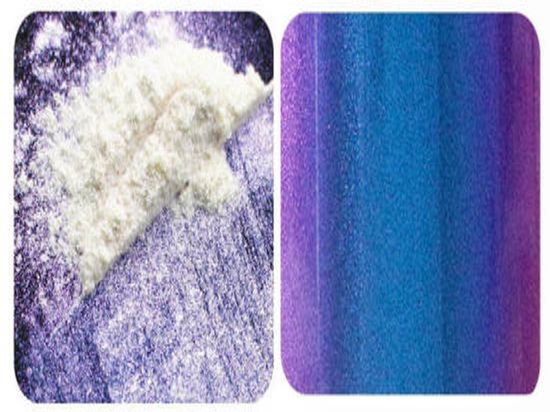
KT-92230 is a multichrome pigment that shifts through a full blue-purple-red-orange sequence as the viewing angle changes — one of the broadest color-travel arcs we produce in the KT-9000 series. Built on a natural mica substrate with a multi-layer TiO₂/Fe₂O₃/silica/tin oxide coating, it comes in a 25–130 μm particle size that delivers strong angular contrast and high visual impact across automotive finishes, decorative coatings, and specialty printing.
Read More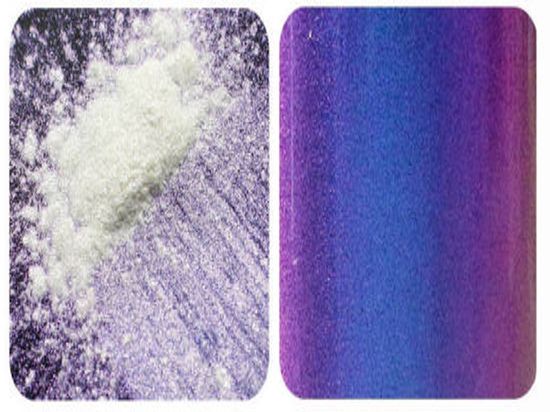
KT-92330 is a multi-layer interference pigment from Kolortek's KT-9000 Magic Chameleon Series, producing a continuous color shift sequence — indigo through purple, red, orange, and yellow — as the viewing angle changes. Built on natural mica coated with TiO₂, silica, and tin oxide, it delivers a high-mirror goniochromatic effect with a 25–130 μm particle size distribution engineered for maximum visual impact. This color shifting pigment powder performs best over dark or black substrates, where the full angular color travel is most legible.
Read More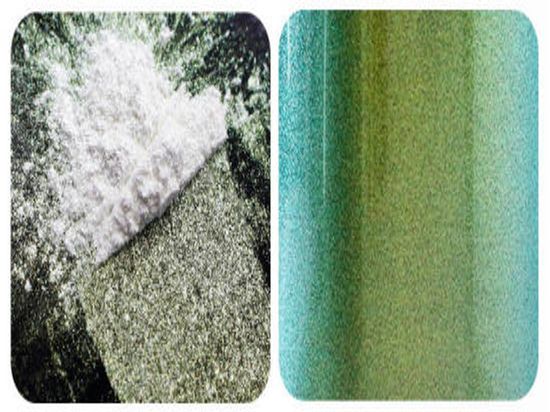
KT-92630 is a large-particle chameleon paint pearl from our KT-9000 Magic Chameleon Series, producing a sequential golden-to-kelly-green-to-blue color travel as the viewing angle shifts. With a 25–130 μm particle range, it delivers high visual impact in automotive custom finishes, decorative coatings, and specialty applications where a pronounced, multi-stop color flip is the goal. The substrate is natural mica with a multi-layer TiO₂/SiO₂/metal-oxide coating that generates the goniochromatic interference effect.
Read More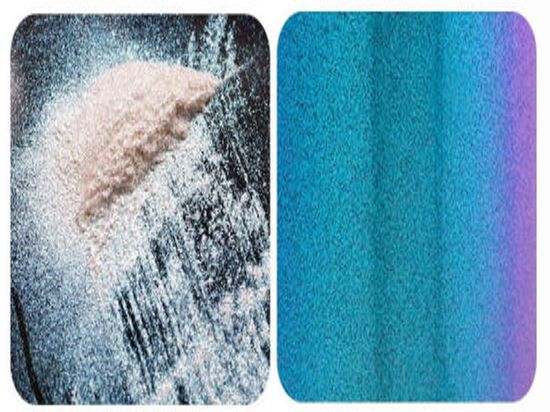
KT-92175 is the large-particle grade of our chameleon pigment for resin, built on a natural mica substrate with a multi-layer TiO₂, silica, and tin oxide coating that produces a continuous cyan-to-blue-to-purple-to-red angle-dependent color shift. At 75–175μm, it is the highest-sparkle option in the KT-9000 Magic Chameleon Series' KT-921** Cyan-Blue-Purple-Red range. Compatible with epoxy and UV resin at loadings of 1–10% by weight, the effect reads strongest on dark or black substrates where the goniochromatic shift has maximum contrast.
Read More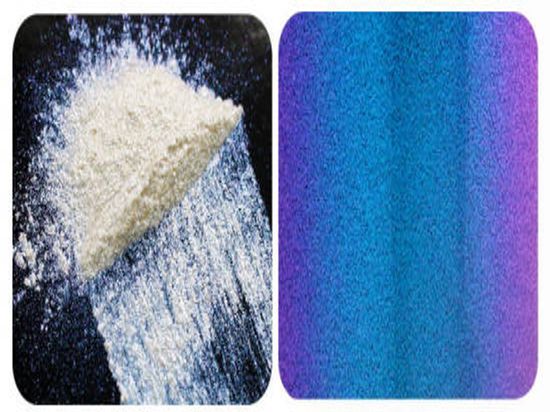
KT-92275 is a large-particle duochrome loose pigment from our KT-9000 Magic Chameleon Series, delivering a full blue-purple-red-orange color travel sequence that shifts continuously across the visible spectrum as the viewing angle changes. With a particle size range of 75–175 μm, this grade is engineered specifically for applications where maximum sparkle is the priority — loose eyeshadow, nail art toppers, and high-impact decorative cosmetics where the angular shift needs to read clearly against the skin or a dark base.
Read More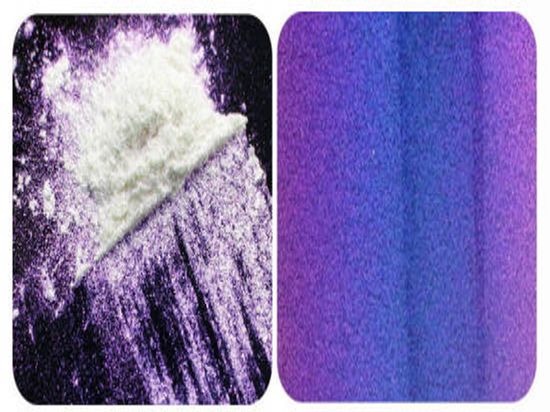
KT-92375 is a large-particle ghost chameleon pigment from Kolortek's KT-9000 Magic Chameleon Series, delivering a continuous five-stage color shift — indigo → purple → red → orange → yellow — as the viewing angle changes. Built on natural mica coated with titanium dioxide, silica, and tin oxide, it carries a particle size of 75–175 μm for maximum sparkle. We developed this grade specifically for high-impact automotive finishes, custom coatings, and luxury decorative applications where a dramatic, angle-dependent color shift is the primary design goal.
Read More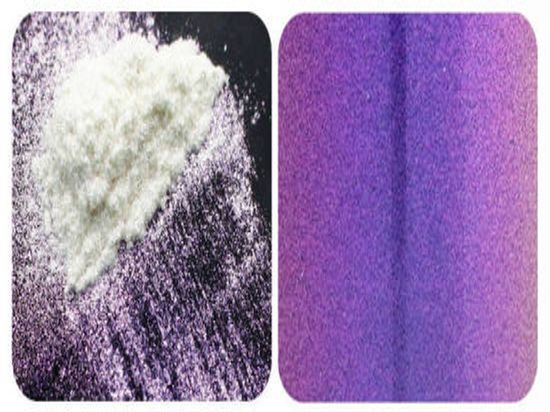
KT-92475 is a large-particle chameleon pigment from the KT-9000 Magic Chameleon Series, producing a continuous mauve → red → orange → yellow color shift that sweeps across the visible spectrum as the viewing angle changes. With a particle size of 75–175 μm and a natural mica substrate coated with titanium dioxide, silica, and tin oxide, it delivers the coarse, high-sparkle texture that nail art formulators need for maximum visual drama — particularly over a dark or black base coat.
Read More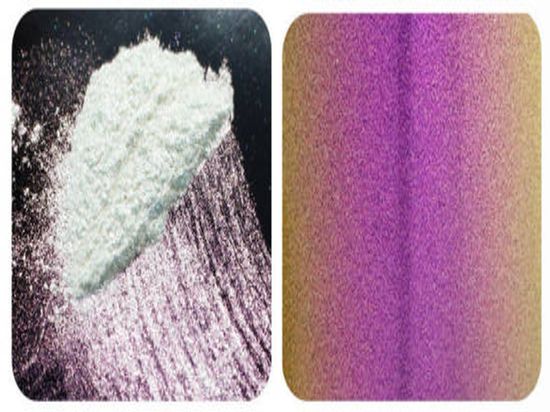
KT-92575 is a large-flake chameleon pearl powder from our KT-9000 Magic Chameleon Series, producing a dramatic angle-dependent color shift spanning red, orange, yellow, and kelly green on dark substrates. Built on a natural mica substrate with a multi-layer coating of titanium dioxide, silica, and tin oxide, it delivers an INCI composition suited to high-end cosmetic and nail art formulations. The 75–175 μm particle range gives it the high-sparkle, deep color-travel behavior that distinguishes it from finer cosmetic pearl grades.
Read More
 English
 Français
 Deutsch
 Русский
 Español
 Português