
Leave A Message
If you are interested in our products and want to know more details,please leave a message here,we will reply you as soon as we can.
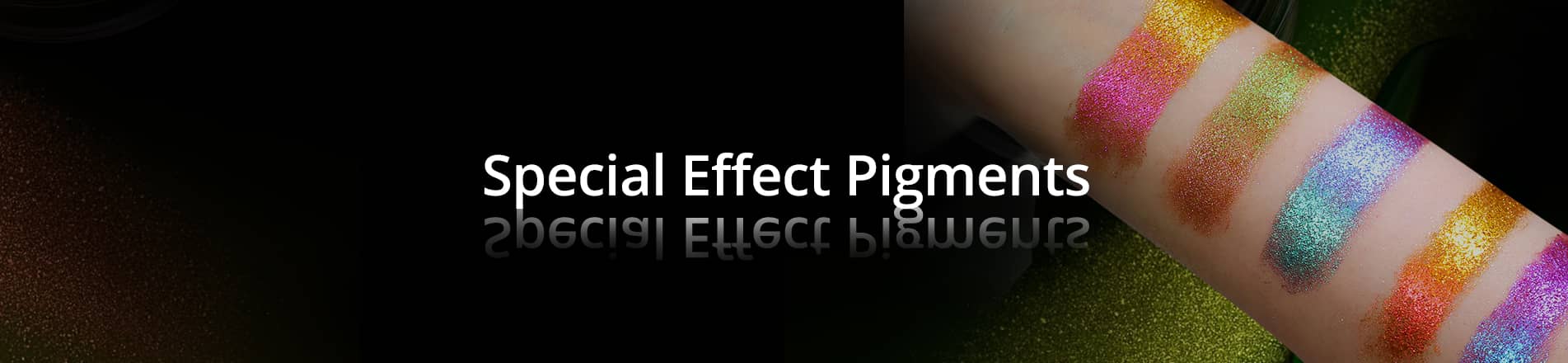
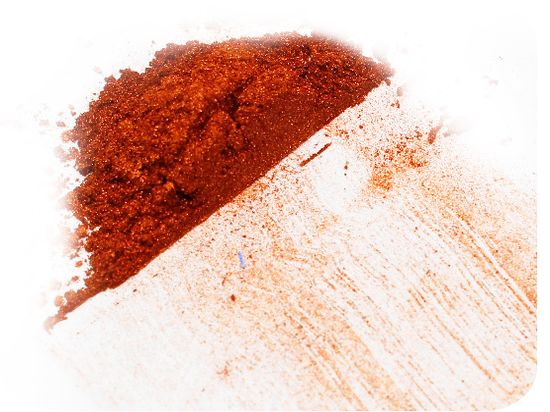
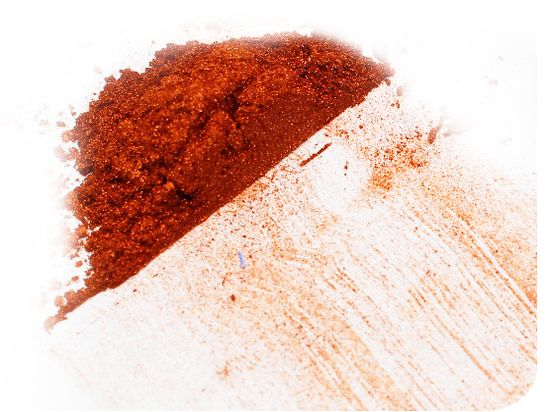
KT-F60-50-WR is an aluminum oxide effect pigment in Kolortek's XiallicSparks series, engineered specifically for automotive basecoat/clearcoat systems where a faceted, mirror-like crystal sparkle is required. Built on an Al₂O₃ flake substrate with a refractive index of 1.76, it delivers the kind of high-chroma, angular brilliance that mica-based pearls simply cannot replicate — making it a direct working alternative to Merck Xirallic® in flame copper colorways.
Most of Kolortek's pearlescent lines — the KT-100 through KT-9000 ranges — are built on natural or synthetic mica. XiallicSparks is a separate, specialized series that uses an alumina (Al₂O₃) crystal flake substrate instead. That substrate distinction is not cosmetic. Alumina has a refractive index of 1.76 compared to roughly 1.58 for natural mica, and its surface is exceptionally smooth, which allows for thinner, more uniform optical coating layers. The result is a different category of visual effect: each platelet functions like a miniature mirror, producing sharp, faceted highlights with high color purity rather than the soft, diffuse glow characteristic of mica-based pearls.
In our application lab, we position XiallicSparks explicitly for formulators who need that crystal-effect sparkle — the kind visible in premium automotive finishes where individual light reflections appear as distinct, bright flecks rather than a continuous sheen. If your target effect is soft luster or general interference color, the standard Kolortek pearlescent series is more economical and appropriate. XiallicSparks carries a cost premium, and it's there for a reason.
| Parameter | Value / Description |
|---|---|
| Product Code | KT-F60-50-WR |
| Color | Flame Copper |
| Series | XiallicSparks |
| Substrate | Aluminum oxide (Al₂O₃) flake |
| Substrate Refractive Index | 1.76 |
| Particle Size | 6–30 μm |
| Effect Type | Faceted crystal-like sparkle (non-pearlescent) |
| Heat Resistance | 140–160 °C / 20–30 min |
| Weather Resistance | Excellent |
| Chemical Resistance | Good resistance to automotive fluids |
| Transparency | High transparency in clear coats |
| Primary Application | Automotive OEM and refinish basecoats |
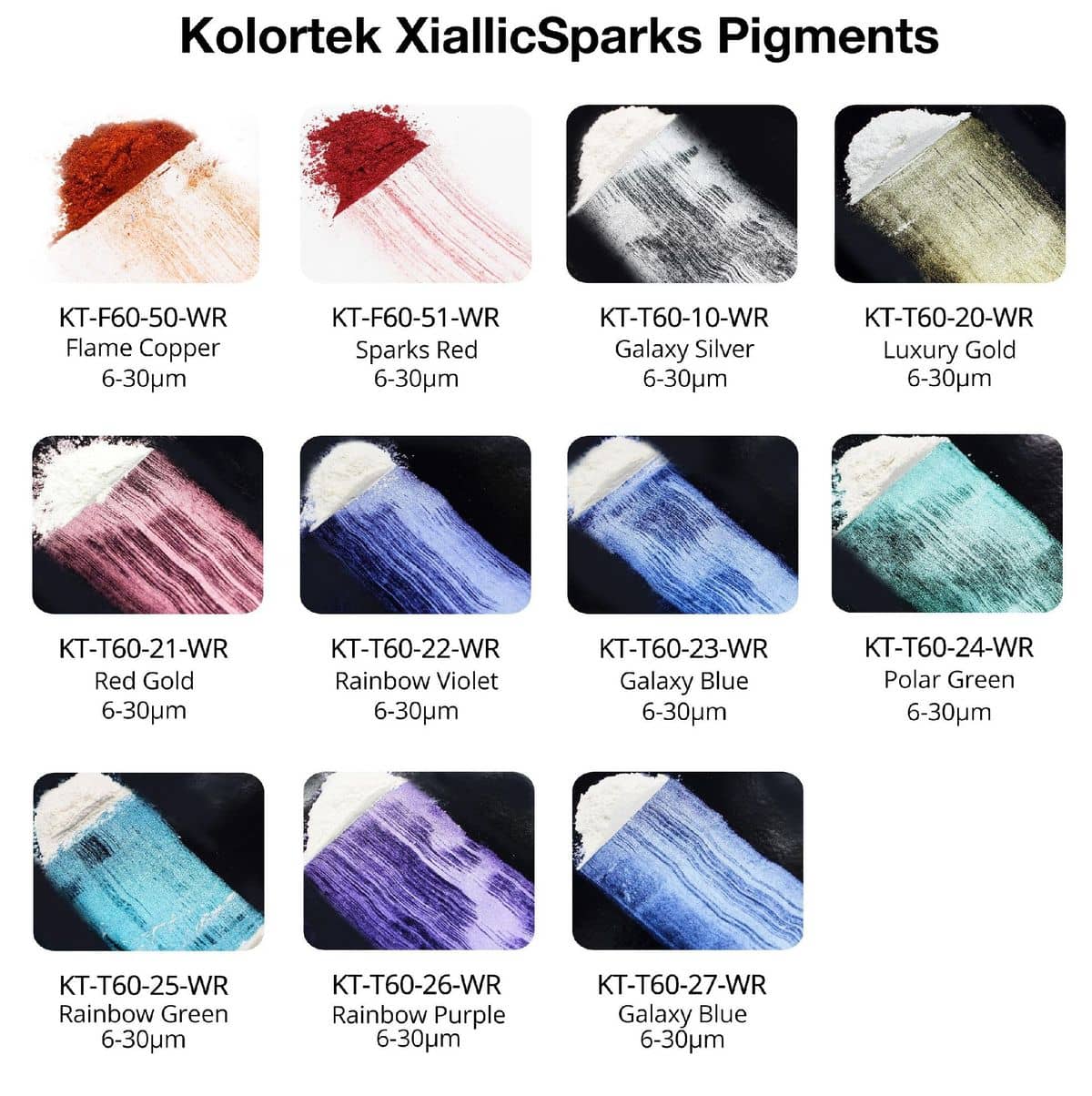
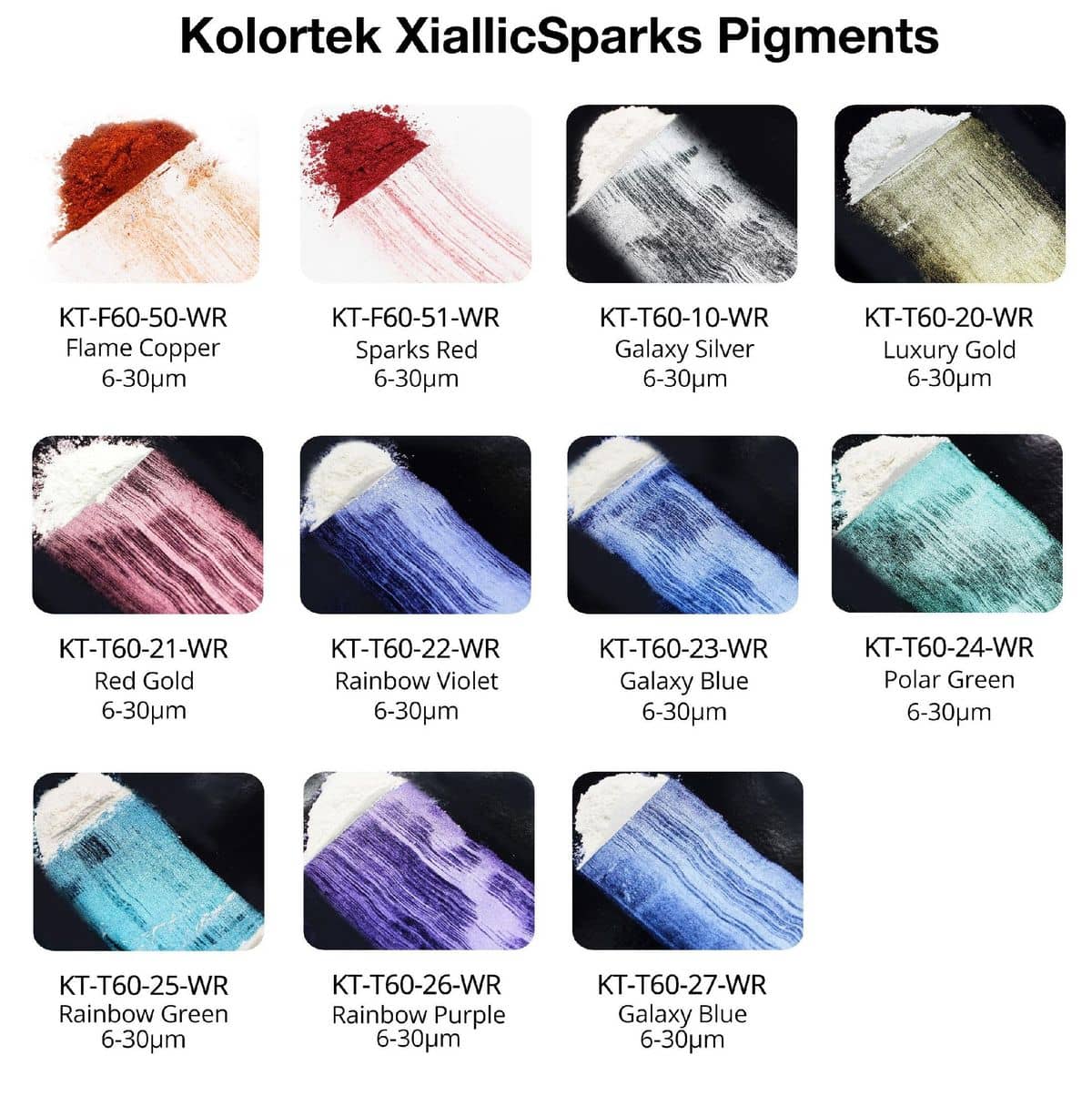
KT-F60-50-WR is one of 11 shades in the XiallicSparks range. All share the same 6–30 μm particle size and alumina flake substrate. The series covers silver, gold, red, blue, green, violet, and purple colorways, giving formulators full palette coverage within a consistent optical platform.
| Product Code | Color |
|---|---|
| KT-F60-50-WR | Flame Copper (this product) |
| KT-F60-51-WR | Sparks Red |
| KT-T60-10-WR | Galaxy Silver |
| KT-T60-20-WR | Luxury Gold |
| KT-T60-21-WR | Radiant Red |
| KT-T60-22-WR | Rainbow Violet |
| KT-T60-23-WR | Galaxy Blue |
| KT-T60-24-WR | Polar Green |
| KT-T60-25-WR | Rainbow Green |
| KT-T60-26-WR | Rainbow Purple |
| KT-T60-27-WR | Galaxy Blue (variant) |
KT-F60-50-WR is engineered for automotive OEM and premium refinish applications. That scope is deliberate — the alumina substrate's optical properties and its cost point make it the right tool for top-line metallic and crystal automotive finishes, not for general decorative work where the standard Kolortek pearlescent series provides better economics.
The pigment is also applicable to high-end industrial coatings, including premium consumer electronics and luxury goods, where an automotive-grade sparkle effect is the target. Outside those contexts, we typically steer customers toward other series.
In automotive basecoat formulations, a loading of 3–8% on total paint weight is the practical working range. The alumina platelets orient flat and parallel to the substrate in liquid coatings, which is what produces the uniform sparkle distribution in the cured film. To maximize the visual impact of the copper crystal effect, apply over a black or dark basecoat — the high transparency of the alumina flakes means the underlying color strongly influences the final appearance.
Multiple thin coats consistently outperform a single heavy coat in terms of platelet orientation and sparkle uniformity. Finish with a high-gloss clearcoat, which both protects the pigment layer and amplifies the crystal effect optically.
Pre-disperse KT-F60-50-WR in a small portion of the binder before incorporating into the bulk system. A Cowles blade or equivalent high-speed disperser works well. One thing to note: avoid milling or any high-shear processing step that could fracture the alumina flakes. Unlike mica, alumina substrates are crystalline, and mechanical damage to the platelet geometry directly degrades the sparkle effect. The same principle applies to recirculation — high-shear pump recirculation loops in production equipment are a common source of platelet damage that formulators don't always trace back to the mixing stage.
For best platelet orientation, work with coating systems that have slow solvent flash and good flow characteristics. Flash-off timing between basecoat and clearcoat is critical — rushing that stage disturbs platelet alignment while the film is still mobile. Avoid over-thinning the basecoat; it can disrupt orientation without improving flow in the way that a properly formulated system with the right solvent profile does.
The XiallicSparks series was developed as a direct functional alternative to Merck Xirallic® effect pigments, sharing the same Al₂O₃ crystal substrate technology that defines that class of effect pigment. KT-F60-50-WR is mapped against Xirallic T60-20 in our internal equivalence table — though we recommend confirming exact shade alignment against your current Xirallic reference panel before committing to a full production switch, since color perception in these high-chroma copper tones can be sensitive to minor coating system differences.
One practical reason customers switch to XiallicSparks: factory-direct supply from Kolortek eliminates distributor margin. We don't publish pricing, but the cost differential for comparable alumina-substrate quality is significant enough that it's consistently cited by automotive coatings customers as the primary evaluation driver — ahead of shade matching.
It's worth being precise about what XiallicSparks replaces: this series is the Xirallic-class alternative. It is not a replacement for Iriodin® grades, which are mica-based and serve a different optical effect category. If you're sourcing an Iriodin equivalent, the relevant Kolortek series are the KT-100 through KT-9000 pearlescent lines.
Kolortek operates under ISO 9001:2015 quality management, covering production and sales across all pigment and glitter lines including XiallicSparks. SDS documentation ships with all product orders as standard practice.
Two areas where we advise direct confirmation rather than assumption: REACH registration for this Al₂O₃-based product requires product-specific verification — the REACH certificate on file at Kolortek covers fluorphlogopite (synthetic mica) grades specifically. Additionally, XiallicSparks are not recommended for cosmetic applications and have not been developed or tested for face-safe certification.
What is the difference between KT-F60-50-WR and a standard mica-based pearlescent pigment?
KT-F60-50-WR uses an aluminum oxide (Al₂O₃) flake substrate with a refractive index of 1.76, compared to roughly 1.58 for natural mica. This higher refractive index, combined with the smooth alumina surface, produces a faceted, mirror-like crystal sparkle with high color purity — categorically different from the soft, diffuse glow of mica-based pearl pigments. It is a non-pearlescent, crystal-effect pigment in the 6–30 μm particle size range.
Is KT-F60-50-WR a direct replacement for Merck Xirallic® flame copper grades?
Yes — KT-F60-50-WR is designed as a xirallic replacement pigment and is mapped against Xirallic T60-20 in the Kolortek equivalence reference. Both use an Al₂O₃ crystal substrate and operate in the same automotive basecoat/clearcoat context. That said, we recommend a panel comparison against your existing Xirallic reference before final approval, particularly for high-chroma copper tones where coating system variables can influence perceived color.
What loading rate and application method gives the best crystal sparkle effect?
In automotive basecoat systems, a loading of 3–8% on total paint weight is recommended. Apply multiple thin coats over a dark or black basecoat to maximize platelet orientation and visual contrast. Top with a high-gloss clearcoat. Avoid high-shear mixing or milling at any stage — fractured alumina platelets reduce sparkle intensity and cannot be recovered in the formulation.
Can KT-F60-50-WR be used in cosmetic formulations?
No. XiallicSparks grades, including KT-F60-50-WR, are not recommended for cosmetic applications. The series has been developed and tested exclusively for automotive and high-end industrial coating systems. Formulators looking for Kolortek cosmetic-grade effect pigments should reference other series designed and certified for that use.
Contact our technical team to discuss formulation requirements or to request a shade panel for your specific automotive coating project.
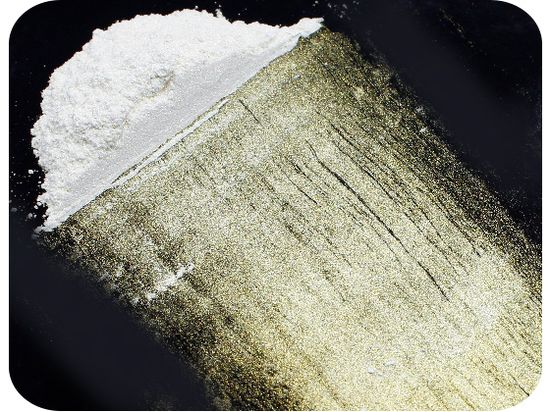
KT-T60-20-WR is Kolortek's direct aluminum oxide gold pigment in the XiallicSparks series — a factory-confirmed equivalent to Merck Xirallic® T60-20. Built on α-Al₂O₃ flakes rather than mica, it delivers a sharp, crystal-effect gold sparkle with exceptional chroma and flake orientation in automotive basecoat/clearcoat systems. Particle size runs 6–30 μm (D50: 9–11 μm), with heat stability to 140–160 °C for 20–30 minutes — fully compatible with standard automotive OEM cure cycles.
Read More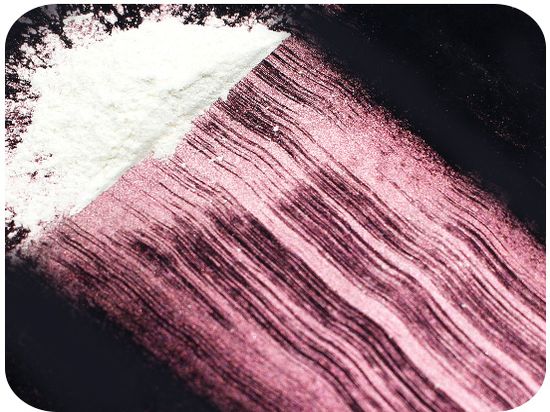
KT-T60-21-WR Radiant Red is a direct xirallic substitute radiant red pigment built on an alumina (Al₂O₃) flake substrate — not mica — producing the faceted, mirror-sharp crystal sparkle that defines the Xirallic® aesthetic. It maps directly to Merck Xirallic® T60-21, making it a 1:1 drop-in reference for formulators working in automotive OEM basecoats or premium refinish systems who need an equivalent shade and optical performance at factory-direct pricing.
Read More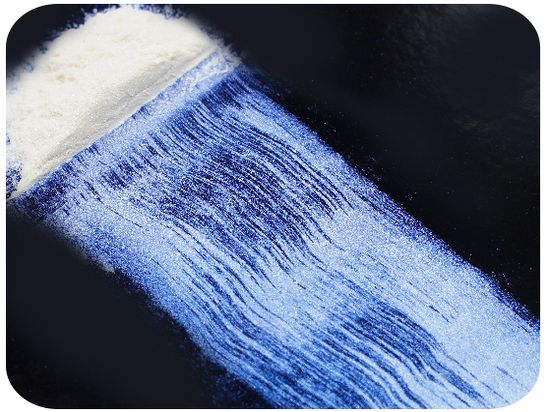
KT-T60-22-WR Rainbow Violet XiallicSparks is our direct equivalent to Xirallic T60-22 — an al2o3 violet effect pigment built on aluminum oxide flake substrate rather than mica. With a refractive index of 1.76 and a 6–30 μm particle size, it produces the sharp, faceted crystal sparkle that defines high-end automotive basecoat finishes. Where mica-based pigments deliver a soft diffuse glow, this grade gives you tight, mirror-like highlights with exceptional chroma and color purity in a Rainbow Violet effect.
Read More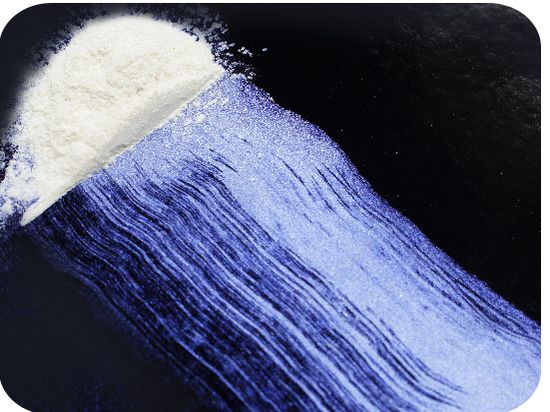
KT-T60-23-WR is our alumina-based xirallic replacement galaxy blue pigment, engineered as a direct drop-in alternative to Merck Xirallic T60-23. Built on a high-refractive-index Al₂O₃ crystal substrate (RI 1.76) with a 6–30 μm particle range, it delivers a faceted, crystal-clear blue sparkle in automotive basecoat systems — the kind of depth and brilliance that mica-based pigments structurally cannot match.
Read More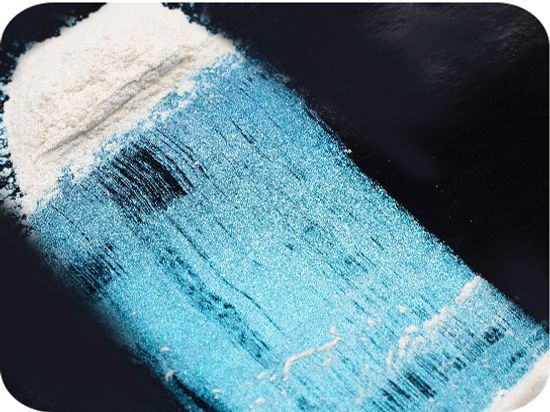
KT-T60-25-WR is an alumina (Al₂O₃) crystal-effect pigment in our XiallicSparks series, producing a vivid Rainbow Green sparkle with the kind of faceted, high-brilliance character you see in top-tier automotive OEM finishes. With a 6–30 μm particle size range and an Al₂O₃ substrate refractive index of 1.76 — significantly higher than standard mica — this rainbow green Al₂O₃ pigment delivers exceptional chroma and clarity in basecoat/clearcoat systems, at factory-direct pricing.
Read More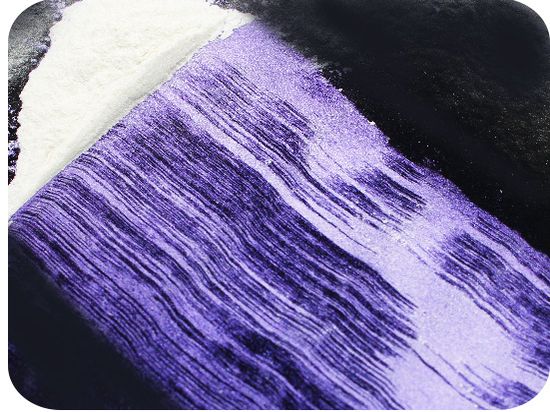
KT-T60-26-WR Rainbow Purple is an alumina-based crystal-effect pigment from our XiallicSparks series, producing a vivid rainbow purple sparkle in automotive basecoat-clearcoat systems. Built on an Al₂O₃ flake substrate — not mica — it delivers higher chroma, sharper highlights, and better flake orientation than conventional pearl pigments. With a particle size range of 6–30 μm and a D50 of 9–11 μm, it is engineered specifically for high-end automotive OEM and refinish applications where a distinct, crystal-like purple sparkle is the design intent.
Read More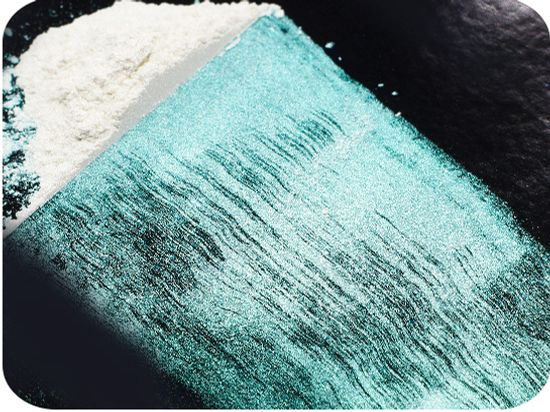
XiallicSparks is Kolortek's line of aluminum oxide effect pigment available in bulk supply, engineered as direct alternatives to Merck Xirallic® in automotive OEM and premium industrial coating applications. Built on an Al₂O₃ flake substrate rather than mica, the series delivers the faceted, crystal-like sparkle that defines high-end automotive finishes — at factory-direct pricing that typically runs 20–40% below Merck equivalents for comparable performance. If you're evaluating a xirallic alternative wholesale source, this is the product line to assess.
Read More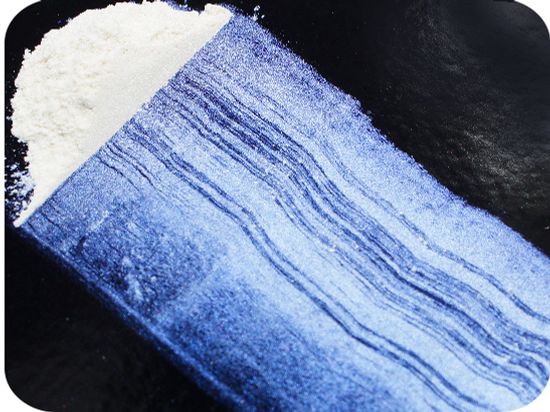
If you're sourcing a xirallic equivalent factory direct and need the same aluminum oxide crystal substrate that drives Merck Xirallic's signature faceted sparkle, Kolortek's XiallicSparks series — product codes KT-T60 and KT-F60 — delivers that effect at 20–40% lower cost than branded equivalents. With eleven grades covering colors from Galaxy Silver to Flame Copper, particle sizes of 6–30 μm, and factory-direct supply from our manufacturing base in China, these are purpose-built alternatives for automotive coating formulators who want performance without the Merck price tag.
Read More
 English
 Français
 Deutsch
 Русский
 Español
 Português