
Leave A Message
If you are interested in our products and want to know more details,please leave a message here,we will reply you as soon as we can.
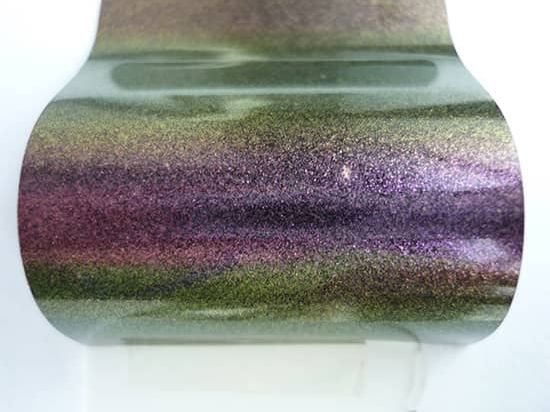
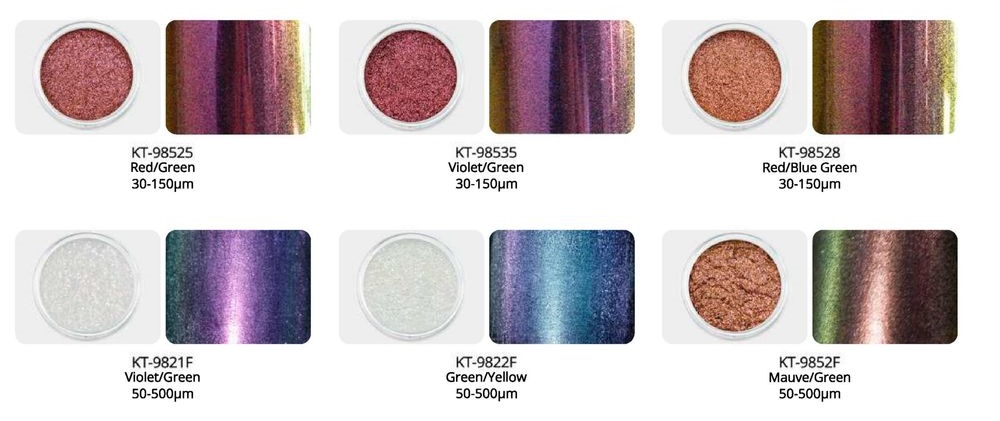
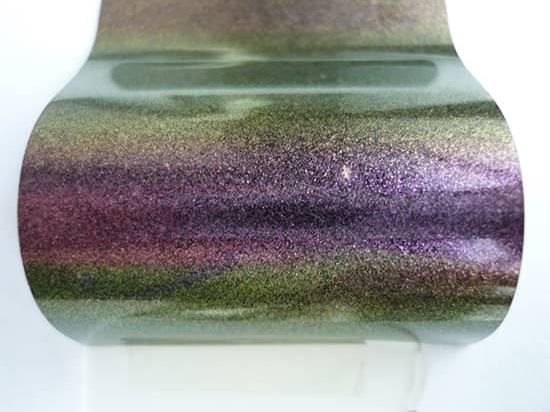
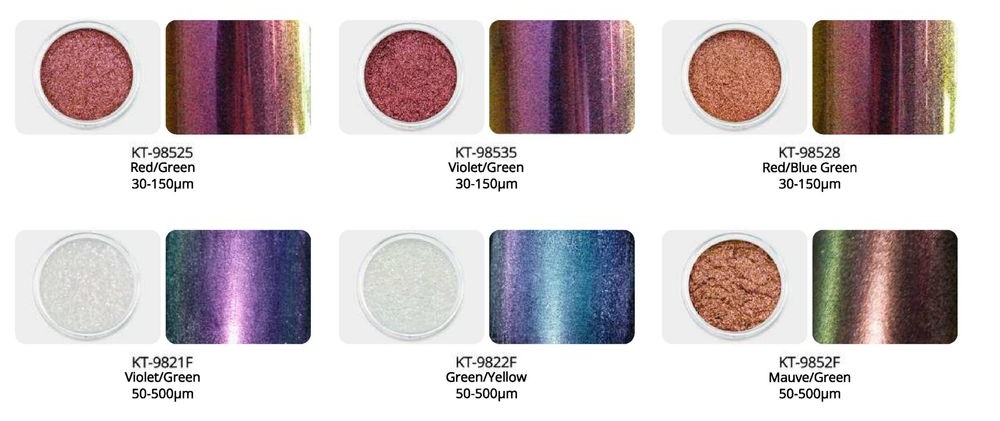
KT-98535 is a violet/green color shift pigment from Kolortek's KT-9000 Magic Chameleon Series — a multi-layer interference pigment built on a natural mica substrate coated with iron oxide and silica. It delivers a sharp goniochromatic shift between violet and green depending on viewing angle, with a particle size range of 30–150 μm (D50: 49–65 μm) and a pH of 6.0–9.0. The effect is most dramatic on dark or black substrates and is well-suited to automotive custom finishes, high-end cosmetics, luxury packaging, and decorative coatings.
The visual behavior of KT-98535 comes from thin-film optical interference across its multi-layer mica structure. As the angle of illumination or observation shifts, the dominant reflected wavelength moves — in this case, cycling between violet and green. That's the defining characteristic of optically variable pigments: the color you see depends entirely on geometry, not on dye chemistry or absorption.
The mica substrate provides the flat, reflective platform needed for coherent interference. The iron oxide and silica coating layers are where the optical path difference is built in. No TiO₂ appears in the KT-98535 composition — the iron oxide and silica combination is what drives this particular violet/green travel. Formulators who've worked with TiO₂-based interference pigments before will notice a slightly different character to the shift: richer, more saturated at the violet end.
One practical point we always flag: this effect is substrate-dependent. On a white or light-colored base, the color travel becomes muted and the interference signal competes with background scattering. On a black or deep-toned substrate, the contrast is sharp and the shift reads cleanly. If you're developing a formulation where the substrate tone is variable, build in a dark interlayer or tinted basecoat.
| Property | Value |
|---|---|
| Form | Powder |
| Colour / Appearance | Violet / Green (angle-dependent) |
| Particle Size Range | 30–150 μm |
| D50 | 49–65 μm |
| Density | 2.7–3.1 kg/L |
| Bulk Density | 23–29 g/100 mL |
| pH (4% H₂O) | 6.0–9.0 |
| Solubility in Water | Insoluble |
| Odour | Odourless |
| MSDS Classification (CLP / 1272/2008) | Not classified |
| Component | C.I. Number | Content |
|---|---|---|
| Mica | CI 77019 | 63.0–68.0% |
| Iron Oxide | CI 77491 | 2.0–12.0% |
| Silica | — | 25.0–30.0% |
| Element | Limit | Element | Limit |
|---|---|---|---|
| As | < 2 ppm | Pb | < 10 ppm |
| Hg | < 1 ppm | Cr | < 100 ppm |
| Ba | < 50 ppm | Sb | < 1 ppm |
| Ni | < 10 ppm | Cu | < 50 ppm |
| Cd | < 3 ppm | Zn | < 50 ppm |
Specific temperature resistance and lightfastness ratings for KT-98535 are not available in our current published data. At the KT-9000 series level, the inorganic iron oxide and metal oxide coatings are heat-stable and light-fast in general use — but the actual limits depend on the coating system and cure conditions. Contact us if you need application-specific stability data for your formulation.
The KT-9000 series was designed primarily around automotive custom finishes and wraps — the application where angle-dependent color travel generates the most commercial value. KT-98535's violet/green travel reads particularly well on vehicle body panels and curved surfaces, where shifting viewing angles are constant and the effect has room to play out across the geometry. We regularly see it specified in custom motorcycle helmet coatings and sporting goods finishes for the same reason.
In cosmetics, duochrome color shifts like violet/green map closely to eyeshadow and nail polish applications. The 30–150 μm particle size range provides strong optical impact at cosmetic film thicknesses, and the inorganic composition (mica, iron oxide, silica) is consistent with cosmetic-grade ingredient requirements. Cosmetic-grade options are available — but specific grade suitability under EU Cosmetics Regulation (EC) No 1223/2009 depends on the selected grade and the intended use; product-specific documentation should be requested before finalizing a formulation.
Beyond automotive and cosmetics, the KT-9000 series is used in luxury packaging and printing, security and anti-counterfeiting applications, synthetic leather coatings, and high-end decorative finishes. The pigment is compatible with most resin systems. For powder coatings, leather coatings, and dispersion paint systems, series-level data confirms suitability — though we recommend running your own compatibility screen in any new binder system before committing to a production run.
Kolortek's quality management system is certified to ISO 9001:2015, covering production and sales of pigments and glitters. REACH compliance documentation is available — note that the supplied REACH registration certificate specifically covers fluorphlogopite (synthetic mica); for natural mica-based grades like KT-98535, product-specific REACH confirmation should be requested. MSDS classification under Regulation (EC) No. 1272/2008 (CLP): not classified.
For cosmetic applications in the EU market, supporting composition documents for grades formulated under EU Cosmetics Regulation (EC) No 1223/2009 are available on request. Final suitability confirmation depends on both the selected grade and the specific cosmetic use category. For US-market cosmetic applications, grades formulated to meet applicable US color-additive requirements are available — establishment registration does not constitute FDA approval, and formulators remain responsible for final compliance assessment.
KT-98535 is an inorganic pigment with no hazard classification under applicable EU chemical regulations. Standard industrial handling precautions apply: provide adequate ventilation, avoid dust generation, and use appropriate PPE (dust mask, gloves, eye protection) where airborne dust is a risk.
What is the particle size of KT-98535, and how does it affect the color shift?
KT-98535 has a particle size range of 30–150 μm with a D50 of 49–65 μm. Larger platelets in this range tend to produce a more vivid, sparkle-forward color travel because individual flakes reflect more light. Finer fractions give a smoother, more satin appearance. In practice, the full 30–150 μm distribution works well for automotive and coating applications where visual impact at distance matters.
Is KT-98535 suitable for cosmetic formulations?
The composition — mica (CI 77019), iron oxide (CI 77491), and silica — is consistent with ingredients commonly used in cosmetic-grade effect pigments. Cosmetic-grade options within the KT-9000 series are available with supporting documentation for EU Cosmetics Regulation (EC) No 1223/2009. Suitability depends on the specific grade and intended use, so we'd recommend requesting product documentation before finalizing any cosmetic formulation.
Why does the violet/green color travel disappear on light-colored substrates?
Optically variable pigments rely on contrast between the reflected interference color and the substrate. On white or light bases, scattered background light competes with and washes out the interference signal, making the shift appear weak or absent. KT-98535, like all KT-9000 series chameleon pigments, performs most effectively over black or dark substrates. If a light base is required, applying a dark interlayer before the pigment-containing coat is the standard solution.
Does KT-98535 contain TiO₂?
No. The KT-98535 TDS composition lists only mica, iron oxide, and silica — no TiO₂. This distinguishes it from TiO₂-based interference pigments and places it in a category where the color travel is driven by the iron oxide and silica coating stack. For formulators working in markets where TiO₂ use is restricted or under review, this is a relevant point to note. Kolortek also offers a dedicated TiO₂-Free Chameleon sub-series within KT-9000 for applications where that distinction matters formally.
Contact our technical team to discuss formulation requirements for your specific application.
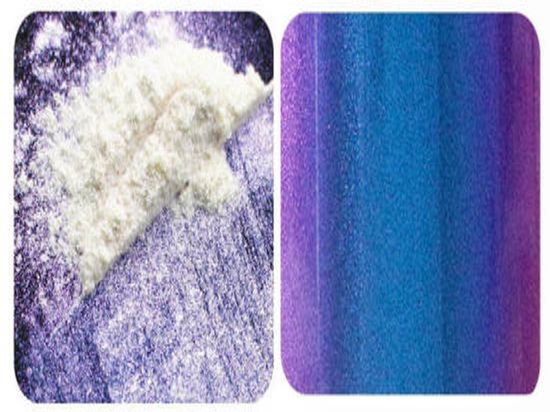
KT-92230 is a multichrome pigment that shifts through a full blue-purple-red-orange sequence as the viewing angle changes — one of the broadest color-travel arcs we produce in the KT-9000 series. Built on a natural mica substrate with a multi-layer TiO₂/Fe₂O₃/silica/tin oxide coating, it comes in a 25–130 μm particle size that delivers strong angular contrast and high visual impact across automotive finishes, decorative coatings, and specialty printing.
Read More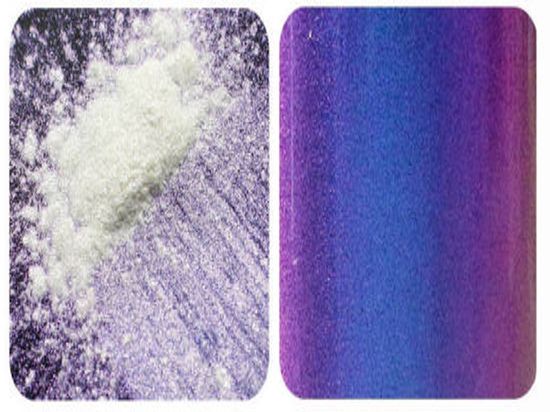
KT-92330 is a multi-layer interference pigment from Kolortek's KT-9000 Magic Chameleon Series, producing a continuous color shift sequence — indigo through purple, red, orange, and yellow — as the viewing angle changes. Built on natural mica coated with TiO₂, silica, and tin oxide, it delivers a high-mirror goniochromatic effect with a 25–130 μm particle size distribution engineered for maximum visual impact. This color shifting pigment powder performs best over dark or black substrates, where the full angular color travel is most legible.
Read More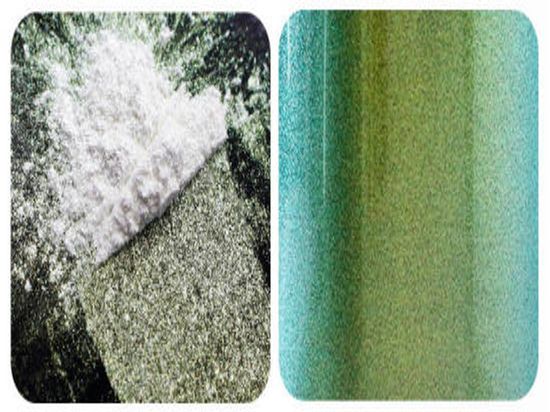
KT-92630 is a large-particle chameleon paint pearl from our KT-9000 Magic Chameleon Series, producing a sequential golden-to-kelly-green-to-blue color travel as the viewing angle shifts. With a 25–130 μm particle range, it delivers high visual impact in automotive custom finishes, decorative coatings, and specialty applications where a pronounced, multi-stop color flip is the goal. The substrate is natural mica with a multi-layer TiO₂/SiO₂/metal-oxide coating that generates the goniochromatic interference effect.
Read More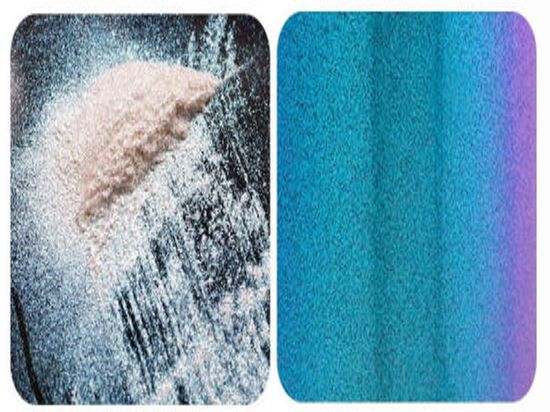
KT-92175 is the large-particle grade of our chameleon pigment for resin, built on a natural mica substrate with a multi-layer TiO₂, silica, and tin oxide coating that produces a continuous cyan-to-blue-to-purple-to-red angle-dependent color shift. At 75–175μm, it is the highest-sparkle option in the KT-9000 Magic Chameleon Series' KT-921** Cyan-Blue-Purple-Red range. Compatible with epoxy and UV resin at loadings of 1–10% by weight, the effect reads strongest on dark or black substrates where the goniochromatic shift has maximum contrast.
Read More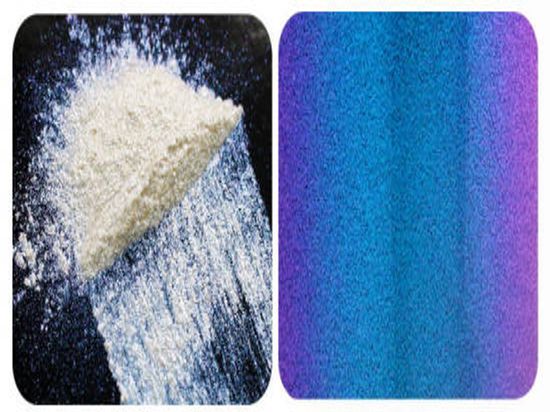
KT-92275 is a large-particle duochrome loose pigment from our KT-9000 Magic Chameleon Series, delivering a full blue-purple-red-orange color travel sequence that shifts continuously across the visible spectrum as the viewing angle changes. With a particle size range of 75–175 μm, this grade is engineered specifically for applications where maximum sparkle is the priority — loose eyeshadow, nail art toppers, and high-impact decorative cosmetics where the angular shift needs to read clearly against the skin or a dark base.
Read More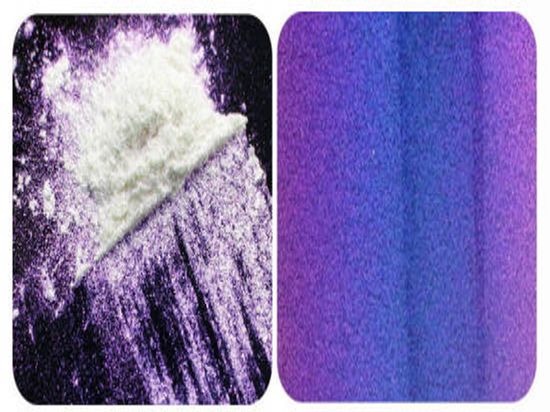
KT-92375 is a large-particle ghost chameleon pigment from Kolortek's KT-9000 Magic Chameleon Series, delivering a continuous five-stage color shift — indigo → purple → red → orange → yellow — as the viewing angle changes. Built on natural mica coated with titanium dioxide, silica, and tin oxide, it carries a particle size of 75–175 μm for maximum sparkle. We developed this grade specifically for high-impact automotive finishes, custom coatings, and luxury decorative applications where a dramatic, angle-dependent color shift is the primary design goal.
Read More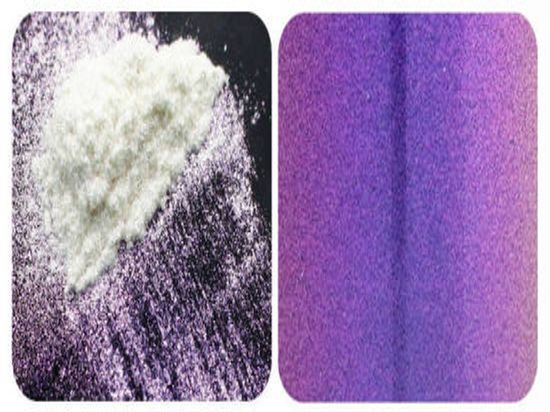
KT-92475 is a large-particle chameleon pigment from the KT-9000 Magic Chameleon Series, producing a continuous mauve → red → orange → yellow color shift that sweeps across the visible spectrum as the viewing angle changes. With a particle size of 75–175 μm and a natural mica substrate coated with titanium dioxide, silica, and tin oxide, it delivers the coarse, high-sparkle texture that nail art formulators need for maximum visual drama — particularly over a dark or black base coat.
Read More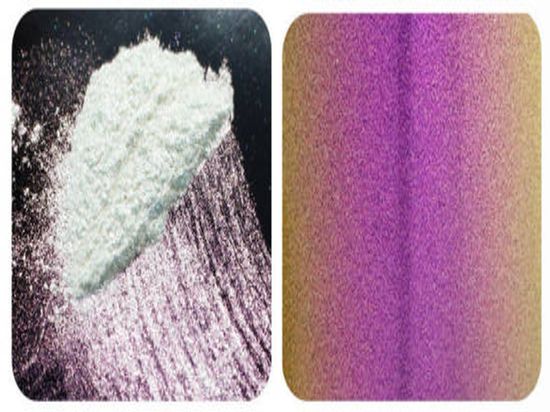
KT-92575 is a large-flake chameleon pearl powder from our KT-9000 Magic Chameleon Series, producing a dramatic angle-dependent color shift spanning red, orange, yellow, and kelly green on dark substrates. Built on a natural mica substrate with a multi-layer coating of titanium dioxide, silica, and tin oxide, it delivers an INCI composition suited to high-end cosmetic and nail art formulations. The 75–175 μm particle range gives it the high-sparkle, deep color-travel behavior that distinguishes it from finer cosmetic pearl grades.
Read More
 English
 Français
 Deutsch
 Русский
 Español
 Português