
Leave A Message
If you are interested in our products and want to know more details,please leave a message here,we will reply you as soon as we can.
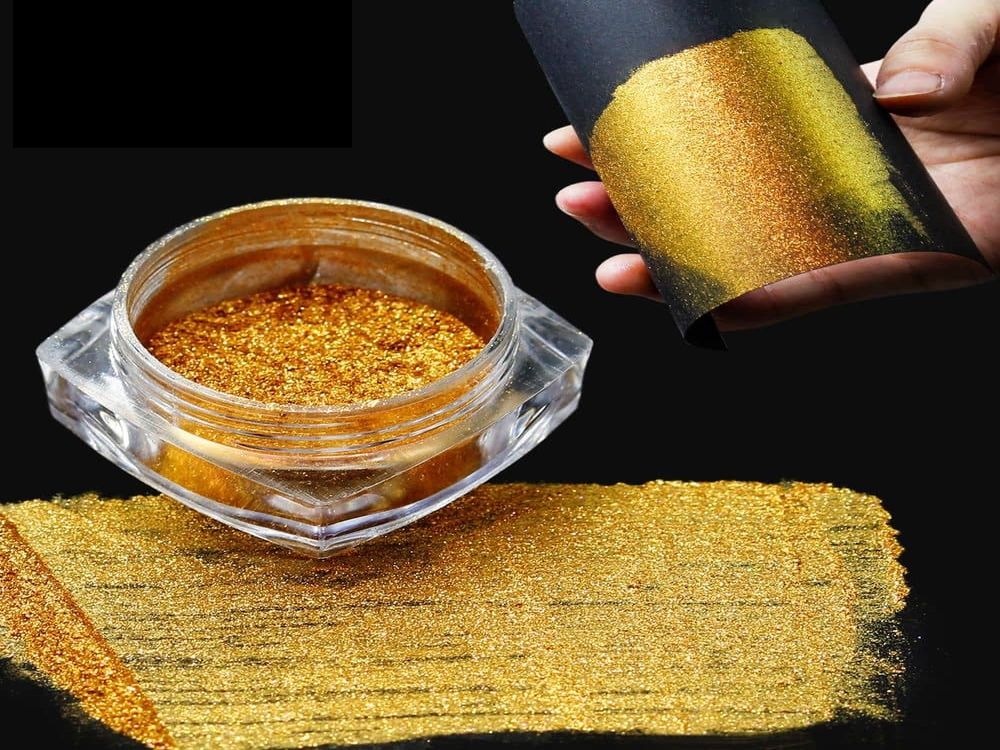
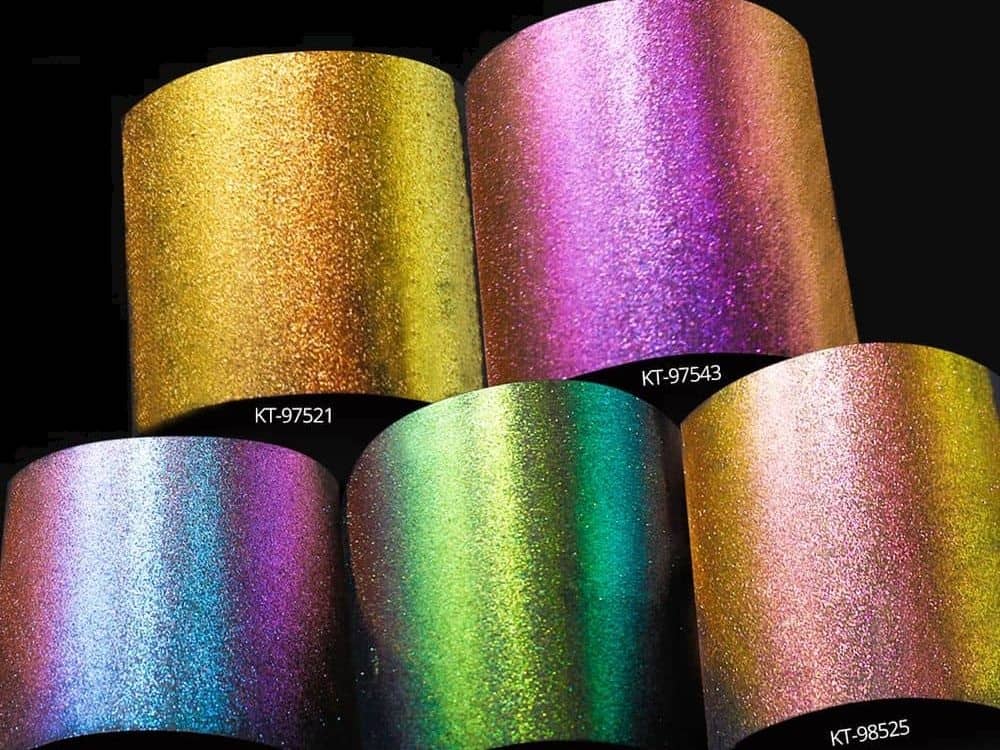
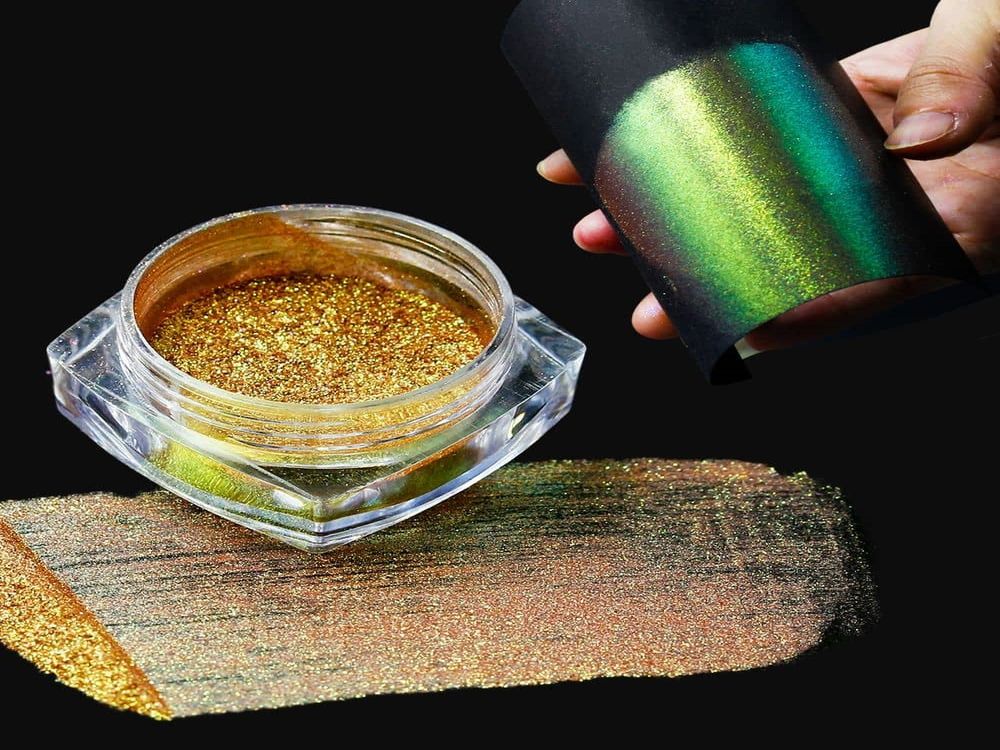
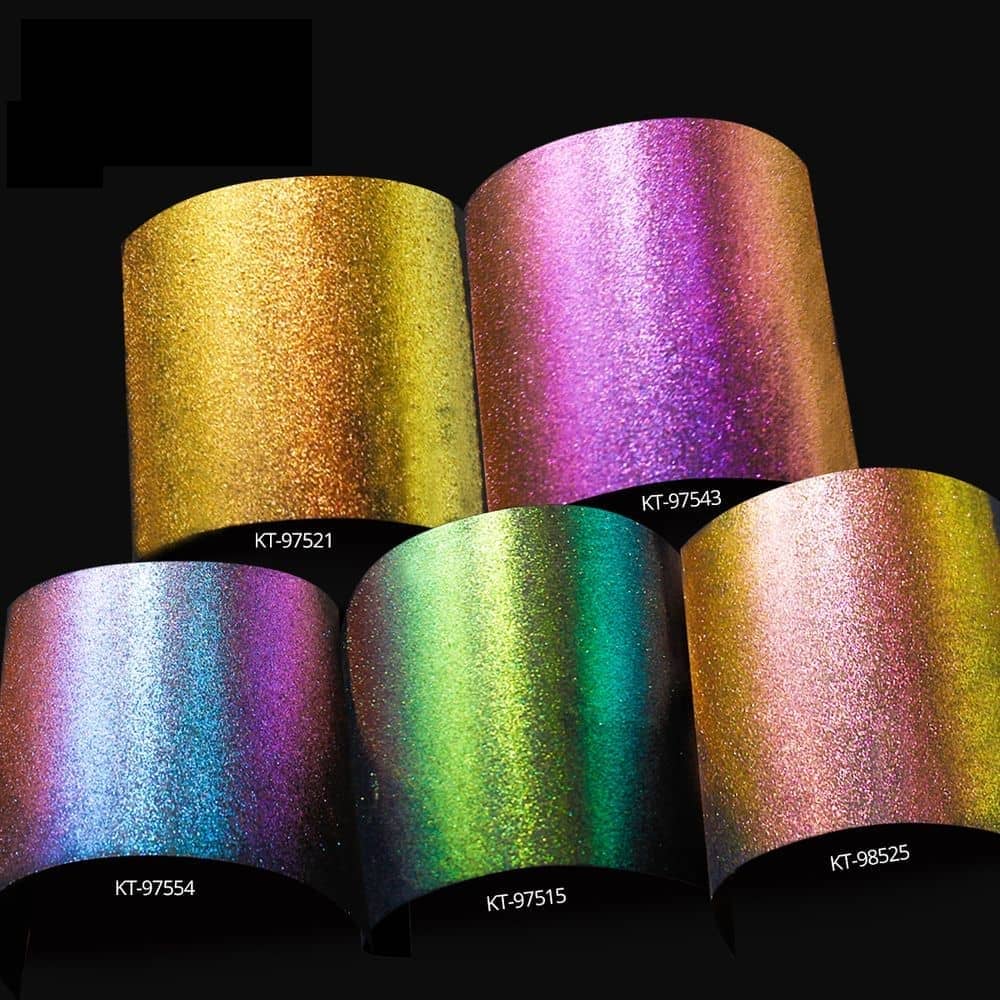
Dynamic color shift chameleon pigment produces a dramatic, angle-dependent color travel effect — where the observed hue shifts continuously as the viewing or light angle changes. At Kolortek, we supply this effect through the KT-9000 Magic Chameleon Series: multi-layer iron oxide and metal oxide coatings on natural mica, available in duochrome (two-color) and multicolor (three-plus color) variants across particle sizes from 5–25μm up to 100–250μm. The effect is most striking on dark or black substrates and is widely specified in automotive custom finishes, high-end cosmetics, luxury packaging, and anti-counterfeiting applications.
Conventional pearlescent and metallic pigments produce a single luster or color from any angle. A chameleon pigment — also described as a goniochromatic pigment — works differently: the interference color shifts as the observation angle moves relative to the light source. The effect results from destructive and constructive light interference across multiple thin-film oxide layers deposited on the mica substrate. As the angle changes, the effective optical path through those layers changes, and so does the dominant reflected wavelength.
In practice, this means a single coated surface can display cyan at face angle, transition through blue and purple at mid-angle, and arrive at red or orange at a steep flop angle — all from the same particle. The visual range and smoothness of that transition depend on the specific coating stack and particle size. Larger particles (75–175μm, 100–250μm) deliver maximum sparkle and a more distinct, dramatic flop. Finer grades (5–25μm, 10–40μm) produce a satiny, softer transition better suited to cosmetics and fine-detail printing inks.
One consistent formulation requirement: the effect requires a dark or black background. On white or light substrates, the transmitted light washes out the interference contrast and the color shift becomes subtle to invisible. This isn't a product limitation — it's a physical property of thin-film interference optics, and it applies to all goniochromatic pigments regardless of supplier.
The clear duochrome grades cover six distinct color travel axes. Each base code is available with nine particle size suffixes, giving formulators precise control over the visual intensity and texture of the final effect.
| Base Code | Color Travel Sequence |
|---|---|
| KT-921xx | Clear Cyan → Blue → Purple → Red |
| KT-922xx | Clear Blue → Purple → Red → Orange |
| KT-923xx | Clear Indigo → Purple → Red → Orange → Yellow |
| KT-924xx | Clear Mauve → Red → Orange → Yellow |
| KT-925xx | Clear Red → Orange → Yellow → Kelly Green |
| KT-926xx | Clear Golden → Kelly Green → Green → Blue |
The two-digit suffix in the model code specifies particle size. The table below covers all available size options:
| Suffix | Particle Size (μm) | Typical Use |
|---|---|---|
| 02 | 5–25 | Inks, cosmetics (satin finish) |
| 04 | 10–40 | Fine pearl, cosmetics, printing |
| 06 | 10–60 | Standard coatings (most popular) |
| 07 | 10–70 | Medium effects, coatings |
| 15 | 20–100 | Flash effects |
| 25 | 25–130 | High visual impact |
| 30 | 25–130 | High visual impact |
| 75 | 75–175 | Large particle, maximum sparkle |
| 100 | 100–250 | Extra large, decorative finishes |
For a standard automotive base coat or decorative coating application, the 06 suffix (10–60μm) is the starting point most of our customers use. It balances color travel visibility with smooth film build. For nail art, body powder, or cosmetic applications, the 02 suffix (5–25μm) is the right call — finer dispersion, better skin feel, and compatibility with cosmetic binder systems.
For formulations where TiO₂ is restricted or undesirable — whether for regulatory reasons or specific optical targets — the KT-951xx and KT-985xx sub-series use an Fe₂O₃ + Silica coating system without titanium dioxide. Color travel options span blue-green through violet-red and red/green, across particle sizes from 5–25μm through 100–250μm. KT-90507 (Orange/Cyan, 20–80μm) is a notable standalone in this group for formulators looking for a warm-to-cool shift axis.
The multicolor grades extend the color travel to three or more distinct hues across the viewing arc. The KT-972106 (Golden Green), KT-972206 (Red Golden), KT-973206 (Violet Red), and KT-974206 (Blue Violet) are all supplied at the 10–60μm standard particle size. Broader sub-series under KT-96000, 97000, 98000, 98500, 96500, 96300, and 96200 expand color coverage further — contact us for a current shade card if you're targeting a specific shift sequence that isn't covered by the clear chameleon range.
View our complete chameleon pigment catalog: Kolortek Chameleon Pigment Catalog
| Parameter | Value / Notes |
|---|---|
| Substrate | Natural mica |
| Coating system | Multi-layer TiO₂ + Fe₂O₃ + Silica + metal oxides (TiO₂-free variants: Fe₂O₃ + Silica) |
| Particle size options (μm) | 5–25 / 10–40 / 10–60 / 10–70 / 20–80 / 20–100 / 25–130 / 75–175 / 100–250 |
| Density | ~2.9–3.2 g/cm³ |
| Lightfastness | Light-fast (inorganic coating system — iron oxide and metal oxides) |
| Heat stability | Heat stable; specific threshold varies by coating system — confirm with our technical team for your resin |
| Optimal substrate color | Dark/black (interference contrast is suppressed on light substrates) |
| Chemical/pH stability | Not published — request SDS for your specific grade |
Because the color travel effect relies entirely on the integrity of those thin oxide layers, density and particle geometry are stable manufacturing targets — but pH and chemical resistance data vary enough by coating system that we don't publish a single blanket figure. The SDS shipped with every order covers safety handling; for formulation compatibility testing, reach out to our lab.
Automotive is the largest single application for the KT-9000 series. The curved geometry of body panels and helmets naturally generates the viewing angle variation that makes the color travel visible — which is exactly why this effect reads so compellingly on cars and motorcycles. A clear topcoat is always required to protect the pigment layer and maintain optical clarity. Without it, the interference film degrades over time from UV and mechanical abrasion.
For spray application, the 10–60μm grade (suffix 06) is the standard starting point. For custom show finishes where maximum sparkle and visual drama are the goal, moving to the 75–175μm or 100–250μm grades produces a coarser, higher-energy flake effect that's unmistakable at distance.
Cosmetic-grade variants within the KT-9000 series are formulated to meet EU EC 1223/2009 requirements where applicable — though suitability always depends on the specific grade and intended regional market. For face, eye, and nail applications, the 5–25μm particle size (suffix 02) is the correct specification: fine enough for smooth skin adhesion, compatible with most cosmetic binder and gel systems, and capable of delivering the full color shift in nail topcoats and pressed powder formats.
A key consideration for nail art specifically: the dark base requirement translates naturally — most nail art using this effect is applied over black, deep navy, or opaque dark gel bases to maximize the shift visibility.
Fine-particle grades (5–25μm) are specified for printing ink systems — offset, gravure, and screen — where they add overt goniochromatic authentication features to packaging and documents. The color shift is not reproducible by standard four-color printing or photocopying, which makes these pigments useful in anti-counterfeiting designs alongside other security features. Luxury cartons, cosmetic outer packaging, and premium labels are all established end-uses.
Chameleon pigments are compatible with most resin systems used in coatings and cosmetics. One technique worth noting: combining KT-9000 series pigment with a transparent absorption pigment can modify both the base apparent color and the effective shift range. For example, adding a transparent yellow toner to a KT-925xx (Red–Orange–Yellow–Green shift) system shifts the perceived start color warmer and can extend the visible green flop. This is a common approach in automotive tinting where a customer wants a specific "face-angle" color but still needs the full color travel arc.
Higher pigment loading does increase the perceived intensity of the color shift — but beyond a certain threshold, film smoothness suffers and the effect can appear grainy rather than flowing. The optimal loading depends on particle size and binder system; we recommend running a loading curve in your formulation before committing to a production ratio.
For dispersion: avoid high-shear equipment that can fracture the mica platelets and reduce particle size distribution. Gentle paddle mixing or low-speed dispersers at the letdown stage preserve the aspect ratio that drives interference efficiency. Full dispersion guidelines and SDS documentation are available with every shipment.
Kolortek operates under ISO 9001:2015 certification covering production and sales of pigments and fillers. REACH registration covers fluorphlogopite (synthetic mica) grades; for natural mica grades, product-specific compliance confirmation is required. Cosmetic-grade options within this series are available for applications targeting EU EC 1223/2009 compliance — grade selection and intended end-use both determine suitability. US FDA color-additive requirements are addressed in grades specifically formulated for those markets.
SDS documentation ships with all orders. SGS sample test reports are available on request for specific grades. For applications in regulated categories — cosmetics, food-contact packaging, or pharmaceutical packaging — always confirm compliance at the grade level, not the series level.
What is the difference between a duochrome pigment and a multicolor chameleon pigment?
A duochrome pigment shifts between two primary colors across the viewing angle — for example, cyan to red (KT-921xx) or red to green (KT-985xx). A multicolor chameleon pigment travels through three or more distinct hues, such as golden to green to blue. In the KT-9000 series, the KT-921 through KT-926 codes are duochrome; the KT-96000/97000/98000 sub-series are multicolor. The choice depends on whether you need a clean two-tone contrast or a flowing multi-hue spectrum.
Does cyan chameleon pigment work on light-colored substrates?
Not effectively. The KT-921xx cyan chameleon pigment — and all KT-9000 series chameleon pigments — rely on thin-film interference to generate their color shift. On white or pale substrates, transmitted light scatters back through the pigment layer and washes out the interference contrast. The color travel becomes faint to invisible. Dark or black substrates are required to see the full cyan-to-red or cyan-to-blue-purple shift clearly.
Which particle size should I specify for a chameleon pigment in a spray coating application?
The 10–60μm grade (suffix 06 in the KT-9000 model code) is the most commonly specified size for spray coating applications — it balances color travel intensity with practical film build and spray atomization. For automotive show finishes or decorative applications where maximum sparkle is the objective, the 75–175μm (suffix 75) or 100–250μm (suffix 100) grades are used. For printing inks, the 5–25μm grade (suffix 02) is required for printhead and press compatibility.
Are there TiO₂-free options in Kolortek's chameleon pigment range?
Yes. The KT-951xx and KT-985xx series use an Fe₂O₃ + Silica coating system without titanium dioxide. These cover color travel axes including blue-green through violet-red and red/green shifts, available from 5–25μm through 100–250μm particle sizes. KT-90507 (Orange/Cyan, 20–80μm) is also TiO₂-free. These grades address both regulatory preferences and specific optical targets where TiO₂ would alter the interference behavior.
Contact our technical team to discuss formulation requirements or request a sample card for your specific application.
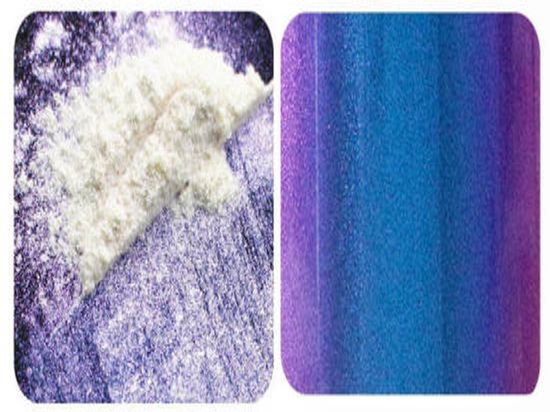
KT-92230 is a multichrome pigment that shifts through a full blue-purple-red-orange sequence as the viewing angle changes — one of the broadest color-travel arcs we produce in the KT-9000 series. Built on a natural mica substrate with a multi-layer TiO₂/Fe₂O₃/silica/tin oxide coating, it comes in a 25–130 μm particle size that delivers strong angular contrast and high visual impact across automotive finishes, decorative coatings, and specialty printing.
Read More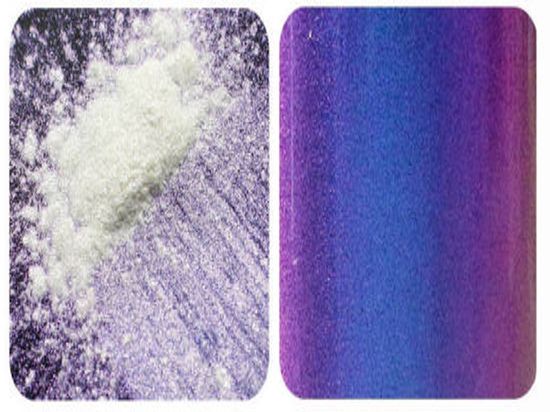
KT-92330 is a multi-layer interference pigment from Kolortek's KT-9000 Magic Chameleon Series, producing a continuous color shift sequence — indigo through purple, red, orange, and yellow — as the viewing angle changes. Built on natural mica coated with TiO₂, silica, and tin oxide, it delivers a high-mirror goniochromatic effect with a 25–130 μm particle size distribution engineered for maximum visual impact. This color shifting pigment powder performs best over dark or black substrates, where the full angular color travel is most legible.
Read More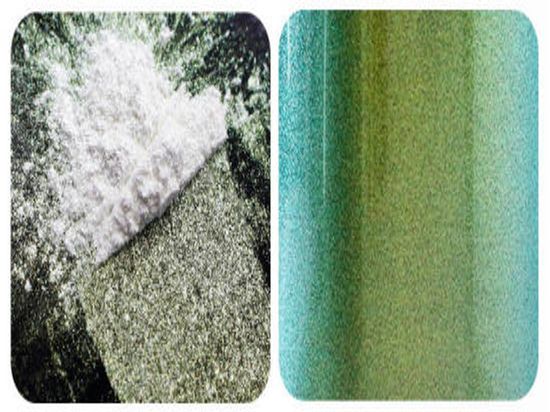
KT-92630 is a large-particle chameleon paint pearl from our KT-9000 Magic Chameleon Series, producing a sequential golden-to-kelly-green-to-blue color travel as the viewing angle shifts. With a 25–130 μm particle range, it delivers high visual impact in automotive custom finishes, decorative coatings, and specialty applications where a pronounced, multi-stop color flip is the goal. The substrate is natural mica with a multi-layer TiO₂/SiO₂/metal-oxide coating that generates the goniochromatic interference effect.
Read More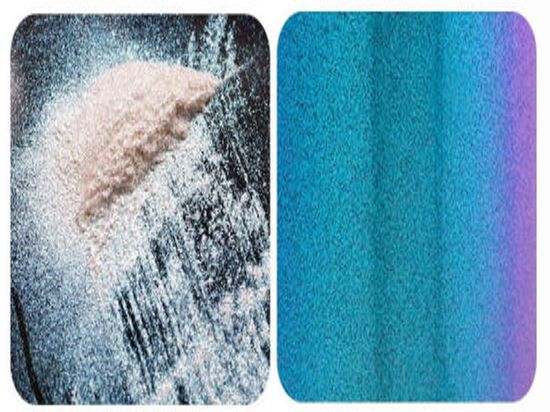
KT-92175 is the large-particle grade of our chameleon pigment for resin, built on a natural mica substrate with a multi-layer TiO₂, silica, and tin oxide coating that produces a continuous cyan-to-blue-to-purple-to-red angle-dependent color shift. At 75–175μm, it is the highest-sparkle option in the KT-9000 Magic Chameleon Series' KT-921** Cyan-Blue-Purple-Red range. Compatible with epoxy and UV resin at loadings of 1–10% by weight, the effect reads strongest on dark or black substrates where the goniochromatic shift has maximum contrast.
Read More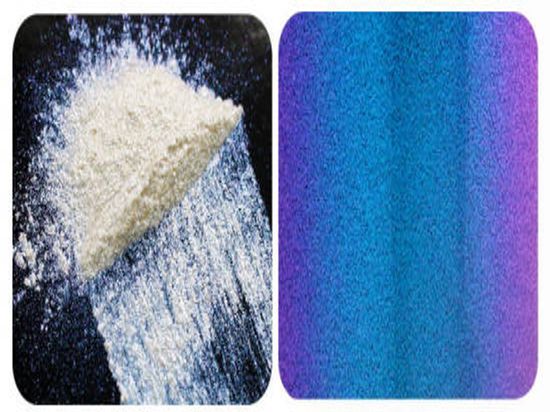
KT-92275 is a large-particle duochrome loose pigment from our KT-9000 Magic Chameleon Series, delivering a full blue-purple-red-orange color travel sequence that shifts continuously across the visible spectrum as the viewing angle changes. With a particle size range of 75–175 μm, this grade is engineered specifically for applications where maximum sparkle is the priority — loose eyeshadow, nail art toppers, and high-impact decorative cosmetics where the angular shift needs to read clearly against the skin or a dark base.
Read More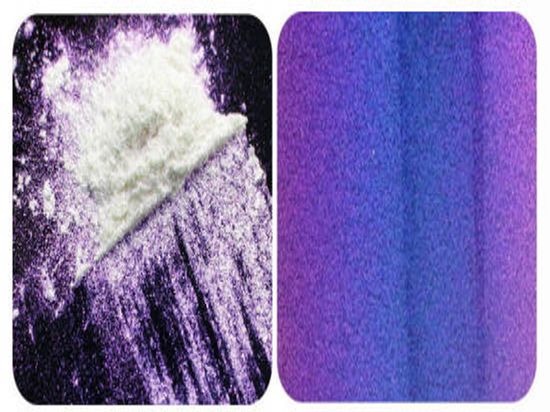
KT-92375 is a large-particle ghost chameleon pigment from Kolortek's KT-9000 Magic Chameleon Series, delivering a continuous five-stage color shift — indigo → purple → red → orange → yellow — as the viewing angle changes. Built on natural mica coated with titanium dioxide, silica, and tin oxide, it carries a particle size of 75–175 μm for maximum sparkle. We developed this grade specifically for high-impact automotive finishes, custom coatings, and luxury decorative applications where a dramatic, angle-dependent color shift is the primary design goal.
Read More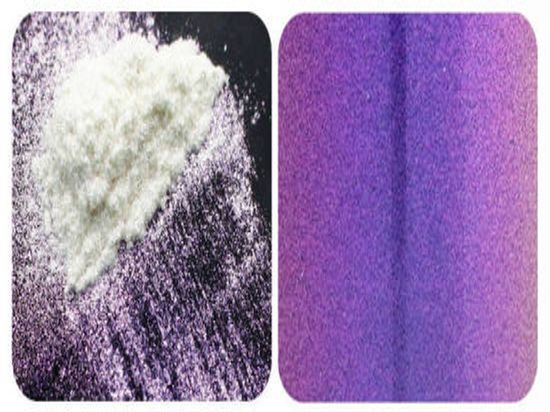
KT-92475 is a large-particle chameleon pigment from the KT-9000 Magic Chameleon Series, producing a continuous mauve → red → orange → yellow color shift that sweeps across the visible spectrum as the viewing angle changes. With a particle size of 75–175 μm and a natural mica substrate coated with titanium dioxide, silica, and tin oxide, it delivers the coarse, high-sparkle texture that nail art formulators need for maximum visual drama — particularly over a dark or black base coat.
Read More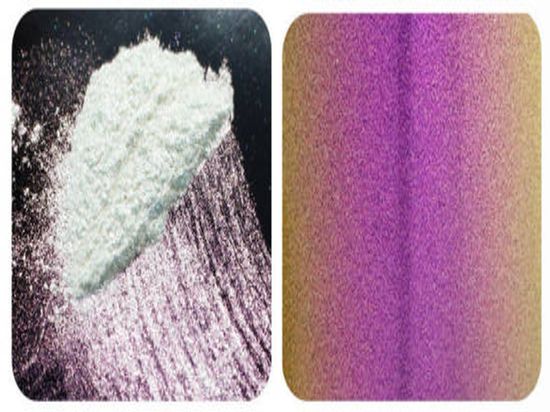
KT-92575 is a large-flake chameleon pearl powder from our KT-9000 Magic Chameleon Series, producing a dramatic angle-dependent color shift spanning red, orange, yellow, and kelly green on dark substrates. Built on a natural mica substrate with a multi-layer coating of titanium dioxide, silica, and tin oxide, it delivers an INCI composition suited to high-end cosmetic and nail art formulations. The 75–175 μm particle range gives it the high-sparkle, deep color-travel behavior that distinguishes it from finer cosmetic pearl grades.
Read More
 English
 Français
 Deutsch
 Русский
 Español
 Português