
Leave A Message
If you are interested in our products and want to know more details,please leave a message here,we will reply you as soon as we can.
Red Thermochromic Pigment, Color Changing at 16°C, 1–10μm – KTP-16-BR
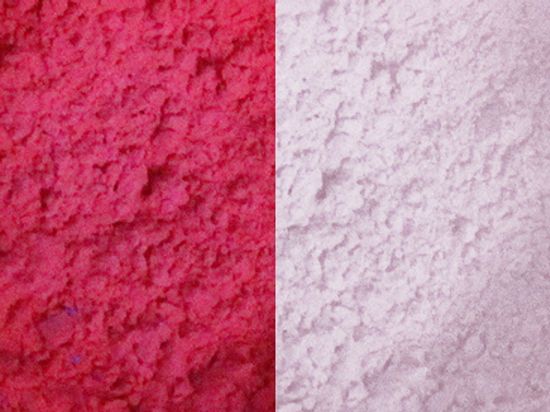
KTP-16-BR is a Red thermochromic pigment with an activation temperature of 16°C, in the fine 1–10μm particle size range — a leuco dye-based color-changing pigment that is red below 16°C and becomes colorless as temperature rises above the activation threshold.
Item No. :
KTP-16-BRColor Effect :
Red 16℃Particle Size :
1-10μmBrand :
Kolortek / OEMMOQ :
1KGApplication :
Packaging, Printing Inks, Cosmetics, Textiles, Toys, Paints & Coatings, Food Contact (BPA-free series), Safety Indicators
Red Thermochromic Pigment, Color Changing at 16°C, 1–10μm – KTP-16-BR
Special Effect Pigments › Thermochromic Pigment Series
KTP-16-BR is a Red thermochromic pigment with an activation temperature of 16°C, in the fine 1–10μm particle size range — a leuco dye-based color-changing pigment that is red below 16°C and becomes colorless as temperature rises above the activation threshold. The 16°C switching temperature is the lowest in the Kolortek thermochromic range, making KTP-16-BR specifically suited for applications that respond to cool or cold conditions — cold beverages, refrigerated packaging, outdoor temperature indicators, and smart labels designed to signal whether a product has been adequately chilled. At 1–10μm, it disperses in printing inks, coatings, and plastic systems without visible particle texture in thin films.
KTP-16-BR belongs to the Colored-to-Colorless (C2C) class of thermochromic pigments. Below the activation temperature, the leuco dye within the microcapsule is in its colored (red) state. As temperature rises through the activation threshold (~16°C), an interaction within the encapsulated system causes the dye to adopt a colorless form — the red disappears and the underlying substrate, base coat, or design becomes visible. The effect is reversible: cooling below 16°C restores the red color. The transition is sharp and repeatable under normal use conditions.
The practical design implication is straightforward: at typical refrigerator temperature (4–8°C), KTP-16-BR is fully red. At room temperature (20°C+), it is fully colorless. The transition occurs across the 16°C threshold. Formulators can design graphics, text, or color layers that appear only when cold and disappear at ambient temperature — a temperature-responsive indicator built directly into the ink or coating.
| Item No. | Color | Activation Temp. | Typical Use Context |
|---|---|---|---|
| KTP-16-BR | Red | 16°C | Cold beverage / refrigerator indicator |
| KTP-17-MG | Malachite Green | 17°C | Cold-activated green indicators |
| KTP-18-BY | Yellow | 18°C | Cold temperature indication |
| KTP-22-GY | Gold Yellow | 22°C | Near-ambient switching |
| KTP-30-SB | Sapphire Blue | 30°C | Body/skin temperature indication |
| KTP-31-BR / KTP-31-RBF | Red / Red (BPA Free) | 31°C | Body temperature, mood products |
| KTP-45-BR | Red | 45°C | Hot liquid / heat warning indication |
Color-to-color shift grades (e.g., KTP-30-BR Black-Red, KTP-30-GY Green-Yellow) and BPA Free food-grade grades (KTP-31-RBF, KTP-31-GBF and others) are available. Contact Kolortek for the full thermochromic color and temperature range.
| Parameter | Value / Notes |
|---|---|
| Item No. | KTP-16-BR |
| Color (below activation temp.) | Red |
| Color (above activation temp.) | Colorless — reveals underlying substrate or base coat |
| Activation Temperature | 16°C — lowest activation point in the Kolortek thermochromic range |
| Change Type | Colored to Colorless (reversible) |
| Pigment Technology | Microencapsulated leuco dye system |
| Particle Size | 1–10μm |
| Form | Microencapsulated powder |
| Reversibility | Fully reversible — repeated thermal cycling under normal conditions |
| Binder Compatibility | Water-based, solvent-based, UV-curable inks and coatings — confirm compatibility with specific systems |
| BPA Status | Standard grade — for BPA Free food-grade applications, specify KTP-31-RBF or other BPA Free series |
| Documentation | TDS, SDS on request |
| Brand | Kolortek |
16°C activation — the cold-indicator specification: The 16°C threshold is positioned between typical refrigerator temperature (4–8°C) and ambient room temperature (20–25°C). This means KTP-16-BR is reliably red when a product is cold and reliably colorless at room temperature — a clean binary visual signal with a practical margin on both sides of the transition point. For cold beverage cans, bottle labels, and refrigerator-activated packaging, this threshold is more appropriate than the more common 31°C body-temperature grades, which would remain colored at refrigerator and ambient conditions without activating until warm skin contact.
Microencapsulation — the enabling technology: The leuco dye system in KTP-16-BR is contained within polymer microcapsules (1–10μm). The capsule provides the controlled chemical environment necessary for the thermochromic reaction and protects the active chemistry from direct contact with the binder, solvent, or substrate. Capsule integrity is critical to performance — high-shear mixing, grinding, or mechanical stress that ruptures the capsules permanently disables the thermochromic function. This is the primary processing constraint that distinguishes thermochromic pigments from conventional pigments.
Designing with color-to-colorless change: KTP-16-BR becomes colorless above 16°C, which means the visual design depends entirely on what is underneath. A white substrate produces a white surface at room temperature; a printed graphic under the thermochromic layer is revealed when the red disappears at warm temperatures. Conversely, a black base coat under KTP-16-BR produces a red surface when cold and reveals black (or whatever is printed) at room temperature. The base coat design is as important as the pigment specification — the thermochromic layer is a reveal mechanism, not a standalone color.
UV and heat stability — the durability constraints of leuco dye chemistry: Leuco dye thermochromic pigments are less UV-stable than conventional pigments. Extended outdoor UV exposure causes gradual fading of the color intensity and may affect the sharpness of the thermal transition over time. For indoor and point-of-sale applications, this is generally not a practical concern. For outdoor-exposed labels or packaging, UV-protective topcoats and avoiding direct prolonged sun exposure extend the functional service life. Contact Kolortek for specific stability data relevant to your application conditions.
| Application | How KTP-16-BR Contributes | Notes |
|---|---|---|
| Cold beverage packaging | Red indicator on cans, bottles, labels that signals "cold enough to drink" below 16°C | Printed in water-based or UV-curable label ink; design reveals underlying text or graphic when warm |
| Printing inks | Temperature-responsive red in screen, flexo, and gravure inks for labels and packaging | 1–10μm suitable for most printing systems; avoid high-shear dispersion; low-shear mixing only |
| Decorative coatings | Cold-activated red in decorative wall coatings, novelty surfaces | Apply over dark base coat to reveal hidden design or text when surface warms above 16°C |
| Plastics | Temperature-responsive red in injection-molded novelty and promotional plastic items | Confirm processing temperature limits — capsule integrity must be maintained through compounding |
| Smart labels & indicators | Cold-chain temperature indication — red visible when product is at correct cold temperature | 16°C threshold appropriate for refrigerator and cold product quality indicators |
| Nail lacquer & cosmetics | Color-changing red nail polish that shifts with hand temperature | 16°C activates in cold air/water conditions — nail film transitions to colorless in warm conditions; verify cosmetic regulatory compliance |
Low-shear mixing — non-negotiable for microencapsulated pigments: The thermochromic function of KTP-16-BR depends entirely on intact microcapsules. High-shear dispersers, ball mills, three-roll mills, and tight-clearance pumps will rupture the capsule walls, permanently destroying the color-change capability. Mix KTP-16-BR into the pre-dispersed ink or coating base using only low-shear paddle or anchor mixing. If the ink or coating contains other pigments or fillers that require high-shear dispersion, complete all high-shear steps before adding the thermochromic component at the end.
Solvent compatibility: Strong solvents — ketones, aromatic hydrocarbons at high concentration — can attack the polymer capsule wall over time and reduce thermochromic performance. Water-based and mild solvent-based systems generally provide better capsule longevity. UV-curable systems are compatible provided the UV cure step does not generate excessive heat that could activate the pigment during curing and affect final print quality. Contact Kolortek for specific solvent compatibility guidance.
Loading levels: Typical loading for printing inks runs 10–30% by weight of the ink phase depending on desired color intensity. In thinner ink films (gravure, flexo), higher loading compensates for reduced film thickness. For coatings, 15–25% in the wet film is a practical starting range for full color development. Color intensity at the cold state and the sharpness of the color transition are both loading-dependent — bench evaluation at your target film thickness is the most reliable method for establishing final loading levels.
Kolortek has supplied thermochromic pigments across the full temperature and color range for over 20 years, with consistent activation temperature and capsule quality across production batches. The thermochromic range covers activation temperatures from 16°C through 45°C, multiple colors including BPA Free food-grade grades (KTP-31-RBF, KTP-31-GBF, and others at 31°C), and color-to-color shift variants for more complex design requirements. TDS and SDS are available on request for KTP-16-BR.
Q: Does the 16°C activation temperature mean the color changes only at exactly 16°C?
A: The activation temperature designates the midpoint of the color transition range. In practice, thermochromic pigments transition across a range of approximately 3–8°C around the activation point rather than switching instantaneously at a single degree. KTP-16-BR begins its transition slightly below 16°C and completes it slightly above. For visual indicator applications, this is a practical advantage — the transition is visible and progressive rather than abrupt. For applications requiring a very sharp specific threshold, this range should be confirmed against the TDS and evaluated in bench trials.
Q: Can KTP-16-BR be combined with non-thermochromic pigments in the same formulation?
A: Yes — thermochromic pigments can be combined with conventional pigments, pearlescent pigments, and other effect pigments in the same ink or coating. Adding a non-thermochromic base color alongside KTP-16-BR creates a bi-color effect: the base color is visible at all temperatures, while the thermochromic red is added when cold and disappears when warm. Layering approaches (thermochromic ink over a static base) give more design flexibility than blended single-layer systems. Ensure all conventional pigments are dispersed before KTP-16-BR is added via low-shear mixing.
Q: Is KTP-16-BR food-safe for direct food contact packaging?
A: KTP-16-BR is the standard grade and is not specifically formulated or certified for direct food contact applications. For food packaging applications requiring food safety compliance, specify the BPA Free series — KTP-31-RBF (Red, 31°C, BPA Free) or other BPA Free grades. The 16°C activation temperature is not currently available in the BPA Free series; contact Kolortek to discuss available food-grade temperature options.
Q: What happens if KTP-16-BR is exposed to temperatures well above the activation point for extended periods?
A: Brief exposure to temperatures significantly above the activation point (such as during summer shipping or storage) does not permanently damage the thermochromic function — the color returns when the pigment cools. Extended exposure to very high temperatures (above approximately 80–100°C depending on the specific binder and capsule chemistry) can cause irreversible capsule degradation. Storage and shipping temperatures should be kept below 40°C as a practical precaution. Contact Kolortek for specific thermal stability data for KTP-16-BR.
Thermochromic color-change effects must be evaluated in your specific ink or coating system and at your target film thickness — bench trials are the most reliable way to confirm activation temperature sharpness, color intensity, and thermal cycling durability before production commitment. Contact Kolortek to request a sample of KTP-16-BR, download the TDS with activation temperature data, or discuss the full thermochromic range including BPA Free and color-to-color shift grades.
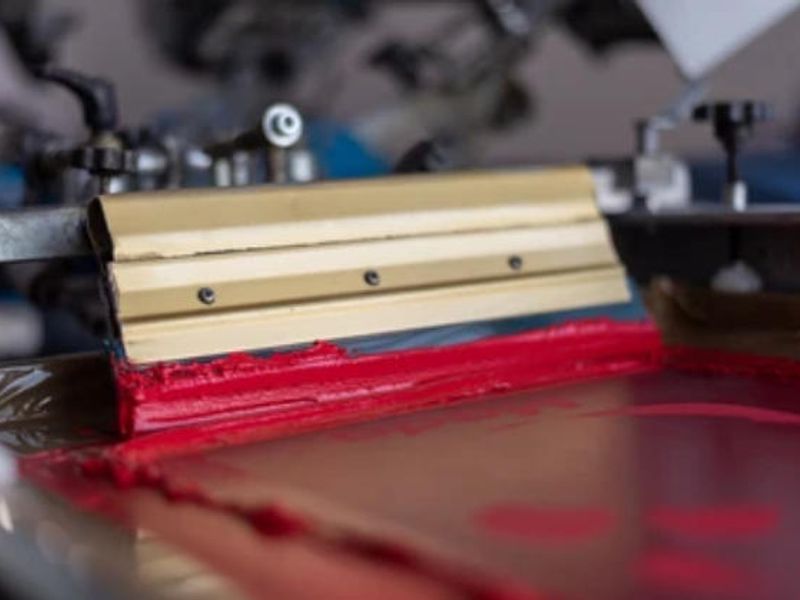
Screen printing with thermochromic ink is one of the more demanding pigment applications — you're asking a material to perform a reversible color transition reliably, across thousands of print cycles, under real-world handling conditions. The pigment has to disperse cleanly into the ink vehicle, survive the shear of the squeegee, and still respond predictably to temperature after it's cured onto the substrate.
Read More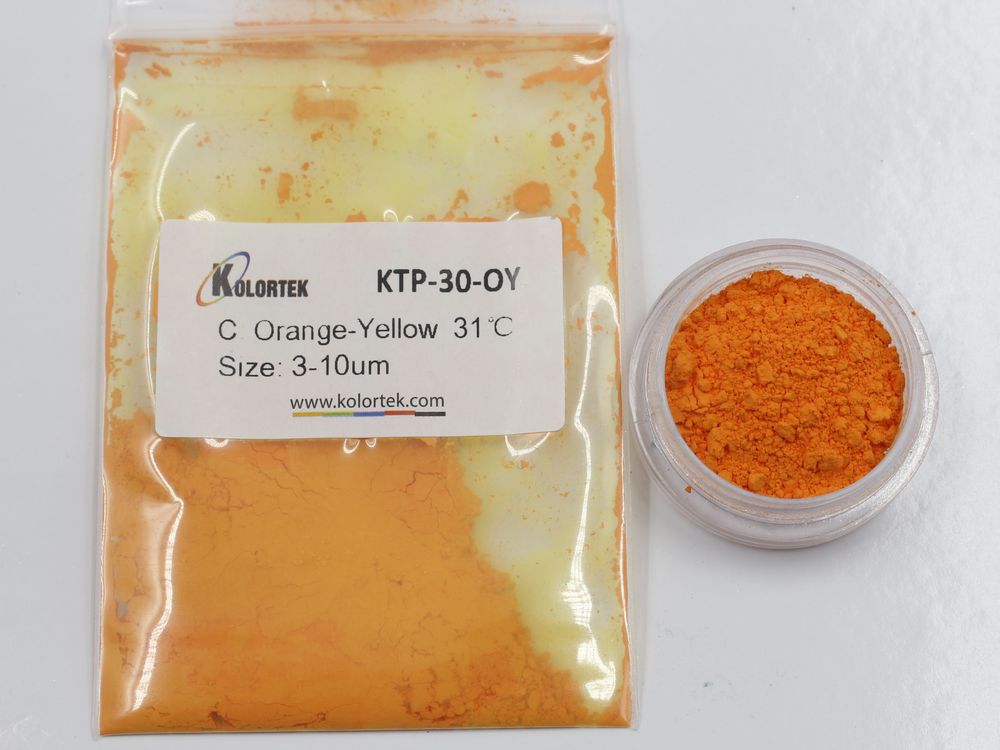
Fabric is one of the more demanding substrates for thermochromic chemistry. The dye has to survive wash cycles, flex without cracking, bond to fiber structures that weren't designed to hold encapsulated colorants, and still deliver a clean, repeatable color transition. That's a tighter brief than most people expect when they first start sourcing.
Read More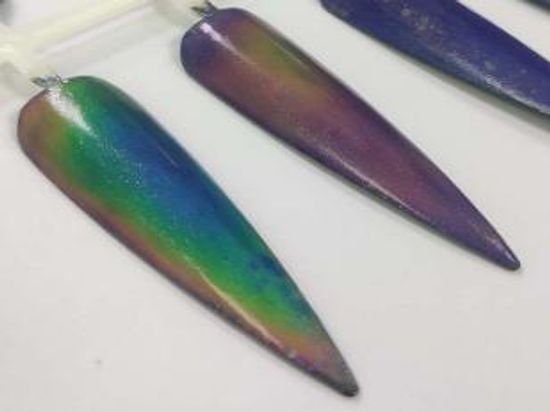
KT-MLC01 is a water-based thermochromic liquid crystal that cycles through twelve distinct colors — from black through copper, yellow, green, blue, and violet — across a 14℃ to 36℃ temperature window, making it one of the more visually dynamic options in the thermochromic category. Unlike single-transition thermochromic pigments, these mood liquid colors deliver a continuous chromatic shift in a single liquid formulation, suited for custom decorative paints, textile printing, and novelty cosmetic applications. Formulators looking to introduce live color-shift behavior into coatings or printed substrates will find the liquid format straightforward to incorporate.
Read More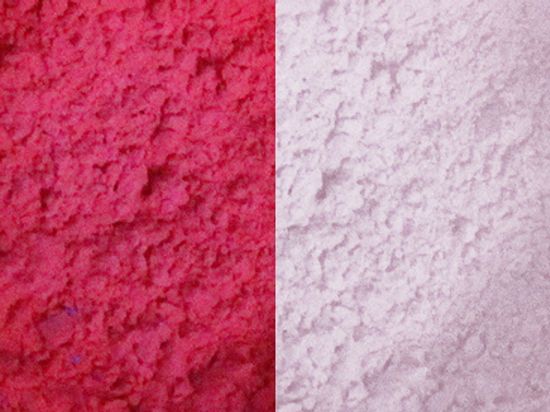
KTP-16-BR is a red thermochromic pigment that transitions from vivid red to fully colorless when temperature rises above 16°C — making it one of the lowest activation-point options in Kolortek's standard range. As a heat sensitive pigment, it's well-suited for applications where near-ambient temperature triggers are required, including temperature-indicating textiles, novelty printing, and decorative coatings. Formulators working with color change with temperature effects will find the fine 1–10μm particle size integrates cleanly into most ink and coating systems.
Read More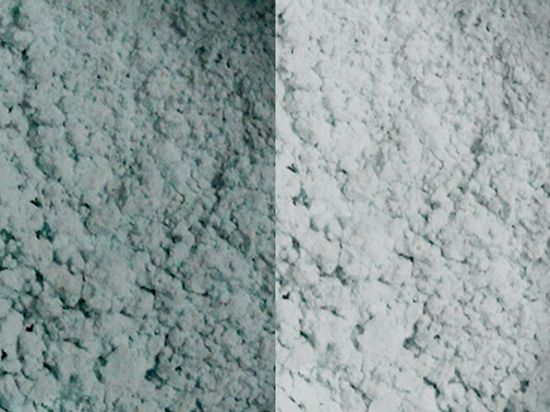
KTP-17-MG is a thermochromic powder that transitions from malachite green to fully colorless at 17°C — a low activation threshold that makes it effective for skin-contact, ambient-response, and cool-environment applications. As a heat reactive pigment, it integrates cleanly into printing, coating, and cosmetic systems where a sharp, reversible color reveal is the intended effect. Typical end-uses include nail formulations, textile printing, and craft coatings.
Read More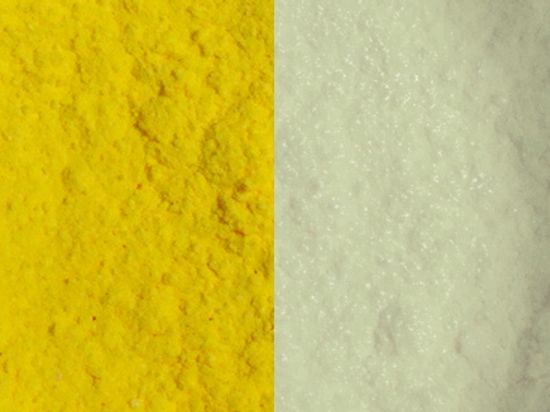
KTP-32-BY is a thermochromic powder that transitions from vivid yellow to colorless at 32°C — a body-temperature-adjacent activation point that makes it well-suited for skin-contact applications like cosmetics and nail products. This heat sensitive pigment powder disperses cleanly in most coating and printing systems, and is also available in a BPA Free food grade version for product contact use cases such as cups and utensils. Formulators working in textiles printing, craft art, or specialty inks will find the 1–10μm particle range compatible with a broad range of application methods.
Read More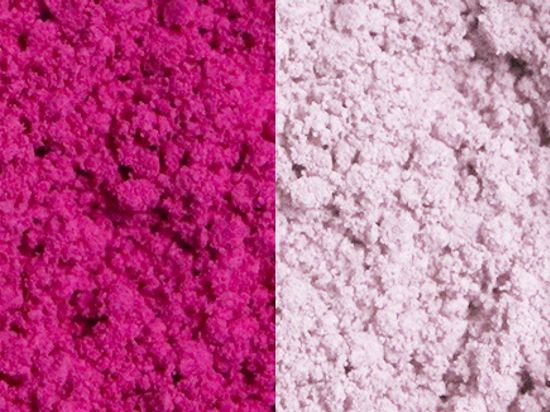
KTP-31-PBF is a rose red thermochromic pigment powder that transitions to colorless at 31°C — a body-temperature-proximate activation point well-suited for skin-contact and food-contact applications. Certified BPA Free, this heat reactive pigment is formulated for cosmetics, nail systems, and food-contact printing where safety compliance is non-negotiable. It performs equally well in textile printing and craft applications where a clean, reversible color-fade effect is the design intent.
Read More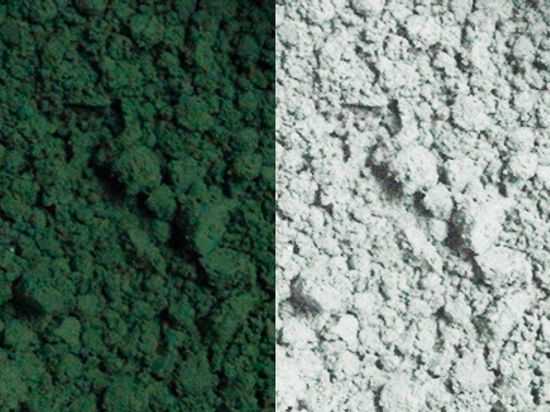
KTP-31-GBF is a food grade thermochromic pigment that shifts from vivid green to fully colorless at 31°C — clean, reversible, and BPA Free. Engineered for direct skin and food contact surface applications, this heat sensitive pigment powder is well suited for cosmetic formulations, nail products, and food contact items like cups and spoons. Its fine 3–10μm particle size ensures smooth dispersion across both water- and solvent-based systems.
Read More
 English
 Français
 Deutsch
 Русский
 Español
 Português