
Leave A Message
If you are interested in our products and want to know more details,please leave a message here,we will reply you as soon as we can.
RC800 Red copper metallic powder 800 mesh factory direct
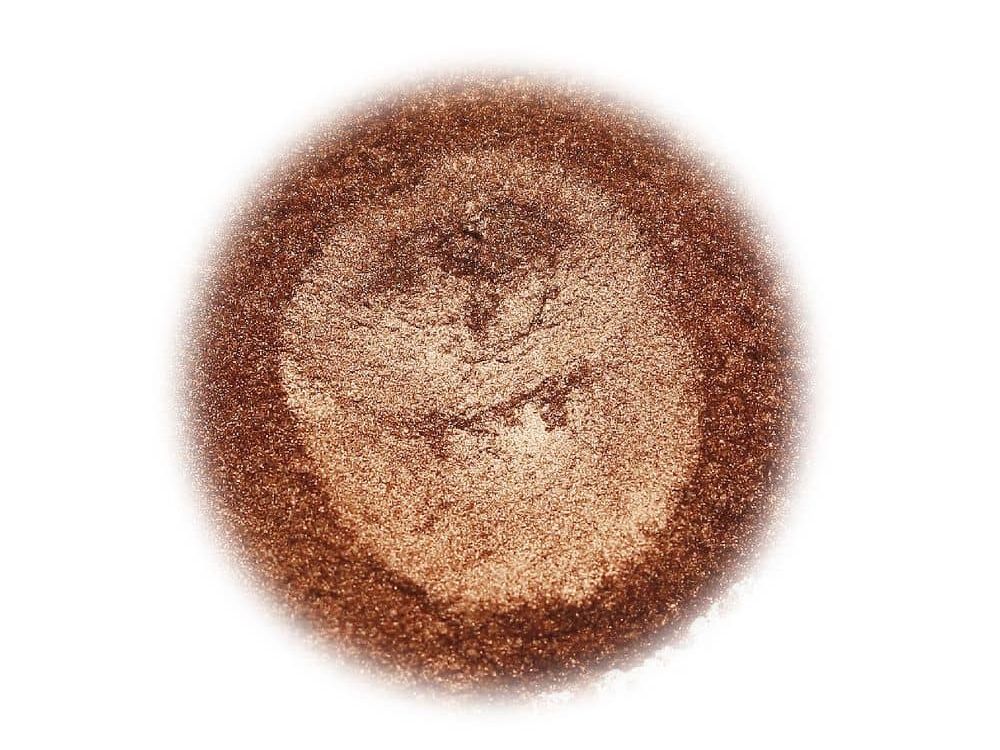
RC800 is an 800-mesh red copper metallic powder that delivers a warm, lustrous copper tone across paints, coatings, plastics, and decorative inks. We manufacture and ship it factory-direct, making it a practical choice for teams placing a bulk copper powder order or sourcing ongoing production volumes without intermediary markups. The 800-mesh fineness gives formulators a fine particle distribution suited to smooth-film applications where coarser metallic powders would read as grainy.
The copper-red visual effect in products like RC800 comes from mica coated with iron oxide (Fe₂O₃). The thickness of that Fe₂O₃ layer determines the specific hue — a thinner deposit reads as gold or pale copper; a heavier coat shifts toward deep red-brown. This is not surface dye. The color is structural, meaning it holds up against light, dilute acids, alkalis, and common organic solvents that would strip a dyed metallic.
Particle size controls the luster character. Finer cuts — our satin grades run 5–25 μm — produce a smooth, silky sheen with excellent substrate coverage. Coarser distributions, like the 10–100 μm Super Flash grades, generate the intense glitter and high-luster spark that reads well on larger surface areas. The 800-mesh specification of RC800 places it toward the fine end of the range, making it a natural fit where a refined metallic film is the goal rather than a coarse, sparkle-forward effect.
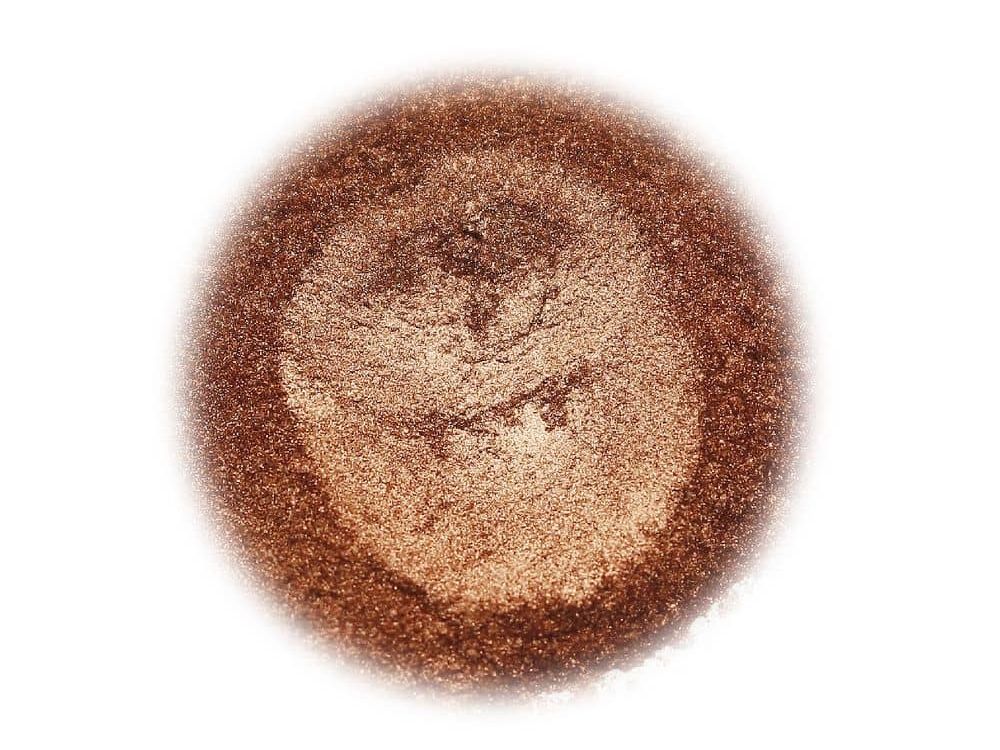
RC800 sits within Kolortek's broader red and copper metallic portfolio. For reference, the documented series that cover this color space are listed below. Formulators evaluating particle size, luster intensity, or application fit can use this as a starting point when requesting samples.
| Model | Effect Description | Particle Size | Luster Character |
|---|---|---|---|
| KT-502 | Red-Brown | 10–60 μm | Intense red-brown metallic |
| KT-508 | Red (Ruby) | 10–60 μm | Intense ruby metallic |
| KT-522 | Red-Brown Satin | 5–25 μm | Smooth satin, excellent coverage |
| KT-532 | Super Flash Red-Brown | 10–100 μm | Super luster, deep red-brown |
| RC800 | Red Copper | 800 mesh (fine) | Warm copper-red metallic film |
Fe₂O₃-coated mica pigments are chemically stable in the conditions most industrial formulations present. RC800 resists water, dilute acids, dilute alkalis, and common organic solvents. The powder is non-reactive, non-flammable, non-auto-ignitable, electrically non-conductive, and non-toxic — properties that simplify handling, transport classification, and formulation work in regulated product categories.
Light and weather resistance are also confirmed for this pigment class. In our experience supporting coating customers, the Fe₂O₃ layer contributes meaningfully to color durability in exterior-exposed formulations, though specific long-term performance data should be validated against your exact system and exposure conditions.
The powder is free-flowing and disperses readily in both water-borne and solvent-borne systems. We typically recommend low-shear mixing for metallic pigments — high-shear equipment can fracture platelet structures and reduce the luster. Standard MSDS/SDS documentation covering safe handling, storage, and transport is provided with every shipment.
RC800 works across the application segments that most commonly specify a decorative copper powder: architectural and industrial coatings, gravure and screen printing inks, plastics, and decorative automotive finishes. The table below reflects our documented loading ranges for Fe₂O₃ metallic pigments by end-use category.
| Application | Recommended Loading (%) |
|---|---|
| Automobile surface & refinish paints | 5–15 |
| Inner and outer wall paints | 5–15 |
| Bicycle paints | 5–12 |
| Daily electric appliance paints | 4–10 |
| Toy paints | 5–10 |
| Powder coatings | <2 |
| Gravure inks | 5–15 |
| Screen inks | 10–30 |
| Offset inks | 5–10 |
| Plastics bottles | 0.5–2 |
| Plastics parts | 0.3–1 |
| Plastics films | 1–4 |
| Latex and rubber products | 5–15 |
One thing to note on powder coatings: the sub-2% loading reflects the sensitivity of metallic platelet orientation to the electrostatic application process. Higher loadings tend to disrupt film uniformity rather than intensify the effect. In our application lab, we find that staying within the lower end of any range — then adjusting based on actual drawdown or molded test pieces — is more reliable than starting at the ceiling and working down.
Production at Kolortek runs under ISO 9001:2015, covering manufacturing and sales of pigments and fillers. For teams managing a red copper powder wholesale program, that certification matters at the procurement level — it documents the quality management system behind batch consistency, not just a single product snapshot.
REACH registration in our portfolio specifically covers fluorphlogopite (synthetic mica) grades; other grades require product-specific confirmation. If your formulation is destined for EU markets or regulated end-uses, we recommend requesting the current compliance documentation for the exact grade rather than relying on blanket portfolio claims. The same applies to any application targeting US FDA color-additive requirements or EU Cosmetics Regulation (EC) No 1223/2009 — compliant grades are available, but grade-level documentation needs to be matched to your intended use.
What is 800 mesh in microns, and how does it affect the metallic effect in coatings?
800 mesh corresponds to a fine particle cut well below the coarser standard ranges we document for our red-brown metallic series (10–60 μm for KT-502, 10–100 μm for KT-532). Finer particles produce a smoother, silkier metallic film with less visible sparkle. For applications like wall paints, screen inks, or fine-finish automotive coatings where a uniform copper sheen is required rather than a glittery effect, the finer mesh is the practical choice.
Is RC800 red copper metallic powder compatible with water-borne formulations?
Yes. Fe₂O₃-coated mica metallic pigments like RC800 are compatible with both water-borne and solvent-borne systems. The inorganic oxide coating is chemically stable against water, dilute acids, and dilute alkalis, which means the pigment does not corrode or discolor in aqueous binders the way uncoated metallic flake powders can. Standard low-shear dispersion methods apply in both system types.
What loading rate should I use for RC800 in industrial coatings versus printing inks?
For industrial coatings — automotive, wall, and appliance paints — our documented range is 4–15% depending on substrate and gloss target. Gravure and offset inks typically run 5–15%, while screen inks can carry 10–30% because the thicker ink film supports a higher pigment load without sacrificing print definition. Powder coatings are the exception: keep loading below 2% to maintain platelet orientation during electrostatic application.
What certifications cover Kolortek's metallic copper pigments for a bulk copper powder order?
The manufacturing system is certified to ISO 9001:2015. MSDS/SDS documentation ships with every order. REACH registration is confirmed for fluorphlogopite synthetic mica grades; other grades require product-specific verification. If your procurement requires EU cosmetics compliance documentation or US FDA color-additive alignment, request grade-level paperwork at the time of inquiry — the scope of each certificate matters more than a portfolio-level claim.
Contact our technical team to discuss formulation requirements or request samples for your specific application.
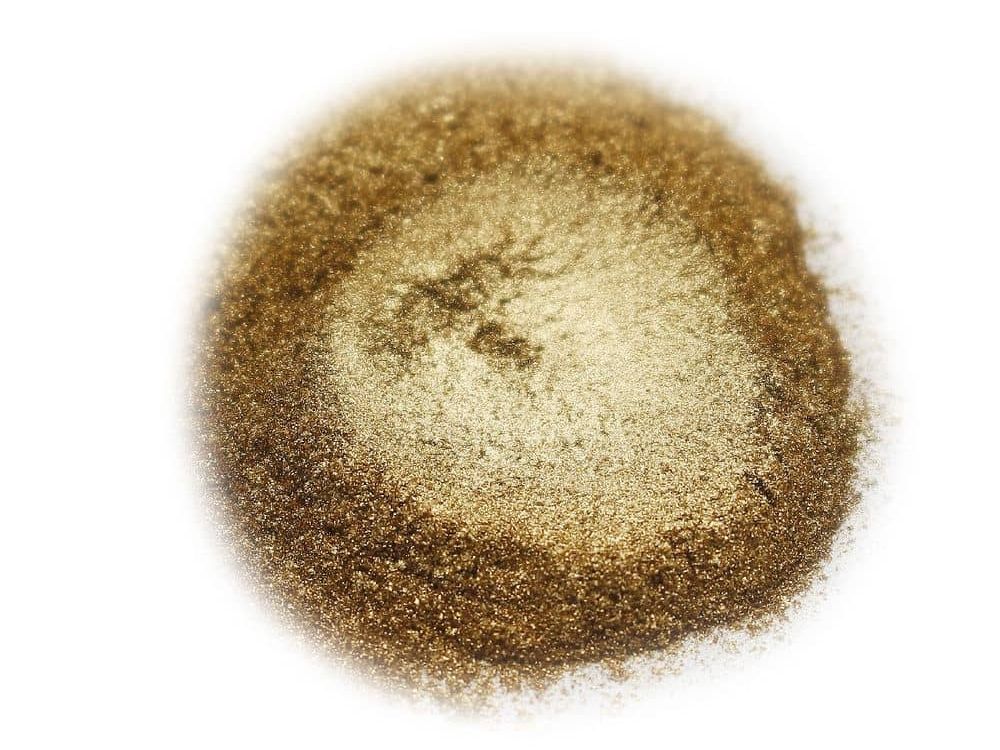
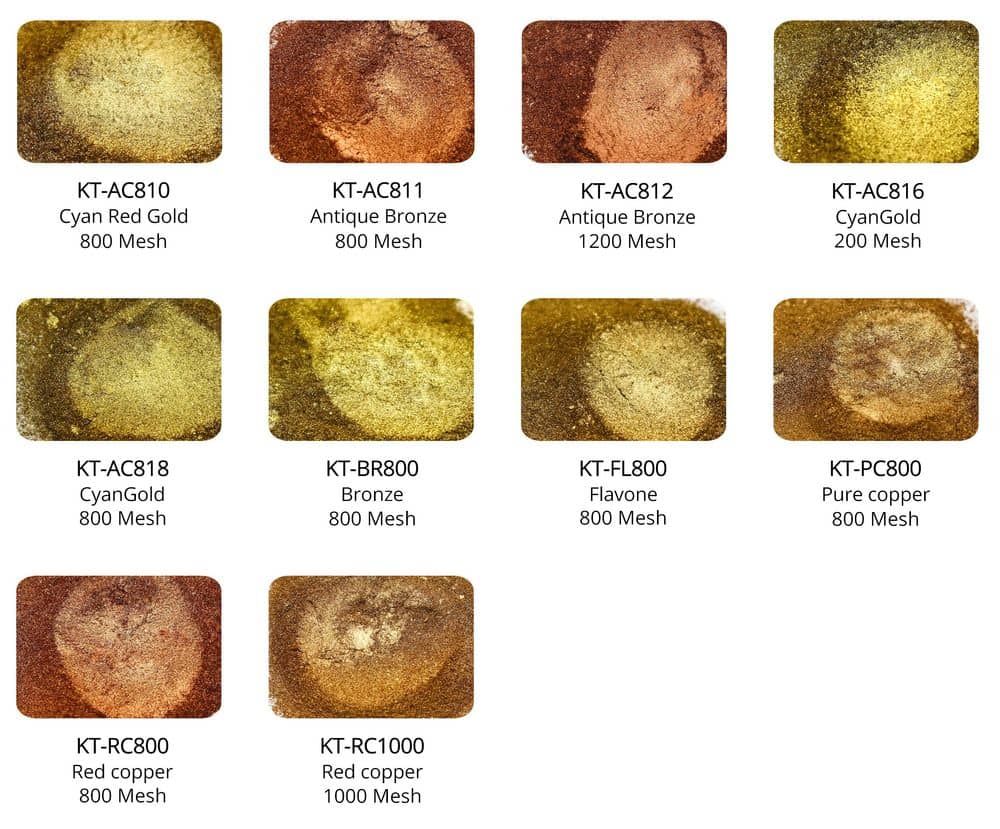
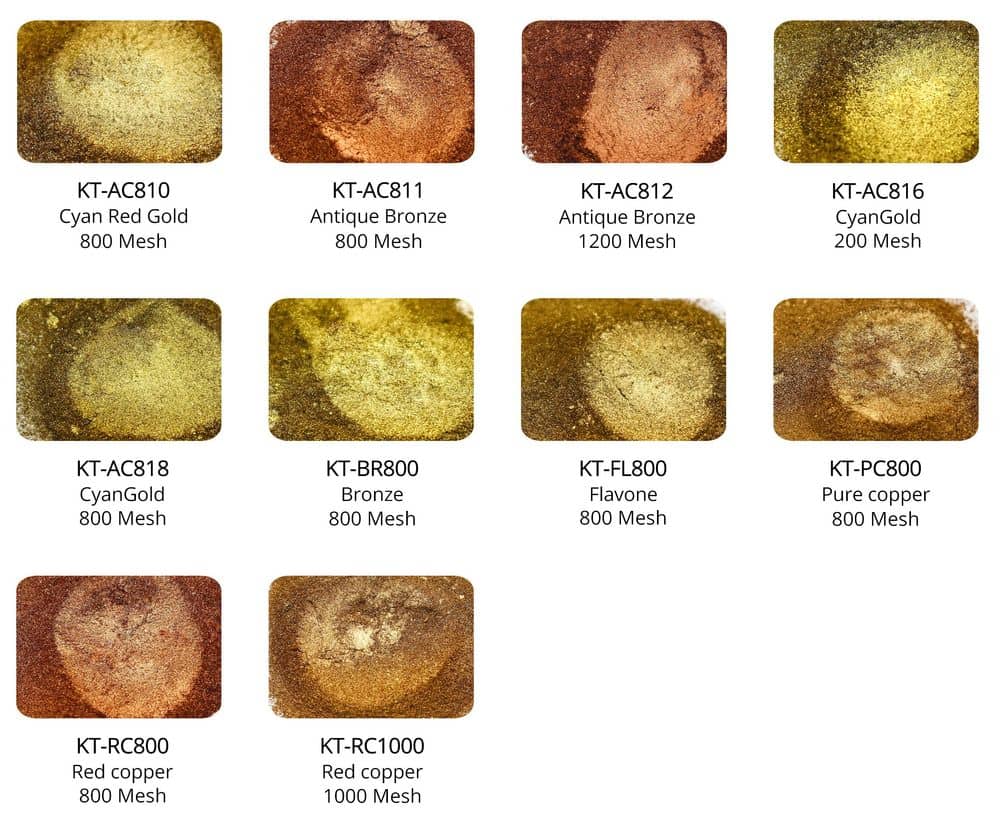
KT-AC810 is an 800-mesh cyan red gold bronze powder delivering smooth, uniform metallic coverage at 3–8% loading. From our experience in decorative coatings and printing inks, this fine-particle copper-zinc alloy provides opaque, true-metal reflection — ideal for packaging, gift wrap, and high-end craft applications where you need consistent gold bronze powder bulk performance without visible flake texture.
Read More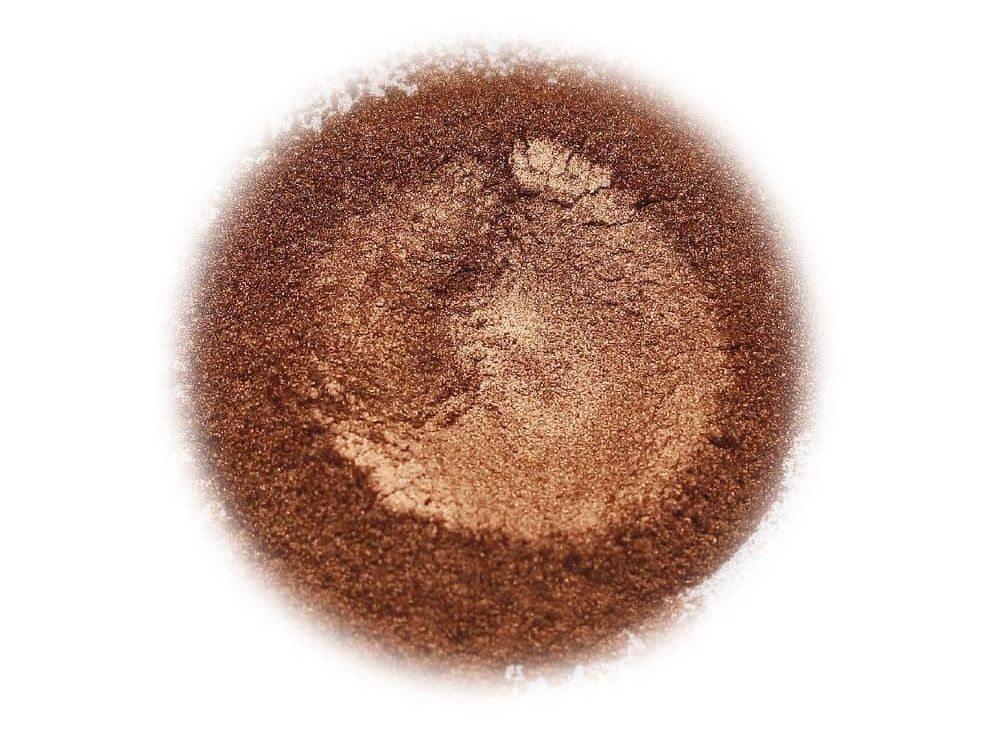
AC811 antique bronze metallic powder delivers genuine copper-zinc alloy metallic reflection at 800 mesh fineness — a smooth, uniform bronze finish you can't replicate with interference pigments. At Kolortek, we position this grade for printing inks, decorative coatings, and plastics where a true metallic surface is required. Typical loading is 3–8%, fully opaque, with excellent hiding power and thermal stability for high-temperature processing.
Read More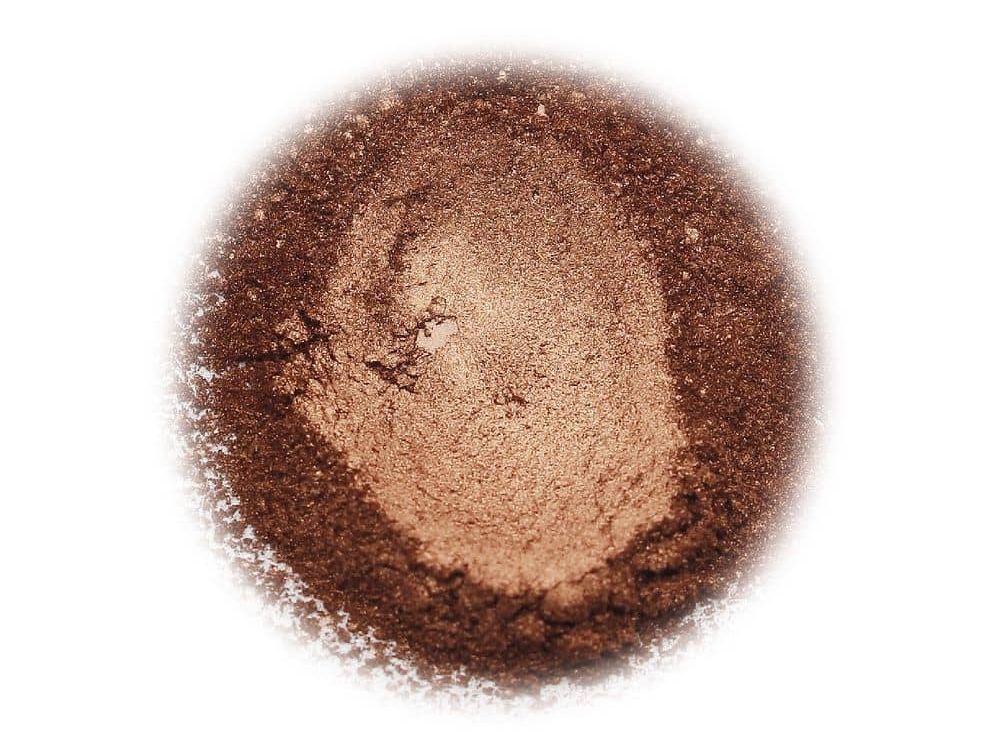
AC812 Antique Bronze is a 1200-mesh extra-fine metallic pigment from Kolortek's Gold Bronze Powder Series, delivering a silky-smooth antique bronze finish with exceptional opacity at 3–8% loading. We designed this copper-zinc alloy powder for high-quality printing applications and fine decorative coatings where a genuine metallic effect—not a pearlescent imitation—is required.
Read More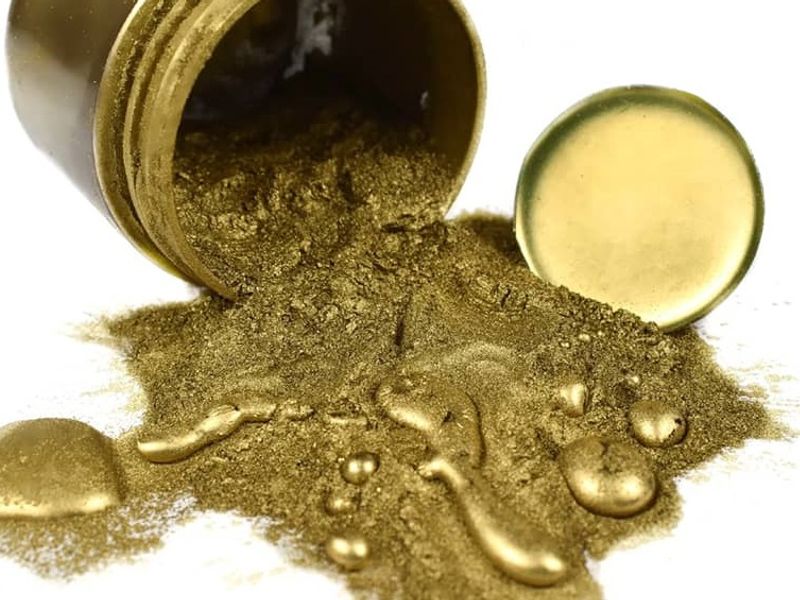
KT-AC816 is a cyan gold bronze powder manufactured by Kolortek from copper-zinc alloy, available at 200 mesh — a coarser grade that delivers maximum metallic sparkle and strong visual presence on the substrate. As a gold bronze powder manufacturer with over two decades of production experience, we supply this grade into decorative coatings, printing inks, plastics masterbatch, and craft applications where a bold, fully opaque gold-bronze effect is the primary requirement. Typical loading runs 3–8% for complete opacity.
Read More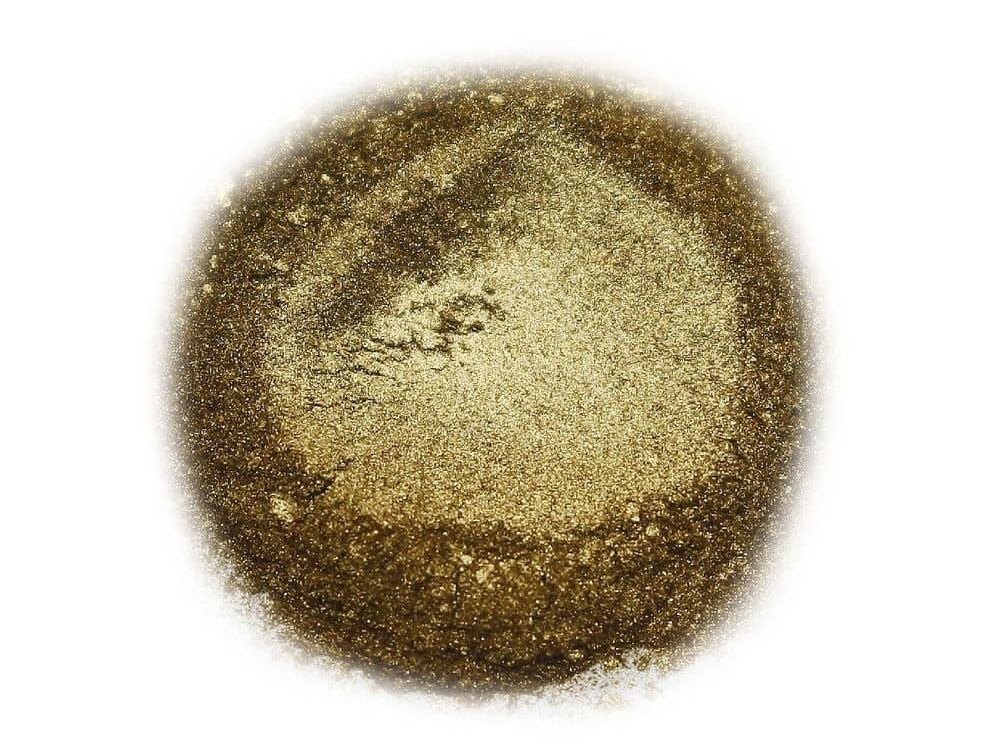
KT-AC818 Cyan Gold bronze powder is a fine-mesh metallic pigment designed for decorative coatings and plastics applications where a smooth, opaque gold finish with a cyan undertone is required. At 800 mesh particle size, this copper-zinc alloy powder delivers full hiding power at 3–8% loading and integrates into water-based systems when properly formulated, making it a practical choice for wholesale buyers sourcing plastics bronze powder or coating bronze powder in bulk.
Read More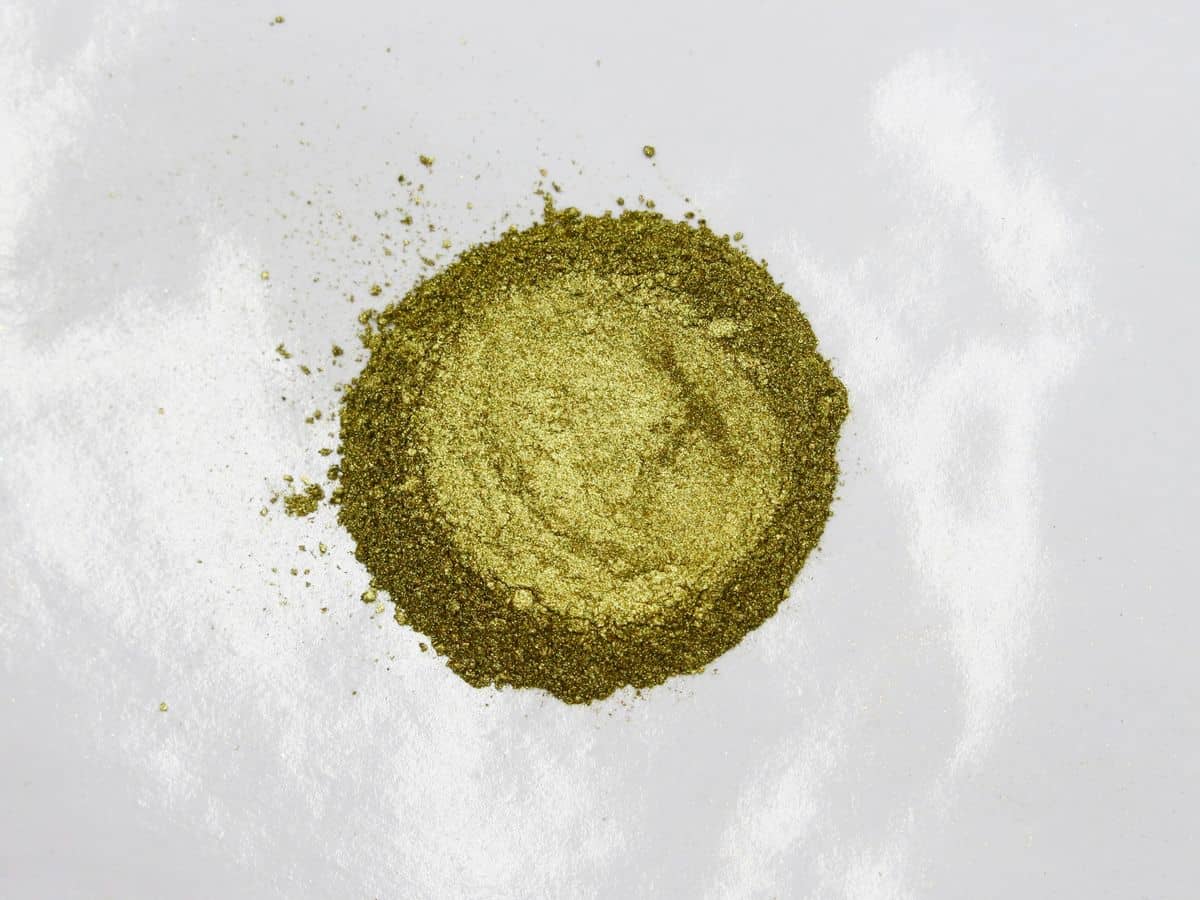
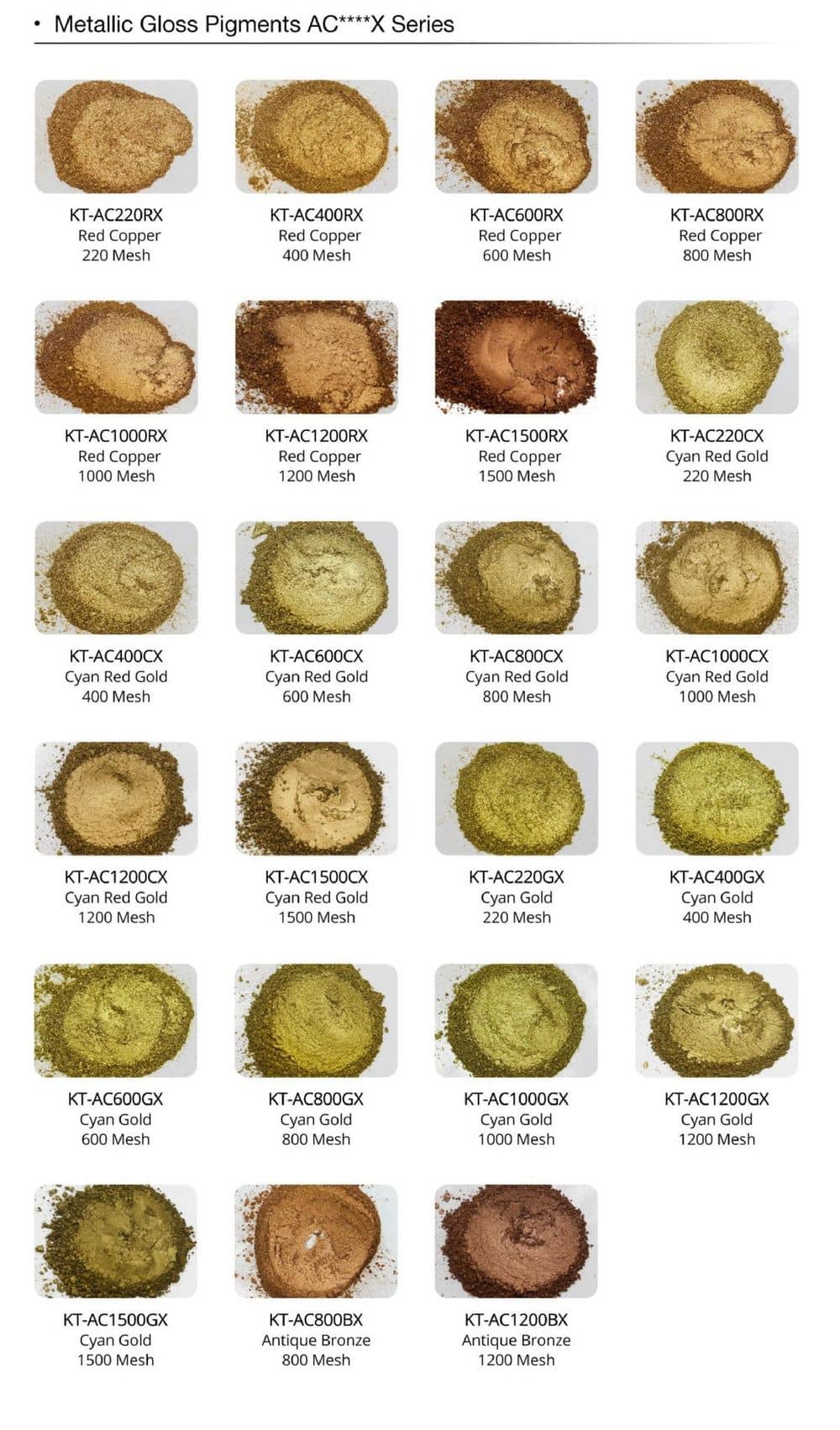
For printing ink formulators who need a consistent, high-coverage metallic finish, our AC1000GX at 1000 mesh delivers a smooth cyan-gold metallic effect with excellent hiding power at loadings of 3–8%. As wholesale gold bronze powder sourced direct from our manufacturing facility, it is classified in our fine-grade range (800–1000 mesh), where individual flakes are no longer visible and the resulting print surface reads as a uniform, continuous metal tone — the grade we see specified most often for packaging, labels, and decorative print applications.
Read More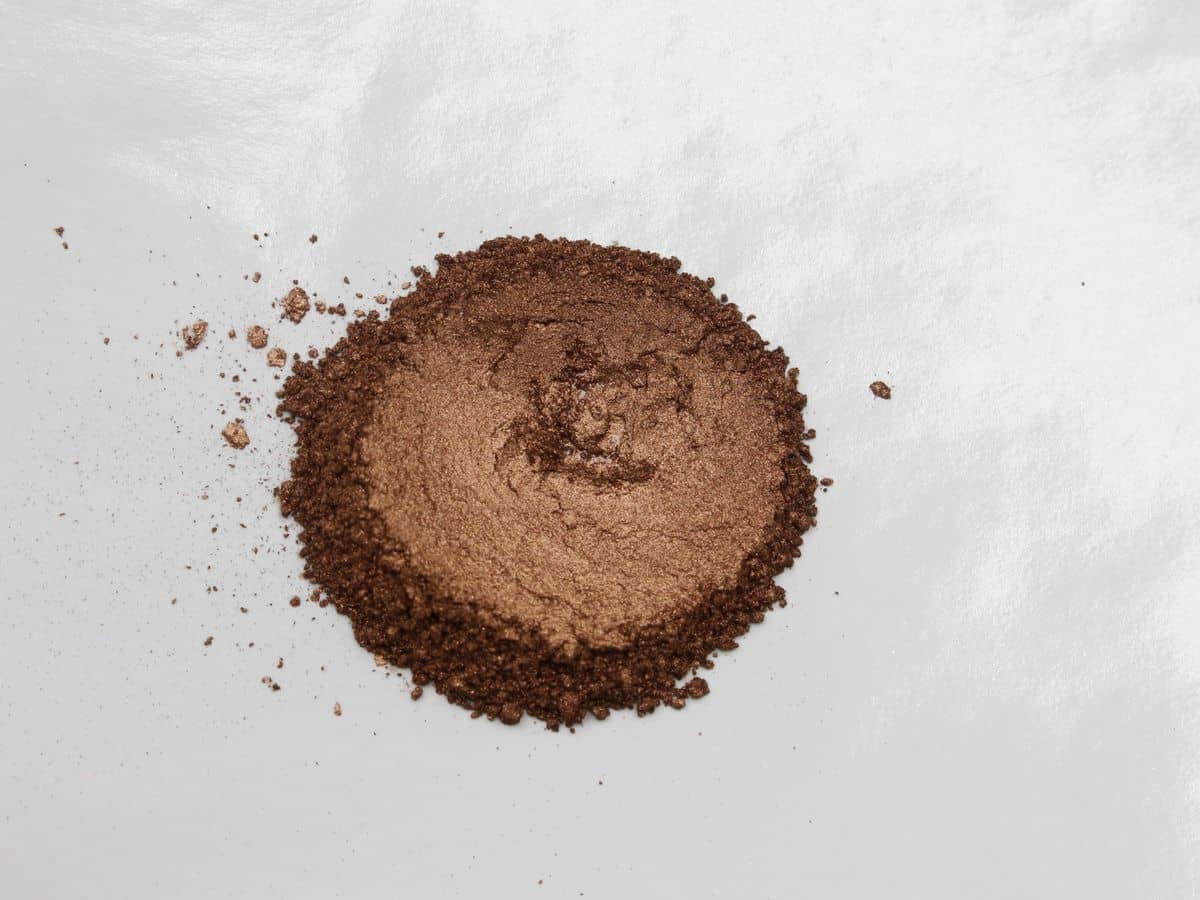
For printing ink formulators sourcing bulk antique bronze powder in extra-fine grades, the KT-AC1200BX delivers a genuine copper-zinc alloy metallic effect at 1200 mesh — classifying it as extra fine within our BX Series. At typical loadings of 3–8%, it achieves full opacity with a silky, smooth metallic finish well-suited to high-quality offset and gravure printing. The flake-based construction produces true metallic reflection, not a pearl or interference effect.
Read More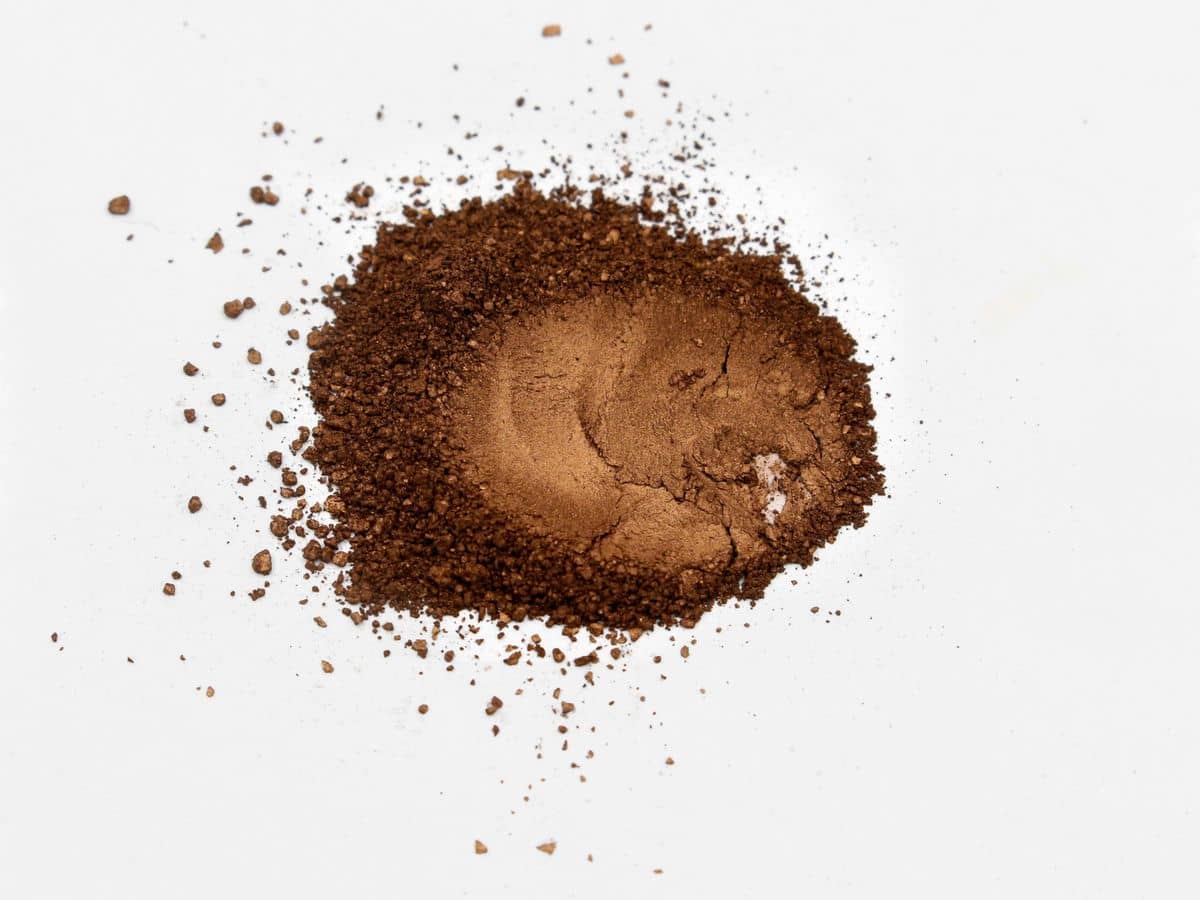
AC1500RX (KT-AC1500RX) is Kolortek's 1500-mesh extra-fine red copper gold bronze powder — a copper-zinc alloy metallic pigment delivering a true, opaque metallic finish in decorative coatings, printing inks, and plastics. As a dedicated red copper powder supplier, we produce this grade specifically for applications where a warm, rich copper tone and smooth, fine-particle surface are required. At 3–8% loading, it achieves full opacity with genuine metallic luster, not the soft sheen of mica-based interference pigments.
Read More
 English
 Français
 Deutsch
 Русский
 Español
 Português