
Leave A Message
If you are interested in our products and want to know more details,please leave a message here,we will reply you as soon as we can.

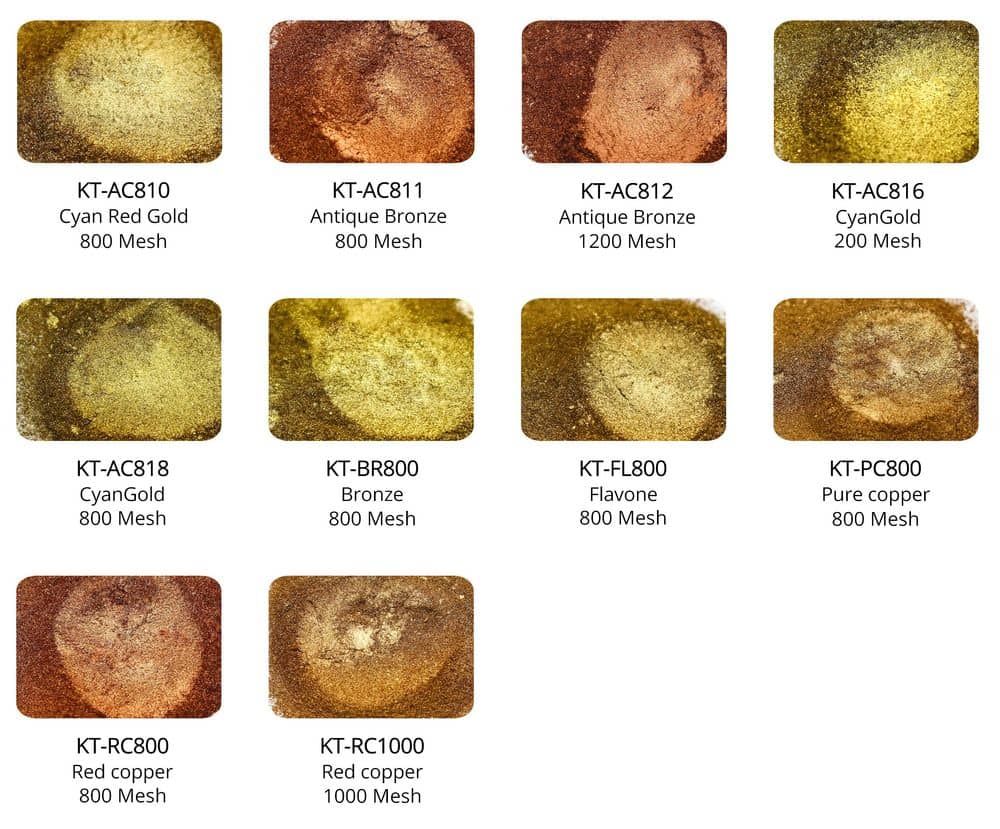
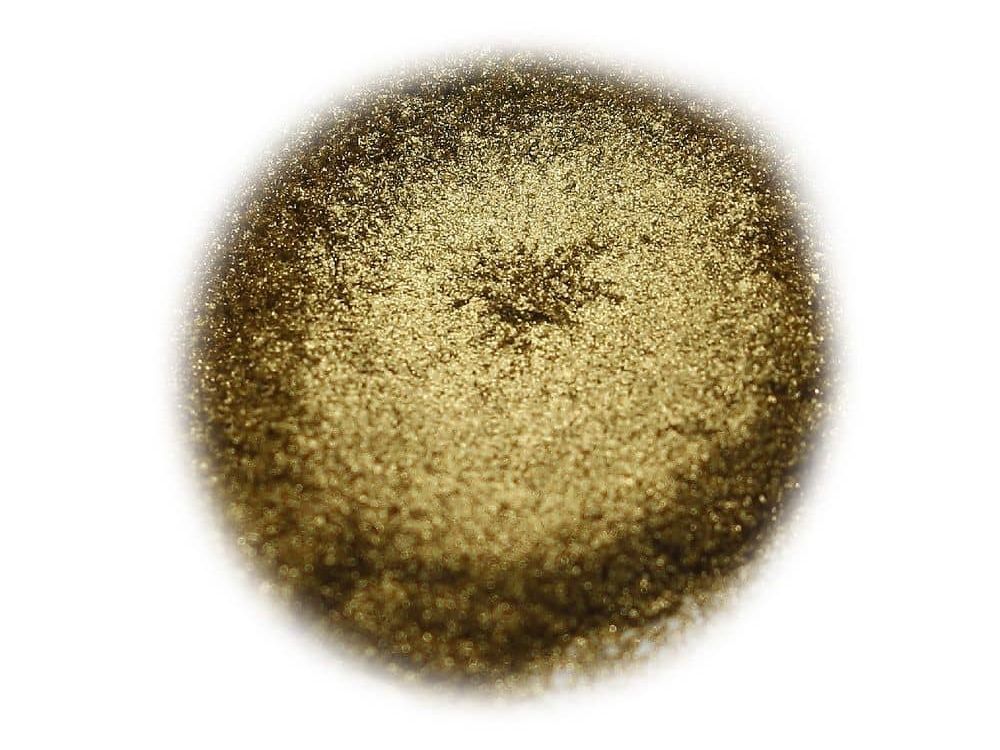
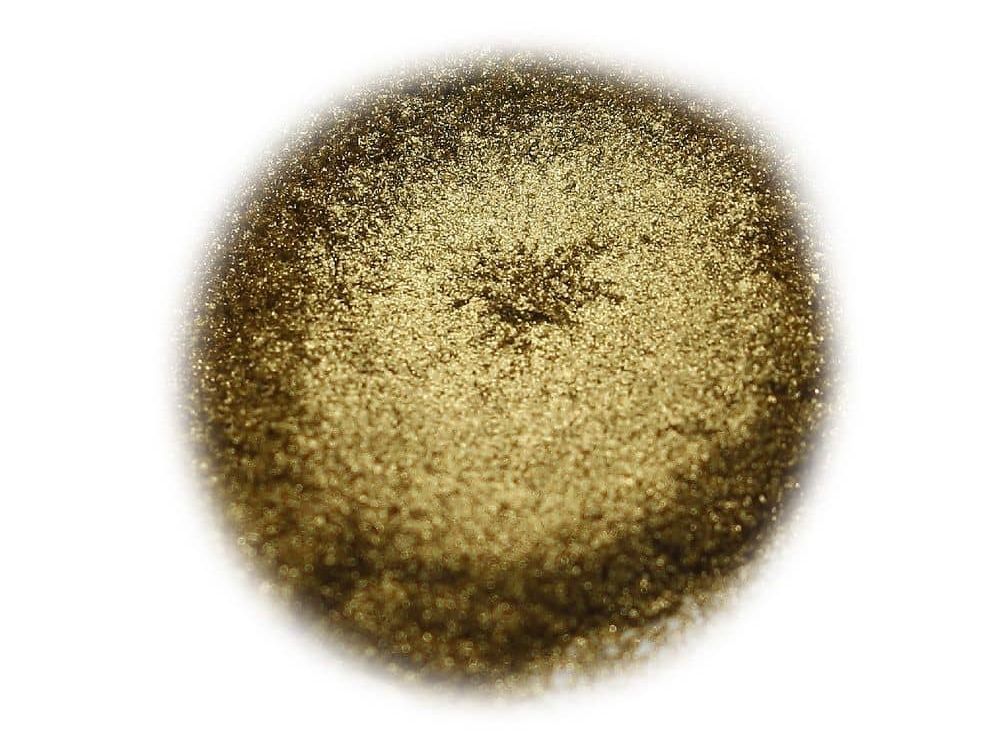
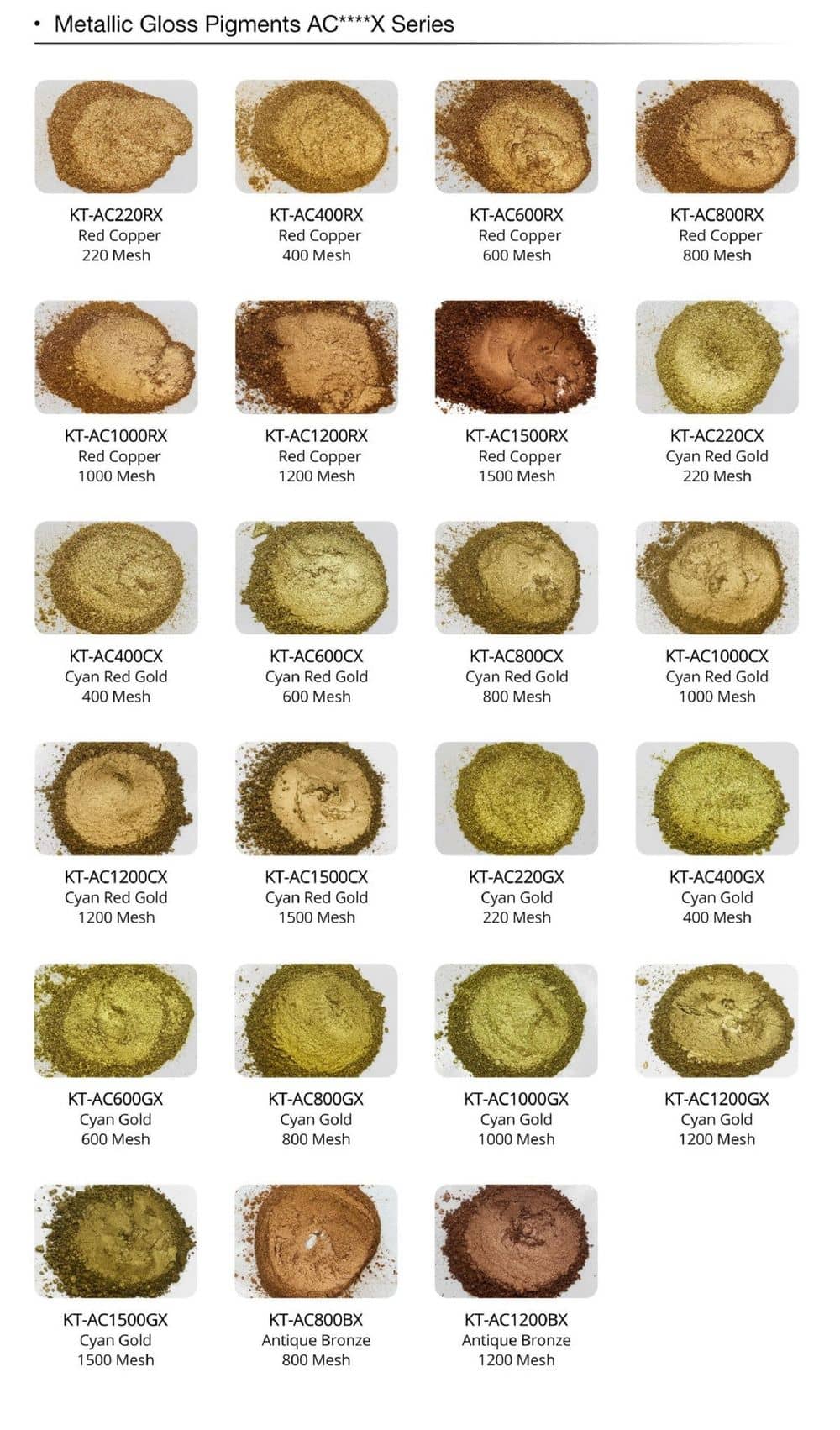
KT-AC816 is a cyan gold bronze powder manufactured by Kolortek from copper-zinc alloy, available at 200 mesh — a coarser grade that delivers maximum metallic sparkle and strong visual presence on the substrate. As a gold bronze powder manufacturer with over two decades of production experience, we supply this grade into decorative coatings, printing inks, plastics masterbatch, and craft applications where a bold, fully opaque gold-bronze effect is the primary requirement. Typical loading runs 3–8% for complete opacity.
Unlike mica-based pearlescent or interference pigments, KT-AC816 is a true metallic — a copper-zinc alloy flake that reflects light the way a metal surface does. The result is a dense, genuine gold-bronze appearance with excellent hiding power. At the 200 mesh grade, the flakes are coarser than the 800 or 1200 mesh grades we carry in the same color family, which means individual flakes catch light at different orientations and produce a pronounced, visible sparkle. If you need a smooth, homogeneous metallic finish for fine printing inks, 200 mesh is not the right starting point — but for bold decorative work, textured coatings, or craft applications where visual impact matters more than surface smoothness, it performs exactly as intended.
The cyan gold tone sits between a warm yellow-gold and a cooler, slightly green-shifted gold — distinct from red copper or antique bronze tones in the same series. At Kolortek, we often see this shade specified for picture frames, decorative furniture trim, temple ornaments, and packaging where a rich, non-standard gold is preferred over a straightforward yellow-gold.
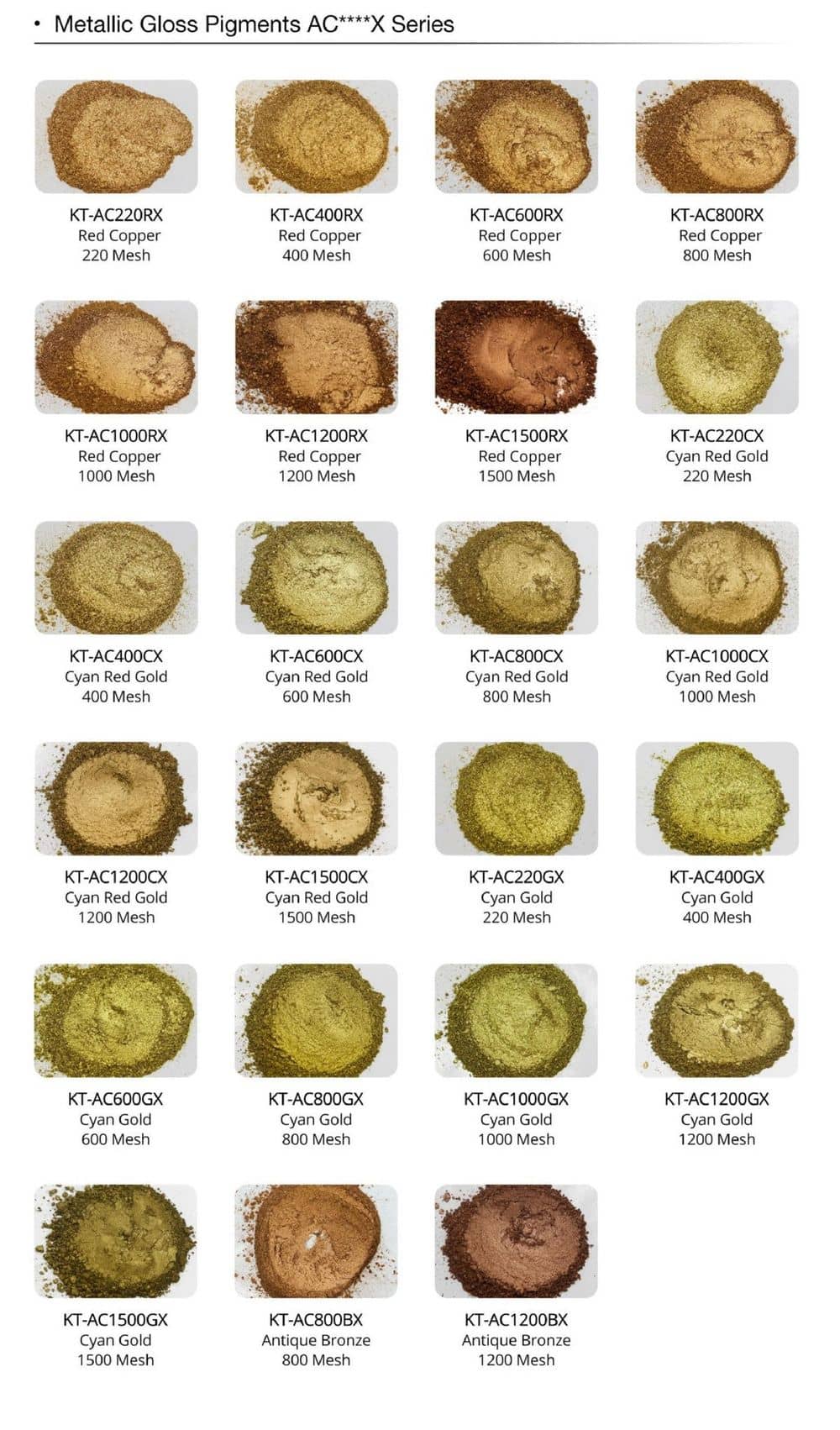
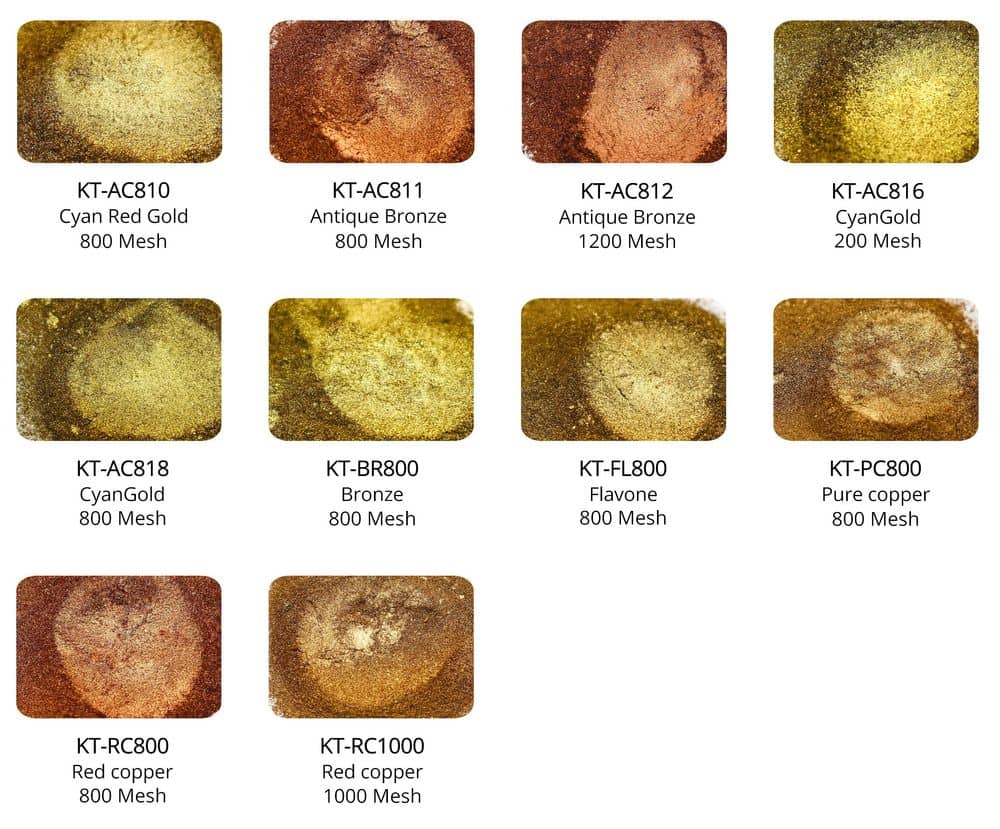
KT-AC816 is part of our Standard Gold Bronze Colors family. Cyan Gold is also available at 800 mesh (KT-AC818), and the broader GX Series spans seven mesh sizes — from 220 mesh to 1500 mesh — giving formulators a consistent color tone across a wide range of fineness levels. The table below shows where AC816 sits in relation to the closest related grades.
| Model | Color | Mesh | Typical Use |
|---|---|---|---|
| KT-AC816 | Cyan Gold | 200 | Decorative coatings, craft, bold textured finishes |
| KT-AC818 | Cyan Gold | 800 | Smooth metallic finish, general decorative coatings, printing inks |
| KT-AC220GX – KT-AC1500GX | Cyan Gold (GX Series) | 220–1500 (7 sizes) | Full range from decorative to high-quality gravure/offset inks |
| KT-AC810 | Cyan Red Gold | 800 | Decorative coatings, printing inks |
| KT-AC811 / KT-AC812 | Antique Bronze | 800 / 1200 | Decorative coatings, offset and gravure printing |
| KT-BR800 | Bronze | 800 | General decorative coatings and printing inks |
The mesh-size hierarchy across the GX Series follows a consistent logic: coarser grades (200–400 mesh) deliver maximum sparkle for decorative and craft applications; mid-range grades (400–600 mesh) are general-purpose for decorative coatings; finer grades (800–1000 mesh) give smooth metallic finishes suitable for printing inks; and the finest (1200–1500 mesh) are optimized for silky-feel, high-quality offset and gravure inks. Choosing the right mesh for the application is more important than it might seem — we've seen formulators spec a 200 mesh grade into a gravure ink job and then struggle with blade streaking and uneven laydown that disappears immediately when they move to 1200 mesh.
| Parameter | Value / Note |
|---|---|
| Base material | Copper-zinc alloy (true metallic flake) |
| Color | Cyan Gold |
| Mesh / fineness | 200 mesh (coarse grade) |
| Hiding power | Excellent — fully opaque at 3–8% loading |
| pH compatibility | pH 6–9 (tarnishes below 6 or above 9) |
| Electrical conductivity | Electrically conductive — not for insulation-critical applications |
| Heat stability | Heat stable (metal-based); specific threshold not published for this grade |
| Transport classification | Not classified as hazardous (non-flammable solid) |
| Cosmetics suitability | Not suitable — metal pigments are not cosmetic-grade |
One characteristic worth flagging for procurement: the electrical conductivity of copper-zinc alloy powders is not a defect — it's inherent to the material. For decorative furniture coatings or printing inks, it's irrelevant. For any application where the coating also serves as an electrical barrier, specifying a conductive metallic powder creates a problem that no formulation trick will solve. Match the pigment type to the functional requirement before specifying.
KT-AC816 is used across a defined set of applications where a genuine metallic gold effect and strong opacity are the priorities. The 200 mesh coarseness makes it most suitable for applications where surface texture is either acceptable or desirable — it is not intended for applications that demand a perfectly smooth, printable metallic layer.
Picture frames, furniture trim, hardware finishes, and architectural decorative elements are the natural territory for this grade. The coarse flakes produce a textured, high-impact metallic surface that reads as genuinely metallic rather than printed or simulated. Religious and cultural items — statue decoration, temple ornaments, traditional craft objects — are a consistent application segment in markets across Asia, the Middle East, and South America.
For packaging, labels, gift wrap, greeting cards, and general decorative print, 200 mesh bronze powder works in screen printing and coarser flexographic applications where ink film thickness is sufficient to carry the flake size. It is not suited for gravure or fine offset work — those applications require the finer grades in the GX Series (800–1500 mesh). KT-AC816 can also serve as a cost-effective foil substitute on substrates where full metallization is not required.
In injection-molded or extruded decorative plastic parts, the 200 mesh grade delivers a bold metallic sparkle effect. Compounders incorporating bronze powder into masterbatch should confirm processing temperatures align with the heat stability of the alloy; while the AC series is described as heat stable at typical plastics processing conditions, we recommend requesting specific thermal data for your target processing window.
Fabric decoration and traditional textile printing are listed application areas, particularly for cultural textiles and decorative fabrics where a metallic gold print is expected. Screen-printing pastes for textiles can carry the 200 mesh flake effectively, and the opacity ensures the gold reads cleanly over colored ground fabrics.
Low-shear mixing is mandatory for metallic flake pigments. Use high-speed dispersers equipped with Cowles blades. Ball mills, sand mills, and high-intensity mixers deform and fracture the flakes — reducing particle aspect ratio directly reduces the reflective metallic effect. In our experience, formulators who switch from a bead mill to a Cowles disperser for bronze powder often see a significant improvement in the metallic brightness of the finished coating, without any other change to the formulation.
Uncoated copper-zinc alloy powders react with water to generate hydrogen gas and undergo rapid oxidation, causing discoloration and formulation instability. The AC series is specifically positioned as compatible with water-based systems — but only when the correctly formulated, surface-protected grade is specified. Confirm with our technical team that the version of KT-AC816 you are receiving has the appropriate surface treatment for your system. Keeping formulation pH within the 6–9 window is also non-negotiable; outside that range, chemical attack on the flake surface accelerates regardless of surface treatment.
Store in sealed containers in dry conditions. Metal flake pigments oxidize on prolonged exposure to moisture and air; partially used containers should be resealed immediately. Shelf life in properly sealed, dry storage is acceptable for typical inventory cycles, though we do not publish a specific shelf-life figure for this grade.
As a bronze powder manufacturer China-based operation, Kolortek manufactures and ships gold bronze powders to customers in over 100 countries. The manufacturing and R&D base is in China, which means lead times and pricing reflect direct factory supply — not distributor margin. We hold ISO 9001:2015 certification covering production and sales of pigments, glitters, and fillers.
For procurement teams evaluating suppliers: we accept small batch orders, provide free evaluation samples for qualified inquiries, and supply TDS documentation for most products along with MSDS/SDS with all shipments. Custom color matching and OEM/private label packaging are available across the bronze powder range. When specifying custom bronze powder requirements — whether a specific mesh size, color tone, or surface treatment for water-based compatibility — our application team works directly with your formulation data to recommend the right grade or develop a matched variant.
One note on certifications: our ISO 9001:2015 quality management system applies company-wide. Product-specific compliance documentation (REACH, SGS, etc.) should be discussed per-product and per-application during inquiry — we do not apply blanket cosmetics or food-contact certifications to the gold bronze powder series, and those claims should not be assumed.
What is the difference between KT-AC816 (200 mesh) and KT-AC818 (800 mesh) cyan gold bronze powder?
Both are cyan gold copper-zinc alloy powders, but mesh size controls the visual character and application fit. KT-AC816 at 200 mesh is coarser — individual flakes are visible, producing a strong metallic sparkle suited to decorative coatings, craft, and screen printing. KT-AC818 at 800 mesh is finer, giving a smoother metallic surface more appropriate for printing inks and general decorative coatings where texture needs to be minimized. The GX Series extends this range from 220 to 1500 mesh for further refinement.
Can KT-AC816 cyan gold bronze powder be used in water-based coatings or inks?
Yes — the AC series is formulated for compatibility with water-based systems, but only when the surface-protected grade is correctly specified. Uncoated copper-zinc alloy powders react with water, generating hydrogen gas and causing discoloration. The formulation must also maintain a pH between 6 and 9; outside this range, the flake surface degrades regardless of coating treatment. Confirm surface treatment details with our technical team before finalizing your water-based formulation.
Is KT-AC816 suitable for cosmetics or personal care products?
No. Copper-zinc alloy metallic powders are not cosmetic-grade and must not be used in personal care, skin contact, or leave-on applications. KT-AC816 is positioned exclusively for industrial applications — decorative coatings, printing inks, plastics masterbatch, textile printing, and craft. Formulators developing cosmetic metallic effects should evaluate our separate cosmetic-grade pigment ranges instead.
What loading rate is recommended for KT-AC816 in a decorative coating?
A loading of 3–8% by weight achieves full opacity in typical decorative coating applications. Within that range, higher loadings increase metallic density and sparkle intensity; lower loadings can be used where a lighter metallic effect over a pre-colored substrate is preferred. Dispersion method matters as much as loading rate — always use low-shear mixing (Cowles blade disperser) to preserve flake geometry and maximize the metallic reflectance of the finished film.
Contact our technical team to discuss formulation requirements or to request an evaluation sample of KT-AC816 for your specific application.
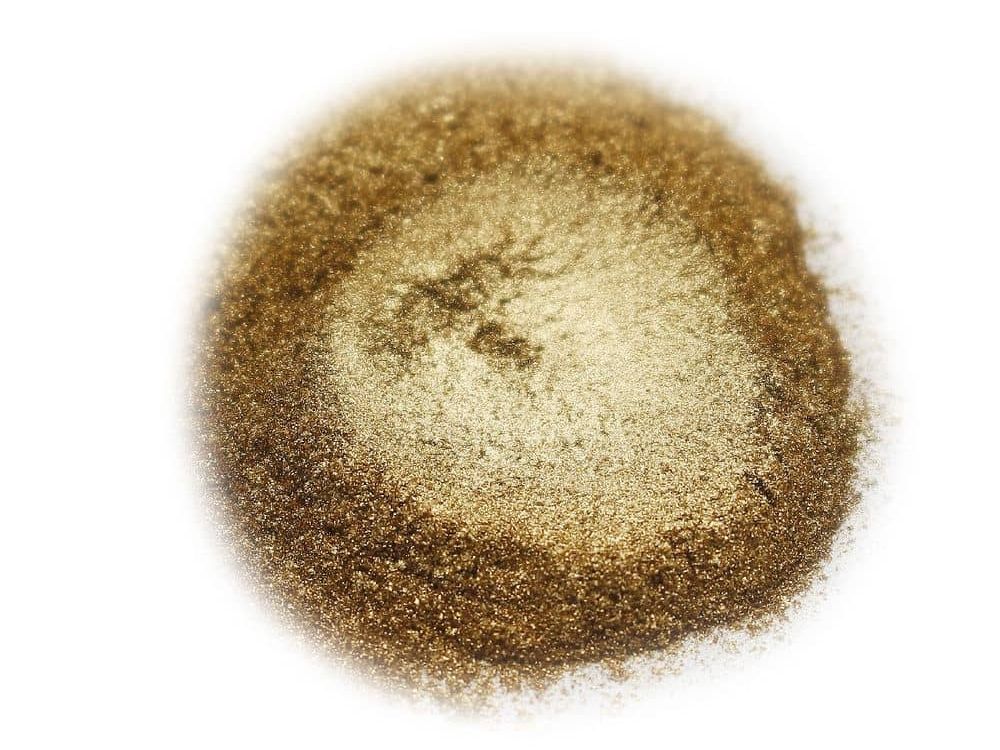
KT-AC810 is an 800-mesh cyan red gold bronze powder delivering smooth, uniform metallic coverage at 3–8% loading. From our experience in decorative coatings and printing inks, this fine-particle copper-zinc alloy provides opaque, true-metal reflection — ideal for packaging, gift wrap, and high-end craft applications where you need consistent gold bronze powder bulk performance without visible flake texture.
Read More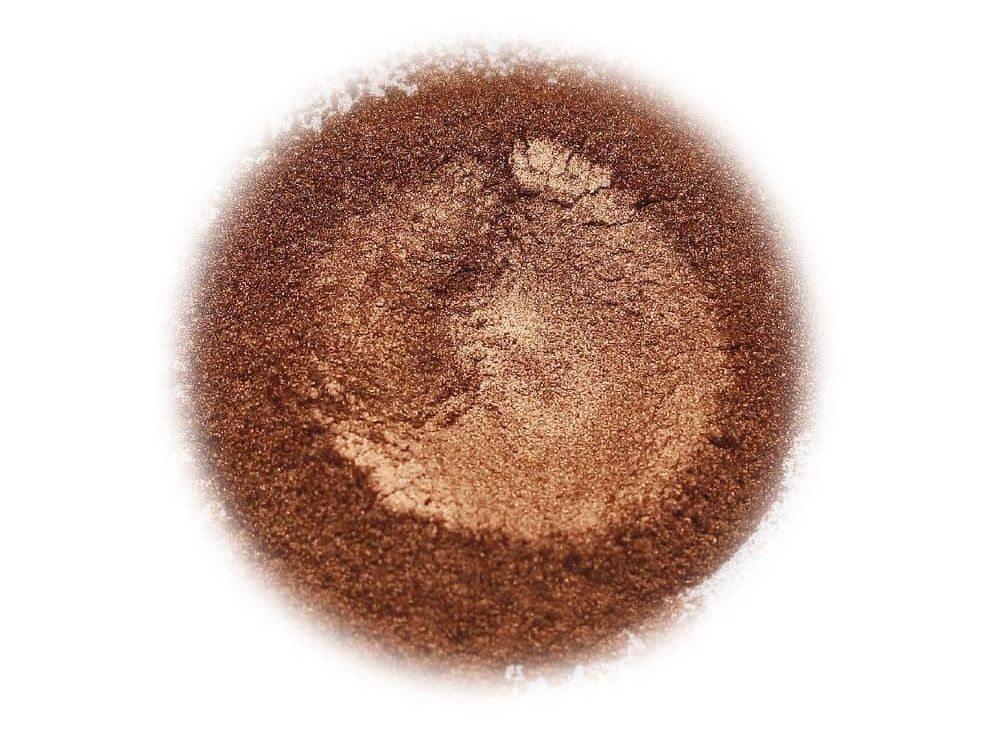
AC811 antique bronze metallic powder delivers genuine copper-zinc alloy metallic reflection at 800 mesh fineness — a smooth, uniform bronze finish you can't replicate with interference pigments. At Kolortek, we position this grade for printing inks, decorative coatings, and plastics where a true metallic surface is required. Typical loading is 3–8%, fully opaque, with excellent hiding power and thermal stability for high-temperature processing.
Read More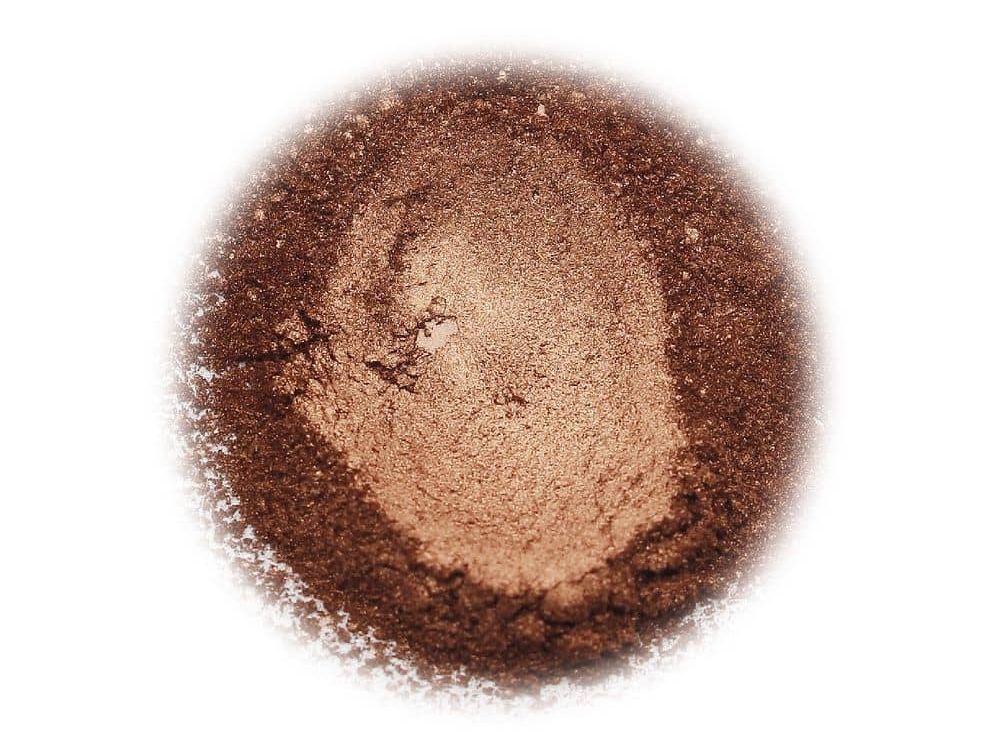
AC812 Antique Bronze is a 1200-mesh extra-fine metallic pigment from Kolortek's Gold Bronze Powder Series, delivering a silky-smooth antique bronze finish with exceptional opacity at 3–8% loading. We designed this copper-zinc alloy powder for high-quality printing applications and fine decorative coatings where a genuine metallic effect—not a pearlescent imitation—is required.
Read More
KT-AC816 is a cyan gold bronze powder manufactured by Kolortek from copper-zinc alloy, available at 200 mesh — a coarser grade that delivers maximum metallic sparkle and strong visual presence on the substrate. As a gold bronze powder manufacturer with over two decades of production experience, we supply this grade into decorative coatings, printing inks, plastics masterbatch, and craft applications where a bold, fully opaque gold-bronze effect is the primary requirement. Typical loading runs 3–8% for complete opacity.
Read More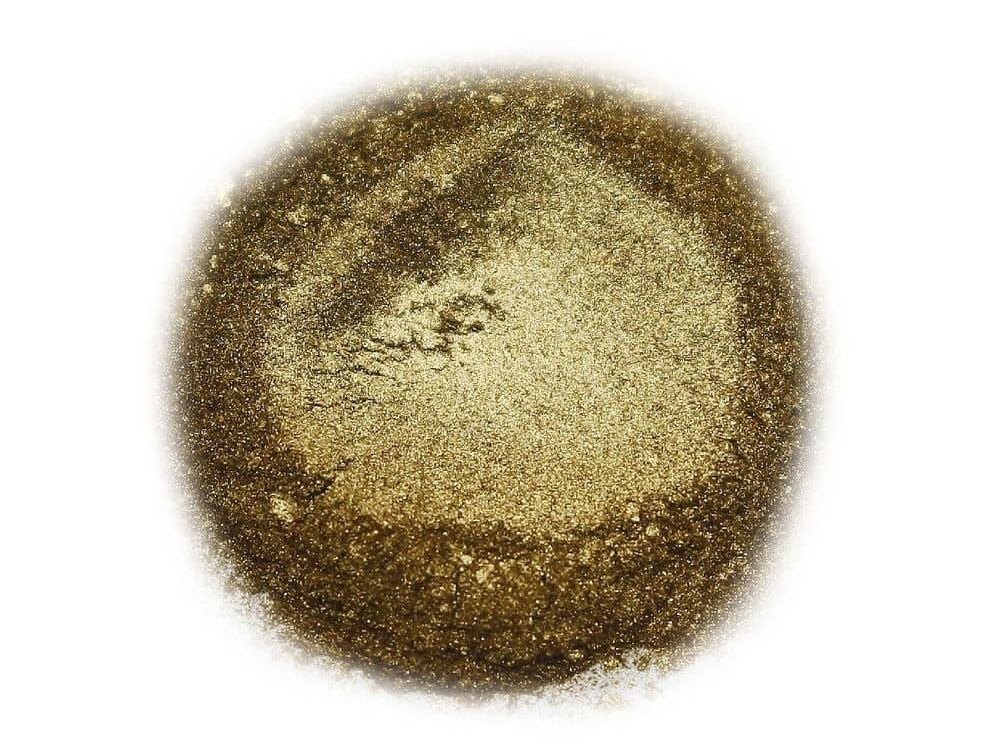
KT-AC818 Cyan Gold bronze powder is a fine-mesh metallic pigment designed for decorative coatings and plastics applications where a smooth, opaque gold finish with a cyan undertone is required. At 800 mesh particle size, this copper-zinc alloy powder delivers full hiding power at 3–8% loading and integrates into water-based systems when properly formulated, making it a practical choice for wholesale buyers sourcing plastics bronze powder or coating bronze powder in bulk.
Read More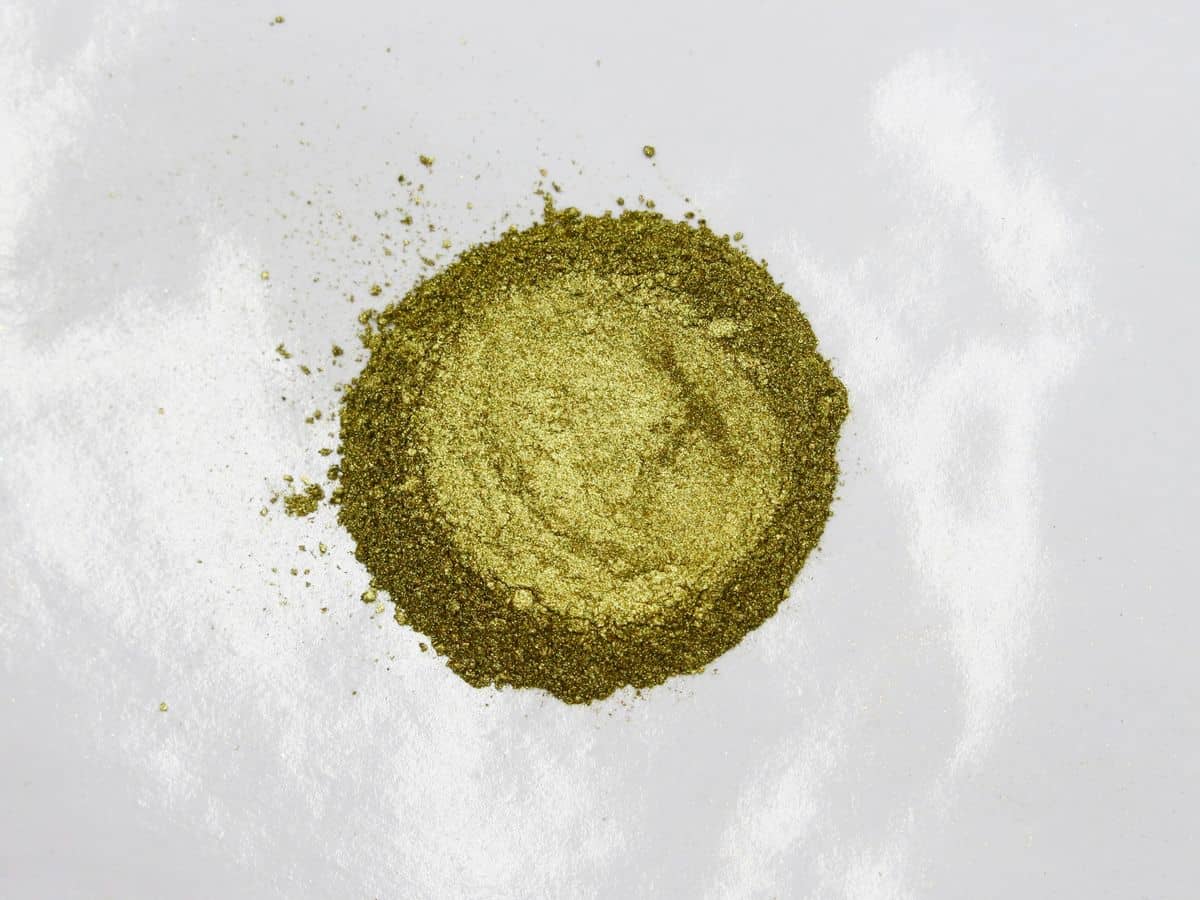
For printing ink formulators who need a consistent, high-coverage metallic finish, our AC1000GX at 1000 mesh delivers a smooth cyan-gold metallic effect with excellent hiding power at loadings of 3–8%. As wholesale gold bronze powder sourced direct from our manufacturing facility, it is classified in our fine-grade range (800–1000 mesh), where individual flakes are no longer visible and the resulting print surface reads as a uniform, continuous metal tone — the grade we see specified most often for packaging, labels, and decorative print applications.
Read More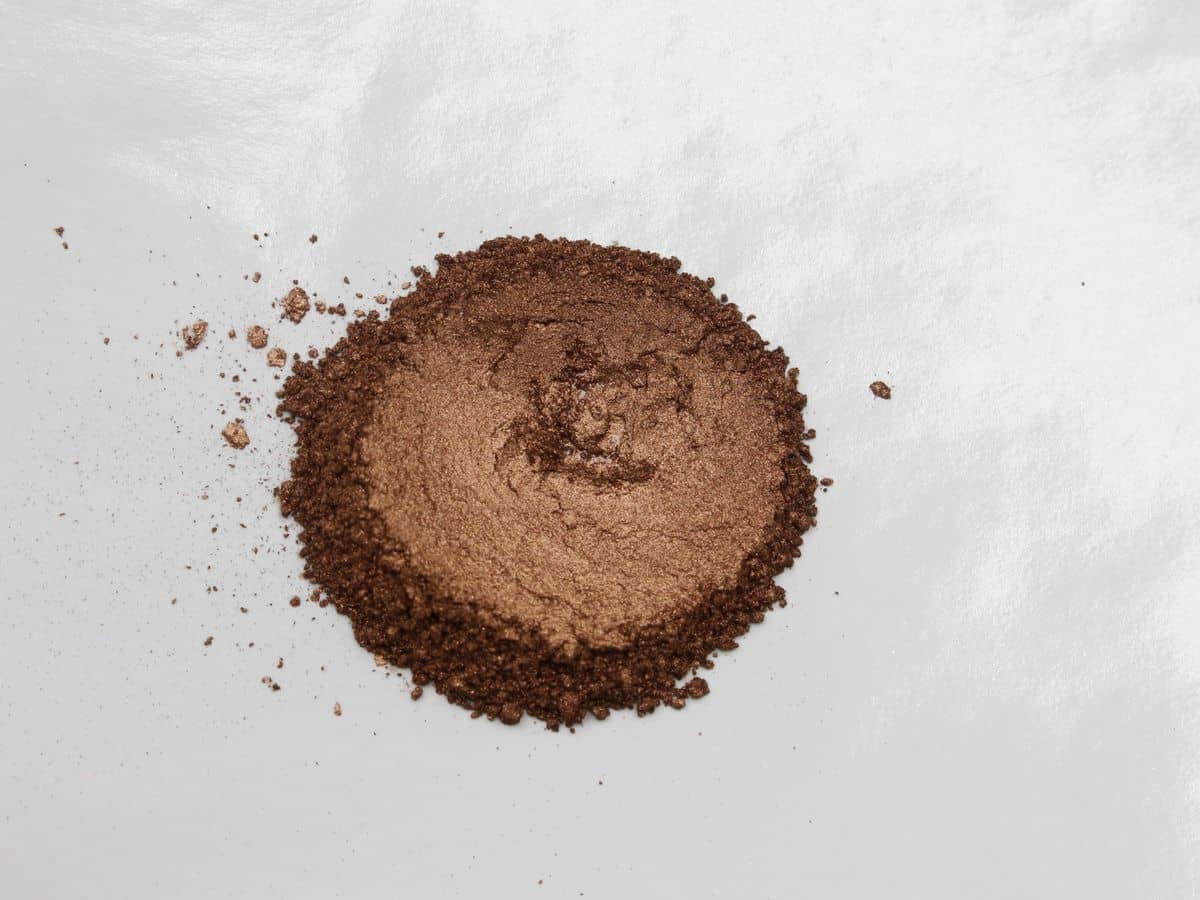
For printing ink formulators sourcing bulk antique bronze powder in extra-fine grades, the KT-AC1200BX delivers a genuine copper-zinc alloy metallic effect at 1200 mesh — classifying it as extra fine within our BX Series. At typical loadings of 3–8%, it achieves full opacity with a silky, smooth metallic finish well-suited to high-quality offset and gravure printing. The flake-based construction produces true metallic reflection, not a pearl or interference effect.
Read More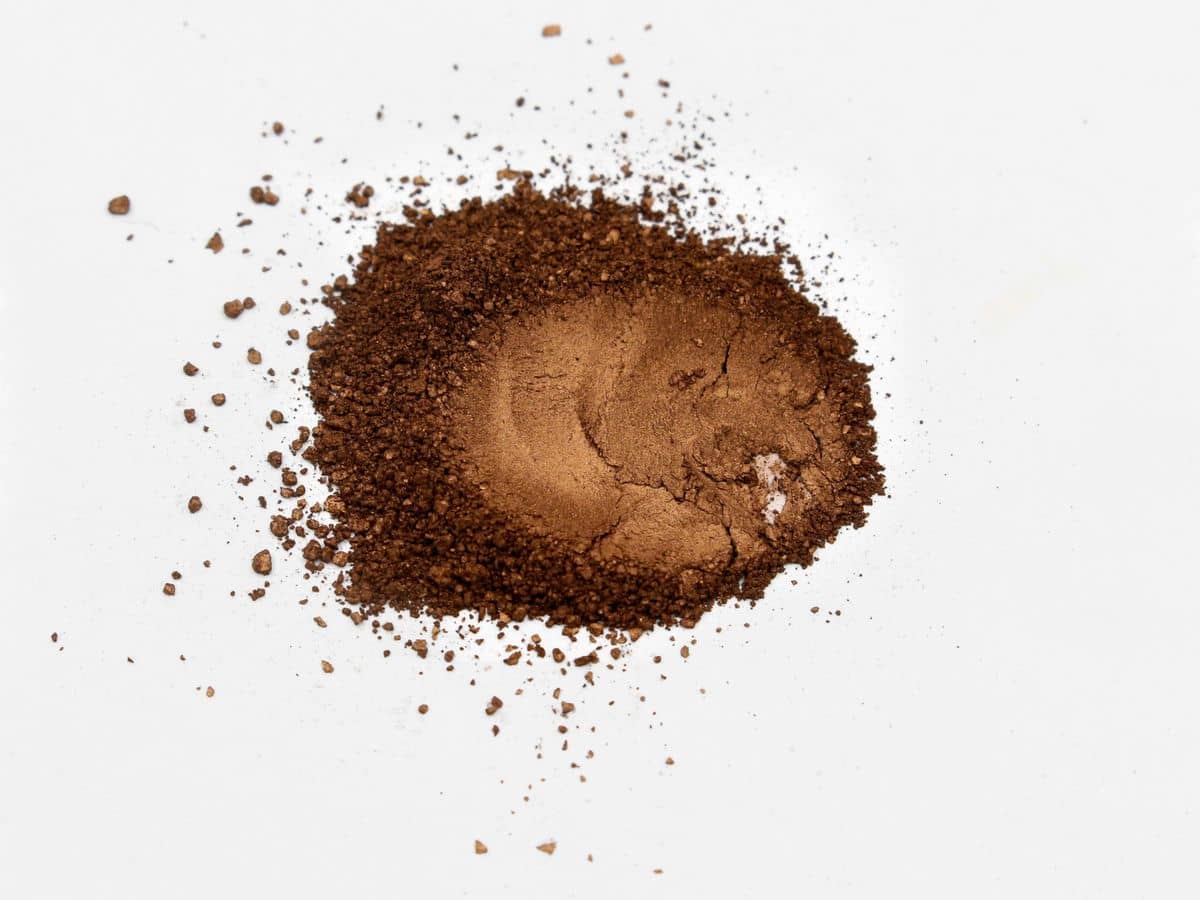
AC1500RX (KT-AC1500RX) is Kolortek's 1500-mesh extra-fine red copper gold bronze powder — a copper-zinc alloy metallic pigment delivering a true, opaque metallic finish in decorative coatings, printing inks, and plastics. As a dedicated red copper powder supplier, we produce this grade specifically for applications where a warm, rich copper tone and smooth, fine-particle surface are required. At 3–8% loading, it achieves full opacity with genuine metallic luster, not the soft sheen of mica-based interference pigments.
Read More
 English
 Français
 Deutsch
 Русский
 Español
 Português