You've specified a chameleon paint system for an automotive topcoat, selected your color shift mica powder, and now the applicator is reporting uneven color travel or worse—outright particle dropout in the gun. The particle size wasn't wrong on the datasheet. It was wrong for this system.
Sel...
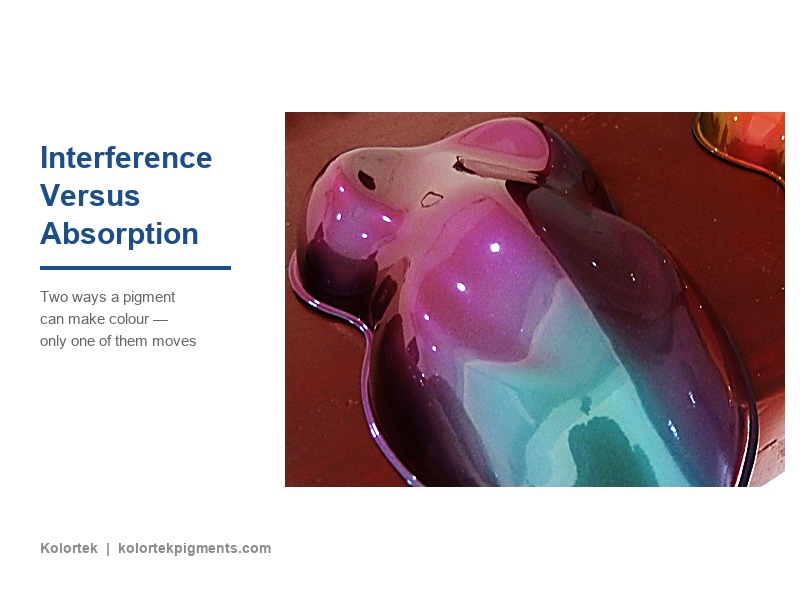
Color shift pigment — whether formulated as a chameleon pigment for automotive topcoats or as an optically variable pigment for security printing — produces a continuous, flowing color transition across viewing angles by exploiting thin-film light interference rather than conventional ab...
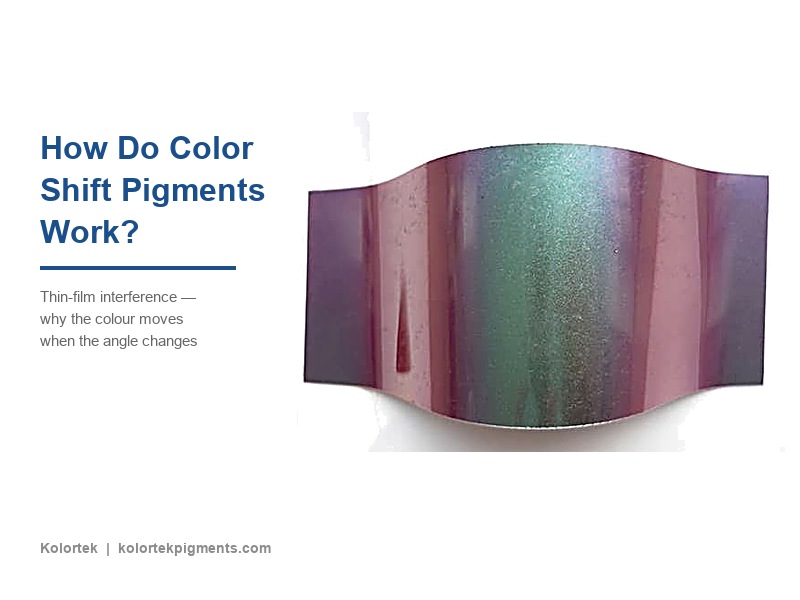
How do color shift pigments work — and why does the colour you see depend on where you're standing? The answer lives in physics, not chemistry. A chameleon pigment flake is a micro-scale optical stack: light bounces off multiple thin layers, those reflected waves interfere with each other, and...
Have you ever wondered why a soap bubble has colour when it contains no dye at all? The answer is structure, not chemistry — thin walls reflecting light in a way that reinforces one wavelength over the others. Chameleon pigments work the same way. Their colour shift comes from layer interferen...
You spray two panels with the same pigment from the same container. One delivers a clean green-to-violet travel. The other looks flat grey. Your first call goes to the supplier. It should go to the film. Nine categories of coating defect trace back to causes that sit upstream of the pigment grade, a...


 English
 Français
 Deutsch
 Русский
 Español
 Português