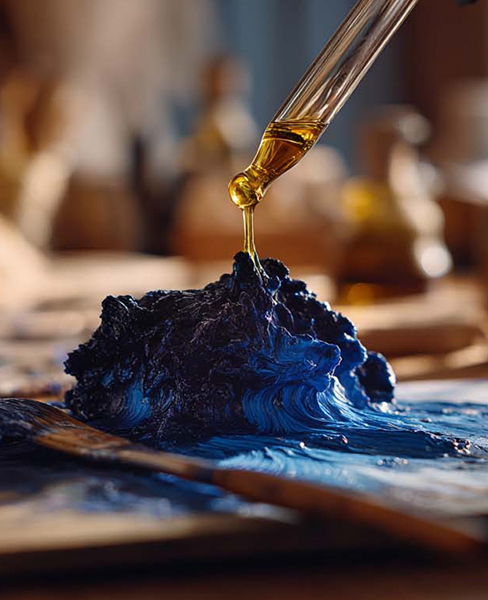
Have you ever wondered why a soap bubble has colour when it contains no dye at all? The answer is structure, not chemistry — thin walls reflecting light in a way that reinforces one wavelength over the others. Chameleon pigments work the same way. Their colour shift comes from layer interference selecting wavelengths, while absorption contributes background colour. That single distinction — absorption versus interference — explains how and why the colour moves.
Key Takeaways
- Ordinary pigments show colour by absorption — molecules remove unwanted wavelengths and reflect what is left; the colour does not move with the viewing angle.
- Chameleon pigments show colour by interference — thin-film reflections add up to reinforce one wavelength; the colour shifts as the angle changes.
- That shift is not the pigment changing — it is the same film stack handing you a different wavelength at each angle. This is structural colour.
- Inside a chameleon flake the two mechanisms cooperate: transparent layers handle interference and wavelength selection; the iron oxide layer handles absorption and background depth.
Absorption: How Ordinary Pigments Make Their Colour
Pick up any red dye, organic pigment, or iron oxide and the colour mechanism is the same. The pigment's molecules or crystal lattice absorb specific wavelengths of incoming light and reflect the rest. Your eye sees those reflected wavelengths and reads them as a colour.
This is subtractive colour. White light arrives carrying all wavelengths; the pigment removes a portion of them; what remains bounces back to your eye as the visible colour. The colour you see is always the portion that was not absorbed.
What Absorption Actually Does
Think of it as subtraction: a pigment molecule "eats" certain wavelengths from white light and gives back what is left. The wavelengths it eats are fixed by its molecular structure — that chemistry does not change whether you look straight on or from the side.
Because the absorbed wavelengths are fixed, the reflected wavelengths are fixed too. Same molecule, same absorption, same reflected colour every time.
Why Absorption Colour Stays Put
Tilt the panel. You have changed the viewing geometry, but you have not changed which wavelengths the molecule absorbs. The reflected colour is identical. Absorption colour is stable across angles — that is both its strength and its limitation.
An absorption-dominant finish can start showing angle effects when metallic flakes or pearlescent particles are added alongside it, introducing their own reflections. Metallic flakes introduce directional reflection; pearlescent particles introduce interference, which is exactly what chameleon pigments are built around.
Interference: How Chameleon Pigments Make Their Colour
A chameleon flake relies on interference to generate its colour shift. Its core is a natural mica platelet coated with multiple layers, including transparent TiO₂ and silica layers, which reflect a portion of incoming light at their interfaces. Those reflections overlap and add together. At a given angle, one wavelength is reinforced by constructive interference and reaches your eye more intensely than the others.[1][3] That is the colour you see.
This is structural colour — the same class of phenomenon as a soap bubble, a butterfly wing, or a peacock feather. Their iridescence comes from optical structures, although absorbing pigments can also contribute to their appearance. The shifting colour comes from the geometry of the structure, not from molecular chemistry. To learn more about the multi-layer architecture that separates chameleon flakes from single-layer pearls, see our comparison of duochrome versus standard pearl.
What Interference Actually Does
The film stack aligns reflected waves so that waves at one wavelength reinforce each other — constructive interference — while reflections at other wavelengths are weakened by destructive interference. You see the reinforced wavelength. This is not absorption in reverse; interference redistributes light rather than absorbing it. Instead, the geometry of the layers decides which wavelength gets the boost.
Why Interference Colour Moves
When you tilt the panel, light travels a different path through each layer. The path-length difference between reflections — the optical path difference — changes. A different wavelength now satisfies the condition for constructive interference, so a different colour comes back to your eye.[1]
Absorption colour is fixed. Interference colour moves. That single sentence is the clearest way to explain the difference to a client who thinks colour shift is just "a dye that changes."
Absorption Versus Interference at a Glance
The two mechanisms sit at opposite ends of the same question — where does the colour come from? This table puts them side by side.
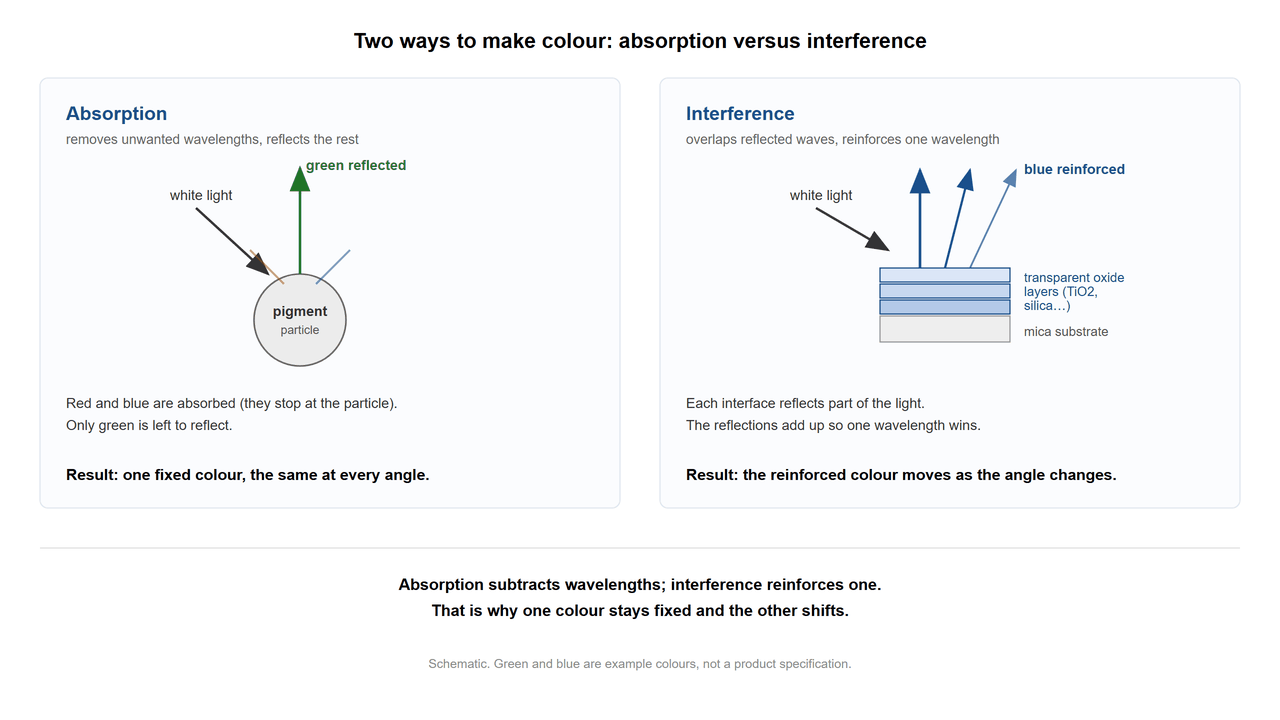
Figure 1. An absorbing pigment reflects the wavelengths it does not absorb; a chameleon flake reflects the wavelength its film stack reinforces.
| Colour Mechanism |
Where the Colour Comes From |
Shifts with Angle? |
Examples |
| Absorption |
Molecules remove unwanted wavelengths; the wavelengths left over are reflected |
No |
Dyes, organic pigments, iron oxide |
| Interference |
Thin-film reflections add up; the wavelength the stack reinforces reaches the eye |
Yes |
Chameleon flakes, soap bubbles, butterfly wings |
Where the Two Meet in a Chameleon Stack
Here is a detail that often gets skipped: a chameleon flake is not a purely interference system. Its multi-layer coating uses both mechanisms deliberately, and understanding how they divide the work explains a lot about why the colour behaves the way it does.
The Transparent Interference Layers
The TiO₂ and silica layers are transparent to visible light. Their role here is to create the optical path-length differences that produce constructive interference. These layers are what select the colour you see at any given angle and what make the colour travel as the viewing geometry changes. Whether you are looking at a duochrome travelling between two anchor colours or multicolor shade-pair families moving through three or more, the interference layers are driving that travel.
The Absorbing Oxide Layer
Fe₂O₃ — coloured iron oxide — sits in the stack as an absorbing layer. It does not produce the colour shift; it anchors and deepens the background colour. By absorbing light that would otherwise scatter diffusely, it gives the interference colour a darker, richer ground to contrast against. That is why chameleon pigments show stronger, more saturated shifts over a dark substrate: the absorption background suppresses competing scatter.
Interference selects the wavelength. Absorption manages the background. The two are not alternatives to each other inside a chameleon flake — they are partners. Designing a formulation that brings out the most from both is what the product page covers in detail.
The simplest field test for any finish — no instruments needed — is the tilt test:
- Tilt the panel and watch the colour.
- Colour shifts to a different hue → interference is dominant. Structural colour. Chameleon territory.
- Colour stays the same → absorption is dominant. Conventional pigment territory.
That is the fastest way to explain to a client whether their finish is "dyed" or "structured." And it is the first practical question to settle before choosing between an absorption pigment for a stable, angle-independent colour and a chameleon pigment for a finish that moves.
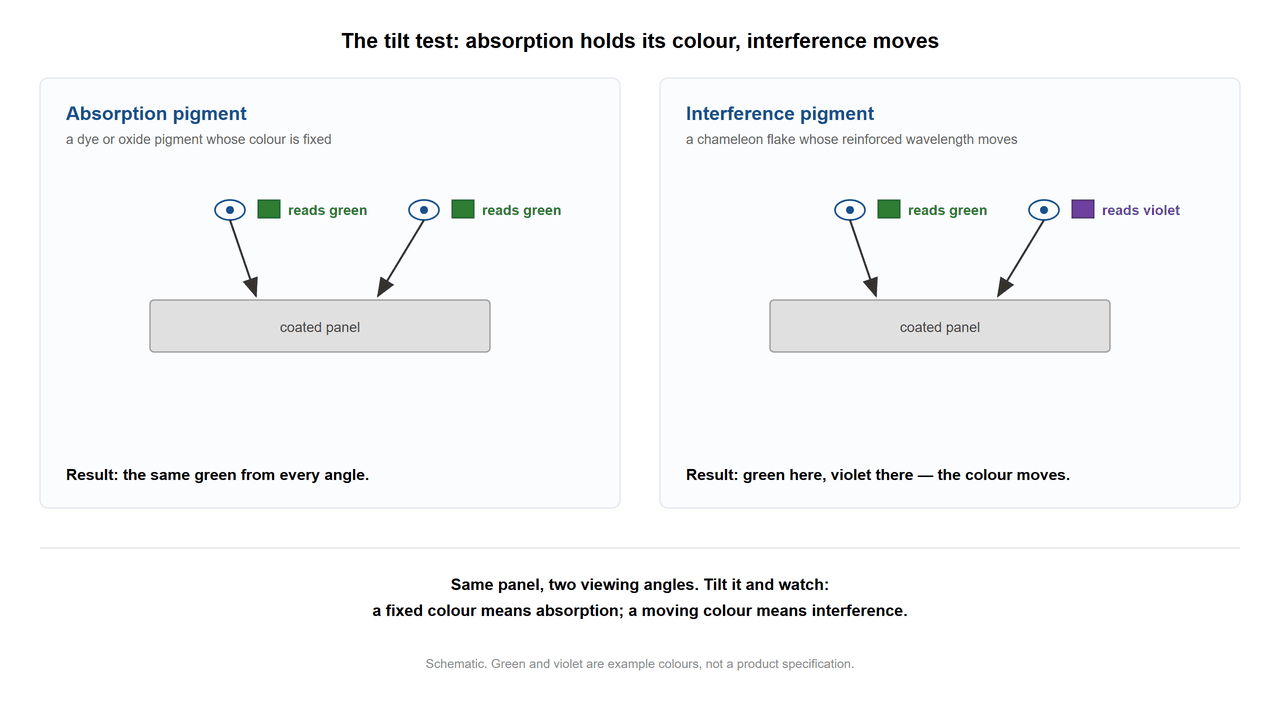
Figure 2. Tilt the panel: an absorbing pigment keeps its colour, while an interference pigment moves to a different anchor colour.
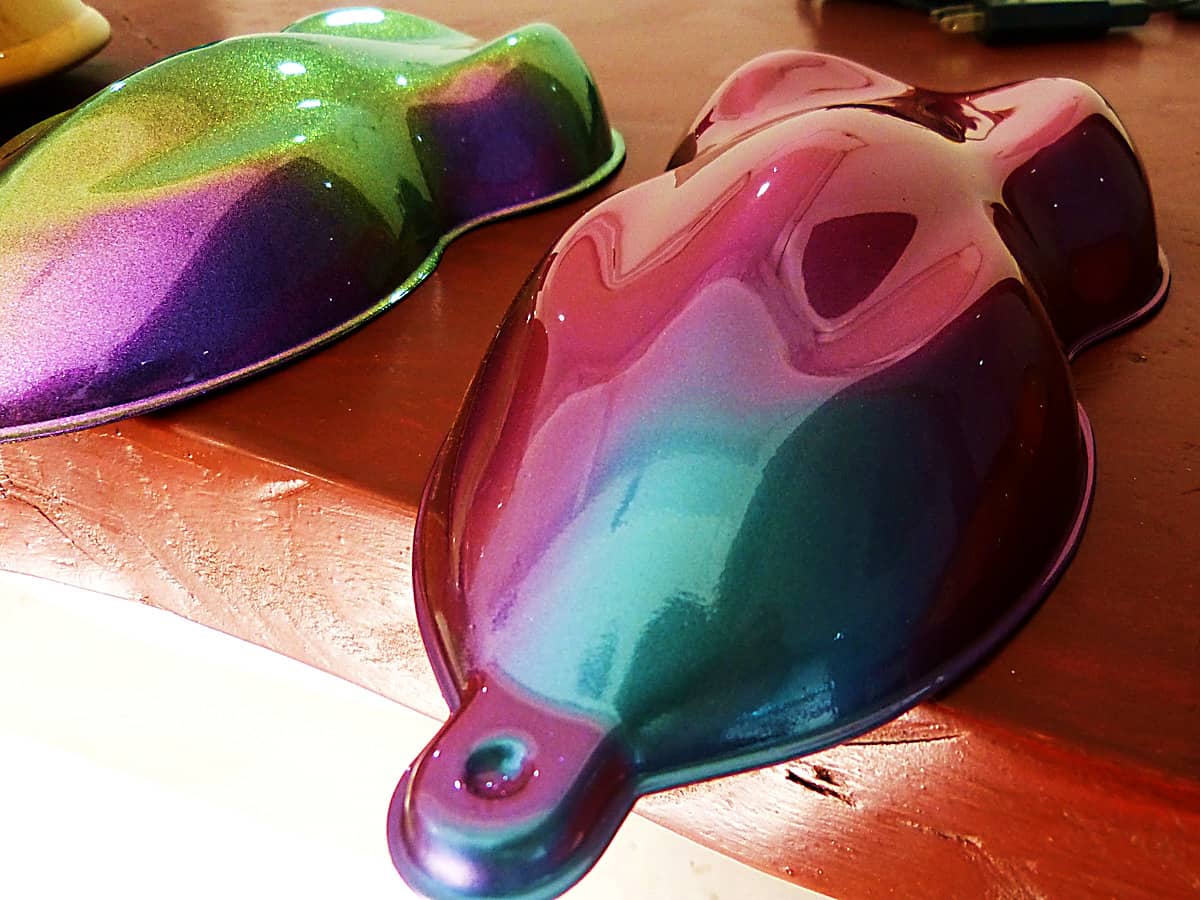
Figure 3. Two coated test pieces under one light. The nearer piece reads violet-red over its upper crest, green-teal down the flank and violet again at the tip; the piece behind travels green to violet. Both were photographed as-is — the colour changes with the angle each part of the surface sits at.
From Mechanism to Grade Selection
Now that absorption and interference are clear, the next step is matching the right flake to your substrate, binder, and target colour travel. Browse the full chameleon range for specifications across the KT-9000 series, or download the Chameleon Collection catalogue to compare shade families, particle sizes, and application guidance in one document.
Frequently Asked Questions
Is color shift the same as a dye changing colour?
No. A dye or ordinary pigment shows colour through absorption — molecules remove specific wavelengths from white light and reflect the rest. The colour is fixed at the molecular level and does not shift with the viewing angle. Chameleon pigments show colour through interference — the film stack selects a wavelength geometrically. Tilt the panel and that geometry changes, so the colour changes. Two completely different mechanisms.
Why does the colour move when I tilt it?
Tilting changes the angle at which light passes through each layer of the film stack. That alters the optical path difference between reflections, so a different wavelength now satisfies the condition for constructive interference. A different wavelength reaches your eye — a different colour. The pigment itself has not changed; the geometry has.
Does a chameleon pigment still absorb any light?
Yes. The Fe₂O₃ layer in the coating is a coloured iron oxide with genuine absorbing character. It suppresses background scatter and gives the interference colour a deeper, more saturated foundation. So a chameleon flake uses both mechanisms: transparent layers for interference and wavelength selection, the iron oxide layer for absorption and background depth.
How do I tell if a finish is interference or absorption?
Use the tilt test. Hold the panel under a consistent light source and rotate it. If the colour shifts to a noticeably different hue, interference is dominant — you are looking at structural colour. If the colour stays the same regardless of angle, absorption is dominant. No instruments needed; the answer is visible in seconds.
References
- Maile, F. J.; Pfaff, G.; Reynders, P. Effect pigments—past, present and future. Progress in Organic Coatings 2005, 54 (3), 150–163. https://doi.org/10.1016/j.porgcoat.2005.07.003
- Akinay, Y.; Akkuş, İ. N. Synthesis and characterization of the pearlescent pigments based on mica deposited with SiO₂, AlN and TiO₂. Ceramics International 2020, 46 (11), 17735–17740. https://doi.org/10.1016/j.ceramint.2020.04.078

 English
 Français
 Deutsch
 Русский
 Español
 Português