You spray two panels with the same pigment from the same container. One delivers a clean green-to-violet travel. The other looks flat grey. Your first call goes to the supplier. It should go to the film. Nine categories of coating defect trace back to causes that sit upstream of the pigment grade, and six systematic checks will tell you which one you are looking at.
Why Does the Same Pigment Produce Two Different Panels?
A color shift pigment consists of a flat platelet carrying a stack of transparent oxide layers. The colour you see comes from light interference inside that stack. Interference depends on the angle at which light enters and exits those layers.
This imposes one absolute requirement. Every platelet in your field of view must sit at roughly the same angle relative to your eye. When they lie flat and parallel to the substrate, you receive one consistent optical geometry. The panel reads as one colour that shifts as you move.
When platelets tilt, stand upright, or clump, your eye averages many different angles simultaneously. Different path lengths reinforce different wavelengths. The result is a muddy average tone. The pigment performs exactly as designed. The arrangement does not.
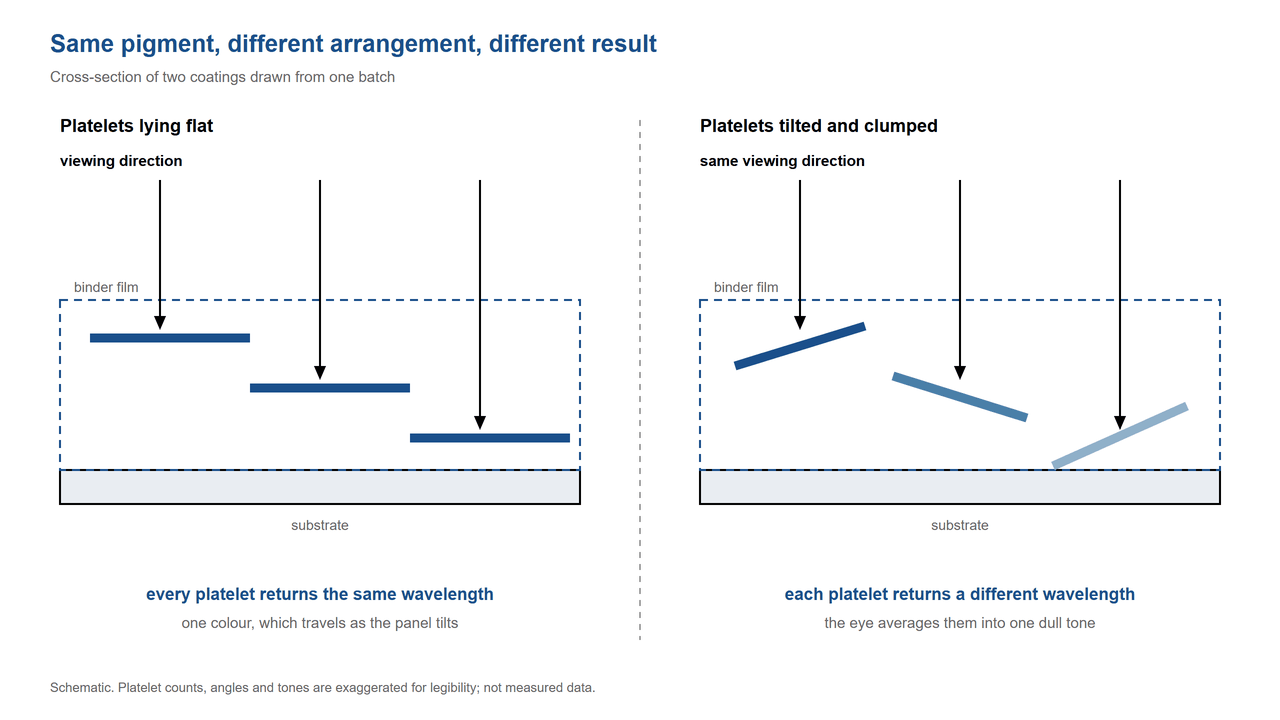
Figure 1. Cross-section of the same coating with platelets lying flat (left) and tilted (right). Both contain the same pigment; only the viewing geometry differs. Schematic, not measured data.
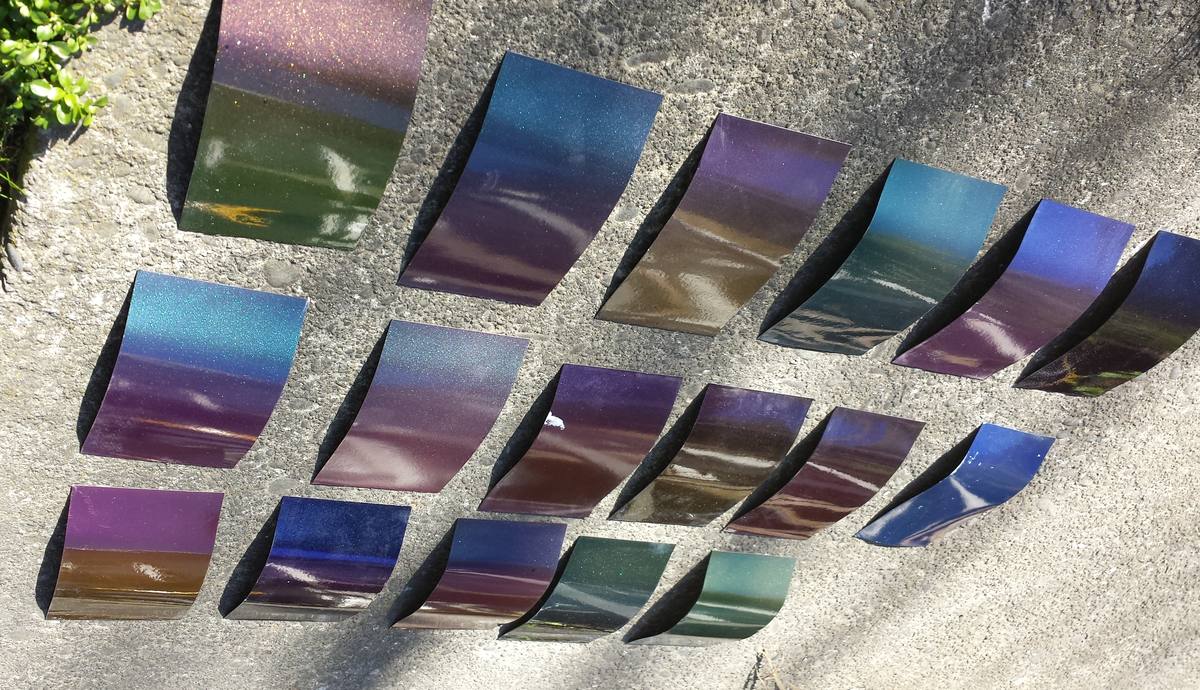
Figure 2. Twenty curved panels from one color shift system, photographed in daylight. Each panel holds several colours at once because its curvature sweeps the platelets through a range of angles. It is one film, not a printed gradient.
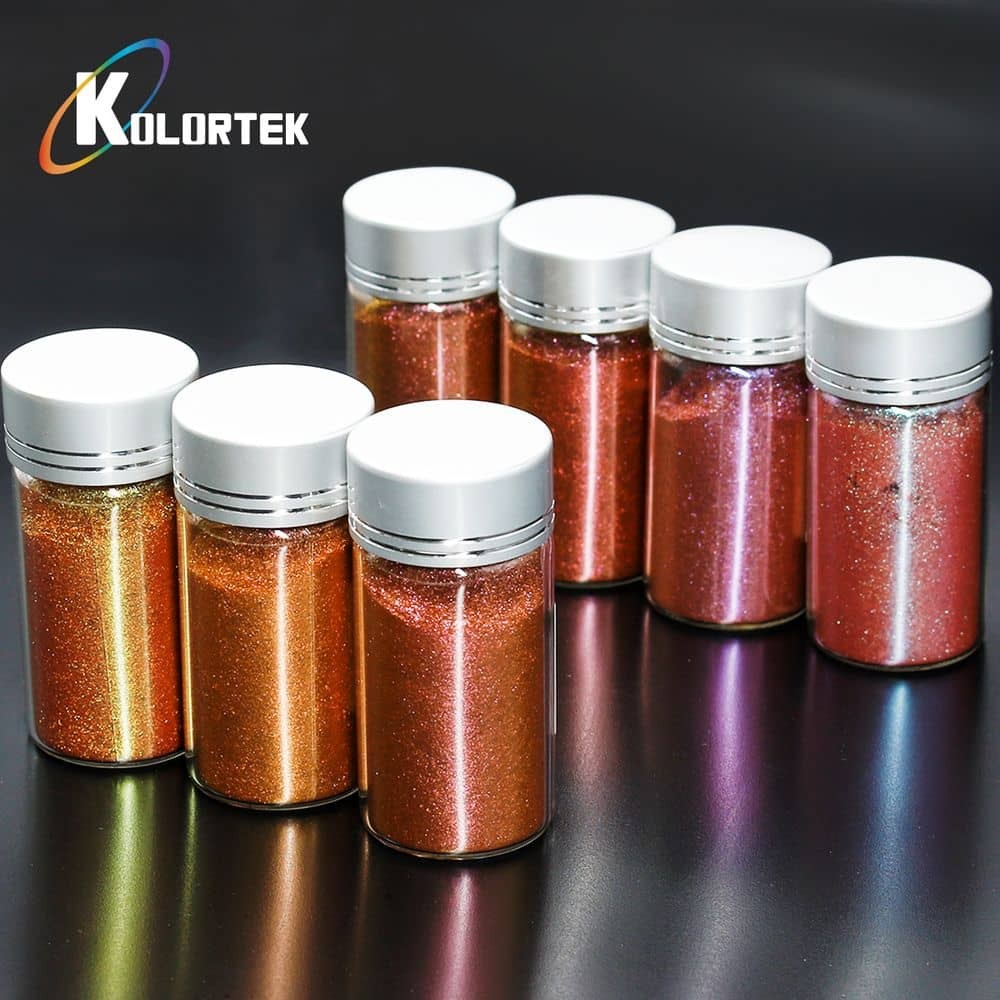
Figure 3. Seven Duochrome grades under the same light. Nothing in the pot looks wrong — what changes is what happens once they are sprayed.
This behaviour is not unique to color shift pigments. Measurements on platelet effect pigments using variable-angle spectrophotometry and coating cross-sections confirm that disturbing platelet orientation moves measured colour values [4]. Application conditions alone produce that disturbance and alter the finished appearance [14].
For the physics behind interference itself, see interference versus absorption.
Which Causes Sit Upstream of the Pigment?
Our coating troubleshooting sheet organizes nine defect types by their actual causes. Read the corrective-action column and notice where pigment grade selection appears. It appears late and infrequently.
The checklist begins with the binder. An unstable binder yellows or separates regardless of which pigment you load into it. No grade change fixes that. The next row addresses other colorants in the formula, which fade before the effect pigment does.
Then it reaches fillers, and this step is routinely skipped. A filler particle is nearly spherical. Pack enough of them around flat platelets and they prevent parallel settling. Light scatters off the filler instead of reaching the platelets. The sheet states it plainly: excessive hiding filler; use little or none.
The mechanism is the same one measured in the studies above. Near-spherical extender disrupts platelet orientation, and disrupted orientation changes colour measurements [4]. A formula that swaps pigment for filler to reduce cost can lose the effect without anyone touching the pigment batch.
Only after binder, other colorants, fillers, and thinner does the sheet reach pigment selection. That sequence is the reason this article exists. Starting by changing suppliers means starting at the end of the causal chain.
The same ordering appears on our coatings application page, where the product table is one input among several rather than a solution on its own.
Why Does Film Thickness Have a Window?
Application sits next in the checklist, and film build is where it fails first. Thickness is the variable that fails in both directions. It fails differently at each end. The instinct to add one more coat is as dangerous as spraying too thin.
When the film is too thin, there is insufficient wet binder for platelets to rotate into a flat position before it sets. The film dries with them locked mid-rotation. You also lose hiding, because the sheet lists low loading and inadequate coverage together.
When the film is too thick, solvent in the lower layers must travel a longer path to escape. That produces convection between the wet surface and the layers below. The moving liquid drags platelets into visible streaks. The sheet names over-thick application and too-close gun distance as the first two causes of mottling.
The recommended fix is worth quoting because it is a process instruction, not a product specification: improve the application method, and build the film in several thin passes rather than one heavy coat.
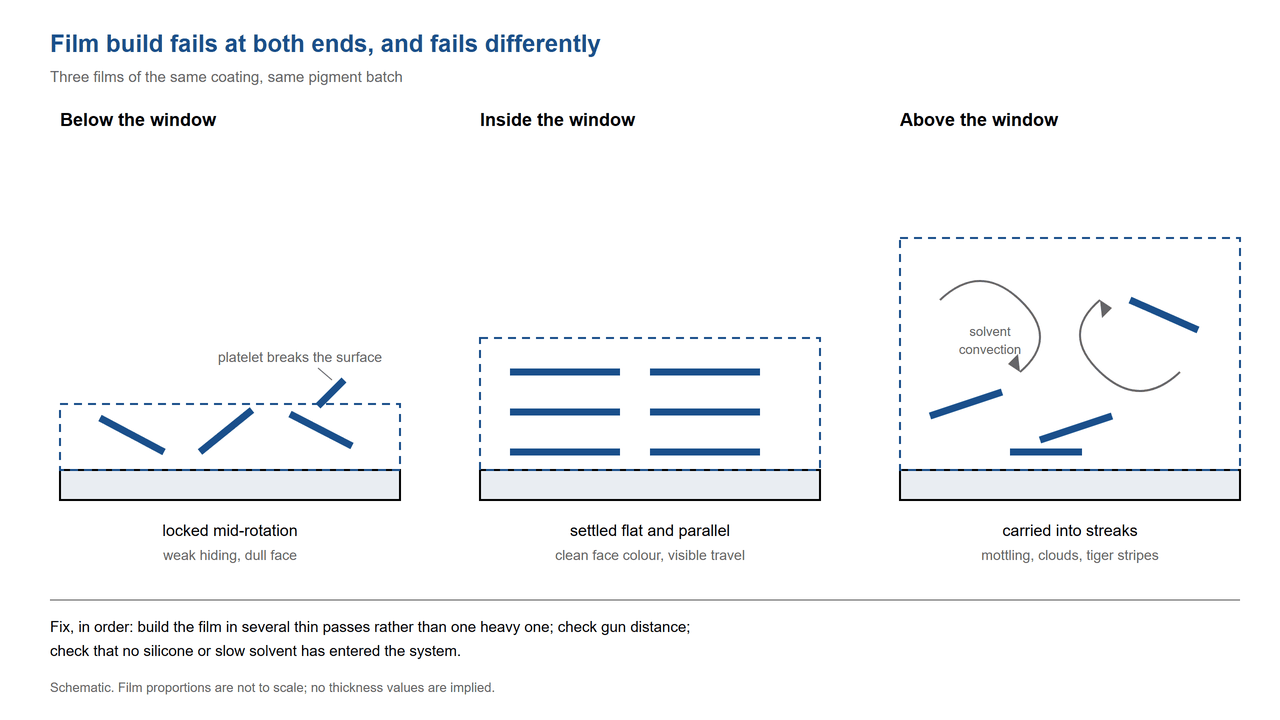
Figure 4. Three films of the same coating: below the window platelets are trapped mid-rotation, inside it they settle flat, above it solvent retention drives convection that lifts them again. Schematic.
Particle size determines where that window sits, because a larger platelet requires more clearance to lie flat. Our range spans three bands: 10–60 μm, 10–70 μm, and 20–80 μm across the Magic Chameleon series. The coarse band is most sensitive to film build.
That is why a fine grade and a coarse grade delivering the same colour shift are not interchangeable on a thin film, even though both share the same interference chemistry. Full grade data appears in the Chameleon Collection catalogue.
Which Defects Are Really Orientation Failures?
The two layers above account for most failures. The troubleshooting sheet tracks nine defect categories in total. Here they are in checklist order, with what each one indicates. The last column matters most: it identifies who must change something.
| What you see |
What to check first |
Why it is usually not the grade |
Who changes it |
| Film is brittle, cracks, or loses adhesion |
Loading level |
Too much platelet leaves too little binder to hold the film together |
Formulator |
| Colour drifts, and not with angle |
Binder stability, then the other colorants |
An unstable binder or a fading colorant moves the whole panel |
Formulator, raw material supplier |
| Gloss drops, surface powders |
Binder weather resistance, rutile grade |
The binder degrades first; a non-rutile grade accelerates it |
Formulator |
| Pigment settles hard in the can |
Solid content, anti-settling agent |
A thin vehicle gives platelets room to fall; the grade cannot thicken it |
Formulator |
| Small seeds or lumps in the film |
Other pigments flocculating, binder separation |
Platelets become trapped inside flocs formed by something else |
Formulator, raw material supplier |
| Hiding is weak |
Loading, grade, substrate colour |
A light effect coat over a dark substrate has nothing to work against |
Formulator, applicator |
| Mottling, clouds, tiger stripes |
Film build, gun distance, silicone contamination, slow solvent |
Wet-film convection carries platelets into streaks; orientation is lost |
Applicator |
| Hard cake, flocculated mass |
Storage stability, thinner choice, anti-settling agent |
Flocculation binds platelets into clumps that will not re-disperse |
Formulator, storekeeper |
| No colour travel at all |
Filler level, dispersion intensity, compatibility |
Rounded filler holds platelets apart, or over-dispersion breaks the stack |
Formulator, production |
When Is the Damage Permanent?
Most items above are recoverable. You change a thinner, lower the filler, slow the pass, and the next panel is fine. One is not recoverable.
A color shift platelet is a coated multilayer stack on a thin substrate. Apply enough shear and you do not bend it. You break it. A broken platelet still scatters light, so the coating does not look obviously defective. It simply stops shifting through colour.
The troubleshooting sheet lists this as its own cause, separate from orientation: incorrect dispersion breaks the platelet. Note the word incorrect. Some dispersion is required to wet the pigment. Too much shear, or the wrong equipment, converts a working batch into scrap that no additive will recover.
Orientation behaviour is what optical performance of effect pigments rests on, and it is a property of intact platelets [1]. Once they are fragments, there is no orientation left to restore.
This is also the case where changing pigment grade genuinely is the answer, but only because the batch in the tank is already destroyed, not because the grade was wrong when purchased.
What Should You Send Before Anyone Checks a Batch?
If you have worked through the sequence above and the effect is still absent, the next step is a batch check. What makes that check fast is context, not more powder samples.
- The grade code and batch number on the container.
- The full formula, including filler type and level, and every other colorant.
- Target and actual film build, plus how many passes you applied.
- Substrate colour and whether a basecoat was used.
- Dispersion method, time, and equipment.
- One good panel and one bad panel from the same batch.
Two panels matter more than any written description. They convert a conversation about opinion into a comparison of two real films, and they usually reveal which of the nine rows above you are in.
We will not confirm a batch from a photograph. Colour travel depends on viewing geometry, and a photograph captures one geometry. Send the panels.
One note before you act on any of this: every operation runs its own trials against its own parameters. Different customers must test different parameters to reach the effect they require. The sequence above is a starting point, not a specification.
If you prefer to start from the grade side, the color shift powder series lists the particle-size bands and their typical uses. If you prefer to start from the failure, send the two panels, the formula with its filler level, and the film build you were targeting. We will identify which row above your case sits in, and whether the powder is involved at all.
References
[1] Maile, F. J.; Pfaff, G.; Reynders, P. Effect pigments—past, present and future. Progress in Organic Coatings 2005, 54 (3), 150–163. https://doi.org/10.1016/j.porgcoat.2005.07.003
[4] Kettler, W. H.; Richter, G. Investigation on topology of platelet-like effect-pigments in automotive surface-coatings. Progress in Organic Coatings 1997, 31 (4), 297–306. https://doi.org/10.1016/S0300-9440(97)00087-8
[14] Sung, L.-P.; Nadal, M. E.; McKnight, M. E.; Marx, E.; Laurenti, B. Optical Reflectance of Metallic Coatings: Effect of Aluminum Flake Orientation. Journal of Coatings Technology 2002, 74 (932). NIST. https://www.nist.gov/node/603136

 English
 Français
 Deutsch
 Русский
 Español
 Português