Two suppliers quote the same shade name and ship two powders with no shared chemistry: different substrate, different composition, different price. The word on the bag names an optical effect, not a material. The answer is INCI, read against particle size, and it holds for every product in this group. This page settles which questions produce that answer, and what a sample can honestly tell you.
Three Names on a Quotation, and Two That Describe Nothing in the Bag
Key takeaways. A diffraction flake splits white light into a band at one angle; an interference flake returns one band plus its complement. The word holographic sits on top of several unrelated INCI compositions, and a single Holographic Silver name can cover two of them. Neither colour standard covers the diffraction type, so a batch certificate describes a measurement, not a surface. A sample settles appearance; solvent resistance, cure stability and the master-panel match have to be measured in your own plant.
The first name is holographic mica powder, and no mica appears on the specification. Those sheets declare silica, aluminium and titanium dioxide, or in one case polyester film with aluminium and iron oxide. Mica does structural work in a pearlescent pigment: it is the substrate that carries the thin film producing the colour. In these products it is absent.
The second name is holographic pearl pigment. Pearl is an interference effect. Light reflects off the upper and lower faces of a thin film, the two reflections reinforce or cancel at particular wavelengths, and the eye reads one colour that turns to its complement. Holographic is a diffraction effect. These are two mechanisms, not one mechanism wearing two labels.
The third name pins holographic to borosilicate glass with a slash. Borosilicate flake is a separate product whose colour comes from layers built onto the flake itself, and buyers reach it through a different set of questions. A holographic flake carries a periodic surface structure instead. Both are flakes. They are not interchangeable, and a quotation that treats the two names as one is quoting the wrong powder.
Effect pigments are usually described by what they produce: optical depth, colour that shifts with viewing angle, the imitation of a natural pearl [1]. A diffraction flake produces none of those three. The vocabulary was built for interference, and diffraction inherited it without anyone checking whether the words still fit.
What Does Diffraction Give That Interference Cannot?
An interference pigment returns a pair. At a given angle one wavelength band is reinforced and its complement is suppressed, so one panel reads green from one direction and red from another. The mechanism is well characterised and it underlies most of the effect pigment market.
A diffraction pigment returns a band. Its surface carries a periodic microstructure that turns each wavelength through a slightly different angle, so white light leaves the flake already separated into components. At any single viewing angle part of the spectrum reaches the eye at once. That is why the flash reads as several colours rather than one colour and its opposite.
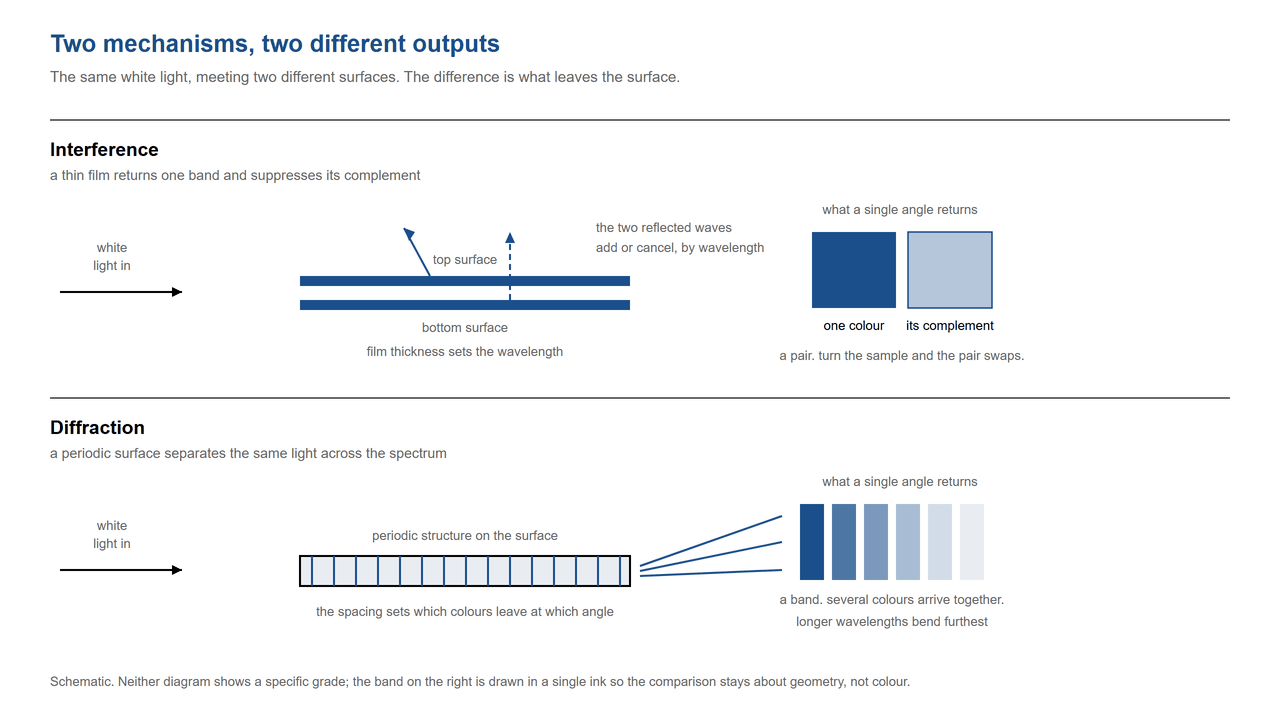
White light in, two different outputs. Top: an interference flake reinforces one band and suppresses its complement, so a single angle returns a pair. Bottom: a grated flake separates the same white light across the spectrum, so one angle returns several colours at once.
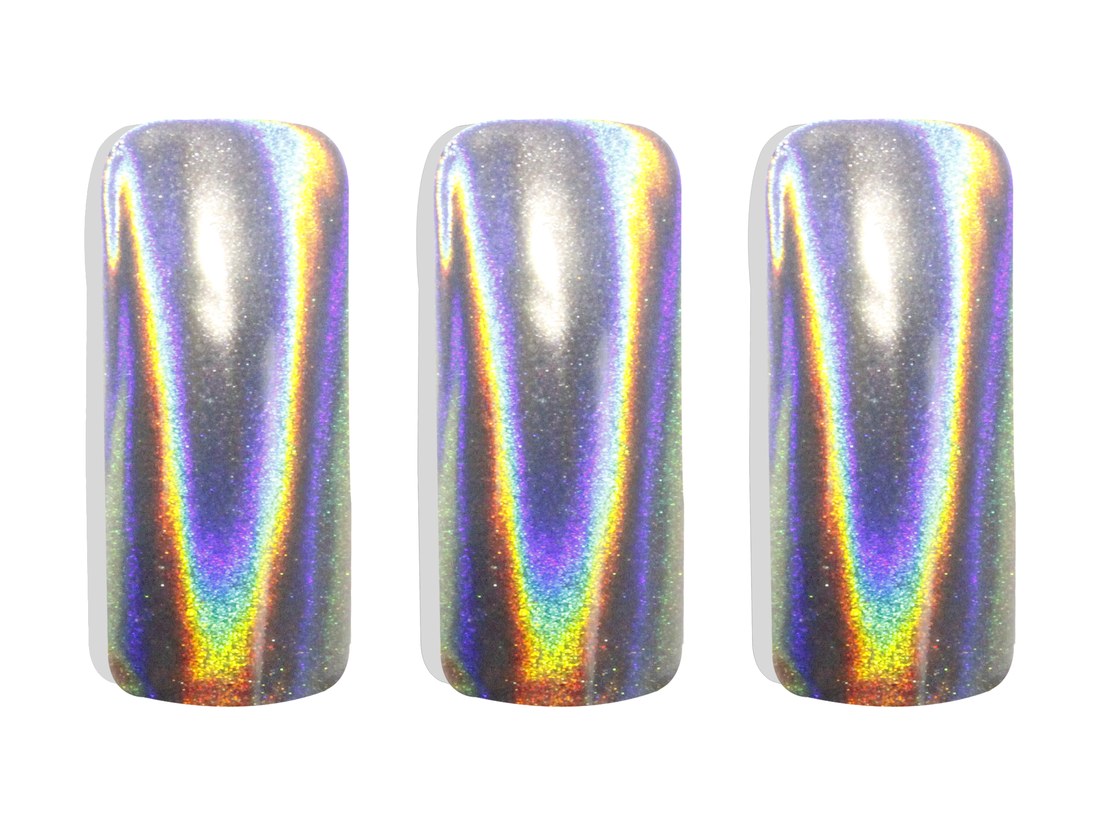
The same holographic grade on three nail tips, one light source. Each tip returns a band that runs through violet, green and orange as the surface curves away — a band, not a colour with its complement.
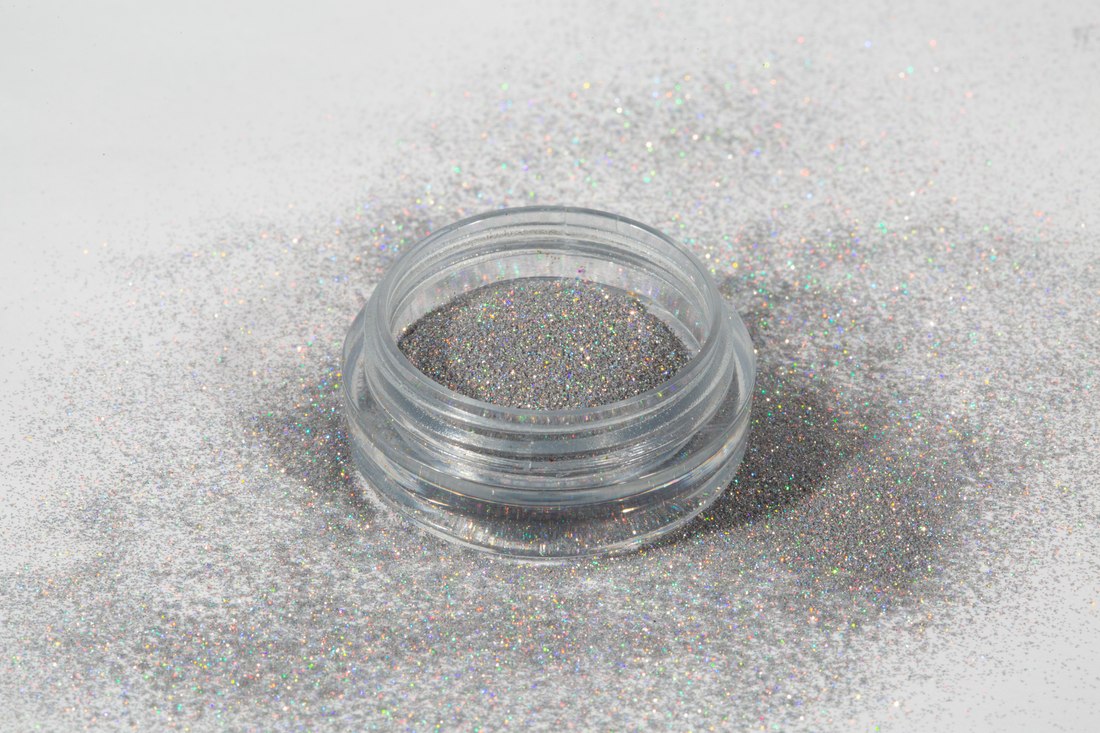
One holographic grade on eight different films. Each one reads as a band spread across the surface rather than as a single colour with its complement.
Orientation advice borrowed from interference pigments transfers only in part. In an interference coating, flake orientation governs colour strength and travel, and that relationship has been measured with variable-angle spectrophotometry [2]. A holographic flake still has to lie flat to send light back. What colour it sends is set by the spacing of its surface structure, not by how far the flake tilts.
Why Does the Word Holographic Say Nothing About Chemistry?
A buyer meets one word for this effect and assumes one material. The declarations behind that word name silica with aluminium and titanium dioxide, polyester film with aluminium and iron oxide, a polyethylmethacrylate, and a magnesium oxide blend — chemistries with nothing in common except the word on the bag. What the products share is an optical description. Past that description the sharing stops.
Holographic Silver is the name quoted most often, and what is sold under it splits across two chemistries: nearly all of it is silica with aluminium and titanium dioxide, and one product in the group is polyester film with aluminium and iron oxide. The quoted particle size travels with the chemistry rather than with the name, so two quotations for one name can be two materials, and neither sheet is wrong.
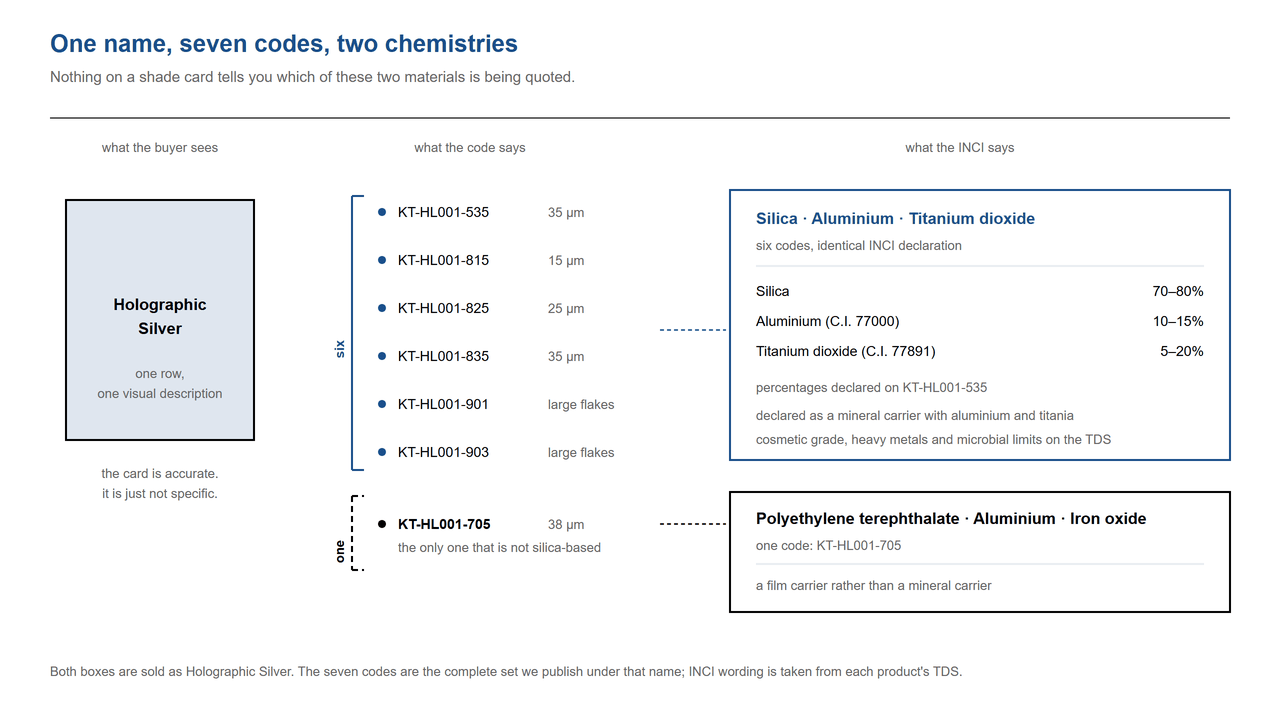
One name on a shade card, two chemistries underneath. The colour on the card comes from silica-aluminium grades and, in one case, from a polyester-film grade. Nobody reading the card can tell which one they are being quoted.
The divergence runs past silver. Holographic Gold is polyethylmethacrylate with aluminium oxide. Holographic Blue is magnesium oxide, aluminium oxide and Pigment Blue 29. Neither contains silica. Whatever they share with the silver grades, it is not a base material, a coating or a manufacturing route.
The published declarations show how far apart two products under one name can sit. One carries 70–80% silica, 10–15% aluminium and 5–20% titanium dioxide; the other carries 56–65% silica, 33–43% titanium dioxide and 1–4% zinc sulfide. Different refractive layers, different acid and solvent tolerance, one name on the order.
The medium carries as much of the result as the grade. ASTM E2539-25 notes that the gonioapparent effect depends strongly on the medium, and that vehicle viscosity, thickness, transparency and volume solids all shift what an instrument reads [3]. Change the lacquer and the colour moves without the pigment code changing.
What Should a Specification Ask For Instead of a Shade?
The two colour standards mark a boundary, and the boundary is the useful part. ASTM E2194-14(2025) covers metal flake pigments, requires three angles of measurement, and states that pearlescent and interference materials are outside its scope, referring them to E2539 [4]. E2539 in turn excludes metal flake. Neither names diffraction.
That gap has a practical cost. A certificate of colour difference says a batch matched a standard under a stated geometry. It says nothing about what the surface looks like. ASTM E2194-14(2025) states plainly that specimens reading the same at three angles may still fail a visual match when gloss, texture or flake orientation differ [4].
So the table below asks for process facts instead of a colour. Every row is something you know before you place the order, and every row removes a class of failure that a shade card cannot catch. Answer them and the grade usually selects itself. None of the answers depends on taste.
| What you answer first |
Why it changes the grade |
Where it shows |
| Carrier: solvent-borne, water-borne, high solids, or powder |
Settles which carrier chemistry sits in the can; a film carrier and a mineral carrier do not swap freely from one vehicle to the next |
INCI declaration |
| Application: spray, print, brush, or mixed into resin |
Sets the particle size ceiling; 100–1000 μm will not pass a nozzle |
Particle size |
| Dry film thickness |
Has to exceed the largest particle, or flakes stand proud of the film and read as grit |
Particle size |
| Substrate lightness |
The rainbow reads strongest over dark ground and weakens over white |
Application note |
| Service temperature and contact chemistry |
Decides whether an aluminium reflector layer is acceptable at all |
INCI declaration |
| Target market |
Decides the heavy-metal and microbial limits you have to document |
Heavy metals, microbial purity |
What Can a Sample Prove, and What Must You Measure Yourself?
A sample answers appearance questions and nothing else. It shows whether the flash is coarse or fine, whether the spectrum reads as a full rainbow or a narrow two-colour turn, and whether the effect survives your binder at your solids. That is a real answer to the question most buyers are asking.
It will not tell you how the batch behaves at production scale, because a sample bag is not a production run. It will not tell you what your customer's eye will accept. And it cannot stand in for a measurement that neither published standard describes. All of that stays on your side of the table.
Three things have to be measured where the product is used: solvent resistance in your own vehicle at your own dwell time, colour stability through your cure schedule, and the visual match against the master panel, judged by whoever signs off. We can support all three with data from our side. We cannot run them for you.
INCI declarations, particle sizes and heavy-metal limits sit on the data sheet for every product in this group, and we will send them before you order. For reference, our specifications run As < 2 ppm, Hg < 1 ppm, Pb < 10 ppm and Cd < 1 ppm. Those are our own limits, not a quotation of any regulation.
What we publish is INCI, particle size, heavy-metal limits and microbial limits, grade by grade. What we do not publish is grating structure or layer thickness, and we will not describe them as if we did.
If you already know which side of this group you need, the holographic pigment product page lists the grades. If you are still weighing one mechanism against another, the interference mica page and the borosilicate glass page show what the other two routes look like. Current catalogues sit in the download centre.
Two quotations carrying one name are the failure this page exists to prevent. The shade name, the INCI line and the particle size from each sheet are enough to separate the two cases, and none of them needs a sample. Send us both sheets and we will tell you which material is on each.
References
[1] Maile, F. J.; Pfaff, G.; Reynders, P. Effect pigments—past, present and future. Progress in Organic Coatings 2005, 54 (3), 150–163. https://doi.org/10.1016/j.porgcoat.2005.07.003
[2] Kettler, W. H.; Richter, G. Investigation on topology of platelet-like effect-pigments in automotive surface-coatings. Progress in Organic Coatings 1997, 31 (4), 297–306. https://doi.org/10.1016/S0300-9440(97)00087-8
[3] ASTM E2539-25, Standard Test Method for Multiangle Color Measurement of Interference Flake Pigmented Materials. ASTM International, West Conshohocken, PA, 2025. https://doi.org/10.1520/E2539-25
[4] ASTM E2194-14(2025), Standard Test Method for Multiangle Color Measurement of Metal Flake Pigmented Materials. ASTM International, West Conshohocken, PA, 2025. https://doi.org/10.1520/E2194-14R25

 English
 Français
 Deutsch
 Русский
 Español
 Português