How do color shift pigments work — and why does the colour you see depend on where you're standing? The answer lives in physics, not chemistry. A chameleon pigment flake is a micro-scale optical stack: light bounces off multiple thin layers, those reflected waves interfere with each other, and one wavelength gets amplified. Tilt the flake — or walk around the panel — and the amplified wavelength moves. The colour follows.[1]
Key Takeaways
- The colour you see is not baked into the pigment particle — it is produced by light interfering inside a multi-layer film.
- Change the viewing angle, change the optical path difference, and the wavelength that gets reinforced shifts — so the colour shifts with it.
- The "colour travel" range of a pigment is simply the set of wavelengths that this interference system amplifies as the angle sweeps from face-on to grazing.
- To specify a colour-shift pigment, start with three decisions: how many anchor colours you need, which angle you will read each one at, and what substrate you are coating.
What Happens When Light Hits a Chameleon Flake
Each chameleon pigment particle is a natural mica platelet coated with several transparent oxide layers — TiO₂, Fe₂O₃, silica, and related metal oxides laid down one over another. Think of it as a microscopic sandwich of partially reflective surfaces.
When light arrives at the flake, part of it reflects immediately at the topmost surface. The rest travels into the stack, hits the next interface, and partly reflects there too. This continues through every layer. You end up with several reflected beams, all derived from the same incoming ray but having travelled slightly different distances.
Those beams then overlap. Where their wave peaks align, the waves add together — constructive interference — and that wavelength is amplified. Where peaks and troughs cancel, the light is suppressed. The result is that the film acts as a selective filter: one wavelength is reinforced and you perceive it as colour.[1]
The colour you see is not a dye or pigment molecule absorbing light in the conventional sense. It is a wavelength that a set of reflections has voted to amplify.
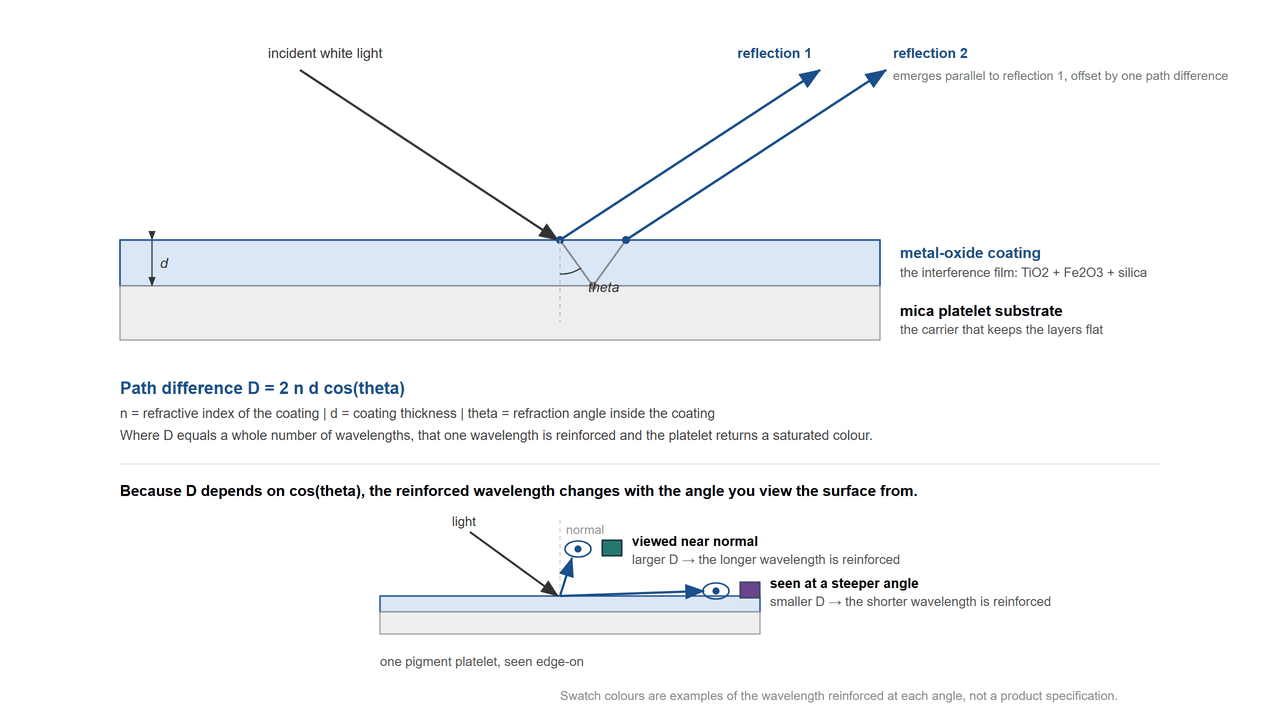
Figure 1. White light reflects at each interface of a multi-layer flake; the reflected waves interfere so one wavelength is reinforced — and tilting the flake shifts that wavelength.
Why the Colour Moves When You Change the Angle
The critical variable is optical path difference: the difference between the paths travelled by reflected beams, accounting for the refractive index along each path. Together with phase changes at the interfaces, it determines which wavelength constructively interferes.
When light strikes the flake almost face-on, it travels nearly perpendicular to the layers. In the corresponding reflection direction, the path difference between adjacent reflections takes one specific value, and a specific wavelength wins.
Tilt the panel under the same lighting, and light travels through each layer at a different angle. The path difference changes, the constructive interference lands on a different wavelength, and you see a different colour in the corresponding reflection direction.[1][4]
A useful analogy: imagine looking through a stack of glass plates at a narrow-band light source. Rotate the stack and the interference pattern shifts. The glass did not change — the geometry did.
This is why the term goniochromatic fits: the colour is a function of the observation angle. The pigment particle itself is the same particle at every angle; only the optical geometry — and therefore the amplified wavelength — is different.
What the Multi-Layer Stack Adds Over a Single Layer
Standard pearlescent pigments are built on a single TiO₂ coating over mica. One coating means one main set of interfering surfaces, which produces one interference colour. As the angle changes, what you mostly see is brightness shifting — lighter near the specular angle, darker away from it — rather than a full colour travel.
Chameleon pigments add further layers — TiO₂, Fe₂O₃, silica, and other oxides — stacked deliberately on top of each other. Each additional interface introduces another set of reflected beams and another set of path differences. The stack now carries multiple interference systems running simultaneously.[3]
As the angle sweeps from face-on to grazing, those systems take turns dominating. Each hands off to the next at a different angle, producing a distinct second — or third — amplified wavelength. That is what generates the colour travel: a duochrome pigment delivers two anchor colours across the angle range, a multicolour pigment three or more.
More layers, more anchor colours — that is the core optical logic. For a direct comparison of how a duochrome flake reads against a standard pearl in a formulated coating, see duochrome versus standard pearl.
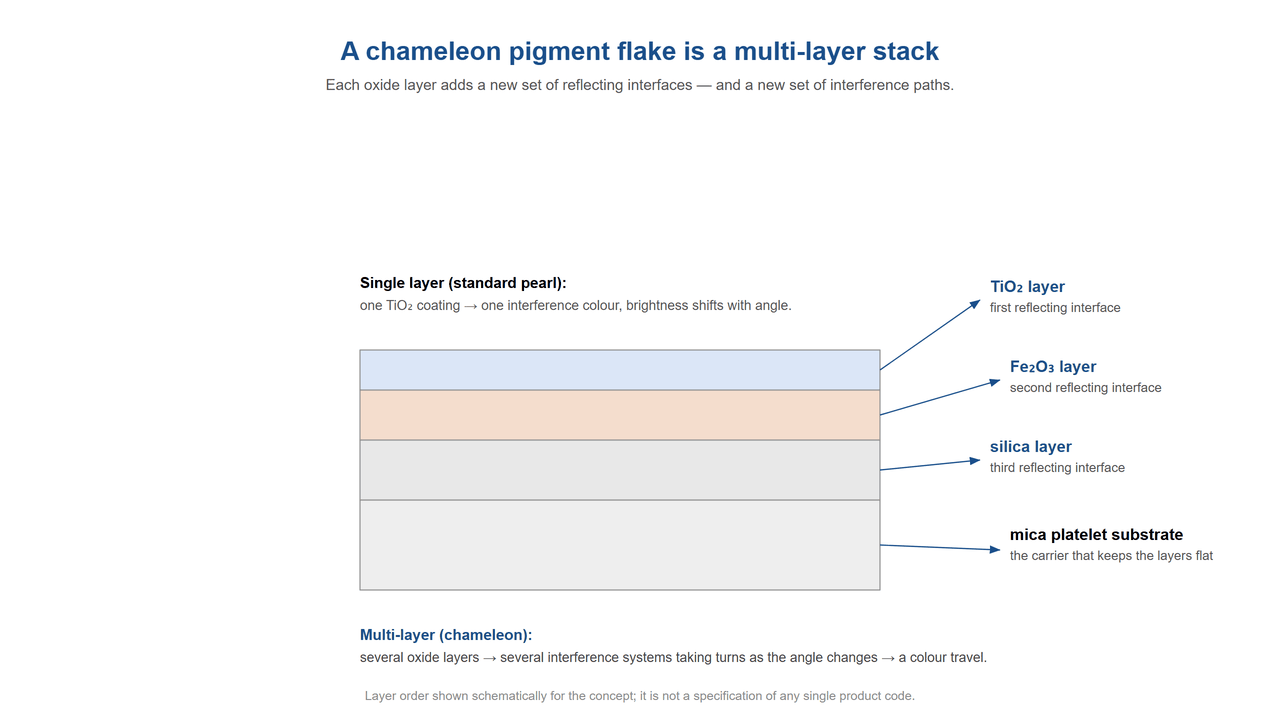
Figure 2. A cross-section of the multi-layer stack — mica, TiO₂, Fe₂O₃ and silica — that produces the colour travel.
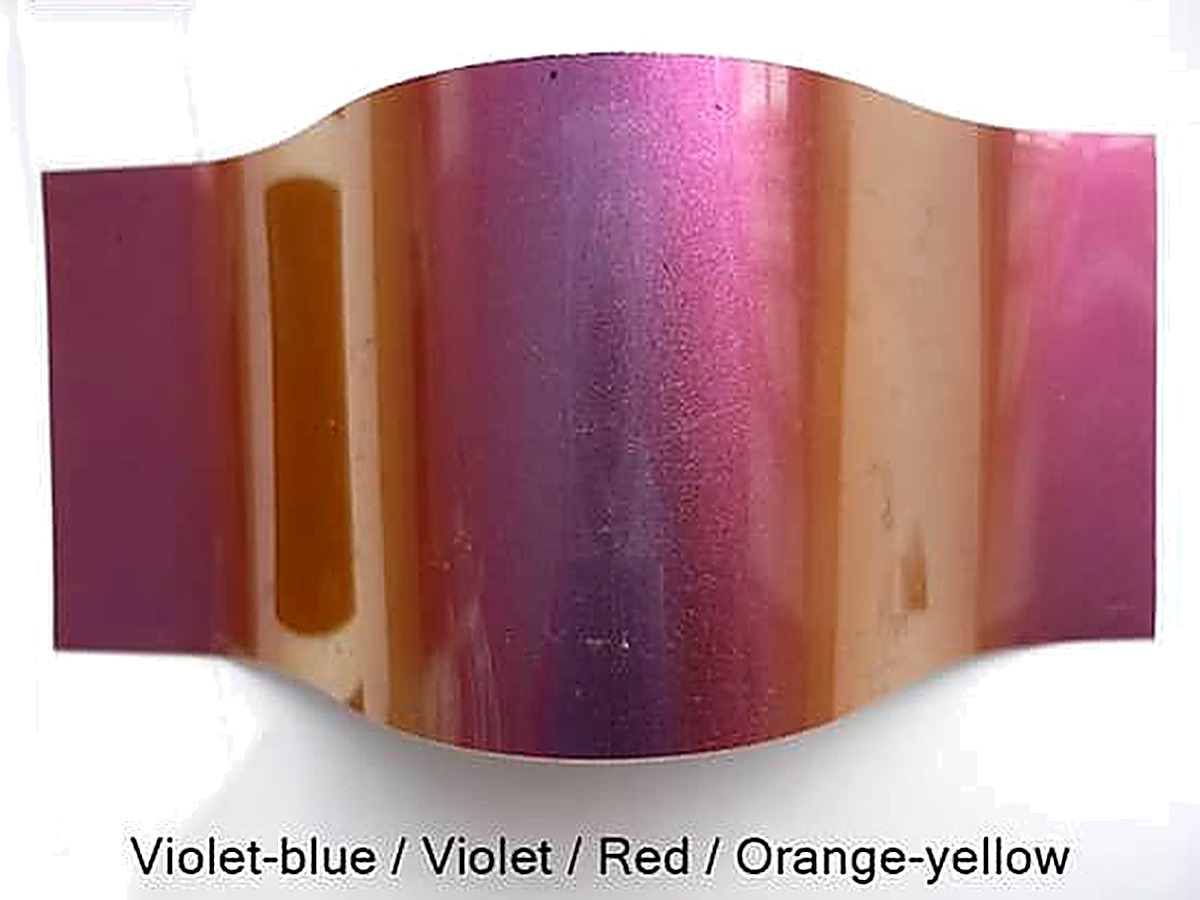
Figure 3. One coated card bent into a curve: violet-blue through violet and red to orange-yellow, all on the same surface under the same light. Nothing was repainted between the colours — the angle at each point decides what you read there.
What This Means When You Specify a Colour-Shift Pigment
Understanding the mechanism reframes the selection question. You are not just picking a colour — you are choosing a film architecture that will produce specific colours at specific angles in your specific application.
Start with three decisions before you look at a product page:
- How many anchor colours do you need? Two (duochrome) or three-plus (multicolour) are different film architectures, not just different shades of the same product.
- At which viewing angle will each colour be read? The interference that delivers your main colour face-on is not the same interference that delivers the flop colour at a grazing angle. For a detailed look at how the viewing geometry changes the reading, see the product page.
- What is your substrate colour? Dark substrates let interference colours read clearly because little background reflectance competes with the thin-film signal. On a light substrate, transmitted light bouncing back through the flake dilutes the contrast between anchor colours, and the travel looks washed out.
Lock in those three parameters and you can match them against actual pigment families and particle-size grades rather than browsing by shade name alone.
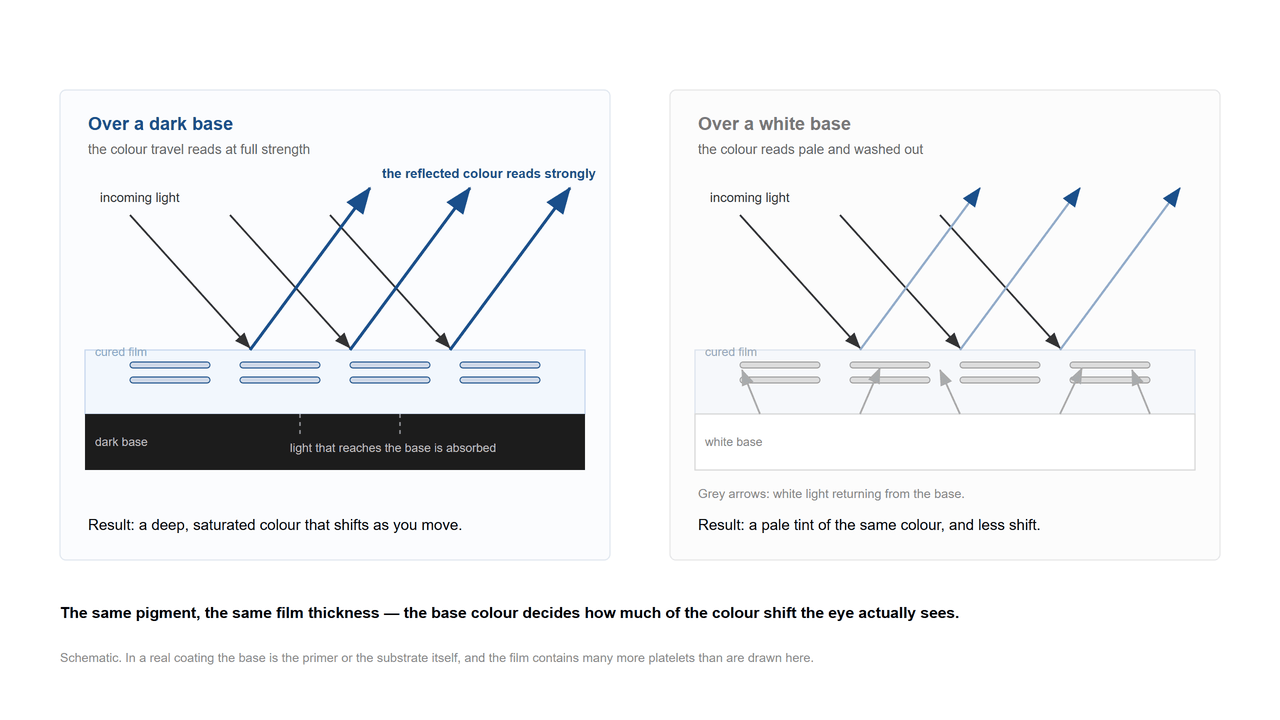
Figure 4. The same pigment reads at full strength over a dark base; over a white base the returning light dilutes the colour travel.
Video 1. The same coating filmed in one take. Tilt the surface and the colour travels through its anchor colours — nothing is repainted, only the angle changes.
Video not loading? Watch it on YouTube.
Explore the Chameleon Range
Now that the physics is clear, the next step is matching it to a grade. Browse grades by anchor-colour pair and particle size in the full chameleon range, or download the Chameleon Collection catalogue for a reference to the KT-9000 series.
Frequently Asked Questions
Is color shift paint the same as pearlescent paint?
Both use thin-film interference to generate colour rather than absorbing dyes. The difference is the film architecture: standard pearlescent pigments have a single coating and produce mainly brightness shift as the angle changes; chameleon pigments have a multi-layer stack that produces a genuine colour shift — a different hue, not just a different lightness, at different angles. See the product page for a side-by-side reading.
Why does the colour change when I tilt the panel?
Tilting the panel changes the angle at which light travels through each layer of the film stack. That changes the optical path difference between reflected beams. A different path difference means constructive interference lands on a different wavelength — and a different wavelength means a different colour. The pigment particle has not changed; the geometry has.
Do I need a black base for the shift to show?
A dark basecoat gives the clearest result. On a light substrate, the background reflects light back up through the flake, which dilutes the interference signal and reduces the contrast between anchor colours. You do not have to use black specifically, but the darker the substrate, the more vivid the colour travel. Confirm the result on your intended substrate when selecting a grade.
What is the difference between duochrome and multichrome?
The number of oxide-layer groups in the stack. A duochrome pigment has enough interfaces to hand off between two anchor colours as the viewing angle changes. A multichrome (multicolour) pigment has additional layer groups and cycles through three or more anchor colours. More layers is not automatically better — it depends on how many distinct colour positions your application needs to deliver.
References
- Maile, F. J.; Pfaff, G.; Reynders, P. Effect pigments—past, present and future. Progress in Organic Coatings 2005, 54 (3), 150–163. https://doi.org/10.1016/j.porgcoat.2005.07.003
- Akinay, Y.; Akkuş, İ. N. Synthesis and characterization of the pearlescent pigments based on mica deposited with SiO₂, AlN and TiO₂. Ceramics International 2020, 46 (11), 17735–17740. https://doi.org/10.1016/j.ceramint.2020.04.078
- Kettler, W. H.; Richter, G. Investigation on topology of platelet-like effect-pigments in automotive surface-coatings. Progress in Organic Coatings 1997, 31 (4), 297–306. https://doi.org/10.1016/S0300-9440(97)00087-8

 English
 Français
 Deutsch
 Русский
 Español
 Português