
 English
 Français
 Deutsch
 Русский
 Español
 Português
You've specified a chameleon paint system for an automotive topcoat, selected your color shift mica powder, and now the applicator is reporting uneven color travel or worse—outright particle dropout in the gun. The particle size wasn't wrong on the datasheet. It was wrong for this system.
Selecting the right particle size distribution for color shift mica powder in automotive coatings isn't about matching a single spec. It's about balancing visual intensity, application method, film thickness, surface finish, and the practical limits of your spray equipment. Get it right and you have consistent, dramatic color travel across every panel. Get it wrong and you're explaining to a customer why the hood looks different than the door.
Why Particle Size Controls More Than You Think
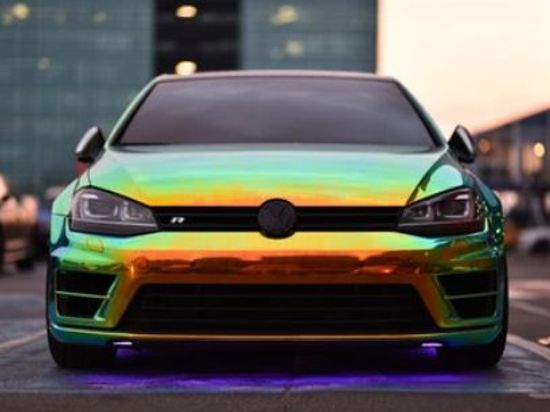
Color shift pigments—whether you call them chameleon paint pigment, chromashift, or automotive color shift pigment—generate their effect through multilayer optical interference on thin, platelet-shaped mica flakes. The color you see depends on viewing angle, and the intensity of that shift depends largely on flake size.
Larger particles (75–175 μm or coarser) create stronger, more dramatic color transitions. The increased surface area per particle amplifies reflected light and makes the shift more visible at oblique angles. These grades deliver the high-impact look clients expect from a chameleon finish.
Smaller particles (5–25 μm or 10–60 μm) produce subtler shifts with smoother surface finish. They're easier to suspend in low-viscosity systems and less prone to settling during storage. They also orient more uniformly during spray application, which matters when you need color consistency across complex body panels.
That said, smaller doesn't always mean better. Fine grades can look washed out if your film build is too thin, and they're harder to load at high concentration without affecting rheology.
Matching Particle Size to Application Method
Automotive coatings are applied by spray—HVLP, electrostatic, or conventional air-atomizing guns—and each method has practical limits on what it can deliver without clogging, spitting, or producing tiger-striping.
Spray Gun Compatibility
Most automotive spray systems work reliably with particle sizes up to 60–80 μm if the pigment is properly dispersed and the fluid tip is sized accordingly. Standard HVLP guns with 1.3–1.4 mm tips handle 10–60 μm grades without issue. If you're working with coarser grades (100–250 μm), you'll need larger tips (1.8–2.0 mm) and potentially higher atomizing pressure, which can compromise finish quality.
Electrostatic systems are more restrictive. Particles above 80 μm tend to lose charge efficiency and don't transfer as uniformly, leading to uneven coverage. For high-transfer-efficiency automotive lines, stay in the 10–60 μm range.
Film Thickness and Pigment Load
Color shift effects require adequate film build to allow full flake orientation and light interference. A thin basecoat (15–25 μm dry) might look acceptable with fine pigments (5–25 μm), but larger flakes (75–175 μm) will protrude through the surface or fail to lay flat, killing the optical effect.
General guideline: particle D50 should not exceed one-third of the dry film thickness. For a 40 μm coating, use pigments with D50 ≤ 13 μm if you want smooth orientation. If you're building 60–80 μm films (more common in custom automotive work), you have more latitude—10–60 μm grades perform well, and even 75–175 μm grades are workable if applied in multiple passes.
Common Particle Size Ranges and Their Trade-Offs
| Particle Size Range | Visual Effect | Surface Finish | Application Notes | Typical Use |
|---|---|---|---|---|
| 5–25 μm | Subtle, refined shift | Smooth, minimal texture | Easy to spray; stable suspension | OEM-quality finishes, thin films |
| 10–60 μm | Moderate to strong shift | Balanced smoothness | Versatile; works in most systems | Mainstream automotive custom work |
| 10–70 μm / 20–80 μm | Strong, visible travel | Slight texture at high load | Requires adequate film build | Showcar finishes, full customs |
| 75–175 μm | Dramatic, high-impact | Coarse; visible flake | Large tips; multiple coats needed | Specialty effects, motorcycles |
| 100–250 μm | Extreme sparkle and shift | Very coarse texture | Difficult to spray uniformly | Art panels, show pieces |
How to Test Before You Commit
Datasheets give you D50 and particle distribution curves. Spray-outs tell you how the pigment actually behaves in your system.
Request lab samples in at least two size ranges—typically 10–60 μm and 20–80 μm—and prepare test panels at your target film thickness. Apply over the same primer and under the same clearcoat you'll use in production. Evaluate under natural light and at multiple viewing angles, not just under shop fluorescents.
Check for: color travel consistency across the panel, surface smoothness after clear, ease of application (any tip clogging or spitting), and color match between passes if you're doing multiple coats.
Worth noting: some color shift pigments lose intensity when buried under thick clearcoats (>60 μm). If you're doing a heavy clear build for gloss or protection, test that too. The shift can dull significantly.
Practical Considerations for Batch Consistency
Particle size distributions can shift slightly between production batches, especially in larger or irregularly shaped grades. If color consistency is critical—say, for fleet vehicles or multi-stage paint programs—specify a tighter tolerance on D50 (±5 μm) and request a certificate of analysis with each lot.
For custom one-offs, you have more flexibility. But if you're running production volumes, even a 10 μm drift in average particle size can produce visible color mismatch under certain lighting.
What About Mixing Particle Sizes?
Some formulators blend two grades—say, 10–60 μm for base color travel and a small percentage of 100–250 μm for added sparkle. This works, but it adds complexity. The larger particles settle faster, so you need robust agitation during application and potentially a rheology modifier to prevent stratification in the can.
In practice, most automotive systems get better results from a single, well-chosen grade than from a blend that requires constant monitoring.
Typical Product Options for Automotive Work
Kolortek manufactures both chromashift and chameleon series pigments across a wide size spectrum. The chromashift line includes grades like KT-K15716 (Green/Orange) and KT-K14216 (Blue/Red) in 10–60 μm, which handle well in standard automotive spray systems and deliver strong color travel without excessive texture.
The chameleon series extends into coarser ranges—models like KT-95175 (Blue-green/blue/violet/red, 75–175 μm) or KT-95125 (100–250 μm) are used where dramatic flake and maximum shift are priorities, though they require larger spray tips and thicker films.
For electrostatic or high-efficiency application, finer grades such as KT-95102 or KT-K12125 (both 5–25 μm) maintain good transfer rates and produce uniform coverage even at lower film builds.
When Particle Size Isn't the Problem
If you've matched the particle size correctly but still see poor color shift or application issues, look elsewhere: inadequate dispersion (agglomerates behave like larger particles), incompatible resin wetting (mica flakes don't orient), or incorrect pigment loading (too low for optical density, too high for rheology).
Automotive color shift pigment requires more than just tossing powder into a basecoat. Surface treatment on the mica, choice of dispersing agent, and mixing shear all influence final performance—sometimes more than particle size alone.
Frequently Asked Questions
What particle size should I use for a standard automotive basecoat clear system?
10–60 μm is the most versatile range for automotive basecoat applications. It provides strong color shift, works with standard HVLP spray guns (1.3–1.4 mm tips), and produces a smooth finish under clear without excessive texture.
Can I use 100–250 μm chameleon pigments in a spray gun?
Yes, but you'll need a larger fluid tip (1.8–2.0 mm or bigger), higher film build (60+ μm dry), and likely multiple coats to achieve full coverage. Expect visible flake texture in the final finish. These grades are better suited for custom show work than production automotive coatings.
Do finer particle sizes reduce color shift intensity?
Generally yes. Smaller particles (5–25 μm) produce subtler color travel compared to larger grades (75–175 μm) because they have less surface area per flake to reflect light. However, at appropriate loading levels and film thickness, fine grades still deliver visible shift—just less dramatic.
How does particle size affect pigment settling in the can?
Larger, heavier particles settle faster. Grades above 80 μm typically require more aggressive anti-settling additives and more frequent agitation during use. Finer grades (10–60 μm) are easier to keep in suspension, especially in lower-viscosity basecoats.
What's the relationship between particle size and dry film thickness?
For smooth flake orientation, keep the particle D50 below one-third of your dry film thickness. A 30 μm coating works well with 10 μm average particles but will look rough or incomplete with 75 μm flakes. Thicker films (60–80 μm) give you more flexibility to use coarser pigments.
Can I mix two different particle sizes in one formulation?
You can, but it complicates suspension stability and application consistency. The different settling rates can cause color variation between the top and bottom of the can, and you may see uneven flake distribution on the panel. Most production systems perform better with a single, optimized particle size.
Getting It Right the First Time
There's no universal "correct" particle size for automotive color shift coatings—only the right size for your specific combination of application method, film build, visual target, and production constraints. Start with 10–60 μm if you're unsure; it's the most forgiving range and works across the widest set of conditions.
If you need technical support matching a pigment grade to your system, Kolortek's technical team can provide spray-out samples and application guidance based on your equipment and film specifications. Real-world testing beats guesswork every time.