Food grade pearlescent pigments are used to give cakes, chocolates, confectionery, and selected beverages a shimmering, metallic, or pearl-like finish. From gold wedding cake decorations to sparkling cocktail drinks, edible luster dust helps food manufacturers and professional decorators create visual effects that ordinary food coloring cannot achieve on its own.
However, choosing a food grade pearlescent pigment involves more than selecting a color. Buyers need to understand the difference between edible glitter and non-edible decorative products, check ingredient and regulatory information, and select a particle size and application method that suit the food product.
This guide explains how food grade pearlescent pigments work, where they are used, how to choose between standard and titanium dioxide-free options, and what food manufacturers should verify before purchasing. It also introduces Kolortek's Edible Glitter Series and its product options for cake decoration, confectionery, and beverage applications.
What Is Food Grade Pearlescent Pigment?
Food grade pearlescent pigment is a decorative color ingredient designed to create a pearl-like shimmer, metallic appearance, or sparkling visual effect in food applications where the specific product and ingredients are permitted for the intended use.
Unlike conventional food coloring, which mainly changes the base color of a product, pearlescent pigments create visual depth through the reflection of light from their fine particle structures. Depending on the formulation, they can produce soft satin luster, silver-white pearl, warm gold, bronze, or colored shimmer.
Food decoration products are also marketed under names such as edible luster dust, edible pearl dust, edible shimmer powder, and edible glitter. These terms are often used interchangeably in the market, but they do not automatically describe the same particle structure, ingredients, or permitted application. Always check the product label and technical documentation.
Kolortek's Edible Glitter Series is a dedicated range of mica-based pearlescent powders for food and beverage decoration. The series includes different shades and visual effects, from subtle pearl finishes to more noticeable sparkle, with titanium dioxide-free options also available.

Gold luster dust shown with a decorated cake application.
How Do Edible Pearlescent Pigments Create a Shimmer Effect?
Pearlescent pigments create their characteristic appearance through the interaction of light with thin, reflective particles. In many traditional effect pigments, a platelet-shaped substrate is coated with materials that influence light reflection and interference.
When light reaches the decorated surface, different parts of the particle structure reflect light at different angles. The result can appear as a soft pearl glow, metallic-looking finish, or visible sparkle. The final effect depends on the pigment composition, particle size, color, concentration, and the surface or food matrix where it is applied.
For food decoration, the visual result is influenced by several practical factors:
- Base color: Gold and colored pearl effects may appear different on white fondant, dark chocolate, or colored icing.
- Particle size: Fine particles generally produce a more uniform sheen, while larger particles create more visible sparkle.
- Application method: Dry brushing, painting, and mixing into a food matrix can produce different levels of reflection.
- Surface condition: A smooth, dry surface may show a different finish from a moist or textured surface.
- Lighting: Pearl and interference effects can look different under natural light, indoor lighting, and photography lighting.
This is why a pigment sample should be evaluated on the actual food product rather than judged only from a color chart or dry powder sample.
Food Grade Pearlescent Pigment Applications
Edible pearlescent pigments are used in many decorative food applications. The best product choice depends on the food matrix, the desired appearance, the application process, and whether the pigment is permitted for that specific use.
Cake and fondant decoration
Gold, silver, and pearl luster dust are commonly evaluated for wedding cakes, celebration cakes, fondant figures, sugar flowers, and molded decorations. Fine and medium particle grades can provide a smooth decorative finish, while more pronounced sparkle effects can be used for selected accents.
Chocolate and confectionery
Chocolate bonbons, molded chocolates, pralines, and sugar decorations can benefit from metallic or pearl effects. One decorating technique is to apply an appropriate edible pigment to a clean, dry mold before adding the chocolate. The final result depends on the mold surface, pigment grade, chocolate process, and release conditions. Confirm that the selected pigment is suitable for the intended application.
Cookies, macarons, and pastries
Edible shimmer powders can be used to add decorative highlights to cookies, macarons, cupcakes, and pastry toppings. For small details, a controlled brush application may be easier than mixing the pigment throughout the entire recipe.
Drinks and beverage decoration
Shimmering beverages are used in specialty cocktails, mocktails, event drinks, and selected beverage products. However, a pigment that performs well on a dry cake surface may not behave the same way in liquid. Suspension, settling, particle size, dispersion, and the beverage's acidity or other formulation characteristics should be tested before commercial use.
Ice cream and dessert toppings
Pearlescent effects can also be considered for selected ice cream decorations, dessert toppings, and cake pops. The manufacturer should evaluate how the pigment behaves under the product's storage and serving conditions, including moisture and temperature changes.
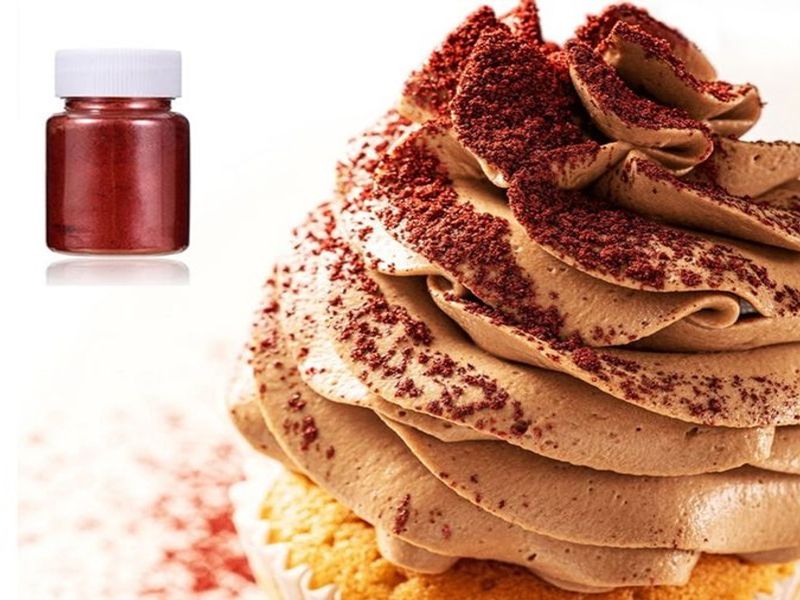
Colored edible dust used to create a decorative finish on a chocolate dessert.
For food and confectionery businesses developing liquid applications, Kolortek also provides a dedicated shimmery effect pigment solution for edible drinks. Beverage performance should be confirmed through testing in the actual drink formulation.
Standard Edible Glitter vs Titanium Dioxide-Free Pearlescent Pigments
One important purchasing consideration is whether a food decoration pigment contains titanium dioxide (TiO₂). Titanium dioxide has historically been used in food applications as a whitening agent and in some pearlescent pigment systems to produce reflective effects.
Regulatory requirements differ by market. In the European Union, titanium dioxide as a food additive (E171) has not been permitted in food since 2022. Food businesses selling into the EU therefore need to pay particular attention to the composition of their decorative ingredients and the applicable rules for the intended product.
Kolortek offers titanium dioxide-free edible glitter options for buyers who need to evaluate alternatives to conventional TiO₂-containing grades. These products are relevant to formulation and sourcing discussions where TiO₂-free requirements apply.
| Selection Point |
Standard Grade |
TiO₂-Free Grade |
| Composition |
May contain titanium dioxide, depending on the specific grade |
Formulated without titanium dioxide as an ingredient |
| Visual effect |
Pearl, metallic, or shimmer effects depending on the grade |
Alternative pearlescent effects; appearance varies by shade and formulation |
| Purchasing consideration |
Check the full composition and market-specific requirements |
Confirm the complete ingredient declaration and suitability for the target market |
| Best next step |
Review documentation for the exact product code |
Request samples and verify the required visual effect and regulatory status |
It is important to understand that "TiO₂-free" does not automatically mean approved for every food application or every country. The complete ingredient composition, applicable food additive rules, permitted food categories, and conditions of use must still be reviewed by the responsible food business operator.
How Particle Size Affects Edible Pearl Dust
Particle size has a direct influence on the visual appearance and practical handling of edible pearlescent pigments. A fine grade may create a delicate pearl finish, while a coarser grade produces more visible individual points of sparkle.
| Particle Size Guide |
Typical Appearance |
Potential Application |
| Below 15 μm |
Fine, soft satin sheen |
Fine surface decoration and selected mix-in applications |
| 10–60 μm |
Balanced pearl shimmer |
Fondant, cookies, chocolates, and general decorative work |
| 20–100 μm |
More visible sparkle |
Decorative accents and statement cake finishes |
| Larger particle grades |
Pronounced individual sparkle points |
Selected decorative effects where the product specification permits |
These are general selection guidelines, not universal specifications for all edible pigments. The actual particle size range should be confirmed from the manufacturer's technical data sheet.
For example, Kolortek's F1103A Pearlescent Grade Violet Edible Dust has a listed particle size of 10–60 μm. This makes it a useful product to evaluate when a manufacturer wants a medium-fine violet pearl effect for food decoration. Its suitability must still be checked against the intended food category and target-market requirements.
For beverage applications, finer particles may be worth evaluating because particle size can influence settling behavior. However, particle size alone does not guarantee long-term suspension. The beverage formulation, density differences, viscosity, and processing conditions all matter.
How to Apply Food Grade Pearlescent Pigments
The right application method depends on the surface, food matrix, and product instructions. Before using a pigment in production, confirm that the grade is intended for the proposed method and that any carrier or processing aid is suitable for food use.
Dry brushing
Dry brushing is a common method for applying edible luster dust to fondant, molded sugar decorations, and selected dry surfaces. A clean, food-use brush helps distribute the powder in a controlled way. Apply gradually and build the effect in light layers rather than adding too much pigment at once.
Painting with a suitable food-grade carrier
Some edible dusts can be mixed with a suitable food-grade liquid or carrier to create a brushable decoration medium. The carrier must be appropriate for food use and permitted in the target market. Follow the supplier's instructions and test the mixture on a small sample before decorating a full product.
Application to chocolate molds
For selected molded chocolate applications, a suitable edible pigment can be applied to a clean, dry mold before chocolate is added. This technique can create a decorative surface after demolding. Test the pigment and chocolate process together to confirm transfer, appearance, and release performance.
Mixing into a food matrix
Some pigments may be incorporated into icing, chocolate, sugar preparations, or other food matrices when the product is specifically suitable for that use. Mixing can produce a different visual effect from surface decoration. Check the recommended use level and assess the final appearance, texture, and stability.
Use in beverages
For drinks, evaluate the pigment in the actual beverage base. Check dispersion, visible shimmer, settling rate, serving conditions, and appearance over the expected shelf or service period. A product designed for cake decoration should not automatically be assumed suitable for beverage use.
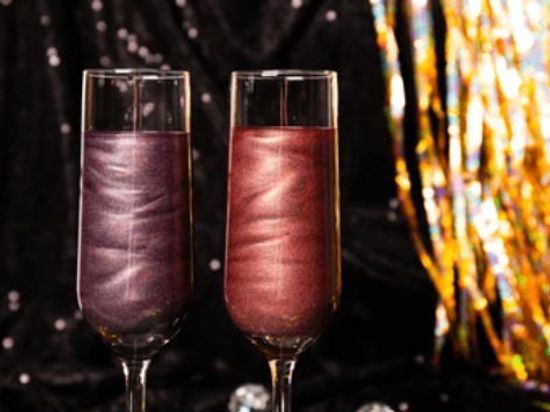
Pearlescent shimmer effect demonstrated in beverage applications.
How to Select the Right Food Grade Pearlescent Pigment
Food manufacturers, confectionery brands, and professional decorators should evaluate pigments against the actual product requirements. The following selection points can help narrow down suitable grades before requesting samples.
- Define the food application: Identify whether the pigment will be used on cakes, fondant, chocolate, cookies, confectionery, or beverages.
- Choose the visual effect: Decide whether the target is a soft pearl sheen, metallic gold, silver luster, colored shimmer, or stronger sparkle.
- Confirm particle size: Match the grade to the desired finish and the application process.
- Check TiO₂ requirements: Determine whether the target market or customer specification requires a titanium dioxide-free product.
- Review ingredient information: Request the full composition and relevant food additive information for the exact product code.
- Confirm permitted use: Check the applicable regulations for the food category, dosage, and country of sale.
- Test a sample: Evaluate the pigment in the real food matrix and under normal processing and storage conditions.
- Check supply consistency: Agree on product specifications, batch documentation, packaging, MOQ, and lead time before production orders.
For a specific product reference, Kolortek's F1103A Violet Edible Dust provides a listed color, particle size, and food decoration application. Buyers can use the product information as a starting point for technical discussion and sample evaluation.
Food Safety and Documentation: What Buyers Should Verify
Food safety is not determined by appearance or by a general product description. A pigment must be evaluated according to its complete composition, intended use, and the regulations that apply in the market where the finished food will be sold.
Terms such as "non-toxic," "food contact," and "food grade" should not be treated as proof that a decorative powder is approved for direct consumption. Some decorative products are intended only for surfaces that are removed before eating. Others are formulated for edible applications. The distinction must be clear on the product specification and labeling.
Before approving a food pearlescent pigment, ask the supplier for the documentation relevant to the exact grade:
- Full ingredient composition: Identify the materials and colorants used in the product.
- Product specification or TDS: Review particle size, appearance, and other technical properties.
- Safety Data Sheet: Review handling, storage, and safety information where applicable.
- Certificate of Analysis: Check batch-specific quality information where supplied.
- Food additive and colorant information: Confirm the relevant regulatory status and permitted food categories.
- Market-specific compliance information: Assess requirements for the EU, United States, or other destination markets separately.
- Labeling guidance: Confirm the appropriate ingredient declaration and any required use instructions.
Certifications and management-system documents can support supplier assessment, but they do not replace verification of the ingredient's legal status for a particular food use. The food manufacturer or brand owner remains responsible for ensuring that the finished product complies with the regulations in its market.
Kolortek provides technical information for its food decoration pigment range and can discuss documentation requests for specific grades. Buyers can review the company's food application solutions when comparing decorative effects and application requirements.
Why Consider Kolortek for Food Decoration Pigments?
For commercial bakeries, confectionery manufacturers, and food decoration brands, a pigment supplier needs to offer more than a broad color selection. Product information, technical support, sample evaluation, and supply consistency are also important parts of the sourcing process.
Kolortek's food decoration portfolio includes edible glitter and luster dust designed for decorative applications in food and beverages. Its range includes gold, silver, bronze, and other color options, as well as titanium dioxide-free alternatives for buyers with specific formulation requirements.
When discussing a project with Kolortek, buyers can provide:
- The intended application, such as cake decoration, chocolate, confectionery, or drinks.
- The desired color and finish, such as gold metallic, silver pearl, violet shimmer, or fine satin luster.
- The preferred particle size or visual effect.
- Whether a TiO₂-free option is required.
- The target country or region and relevant regulatory requirements.
- Expected order volume, packaging needs, and sample requirements.
This information helps the supplier identify products for further review and reduces unnecessary sample comparisons. For food applications, the final grade should always be approved only after the required documentation and product testing have been completed.
Frequently Asked Questions About Food Grade Pearlescent Pigments
What is food grade pearlescent pigment?
Food grade pearlescent pigment is a decorative ingredient intended for specified food applications where its composition and use are permitted. It creates pearl-like shimmer, metallic-looking effects, or sparkle through light reflection. Buyers should verify the exact grade's ingredients, labeling, and permitted use before consumption.
Is edible luster dust the same as non-toxic glitter?
No. Non-toxic does not necessarily mean edible. Some decorative glitters are intended for decoration only and must be removed before eating. Use only products clearly identified and documented for the intended edible application, and follow their label instructions.
Can food grade pearlescent pigment be used on cakes and fondant?
Some edible pearlescent pigments are designed for cake and fondant decoration. The selected grade should be suitable for the intended surface application, and its ingredients and permitted use should be checked for the destination market.
What is the difference between standard and TiO₂-free edible glitter?
Standard grades may contain titanium dioxide depending on their formulation. TiO₂-free grades are formulated without titanium dioxide. The visual effect can vary by product and shade, so buyers should request the ingredient composition and test samples before selecting a replacement.
Why is titanium dioxide-free edible pigment important for the EU market?
The European Union no longer permits titanium dioxide (E171) as a food additive. Food businesses selling into the EU should check whether a decorative pigment contains TiO₂ and assess the complete ingredient composition and intended use against current EU requirements.
What particle size is suitable for cake decorating?
Fine particles can provide a softer, more uniform sheen, while medium and larger particles create more visible sparkle. A 10–60 μm grade can be a practical starting point for general decorative evaluation, but the best choice depends on the surface, application method, and desired finish.
Can edible pearlescent pigments be mixed into drinks?
Only use a grade that is specifically suitable for the intended beverage application. Test its dispersion, settling behavior, appearance, and stability in the actual drink formulation. Cake decorating grades should not automatically be assumed suitable for beverages.
Can edible luster dust be mixed with water or alcohol?
Some products can be mixed with a suitable food-grade carrier to create a brushable decoration medium. The correct carrier depends on the product and intended use. Follow the supplier's instructions and verify that the carrier is permitted for the target food application.
What documents should I request from a food pigment supplier?
Request the full ingredient composition, product specification or TDS, applicable safety information, batch documentation such as a COA where available, and relevant regulatory information for the intended market. Do not rely only on a general food-grade statement.
Does Kolortek offer titanium dioxide-free edible pearlescent pigments?
Yes. Kolortek lists titanium dioxide-free options within its edible glitter range. Buyers should request the exact product composition, available shades, technical documents, and sample information to confirm suitability for their intended food application and market.
Choosing the right food grade pearlescent pigment starts with the intended food application, the desired decorative effect, and the regulatory requirements of the destination market. Contact Kolortek with your target color, particle size preference, application, and TiO₂ requirements to discuss suitable products and sample evaluation.

 English
 Français
 Deutsch
 Русский
 Español
 Português