Color shift pigment — whether formulated as a chameleon pigment for automotive topcoats or as an optically variable pigment for security printing — produces a continuous, flowing color transition across viewing angles by exploiting thin-film light interference rather than conventional absorption chemistry. The practical consequence is a finish that reads as two or more distinct colors depending on angle and illumination, a property that drives real value in anti-counterfeiting, cosmetics, and premium decorative coatings. This article covers the underlying optical mechanisms, the structural differences between major pigment types, and the formulation variables that determine whether that shift actually performs in a finished coating or ink.
The Optical Mechanism: Why These Pigments Shift
The color shift effect is fundamentally an interference phenomenon, not a dye effect. When white light enters a semitransparent flake, it encounters multiple refractive boundaries — typically a high-index coating such as titanium dioxide deposited over a transparent substrate. Part of the light reflects from the top surface, part transmits and reflects from the lower surface. Those two reflected beams travel slightly different path lengths. Depending on that path length difference — which scales with layer thickness and refractive index — certain wavelengths constructively interfere while others cancel.
As viewing angle increases from near-normal to oblique, the effective optical path through the layer decreases. Constructive interference shifts toward shorter wavelengths. The practical result: a flake that reads red at normal incidence may read green or gold at 45°, and violet at steeper angles. The magnitude and cleanliness of that shift depend on how precisely the coating layers are controlled during production.
This is why color shift is fundamentally different from thermochromic or photochromic color change. Those systems respond to external stimuli — temperature or UV exposure — and are reversible. Interference-based shift is entirely structural. The color is encoded in layer geometry, not chemistry.
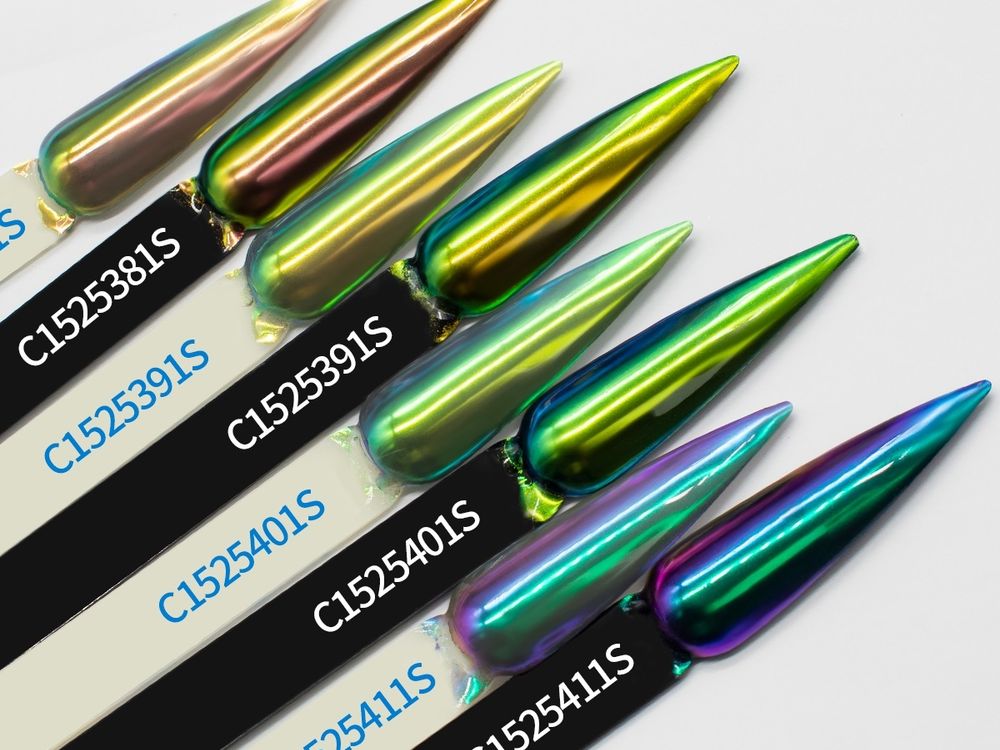
Structural Variants: Not All Color Shift Pigments Are Built the Same
There are four structurally distinct approaches to producing angle-dependent color, and they are not interchangeable in formulation.
Transparent flake / TiO₂ multilayer (chameleon pigments). The most common architecture. A highly transparent mica or synthetic flake substrate carries a titanium dioxide coating grown to a precise thickness. This is the backbone of most chameleon series pigments. The substrate's transparency is critical — any opacity at the base layer compromises the interference depth and dulls the shift. Color shift range is determined primarily by TiO₂ layer thickness: thinner layers produce blue-violet first-order colors; thicker layers push into red-orange-green second-order territory. Multi-layer constructions — alternating high/low refractive index layers — extend the range further and sharpen the color boundaries.
Optically variable pigments (OVP) — metal/dielectric/metal stacks. These use a vacuum-deposited sandwich: an opaque or semi-opaque metal layer, a dielectric spacer, and a thin reflective metal layer on the other side. The color is generated by Fabry-Pérot cavity interference between the two metal surfaces. OVP constructions tend to produce sharper, higher-chroma shift transitions than simple TiO₂-on-mica and are engineered specifically for security applications. They are also structurally distinct from magnetic variants.
Holographic diffractive pigments. These operate by diffraction, not thin-film interference. A relief grating — typically a surface-embossed pattern on a metallized film that is subsequently milled into flakes — disperses incident light into spectral components. The result is a rainbow-spectrum shimmer rather than a clean two-color shift. Holographic pigments with a "colorshift" variant use a combination of a colored selective reflector with the diffraction grating to produce both a spectral rainbow and a directional hue shift simultaneously. Particle geometry here matters considerably — larger irregular flakes produce more dramatic visible diffraction; fine powders tend toward a diffuse silver glitter with less distinct rainbow structure.
Magnetic chromashift (cat eye / OVMP). This is a composite effect. The pigment flakes carry magnetic properties — achieved by incorporating a magnetic layer into the stack — which allows external field alignment during application. When an array of flakes is aligned by a magnet, they create a lens-like or stripe-like optical pattern that reads as a three-dimensional "cat eye" moving across the surface as the viewing angle changes. The color-shift mechanism within each flake is still interference-based, but the macroscopic pattern effect is magnetic alignment. These pigments — sometimes called 3D Cat Eye Magnetic Chromashift Powders — are a distinct sub-category combining OVMP functionality with controlled spatial arrangement.
How Pigment Architecture Translates to Observed Color Range
A useful way to compare the major types side by side:
| Type |
Mechanism |
Color Shift Character |
Typical Use Cases |
| Chameleon / Duochrome (TiO₂ multilayer) |
Thin-film interference |
Flowing, continuous 2–4 color travel |
Paints, coatings, cosmetics, nail |
| Chromashift OVP (metal/dielectric stack) |
Fabry-Pérot cavity interference |
High-chroma, sharp shift; strong at oblique angles |
Security printing, banknotes, high-end packaging |
| Holographic diffractive |
Diffraction grating |
Full rainbow spectrum; angle-dependent spectral dispersion |
Cosmetics, packaging, nail art, craft |
| Magnetic Chromashift (OVMP / Cat Eye) |
Interference + magnetic alignment |
3D rolling / cat eye pattern with hue shift |
Nail gel, security ink, specialty coatings |
| Aurora / Iridescent multilayer |
Multi-angle interference |
Soft, multidimensional shimmer with color travel |
Cosmetics, eyeshadow, nail, craft |
In practice, the cleanness of the shift — how distinct the two or more colors appear versus how blended the transition looks — correlates directly with the quality of the coating deposition. Poorly controlled layer thicknesses produce a muddy, ambiguous color rather than a clean angular transition.
What Controls Shift Performance in a Formulated System
Understanding the mechanism is necessary but not sufficient. Several formulation variables will determine whether a colour shifting pigment delivers its rated visual effect in a real product.
Substrate and background color. Interference pigments are partially transparent. On white or light substrates, the shift effect is substantially diluted because reflected light from the substrate background adds incoherent white light that washes out the chroma. Dark backgrounds — ideally black — provide maximum contrast for the reflected interference color. This is not optional; it is physics. For security printing applications, this means black ink layers beneath OVP are standard practice.
Flake orientation. The interference is angle-dependent, so flakes must be oriented roughly parallel to the substrate surface to produce a coherent color shift across the viewing range. Turbulent application methods, high-viscosity systems that trap flakes at random angles, or excessive shear during mixing all reduce parallelism and degrade the effect. In spray-applied automotive coatings, the wet film rheology during solvent evaporation is the primary driver of flake orientation. In printing inks, squeegee pressure and substrate porosity both play roles.
Dispersion versus agglomeration. Interference pigments should not be treated like conventional pigments in a high-speed disperser. Mechanical shear breaks flakes, reduces aspect ratio, and directly degrades both brightness and shift quality. The correct approach is low-shear incorporation — hand-stir into a pre-formed letdown, or use a dissolver at controlled low RPM. This is one of the most common formulation errors that leads to underwhelming performance reports.
Binder refractive index. The effective optical path through the interference layer is influenced by the surrounding medium. High-refractive-index binders shift the observed color slightly relative to the specification. In most decorative applications this is a second-order effect, but in security printing where exact color match at specified angles is part of the anti-counterfeiting specification, binder selection is a controlled variable.
Load level. These pigments function by individual flake reflection. Overlapping flakes at high load levels compete and partially cancel each other's effect. Optimal load for chameleon and OVP pigments in most coating systems falls in the range of 3–8% by weight of total formulation. Higher loads tend to produce a "flat" metallic appearance as individual flake contributions average out.
That said, load level thresholds differ significantly between coating types. A high-solids automotive topcoat at 5% OVP will look very different from a UV nail gel at 5% — film thickness, cure behavior, and shrinkage all affect final flake geometry.
Application-Specific Considerations
Automotive coatings. Color shift pigments in automotive use are almost always applied in a basecoat layer with a clear topcoat. The shift effect is viewed through the clearcoat, so clearcoat refractive index and gloss level affect apparent chroma. Matte clearcoats scatter light and reduce the perceived shift intensity considerably. Solvent-borne vs. waterborne basecoats also differ in drying dynamics and therefore in flake orientation quality.
Security printing. Chromashift OVP and magnetic OVMP are engineered for this market specifically. The key performance requirement is a defined color change at a defined angle — for example, green to gold between 0° and 45° — that is easily verified by the human eye without equipment. Magnetic variants add a second authentication feature in the form of a machine-readable magnetic signal. For gravure printing, etching cell depth in the 45–70μm range and ink viscosity management in the 18–30°C temperature window are standard operating parameters for OVP inks. Deviation from these parameters directly affects layer uniformity and shift quality.
Cosmetics and nail. The shift effects most relevant here are chameleon, holographic, aurora, and cat eye variants. Cosmetic-grade compliance is a prerequisite — not a differentiator. The practical formulation challenge in nail gel is that UV curing shrinkage can reorient flakes post-application, so gel viscosity before cure needs to hold flakes in position long enough for the magnetic alignment (in cat eye gels) or gravitational settling (in standard gels) to complete. Working time is a real variable. In pressed powder cosmetics, the shift effect is substantially reduced relative to liquid or gel systems because the film is thin and discontinuous.
Thermochromic and Photochromic Pigments: A Brief Distinction
These are frequently grouped with color shift pigments in product catalogs but they are mechanistically unrelated. Thermochromic pigments change color in response to temperature — the transition is reversible and is driven by a microencapsulated leuco dye system that shifts between colorless and colored states at a defined activation temperature. Photochromic pigments respond to UV exposure, shifting from pale to saturated in under a second under direct sunlight, then reverting in the absence of UV.
Neither mechanism involves light interference. Neither is angle-dependent. They are stimulus-responsive pigments, not optically variable ones. Conflating them with interference-based colour shifting pigment in formulation or specification documents creates real problems downstream.
Selecting the Right Type for Your Application
A few practical criteria that narrow the choice quickly:
If you need a defined two-color shift on a dark background in a transparent medium: standard TiO₂ multilayer chameleon pigments are the most straightforward and cost-effective route. Available in duochrome (two-color) and multicolor (three or four sequential hue) variants. Particle size selection affects both sparkle intensity and shift softness — finer grades give smoother color travel; coarser grades give a more pronounced individual flake sparkle.
If your application requires authentication or machine-readability: OVP or OVMP are the relevant categories. These are not decorative-grade alternatives to chameleon pigments; they are purpose-engineered for that function and priced accordingly.
If the brief calls for a spectral rainbow rather than a directional hue shift: holographic diffractive pigments. Worth noting: holographic and interference effects can be layered in a single formulation for a combined directional shift plus rainbow dispersion.
If you need a 3D spatial pattern in a nail or decorative coating: magnetic cat eye pigments. These require a formulation designed to allow flake movement before cure or set, plus a magnet tool applied post-application. The formulator controls both gel open time and magnetic field strength.
Frequently Asked Questions
Why does my color shift pigment look dull or flat in the finished coating?
The most common causes are: over-shearing during dispersion (broken flakes, reduced aspect ratio), light-colored substrate reducing contrast, insufficient flake orientation due to high viscosity during application, or excessive pigment load causing flake overlap. Check each variable independently before adjusting pigment grade.
Can color shift pigments be used in water-based systems?
Yes, but compatibility depends on the specific surface treatment of the flake and the pH of the aqueous medium. Uncoated metallic flakes corrode in water; TiO₂-coated interference flakes on mica substrate are generally stable. Always verify with your supplier's TDS for the specific product. Flake orientation in waterborne systems can be more challenging than in solvent-borne due to higher surface tension and different drying dynamics.
What is the difference between a duochrome and a multicolor chameleon pigment?
A duochrome transitions between two primary colors as the viewing angle changes — for example, green to orange or blue to red. A multicolor variant travels through three or four colors sequentially — such as red to orange to yellow to green — across a wider angular range. The multicolor effect is produced by additional coating layers or thicker interference stacks that support multiple interference orders simultaneously. The trade-off is that multicolor pigments can appear less saturated at any individual angle because each hue occupies a narrower angular window.
Are chameleon pigments safe for cosmetic use?
Cosmetic-grade chameleon pigments formulated on mica with TiO₂ and approved colorant coatings are widely used and compliant with major regulatory frameworks (EU Cosmetics Regulation, FDA color additive requirements). However, "cosmetic grade" is a designation that must be explicitly confirmed for each specific product — not assumed based on the pigment type. Verify compliance documents (MSDS, COA, REACH declaration) for the specific SKU intended for cosmetic application.
For technical specifications, particle size range options, or sample requests across chameleon, OVP, holographic, magnetic, and aurora series, Kolortek's technical team can be reached for formulation-specific guidance — particularly for applications with defined substrate conditions, viscosity ranges, or regulatory requirements.

 English
 Français
 Deutsch
 Русский
 Español
 Português