The question underneath every pearl-finish complaint is whether the pigment failed. Most of the time something else did, and the coat stack says which layer before any sample leaves the building. This page orders the checks by what they cost rather than by how strongly each cause is suspected, and states what each one settles and what it cannot.
When the top coat wears through, what is left underneath
A finished hide is a stack, and its layers do not share a job. The top coat meets the world: the abrasion of handling, the drag of a strap against a body, the rub of a zip. The pigment sits below it, in a layer built to be protected and never to be rubbed. Once that division is clear, the first question about a defect is not whether the pigment is fast. It is whether any top coat is still present over the area that failed.
That question answers itself by eye. Where a coat has worn through, the patch usually reads differently at its rim than at its centre: the rim still carries coating and looks brighter and flatter, while the centre has lost it and shows the pigment layer. Set the failed area beside an untouched area of the same piece. The difference in depth is easier to trust than either reading on its own. Then look at where the defect sits. A patch that follows a handle, a zip pull, a strap edge or a pocket mouth follows contact, and contact takes the outer layer first. The pigment was never exposed until the coat above it was gone.
This is the commonest cause of a pearlescent or metallic complaint that turns out not to be about pigment, and it is the least expensive to rule out — the sample and your eye are the whole apparatus. It also explains a pattern that otherwise looks strange: a finish that left the line even, failing in one band of the article and nowhere else. Wear is not distributed evenly across a hide, and neither is top coat. Nothing was formulated wrongly. The coat was asked to do the job it was designed for, and did it until it ran out.
For how the layer beneath produces its colour at all, the general introduction to pearlescent pigments covers the optics. At the bench the point is narrower: the layer that failed was the one on top.
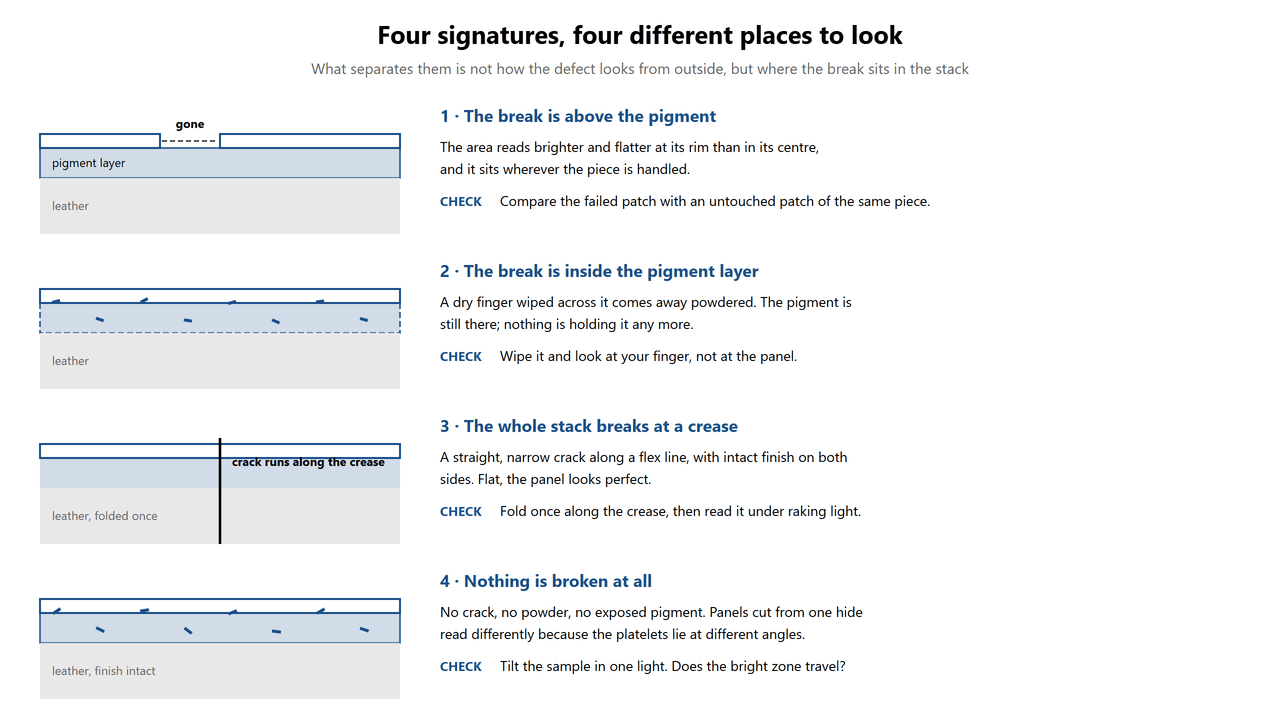
Fig. 1 — Four failure signatures drawn on the same cross-section, because what separates them is where the break sits: above the pigment layer, inside it, through the whole coat at a fold, or not a break at all but a change in platelet orientation.
When the binder runs out before the pigment does
Wipe. A dry finger drawn across the failed area settles it. If the finger comes away with pigment powder on it, the film has lost its binder and the pigment is still there, with nothing holding it in place. Read that against the section above. A film that powders failed within itself; a film with a clean surface and a bright rim failed from above. The finger separates two causes a photograph cannot.
This is the one failure mode that lands inside the pigment’s own remit, and even here the decision was made in the formulation rather than in the drum: too much pigment for the binder present, or a film too thin to carry the loading that went into it. The powder was within its specification. The ratio was not. Nothing about the material changed between a batch that held and a batch that powdered; the system around it did.
Recognising the signature is enough for a decision this week. If the finger powders, the stack is under-bound, and a reformulation is a question about the binder before it is a question about the powder. The companion page on how much pigment a binder can carry takes that from the binder side. What the wipe supplies is the reason to open the question at all.
Set the two commonest complaints side by side and one action now separates them: powder on the finger means the film failed within itself, a clean finger and a bright rim mean it failed from above. Neither answer needed a sample to leave the building.
When the coat cannot follow the fold
A finish cracks at a fold for a structural reason. The coating cannot extend as far as the leather beneath it. Leather stretches; the film on it is thinner and stiffer; when the substrate moves, the coating either follows or breaks. Flat on a bench there is nothing to see, which is why this one clears goods inward and turns up later, on a folded article, in front of the person who bought it.
The signature is a straight, narrow crack running along a crease or a flex line, with the finish intact on both sides. It is not a patch, not a ring around a contact point, not a place where something rubbed. It is a line, and it sits where the article was built to bend. Fold the sample once along the suspect line and look into the crease under raking light. A coating with no extension left usually shows a hairline at the fold long before it fails on the shelf. Raking light matters, because a crack that narrow is invisible under diffuse light and immediate when light is thrown across the surface at a shallow angle.
There is an asymmetry in the standards worth knowing before anyone blames the powder. ISO 14931:2021, written for apparel leather excluding furs, gives recommended values rather than mandatory requirements, and it holds a pigmented finish to a higher flex figure than an unpigmented one: 50,000 cycles without visible damage or crack, against 20,000 for an aniline finish carrying no pigment, tested to ISO 5402-1 [3]. That is not a penalty invented by pigment suppliers. The uncoated aniline surface is the baseline the standard starts from, and a film laid over leather is expected to survive more bending, not less.
So “the finish cracked” is not evidence against the pigment. It is evidence that the coat stack has to move with the substrate, and that something in the stack has stopped being able to. The same standard caps coating thickness at 0.15 mm [3], which closes off the obvious answer: a stack already at that cap cannot be made more flexible by adding more material, because there is no headroom left to add it in.
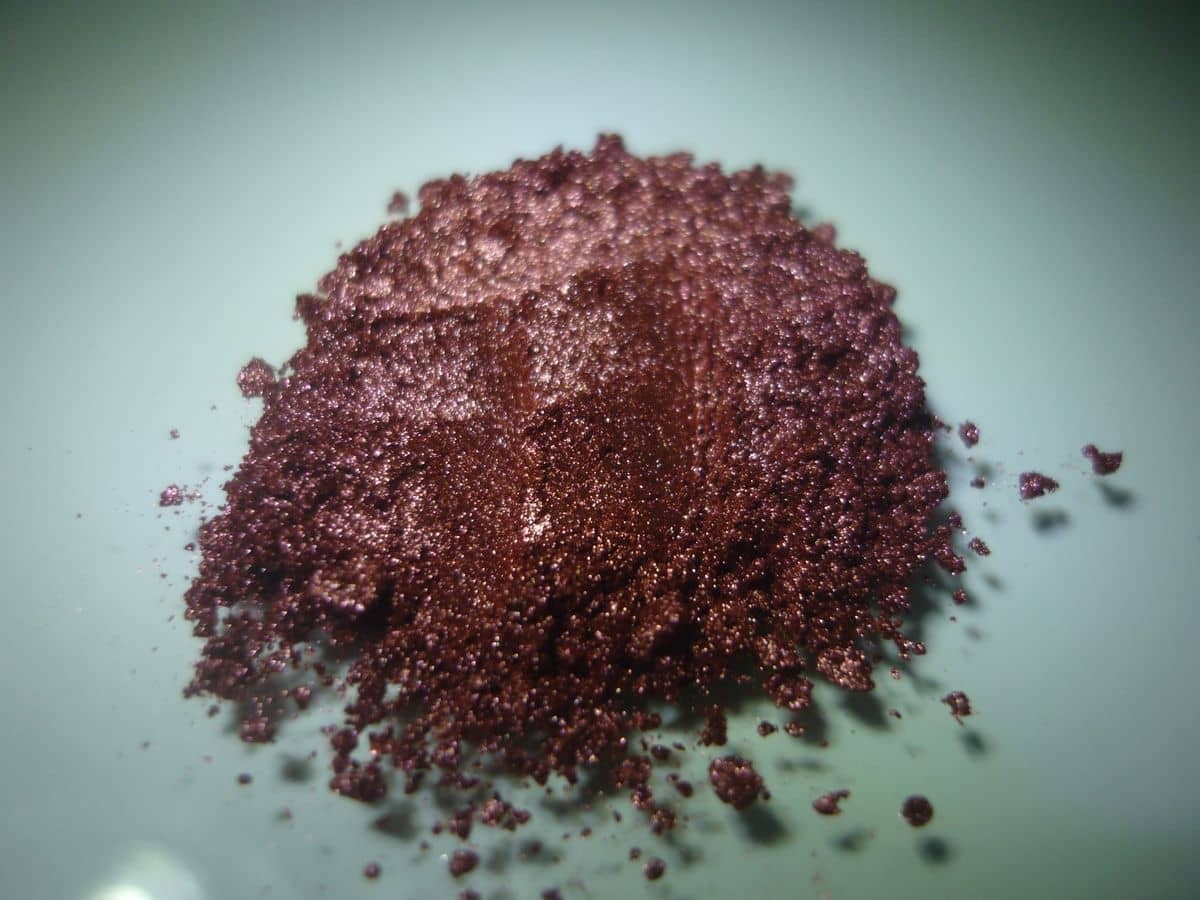
Fig. 2 — A fine pearl pigment powder as supplied. The platelet size band is what the customer selects; whether those platelets end up lying flat, and whether anything is still covering them a year later, is decided on the finishing line.
When the colour moves before the coating does
Two complaints arrive looking like fading and are not. In the first, a panel reads lighter or darker as the piece tilts. In the second, two panels cut from the same hide do not match each other under shop lighting, though nothing different was done to either on purpose.
Platelet pigments produce their effect only when the platelets lie roughly parallel to the surface. What the eye reads as colour is the angle at which light arrives at those plates and leaves them again. Orientation in a dried film is set by how the film was laid down and how it dried — spray distance, atomisation, wet film thickness, drying rate — and orientation behaviour of that kind is one of the properties treated in the effect-pigment literature [1]. Change a spraying condition and you change the appearance of the same pigment at the same loading, measured on aluminium flakes and modelled from the measured orientation distribution [2]. Where the hide was cut then decides how any given panel reads from the angle a customer happens to look from.
Rotating the sample in the hand under one light separates this from fading without an instrument. Watch the bright zone. If it travels across the surface as a band while the piece turns, that is normal angle dependence and the pigment is behaving as a platelet pigment should. If it sits in patches that stay where they are, you are looking at orientation — a film that dried with its platelets in mismatched alignments — and not at colour that has gone. The relationship between plate alignment and observed colour is set out in more detail in the material on interference and iridescent mica pigments.
This failure has a property the others do not: nothing has degraded. The film is intact, the binder is holding, the top coat is present, and the pigment is the same chemistry it was in the drum. Do not scrap the batch before this check has been run, because a batch scrapped on a patchy panel is a batch scrapped for a drying condition.
After the low-cost checks, what is worth sending
Order the investigation by cost, not by suspicion. Each step is defined by what it removes from the list.
- Look and wipe. No tool, no sample preparation, no freight. A dry finger, and a comparison between the failed area and a sound area on the same piece. This settles top-coat wear from above against binder starvation within the film. It says nothing about adhesion to the substrate, and it produces no number.
- Fold once under raking light. Still no cost: the sample already in hand, folded along the suspect line, viewed with light thrown across the crease. This separates a cohesive failure of the film itself from a failure of adhesion or of extension, and it shows where the break wants to happen before service makes it happen. It cannot say how many cycles the article would survive.
- Then the instrumented tests. Flex resistance to ISO 5402-1 and rubbing to ISO 11640, run on a conditioned specimen [3]. This is the only step that produces a number anyone can compare, and it measures the finished article rather than the pigment inside it.
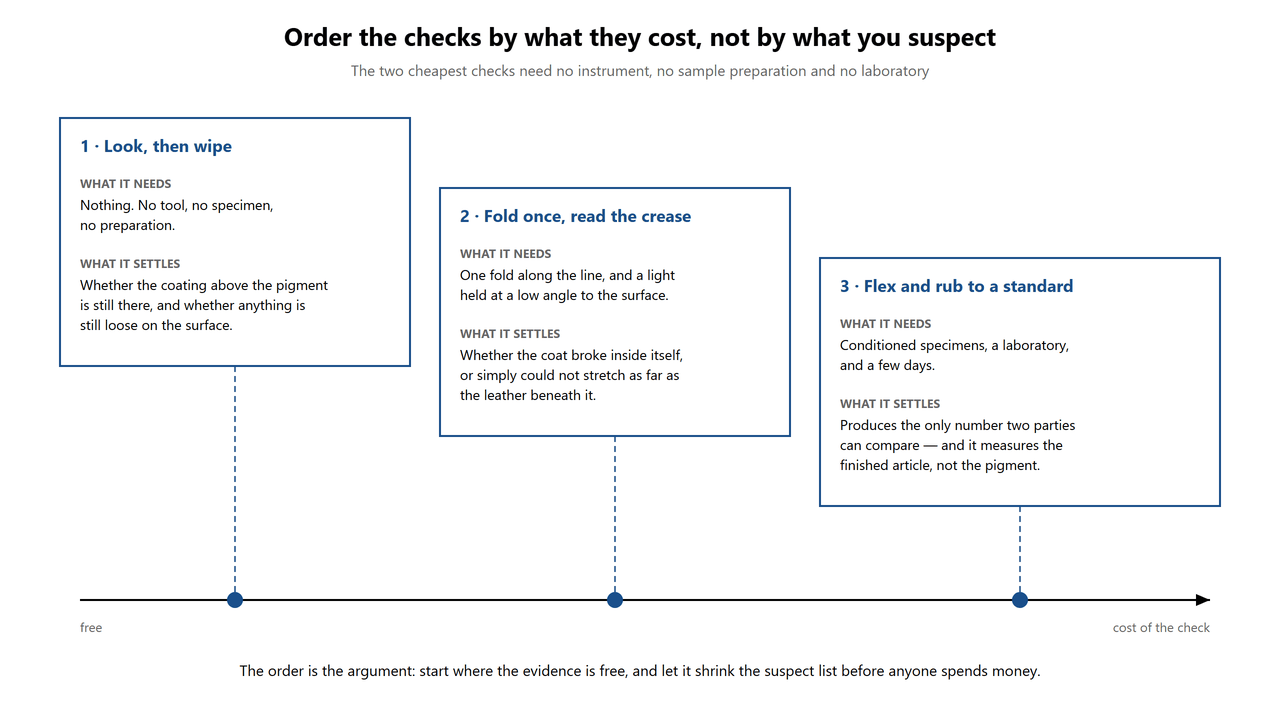
Fig. 3 — Three checks ordered by what they cost, not by how strongly they are suspected. The two that cost nothing need no instrument and no sample preparation, and between them they settle the two failure modes that are most often blamed on the pigment.
If part of the question is whether the panel shows the colour that was ordered, the comparison to make is against the pearl pigment colour card and not against another panel off the same line. Download it, read it under the light the complaint was made in.
A pigment supplier can speak to the pigment’s own contribution: its chemistry, its size band, its freedom from azo groups. For mica-based and borosilicate-based effect pigments, colour comes from inorganic oxide layers of TiO₂ and Fe₂O₃, a structure with no azo group in it — a statement about chemistry, not a certificate for an article. What no supplier can do is certify that a given hide will pass the recommended 50,000-cycle flex value. That figure belongs to the coat stack, the substrate and the cure, and we do not run your line.
If you want an answer worth the freight, put this in the message: the substrate — full grain, corrected grain or PU — the coat stack and which layer the pigment went into, the top coat type, the loading as it was run, and one 10 × 10 cm piece that includes the failed area with a sound area beside it. Everything else is a photograph of a symptom.
References
- Maile, F. J.; Pfaff, G.; Reynders, P. Effect pigments—past, present and future. Progress in Organic Coatings 2005, 54 (3), 150–163. https://doi.org/10.1016/j.porgcoat.2005.07.003
- Sung, L.-P.; Nadal, M. E.; McKnight, M. E.; Marx, E.; Laurenti, B. Optical Reflectance of Metallic Coatings: Effect of Aluminum Flake Orientation. Journal of Coatings Technology 2002, 74 (932). https://www.nist.gov/node/603136
- ISO 14931:2021. Leather — Leather for apparel (excluding furs) — Specifications and sampling procedures. International Organization for Standardization: Geneva, 2021. https://www.iso.org/standard/77275.html

 English
 Français
 Deutsch
 Русский
 Español
 Português