A dull slime is almost never short of pigment. The shine was fixed the moment the activator closed the network, and no amount of powder added afterwards brings it back — only flakes, which sparkle on their own, keep glinting. What follows walks through it in the order it happens on the bench, because that is the order the reader can act on it.
Before the activator goes in, the pigment has one chance at orientation
A pearlescent pigment is not a colour in the way a dye is a colour. What arrives in the bag is a heap of flat plates, and a pearl reads as a pearl only because a large share of those plates end up lying roughly parallel to the surface and hand light back at more or less the same angle [1]. Same powder, same loading, plates at random, and the tub reads as a matte, chalky solid with a faint grey cast. Nothing chemical has happened. The geometry went wrong. The effect is understood well enough that the trade measures it: disturb the orientation of a platelet pigment and the measured colour values move, which is what happens when near-spherical extender is loaded into a coating beside it [2].
In a coating or an ink the film stays fluid while it drains and shrinks, so the plates get a second chance to swing towards parallel after the applicator has finished with them. Slime gives you no such second chance. The window in which the plates can still be arranged is exactly the window in which the batch is a liquid, and that window ends the moment the borate hits the PVA. So the useful question at the kettle is not how much pigment to use. It is when the pigment goes in.
The powder belongs in the plasticised PVA-and-water phase, before any activator, and it belongs there as a pre-dispersed slurry rather than as dry powder tipped from a scoop. Dry powder dropped into a viscous phase wets unevenly. You get skins, you get lumps with dry cores, and no amount of stirring afterwards opens them — after crosslinking, stirring tears the network instead of distributing the pigment through it. A fine powder disperses more smoothly in a hand-handled gel than a coarse one, which is one reason the 5–25 µm and 10–60 µm bands of silver white pearlescent give less trouble at the mixing stage than the 60–200 µm+ band. Loading is the easy part by comparison. 0.5–3 % by weight is where most formulators begin, and that is a place to start on the bench, not a specification.
The check before you activate costs nothing. Draw a small amount down on a white card with a fingertip and look along it. If the draw-down is streaky, the dispersion is not finished and the batch will show it — the streaks are patchiness, visible early. If it lies down even and the sheen comes up as you tilt the card, you have something worth activating.
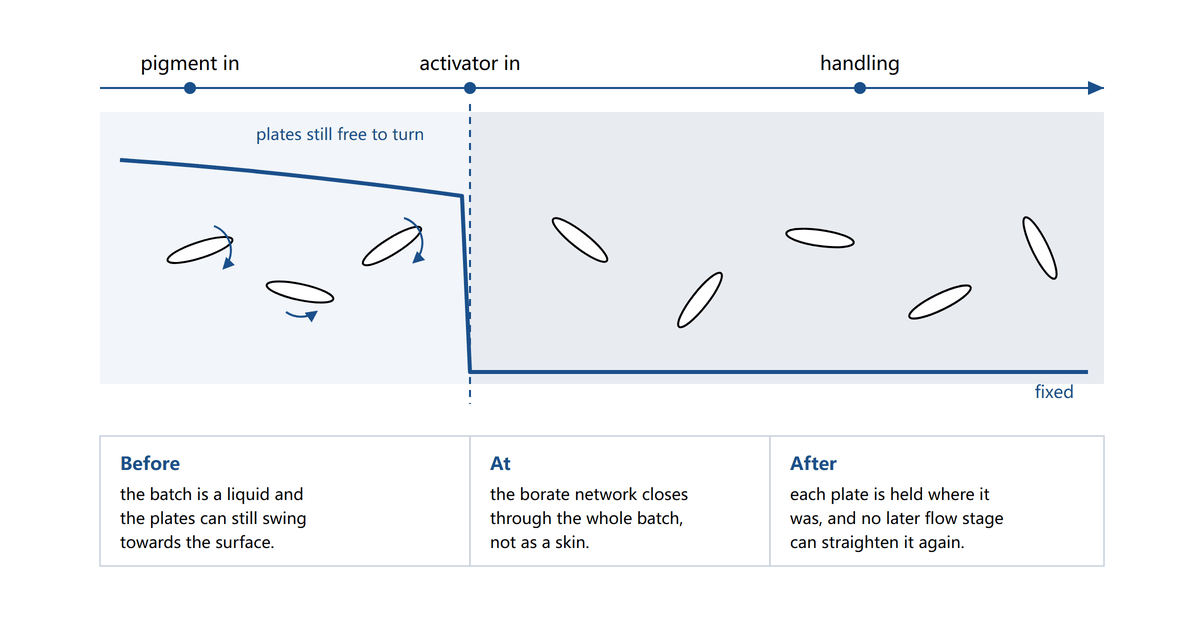
Fig. 1 — A slime batch is fluid, then it is a network; there is no stage in between where the platelets are still free to turn. The window in which a pearl effect can be arranged is the left-hand part of this line, and it closes once and does not reopen.
At the moment the network closes, the platelets stop being free to turn
A drying film gives its platelets time. As the film flows and shrinks the plates keep re-orienting, and the same pigment at the same loading will read differently when the application conditions change — measured directly by varying spray conditions on aluminium flake and reading the resulting reflectance [4]. In moulding, the through-thickness orientation distribution can be reproduced from the aspect ratio of the plates alone, with in-plane shape contributing little, verified on polypropylene with 2 wt% glass flakes [3]. Both are cases where something downstream of the pigment still has a say in the outcome.
A slime is neither of those. The borate–PVA network forms fast and it forms throughout the batch, not as a skin that thickens inwards. Once it has formed, every platelet is held at the angle it happened to hold at that instant. There is no later flow stage that can straighten them, because the network resists the flow that would do the straightening. The transition is not gradual, and it does not run backwards — you cannot loosen the gel and start the arrangement again by stirring it.
What that looks like on the bench: the sheen in a slime is skin-deep and direction-locked. Tilt the tub and the highlight does not travel the way it travels across a coated panel. It shifts a little and stops, because the plates cannot rotate far enough to carry the highlight with them. This is the same property that makes holographic pigment a platelet effect that depends on viewing angle — the effect lives in aligned plates, so it is only ever as good as their alignment. Where a coating lets the highlight sweep, a set slime lets it twitch.
Nothing in that description is degradation. The pigment has not faded, bleached or reacted with anything. The colour the customer calls "sunk" is the colour of plates scattering instead of returning light.
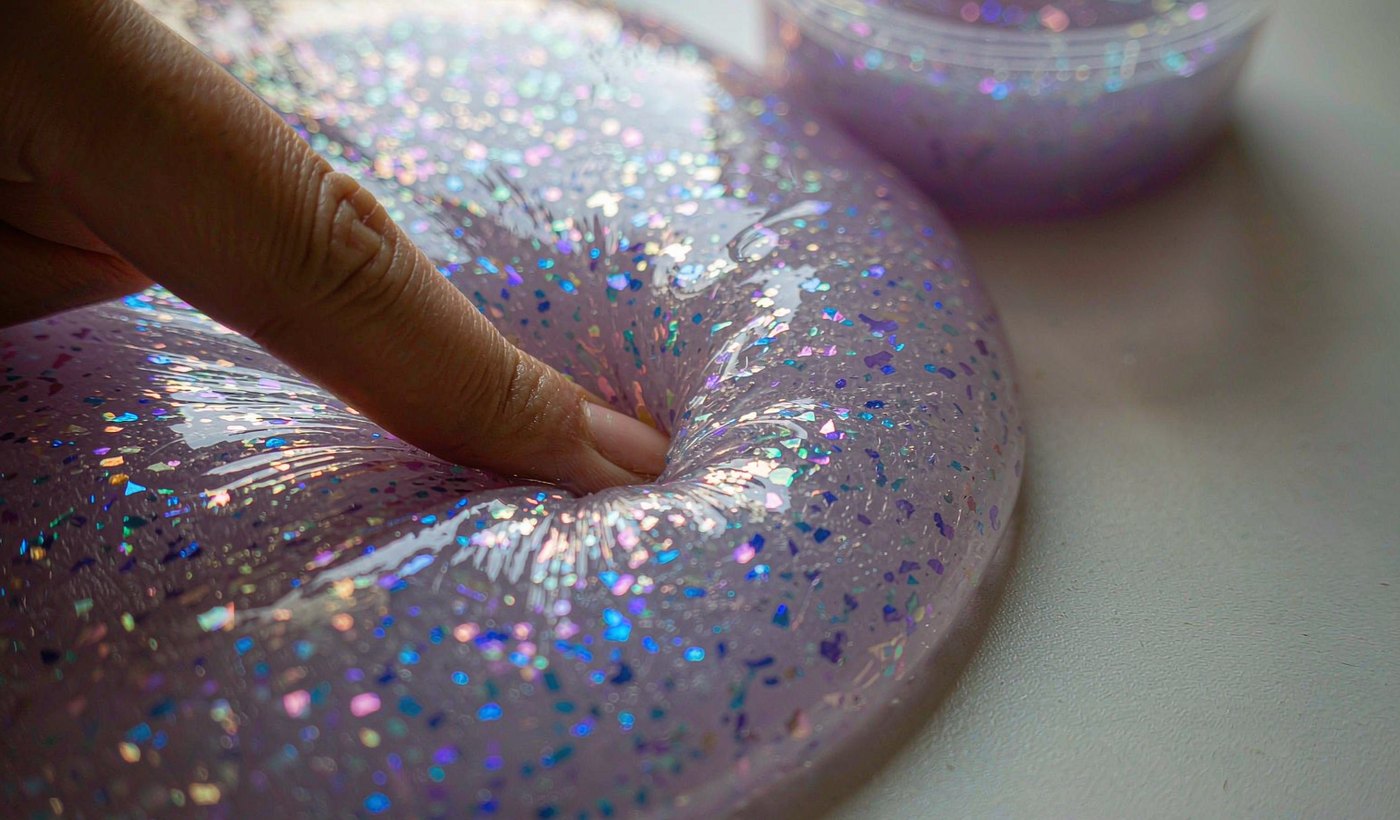
Fig. 2 — Finger pressure crowds the flakes and brightens the surface right at the dent.
After the slime has set, more pigment changes the colour and not the shine
The instinct when a batch comes out dull is to add more powder, and once the network has closed that is the one response that cannot work. A late addition raises the solids loading, darkens the mass, and puts exactly the gritty, uneven texture into the tub that the customer was trying to avoid. The new platelets arrive into a network that will not let them lie down; they sit at random angles and scatter light rather than return it. You have paid for pigment and bought opacity.
There is one case where adding pigment is right, and it is worth separating out, because it is the case people remember when they generalise. A batch can be genuinely under-coloured and still have good orientation. The test is a stretched film held up against a window and tilted slowly. If the highlight moves cleanly across the surface, the arrangement is fine and what is missing is depth of colour — more pigment or a different route to the same colour may address that. If the highlight does not move, the problem is orientation, and more pigment makes it worse in every direction at once: darker, duller, grittier, more expensive.
This is where a pigment supplier's knowledge stops, and it is worth being blunt about it. What a supplier can speak to is the pigment: its chemistry, its size band, how it appears on a draw-down. What no supplier can tell you is what your activator dose did to your batch, because that belongs to your formulation and your process, and the tub in front of you is the evidence either party has.
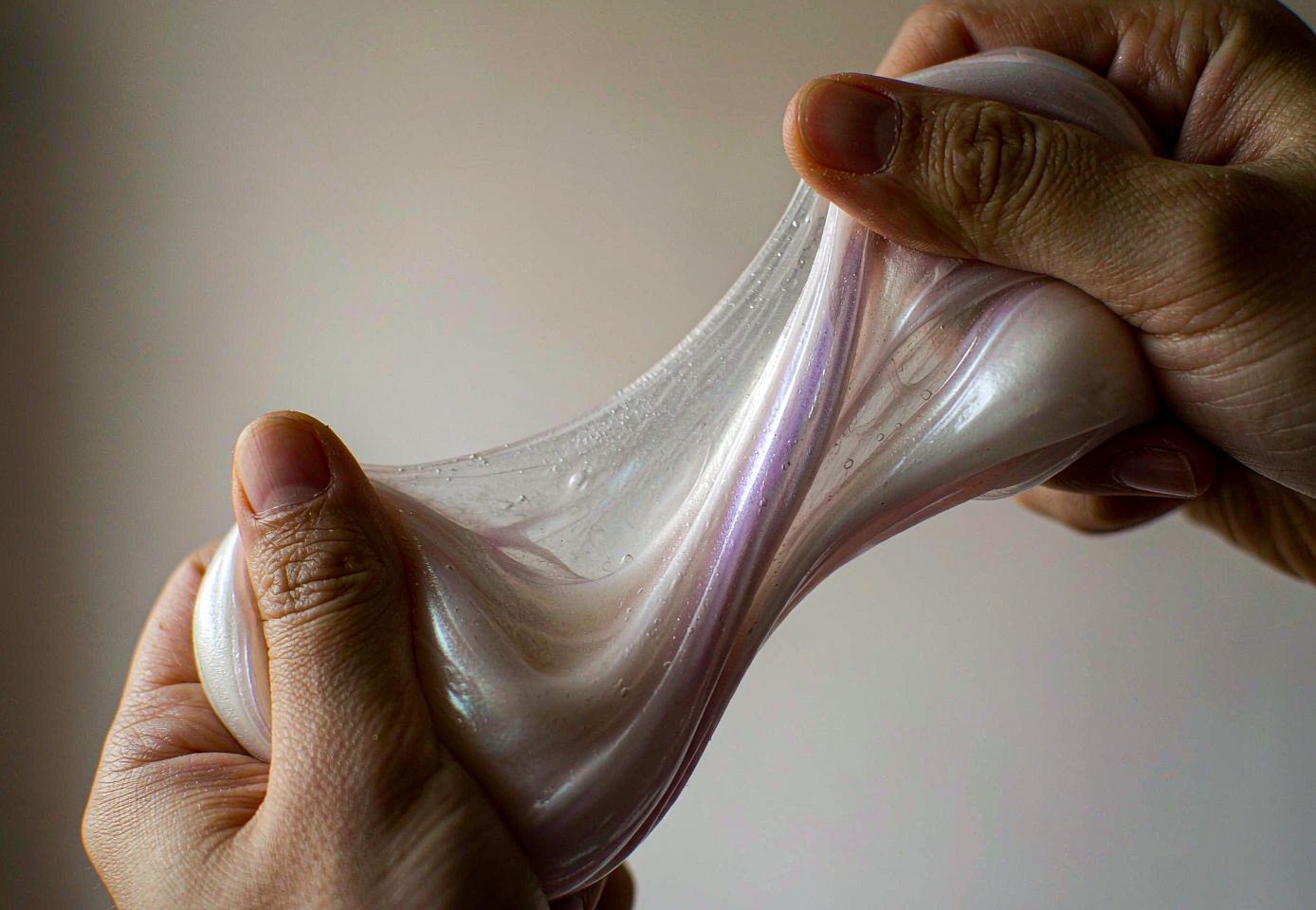
Fig. 3 — A hand-stretched slime. The body of the slime catches light unevenly as it is pulled, because the platelets inside are locked at the angles they held when the activator closed the network. Stretching the gel does not re-align them.
When the batch is gritty or flat, the fix is form, not dose
Gritty is felt with the fingertips; flat is seen. Gritty comes from undispersed clusters — dry powder dropped into a viscous phase, or powder tipped in after the network has begun to form. No amount of stirring after crosslinking opens a cluster, because the stirring tears the network before it separates the grains. If you can feel grit, you are feeling a mixing failure that has already been frozen in place, and the batch will not recover by being worked harder.
Flat is a different animal, and it is decided by form. A fine effect powder — the pearl bands, the holographic powders, the aurora holographic powder at 15–75 µm — is a platelet effect: it returns light from aligned plates, so it lives and dies by orientation. A flake, a glitter, a foil is the large-particle version of the same idea. Each particle is big enough to catch light on its own face, so it sparkles whatever angle it ends up at, and it goes on sparkling after the network has closed around it. That is why choosing between a powder and a flake changes what "add more" is able to do.
More powder after the batch has set darkens the mass and cannot bring a sheen back. Flakes are added for sparkle rather than a soft sheen, and sparkle is a property of the individual particle, not of the arrangement — which is why the KT-AH9 irregular large flakes still glint in a batch that has already gelled, while a finer powder in the same place will only grey it down. Someone asking for glint rather than a soft sheen is asking for a flake or a glitter, not for a higher dose of what is already in the kettle.
The check needs two fingers and no instrument. Press a sample flat between them and pull them apart slowly. Clusters show as drag and as a rough film on the skin; properly dispersed pigment pulls clean and slightly tacky, with no bits in it. Do that before you decide the batch is a write-off, and do it on the next one before you activate.
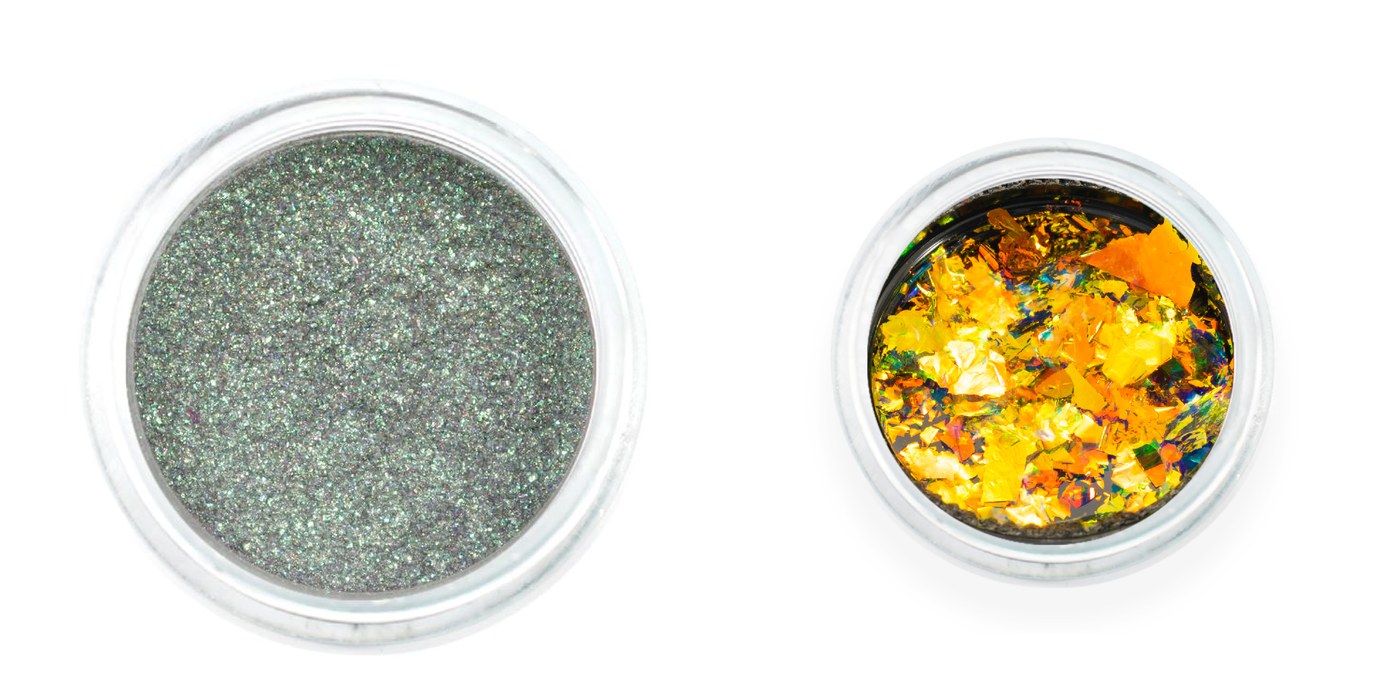
Fig. 4 — Aurora holographic flakes and powder side by side as supplied. The fine powder is a platelet effect that depends on orientation; the flakes sparkle on their own, so they keep catching light after the network has set.
Before you scale up, decide what one small batch can settle
None of this gets settled by argument at a desk, and all of it gets settled on one small batch you can afford to throw away. Run these in order.
- Run the same formulation twice, adding the pigment before the activator in one and after it in the other, then compare the two under the same light. This settles whether the process, not the pigment, is the variable.
- Draw a thin film of each down on a card and tilt it, watching whether the highlight travels. This settles orientation, which no dosing change can fix.
- Only then, if you need a number to compare across batches or across suppliers, measure at several angles rather than at one, because a single reading cannot describe a goniophotometric effect.
What a pigment supplier can answer is what the pigment is. What a batch did is a property of that batch, and it stays with whoever poured it. Before you scale, check the colour card against the effect you are matching — in a system where the plates cannot be re-aligned after the fact, the size band you pick decides more of the finish than the shade name does.
One obligation sits with the batch rather than the pigment. A slime sold as a children's product is assessed against the toy-safety rules of the destination market, and the two the buyer will ask about are ASTM D-4236 for chronic hazard labelling in the US and EN 71 in the EU. Where the slime is meant for prolonged skin contact, cosmetic-grade material is the normal starting point. Documentation on the pigment is available on request; the assessment of the finished article is the maker's to carry out.
If you want a useful answer about a dull batch, put this in the message: the medium and its PVA source, where in the sequence the pigment went in, the size band and the loading as run, the activator type, and two small samples — one failed, one good, from the same week.
References
- Maile, F. J.; Pfaff, G.; Reynders, P. "Effect pigments—past, present and future." Progress in Organic Coatings, 2005, 54(3), 150–163. DOI: 10.1016/j.porgcoat.2005.07.003
- Kettler, W. H.; Richter, G. "Investigation on topology of platelet-like effect-pigments in automotive surface-coatings." Progress in Organic Coatings, 1997, 31(4), 297–306. DOI: 10.1016/S0300-9440(97)00087-8
- Sasayama, T.; Okamoto, H.; Sato, N.; Kawada, J. "Numerical simulation of plate-like particle orientation in injection molding." Powder Technology, 2022. DOI: 10.1016/j.powtec.2022.117481
- Sung, L.-P.; Nadal, M. E.; McKnight, M. E.; Marx, E.; Laurenti, B. "Optical Reflectance of Metallic Coatings: Effect of Aluminum Flake Orientation." Journal of Coatings Technology, 2002, 74(932). https://www.nist.gov/node/603136

 English
 Français
 Deutsch
 Русский
 Español
 Português