Applications
What are pearlescent pigments? They are specialty effect pigments. They create a soft, pearl-like luster by reflecting and refracting light. These pigments typically use mica or synthetic substrates. Thin metal oxide layers, such as titanium dioxide or iron oxide, coat the substrate. This structure separates them from ordinary pigments and dyes. Pearlescent pigments are insoluble effect pigments. They deliver shimmer and depth, not just flat color.
Pearlescent pigments reach coatings, plastics and cosmetics because the same optical mechanism works in any transparent binder.
Key Takeaways
-
Pearlescent pigments create a shimmering, pearl-like effect by reflecting light, not by adding flat color.
-
You can use these pigments in coatings, cosmetics, and plastics to add depth and a premium look.
-
Choose the right particle size to control the final effect, from soft satin to bold sparkle.
What Are Pearlescent Pigments and How Do They Differ from Ordinary Pigments?
You may wonder what are pearlescent pigments at their core. They belong to a special class of materials called effect pigments. These pigments do not simply add color to a surface. They interact with light in ways that ordinary colorants cannot. This difference shapes how formulators use them across coatings, cosmetics, and plastics.
Effect Pigments vs. Color Pigments
Ordinary color pigments absorb certain wavelengths of light and reflect others. This process creates a flat, solid color. A red pigment absorbs most wavelengths except red, which reaches your eye. Effect pigments work differently. They reflect and refract light to produce luster, depth, and a sense of motion. Pearlescent pigments fall into this effect pigment category. They create a soft, pearl-like glow rather than a dull, uniform shade.
The physical structure of these pigments explains their behavior. A mica platelet serves as the substrate. A thin metal oxide layer, often titanium dioxide, coats the platelet surface. Light strikes this layered structure and bounces between the layers. The result is a shimmering effect that changes with viewing angle.
Particle size plays a major role in the final look. The table below shows typical dimensions for mica-based pearlescent pigments.
|
Property
|
Value
|
|
Platelet broad-face size
|
4–1,000 microns
|
|
Platelet thickness (natural mica)
|
~0.5 micron
|
|
Platelet thickness (synthetic mica)
|
<0.25 micron
|
|
Optimum particle size for luster
|
10–60 microns
|
You can see that the optimum particle size for luster falls between 10 and 60 microns. Smaller particles scatter more light and produce a softer, satin finish. Larger particles create a brighter, more sparkling effect. This range gives you a useful tool for tuning the visual outcome.
The oxide layer thickness controls the interference color. A very thin, uneven titanium dioxide coating yields a white pearl. Mixed reflected colors combine additively to white in this case. As the coating thickness increases, interference begins and the reflection shifts to yellow. A further increase moves the color to red. More thickness pushes the reflection to blue. The final stage in this progression produces green. You can therefore select a pigment grade based on the interference color you need.
Why Pearlescent Pigments Are Not Dyes
Many people confuse pigments with dyes. The two categories behave in fundamentally different ways. Consider the standard definitions:
Dyes: Colorants which are soluble in vehicles such as water, alcohol, glycerin or oils. Pigments: Colorants which are insoluble in the vehicle in which they are used; generally referred to as "dispersible" (they mix with water or oil but do not dissolve).
This solubility difference drives everything else. A dye dissolves into the vehicle and penetrates the substrate. A pigment stays as solid particles and disperses through the binder. Pearlescent pigments follow the pigment path. They remain insoluble solid particles in water and most organic solvents.
The table below summarizes the key contrasts.
|
Property
|
Pigments (incl. pearlescent)
|
Dyes
|
|
Solubility
|
Insoluble in water and most organic solvents
|
Soluble in water or organic solvents
|
|
Form
|
Fine solid particles, dispersed in binder
|
Dissolved, penetrate substrate
|
|
Coloring mechanism
|
Selective light absorption and scattering
|
Molecular-level bonding via adsorption/chemical interaction
|
The classification logic is straightforward. Pearlescent pigments belong to the functional pigments category. Functional pigments are a sub-type of pigments. All pigments are insoluble. Therefore, pearlescent pigments are insoluble effect pigments, not dyes. This distinction matters for formulation. A dye cannot deliver the light interference effect that defines what are pearlescent pigments. Only a layered, insoluble platelet structure can produce that pearl-like shimmer.
You should also note the practical consequences. Dyes often fade under UV exposure because the dissolved molecules break down. Pearlescent pigments do not fade the way organic dyes do, because the oxide layer is inorganic. Where UV exposure and heat are severe, the substrate matters more than the coating: synthetic mica and borosilicate glass hold their optical properties longer than natural mica. Dyes can migrate through a plastic matrix. Pearlescent pigments stay locked in place as dispersed particles. These differences guide your choice between the two colorant types for any given application.
How Pearlescent Pigments Work
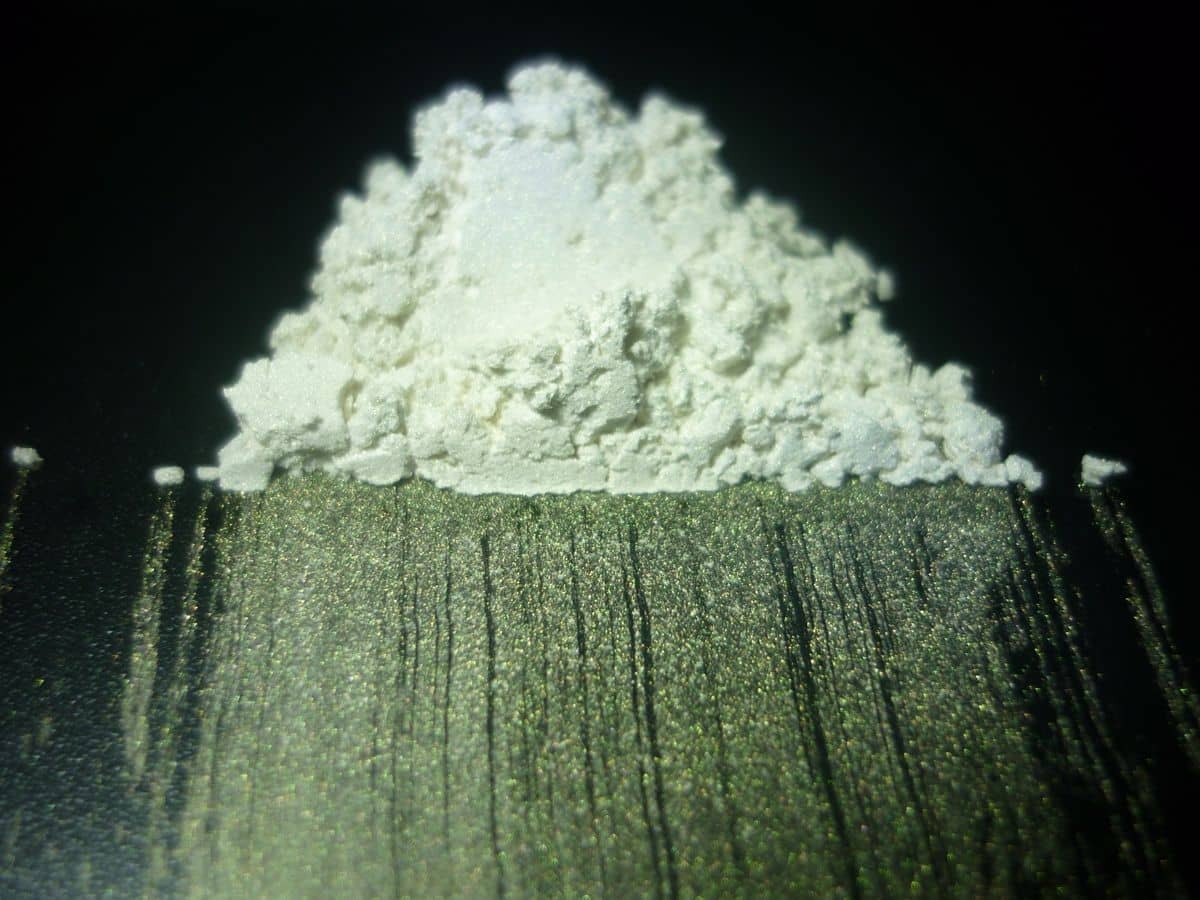
Dry pearlescent pigment is white in the pile. The colour appears only on the surface the pigment is oriented in.
You see the pearl effect because light behaves in a specific way inside these pigments. Understanding this mechanism helps you predict how a pigment will look in your final product.
Light Interference and Reflection
Light strikes the surface of a pearlescent pigment platelet. Part of the light reflects off the top oxide layer. Another part passes through the oxide layer and reflects off the substrate below. These two reflected waves travel back to your eye. They can reinforce each other or cancel each other out. This process is called light interference. The result is a shimmering color that shifts with viewing angle. This optical behavior answers what are pearlescent pigments at a practical level. They manipulate light rather than simply absorb it.
The Role of the Oxide Layer
The oxide coating controls the final appearance. Titanium dioxide is the most common coating material. Iron oxide is another option. The thickness of this layer determines the interference color you observe. A very thin coating produces a white pearl. Increasing thickness shifts the reflection through yellow, red, blue, and green. You can select a pigment grade based on the color shift you need.
The substrate also matters. Mica provides a smooth, plate-like surface. Synthetic substrates offer tighter thickness control. Both options support consistent light interference across your formulation.
Key Types of Pearlescent Pigments
You can choose from several pigment families. Each family offers distinct performance traits for your formulation.
Natural mica is the most widely produced pearlescent substrate worldwide. It delivers good pearlescence, strong luster, and excellent decorative effects at low bulk density. You get tunable optical performance: coating thickness on the mica substrate determines color and interference effects, while particle size controls brilliance. A ~10 µm grade gives a soft satin sheen, ~60 µm gives dazzling pearlescence, and ≥125 µm sparkles.
Mica-based pigments are delicate: high-shear mixing can fracture them or strip their surface coatings, which may diminish their optical properties. For cosmetic and nail formulations, surface treatments protect the platelet from moisture, pH change and interaction with the other powders in the formula, which preserves the platelet structure that produces the desired optical effects.
|
Dimension
|
Advantages
|
Disadvantages
|
|
Stability
|
Lightfast, heat-resistant, weather-resistant and chemically stable; outperforming organic pigments
|
Natural mica is mined in several regions, so grade availability and lead time vary by source.
|
|
Cost
|
Made from natural mica with a long-established supply base; large producers gain raw-material cost advantages
|
Natural mica is available in a wide range of particle sizes and is the most widely used pearlescent substrate.
|
|
Optical Performance
|
Good pearlescence, strong luster, excellent decorative effects, low bulk density
|
—
|
Polar hydroxyl groups with adsorbed moisture can cause stability problems and color shift. In cosmetic and nail formulations, surface treatments mitigate these issues and improve stability.
Synthetic Mica
Synthetic mica is produced from a controlled melt, so its particle size spread, whiteness and oxide coating are more uniform than natural mica. That makes it the usual choice for exterior durability, high-heat processing and tight colour tolerances. Kolortek supplies the silver white, interference, gold and metal luster effects on synthetic mica as the KT-7000 Synstar series.
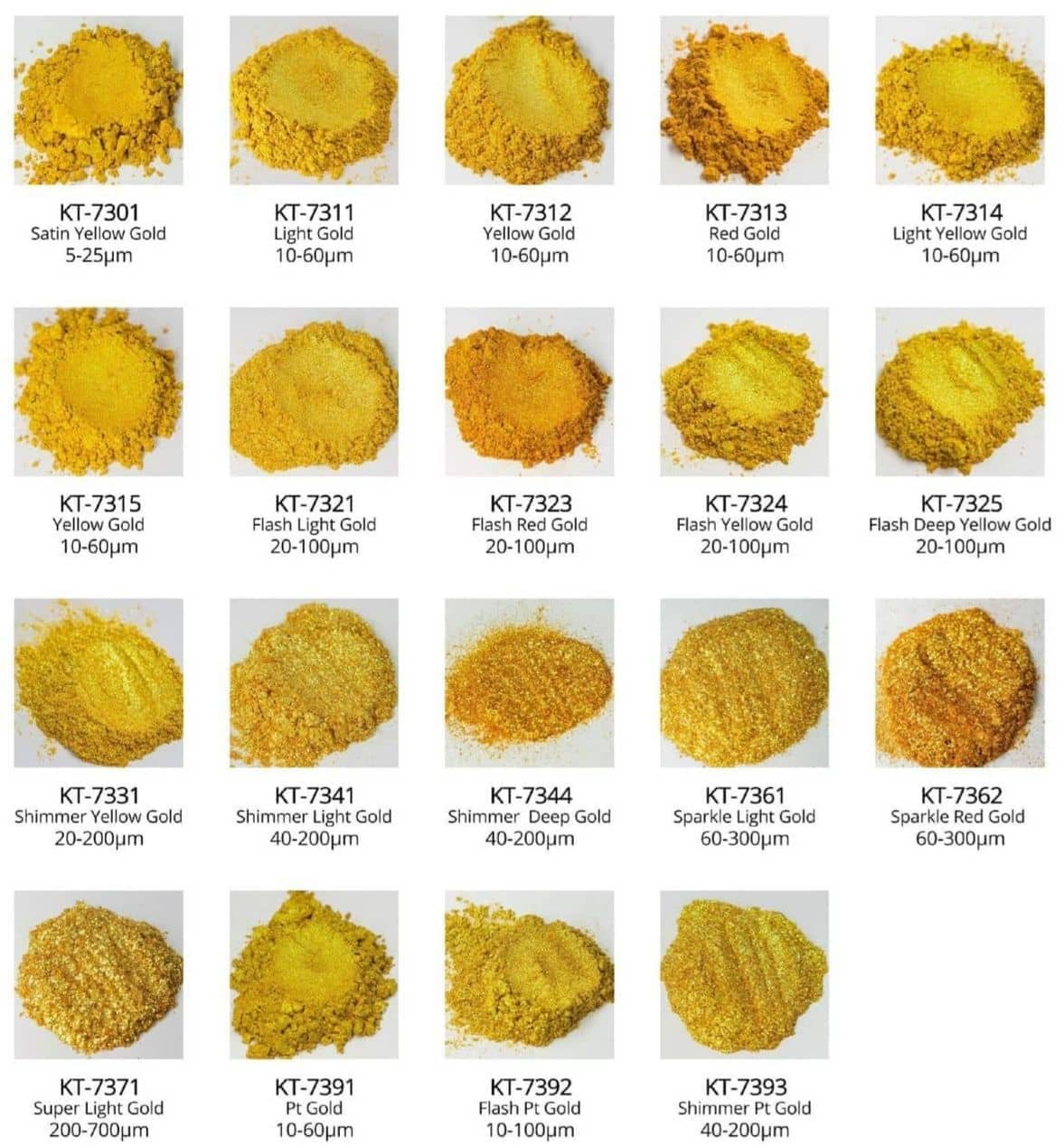
Kolortek Synstar gold grades on synthetic mica — nineteen grades from 5–25 μm to 200–700 μm.
Borosilicate Glass
Borosilicate glass flakes stand out for high-performance applications.
Glass flakes (calcium aluminum borosilicate) are known for high transparency and intense light reflection, offering extreme sparkle ("glitter" effect) and high color saturation, and allowing versatile color combinations to create unique styling effects.
|
Property
|
Effect on Performance
|
|
Extremely smooth surface & high transparency
|
Metal oxide coatings reflect light more efficiently, producing diamond-like sparkle
|
|
Extremely low refractive index
|
Minimizes light diffusion for higher chroma and enhanced brightness vs. natural mica
|
|
Thermal stability & chemical inertness
|
Maintains structure and color during heat processing and long-term storage
|
|
Plate-like geometry
|
Reflects light at specific angles for a mirror-like effect; 10–60 μm tunes sheen to glitter
|
|
Resistance to moisture & pH changes
|
Does not swell, degrade, or leach colorants in water-based systems
|
Borosilicate pigments retain optical properties through high-temperature extrusion and automotive baking cycles. Their exceptional transparency enables clean color mixing with organic pigments without a milky appearance.
Particle Size and Luster Effects
Particle size distribution shapes luster, coverage, and sparkle. Fine grades suspend evenly and orient parallel to the surface for uniform, defect-free finishes. Coarse grades create dramatic sparkle because larger platelets reflect light as discrete points.
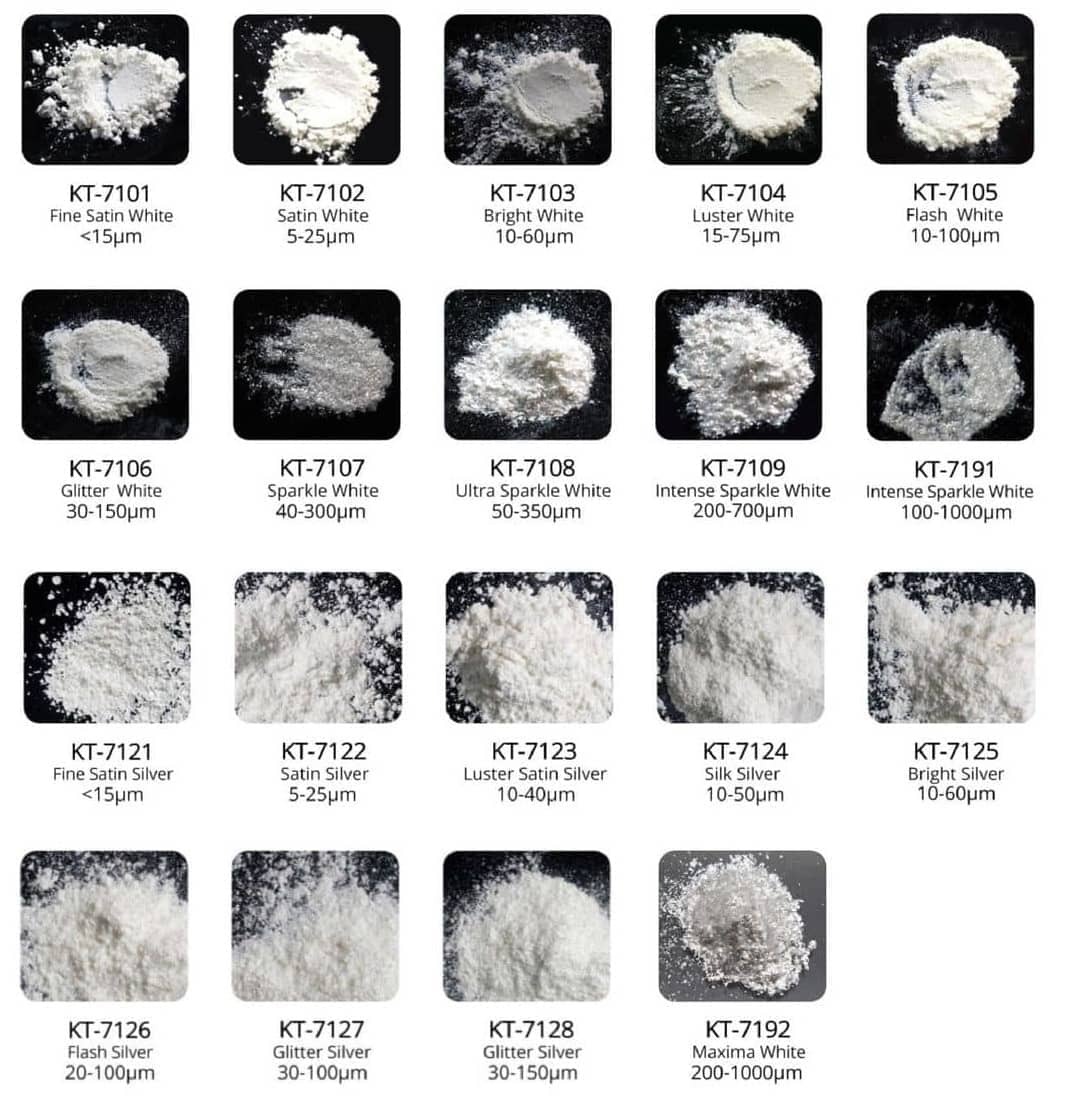
The same white pigment at nineteen particle sizes, from under 15 μm to 100–1000 μm. Fine grades give a satin sheen; coarse grades sparkle.
|
Particle Size Range
|
Luster Effect
|
Coverage / Hiding
|
Sparkle Effect
|
|
Fine: 5–25 μm
|
Soft satin luster, smooth surface feel
|
High coverage
|
Minimal sparkle
|
|
Medium: 10–60 μm
|
Balanced luster
|
Medium coverage
|
Moderate sparkle
|
|
Coarse: 20–150 μm
|
Strong flip-flop effect
|
Low coverage
|
High sparkle, glitter-like
|
|
Extra Coarse: 50–500 μm
|
Pure glitter appearance
|
Very low coverage
|
Individual particles visible
|
Match grade to application. Automotive OEM basecoats use 5–15 μm for uniform orientation in thin films. Gel coats use 30–100 μm for depth in thick clear coat. Offset printing inks stay within 5–15 μm to avoid surface roughness in thin ink films. Blending fine and coarse grades balances coverage and sparkle.
Pearlescent Pigments in Coating Applications
Coatings represent the largest application segment for pearlescent pigments. You can use these pigments to add depth, color travel, and a premium appearance to both automotive and decorative finishes.
Automotive and Industrial Finishes
Automotive manufacturers rely on pearlescent pigments for basecoat colors that shift with viewing angle. A fine grade around 5–15 μm orients evenly in thin films and delivers a uniform metallic-like sheen. Industrial finishes use similar grades for equipment, appliances, and architectural metal. These pigments withstand high-temperature baking cycles without losing optical performance. Kolortek supplies mica-based and borosilicate grades that maintain color stability through demanding cure schedules.
Decorative and Protective Coatings
Decorative and protective coatings benefit from the chemical and environmental durability of pearlescent pigments. You gain several performance advantages over traditional colorants:
These properties make pearlescent pigments suitable for exterior architectural coatings, marine paints, and industrial maintenance systems. Keep the addition level at or below 2% to maintain application quality and avoid overwhelming the coating's protective function. Kolortek offers technical guidance on loading levels and dispersion methods, helping you achieve consistent luster without compromising film integrity.
Pearlescent Pigments in Cosmetic Applications
Cosmetics form the third-largest market for pearlescent pigments. You find these pigments in eyeshadows, lipsticks, blushes, nail polishes, and skincare products. They deliver the soft glow and dimensional shimmer that consumers expect from premium beauty products.
Color Cosmetics and Skincare
Particle size determines the visual effect in cosmetic formulations. The most widely manufactured bulk fraction falls within the 10–60 μm range. Formulators treat this range as the industry standard for a classic pearl finish. Smaller fractions produce a satin sheen, and larger fractions create high-sparkle effects. You can blend grades to achieve the exact luster your product requires. Kolortek supplies cosmetic-grade pigments with tight particle size control for consistent batch-to-batch results.
Formulation and Safety Considerations
Regulatory compliance is critical in cosmetic applications. Pearlescent pigments fall under the same color additive regulations as all other cosmetic colorants. Catalogued pigment grades supplied for cosmetic use come with a specification sheet, a certificate of analysis and heavy-metal test data, so your regulatory file can cite the exact grade rather than the pigment family.
Kolortek provides documentation and technical support to help you navigate these regulatory requirements and select compliant pigment grades for your formulations.
Pearlescent Pigments in Plastic Applications
Plastics represent the second-largest market for pearlescent pigments. You find these pigments in packaging, consumer goods, automotive interiors, and appliance housings. They add depth and a premium look to molded parts.
Injection Molding and Packaging
Injection molding demands careful control of pigment orientation. Plate-like particles align parallel to the mold surface during filling. This alignment produces the pearl effect you want. Weld lines create sudden orientation changes because two flow fronts merge from different directions. These regions often show bright-dark contrast or gloss differences. You can mistake these defects for color problems even when pigment concentration stays constant. Kolortek supplies grades with tight particle size distribution to minimize flow-related defects in packaging applications.
Processing Considerations
You must protect the fragile platelet structure during processing. Follow these guidelines for consistent results:
-
Add pearl powder near the end of mixing to preserve the lamellar structure under high shear.
-
Increase back pressure during masterbatch preparation to improve screw mixing and full dispersion.
-
Raise temperature within a reasonable range to lower melt viscosity and reduce structural damage.
Melt temperature plays a critical role. Higher temperatures reduce viscosity and help flow fronts fuse. Excessive heat causes degradation, discoloration, gas generation, or black specks. An optimum combination exists—higher is not always better. Mold temperature controls surface freezing. A warmer mold delays skin formation and keeps flow fronts mobile longer. Injection speed also matters. A multi-stage profile often works better than uniformly high speed. Holding pressure acts mainly after filling. Once surface orientation freezes, extra pressure may not reorganize platelets and can increase flash or warpage.
Pearlescent pigments are inorganic and thermally stable well above normal plastics processing temperatures, which typically run between 200 °C and 300 °C. They are semi-transparent, chemically inert, and unaffected by processing temperatures. Their lamellar structure will not precipitate, frost, or melt in the resin.
Advantages and Selection Factors
Pearlescent pigments offer clear performance gains over conventional colorants. You gain visual depth, angle-dependent color travel, and a premium appearance that flat pigments cannot match. Selecting the right grade, however, requires careful attention to particle size, substrate, and regulatory requirements. This section walks you through the key benefits and the practical steps for choosing the correct pigment for your application.
Performance Benefits
Pearlescent pigments change how a surface interacts with light. You see metallic depth and angle-dependent color travel under sunlight. These effects directly influence consumer-visible outcomes. A coating or plastic part with pearlescent pigments projects richness and dimension. A conventional pigment produces a flat, non-reflective appearance with minimal visual texture.
The table below summarizes the core performance differences.
|
Attribute
|
Pearlescent/Effect Pigments
|
Conventional Pigments
|
|
Visual impact
|
Deliver shimmer and luminosity for vibrant, high-impact finishes
|
Produce matte or low-sheen, non-reflective finishes that minimize shine
|
|
Depth / dimensionality
|
Interact with light to create multidimensional shine, from soft radiance to bold effects
|
Flat, non-reflective appearance with minimal visual texture
|
|
Color travel
|
Can be engineered (via type and particle size) into color-shifting effects that stand out
|
No angle-dependent color shift; static appearance
|
You control these benefits through pigment selection. Pigment platelets and dispersion attributes determine sheen, depth, and perceived color under varying illumination and viewing angles. A controlled platelet structure governs light reflection and how strongly a surface projects depth and shimmer. Fine platelets orient evenly and produce a soft, uniform radiance. Coarse platelets reflect light as discrete points and create bold sparkle. You can blend grades to achieve the exact balance of soft luster and dramatic shimmer your product needs.
Kolortek engineers its pearlescent pigments with tight control over platelet structure and particle size distribution. This consistency helps you predict how a pigment will perform in your formulation. You avoid the batch-to-batch variation that complicates color matching and quality control.
How to Choose the Right Pigment
Selecting a pearlescent pigment starts with your target visual effect. Particle size is your primary lever. The table below maps particle size ranges to their visual outcomes.
|
Particle size range
|
Visual effect / application property
|
|
~2–25 µm (small)
|
Silky, soft luster with excellent coverage; satin sheen
|
|
~10–60 µm (medium)
|
Pearl-like sheen
|
|
~10–125 µm (large)
|
More pronounced shimmer
|
|
up to ~500 µm
|
Sparkle or glitter effect
|
Align particle size with your formulation's texture and desired aesthetic. A 10–60 µm grade gives a delicate, soft, low-key luxurious gloss. A 30–100 µm grade delivers a fuller, stronger metallic feel and higher brightness. Your vehicle must suspend the pigments effectively and allow smooth flow through the screen pack. Correct mesh size preserves pigment integrity during dispersion.
Color selection follows the same logic. Silver and white grades deliver elegant, high-purity sparkle. Gold grades create rich silky golden effects. Bronze and copper grades produce bright solid-color transparent systems without losing luster. Match the pigment color to your brand identity and the emotional response you want from the consumer.
Substrate choice shapes purity, consistency, and supply-chain traceability. Pearlescent pigment production relies on substrates such as natural mica, synthetic mica, silica, and other coated mineral materials. Titanium dioxide, iron oxides, and additional coating materials serve as key inputs. Synthetic mica-based pigments, such as engineered synthetic fluorphlogopite, are chosen over natural mica when you need greater control over purity, particle size, brightness, consistency, and supply-chain traceability. These substrates are particularly relevant to premium formulations where consistency, appearance, and responsible sourcing are key purchasing criteria.
Regulatory compliance is non-negotiable. Cosmetic-grade pearlescent pigments are subject to requirements on purity, composition, impurities, and heavy metals. The U.S. FDA regulates color additives used in cosmetics, including permitted uses and safety requirements. The EU Cosmetics Regulation (EC) No. 1223/2009 sets requirements for cosmetic products and ingredients. Requirements differ across major markets such as the U.S., EU, China, and Japan. These differences create additional testing, documentation, and product-registration obligations. You must monitor restricted substances and impurity levels such as lead, arsenic, mercury, and other heavy metals. Your supplier must provide batch testing, technical documentation, quality controls, and traceability systems to support your compliance programs.
Supplier selection deserves equal attention. Work with suppliers who prioritize pigment purity, adhere to regulatory standards, and maintain batch consistency. Prefer rigorous certifications such as ISO to minimize batch variability. Require comprehensive documentation, including Certificates of Analysis (CoA), verifying compliance with heavy metal limits and regulatory standards such as US FDA (CFR Title 21). Confirm particle size uniformity via laser diffraction testing. Confirm coating integrity via X-ray diffraction analysis. Use synthetic mica or glass flakes to enhance purity, ensure uniform particle size, and deliver consistent color outcomes. Synthetic mica is generally suitable for cosmetics when cosmetic-grade and supported by supplier documentation such as specifications, CoA, and heavy metal limits.
Kolortek supports your selection process with full documentation, technical guidance, and application expertise. You gain a partner who understands the regulatory landscape across major markets and can recommend pigment grades that meet your performance and compliance needs.
Two defects come up most often on the line. Orange peel or flaking traces back to poor leveling or an improperly prepared substrate: add a leveling agent, clean the substrate of oil and dust, and reduce the curing agent content moderately. Loss of brightness or fading usually means a filler is masking the platelets or the bond is wrong: avoid white powdery fillers such as titanium dioxide and barium sulfate, do not over-add the pearlescent powder, and bond under low shear so the platelets are not damaged.
You should also consider pigment compatibility with your binder system. Chemical and physical interactions between the pigment and other formulation components can affect gloss and stability. Control the dispersion, mixing, and grinding process to preserve the platelet structure. Environmental and additive compliance rounds out your selection checklist. Kolortek provides technical support to help you navigate these factors and avoid common formulation errors.
Common Misconceptions About Pearlescent Pigments
You may hear claims that pearlescent pigments are just fancy metallic powders or that they fade and fail regulatory checks. These ideas often come from mixing up pigment categories or from outdated information. Clearing up these myths helps you specify the right pigment with confidence.
Many people treat pearlescent and metallic pigments as the same product. They are not. Metallic pigments use flake-shaped metal particles that act like tiny mirrors and reflect almost all incident light. Pearlescent pigments use at least three layers of materials with different refractive indexes. A thin, low-refractive-index flake such as mica, silica, alumina, or glass carries a high-refractive-index coating. Light reflects at multiple interfaces and interferes, so white light splits into two complementary beams. You see a simulated natural-pearl luster with angle-dependent color shift. Metallic pigments give a metallic effect color plus functional properties such as anti-corrosion, heat resistance, and conductivity. You can also calculate and tailor the layer thickness of a pearlescent pigment to produce a target interference color.
Stability and Regulatory Myths
Another common myth says pearlescent pigments break down under heat or UV light. In reality, mica-based grades are inorganic and remain chemically inert in the resin; they do not melt, frost or precipitate during processing. A separate myth claims these pigments sit outside color additive rules. They do not. Cosmetic grades must meet purity, heavy metal, and documentation requirements in each major market. Kolortek supplies batch-tested pigments with Certificates of Analysis to support your compliance work.
Pearlescent pigments deliver striking visual impact and formulation versatility across coatings, cosmetics, and plastics. Match pigment type, particle size, and substrate to your specific application for consistent results. Kolortek stands as a trusted source for high-quality pearlescent pigments, offering product consistency, technical support, and application expertise. Select pigments based on your performance requirements and rely on supplier technical guidance for optimal outcomes.
FAQ
What exactly are pearlescent pigments?
Pearlescent pigments are insoluble effect pigments. They use layered substrates coated with metal oxides. These layers reflect and refract light to create a soft, pearl-like shimmer instead of flat color.
How do you choose the right particle size for your application?
Match particle size to your target effect. Fine grades (5–25 μm) give satin luster and high coverage. Coarse grades (20–150 μm) deliver bold sparkle. Thin films need finer grades for even orientation.
Do pearlescent pigments work in both water-based and solvent-based systems?
Yes. Pearlescent pigments are chemically inert and insoluble. They disperse well in water-based and solvent-based systems. Kolortek supplies untreated grades that disperse in both waterborne and solventborne systems. Surface treated grades are supplied for cosmetic and nail formulations only.

 English
 Français
 Deutsch
 Русский
 Español
 Português