Leave A Message
If you are interested in our products and want to know more details,please leave a message here,we will reply you as soon as we can.
Pearl Pigment for Leather Finishing: Where the Loading Limit Comes From
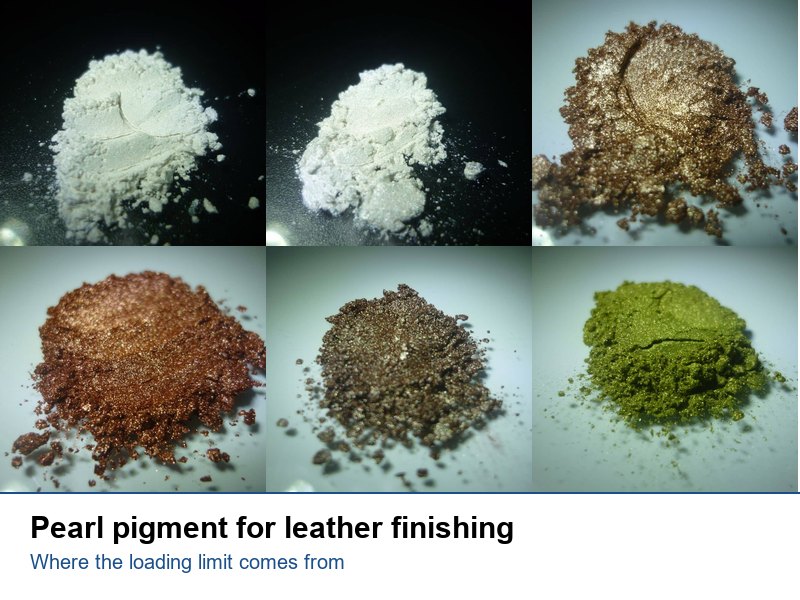
Pearl loading in leather finishing is capped by the resin left between flakes, not by brightness. Two lines, four to eight percent, and one 50,000-cycle test.
A pearl pigment enters a leather finish at 4 to 8 percent of the coating, and almost every question about it comes back to that number. Push past it and the flakes stop sitting in resin; they sit against each other, and the film fails at the fold rather than at the surface. The upper limit is set by binder, not by how bright the effect looks.
Synthetic leather and genuine leather are coated on equipment that looks similar and behaves nothing alike. On a synthetic line the coating is built on release paper and later peeled off, so the face you touch in the finished bag spent the whole process facing down. On a genuine leather line the hide is sprayed from above, one layer after another, and the last layer applied is the first layer the customer sees.
That single difference flips the answer to “which layer does the pearl go into”. Our own material guide says the effect belongs in the face coat on synthetic leather, and in the effect or top coat on genuine leather, without explaining why the wording changes. The reason is the release paper. A formulator who follows the genuine-leather habit on a synthetic line puts the pigment one layer too deep, where it is buried under the layer that actually faces out.
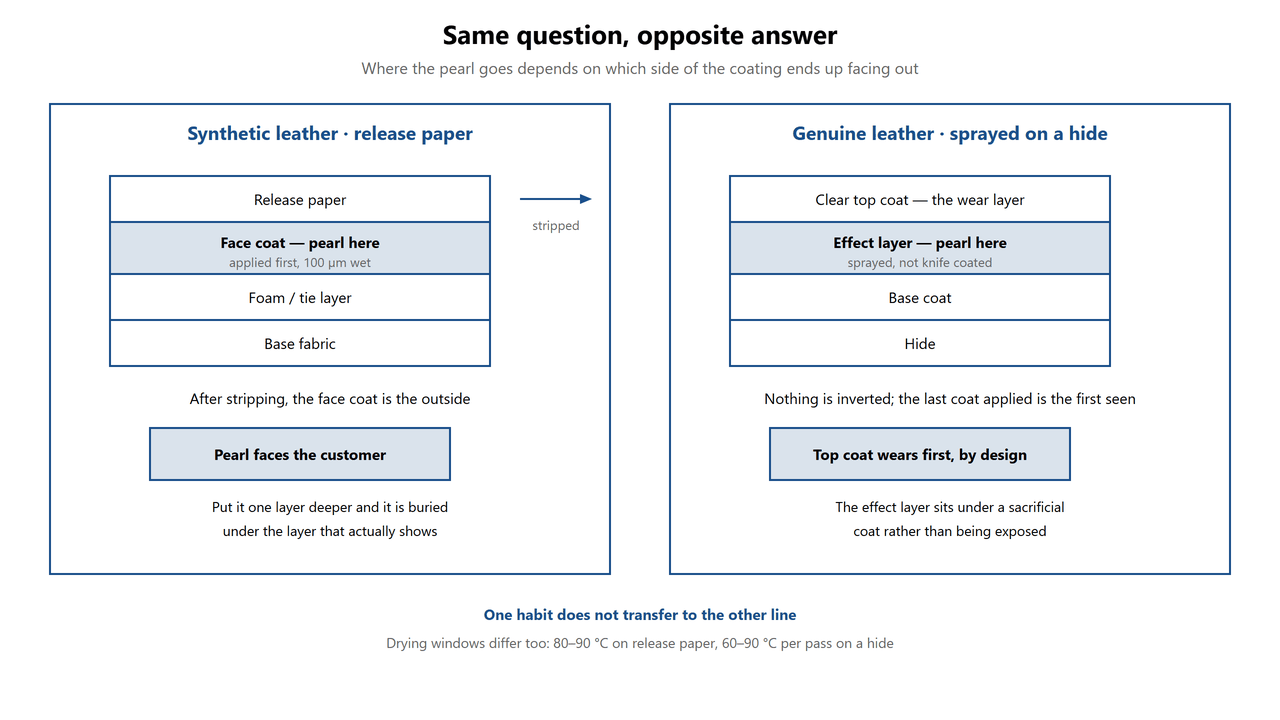
Fig. 1 — The same question, two answers. On release paper the pigment faces down until the paper is stripped; on a hide it faces up from the first pass.
A documented solvent-free polyurethane build runs the face coat at 100 µm wet, dried at 80 °C for two minutes and then 120 °C for two minutes. The foam or tie layer follows at 350 µm and dries between 80 and 140 °C, the base fabric is laminated at 120 to 140 °C, and the release paper comes off last. A second patent on the same transfer route reports the face coat dried at 80 to 90 °C with the line running 15 to 20 m/min.
Two things follow. First, the pigment has to survive 80 to 120 °C as a dry film, which every pearlescent grade does, so heat is not the constraint here. Second, the face coat is a thin film — 100 µm wet typically lands near 20 to 50 µm dry — and a platelet that is coarse relative to that film will stand proud of the surface. Sizing has to come before colour, because no shade choice rescues a flake that is wider than the layer holding it.
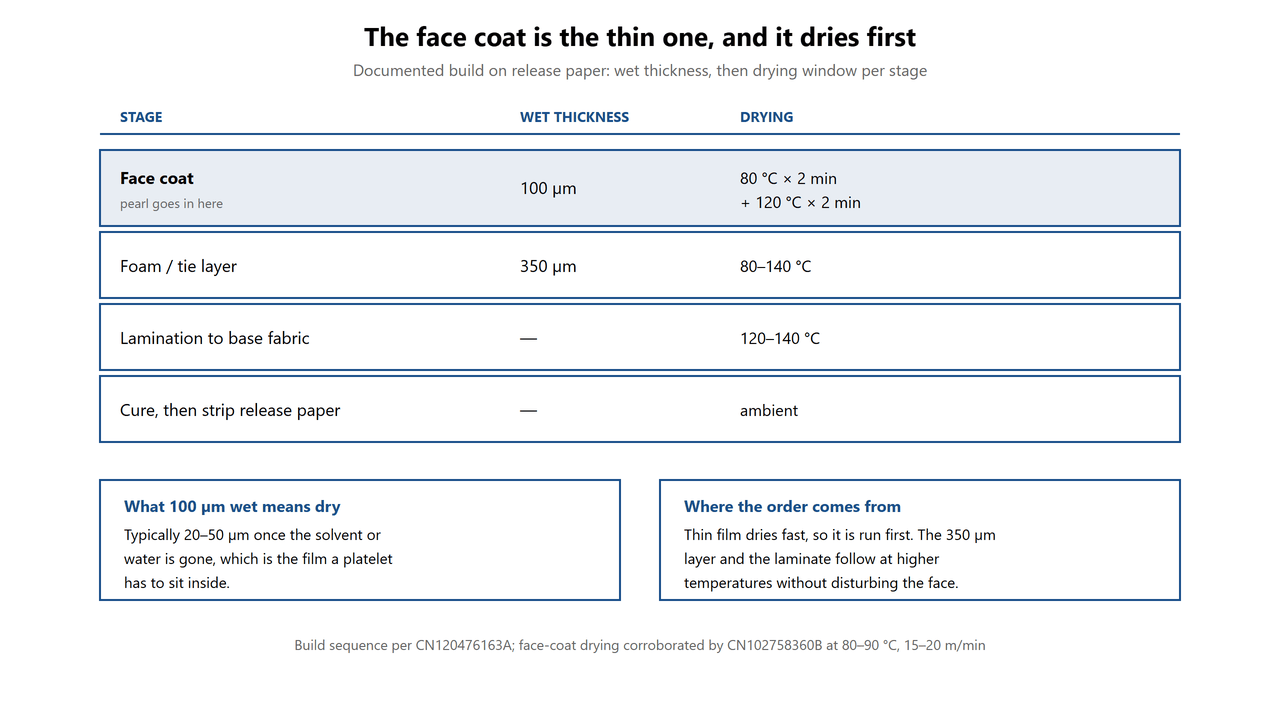
Fig. 2 — Build-up on release paper. The face coat is the thin one at the bottom of the stack until the paper is stripped.
Before a percentage means anything, the band has to be fixed. Our standard pearl range runs a fine band at 5 to 25 µm, a medium band around 10 to 60 µm, and coarse grades from 30 to 150 µm on synthetic mica. On a face coat that lands near 20 to 50 µm dry, the fine band sits inside the film; a 150 µm flake does not, whatever percentage it is dosed at.
This is why a single recommended dosage is not a useful number on its own. The same 8 percent that leaves resin between fine flakes packs coarse flakes against each other. Upholstery work usually wants the fine band for a satin read and a surface that can take 500 dry rubs; fashion leather can carry medium or coarse, because the flake is meant to be seen and the rub requirement is lower.
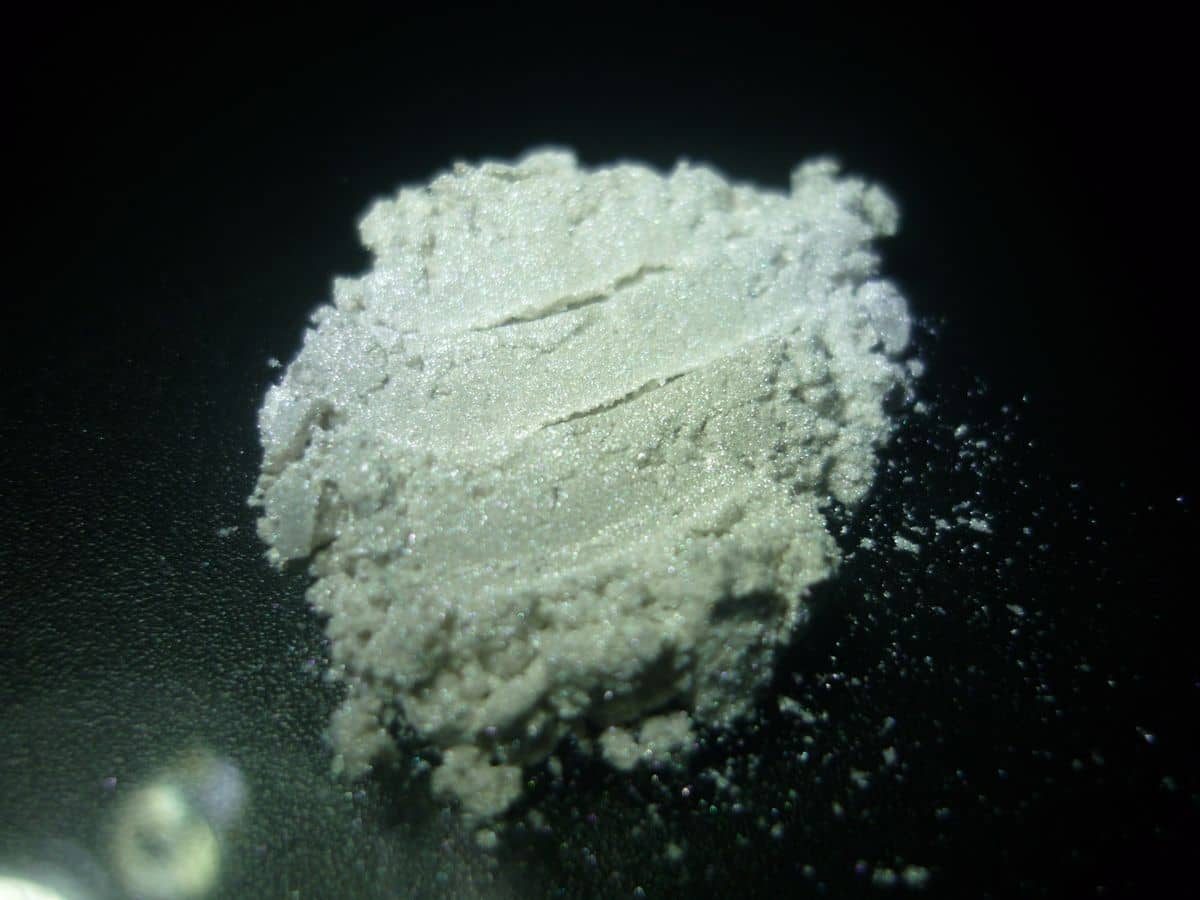
Fig. 3 — A fine pearl grade in powder form. The 5 to 25 µm band is the one that fits inside a face coat of 20 to 50 µm dry.
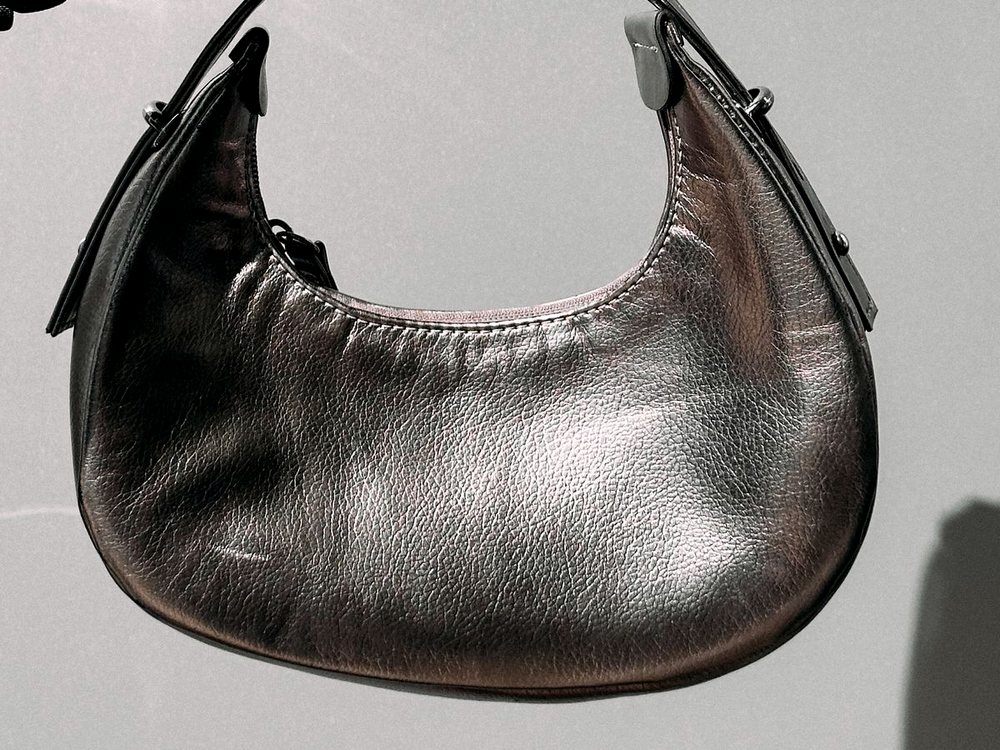
Fig. 4 — A metallic finish on a grain leather bag. The pearl sits in the finish, so the grain still reads through it.
Three figures circulate for the same decision, and they are not in conflict once you see what each is measured against.
| Where the figure comes from | Loading | Measured against | What it tells you |
|---|---|---|---|
| A published face-coat formula for brushed metallic PU leather | 4.0–8.0 % pearl, 5–50 µm | The whole face-coat formulation, alongside PU at 50.5–69.1 % and other pigment at 9.9–16.5 % | The pearl is a minority component. Binder is the majority, and that ratio is what keeps flakes apart |
| Dressing paste for genuine leather finishing | 5–8 % | The paste as mixed, before it is thinned for spraying | Reads lower than the PU figure because the paste is more concentrated than a spray-ready mix |
| Coating liquid for PU and synthetic leather | 5–15 % | The coating liquid, across fine and coarse grades | The wide end is a range across grades, not a target. Fine grades tolerate more; coarse grades at 15 % leave little resin between flakes |
| Supplier specification pages | Not stated | — | Sizes are given, loadings are not. This is the gap most formulators are working in |
The reason the upper end fails is geometric rather than optical. At 4 percent the flakes are spaced out and every one of them is surrounded by resin. As the loading rises, the spacing closes; the film still looks like a film, but the binder between adjacent platelets is now thin enough that a bend has nowhere to put the strain. Leather finishing defect lists name this directly: pigment coat peeling is caused by too much pigment or too little binder, and the two are the same statement read from opposite ends.
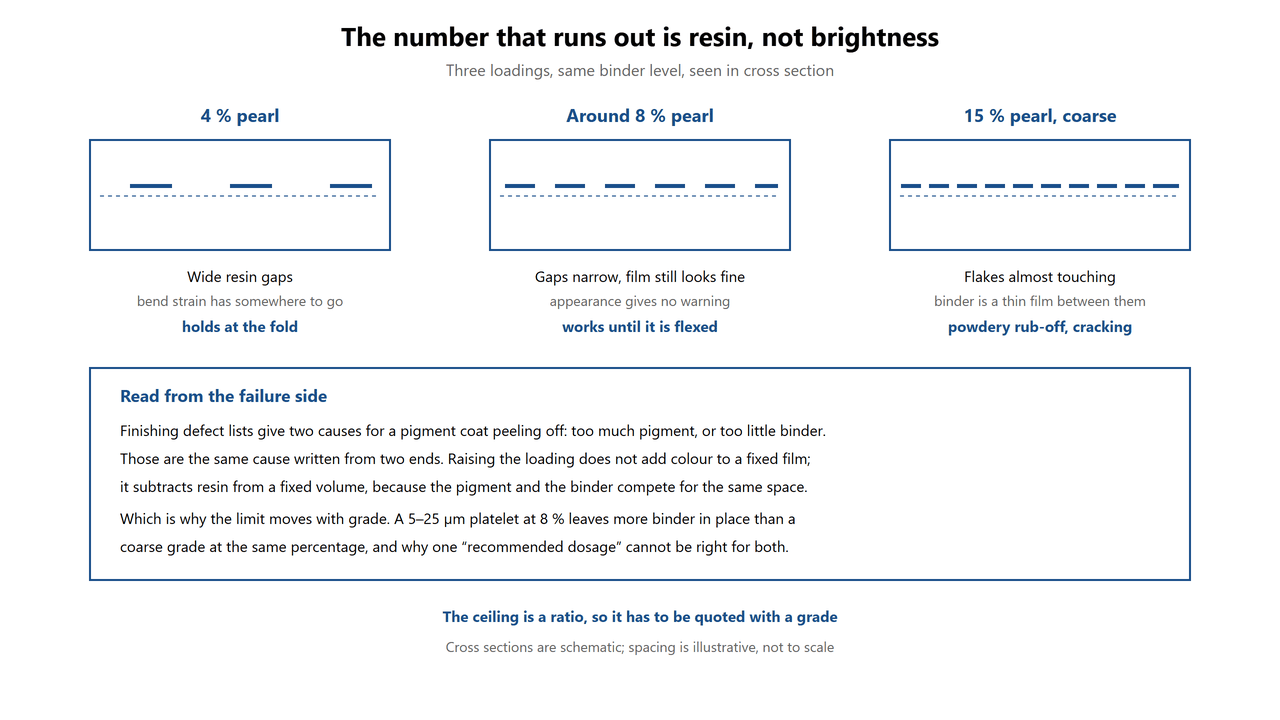
Fig. 5 — What the loading number actually changes. Resin between flakes, not brightness, is the variable that runs out.
ISO 14931 sets the flex requirement for clothing leather at 20,000 cycles for aniline leather and 50,000 cycles for pigmented finish, dry, on ISO 5402-1. The same table asks for 50 dry felt rubs and 20 wet felt rubs at grade 3 grey scale or better, a coating thickness no greater than 0.15 mm, and finish adhesion of at least 2 N per 10 mm. Upholstery leather under ISO 18270 moves the rub requirement to 500 dry cycles at grade 4 and 250 wet.
The comparison is usually read backwards. A pigmented finish is not held to a lower standard than an aniline hide; it is held to two and a half times the flex cycles and twenty-five times the rubs, precisely because there is a coating that can come off. So when a customer asks whether a pearl pigment will pass 50,000 cycles, the honest answer is that the standard is measuring the film and its bond to the hide, and the pigment is one contributor among several.
The practical check costs one offcut. Fold a finished sample along a line, run it back and forth by hand at the fold, and look for a pale line where the coating has started to break rather than where the colour has shifted. A fold test on the actual construction catches the mismatch before a production run does, and it is the same failure the flex machine is built to count.
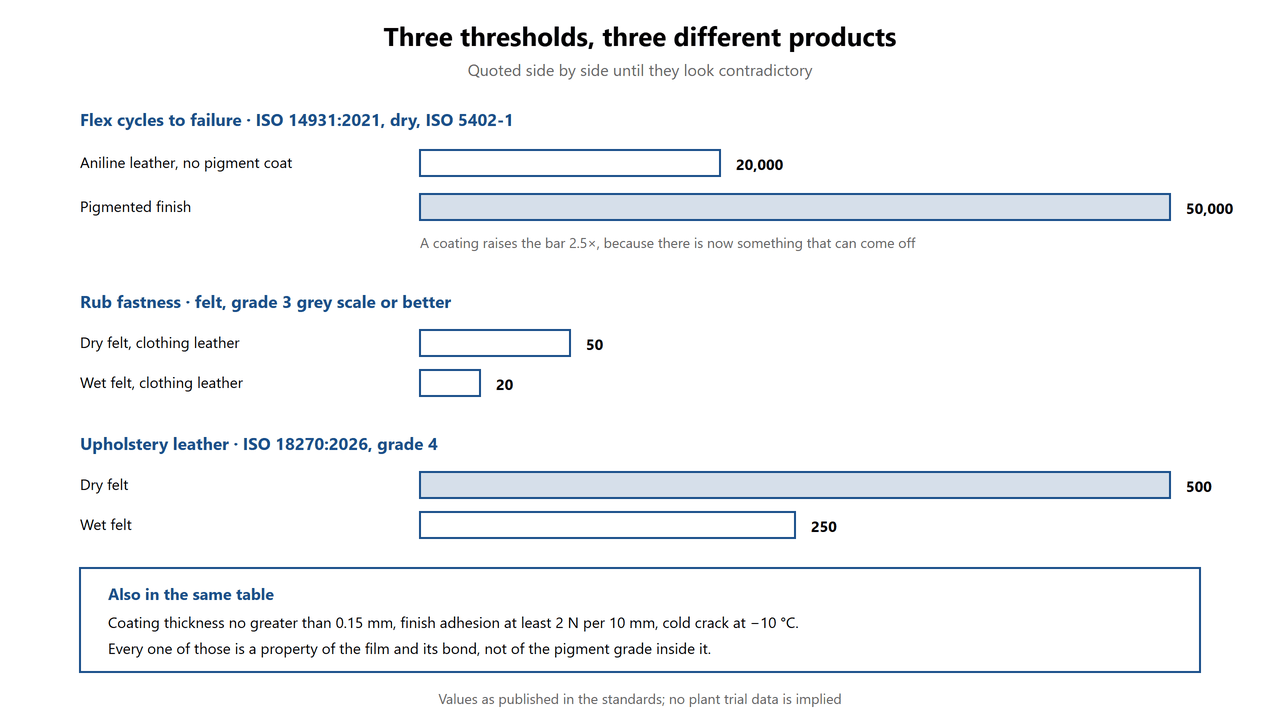
Fig. 6 — Three thresholds that get quoted at each other. They are not alternatives; they apply to different products.
A pearlescent pigment shows colour by reflecting light off platelets that are all supposed to lie flat. Spray a coating and the platelets arrive at random angles; the film then reads blotchy, and the blotches move as the part is turned. Automotive leather lines answer this with electrostatic spraying and orientation additives, because a mottled effect layer cannot be fixed by adding more pigment. The same physics applies to a bag or a shoe upper, where the coating is simply sprayed with less equipment behind it.
The second effect is quieter and causes more complaints. A hide or a roll of synthetic leather has one orientation of platelet alignment. Cut panels from it in different directions and those panels will show different shades under the same shop light, even though they came from the same batch. Brands discover this at the sample stage, when two swatches that should match do not.
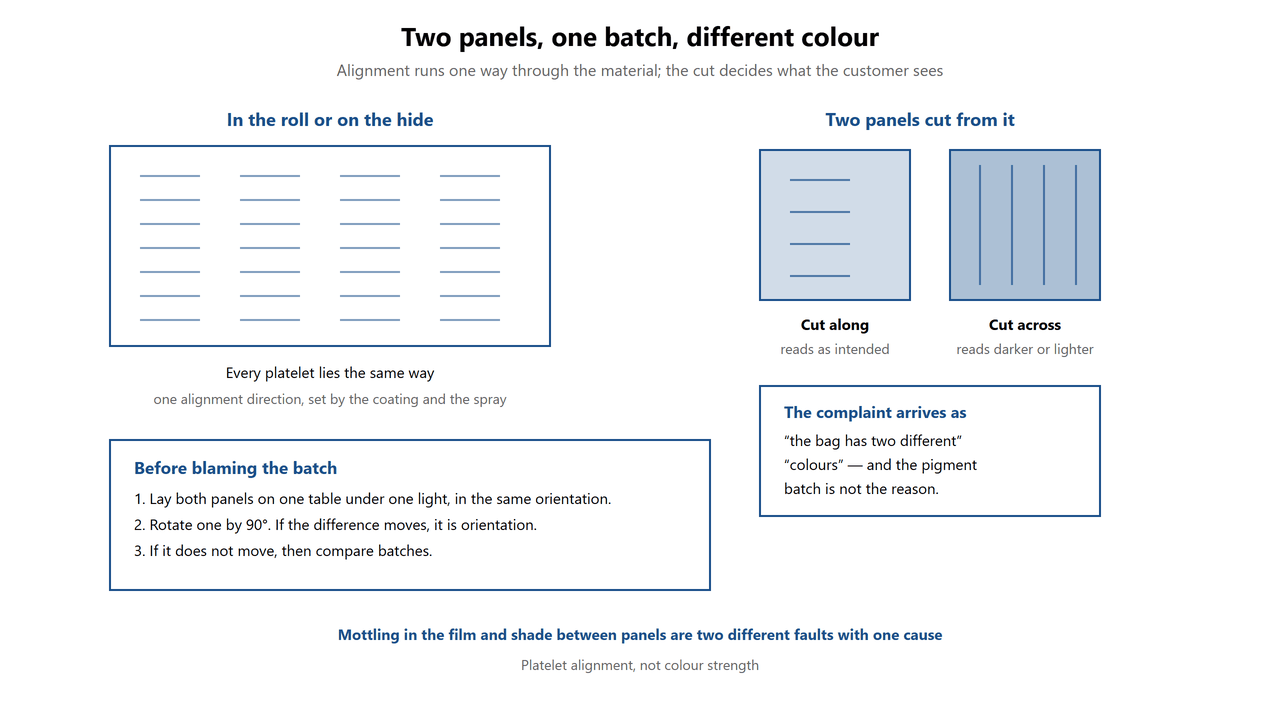
Fig. 7 — Why two panels from one batch can disagree. Alignment direction travels with the material; cut direction decides what the customer sees.
On the compliance side, one sentence is defensible and the rest is not. Mica-based and glass-based effect pigments take their colour from inorganic coatings such as titanium dioxide and iron oxide. There is no azo group in that structure, so there is nothing that could cleave to release a restricted aromatic amine under REACH Annex XVII entry 43, which sets 30 mg/kg as the limit for leather goods in prolonged skin contact. That is a statement about the absence of a structural feature, not a test result, and it covers one entry out of many.
What we cannot say is equally specific. Hexavalent chromium under entry 47, limited to 3 mg/kg, comes from the tanning process, not from a coating pigment, and no pigment choice makes a hide compliant with it. Formaldehyde limits in the same standards belong to the finish system. Whether a finished article complies depends on the dyes, the tannage and the whole coating stack together.
One more boundary, because it is the claim most often made for us rather than by us: a pearlescent finish is not a durable replacement for hot foil stamping. Foil is pressed into the surface and bonded there, and it survives oils and alcohol because of that bond. A pearl layer sits on top of the hide and is protected by a top coat that is designed to wear first. On a single-point rub test, foil wins. What the pearl layer offers instead is area without a die, gradients, colour travel with angle, and no tooling cost to start.
Standard pearlescent grades ship from 25 kg, with fine, medium and coarse bands available within the same colour. Silver white for a satin upholstery finish and interference colours for fashion leather are the two starting points most projects choose between; both are documented on the series pages linked below. A custom colour match runs from 25 kg as well.
For grade windows, treated surfaces and the full colour range in one file, the pearl pigment colour cards cover the standard series. Two series pages worth opening next: KT-100 silver white for the base pearl used across upholstery and fashion leather, and KT-300 gold pearl for warm metallic effects. The interference range starts at interference and iridescent mica powders, which explains the optical mechanism this page deliberately leaves alone.
Does the pigment go into the top coat or the face coat?
On release paper, into the face coat — the one applied first, which becomes the outside after stripping. On a hide sprayed directly, into the effect layer under the clear top coat, so the top coat can act as the wear layer.
Which particle size suits a thin face coat?
The 5 to 25 µm band, when the dry film is around 20 to 50 µm. Coarse grades are for thicker builds and for effects where the flake is meant to be visible as a flake.
Can a pearl finish replace foil stamping?
Not on abrasion. Foil is bonded into the surface and a pearl layer is protected by a sacrificial top coat. Pearl wins on area, gradients, angle-dependent colour and tooling cost, and loses on a single-point rub.
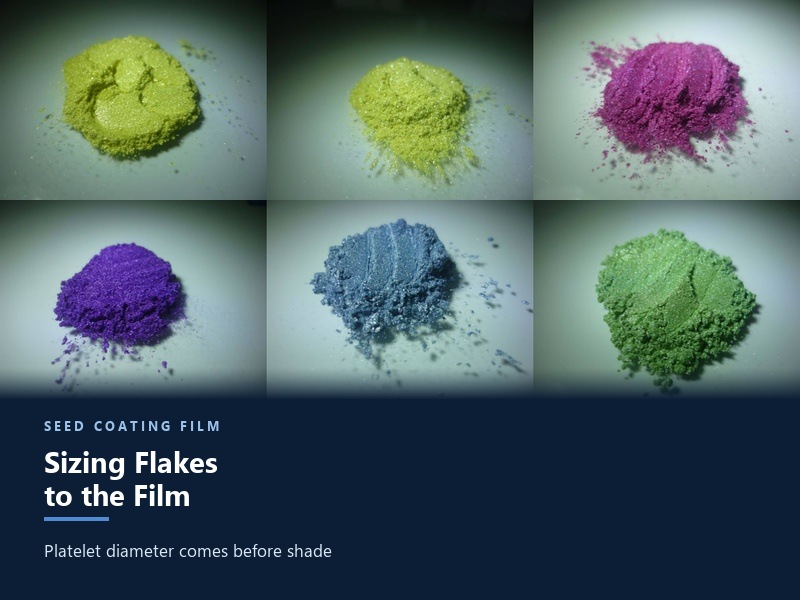
A seed coating film dries at 20 to 50 μm while a pearl platelet measures 10 to 100 μm. Sizing the flake to the film decides whether colour stays on the seed.
Read More
Pearl loading in leather finishing is capped by the resin left between flakes, not by brightness. Two lines, four to eight percent, and one 50,000-cycle test.
Read More
A pearl patch washes out while the flat colour beside it holds. Flakes reflect radiant heat, so that patch cured late. Fix the dwell, not the pigment.
Read More
Mica sinks in melted wax, so the colour settles where the flame cannot reach it. Position, not loading, is what decides whether that colour survives a burn.
Read More
 English
 Français
 Deutsch
 Русский
 Español
 Português