Selecting the right metallic mica powder or pearlescent pigment for epoxy floor coatings comes down to understanding how flake geometry, substrate interaction, and coating chemistry interact to produce the final visual — whether that's a deep gold shimmer, a crisp silver luster, or a layered two-tone effect. The wrong choice doesn't just look off; it affects dispersion stability, flake orientation, and long-term wear performance. This article breaks down the key selection criteria, product categories, and practical trade-offs so formulators and technical buyers can make informed decisions before committing to a run. When sourcing bulk mica pigment for floor applications specifically, the distinctions between natural and synthetic mica bases, coating types, and flake size ranges matter more than most suppliers will tell you upfront.
Natural Mica vs. Synthetic Fluorphlogopite: Which Base Works Better for Floors?
This is where most specifications start — and where many go wrong by treating both as interchangeable. They are not.
Natural mica (muscovite) is the standard substrate for most pearlescent pigments. It's cost-effective, available in broad size ranges, and performs reliably across standard epoxy systems. For floor coatings — particularly mid-range decorative applications — natural mica-based pigments are the practical default. The trade-off is consistency: natural mica carries inherent mineral variability, including trace dark inclusions that show up in high-gloss or large-flake formats.
Synthetic fluorphlogopite (synthetic mica) eliminates that variability. It's produced under controlled conditions, which means fewer black spots, tighter color consistency batch-to-batch, stronger luster, and meaningfully better UV and thermal stability. For high-end commercial floors or applications where the coating will be exposed to extended UV, synthetic mica-based products are worth the cost differential.
In practice, if you're producing a decorative residential floor with a 3–5 year lifecycle expectation, natural mica works fine. If you're specifying a retail showroom or exterior-facing application with a 10+ year target, synthetic mica reduces the risk of luster degradation and color drift.
Worth noting: synthetic mica also disperses more cleanly in epoxy systems due to lower surface contamination from organics, which affects wetting and flake orientation during application.
Coating Chemistry on the Mica Substrate: TiO₂ vs. Iron Oxide vs. Combined
The visual character of a mica-based pigment is almost entirely determined by what's coated onto the flake, not the mica itself. Three major coating types are relevant to floor applications:
Rutile TiO₂-coated mica produces the silver-white and near-white pearlescent effects. High reflectivity, clean sparkle, and good opacity. These are your silver pearl and glitter white variants. They sit in epoxy matrices well and maintain flake alignment through typical floor coating viscosities.
Iron oxide-coated mica (without TiO₂) produces the metal luster series — bronzes, wine reds, deep metallic browns. These have higher hiding power than the TiO₂ series, which makes them useful when you want strong coverage with metallic depth rather than translucent pearl. The iron oxide layer is physically harder than organic colorant coatings, which translates to better abrasion resistance in foot-traffic environments. This is a real functional advantage for floors that doesn't get enough attention.
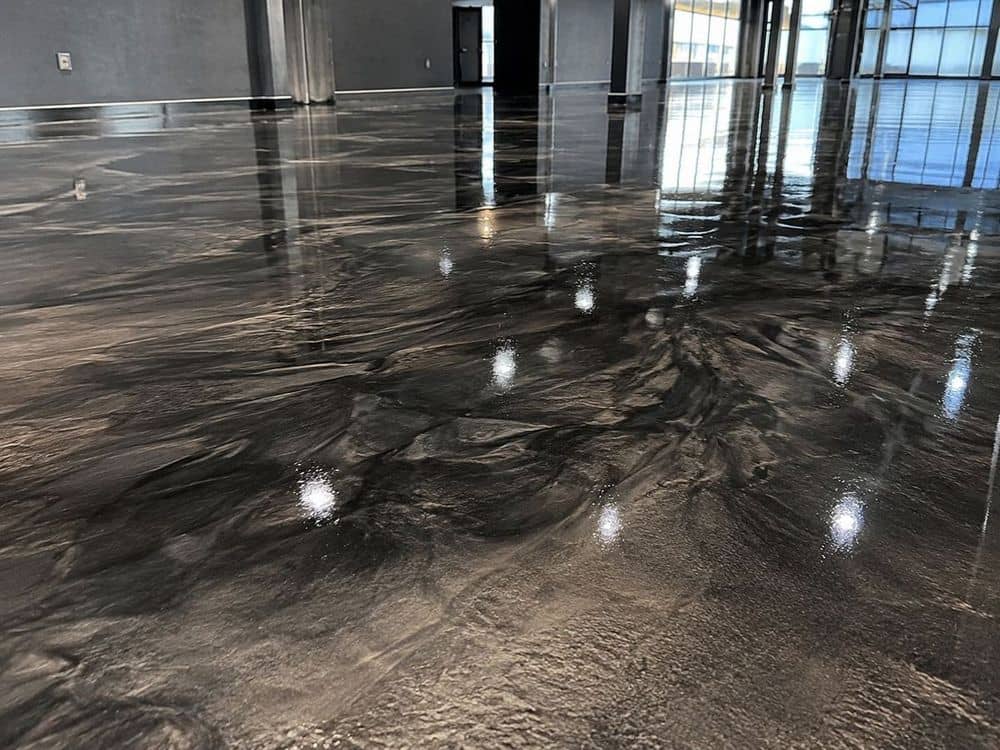
Combined TiO₂ + iron oxide coatings give you the gold and two-tone series. The interference effect from layered coatings creates depth and the characteristic "living" quality of pearlescent golds. Aztec gold, flash red gold, green gold — these effects come from carefully controlled oxide layer thickness. In epoxy floors, these work particularly well under a clear topcoat that allows the interference angle to shift under raking light.
That said, combined-coating pigments are more sensitive to over-shearing during mixing. High-speed dispersion can fracture the flakes and destroy the interference effect. Mix at low to medium RPM and keep mixing time to the minimum needed for homogeneity.
Flake Size and Its Effect on Floor Appearance
Flake size directly controls the visual grain of the final coating — and also affects application behavior.
Fine grades (10–60μm) produce smooth, uniform shimmer with minimal texture variation. They orient well in thin film builds and are the standard choice for self-leveling epoxy floors where a polished, continuous effect is the goal.
Medium grades (20–100μm, 30–150μm) introduce visible sparkle and a slightly more dynamic surface. Under directional lighting, individual flake reflections become perceptible, adding energy to the coating. These work well in roller-applied systems where some texture is acceptable.
Large-flake formats (60–300μm) — particularly in synthetic mica products like the sparkle wine red variants — are primarily decorative accent grades. They're typically broadcast over a wet base coat rather than bulk-mixed in, because at these sizes, uniform dispersion in a fluid epoxy is difficult to achieve and hold through cure.
Mica flakes at 1–3mm and 3–5mm are a separate category entirely. These are decorative aggregates, not pigments. They're used to create stone-like or terrazzo-style effects in epoxy floors — broadcast applications, not dispersion applications. Don't confuse them with pigment-grade mica when writing a specification.
One practical point: larger flakes are more susceptible to settling in low-viscosity epoxy systems. If your formulation has a long pot life or extended leveling window, factor in anti-settling agents or adjust the flake size down.
Product Series Selection Guide for Epoxy Floor Applications
The table below maps common floor coating objectives to the relevant pigment series and format:
| Target Effect |
Recommended Series |
Mica Base |
Notes |
| Clean silver / white pearl |
Silver White Series (KT-100 / KT-7100) |
Natural or Synthetic |
Synthetic preferred for critical color consistency |
| Gold, bronze, warm metallic |
Gold Series (KT-300 / KT-7300) |
Natural or Synthetic |
Layer thickness controls hue; avoid over-shearing |
| Deep metallic with high coverage |
Metal Luster Series (KT-500 / KT-7500) |
Natural or Synthetic |
Iron oxide coating = better abrasion resistance |
| Color shimmer (blue, green, red) |
Multicolor Series (KT-6000 / KT-74XX) |
Natural or Synthetic |
Check lightfastness for UV-exposed floors |
| Terrazzo / stone aggregate look |
KT Mica Flakes (1–3mm, 3–5mm) |
Natural |
Broadcast application; not a dispersion pigment |
| Solid metallic, ready-to-use paste |
Metallic Luster Paste (Solvent Based) |
Pre-dispersed |
Direct addition to epoxy; no dry dispersion step |
Dispersion Mechanics in Epoxy Systems
Mica-based pigments are platelet structures. Their optical performance depends on flakes lying parallel to the substrate surface — what's referred to as flake orientation. In a self-leveling epoxy, gravity and surface tension do a significant portion of that work for you. In a trowel-applied or roller-applied system, you need to be more deliberate.
The dispersion sequence matters. Adding dry mica pigment directly to the mixed epoxy and hardener with inadequate pre-wetting leads to agglomeration and uneven distribution. The better practice is to pre-disperse the pigment into the resin component (Part A) before adding the hardener, using low-shear mixing (paddle or anchor mixer, not a high-speed disperser). This gives the pigment time to wet out before the viscosity starts climbing during cure.
Pre-dispersed paste formats sidestep this entirely. Solvent-based metallic pastes designed for direct epoxy addition already have the pigment wetted and stabilized in a carrier. For production environments where consistent batch-to-batch results are critical, this approach reduces one variable in a process that already has plenty.
Loading rate also affects orientation. Higher pigment concentrations increase viscosity and can impede flake alignment, particularly with larger flakes. Most pearlescent pigment suppliers recommend 2–5% by weight in epoxy coatings as a starting range, with adjustments based on effect intensity and flake size. Going above 8% typically produces diminishing returns on luster and starts creating application challenges.
Lightfastness and Chemical Resistance: What Floor Applications Demand
Epoxy floors face a different stress profile than paint films. Foot traffic, cleaning chemistry (alkaline degreasers, bleach-based sanitizers), UV exposure in some installations, and thermal cycling from radiant floor systems all contribute to coating degradation over time.
The inorganic coating chemistry on standard mica pigments — TiO₂ and iron oxide — handles most of these conditions well. These are among the most chemically stable colorants available. Silver and white pearls based on rutile TiO₂ are particularly robust. Iron oxide-coated metal luster pigments are likewise stable under most industrial cleaning protocols.
The multicolor series introduces organic colorant components (to achieve reds, blues, greens beyond what pure oxide coatings produce), which are inherently less lightfast than pure inorganic systems. For exterior or UV-exposed floor applications — think open-air parking decks, covered walkways with UV penetration — specify inorganic-only pigment systems or confirm lightfastness data from the supplier before committing.
Synthetic mica-based products show a measurable advantage in UV stability versus natural mica equivalents, attributed to the higher purity of the fluorphlogopite substrate and tighter coating uniformity.
When to Use Pearlescent Pigment Powder vs. Pre-Dispersed Paste
This is a formulation workflow question as much as a product question.
Dry pearlescent pigment powder gives you maximum flexibility: you control loading rate, can blend multiple colors, and typically get better economics at volume. It requires a proper dispersion step and equipment capable of low-shear wet-out. For manufacturers producing floor coatings at scale, powder is usually the right format.
Pre-dispersed metallic paste eliminates the dispersion step and reduces the risk of mixing errors. It's also easier to handle from a dust and workplace hygiene standpoint. For contractors applying floor coatings on-site, or for smaller-batch specialty applications, paste formats reduce process variables without compromising the metallic effect.
One consideration specific to floor coatings: solvent-based paste carriers need to be compatible with the epoxy system chemistry. Verify solvent type and loading before finalizing formulation — particularly in systems targeting low-VOC or zero-VOC compliance.
FAQ
Can I mix different mica pigment series together in one epoxy floor coat?
Yes, and it's a common technique for creating custom effects. Silver pearl combined with a small percentage of gold series creates a warm champagne metallic. Metal luster bronze blended with a multicolor blue produces a dimensional bronze-teal shift. Keep flake size ranges compatible — mixing very fine and very coarse grades in the same coat tends to produce visual noise rather than a coherent effect. Test blends at small scale first to confirm the mixed color reads as intended in your specific epoxy system, since resin color and clarity affect the final appearance.
What's the difference between KT Mica Flakes and standard mica pigment powder for floors?
Mica flakes at 1–5mm are decorative aggregates — they're broadcast onto a wet epoxy basecoat to create visual texture, not dispersed into the coating matrix. Pigment-grade mica powder (10–300μm) is mixed into the epoxy to create a continuous pearlescent or metallic effect throughout the film. They serve different design functions and are not interchangeable in formulation.
How does flake size affect the recommended application method?
Fine grades (10–60μm) are suitable for spray, self-leveling pour, and roller application. Medium grades (20–150μm) work well with roller and trowel application but may partially block spray tips at higher loadings. Very large flake formats (100μm+) are generally best applied by trowel or broadcast — forced through spray equipment, they tend to fracture or clog, and the visual advantage of the large flake is lost.
Is synthetic mica worth the cost premium for standard floor coating applications?
For interior decorative floors with limited UV exposure and a typical replacement cycle under five years, natural mica is cost-appropriate. Synthetic mica (fluorphlogopite) is worth specifying when you need consistent batch color, are working with high-clarity epoxy systems where dark inclusions in natural mica would be visible, or when the floor will face UV exposure or elevated temperatures. The luster and chroma improvement in synthetic versions is real and measurable — but for many standard applications, natural mica delivers a result that fully meets specification.
For technical data sheets, sample requests, or formulation-specific guidance on sourcing bulk mica pigment for floor coating production, contact the Kolortek technical team directly at contact@kolortek.com.

 English
 Français
 Deutsch
 Русский
 Español
 Português