Quick Answer
For cosmetic brands building a private label product line, this pearlescent pigment guide covers everything from substrate selection and regulatory compliance to supplier evaluation — because the wrong pigment partner doesn't just cost you money, it can derail a product launch entirely. Sourcing private label pearl pigment successfully means understanding the science behind interference color, the compliance requirements in your target markets, and which questions to ask before you place your first order. At Kolortek, we've spent over 20 years helping brands of every size — from indie startups to multinational personal care companies — navigate cosmetic pigment procurement with confidence.
Key Takeaways
- Substrate matters more than color: The choice between natural mica, synthetic mica (fluorphlogopite), and borosilicate glass flake determines not just aesthetics, but your ethical sourcing story and regulatory standing.
- Particle size controls the effect: A 5–25 µm grade gives you the silky luster ideal for lipstick; a 20–100 µm grade delivers the eye-catching sparkle that sells eyeshadow palettes. Choosing the wrong size is the most common formulation mistake we see from new brands.
- Regulatory requirements differ by market: EU, US FDA, China CSAR, and Japan MHLW each have distinct positive lists and approval frameworks — a pigment compliant in the US may require additional verification for Japan.
- Clean beauty compliance starts at the chemistry level: Inorganic-only interference pigments (TiO₂/SnO₂ coating, no organic dyes) offer the broadest global regulatory acceptance and align with clean label claims.
- Supplier flexibility is a real differentiator: For emerging brands, a supplier who accepts small batch orders, provides free samples, and offers custom color matching is not a luxury — it's a business requirement.
Why Getting Pearlescent Pigment Sourcing Right Is a Brand Decision, Not Just a Purchasing Decision
The global effect pigment market is on track to reach USD 1.5 billion, growing at a CAGR of 5–7%, with pearlescent pigments representing the single largest product category. Within that, cosmetics and personal care is one of the most dynamic end markets — driven by the explosive growth of premium color cosmetics in Asia-Pacific, the "clean beauty" movement reshaping formulation priorities in Europe and North America, and the accelerating demand for multi-chrome and color-shift finishes that define modern prestige launches.
For a cosmetic brand, this means the pigment you select is never just an ingredient. It's a positioning statement. A brand selling ethical, sustainable beauty cannot source from a natural mica supplier with opaque supply chains. A brand selling premium iridescent highlighters in Japan cannot use a colorant that isn't on the MHLW positive list. A startup launching an eyeshadow palette on a tight timeline cannot afford a supplier with a 12-week minimum lead time and a 500kg MOQ.
This guide is built on what we've learned manufacturing cosmetic-grade pearlescent pigments for over two decades: the questions brands should ask, the tradeoffs they need to understand, and the supplier signals that separate a reliable partner from an expensive mistake.
Understanding the Science: How Pearlescent Pigments Actually Work
One of the most common misconceptions we encounter from brand-side buyers is that pearlescent pigments are simply "shiny powders." In reality, the effect is an optical phenomenon — thin-film interference — not a dye or surface coating in the conventional sense.
Pearlescent pigments are built on flat, transparent platelet substrates coated with thin layers of high-refractive-index metal oxides, primarily titanium dioxide (TiO₂) and/or iron oxide (Fe₂O₃). When light enters and reflects between these layers, it interferes constructively or destructively at specific wavelengths — producing color without any dye or pigment absorbing light in the traditional sense.
The coating thickness is the variable that controls color: at approximately 120nm of TiO₂, you get a gold interference color; at around 200nm, you achieve blue. This isn't a formula we invented — it's physics. But executing it consistently across production batches, at cosmetic-grade purity, is where manufacturing expertise becomes the differentiator.
Substrate Options and What They Mean for Your Brand
Natural Mica (Muscovite) has been the backbone of the pearlescent pigment industry for decades. It's abundant and cost-effective, making it the default choice for mass-market cosmetics. However, the natural mica supply chain — predominantly sourced from India and Madagascar — has faced sustained scrutiny over labor practices, including documented instances of child labor in artisanal mining. For brands with ESG commitments or "ethical sourcing" claims, this is an increasingly untenable starting point.
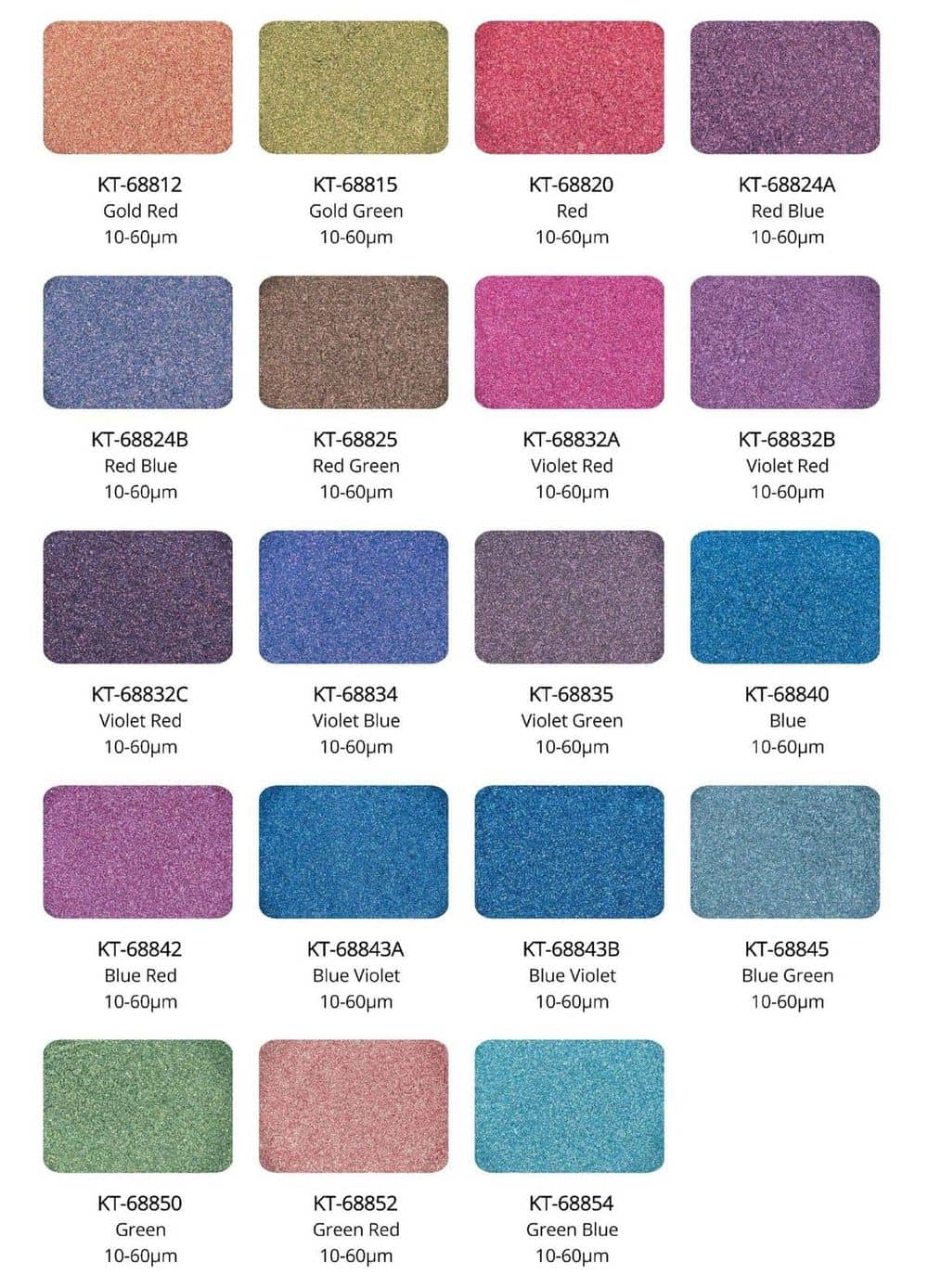
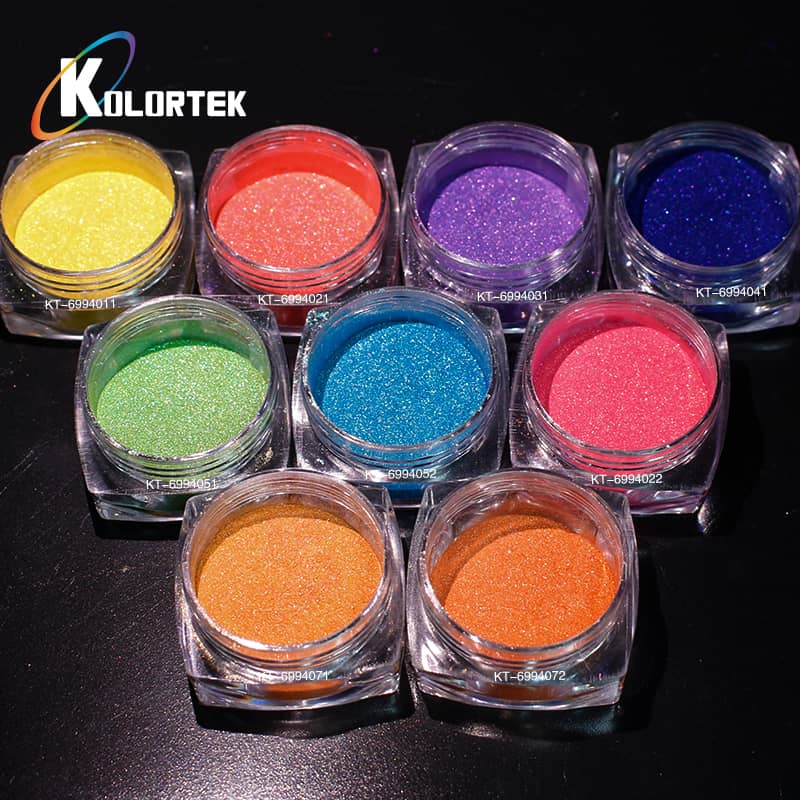
Synthetic Mica (Fluorphlogopite) is the high-performance, high-ethics alternative. Produced entirely in controlled manufacturing environments, it offers higher purity, brighter optical whiteness, superior transparency, and a completely auditable supply chain. Our KT-7000 SynStar series was developed specifically to serve brands that need to make credible synthetic or "mica-free" claims. The performance uplift is real: the improved substrate whiteness means interference colors appear cleaner and more saturated on skin.
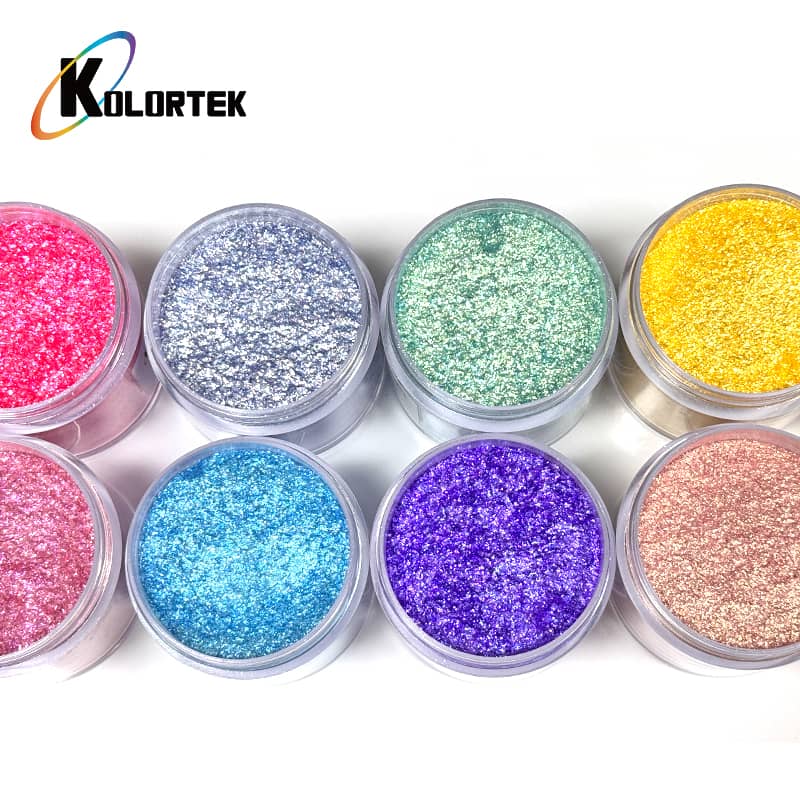
Borosilicate Glass Flake represents the premium tier. Exceptional transparency and refractive properties produce a diamond-like brilliance that synthetic and natural mica simply cannot match. Our KT-68840 and KT-68860 borosilicate series are the recommendation for prestige cosmetics where "luxury" is the non-negotiable brief.
Particle Size: The Variable That Controls the Feel and the Look
Particle size is the most underappreciated variable in cosmetic pigment selection, and it's the one we see brands get wrong most often. Here's the practical framework we share with every new formulation partner:
- 1–15 µm: Satin, smooth, high skin coverage. The right choice for foundations, BB creams, and skincare with a subtle luminosity. The small platelet size means you get coverage over imperfections before the optical effect registers.
- 5–25 µm: Fine luster with a silky texture. Ideal for lipstick and pressed powder applications where you want visible shimmer without grittiness on the lips or skin.
- 20–100 µm: Noticeable sparkle and flash. This is the eyeshadow and nail polish range — particles large enough to catch and reflect light as distinct glints.
- 100–250+ µm: Maximum visual impact. Coarse decorative flakes for special effects, highlight toppers, and festival or theatrical cosmetics.
A common mistake: selecting a 60 µm sparkle grade for a lip gloss formulation because the effect looks impressive in a display sample, then discovering the texture registers as gritty on the lips in consumer testing. Particle size selection must begin with the application format, not the visual effect.
Regulatory Compliance: Market-by-Market Realities for Cosmetic Pigment Procurement
Regulatory compliance is not a checkbox at the end of sourcing — it should be the first filter. Launching a product in a new market with a non-compliant colorant means pulling inventory, reformulating, and, in some cases, regulatory action. We see this happen every year, and it's almost always preventable.
EU (EC 1223/2009)
Cosmetic colorants in the EU must appear on the Annex IV positive list. TiO₂ has attracted additional scrutiny under the EU's CLP regulation regarding the inhalable classification, creating complexity for powder-format products. Brands targeting EU markets should be aware that TiO₂-free formulation options are now available — we offer these specifically for brands that want to get ahead of future restrictions rather than react to them. EU regulations also strongly incentivize biodegradable alternatives to conventional plastic glitters, with microplastic restrictions already in effect for certain applications.
US FDA
The FDA distinguishes between "exempt" colors (Iron Oxides, TiO₂, Mica) — which do not require batch certification — and "certified" colors (FD&C/D&C lakes), which require FDA batch certification on a per-batch basis. The Modernization of Cosmetics Regulation Act (MoCRA, 2022) added mandatory facility registration and product listing requirements that affect both domestic and foreign manufacturers supplying US cosmetic brands. Brands should confirm their pigment supplier has the documentation infrastructure to support MoCRA compliance.
China (CSAR) and Japan (MHLW)
China requires all cosmetic ingredients to appear on the IECIC (Inventory of Existing Cosmetic Ingredients in China). For brands targeting the Chinese market, our KT-655 series is the safest procurement choice — it uses only inorganic components (TiO₂/SnO₂ interference, no organic dyes) that are well-established on the IECIC list. Japan operates a strict positive list system under MHLW, where organic colorants require individual verification. Again, the KT-655 series and standard cosmetic-grade iron oxides are the lowest-risk options for Japanese market entry.
Expert Insight: What 20 Years of Cosmetic Pigment Formulation Actually Teaches You
A brand manager once came to us after spending three months reformulating a pressed highlighter because the shimmer effect kept "disappearing" in the final compressed compact. The pigment itself was performing correctly in a loose powder test. The problem was the mixing process: the brand's contract manufacturer was using a high-speed disperser at 3,000 RPM — standard equipment for oxide colorants, but catastrophic for platelet-structure pearlescent pigments.
High-shear mixing physically fractures the pearlescent platelets. Once the flat, oriented structure is broken, the interference effect collapses. The compressed compact contained the same pigment by weight, but the effect was gone. The fix was straightforward — switch to a low-shear planetary mixer and add the pearlescent pigments late in the dry blending sequence. But the three months of reformulation and the testing costs were entirely avoidable with early formulation guidance.
This is why we build formulation guidance into every new product relationship, not as an upsell, but because a brand that successfully launches a product comes back for more. The processing rules are consistent: avoid high-shear mixing for platelet pigments, pre-disperse in the oil phase before combining with water-based components, and add pearlescents late in the dry blend to minimize mechanical damage.
On the color matching side, we maintain a cross-reference program aligned with major industry benchmarks — including Merck's Iriodin® line — so brands transitioning from an existing supplier or building a formulation around an industry standard can map grades directly without starting development from scratch. This alone has shortened the sampling-to-approval cycle for several of our international brand partners from months to weeks.
Pigment Selection Framework: Key Specifications at a Glance
| Parameter |
Natural Mica (KT-688) |
Synthetic Mica (KT-699 / SynStar KT-7000) |
Borosilicate (KT-68840/68860) |
| Substrate Purity |
Standard |
High (controlled synthesis) |
Very High |
| Optical Whiteness / Transparency |
Good |
Superior |
Exceptional (diamond-like brilliance) |
| Ethical Sourcing / ESG |
Supply chain scrutiny (mining) |
Fully auditable, no mining |
Fully auditable, no mining |
| Best For |
Cost-sensitive mass market |
Clean beauty, ethical claims, premium mid-market |
Prestige / luxury cosmetics |
| Regulatory Risk (EU/Japan) |
Low–Medium (depends on colorant package) |
Low (KT-655: inorganic only) |
Low |
| Typical Dosage (Eyeshadow) |
5–50% |
5–50% |
5–30% |
| Color Range |
Vivid multi-color, D&C coated options |
Broader range, higher brightness |
Focused on brilliance and clarity effects |
| Application Format |
Recommended Particle Size |
Typical Dosage Range |
Key Effect |
| Foundation / Skincare |
1–15 µm |
3–15% |
Soft satin glow, coverage |
| Lipstick / Lip Gloss |
5–25 µm |
1–20% |
Fine luster, silky feel |
| Eyeshadow / Pressed Powder |
20–100 µm |
5–50% |
Sparkle, flash, high impact |
| Nail Polish |
20–100 µm |
1–15% |
Shimmer, sparkle |
| Cream / Lotion |
5–25 µm |
1–15% |
Soft glow, skin radiance |
| Highlight Topper / Special Effects |
100–250+ µm |
5–30% |
Maximum visual impact, flake flash |
How to Evaluate a Private Label Pigment Supplier: The Criteria That Actually Matter
The premium end of the pearlescent pigment market is anchored by names like Merck (Iriodin®), BASF (Colorstream®), and Eckart — companies that command price premiums through decades of technology investment and brand recognition in industrial formulation. For cosmetic brands, these names are familiar, but the sourcing landscape has matured significantly. Asian manufacturers, including Kolortek, Kuncai, and Sudarshan, now offer comparable technical performance with more flexible commercial structures. The question isn't simply "who's the biggest?" — it's "who is the right fit for where my brand is going?"
Here is the evaluation framework we recommend to any cosmetic brand beginning a supplier search:
1. Regulatory Documentation Capability
Can the supplier provide Safety Data Sheets (SDS), Certificates of Analysis (CoA), heavy metal test reports, and market-specific compliance statements (EU Annex IV, FDA exempt color documentation, IECIC listing confirmation) for every grade? If a supplier hesitates on documentation, it's the clearest possible signal to walk away.
2. Order Flexibility and Lead Times
For indie and emerging brands, a 500kg minimum order quantity is not a commercial reality — it's an inventory problem. At Kolortek, we accept small batch orders precisely because we understand the cash flow and storage constraints of brands in the launch phase. A supplier willing to grow with you is worth more long-term than one with a lower unit price but an inflexible MOQ structure.
3. Sample Service and Technical Support
Free sample availability is the baseline expectation for any serious pigment supplier. What separates partners from vendors is what comes with the sample: formulation guidance, application notes, dosage recommendations, and a technical contact who responds within 24–48 hours. The sample is an audition — the technical relationship is the show.
4. Custom Color Matching and Private Label Packaging
If your brand's identity is built on proprietary shades or effects, standard catalog colors are a starting point, not a destination. Confirm that your supplier has in-house color matching capability and can accommodate custom packaging for private label requirements. At Kolortek, both services are part of our standard OEM/ODM offering — not premium add-ons.
5. Sustainability and Ethical Sourcing Credentials
With microplastic regulations already restricting conventional glitters in several EU applications, and the clean beauty movement pushing transparency across the supply chain, sustainability credentials are no longer optional for brands selling in premium channels. Ask directly: Does the supplier offer synthetic mica alternatives? Biodegradable glitter options? TiO₂-free grades? The answers tell you how forward-looking the manufacturer is.
Frequently Asked Questions
What is the difference between natural mica and synthetic mica pearlescent pigments for cosmetic use?
Natural mica (muscovite) is mined and offers good optical performance at a competitive cost, but carries supply chain risks related to mining labor practices. Synthetic mica (fluorphlogopite) is manufactured in controlled facilities, offering higher purity, brighter color, and a fully auditable supply chain — making it the preferred choice for brands making ethical sourcing claims or targeting clean beauty positioning.
How do I choose the right particle size for my cosmetic formulation?
Start with the application format, not the visual effect. Fine grades (1–15 µm) work best in foundations and skincare where smooth coverage is the goal; medium grades (5–25 µm) suit lipstick and pressed powders; larger grades (20–100 µm) deliver the sparkle expected in eyeshadow and nail polish. Selecting a coarse grade for a lip gloss formulation is one of the most common mistakes we see, as it creates textural grittiness in consumer use.
Which pearlescent pigment series is safest for selling in multiple international markets simultaneously?
The KT-655 series — based on inorganic TiO₂/SnO₂ interference only, with no organic dyes — offers the broadest regulatory acceptance across the EU, US, China CSAR, and Japan MHLW simultaneously. For brands building global product lines and wanting to minimize reformulation risk across markets, starting with inorganic-only interference pigments is the most defensible foundation.
Can small indie cosmetic brands source private label pearlescent pigments with low minimum order quantities?
Yes — and supplier MOQ flexibility should be a primary evaluation criterion for emerging brands. At Kolortek, small batch orders are accommodated as standard practice, not exceptions, because we've been working with indie brands long enough to understand that the launch phase requires flexibility, not large inventory commitments. Free samples are also available to support formulation development before any order commitment.
How do I avoid damaging pearlescent pigments during cosmetic manufacturing?
The single most damaging step is high-shear mixing. Pearlescent pigments rely on the structural integrity of their flat platelets; high-speed dispersers or three-roll mills will physically fracture these platelets and destroy the optical effect. Use low-shear planetary or paddle mixing, add pearlescents late in the dry blending sequence, and pre-disperse in the oil phase for emulsion-based formulations.
Are there pearlescent pigment options for cosmetic brands that need to comply with EU microplastic restrictions?
Yes. The EU's restrictions on intentionally added microplastics have significant implications for brands using conventional plastic-based glitters. Kolortek's biodegradable glitter series — made from cellulose and PLA — provides a compliant alternative. Additionally, fine-grade pearlescent pigments on mica or borosilicate substrates are not covered by the microplastic restriction and can replace many decorative glitter applications while offering superior optical performance.
The bottom line: Successful cosmetic pigment procurement isn't about finding the cheapest powder — it's about selecting a technical partner who understands the science, navigates the regulatory landscape alongside you, and has the flexibility to grow with your brand from first sample to full-scale production. Those are the criteria that determine whether a sourcing decision becomes a competitive advantage or a recurring headache.

 English
 Français
 Deutsch
 Русский
 Español
 Português