Choosing between matte mica powder and shimmer mica powder in foundation formulation directly affects finish, skin interaction, and consumer perception — and the decision is rarely as simple as "glow vs. no glow." Both rely on the optical and physical behavior of cosmetic grade mica flakes, but they diverge sharply in surface treatment, particle morphology, and how they interact with skin topography and other formulation components. This article breaks down the functional differences, formulation trade-offs, and selection criteria for R&D and procurement teams working on foundation development.
What Actually Separates Matte from Shimmer in Mica-Based Foundations
The distinction isn't purely about particle size. It's about flake geometry, refractive index, and how light interacts with the mica surface after coating — or the deliberate absence of one.
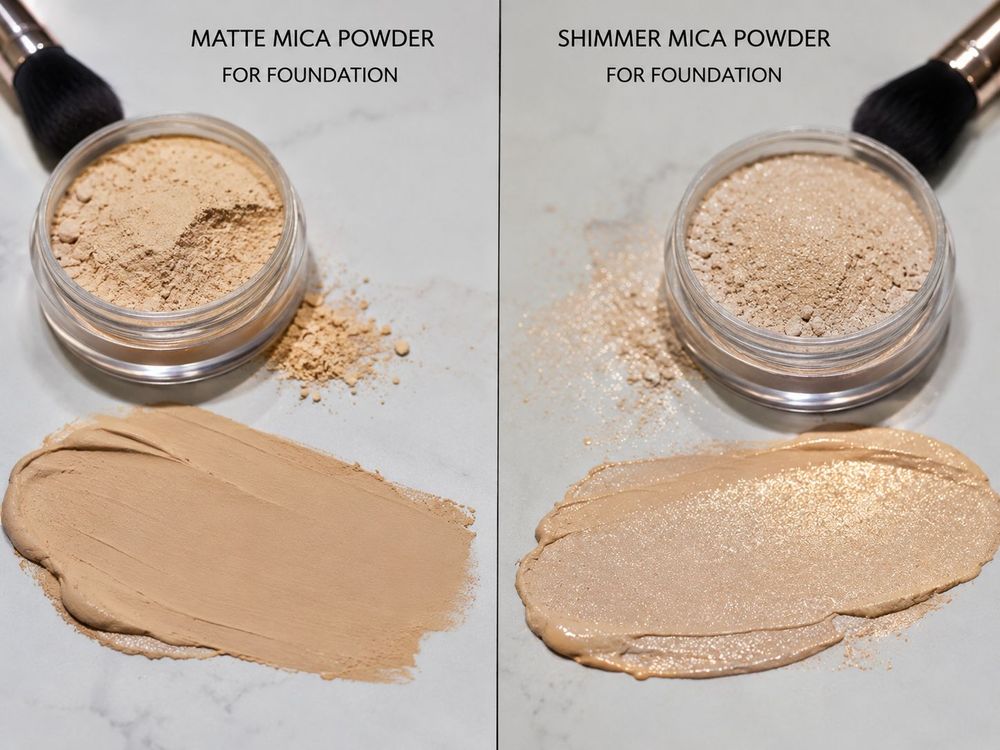
Standard pearlescent shimmer mica consists of thin mica platelets coated with titanium dioxide (rutile or anatase) or iron oxide. These coatings create interference and reflection effects — the thicker the TiO₂ layer, the higher the interference color shift. In foundation, this produces the luminous, light-reflecting finish associated with "dewy" or "radiance" formulations.
Matte mica — particularly sericite-based grades — works on an entirely different principle. Sericite is a fine-grained muscovite with naturally small, irregular platelets. Its platelet aspect ratio is lower than standard pearl mica, meaning it scatters light diffusely rather than reflecting it coherently. The result: soft focus, oil absorption, and a non-reflective skin finish. That optical diffusion is intrinsic to the material, not engineered through post-processing.
In practice, this means you can't substitute one for the other and expect similar skin feel, even at the same loading level.
Functional Role of Matte Mica Powder in Foundation
Matte mica powder in foundation serves multiple roles simultaneously — it's not simply a filler. The primary contributions are:
- Oil absorption control: Sericite and treated matte micas have a higher surface area per unit volume than coated pearls. This translates to better sebum absorption and longer-lasting matte appearance on skin.
- Texture improvement: Fine sericite platelets align on skin and reduce surface friction. The tactile result — often described as "silky" — comes from the lamellar structure creating a low-friction slip layer.
- Soft-focus effect: Diffuse light scattering minimizes the appearance of pores and fine lines without adding luminosity. This is distinct from shimmer, which fills in texture visually through reflection rather than scattering.
- Adhesion and spreadability: The platelet geometry improves film formation on skin. Matte mica acts as a structural backbone in powder and liquid foundation alike.
Surface-treated variants — dimethicone-treated or triethoxycaprylylsilane-treated sericite — add hydrophobicity, which improves water resistance, reduces clumping during manufacturing, and lowers oil absorption rate in controlled ways. Worth noting: the treatment chemistry affects not just performance but also compatibility with emulsifiers and dispersion behavior in emulsion-based foundations.
Shimmer Mica Powder: Optical Mechanics and Formulation Impact
Shimmer mica in foundation delivers its effect through constructive light interference. The perceived color and intensity depend on three variables: TiO₂ coating thickness, flake size, and the refractive index contrast between the coating and substrate.
Silver-white series (mica + rutile TiO₂) produce a clean, high-reflectance shimmer. Gold and interference series introduce color — gold tones from iron oxide coatings, interference colors from thin-film optics. For foundation specifically, gold and warm pearl shades are most commonly used to mimic a natural skin radiance. Borosilicate-based shimmer variants offer larger, smoother flakes and a more diamond-like, high-sparkle output — better suited for highlighting products than everyday foundation use.
Flake orientation in a foundation formula matters significantly. In a liquid foundation, shear forces during mixing and application can disrupt platelet alignment. Poorly aligned shimmer flakes scatter light inconsistently, reducing the intended glow effect and creating a patchy or glittery appearance rather than a smooth radiance. Dispersion protocol — shear rate, addition sequence, and emulsification method — directly affects the final optical result.
That said, shimmer mica at low loadings (typically 0.5–3%) in a foundation matrix can provide luminosity without visible sparkle — a "skin-like glow" rather than a disco effect. The threshold varies by flake size and coating type.
Comparison Table: Matte vs. Shimmer Mica in Foundation
| Parameter |
Matte Mica Powder (Sericite) |
Shimmer Mica Powder (Pearlescent) |
| Light interaction |
Diffuse scattering |
Specular reflection / interference |
| Finish type |
Matte, soft-focus |
Luminous, radiant, glowing |
| Oil absorption |
High (functional) |
Low to moderate |
| Skin feel |
Silky, smooth, friction-reducing |
Varies by flake size; can feel slippery |
| Typical loading in foundation |
5–25% |
0.5–5% |
| Surface treatment options |
Dimethicone, silane, lauroyl lysine |
Silane, silica overcoat, organic treatment |
| Primary substrate |
Natural sericite mica |
Natural mica or synthetic fluorphlogopite |
| Color contribution |
Neutral / white; color from iron oxides |
Pearl white, gold, interference colors |
| Dispersion sensitivity |
Moderate |
High — flake orientation critical |
| Best fit |
Full-coverage, oil-control, natural finish |
Luminizing, skin-perfecting, dewy finish |
Blending Both: The Hybrid Approach
Most high-performance foundations don't use one or the other exclusively. The more refined approach — and the one seen in prestige skin-finish foundations — combines matte sericite as the bulk filler with a low loading of fine-particle shimmer mica to create "natural luminosity" rather than either a flat matte or obvious glow.
The ratio matters. A common starting point is 10–20% sericite with 1–2% interference pearl (gold or silver-white). The sericite handles oil control and soft-focus texture; the pearl adds the subtle light catch that makes skin look alive rather than flat. Push the shimmer above 3–4% and you cross into visible sparkle territory — acceptable for luminizing foundations, problematic for everyday coverage products.
Surface treatment compatibility between the two components is worth checking at formulation stage. Hydrophilic sericite and silane-treated pearl can behave differently in emulsion systems — wetting, dispersion order, and processing temperature all affect how uniformly both integrate into the matrix.
Natural Mica vs. Synthetic Mica Substrate: Does It Matter for Foundation?
For shimmer applications, synthetic fluorphlogopite (synthetic mica) offers higher purity, more uniform flake geometry, and better whiteness than natural mica. In foundation, this translates to cleaner pearl tones and more predictable interference effects. Natural mica carries slight yellowish or brownish undertones depending on origin — which can be useful or problematic depending on target shade range.
For matte applications, sericite is typically natural mica by definition. There is no direct synthetic equivalent with identical soft-focus behavior. The fine, irregular platelet structure of natural sericite is what produces its characteristic diffuse scattering — processing methods to achieve similar results with synthetic substrates exist but are less common in standard cosmetic filler applications.
From a regulatory and sourcing standpoint, both natural and synthetic mica are compliant under major cosmetic regulations (EU Cosmetic Regulation, FDA, etc.), but supply chain transparency — particularly around natural mica sourcing — remains a procurement consideration for brands with ethical sourcing commitments.
Frequently Asked Questions
Can matte mica powder completely eliminate shine in a liquid foundation?
No. Matte mica — including sericite — controls shine through oil absorption and diffuse light scattering, but it doesn't create a zero-shine finish on its own. Shine level in a finished foundation also depends on the emollient system, film formers, and other fillers. Boron nitride and silica microspheres are often co-formulated with sericite to achieve more aggressive mattification.
Does shimmer mica in foundation look appropriate for daytime wear?
At low loadings and with fine-particle grades, yes. The key is keeping shimmer mica below the visible sparkle threshold and using interference or silver-white grades rather than large-flake borosilicate types. The goal in a daytime foundation is luminosity, not visible reflectance — which is a formulation calibration exercise, not an inherent material limitation.
What is the difference between sericite and standard mica powder in foundation?
Sericite is a specific fine-grained variety of muscovite mica with a smaller, less regular platelet structure. Standard cosmetic-grade mica used in pearlescent pigments has larger, more uniform flakes optimized for light reflection. Sericite's smaller aspect ratio gives it better soft-focus and oil-absorption performance — which is why it dominates matte cosmetic filler applications rather than shimmer ones.
Are surface-treated micas necessary for emulsion-based foundations?
In most cases, yes — particularly for shimmer mica. Untreated mica platelets in an emulsion system can aggregate, settle, or orient poorly, reducing optical performance and stability. Silane or dimethicone surface treatments improve wettability in both oil and water phases and prevent agglomeration. For matte sericite in pressed or loose powder foundations, untreated grades may be acceptable depending on the binder system.
For technical data sheets, surface treatment options, or formulation guidance on integrating matte or shimmer mica into your foundation system, contact the Kolortek technical team at contact@kolortek.com.

 English
 Français
 Deutsch
 Русский
 Español
 Português