Quick Answer
Chameleon pigments shift color at different viewing angles because of a phenomenon called multi-layer thin-film interference — the same optical principle behind a soap bubble's rainbow sheen, but precisely engineered at the nanoscale. Understanding how chameleon pigment works comes down to controlling the thickness and refractive index of alternating metal oxide layers coated onto a flat mica substrate, so that light reflected from each layer either amplifies or cancels out specific wavelengths depending on your angle of view. This complete chameleon pigment guide breaks down the science, the structure, the application rules, and what separates a high-performance color shift from a mediocre one.
Key Takeaways
- The color shift in chameleon pigments is produced by constructive and destructive interference of light across multiple thin-film layers — not by dyes, and not by photochromic chemistry.
- The substrate color is critical: the most dramatic goniochromatic effect is only visible on a black or very dark basecoat. On white substrates, the shift nearly disappears.
- Particle size controls the visual character of the effect — fine 5–25 μm particles produce a satin, subtle shift; coarse 75–175 μm particles produce bold, sparkly flashes of color.
- High-shear mixing fractures the platelet structure and permanently degrades the color shift — use low-shear dispersion methods at all stages of formulation.
- TiO₂-free chameleon pigment options (using Fe₂O₃ + Silica coatings) are now available for "clean label" cosmetic and EU-compliant formulations, reflecting a major shift in color shift pigment quality standards.
The Science Behind the Shift: Multi-Layer Thin-Film Interference
Most people encounter the color-shifting effect long before they ever encounter the pigment. Hold a compact disc to the light and tilt it — the surface blooms from gold to green to violet. Blow a soap bubble and watch it cycle through an entire rainbow before it pops. Both phenomena share the same root cause: thin-film interference. Chameleon pigments are what happens when that same physics is put under precise manufacturing control.
At the heart of every chameleon platelet is a transparent mica substrate — in Kolortek's KT-9000 Magic Chameleon Series, this is natural mica — coated with alternating layers of high and low refractive index materials. The typical layer stack looks like this: Substrate → High-RI layer (e.g., TiO₂) → Low-RI spacer (e.g., Silica) → High-RI layer (e.g., Fe₂O₃) → repeat. Each interface between a high-RI and a low-RI layer acts as a partial mirror.
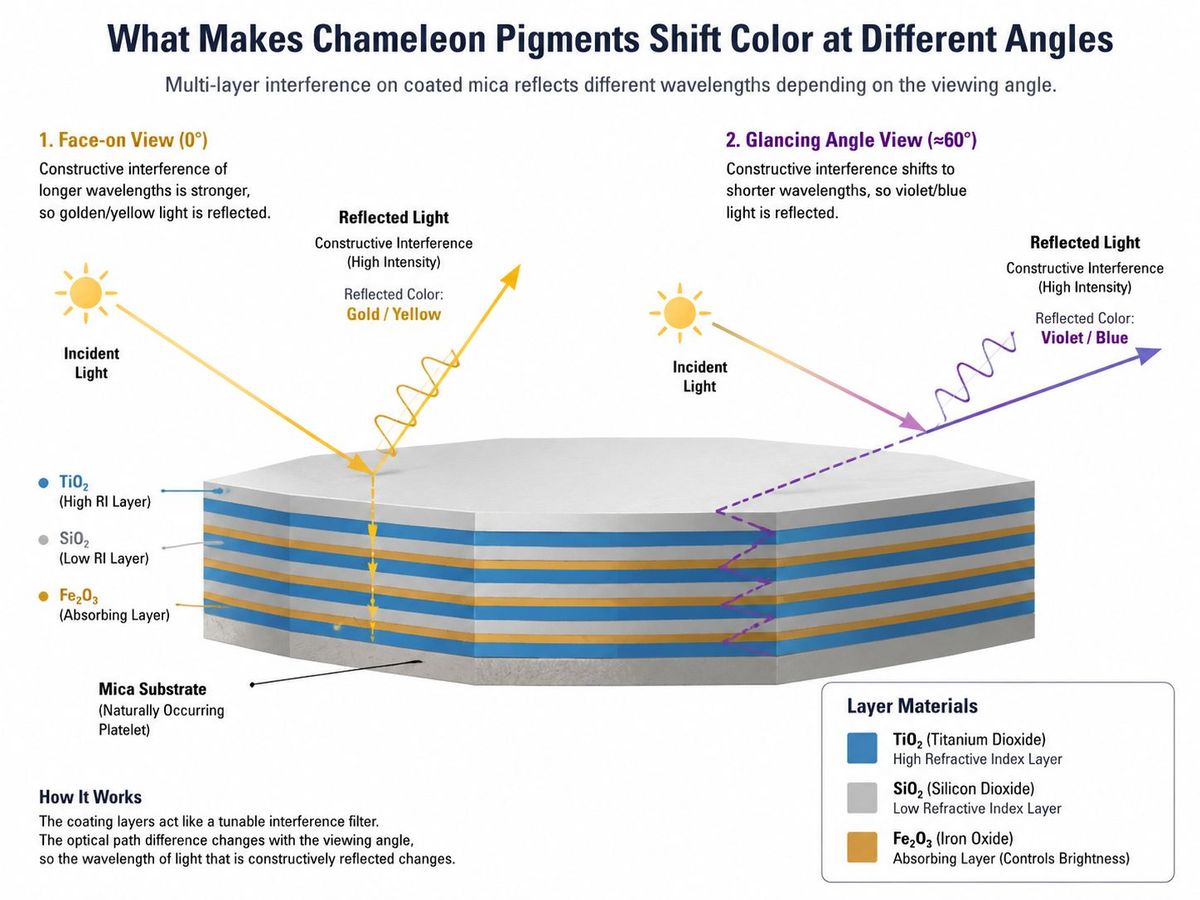
When white light hits the pigment, some reflects off the top surface of the first layer, and the rest transmits through to reflect off the next layer beneath. When those two reflected wavefronts recombine, they either amplify each other (constructive interference, producing a strong visible color) or cancel each other (destructive interference, suppressing that wavelength). The wavelength that gets amplified is determined by the optical path difference between the wavefronts — which is a function of the layer thickness and the angle of incoming light.
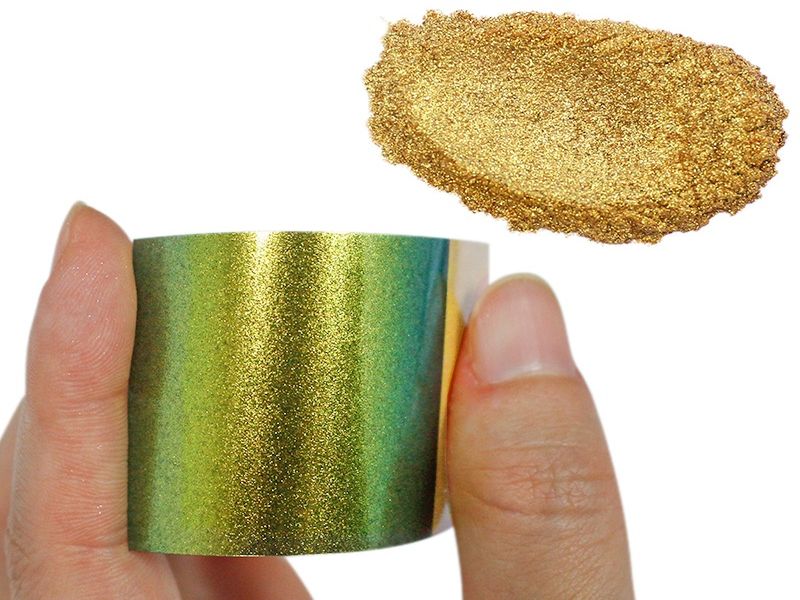
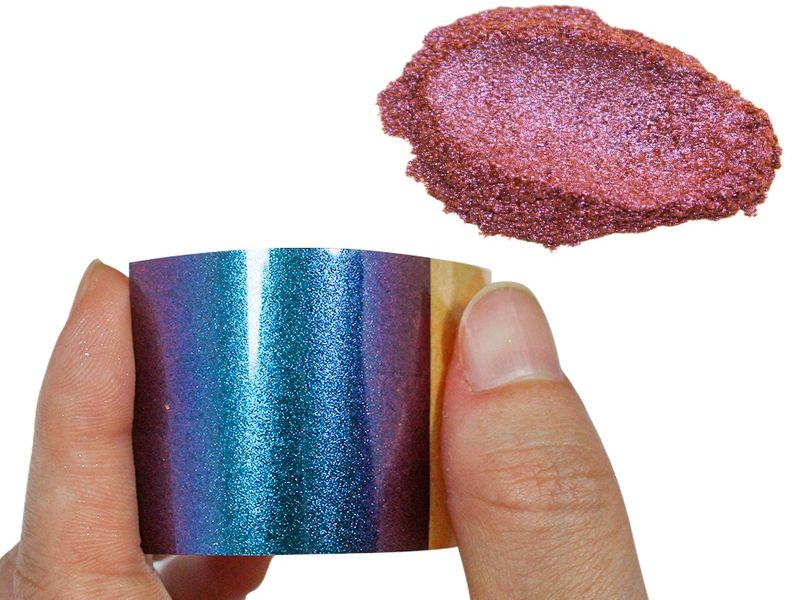
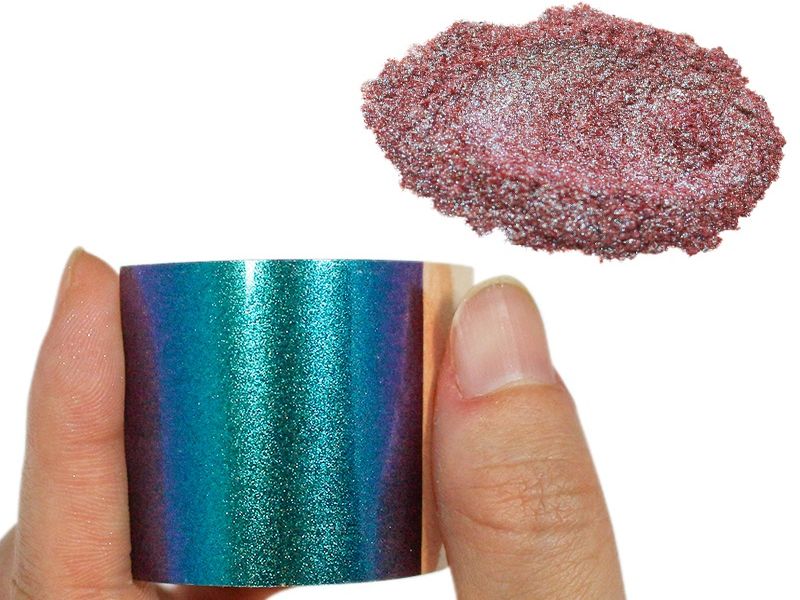
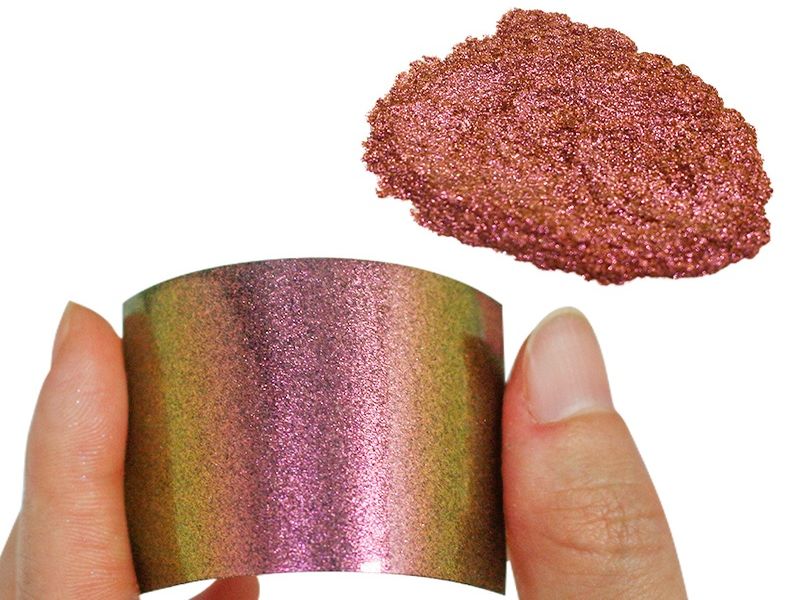
As your viewing angle changes, that optical path length changes, shifting the peak wavelength of constructive interference across the visible spectrum. A pigment that reflects warm gold at face-on suddenly blooms into a cool violet at a 45° glancing angle. This is the goniochromatic effect — and it is entirely structural, requiring no energy input, no temperature change, no UV activation. The color is built into the geometry of the coating itself.
Why the Layer Composition Matters: TiO₂, Fe₂O₃, and Silica
The specific metal oxides chosen for each layer are not interchangeable. TiO₂ (titanium dioxide) has a refractive index of approximately 2.4–2.7 depending on crystal phase, making it one of the most effective high-RI layers available. Fe₂O₃ (iron oxide) adds warm, amber-gold tones to the base reflectance and pushes the shift range toward the red-orange-gold end of the spectrum. Silica (SiO₂), with a low RI of approximately 1.45, functions as the spacer layer that controls the optical path difference. By adjusting the physical thickness of the Silica spacer layer by even a few nanometers, our coating process can tune the peak reflected color precisely — adding 20nm to the spacer can move the shift from a cyan-to-violet range to a green-to-red range.
This is why chameleon pigments are fundamentally different from standard pearlescent pigments, which use a single TiO₂ layer to produce a static iridescent sheen. The multi-layer architecture is what creates the discrete jump between two or more distinct colors — the signature characteristic that sets chameleon pigments apart from color-travel or chromashift products, which produce a smoother, more continuous hue transition.
Duochrome vs. Multicolor: Two Types of Chameleon Effect
Not all chameleon pigments shift across the same range or produce the same number of distinct colors. Understanding this distinction is essential for any formulator or brand developer choosing a product for a specific application.
Duochrome (Clear Chameleon) pigments use a two-to-three layer stack tuned to produce a dramatic jump between exactly two dominant colors — for example, a clear cyan-blue-purple-red shift. These are the most widely used chameleon pigments in cosmetics and coatings because the contrast is bold, the effect is predictable, and the formulation behavior is straightforward. The "Clear" designation in the product name refers to the fact that the base tone is largely transparent rather than opaque, allowing the substrate color to contribute to the final appearance.
Multicolor (Triple+ Shift) pigments — such as Kolortek's 97000 and 98000 series — use a more complex multi-layer interference stack that produces three or more distinct color bands as the viewing angle sweeps from face-on to glancing. A single pigment might show golden green at 0°, red at 30°, and a cool blue-violet at 60°. These products require significantly tighter manufacturing tolerances, as each additional interference layer compounds the difficulty of keeping all color bands clean and distinct. The payoff is extraordinary visual drama, which is why they command premium positioning in automotive custom finishes and high-end luxury packaging.
How Particle Size Shapes the Character of the Color Shift
Here is a common misconception worth addressing directly: particle size does not change which colors a chameleon pigment shifts between — that is determined entirely by the coating structure. What particle size controls is the visual texture and intensity of the effect. Think of it this way: a large platelet reflects light like a tiny mirror, producing a bold point-source flash. A fine platelet diffuses light more broadly, producing a smooth, satin-like color coverage with less sparkle but greater uniformity.
| Particle Size (μm) |
Visual Character |
Texture / Feel |
Typical Application |
KT-9000 Example |
| 5–25 μm |
Satin, fine, high color coverage |
Silky smooth, imperceptible grain |
High-end cosmetic foundations, inks, fine printing |
KT-92102 |
| 10–60 μm |
Standard pearl, vivid color shift, most popular |
Smooth with slight grain |
General coatings, cosmetics, nail polish |
KT-92106 |
| 20–100 μm |
Flash/sparkle, high visual impact |
Noticeable texture, visible sparkle |
Automotive custom finishes, nail art |
KT-92115 |
| 75–175+ μm |
Maximum sparkle, individual glitter flakes visible |
Coarse, highly decorative |
Specialty packaging, crafts, maximum-impact nail art |
KT-92175 |
For most coating and cosmetic formulations, the 10–60 μm range (KT-92106) is the workhorse choice: vivid enough to showcase the full color shift without creating a texture problem in the final film. When formulators ask us for a starting point, that is where we always begin.
Expert Insight from Kolortek: What We've Learned in the Lab and Field
In over 20 years of producing effect pigments, the single most common formulation error we see with chameleon pigments has nothing to do with the pigment itself — it is the substrate. A brand developer will spend months perfecting a chameleon nail polish, only to apply it over a pale or neutral base and wonder why the shift looks washed out. The answer is physics: the transparency of chameleon pigments means the substrate contributes significantly to the perceived final color. On a white base, scattered white light overwhelms the interference signal, collapsing the shift to a near-invisible shimmer. On a jet-black base, that same pigment delivers the full dramatic arc of its color shift because there is no competing background light.
Our standard recommendation for automotive applications: always apply over a dedicated black basecoat, then build the chameleon layer in 2–3 thin passes rather than one heavy coat, and finish with a UV-resistant clear topcoat. The clear coat does two things — it protects the delicate multi-layer platelet structure from mechanical and UV damage, and it dramatically increases the perceived depth and brilliance of the color shift by adding a smooth refractive interface above the pigment layer.
On the processing side, we cannot overstate this rule: never use high-shear mixing equipment — no high-speed dispersers, no three-roll mills — with chameleon pigments. The platelet geometry is the entire source of the effect. Once you fracture it, no amount of formulation adjustment will recover the lost color travel. We recommend adding chameleon pigment as the final step in any mixing sequence, using a low-shear paddle or hand stir, and limiting mix time to what is strictly necessary for homogeneity.
One trend we are watching closely — and actively responding to with our KT-951 TiO₂-free series — is the growing demand for chameleon pigments that eliminate TiO₂ from the coating stack entirely, using Fe₂O₃ and Silica layers instead. This is partly regulatory (ECHA's evolving classification discussions around TiO₂ in spray applications) and partly consumer-driven ("clean beauty" positioning in prestige cosmetics). The TiO₂-free route does narrow the achievable shift range slightly, but for the warm gold-to-red and bronze-to-copper shift families, it delivers outstanding results with a much cleaner ingredient declaration.
Cosmetic Chameleon Pigments: Regulatory Compliance Across Markets
For formulators developing cosmetic chameleon pigment applications across multiple markets, regulatory alignment is not optional — it is the first filter applied before any other performance criteria. The good news is that the core inorganic colorants used in chameleon pigments (mica, TiO₂, iron oxides, silica) have broad acceptance across all major markets.
- EU (EC 1223/2009): Inorganic-only formulations — particularly the TiO₂-free KT-951 series — carry the cleanest path through EU Annex IV compliance and align well with "free-from" marketing claims increasingly demanded by European prestige brands.
- US FDA: Inorganic pigments (iron oxides, mica, TiO₂) are exempt from batch certification requirements, making them operationally simpler to use than organic dye lakes, which require individual lot certification.
- Japan (MHLW): Mica, iron oxides, and titanium dioxide all appear on the Japanese positive list for cosmetic colorants, confirming straightforward approval pathways for KT-9000 series products.
- China (CSAR/IECIC): Synthetic Fluorphlogopite (synthetic mica) and standard inorganic oxides are listed under IECIC, providing a faster-to-market route for chameleon pigments in the rapidly growing China cosmetics market.
A practical note from our regulatory team: always verify the specific product's full ingredient declaration against the target market's positive list or approved colorant annex before finalizing a formula. Coating combinations that are individually permitted can occasionally raise questions at the formulation level when combined — our technical team provides full compliance documentation for all KT-9000 series products on request.
Key Applications: Where Chameleon Pigments Deliver the Greatest Impact
Automotive Custom Finishes and Wraps
Automotive remains the single largest application segment for chameleon pigments. The combination of a deep black basecoat, professionally applied spray application (which inherently avoids high shear), and a durable clear topcoat creates ideal conditions for the goniochromatic effect. A vehicle finished with a multicolor chameleon system from our 97000 or 98000 series will display visually distinct color shifts as it moves through different lighting environments — a marketing asset that has proven extremely effective in the premium and custom vehicle segment.
High-End Cosmetics and Nail Art
In cosmetics, chameleon pigments are most impactful in nail polish, eyeshadow toppers, and highlighter formulations — anywhere that a dark background can be created (the nail plate, the eyelid crease, a bronzed base) to amplify the shift. Fine particle grades (5–25 μm) are preferred for skin applications where texture smoothness is paramount; coarser grades (20–100 μm) are standard in nail art where sparkle intensity is a selling point.
Security and Anti-Counterfeiting
The color shift itself functions as a built-in authentication feature. Documents, packaging, and labels incorporating chameleon pigments cannot be photocopied or scanned faithfully — the angle-dependent optical behavior is lost the moment the image is flattened to a 2D reproduction. This makes chameleon pigments a valued tool in security printing applications where visual verification at point-of-use is required.
Frequently Asked Questions
How does a chameleon pigment produce different colors at different angles?
The effect comes from multi-layer thin-film interference. Light reflects from multiple coating layers inside the pigment platelet, and the two reflected wavefronts interfere with each other. As your viewing angle changes, the optical path length between those wavefronts changes, shifting which wavelength gets constructively amplified — and therefore which color you see. No dyes or energy input are involved; the color is entirely structural.
Why does my chameleon pigment barely shift color in my formulation?
The most common cause is applying over a light or white substrate. Chameleon pigments are transparent by design, so a pale background floods the reflected interference signal with scattered white light and kills the visual contrast of the shift. Apply over a black or very dark basecoat and you will see the full effect immediately. Secondary causes include over-processing with high-shear equipment, which fractures the platelet structure.
What is the difference between a chameleon pigment and a color-shift or chromashift pigment?
Chromashift and color-travel pigments produce a smooth, continuous hue transition across related colors as the viewing angle changes — think of a gradual sweep from blue to green. Chameleon pigments produce a more dramatic, discrete color jump — a sudden switch from gold to red to violet — because their multi-layer coating architecture creates multiple distinct interference bands rather than a single sliding peak. Chameleon pigments are considered the higher-impact, more premium category.
Can chameleon pigments be used in EU cosmetics without TiO₂?
Yes. Kolortek's KT-951 series uses an Fe₂O₃ + Silica coating system that produces a warm gold-to-copper-to-red color shift range without any TiO₂ in the coating stack. These products are designed specifically for "clean label" and "free-from TiO₂" cosmetic formulations and align with the EU Cosmetics Regulation's Annex IV framework. Full compliance documentation is available on request.
How do I choose the right particle size for a cosmetic chameleon pigment application?
For skin-contact applications where texture smoothness is critical — foundations, blushes, eyeshadows — select the 5–25 μm grade (e.g., KT-92102) for a satin, imperceptible-grain finish. For nail polish or eyeshadow toppers where sparkle intensity is a selling point, the 10–60 μm (KT-92106) or 20–100 μm (KT-92115) grades provide progressively more flash. For maximum decorative impact in nail art or craft applications, the 75–175+ μm coarse grade delivers bold individual-flake visibility.
What is the best way to mix chameleon pigments into a coating or cosmetic base without damaging the effect?
Always add chameleon pigment as the final ingredient in your mixing sequence, after all other components have been combined. Use only low-shear mixing — a paddle mixer, spatula, or hand stir at low RPM. Avoid high-speed dispersers, ball mills, three-roll mills, or any equipment that generates significant shear force. High shear fractures the mica platelet, and once the platelet is broken, the multi-layer interference geometry is permanently destroyed and the color shift cannot be recovered.
Chameleon pigments shift color because light is an optical tool, and the multi-layer coating on a mica platelet is a precisely engineered instrument for bending it. Get the substrate right, handle the platelet gently, choose the correct particle size for your application, and verify your coating system against your target market's regulatory requirements — do those four things and you will get a color shift performance that no dye or standard pigment can approach. As substrate technology continues to evolve toward synthetic mica and TiO₂-free architectures, the performance ceiling for this technology is still rising. We are still finding new territory to explore in our lab after two decades — and that, more than anything else, is what makes chameleon pigments one of the most technically compelling materials in the effect pigment category.
Interested in exploring the full KT-9000 Magic Chameleon Series or requesting samples for your next formulation project? Visit our chameleon pigments catalog for the complete range of shift colors, particle sizes, and compliance documentation.

 English
 Français
 Deutsch
 Русский
 Español
 Português