Selecting the right metallic epoxy pigment for floor coatings comes down to more than color — it's about how that pigment holds orientation under pour, resists UV yellowing, and sustains its gold, silver, or chameleon shimmer through traffic and chemical exposure. Metallic pigme nt powder for epoxy systems behaves differently from standard paint applications: the fluid dynamics of an epoxy pour, cure temperature, and resin viscosity all affect flake alignment and final visual depth. This article examines how different pigment types perform in real floor coating scenarios — where aesthetics and durability must coexist.
Why Floor Applications Push Pigments Harder Than Most
Epoxy floor coatings are a demanding application category. The substrate is horizontal, which changes everything about how metallic flakes behave during cure. Unlike a vertical spray application where gravity assists flake orientation parallel to the surface, a floor pour gives pigment particles time to migrate, rotate, and settle — sometimes unevenly.
The visual result you get in a floor depends heavily on three variables: pigment morphology (flake size and aspect ratio), the viscosity profile of the resin system as it cures, and how the pigment is introduced. Get these wrong and you end up with a cloudy finish, uneven metallic luster, or worse — surface defects that can't be corrected without regrinding.
Then there's the durability side. Floors face abrasion, point-load impact, cleaning chemicals, and UV exposure depending on the environment. A pigment that looks exceptional on day one but oxidizes, fades, or causes adhesion issues within 18 months is not a viable product — regardless of how it photographs.
Understanding this is the starting point for any serious evaluation of metallic pigments in floor coating formulations.
Pigment Types Used in Epoxy Floor Systems
Not all metallic-effect pigments are structurally the same, and the differences matter in epoxy floors. The main categories you'll encounter — and that are actually used in production floor coating systems — break down as follows:
1. Mica-Based Pearlescent Powders
These are the workhorses of decorative epoxy floors. Mica flakes coated with titanium dioxide (anatase or rutile) give you a pearlescent shimmer that ranges from subtle silver-white to deep bronze and gold depending on coating thickness. The flake's platelet structure is what creates the interference effect — and that structure also makes them relatively easy to orient flat in a liquid epoxy system.
Rutile-coated grades (like the KT-103 Rutile Silver) offer better UV stability than anatase variants — a practical consideration in commercial floors with skylight or exterior light exposure. For indoor residential use, anatase grades perform acceptably and cost less.
Synthetic mica (fluorphlogopite) grades take this further. They are inherently purer, with lower heavy metal content and a higher refractive index substrate. In practice, this means stronger luster, better chemical resistance, and compliance with stricter regulatory requirements. For countertop and floor applications where food safety or indoor air quality matters, synthetic mica grades are the more defensible choice.
The KT-500 series and its synthetic mica counterpart (KT-7500) fall into this category. These are iron oxide-coated mica flakes treated to behave as metallic pigments — with warm bronze, copper, and wine-red tones that carry a genuine metallic warmth rather than a pearlescent softness.
They carry stronger concealing properties than standard pearls, which affects transparency. In a fluid metallic floor where you want visible depth and layering, that opacity can be a design constraint. In applications where you want a more solid metallic coverage — or where you're blending over a tinted primer — it's an advantage.
These grades are also chemically and physically stable, which makes them well-suited to environments with intermittent solvent exposure or industrial cleaning.
3. Gold Bronze (Copper-Zinc Alloy) Powders
True metallic pigments — actual copper-zinc alloys — deliver a gold luster that mica-based alternatives approach but don't fully replicate. The warm, high-chroma gold of a 200–400 mesh bronze powder in an epoxy floor is visually distinct.
That said, these pigments come with real trade-offs. Copper-zinc alloys are reactive. In high-pH or alkaline environments — which some epoxy hardener systems can create locally during cure — you risk surface oxidation that dulls the metallic finish. Leafing grades are particularly susceptible to this if not properly stabilized.
For floor applications, non-leafing gold bronze powders are generally preferable. They disperse through the coating body rather than floating to the surface, which reduces the risk of a fragile metallic skin that can abrade off. Finer mesh grades (800–1500 mesh) also tend to perform better in clear epoxy systems where coarser particles can cause surface texture issues.
4. Metallic Luster Pastes (Solvent-Based)
Pre-dispersed paste formats solve a practical problem: dry metallic powders can be difficult to wet out consistently in epoxy Part A without creating agglomerates. Solvent-based metallic pastes are already dispersed in a compatible carrier, which simplifies the let-down process and reduces batch-to-batch variation.
The caveat is solvent content. In solvent-sensitive epoxy systems — particularly low-VOC or 100% solids formulations — the solvent load introduced by a paste needs to be accounted for. In some cases, it creates compatibility or cure issues if the addition rate is too high. Formulators need to check compatibility at realistic use levels, not just at low-percentage test additions.
When it works, the result is consistent: smooth metallic luster, good flake orientation, and repeatable color across batches.
5. Effect Pigments: Chromashift, Chameleon, and Holographic
These categories are increasingly requested in high-end decorative floor projects. A chameleon or chromashift floor shifts color as you move across it — typically from one dominant hue to another at oblique angles. Holographic pigments produce rainbow diffraction that moves across the surface under directional light.
They're visually dramatic. They're also the most sensitive to application technique. Flake orientation has to be near-perfect to maximize the color travel. In a self-leveling epoxy applied correctly, you can achieve this. In a roller-applied or brush-touched system, you often get inconsistent effect zones.
For floor applications, these pigments work best as a broadcast-style addition (dusted onto a wet epoxy base coat) or as an accent component within a metallic base, rather than a bulk addition to a single-component pour.
Comparative Overview: Metallic Pigment Types for Epoxy Floors
| Pigment Type |
Visual Effect |
UV Stability |
Chemical Resistance |
Application Sensitivity |
Key Limitation |
| Mica / TiO₂ Pearl (Anatase) |
Silver-white shimmer, soft luster |
Moderate |
Good |
Low |
UV yellowing risk long-term |
| Mica / TiO₂ Pearl (Rutile) |
Brighter silver, deeper luster |
High |
Good |
Low |
Higher cost vs anatase |
| Synthetic Mica Pearl |
High-chroma, bright white / gold / colors |
Very High |
Excellent |
Low |
Premium price point |
| Metal Luster (Fe₂O₃ / Mica) |
Warm bronze, copper, wine-red metallic |
High |
Very Good |
Low–Moderate |
Opacity limits visual depth effects |
| Gold Bronze (Cu-Zn Alloy) |
Strong gold, high chroma metallic |
Moderate |
Moderate (pH sensitive) |
Moderate |
Oxidation risk in alkaline systems |
| Metallic Luster Paste (Solvent) |
Consistent metallic luster, wide color range |
Good |
Good |
Low (pre-dispersed) |
Solvent load in 100% solids systems |
| Chromashift / Chameleon |
Angle-dependent color travel, metallic shimmer |
High |
Good |
High |
Effect requires precise flake orientation |
| Holographic |
Rainbow diffraction over silver metallic base |
Moderate |
Moderate |
Very High |
Best as broadcast, not bulk addition |
Dispersion and Flake Orientation in Epoxy Systems
Dispersion is where many metallic epoxy floor projects go wrong. The goal is complete wetting of individual flakes without mechanical damage to their platelet structure. Damage the flakes — through overly aggressive high-shear mixing — and you lose aspect ratio, which directly reduces luster intensity and interference effect.
For dry powders, the standard approach is to pre-mix the pigment with a small quantity of epoxy Part A using low-shear agitation before adding to the full batch. This allows the resin to wet each flake surface before bulk dilution. Adding powder directly to a full resin batch risks clumping, especially with finer grades where electrostatic behavior causes agglomeration.
In practice, the window between "well dispersed" and "over-sheared" is narrower than most assume. Thirty seconds of excessive mixing can visibly reduce the metallic depth of a floor compared to an identical batch mixed correctly. This is worth communicating clearly to applicators who may default to aggressive mixing habits from standard pigmented epoxy experience.
Once applied, flake orientation in a self-leveling system is largely passive — the flakes settle parallel to the substrate as the resin flows out. Coarser flake sizes (50–150 µm range) orient more reliably than very fine grades, which can remain suspended in variable orientations through the cure cycle. This is one reason why large-flake pearlescent grades often give a more dramatic metallic floor effect than fine grades at equivalent loading rates.
Worth noting: ambient temperature during application affects this directly. Warmer conditions reduce viscosity faster, which can cause larger flakes to sink and cluster. Cooler application conditions — within the resin's working window — generally give better flake distribution.
Selecting Metallic Powder for Epoxy Resin: Particle Size and Loading Rate
Particle size selection for metallic powder for epoxy resin floor applications involves a genuine trade-off between visual impact and surface smoothness.
Larger flakes (100–500 µm) create the dramatic sparkling depth effect typical of high-end decorative floors. You see distinct glitter points and strong angle-dependent light reflection. The downside is surface texture: large flakes that partially protrude at the surface create micro-irregularities that affect cleanability and can trap contamination in food service or healthcare environments.
Finer grades (15–60 µm) produce a smoother, more uniform metallic sheen — closer to a polished metallic surface than a sparkling one. They're more appropriate where hygiene or surface smoothness is a functional requirement. The visual effect is less dramatic but more consistent across viewing angles.
In most commercial decorative floor projects, a blend approach works best: a base load of finer pearl grades (establishing the background metallic luster) with a smaller proportion of coarser flakes or effect pigments broadcast onto the wet surface for sparkle. This gives design flexibility without the cleanability compromise of an all-coarse-grade system.
Loading rates for mica-based pearl pigments in clear epoxy typically run between 3–8% by weight. Below 3%, the metallic effect tends to look diluted. Above 10%, you risk hiding the depth and transparency that makes metallic epoxy floors visually interesting — it starts to look more like a pigmented coating than a metallic one. Gold bronze metallic powders are usually used at lower rates (1–3%) given their higher opacity and coverage strength.
UV Stability and Long-Term Performance
This is where pigment selection intersects most directly with system design. Mica-based pearlescent pigments are inherently UV-stable — the inorganic coating layers don't degrade under UV in the way organic colorants do. The resin matrix is usually the weak link, not the pigment.
Standard bisphenol-A epoxy resins yellow under UV. In a clear metallic system, this yellowing shifts the apparent color of the entire floor — silver pearls take on a warm yellow cast, blue pearls shift greener, and white base tones lose clarity. For interior floors without significant UV exposure, this may be acceptable. For retail environments, showrooms, or any space with glass facades and natural light, it's not.
The standard solution is a UV-stable polyurethane or polyaspartic topcoat over the metallic epoxy layer. This protects the resin matrix and extends aesthetic durability significantly. The pigment itself doesn't need to be changed for UV resistance — but the topcoat system does need to be selected with UV stability in mind.
Gold bronze (copper-zinc) pigments introduce a separate concern: metal oxidation. In environments where the topcoat is damaged and moisture reaches the metallic layer, copper-based pigments can show localized patina or darkening. For high-traffic commercial floors where topcoat integrity may be compromised over time, synthetic or mica-based metallic alternatives carry lower maintenance risk.
Epoxy Resin Metallic Pigment: Application Method Considerations
The application method used with epoxy resin metallic pigment determines as much about the final appearance as the pigment itself. There are three practical approaches used in floor work:
Full-incorporation pour: Pigment mixed into Part A before combining with hardener, then poured and spread across the substrate. Best for uniform metallic color across the floor. The risk is consistency — if the pigment isn't fully wetted before pour, you get streaks or concentration differences between areas poured from the bucket edge versus center.
Broadcast over wet base: A clear or lightly pigmented base coat is applied first, then dry metallic powder is broadcast over the wet surface. The powder sinks into the resin and is then sealed with a topcoat. This technique gives maximum control over visual density — you can vary the broadcast rate to create gradient or mottled effects. It's the most common technique for chameleon and holographic pigments in floor work.
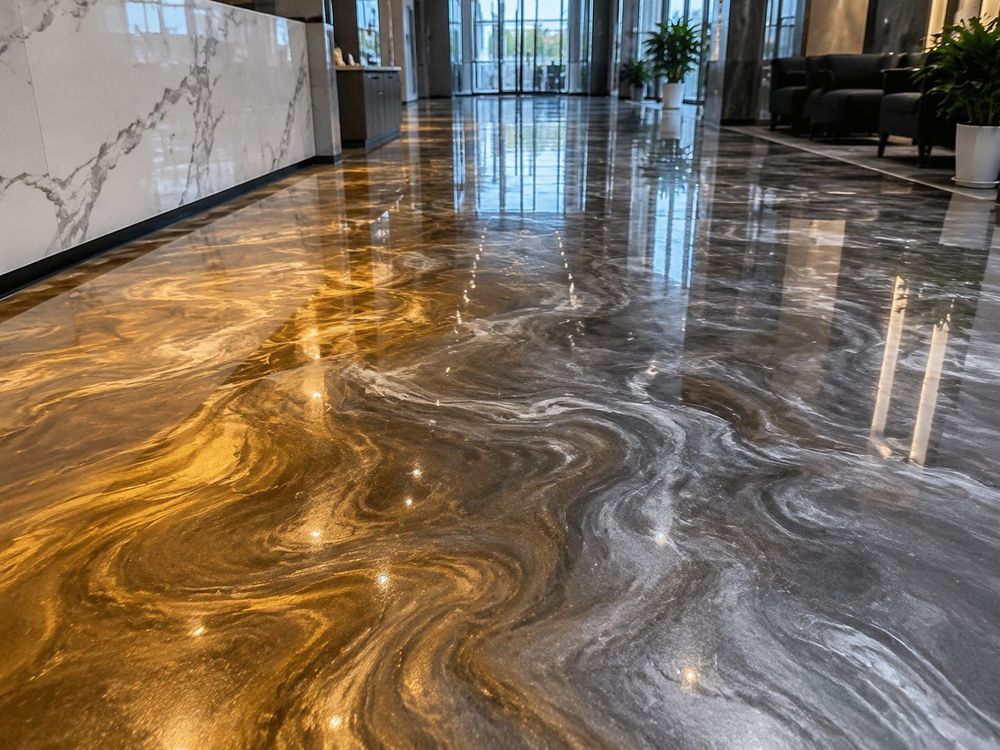
Marbling / swirl technique: Pigmented epoxy streams of different colors are poured and manipulated with tools to create marbled patterns. Metallic pastes work well here because their pre-dispersed consistency allows precise addition without powder clumping in a fluid pour.
Each method has a different failure mode. Know which you're designing for before committing to a pigment format.
FAQ
Can I use cosmetic-grade pearlescent powder in epoxy floor coatings?
Technically yes, but it's not always advisable. Cosmetic-grade pearls are typically fine-ground and treated for skin compatibility — not for substrate wetting in an epoxy matrix. They may not disperse cleanly in high-viscosity resin systems, and their surface treatments may not be optimized for chemical resistance. Pigments formulated specifically for coating or industrial use will generally outperform cosmetic grades in epoxy floor applications.
Why does my metallic floor look good when wet but dull after cure?
This is usually a flake orientation issue. During cure, if the viscosity rises too fast (from heat, incorrect hardener ratio, or low ambient temperature slowing leveling), flakes can lock in sub-optimal orientations before they settle flat. It can also result from over-mixing after adding pigment, which breaks up flake aggregates into random orientations. Review mixing protocol and application temperature. In some cases, finer-grade pigments are less prone to this than coarser grades in fast-setting systems.
Do metallic pigments affect the mechanical properties of the cured epoxy floor?
At standard loading rates (3–8% by weight), the effect on mechanical properties is minor. Very high pigment loads can act as a filler and slightly reduce elongation at break, but for decorative floor applications this is generally not a practical concern. The more relevant variable is whether pigment addition displaces air during cure — with very coarse flakes or high loading, micro-void formation around particles can create adhesion issues under impact. Keep addition rates within the formulator's recommended range.
What's the difference between pearlescent and metallic pigment in terms of floor appearance?
Pearlescent pigments produce a softer, multi-angle luminescence — the color appears to come from within the coating. Metallic pigments (particularly aluminum or bronze types) produce a flatter, more mirror-like reflection that is strongly angle-dependent. In practice, most "metallic epoxy floors" you see in commercial spaces use mica-based pearls, not true aluminum metallics — the depth and transparency of pearl pigments generally gives a more visually complex result in a clear epoxy matrix.
For technical specifications, compatibility data, or sample requests for specific pigment grades for your floor coating formulation, reach out directly: contact@kolortek.com

 English
 Français
 Deutsch
 Русский
 Español
 Português