Cosmetic grade pearlescent pigments are widely used by makeup manufacturers to create shimmer, soft-focus radiance, metallic reflection, and multidimensional color effects. From pressed eyeshadows and loose powders to highlighters, blushes, lip products, and nail cosmetics, the right pearlescent pigment can change how a finished product looks under different lighting conditions.
However, choosing a cosmetic pearl pigment involves more than matching a color sample. Manufacturers also need to consider substrate material, particle size, colorant composition, formulation compatibility, and the regulatory requirements of the target market. A pigment that works well in an eyeshadow may not automatically be suitable for a lip product or another cosmetic application.
This guide explains how cosmetic grade pearlescent pigments work, how to compare different pigment types, and what makeup manufacturers should check before purchasing. It also introduces Kolortek's cosmetic pearl pigment range and practical selection considerations for product development.
What Are Cosmetic Grade Pearlescent Pigments?
Cosmetic grade pearlescent pigments are effect pigments developed for use in decorative cosmetics and selected personal care formulations. Unlike conventional matte pigments, which mainly provide opaque color, pearlescent pigments create visual effects through the reflection, refraction, and interference of light.
Many pearlescent pigments are made from thin platelet substrates coated with metal oxides such as titanium dioxide. When light reaches the coated particles, part of it is reflected from different interfaces within the coating structure. This produces a pearl-like luster, color interference, or sparkling appearance depending on the substrate, coating thickness, and particle size.
For makeup manufacturers, the main advantage is the ability to add dimension without relying only on stronger color concentration. A soft silver pearl can brighten an eyeshadow, a gold pearl can create warmth in a bronzer, and a colored interference pigment can add a subtle color shift to a highlighter.
Kolortek's Cosmetic Multicolor Pearl Pigments cover multiple substrate and colorant systems, including natural mica, synthetic mica, and calcium aluminum borosilicate. This gives formulators options for different visual effects and product requirements.
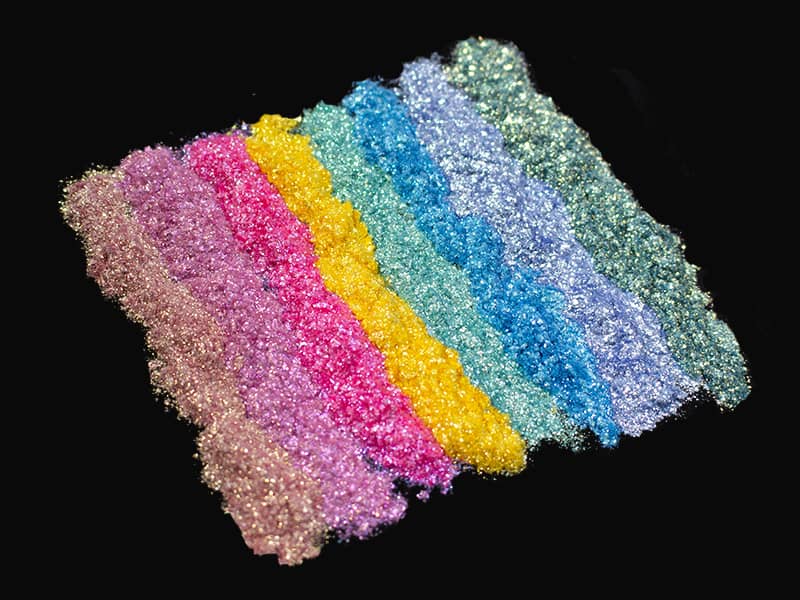
Colored pearlescent pigment powders for decorative cosmetic applications.
How Cosmetic Pearlescent Pigments Create Shimmer and Color
The appearance of a pearlescent pigment is determined by its physical structure and optical behavior. In a typical mica-based pearl pigment, a transparent platelet substrate is coated with one or more layers of metal oxide. The coating changes how light is reflected from the particle surface.
Several factors influence the final appearance:
- Substrate: Natural mica, synthetic mica, and borosilicate provide different levels of purity, optical clarity, and reflection.
- Coating structure: Titanium dioxide and other metal oxides influence the interference color and brightness.
- Colorant system: Inorganic oxides, organic pigments, or approved dyes contribute additional color effects.
- Particle size: Fine particles generally create a softer sheen, while larger platelets produce more visible sparkle.
- Formulation and application: The base formula, pigment concentration, dispersion, and application method affect the finished appearance.
This is why two pigments with a similar color name can look quite different when applied to skin. One may produce a smooth satin finish, while another creates a more noticeable sparkle or a stronger color shift at an angle.
Natural Mica, Synthetic Mica, and Borosilicate: Which Substrate Should You Choose?
Substrate selection is one of the first decisions makeup manufacturers should make. It affects not only the visual effect but also the appearance consistency, formulation target, and product positioning.
| Substrate |
Typical Characteristics |
Common Selection Reason |
| Natural mica |
Classic pearl reflection and a broad range of grades |
Versatile cosmetic color development and cost-conscious formulations |
| Synthetic mica |
Higher substrate purity and fewer natural mineral inclusions |
Premium color cosmetics requiring a cleaner, more uniform appearance |
| Calcium aluminum borosilicate |
High optical clarity and pronounced, glass-like sparkle |
Diamond-effect eyeshadows, highlighters, and statement shimmer products |
Natural mica is a practical starting point for many conventional pearl effects. It offers a familiar reflective appearance and can be used across a wide range of cosmetic color applications. As a natural mineral, however, it may contain minor inclusions, so manufacturers should evaluate the appearance and consistency of the specific grade.
Synthetic mica, also known as synthetic fluorphlogopite, is manufactured under controlled conditions. It is often selected when a formulation requires higher substrate purity, fewer dark inclusions, and a cleaner pearl appearance. It can be particularly useful in premium eyeshadow and face powder development.
Borosilicate pigments create a different visual effect. Their higher optical clarity and refractive properties can produce more defined, diamond-like sparkle compared with conventional mica-based pearls. For example, Kolortek's KT-68840221 Pink Diamond Effect Pigment uses a calcium aluminum borosilicate substrate and has a listed particle size range of 40–200 μm.
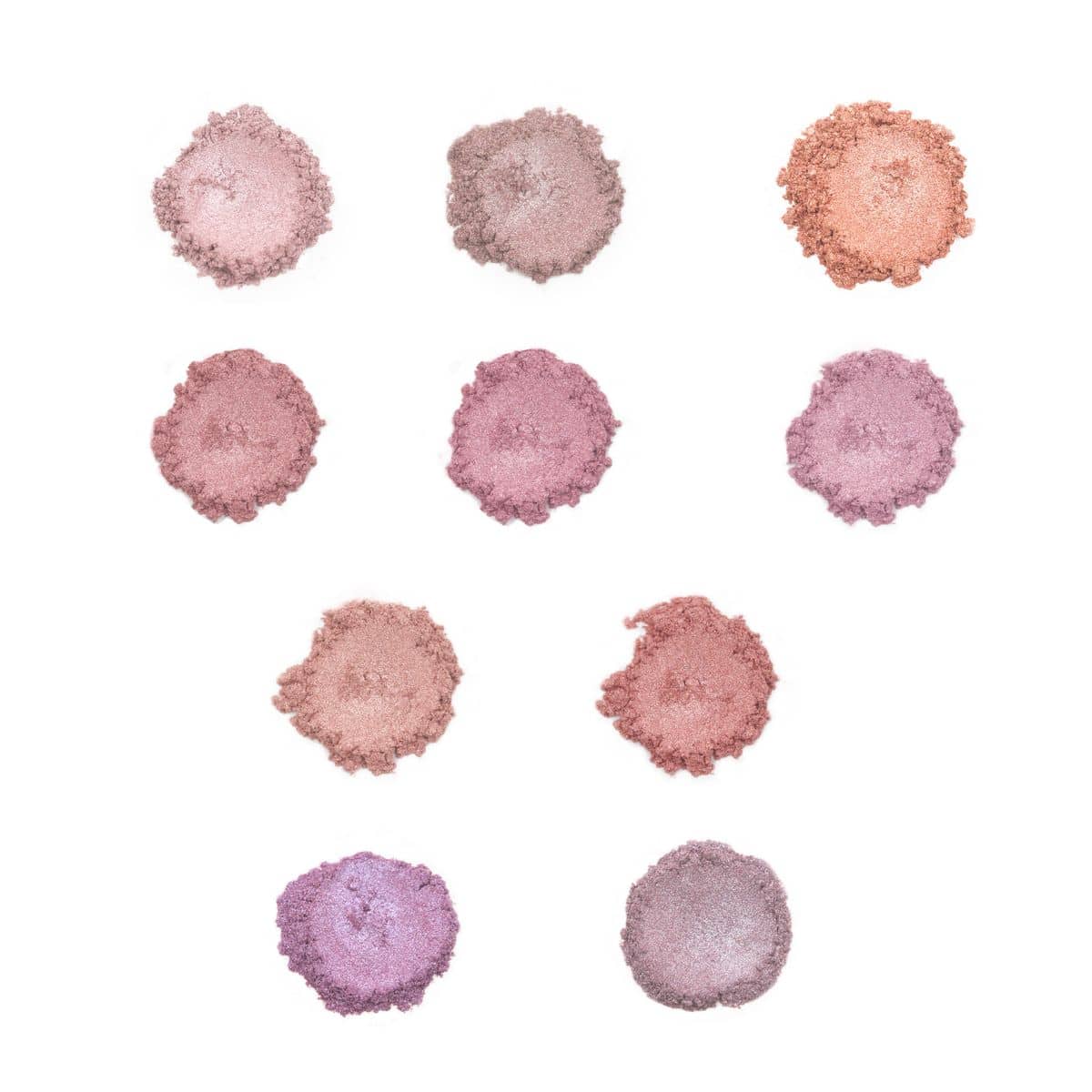
Pearlescent pigment samples showing different cosmetic color effects.
How Particle Size Changes the Finished Makeup Effect
Particle size is a key specification when selecting cosmetic pearlescent pigments. It influences the visibility of individual reflective particles, the smoothness of the finish, and the overall character of the makeup product.
| Particle Size |
Typical Visual Effect |
Potential Applications |
| Fine grades, around 10–25 μm |
Soft sheen and subtle pearl reflection |
Setting powders, smooth eyeshadows, and subtle face products |
| Fine to medium grades, around 10–60 μm |
Visible shimmer with a balanced pearl effect |
Eyeshadows, blushes, and general color cosmetics |
| Medium to larger grades, around 20–100 μm |
More noticeable sparkle and reflection |
Highlighters, eyeshadow accents, and shimmer products |
| Coarse grades, around 40–200 μm |
Pronounced sparkle and decorative effect |
Statement eyeshadows and selected high-impact makeup effects |
These ranges are practical starting points, not universal formulation rules. The actual appearance depends on the substrate, pigment coating, particle size distribution, pigment loading, and finished formula. Manufacturers should compare samples in the intended base rather than selecting a grade from particle size alone.
For example, Kolortek lists KT-68832B Violet Red Multicolor Pigment with a particle size of 10–60 μm. Its natural mica substrate produces a dual-angle effect, with silver reflection at the face angle and violet-red color at an oblique angle. This type of grade can be evaluated for eyeshadows, face powders, and other decorative applications.
Choosing Pearlescent Pigments for Different Makeup Products
The same pearl pigment does not necessarily perform equally well in every cosmetic format. Each application has its own visual target, texture requirements, and regulatory considerations.
Eyeshadow
Eyeshadow manufacturers often need several pearl effects within one palette. Fine grades can create a soft transition shade, medium particles add visible shimmer, and larger particles provide a highlight or topper effect. Synthetic mica may be considered when a cleaner appearance is important, while borosilicate grades can help create a more dramatic sparkle.
Highlighter and Blush
Highlighter formulations typically require a controlled reflective effect that looks bright without appearing excessively coarse. Fine and medium pearl grades are useful starting points for a smooth glow. Blush formulations may combine colored pearl pigments with matte pigments to balance color payoff and luminosity.
Lipstick and Lip Gloss
Lip products require careful attention to colorant permissions in the target market. A pigment suitable for an eyeshadow formulation is not automatically approved for use on the lips. Manufacturers should confirm the complete ingredient composition and permitted use of each colorant before selecting a grade for lipstick, lip gloss, or other lip applications.
Foundation and Face Powder
For foundation, BB cream, and setting powder, fine particle grades are generally easier to evaluate when a smooth finish and even appearance are required. The pigment should be tested for dispersion, shade compatibility, texture, and its effect on the finished product's coverage.
Nail Polish and Body Shimmer
Nail products can accommodate more visible sparkle and color-shift effects, depending on the film-forming system. Body shimmer lotions and similar leave-on products require attention to suspension, settling, skin-contact suitability, and the final sensory profile. The grade should be selected for the specific formulation rather than assumed suitable based only on its cosmetic label.
Kolortek's cosmetics application solutions provide a product-to-application reference covering eyeshadow, highlighter, blush, lip products, foundation, nail products, and personal care formulations.
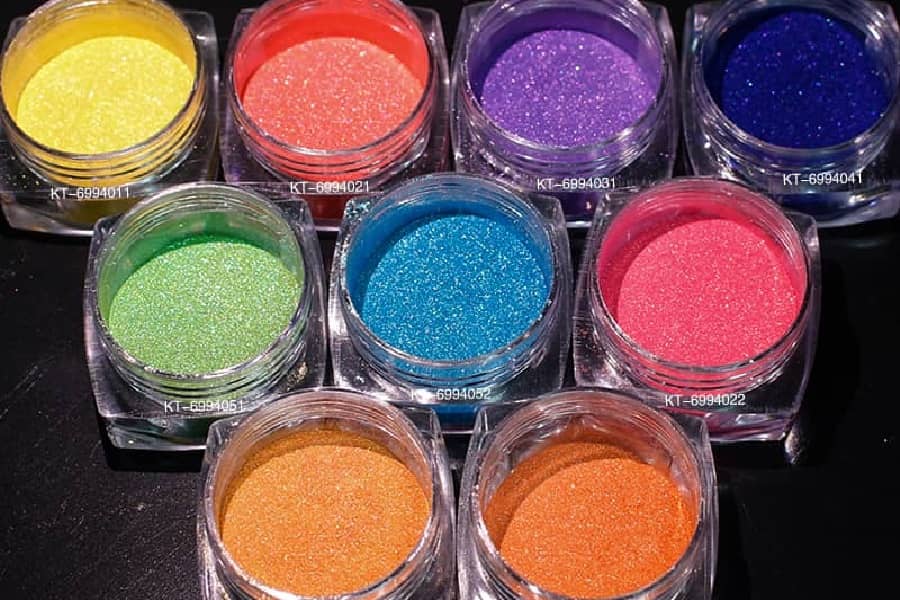
A range of colored pearl pigment shades for cosmetic product development.
Cosmetic Pigment Compliance: What Makeup Manufacturers Need to Check
Regulatory suitability is one of the most important parts of cosmetic pigment sourcing. The term "cosmetic grade" should not be treated as automatic approval for every product type or every country.
Color additive regulations can differ by market and by the intended area of application. Requirements for eye products, lip products, face cosmetics, and other personal care products may not be identical. A colorant permitted in one category may have restrictions or may not be permitted in another.
Before approving a cosmetic pearlescent pigment, manufacturers should request and review the following information:
- INCI name: Confirm the ingredient declaration for the exact grade.
- CAS number: Check the chemical identification of the listed ingredients where applicable.
- Colorant identity: Confirm the colorants, CI numbers, and their permitted use in the intended product category.
- TDS: Review technical specifications such as composition, particle size, and product characteristics.
- SDS: Review handling, storage, and safety information.
- COA: Check batch-specific quality information and agreed product specifications.
- Target-market review: Confirm the current requirements for the country or region where the finished cosmetic will be sold.
For example, Kolortek's cosmetic pearl range includes different colorant systems. Some grades use inorganic colorants, while others may contain organic pigments, carmine, or FD&C dyes. These differences matter when a brand is developing products for multiple markets or has specific vegan, cruelty-free, or ingredient-labeling requirements.
Do not assume that a pigment is suitable for eye, lip, or leave-on use solely because it is listed in a cosmetic pigment category. Request grade-specific documentation and have the finished formulation reviewed by the responsible regulatory team.
Kolortek lists INCI information, CAS numbers, TDS, SDS, and related technical documentation as available for its cosmetic pigment range. Manufacturers can review the cosmetic pigment product category and request documentation for the exact grade under consideration.
How to Test Pearlescent Pigments Before Mass Production
A product description and color card are useful for initial screening, but they cannot replace formulation testing. A pigment may look attractive in a dry sample and behave differently after it is blended, pressed, dispersed, or applied to skin.
A practical evaluation process should include the following steps:
- Confirm the application: Define whether the pigment is intended for pressed eyeshadow, loose powder, highlighter, lip gloss, or another product format.
- Review the documentation: Check the INCI, colorant composition, particle size, TDS, and SDS before starting laboratory trials.
- Prepare small batches: Test the pigment in the actual base formula at several suitable concentrations.
- Evaluate visual performance: Compare color, shimmer, coverage, sparkle, and appearance under different lighting conditions.
- Check processing compatibility: Assess dispersion, mixing stability, pressing behavior, settling, and any change in particle appearance during processing.
- Review finished-product stability: Conduct the relevant stability, packaging, and product safety assessments for the finished formulation.
- Confirm production consistency: Agree on a specification and compare subsequent batches against the approved sample.
For larger or more delicate platelet pigments, excessive high-shear mixing may affect the intended sparkle. The appropriate addition sequence and mixing conditions should therefore be established through trials with the actual formulation and equipment.
Why Makeup Manufacturers Source Cosmetic Pearl Pigments from Kolortek
For manufacturers developing several makeup product lines, sourcing flexibility is important. A single supplier with different substrate options, color systems, and particle sizes can make shade development and procurement easier to manage.
Kolortek is an effect pigment and cosmetic color additive manufacturer established in 2002. Its cosmetic pigment portfolio includes Cosmetic Pearl Multicolor, Cosmetic Matte Pigments, and Cosmetic Fillers & Treated Pigments.
The Cosmetic Pearl Multicolor range includes seven sub-series built around natural mica, synthetic mica, calcium aluminum borosilicate, and blended substrates. These options support different pearl, colored shimmer, and diamond-sparkle effects.
For manufacturers, the practical advantages include:
- Multiple substrate choices for different purity and visual-effect requirements.
- Colored pearl grades for eyeshadow, highlighter, blush, lip products, and other decorative applications, subject to grade-specific regulatory confirmation.
- Different colorant systems to support formulation and target-market assessment.
- Technical documentation and product information available for grade evaluation.
- Sample requests and OEM discussions for product development requirements.
Rather than choosing a pigment by color name alone, manufacturers can provide Kolortek with the intended application, target effect, particle size preference, and sales market. This information helps narrow down suitable grades before laboratory testing.
How to Choose the Right Cosmetic Pearlescent Pigment Supplier
Price is only one part of a pigment purchasing decision. For makeup manufacturers, a reliable supplier should be able to support product selection, documentation review, sample evaluation, and batch consistency.
Before placing an order, consider asking the supplier:
- Which substrate and particle size options are available for the required visual effect?
- Can the supplier provide the full INCI composition and relevant technical documents for the exact grade?
- Are the colorants suitable for the intended product category and target market?
- Can samples be supplied for testing in the manufacturer's own formulation?
- How are particle size distribution, color consistency, and batch quality controlled?
- Are alternative grades available if the first sample does not meet the required appearance or regulatory profile?
- What are the MOQ, lead time, packaging options, and customization possibilities?
A supplier's ability to provide clear, grade-specific information is particularly important when a brand sells cosmetics in several regions. It helps reduce the risk of selecting a visually suitable pigment that later proves unsuitable for the intended formulation or market.
Frequently Asked Questions About Cosmetic Grade Pearlescent Pigments
What is the difference between cosmetic grade and industrial grade pearlescent pigments?
Cosmetic grade pigments are selected and documented for specified cosmetic applications. Industrial grades may be designed for coatings, plastics, printing, or other uses and should not be assumed suitable for skin-contact products. Manufacturers should verify the composition, documentation, and permitted use of the exact grade.
Which pearlescent pigment is best for eyeshadow?
The best choice depends on the desired finish. Fine mica-based grades are suitable starting points for soft shimmer, medium particle sizes can provide visible pearl effects, and larger borosilicate grades can create more dramatic sparkle. The final choice should be confirmed through formulation trials and regulatory review.
Are synthetic mica pigments better than natural mica for makeup?
Not in every formulation. Synthetic mica generally offers higher substrate purity and fewer natural inclusions, which can be useful for premium products requiring a clean appearance. Natural mica remains a versatile option for many cosmetic formulations. The right choice depends on appearance, performance, cost, and brand requirements.
What particle size is suitable for cosmetic shimmer?
Fine grades around 10–25 μm are commonly evaluated for subtle sheen, while grades around 10–60 μm can provide a more visible pearl effect. Larger grades can create stronger sparkle. These are selection guidelines rather than fixed rules; the actual result depends on substrate, formulation, and pigment concentration.
Can the same cosmetic pearl pigment be used in eyeshadow and lipstick?
Not automatically. Colorant permissions can vary by product category and market. Manufacturers should check the full ingredient composition and confirm that the exact grade is permitted for both eye and lip applications before use.
What documents should a cosmetic pigment supplier provide?
Manufacturers commonly request INCI information, CAS numbers, a Technical Data Sheet (TDS), a Safety Data Sheet (SDS), and a Certificate of Analysis (COA). Additional information may be needed for market-specific regulatory assessments and finished-product compliance.
What is the difference between mica-based pearl pigment and borosilicate pigment?
Mica-based pigments typically produce a classic pearl or satin shimmer, while borosilicate substrates can create brighter, more defined, glass-like sparkle. The choice depends on the desired visual effect, particle size, and formulation requirements.
Does Kolortek provide samples and technical documents?
Kolortek lists sample requests and grade-specific technical documentation among its support options. Manufacturers can contact the team with the intended application and target market to discuss suitable grades, samples, INCI information, TDS, and SDS availability.
For cosmetic pigment selection, share your target shade, desired shimmer level, product format, and sales market with Kolortek. The technical team can help identify suitable grades for sample evaluation and further formulation testing.

 English
 Français
 Deutsch
 Русский
 Español
 Português