Leave A Message
If you are interested in our products and want to know more details,please leave a message here,we will reply you as soon as we can.
Pigment for Candle Wax: The Colour Lasts Where the Flame Cannot Reach

Mica sinks in melted wax, so the colour settles where the flame cannot reach it. Position, not loading, is what decides whether that colour survives a burn.
A pearl or metallic effect fails in candle wax for a reason that has nothing to do with the dose. The flake does not dissolve, and at roughly three times the density of the wax around it, it sinks. The burn problem starts after the sinking. Moving the pigment to a different position in the candle fixes what no change in loading can fix.
Three things this page settles
— Why the colour comes out uneven even when the powder went in under proper stirring
— Which temperature the published guides are actually quoting, and why four of them disagree by 20 °C
— Where the pigment has to sit in each kind of candle, and what each position costs you
Paraffin wax runs 0.880–0.925 g/ml. Mica runs 2.8–3.0 g/cm³. Nothing couples the two: the flake is insoluble in wax and holds no chemical reason to remain where it was placed. Stirring spreads it. Nothing suspends it. Settling starts the moment the stirrer stops.
Settling speed climbs with the square of the platelet diameter. That one relationship decides more about a finished candle than the loading does. A 5–25 µm grade can still be moving slowly when the wax sets, and sets with a gradient you can sell. A 40–200 µm grade — the one that throws the strongest sheen in a dry sample — drops out several times faster. The powder that flatters a dry sample is the powder that misbehaves in the pot.

A filled container candle. Everything above the wick has to stay clear enough for the flame to draw fuel; pigment that settles into the lower melt pool works against that.
That is how one batch ends up bright near the rim and thin at the base. The material did not split into two colours. It split into two concentrations. Cut a set candle down the middle and the lower half is usually where the effect went.
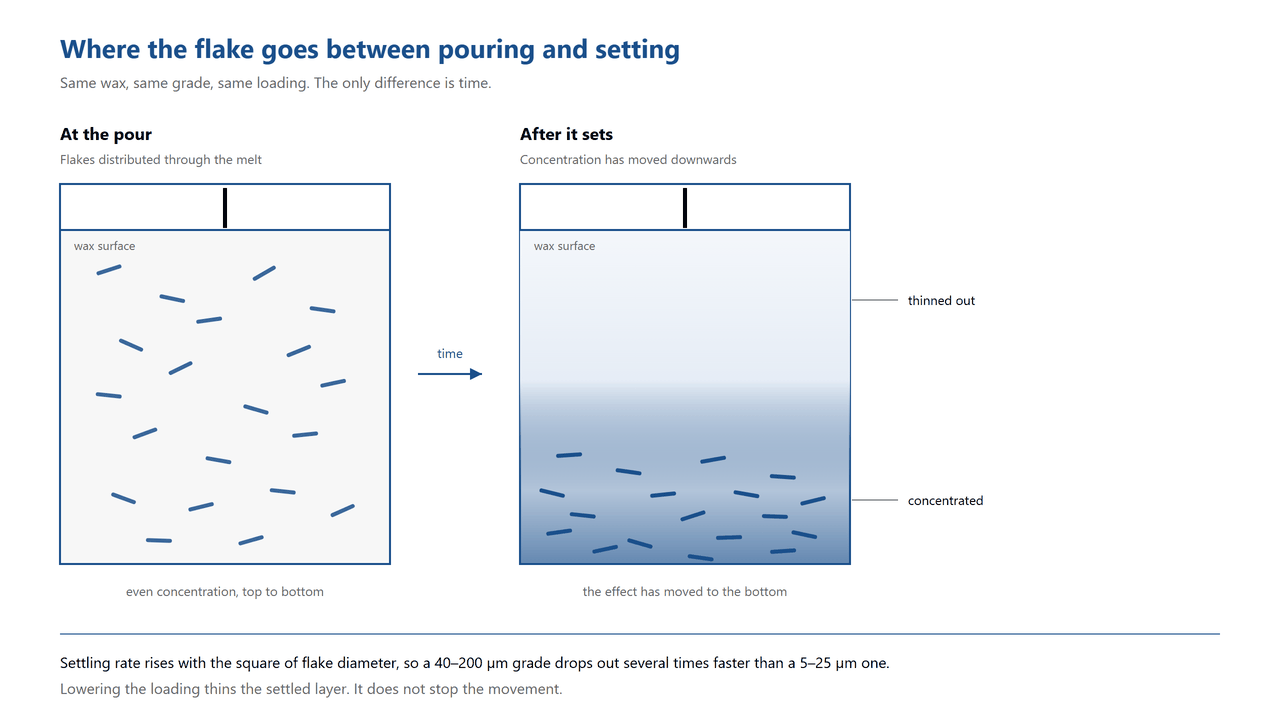
Left: the flake is distributed at the moment of pouring. Right: after the wax sets, the concentration has moved downwards and the upper body has thinned out.
Guidance on adding mica to wax always comes with a temperature, and the figures do not line up. Put four widely circulated guides into Celsius and you land at roughly 60–71, 71–85, 77–82 and 85–90 °C. Read as one recommendation with an error bar, that spread is indefensible. Read as answers to two separate questions, it holds together.
Addition wants heat. Warm wax wets the platelets and breaks up clusters, and a hot addition is what keeps the speckled, grainy surface out of the finished candle. The pour wants the opposite. Viscosity falls as wax heats, and a thinner melt lets a dense flake travel further before the wax sets around it. So a guide can quote a high number for mixing and a low number for pouring without contradicting itself — and several do exactly that, without labelling which is which.
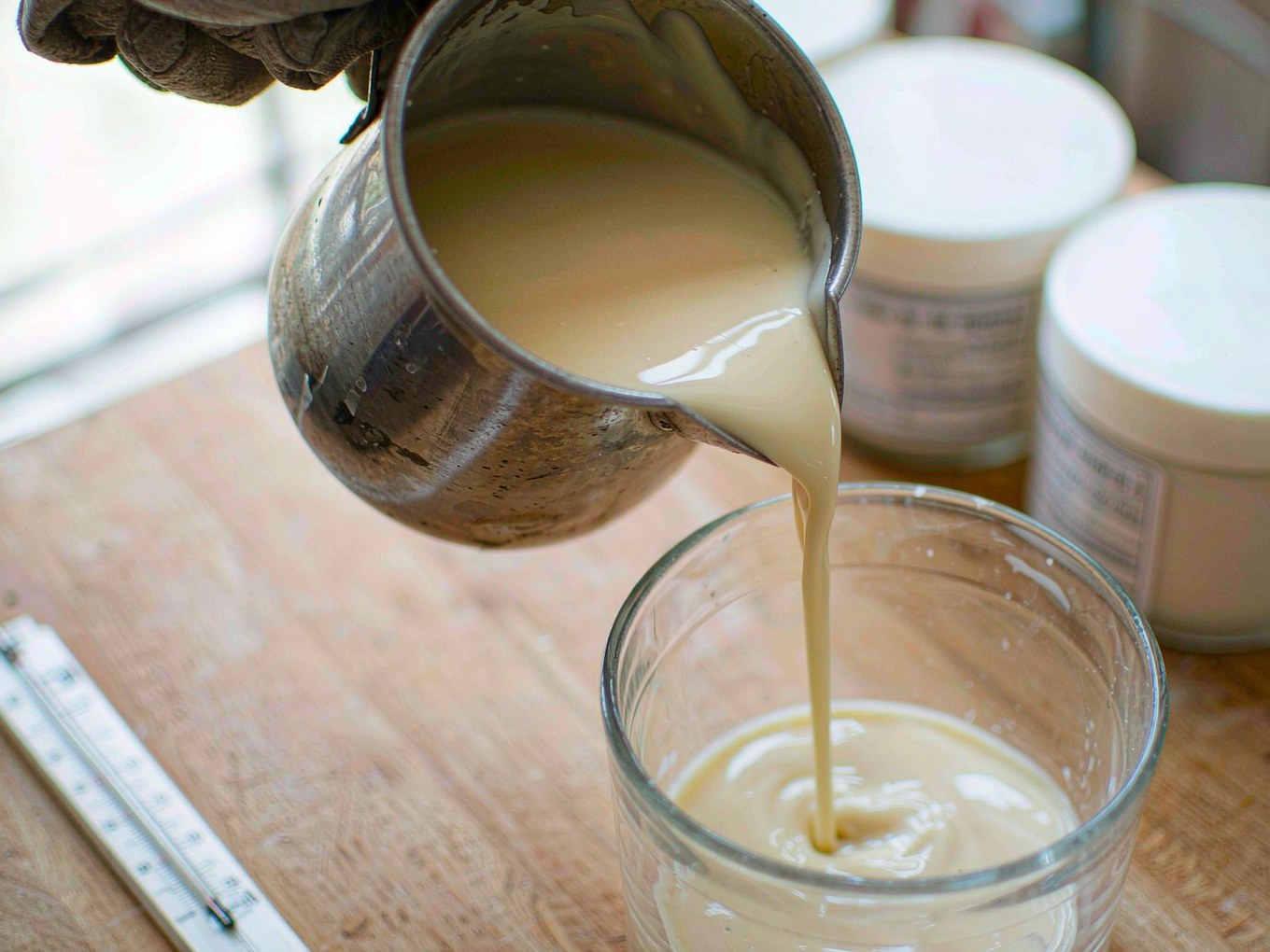
The pour, not the addition. Viscosity at this step decides how far a dense flake travels before the wax sets around it.
What that leaves you with is a two-step route rather than a set point. Add at the hot end, stir until the melt is uniform, then let it come back down before the pour. The thermometer reading worth watching is the one at the pour, because that is the number settling responds to. Checking at the addition tells you less.
A wick does not burn wax. It pulls liquid wax up through its fibre by capillary action, and the flame consumes the vapour above the fibre. Whatever that liquid carries arrives at the same place. Platelets gathered at the wick base get lifted into the fibre and lodge there. The wick fattens, the fuel path narrows, and the flame changes shape.
A granted patent on decorative candles states this plainly, in the context of mineral pigments dispersed in melted wax: they interfere with the capillary action at the wick and reduce or eliminate the wicking effect the candle needs in order to burn, which the patent treats as reason enough to keep such pigments out of the wax body altogether. The patent's own answer is to place the pigment on the outer portion of the candle instead. That is a blunt admission from a document whose entire purpose was finding a way to use these materials.
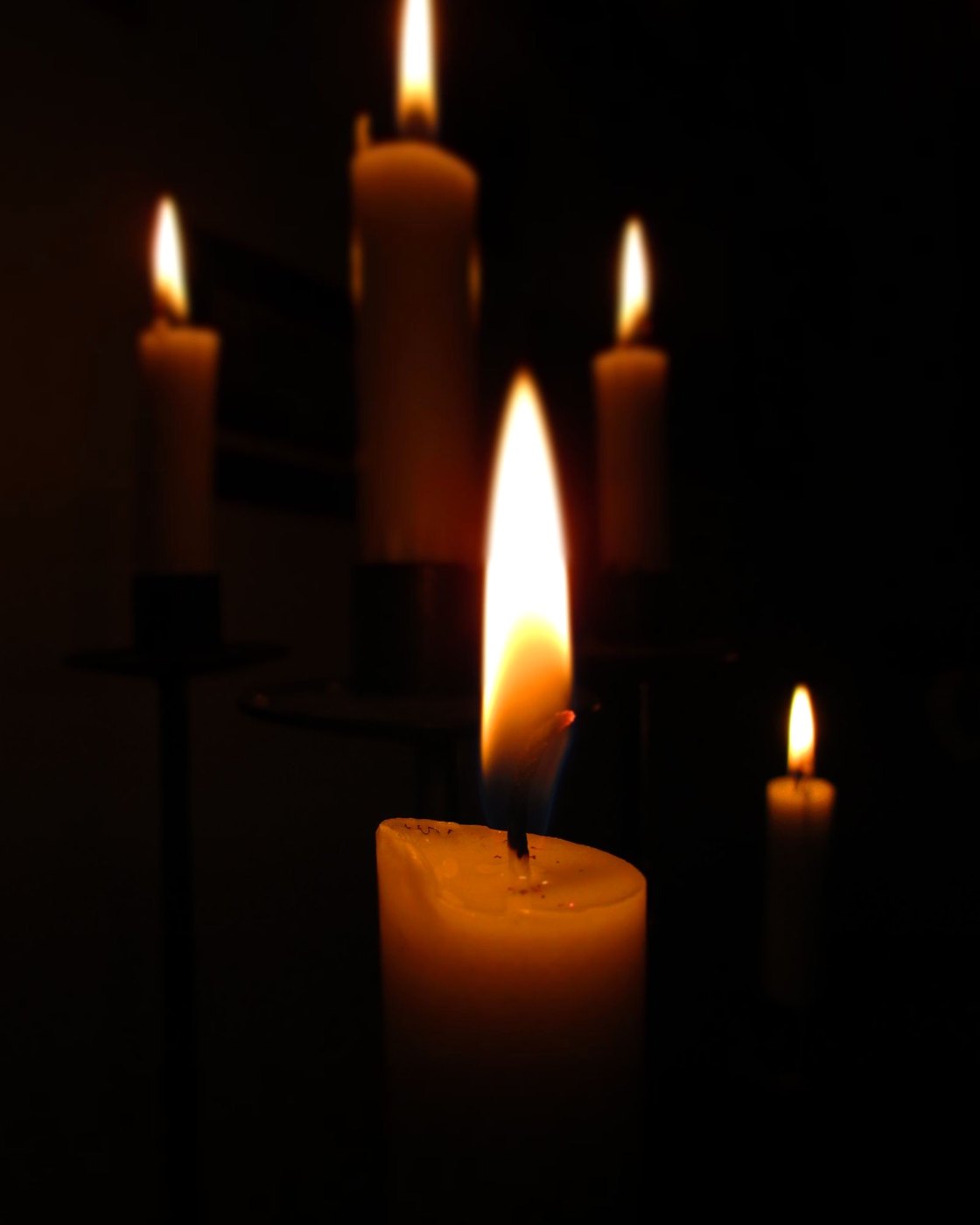
Flame size and position are the visible output of everything happening at the wick. A change in flame shape is the first readable symptom, not the last.
The usual field fix makes it worse. Fitting a larger wick adds fuel capacity to compensate for a narrowed path, which raises flame height and soot without restoring the original burn. Both are measured properties under ASTM F2417, the fire-safety standard for candles, which sets a flame-height ceiling and, since the 2023 revision, a wick-migration clause: the wick must not move or lean so that the flame contacts the container for more than five seconds, and on multi-wick candles no two wicks may merge into a single flame for more than five seconds. The same revision advises a vessel tall enough to keep any particles falling from the wick below the wax surface.
None of that predicts a pigmented candle will fail. It places the failure mode inside the scope of a standard your customer already tests against, and it notes that the standard's own design guidance expects debris at the wick.
Two refractive indices explain why a powder that looks brilliant in its jar goes muted once it is inside wax. A platelet reflects at the boundary with whatever surrounds it, and how strongly it reflects depends on the index difference across that boundary. Muscovite mica runs 1.552–1.616. Paraffin wax runs 1.442–1.448. Through the usual Fresnel approximation at normal incidence, the reflected fraction falls from about 5 % in air to roughly 0.2 % in wax.
The useful part of that calculation is not the absolute figure — the visible sheen also comes from the titanium dioxide coating, whose index near 2.7 narrows the gap to a smaller multiple — it is the direction. Wrapping the platelet in wax removes most of what made it visible. Holding it at the air interface keeps it.

A pillar candle carries its decoration on the outside, where the pigment stays dry and never reaches the melt pool. This is the position that costs the least in burn performance.
Dusting a mould before the pour, brushing a set surface, drawing on the outside with powder dispersed in alcohol — each of these puts the flake where it can reflect against air. A patent on a pearl-effect coating for candles takes the third route in a different form: a solvent-borne film carrying 1–5 parts pearl powder at 500–1000 mesh, formulated so the film stays ahead of the melting wax. The same document names the two defects that route has to beat — ash building on the wick and wax running down the side — a useful reminder that surface work carries its own failure modes rather than none.
A flake has four places to sit. They are not four grades of one answer; they are four different products with different constraints, and the question that separates them is what the candle has to do once it is lit.
| Position | What the flake sits in | Main risk | Suits |
|---|---|---|---|
| In the wax body, with a wick | Wax, from surface to base | Settling first, wick loading after | Nothing that also has to pass a burn test unchanged |
| In the wax body, no wick | Wax, in a warmer dish | Colour drifting between melt cycles | Wax melts and wickless formats |
| On the surface | Air, on a mould or a cooled body | Wear from handling, patchy application | Pillars, moulded shapes, outer walls |
| In a film on the surface | A dried coating | Ash at the wick, wax running at the side | Decorative lines where the coating is part of the design |
Most buyers arrive on the first row, and it is the row with no safe answer. That is the finding, not a sales obstacle. A candle that has to burn to a defined standard and also carry shimmer through its whole body asks one particle to do two jobs that do not fit together.

Filled glass formats show the split most clearly: the visible surface can carry an effect while the body stays a plain, free-drawing wax.
Two things on this page can be carried on paper and two cannot. That split matters more than a confident tone would.
On paper: the densities, the refractive indices and the arithmetic that follows from them come from standard reference tables. The wick mechanism and the surface-only workaround come from a granted patent that states both directly. The standard clauses come from the standard. Off paper: we have run no settling test in wax, we have not measured flame height on a pigmented candle, and we cannot give you a percentage at which a given wick stops drawing properly. Those three need a burn rig and a balance, and we do not publish figures we have not produced.
The same caution applies to a claim that circulates in supplier content: that pearl pigment improves colour retention during burning and boosts fragrance throw. A blocked wick shrinks the melt pool, and a smaller melt pool releases less fragrance, so the claim runs against the mechanism instead of with it. A supplier promising better scent from a heavier pigment load is quoting something untested.
Fix the position and the grade question largely answers itself. Surface work wants the larger platelet, because the size that ruins a body application is exactly the size that reads as a visible flake on the outside. Body work wants the fine end, not because it looks better but because it falls more slowly. Our own material guide for craft and candle work puts the working range at 0.5–2 % of wax weight, with fine grades dispersing more evenly, and that range is a starting point to be narrowed on your line rather than a specification.
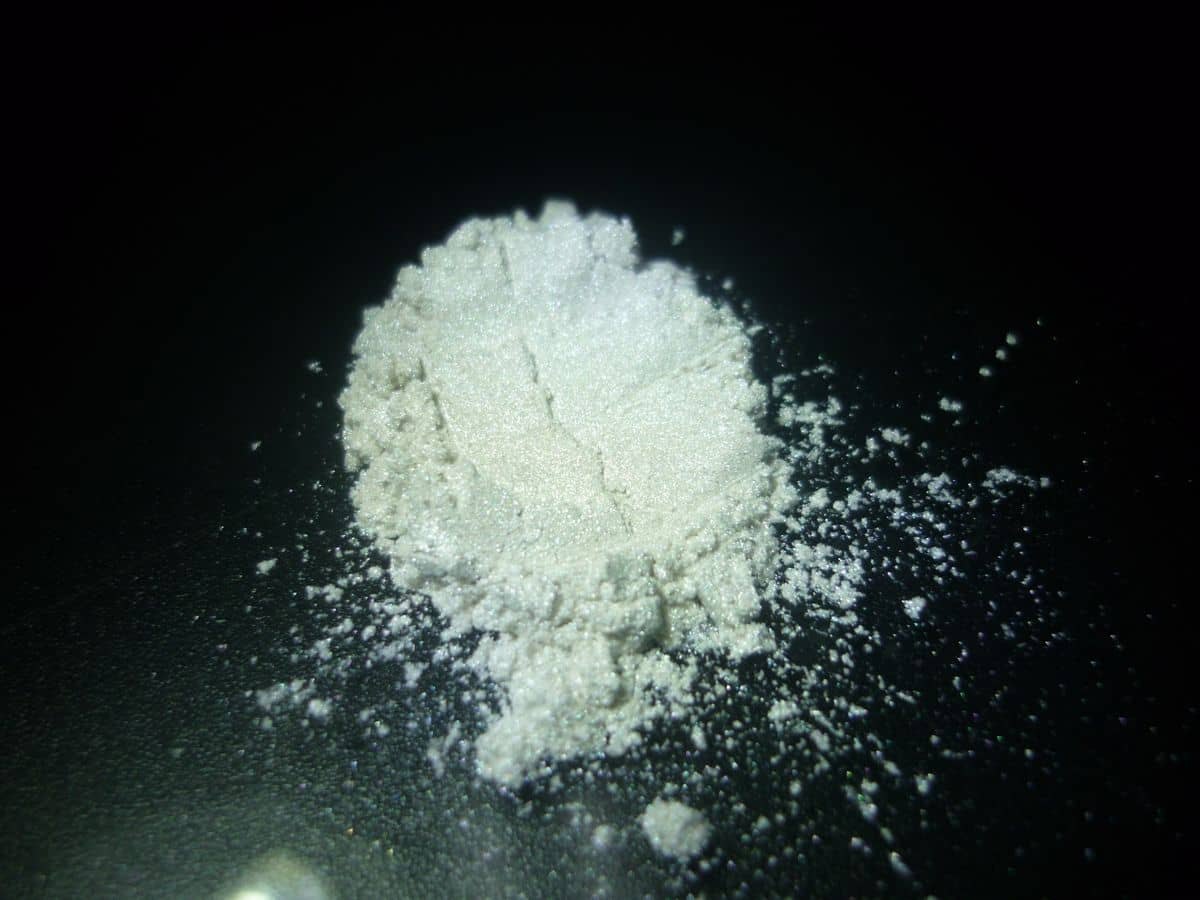
Pearl pigment as supplied. The sheen at this stage is measured against air; everything that happens after it meets hot wax reduces it.
For surface work, a 40–200 µm silver grade such as the KT-163 shimmer pearl carries a flake large enough to read across a room. For a body application where the effect only has to survive a melt cycle, the 5–25 µm end of a silver white pearl range stays distributed longer. Both sit inside the same series documentation, so the choice can be made on size rather than on a colour card.
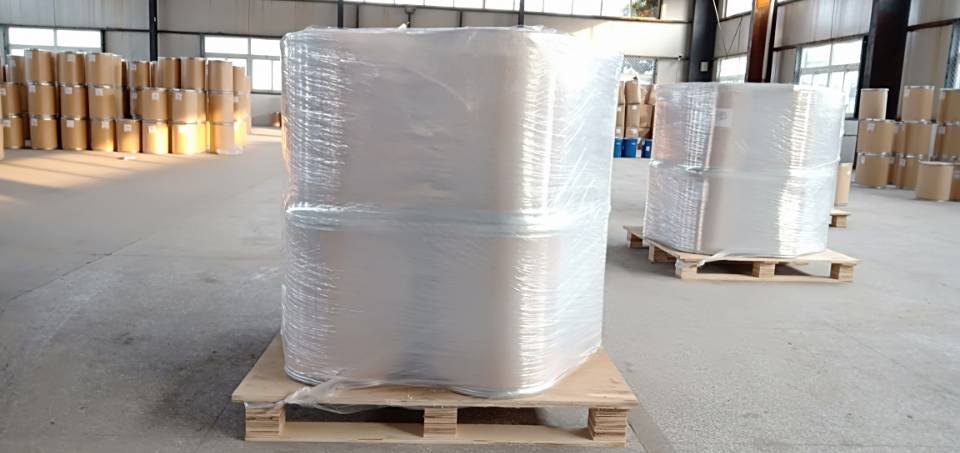
Standard export packing. Candle work usually starts with a trial quantity before a drum, which is why the grade decision and the position decision are worth settling first.
If you would rather start from the paperwork, the silver white series catalogue lists sizes against effects. Candle work sits among the applications grouped under other applications on our site, alongside leather, textile and seed treatment.
Can pearl pigment go into a candle that will be lit?
It can be present, but not dispersed through the body. Put it on the surface, in a mould release layer, or in a film. Dispersed through the wax of a candle with a wick, it settles into the pool the wick draws from.
How much should be added to stop it settling?
No amount stops it. A lower loading makes the settled layer thinner and the timing less obvious, but the flake is still denser than the wax and still has no reason to stay suspended. The variable that changes the outcome is where it sits.
Will a coarser grade give a stronger effect?
Yes, and it will also settle faster and sit further outside a fine wick's tolerance. Coarse grades belong on surfaces. If the body is your only option, the fine end is the defensible choice even though it looks weaker in dry form.
Does the wax type change any of this?
It changes the numbers, not the conclusion. Soy wax melts lower and carries a slightly different refractive index from paraffin; beeswax is more opaque and mutes the effect further. Density differences of this size do not disappear when you switch waxes.
If you are still weighing surface against body, tell us three things: the wax you are pouring, the position you are leaning toward, and the burn standard your customer tests to. We will come back with the size band that suits that position, the loading that keeps it readable, and a straight answer on which part of the problem stays on your line. A custom sample pack for a first pour is the usual way to settle it, and it is built around your wax rather than around a shade card.
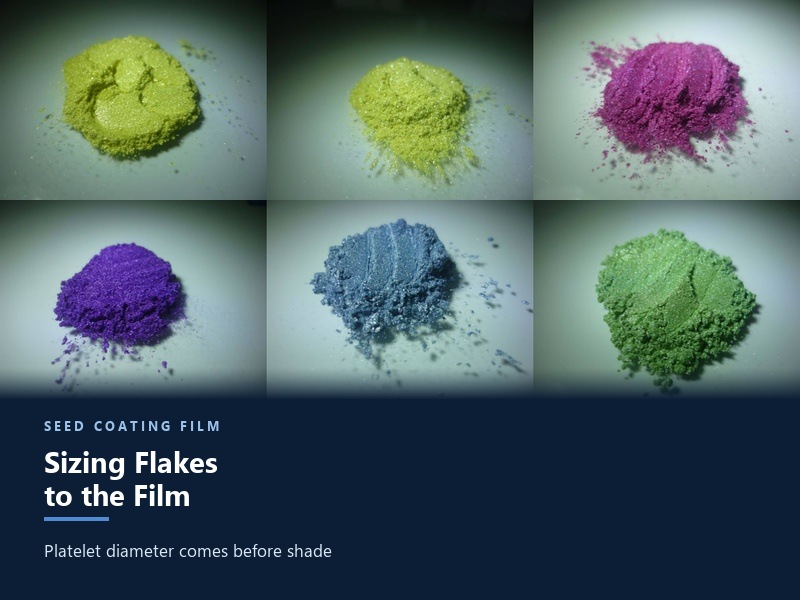
A seed coating film dries at 20 to 50 μm while a pearl platelet measures 10 to 100 μm. Sizing the flake to the film decides whether colour stays on the seed.
Read More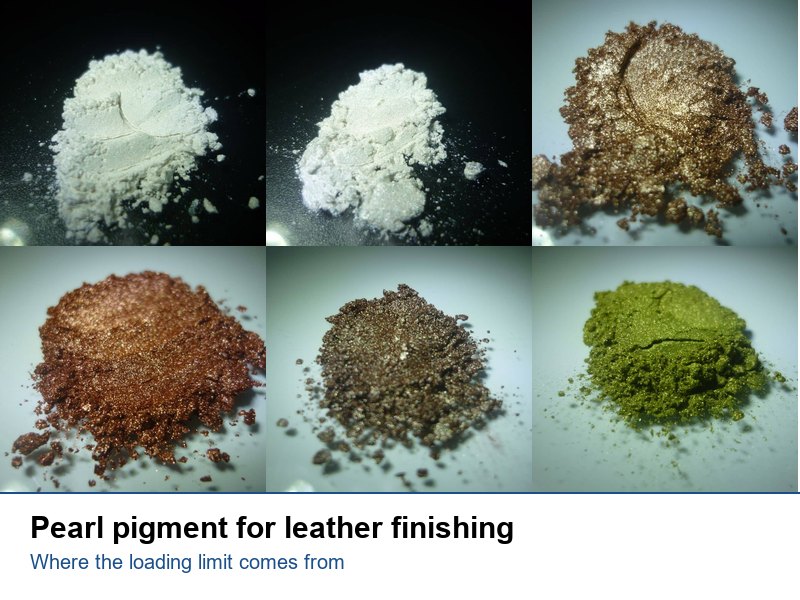
Pearl loading in leather finishing is capped by the resin left between flakes, not by brightness. Two lines, four to eight percent, and one 50,000-cycle test.
Read More
A pearl patch washes out while the flat colour beside it holds. Flakes reflect radiant heat, so that patch cured late. Fix the dwell, not the pigment.
Read More
Mica sinks in melted wax, so the colour settles where the flame cannot reach it. Position, not loading, is what decides whether that colour survives a burn.
Read More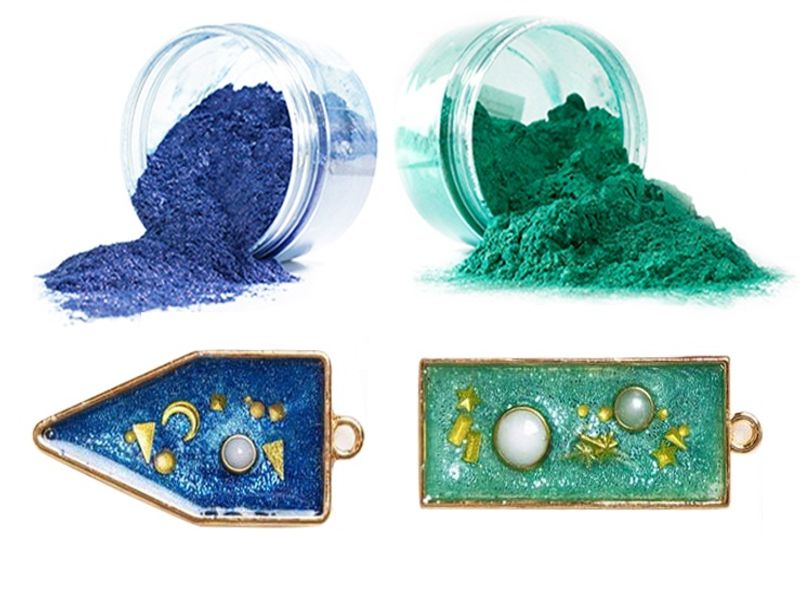
Bulk mica powder for resin art includes pearlescent pigments (KT-100 to KT-500 series), chameleon color-shift effects (KT-9000 series), holographic powders, and biodegradable glitters optimized for epoxy and UV resin systems. At Kolortek, we supply craft grade mica bulk in particle sizes from 5–25 μm for smooth shimmer to 100–250 μm for dramatic sparkle, with dosage recommendations of 1–10% by weight depending on effect intensity. Our resin art pigment wholesale catalog includes over 300 effect options designed for easy hand-mixing without specialized equipment.
Read More
 English
 Français
 Deutsch
 Русский
 Español
 Português