
Leave A Message
If you are interested in our products and want to know more details,please leave a message here,we will reply you as soon as we can.
Photochromic Pigment: The Spec Is How Fast It Fades Back
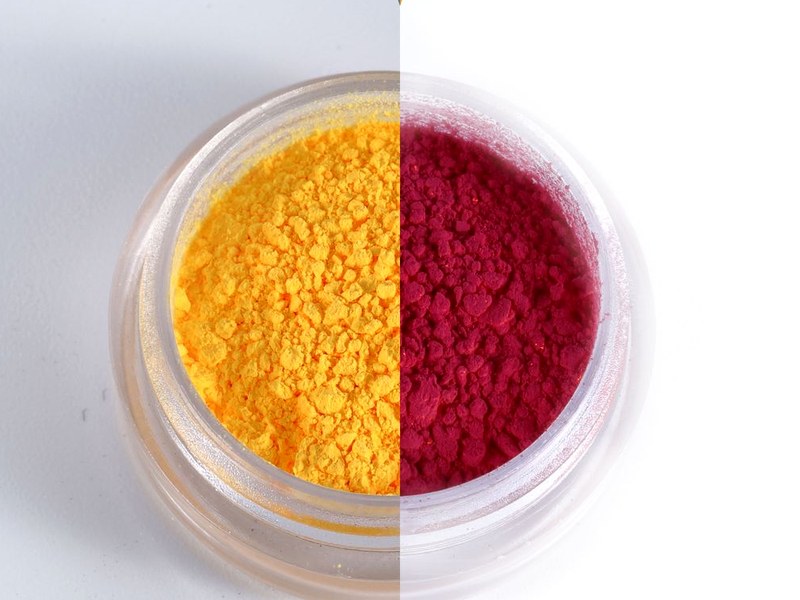
Photochromic pigment and powder: colour arrives in sunlight, leaves when the matrix lets it. Fade-back is the spec nobody asks for. 1 kg MOQ, ISO 9001:2015.
Item No. :
KT-PMC series — colourless-to-coloured and colour-shift types, all in one 1–10 µm bandColor Effect :
Reversible photochromic response under UV (peak sensitivity 340–380 nm); one type gains a colour it does not have indoors, the other swaps its hue and returnsParticle Size :
1–10 µm, every code in the seriesComposition :
Organic photochromic dye held inside a polymer microcapsule; grade-level detail on the TDSBrand :
KolortekMOQ :
1 kgApplication :
Screen and flexo printing, coatings and films, nail gel, promotional and novelty articles, UV-indicator badges and patches, covert security markingUnder UV or sunlight a photochromic pigment shows one colour. With the source gone it shows another, and the return takes time. Buyers name the colour they want in sunlight. Almost none name how fast it leaves — and that second figure decides whether the product still reads correctly after a season outdoors. Every code is milled into the same 1–10 μm band, so particle size is not a dial you turn. What you choose is which leg of the cycle your product has to live on.
Open a jar from the colourless side and the powder sits near-white on the spatula, sometimes with the faintest green or pink cast. Open one from the colour-shift side and the powder is already carrying the colour it holds indoors. Sunlight gives the first a colour it did not have. It makes the second trade one hue for another. Both hand the original back once the light goes.
That is the difference a shopper meets on a shelf under shop lighting. A colourless grade gives an object that looks plain indoors and turns in the sun. A colour-shift grade gives an object that looks finished indoors and changes character outside.
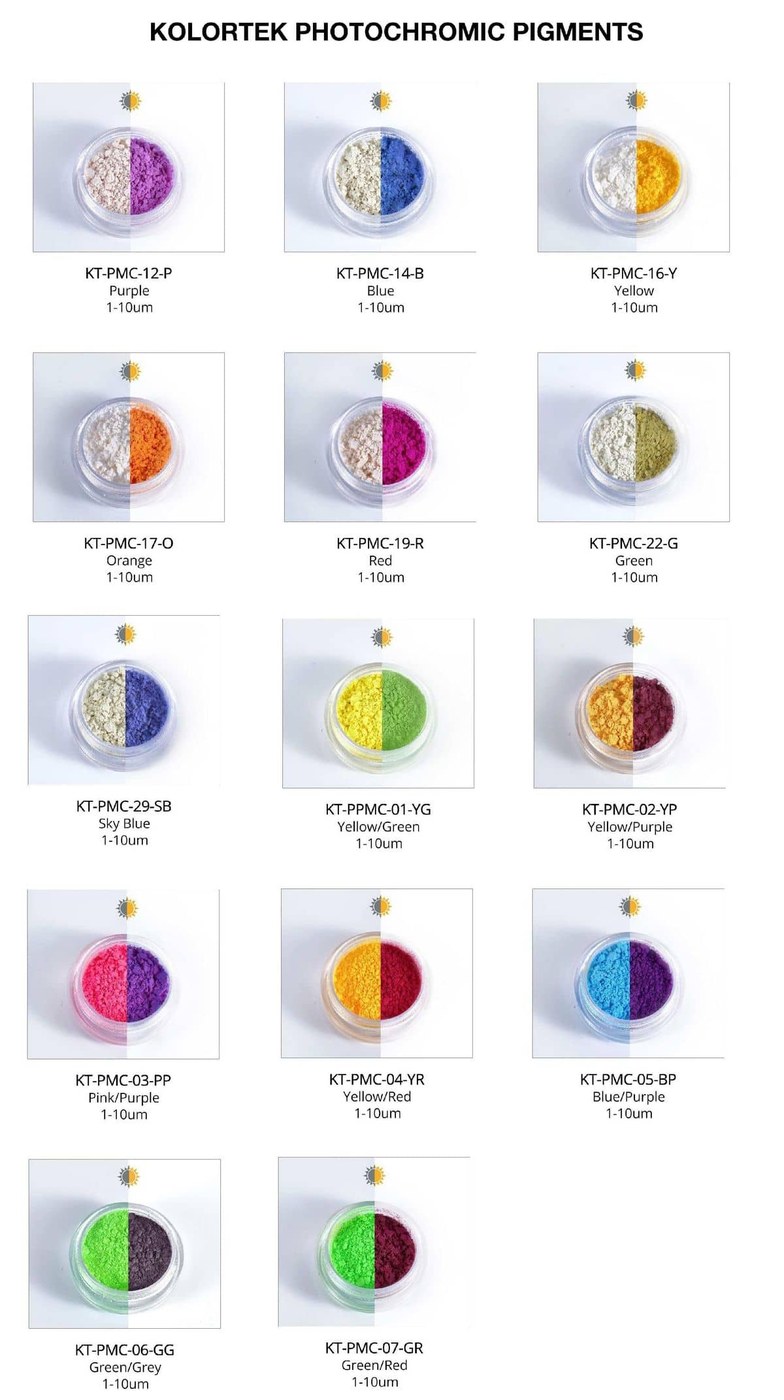
Fig. 1 — Each jar split down the middle: left in room light, right under UV. Pale left halves are the colourless side; tinted ones are the colour-shift side.
Particle size is not a lever either. Every code comes off the mill at 1–10 μm, and there is no coarser grade to order. So a film can be thin and still hold enough capsules to read, which is what makes printing, coating and nail gel workable. And a gram of powder puts a large wall area in contact with the matrix around it.
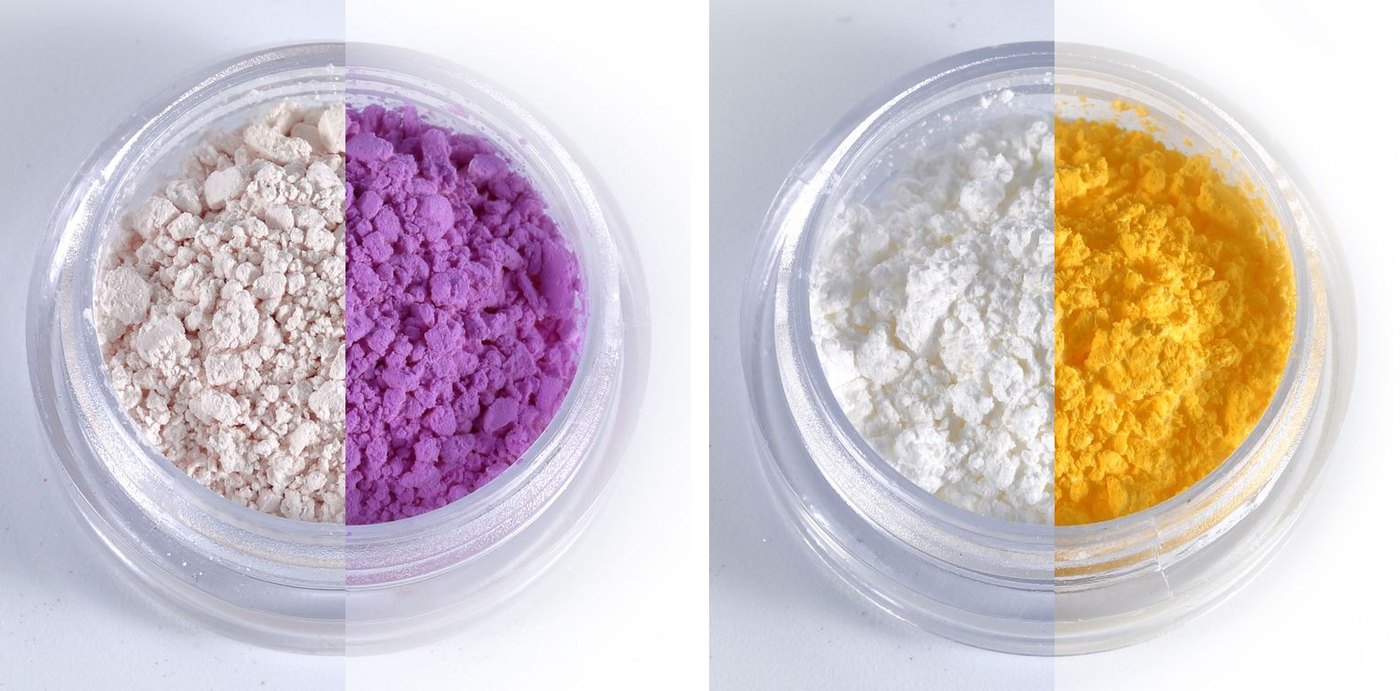
Fig. 2 — Two grades from the colourless side. Indoors both read close to white.
One more property, because spec sheets blur it. The effect is absorption, not interference. Hue does not shift as you walk past the piece the way it does on a mica or borosilicate flake — circle a photochromic print and the colour stays where it was. Angle travel and UV travel come from different pigments. A page promising both is describing a blend.
Activation is a light reaction, and it is picky about wavelength. Sensitivity peaks at 340–380 nm, at the UV-A end. Window glass strips most of that band, so a sample on a desk behind glazing often does almost nothing while the same sample at the loading dock turns inside a minute. When a buyer reports a weak sample, ask where it was standing before you ask about loading.
The trigger is dose, so depth of colour tracks the UV the piece received rather than the pigment that went into it. More loading deepens the reading at any exposure. It does not change how fast the piece clears once the light goes. Most pigments are tuned the other way round.
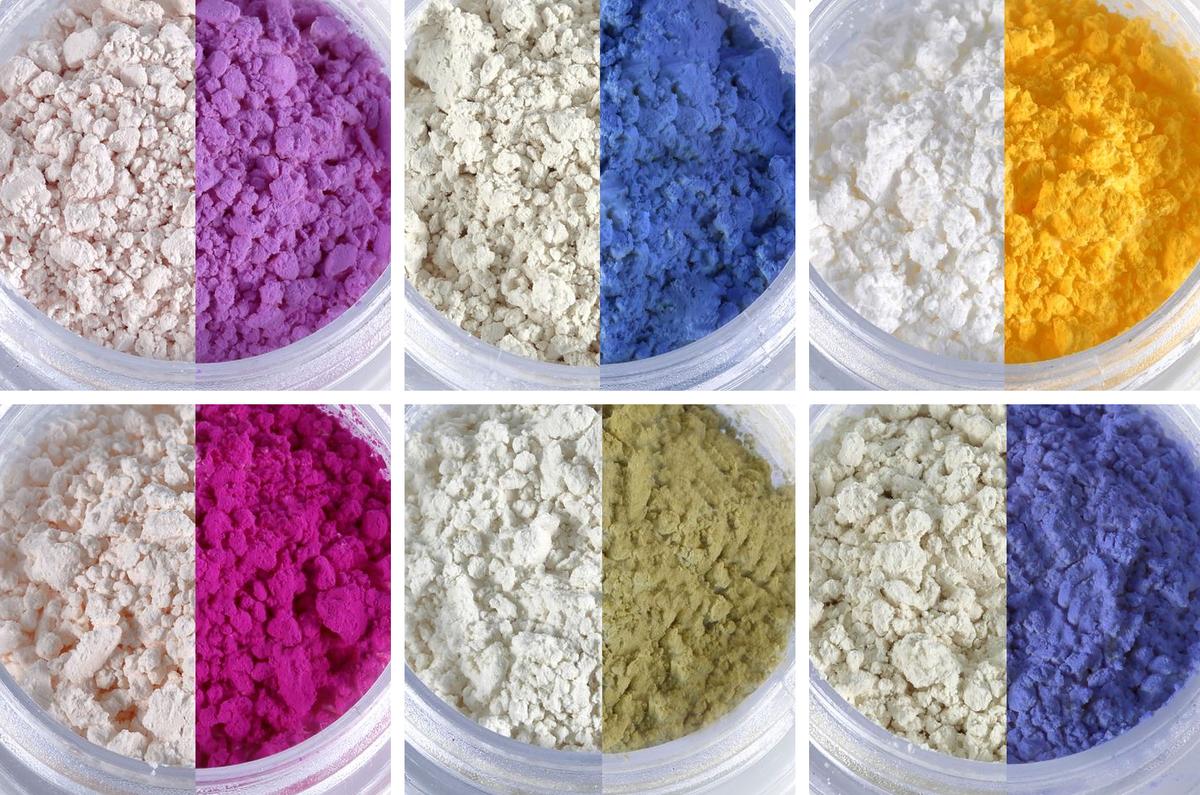
Fig. 3 — Six grades in one frame, each split at the same moment. The right half of every jar sits under the same illumination.
The arrival leg is short. Seconds in direct summer sun for a thin film. Longer through glazing, or inside a thick section, where the outer layer shades the capsules behind it. In a deep casting the colour you see is carried by a skin a few particles thick.
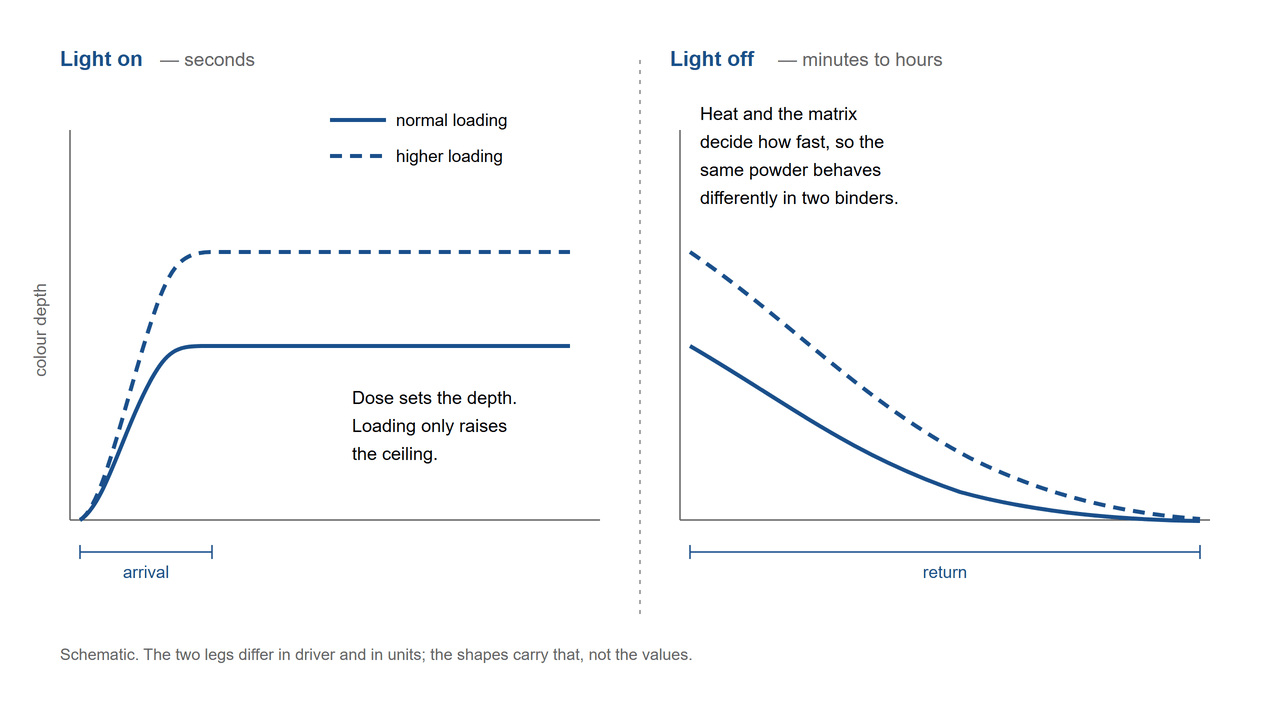
Fig. 4 — The cycle has two legs with different drivers. The upward leg is set by UV dose and runs in seconds; the downward leg is set by heat and by how freely the matrix moves, and runs in minutes to hours.
The return leg is not a light reaction. With the UV gone, the dye relaxes thermally. The rate depends on temperature, and on how freely the material around the capsule can move. Two pieces cut from the same kilogram will come back at different speeds in different binders.
A formulator meets the consequences before any spec sheet does. A thick moulding clears more slowly than a thin print, because heat has to move through it. A cold warehouse holds colour longer than a warm one. A rigid, heavily crosslinked binder holds it longer than a plasticised one. None of that is a defect; it is the mechanism showing through.
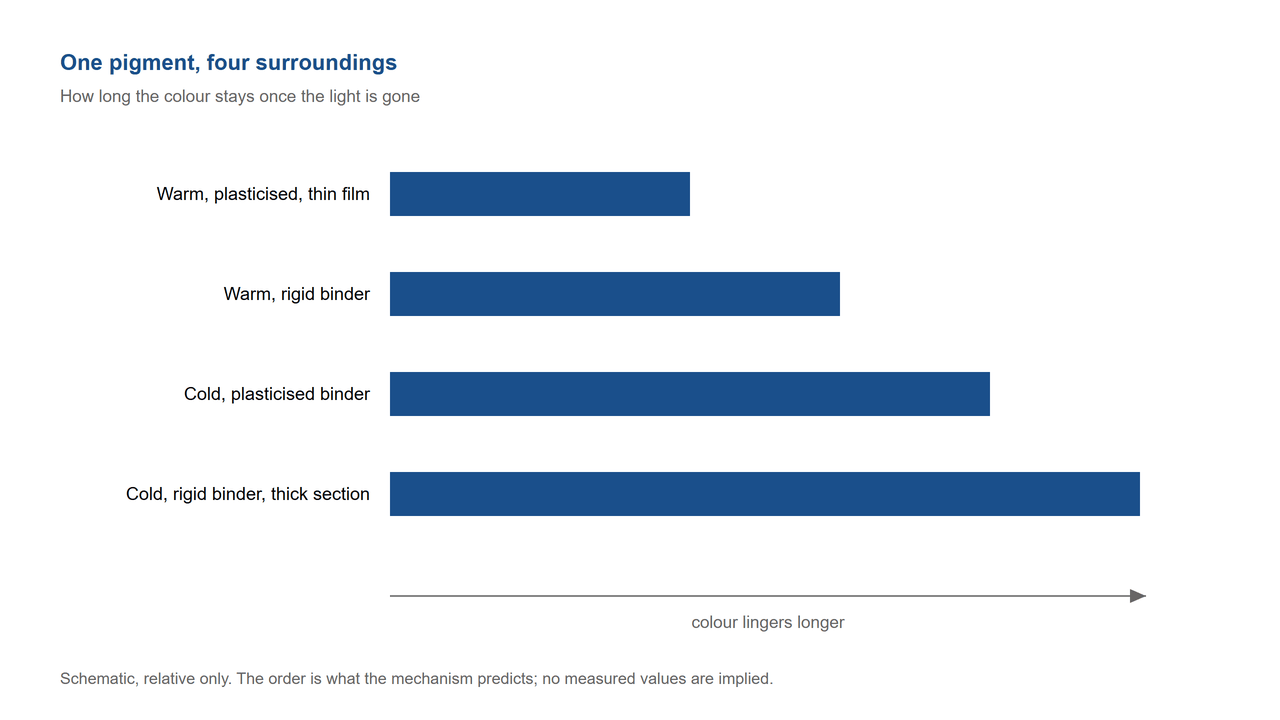
Fig. 5 — One pigment in four surroundings. Warm and mobile clears first; cold and rigid holds longest.
That is why a bare fade-back figure is close to meaningless. "Returns in ten minutes" is a claim about a substrate, a thickness and a temperature. With two of the three missing, nobody can check it. Ask for all three, or measure it yourself.
The colour-shift side hides the problem better. A grade that goes yellow to purple still reads yellow on the way back, so a slow return passes for normal. A grade that goes colourless to red has nowhere to hide. A slow return leaves a pink ghost, and the ghost is what ends up in the customer's photograph.
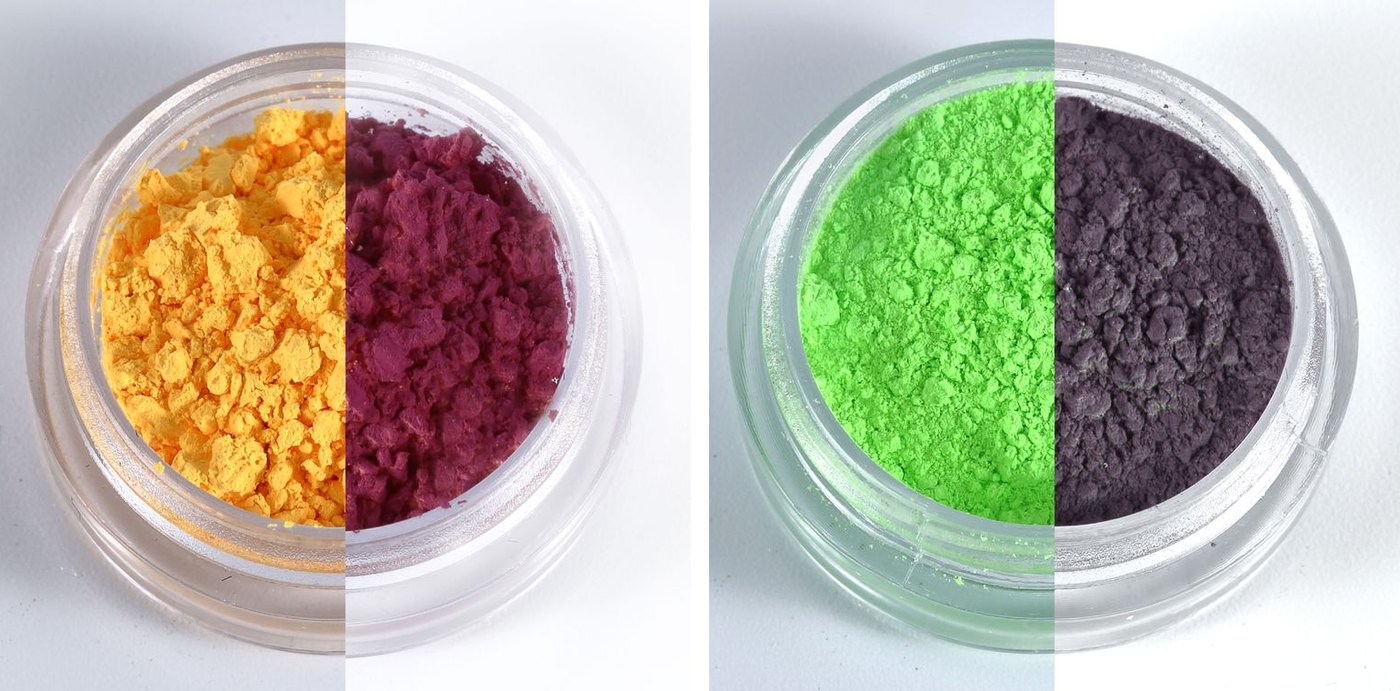
Fig. 6 — Two grades from the colour-shift side. The UV half is a different hue, not a new presence.
A photochromic pigment is an organic dye held inside a polymer capsule. It is not a coloured crystal. The dye does the changing; the wall keeps the dye away from the world. Every limit below is a limit on that wall.
Shear comes first. Bead mills, high-speed dissolvers and tight three-roll nips break capsules, and a broken capsule stays broken. Solvent next: ketones, esters and aromatics swell the wall and let dye migrate into the matrix. Heat above roughly 160–180 °C degrades the dye, so that ceiling applies to the melt. UV dose is the one nobody controls, and it accumulates.
The last two fail differently, and the difference is diagnostic. Fatigue is gradual: colour arrives weaker each season and still returns to where it started. Rupture is a floor: the piece never quite gets back, and usually picks up a grey or brown cast that deepens. Answer fatigue by changing the exposure. Answer rupture by changing the process. Treat a broken capsule as fatigue and the budget goes on UV stabilisers that cannot help.
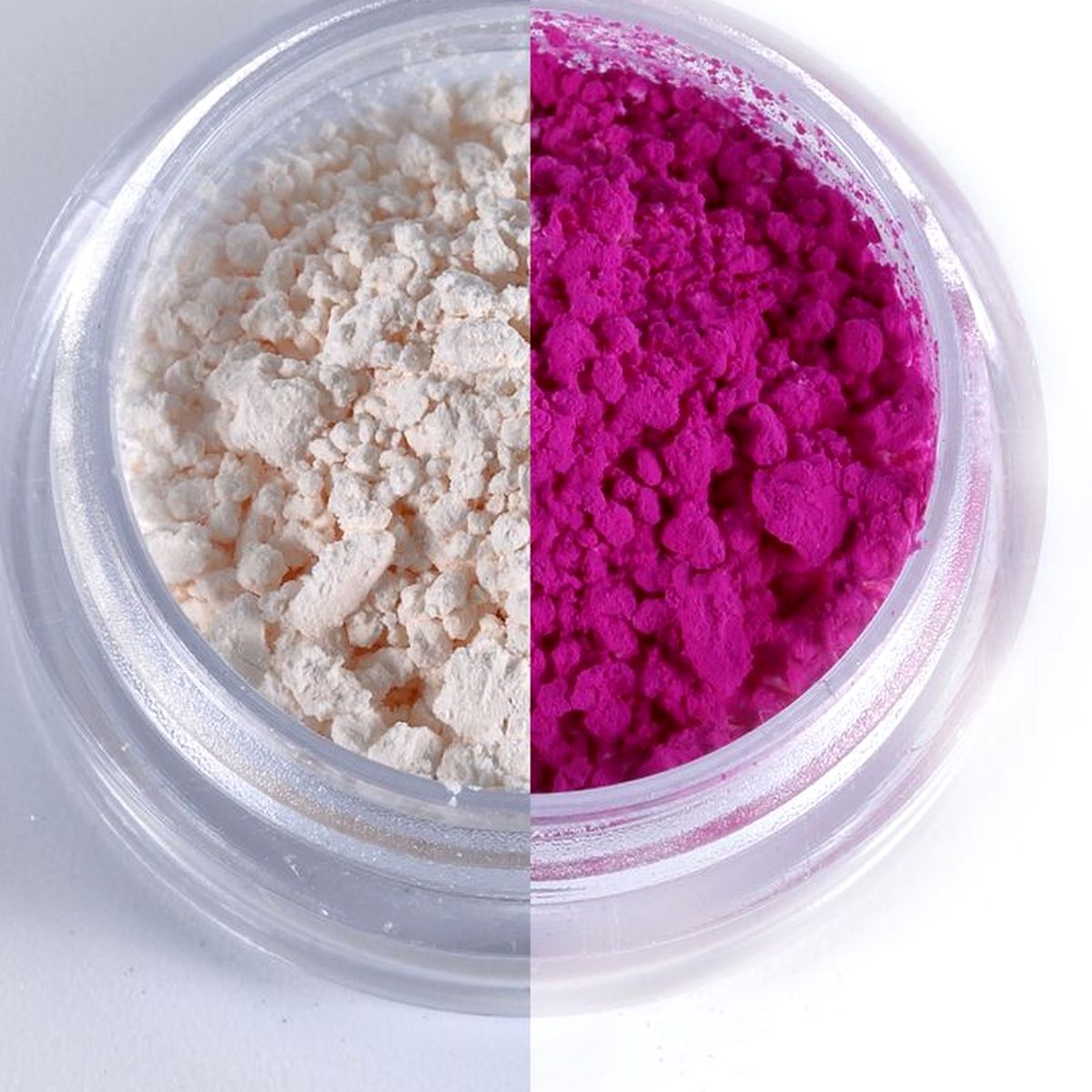
Fig. 7 — Close in, the powder is a mass of fine capsules rather than ground mineral. Hence process limits that read like handling rules.
A sample can be judged in an afternoon with a UV lamp, a stopwatch and your own substrate. Fix the lamp, the distance and the exposure time. A phone torch is not a light source for this, and daylight through a window changes by the hour.
Take the readings on the material you will sell, not on loose powder. The first says whether the effect is strong enough to build on. The second says whether the object looks right back indoors. The third says what the product is worth outside.
| Reading | How to take it | A low number points to |
|---|---|---|
| Depth after a set exposure | One lamp, one distance, a fixed number of seconds, read against a colour chip | A film too thin, a loading too low, or UV that never reached the capsules |
| Half-return time | Lamp off, clock running, to half the original depth, at the service temperature written beside it | A binder too rigid, or a service temperature colder than the one you tested at |
| Depth kept after repeat cycling | The same exposure repeated, read at the start and again after a set number of cycles | A cumulative UV dose already high, or capsules partly broken in the process |
Write the temperature beside every number. A half-return time without one is not a measurement.
Minimum order is 1 kg. Stock codes ship within two weeks; a scheduled or custom-matched code runs three to four weeks. Payment is online bank payment, T/T, Western Union or PayPal. Our quality management system is ISO 9001:2015 certified.
Documents follow the code and the destination market. REACH, RoHS, Halal, Kosher, US FDA registration and independent SGS test reports come on request, and a safety data sheet travels with every code. Certificates are named, not numbered.
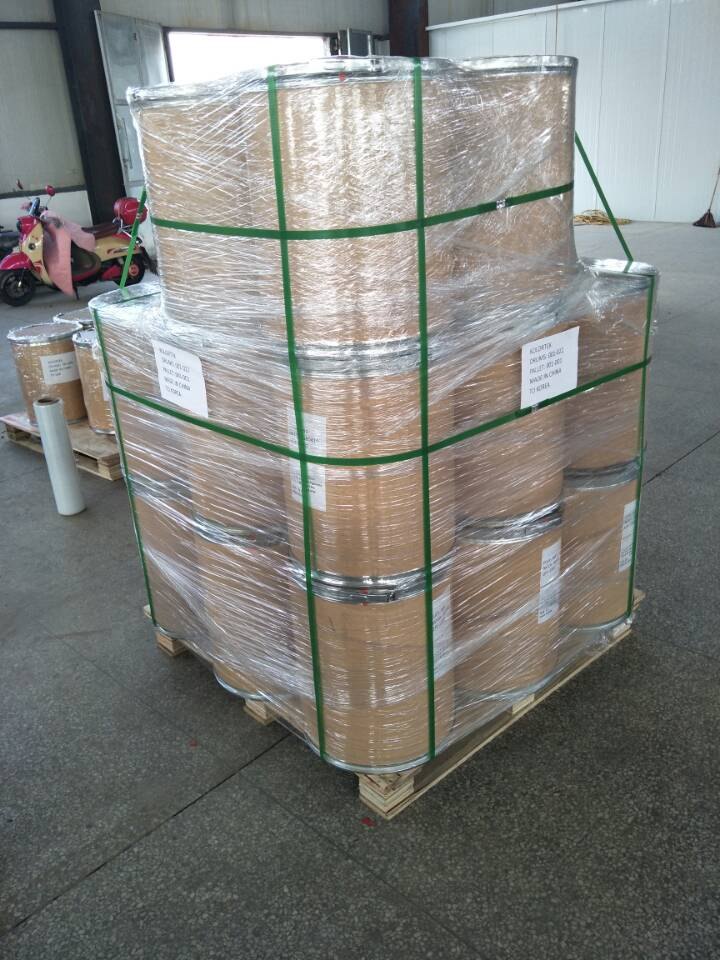
Fig. 8 — Packed and wrapped for dispatch. Stock codes leave inside two weeks.
Every code, colour and particle size is listed in the photochromic pigments catalogue. The UV-activated range page covers the colourless side, the printing grade covers ink and coating work, and the single-code pages for blue, yellow to purple and green to grey show one grade from each side of that split.
Once you know which leg of the cycle the product has to live on, the specification shortens to three lines: code, binder, service temperature. The quotation follows that specification, and it brings a fade-back figure you can check on your own substrate, at your own temperature. Send us the code, the binder and the service temperature.
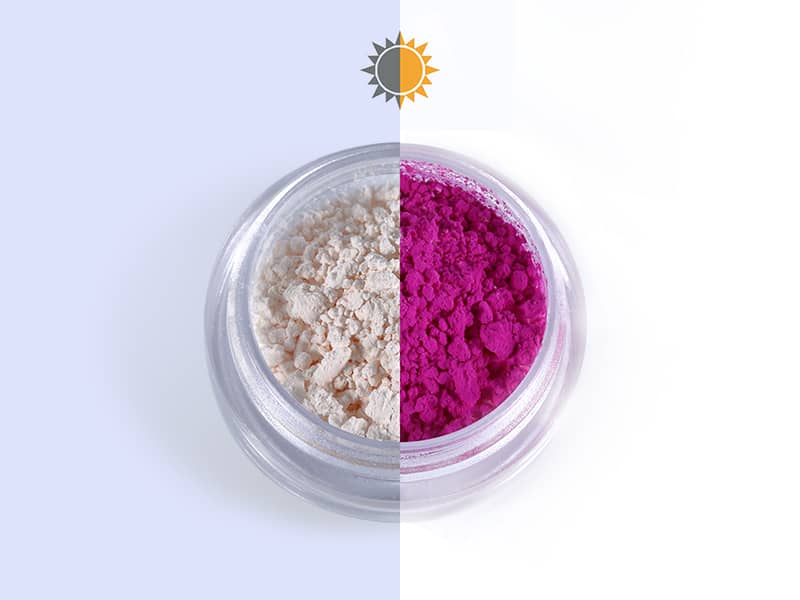
Photochromic Pigments change color in response to UV light exposure, transitioning from a pale or near-colorless state indoors to a saturated color within seconds of UV exposure, then reversing when the UV source is removed. The KPMC series is available in multiple colors with a particle size of 1–10 µm, suitable for inks, coatings, plastics, and cosmetic formulations where a UV-activated color response is required.
Read More
Photochromic pigment and powder: colour arrives in sunlight, leaves when the matrix lets it. Fade-back is the spec nobody asks for. 1 kg MOQ, ISO 9001:2015.
Read More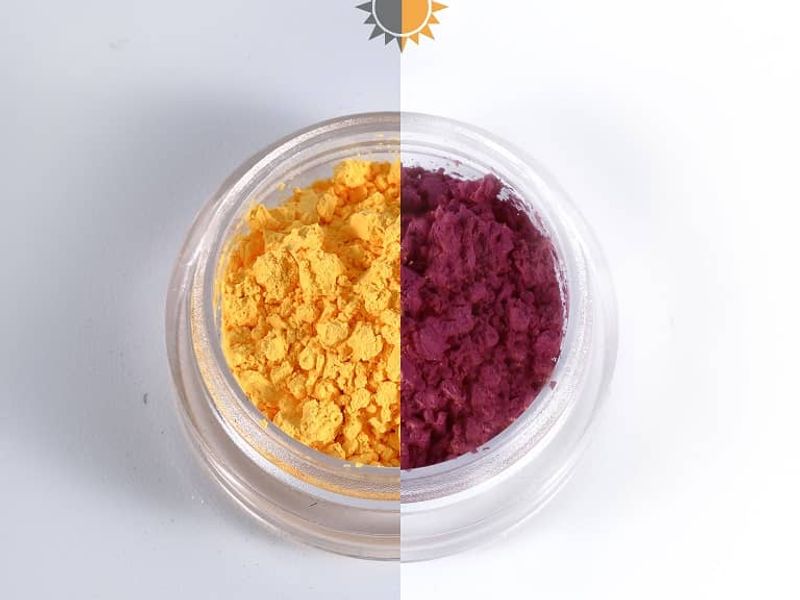
KT-PMC-02-YP is a Yellow/Purple photochromic pigment in the fine 1–10μm particle size range — a UV-reactive organic pigment that appears pale yellow in the absence of UV light and shifts to a deep purple within approximately one second of exposure to direct sunlight or UV illumination.
Read More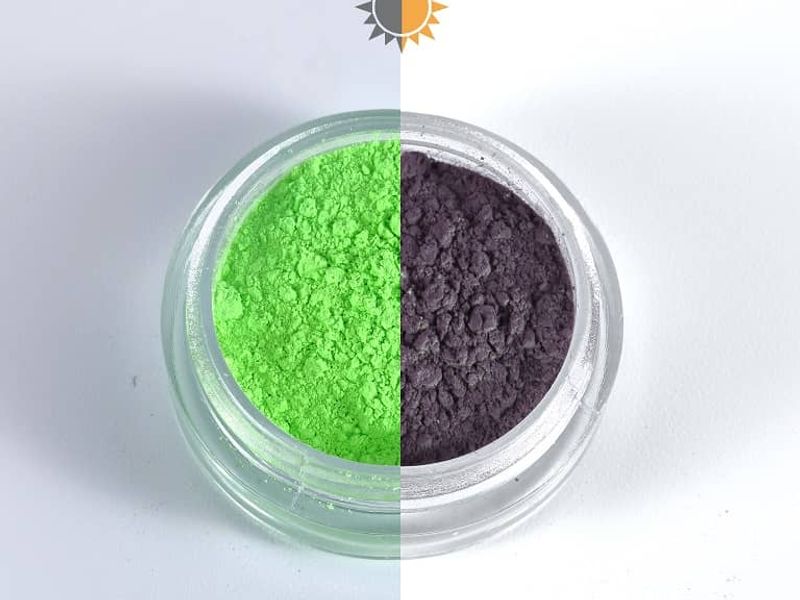
KT-PMC-06-GG is a Green/Grey photochromic pigment in the fine 1–10μm particle size range — a UV-reactive pigment that appears green under standard indoor lighting and shifts to grey when exposed to direct sunlight or UV irradiation.
Read More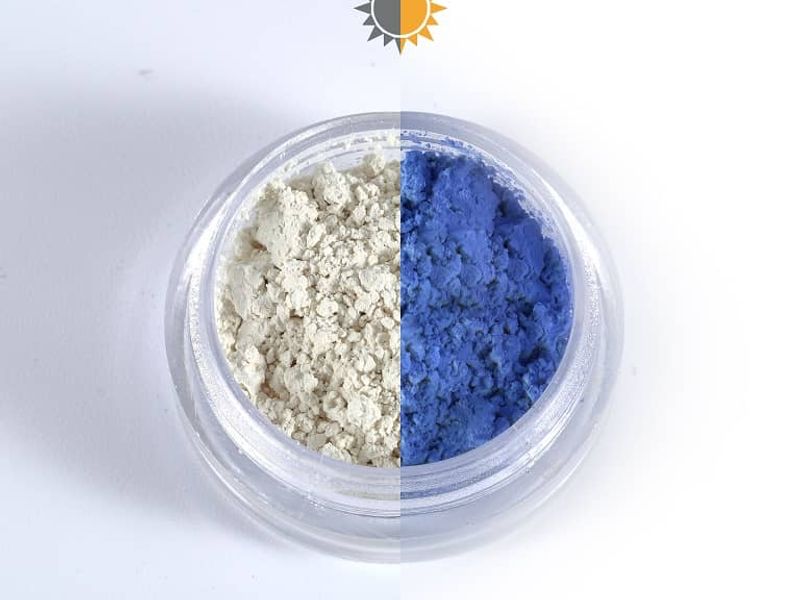
KT-PMC-14-BA is a Blue photochromic pigment in the fine 1–10μm particle size range — a UV-reactive single-color activated grade that appears pale or near-colorless under standard indoor lighting and shifts to a deep blue within approximately one second of exposure to direct sunlight or UV irradiation.
Read More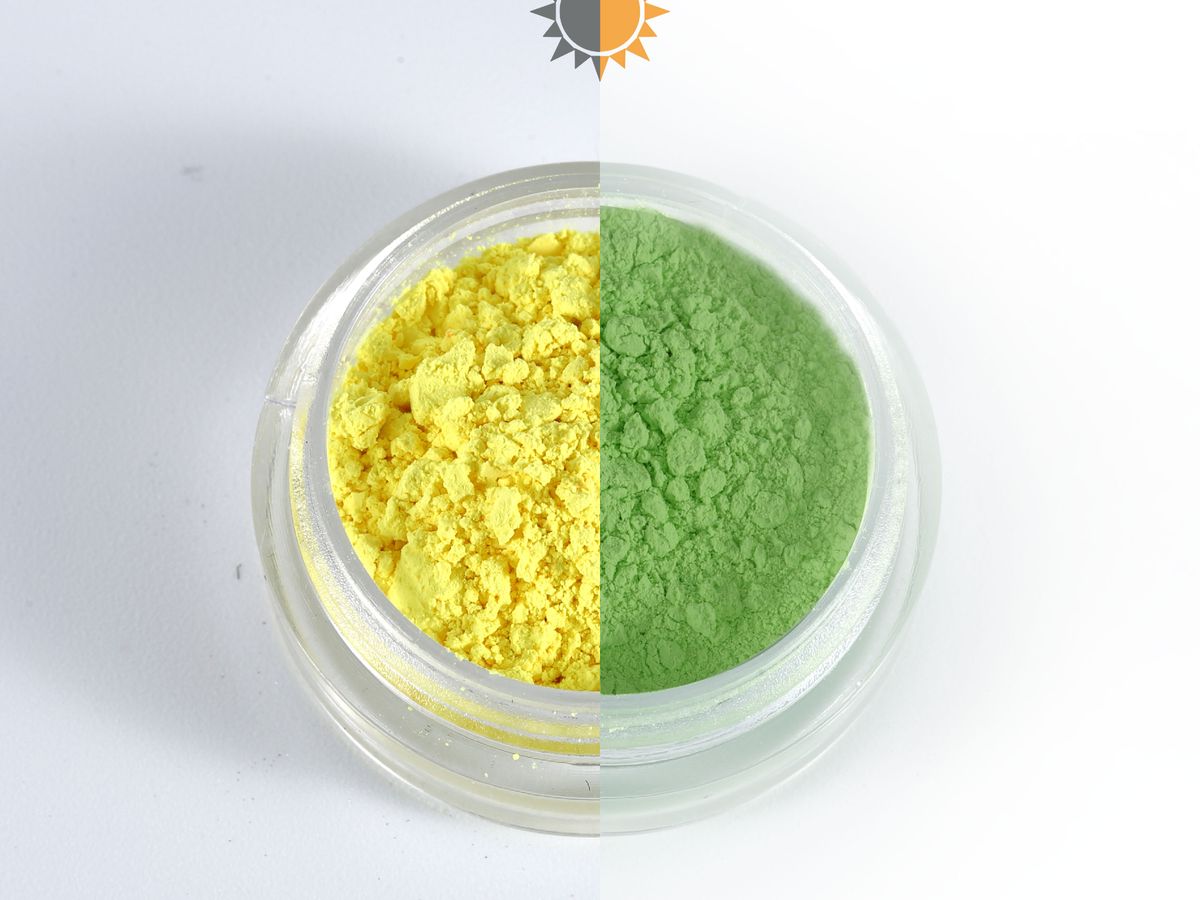
This photochromic pigment shifts from a pale or clear state to a deep, rich color within one second of direct sunlight, then reverses indoors. Fine particle sizing makes it a workable printing pigment for inks, screen printing, and surface effects, with both clear-to-color and color-to-color options across purple, blue, red, green, and more. As a UV activated pigment, it stays dormant until sunlight or UV hits the substrate — no external power, no coating, just light.
Read More
 English
 Français
 Deutsch
 Русский
 Español
 Português