Leave A Message
If you are interested in our products and want to know more details,please leave a message here,we will reply you as soon as we can.
Yellow to Purple Photochromic Pigment, UV Reactive – KT-PMC-02-YP
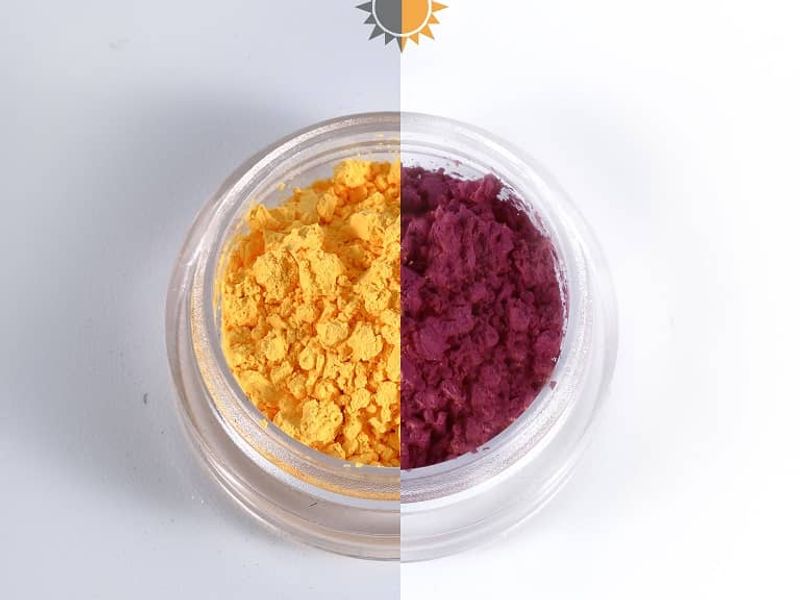
KT-PMC-02-YP is a Yellow/Purple photochromic pigment in the fine 1–10μm particle size range — a UV-reactive organic pigment that appears pale yellow in the absence of UV light and shifts to a deep purple within approximately one second of exposure to direct sunlight or UV illumination.
Item No. :
KT-PMC-02-YPColor Effect :
Yellow/PurpleParticle Size :
1–10 µmBrand :
Kolortek / OEMMOQ :
1KGApplication :
Printing Inks, Textiles, Toys & Novelty, Cosmetics, Packaging, Decorative Coatings, Plastics, Craft
Yellow to Purple Photochromic Pigment, UV Reactive – KT-PMC-02-YP
Special Effect Pigments › Photochromic Pigment Series
KT-PMC-02-YP is a Yellow/Purple photochromic pigment in the fine 1–10μm particle size range — a UV-reactive organic pigment that appears pale yellow in the absence of UV light and shifts to a deep purple within approximately one second of exposure to direct sunlight or UV illumination. The color change is fully reversible: the purple fades back to yellow within seconds of moving out of UV exposure. At 1–10μm, KT-PMC-02-YP disperses in printing inks, coatings, nail lacquer, and plastic systems without visible particle texture, making it suitable for any application where a clean UV-activated yellow-to-purple color shift is the design brief.
Photochromic pigments use organic molecular switches — typically spiropyrans, naphthopyrans, or diarylethene compounds — that undergo a reversible structural isomerization under UV irradiation. In the UV-absent state, the molecule adopts a ring-closed (colorless or pale) conformation. UV exposure opens the ring and generates a chromophore that absorbs visible light, producing the colored state. Removal of UV allows thermal or photochemical reversion to the closed form. The transition is fast — seconds for activation, seconds to minutes for reversion depending on temperature and specific chemistry.
Key distinctions from related pigment types: Thermochromic pigments (KTP series) respond to temperature, not UV. Fluorescent pigments (KT-FDS series) require continuous incident light to produce their effect but do not change color in response to UV — they emit at a fixed wavelength. Glow-in-the-dark pigments store energy and emit in the dark. Photochromic pigments are UV-specific color changers — they are pale or colorless indoors under standard artificial lighting (which contains minimal UV) and become deeply colored in direct sunlight or near UV-lamp exposure.
| Item No. | UV-Off State (Pale) | UV-On State (Deep Color) | Color Contrast |
|---|---|---|---|
| KT-PMC-12-PA | Pale / colorless | Purple | High — colorless to purple |
| KT-PMC-14-BA | Pale / colorless | Blue | High — colorless to blue |
| KT-PMC-16-YA | Pale / colorless | Yellow | Moderate — colorless to yellow |
| KT-PMC-17-OA | Pale / colorless | Orange | High — colorless to orange |
| KT-PMC-19-RA | Pale / colorless | Red | High — colorless to red |
| KT-PMC-22-GA | Pale / colorless | Green | High — colorless to green |
| KT-PMC-01-YG | Yellow | Green | Adjacent warm-to-cool hue shift |
| KT-PMC-02-YP | Yellow | Purple | High contrast — complementary hue shift |
| KT-PMC-03-PP | Pink | Purple | Adjacent warm-pink to cool-purple |
| KT-PMC-04-YR | Yellow | Red | Warm-family high contrast shift |
| KT-PMC-05-BP | Blue | Purple | Adjacent cool-hue shift |
| KT-PMC-06-GG | Green | Grey | Cool-to-neutral shift |
| KT-PMC-07-GR | Green | Red | High contrast complementary shift |
All Kolortek photochromic grades are at 1–10μm standard particle size. Single-color activated grades (KT-PMC-12-PA through KT-PMC-28-B) appear pale or colorless indoors and shift to their designated color under UV. Two-color shift grades (KT-PMC-01-YG through KT-PMC-07-GR) are visibly colored in both UV-off and UV-on states.
| Parameter | Value / Notes |
|---|---|
| Item No. | KT-PMC-02-YP |
| UV-Off Color (indoors) | Yellow — pale to medium yellow without UV exposure |
| UV-On Color (sunlight / UV lamp) | Purple — deep purple under direct UV irradiation |
| Color Contrast | High — yellow and purple are near-complementary hues; maximum visible color shift distance in the series |
| Effect Type | Photochromic (UV-reactive) — activated by UV/sunlight; inactive under standard indoor artificial lighting |
| Activation Trigger | Direct sunlight, UV lamp (365nm range) — NOT activated by standard fluorescent, LED, or incandescent indoor lighting |
| Activation Speed | ~1 second under direct sunlight to reach deep purple state |
| Reversion Speed | Seconds to minutes after UV removal — temperature-dependent (faster reversion at higher ambient temperature) |
| Particle Size | 1–10μm |
| Reversibility | Fully reversible — repeatable UV on/off cycling under normal conditions |
| UV Fatigue | Performance decreases with cumulative UV exposure over time — fatigue resistance varies by binder and formulation conditions |
| Binder Compatibility | Water-based, solvent-based, UV-curable — confirm for specific systems; avoid strong oxidizing environments |
| Documentation | TDS, SDS on request |
| Brand | Kolortek |
Yellow-to-purple — the maximum color wheel distance in the two-color photochromic range: Yellow and purple sit on near-opposite sides of the visible color spectrum. Among the Kolortek two-color photochromic grades, KT-PMC-02-YP produces one of the highest contrast shifts available — the visual change between the yellow UV-off state and the purple UV-on state is immediately apparent to the eye without requiring close inspection. For applications where the color change needs to be clearly visible and functionally obvious — outdoor apparel, consumer novelty products, promotional packaging — the yellow/purple shift provides strong visual communication of UV exposure.
Indoor vs. outdoor — the UV dependency that defines the product category: Standard indoor artificial lighting — LED, fluorescent, incandescent — contains minimal UV. KT-PMC-02-YP remains yellow under these conditions. Direct sunlight, outdoor daylight (even on overcast days to a lesser degree), and UV lamps (blacklight, 365nm) provide sufficient UV to activate the purple state. This means the product reads yellow in the home, office, or retail environment and purple in direct outdoor light — a clean visual UV indicator. The activation is not gradual; it is fast (approximately one second in direct sun) and the color shift is clear.
UV fatigue — the primary durability limitation of organic photochromic pigments: Photochromic organic molecules gradually lose switching efficiency with cumulative UV exposure over time. The color depth in the activated state decreases, and the reversion speed may change. The rate of fatigue depends on the UV intensity, the binder system, protective additives (UV absorbers at the right wavelength can either compete with the photochromic or protect it depending on concentration), temperature, and oxygen exposure. For outdoor applications with high cumulative UV load — apparel, exterior surfaces — fatigue testing under your specific conditions is necessary to establish expected product service life. For shorter-cycle applications — promotional products, seasonal use, novelty items — fatigue rate is less likely to be a limiting factor within the product lifecycle.
UV-curable system compatibility note: Photochromic pigments can be formulated in UV-curable binders, but the UV cure step must be managed carefully. A high-dose UV cure applied to the uncured film will activate the photochromic pigment — the film may appear purple during cure and transition back to yellow as the binder cures and the pigment reverts. This is a cosmetic issue during production rather than a functional problem in the cured film, but it can make color quality assessment during production difficult. Confirm the cure protocol and its effect on final film color with bench testing before production specification.
| Application | How KT-PMC-02-YP Contributes | Notes |
|---|---|---|
| Nail lacquer | Yellow-to-purple UV-reactive nail color — changes in direct sunlight, returns indoors | Fast activation (~1 sec in direct sun); compatible with nitrocellulose and gel bases; verify cosmetic compliance |
| Printing inks | UV-reactive yellow/purple in screen, flexo, and specialty inks for outdoor labels, promotions, security | 1–10μm suits most printing systems; add at final low-shear stage |
| Coatings & paints | Outdoor UV-reactive color change in decorative coatings, promotional paints, children's outdoor products | Fatigue test for cumulative outdoor UV load; protective binder recommended for extended service life |
| Plastics | UV-activated yellow-to-purple color change in molded and extruded plastic products | Confirm processing temperature limits; 1–10μm disperses in masterbatch |
| Textiles & apparel | UV-reactive color change in outdoor sportswear, promotional apparel, accessories | Evaluate fatigue rate for expected washing cycles and UV exposure; apply in protective binder |
| Cosmetics | UV-reactive makeup effects in eye shadow, lip products — transitions in outdoor light | Verify cosmetic regulatory compliance in target market; confirm skin safety documentation |
Q: Will KT-PMC-02-YP activate under indoor LED or fluorescent lighting?
A: Standard indoor artificial lighting — LED, fluorescent, incandescent — contains insufficient UV to activate photochromic pigments under normal conditions. KT-PMC-02-YP remains in its yellow state indoors under these light sources. Direct sunlight, outdoor daylight (including partially cloudy days), and UV lamps (365nm blacklight) provide sufficient UV for activation. UV output varies by specific light source — some specialized LED fixtures emit UV and may partially activate the pigment, but standard commercial and residential lighting does not. This UV-specificity is the core functional characteristic of photochromic pigments and should be communicated to end users of products containing KT-PMC-02-YP.
Q: How does KT-PMC-02-YP (two-color yellow/purple) differ from KT-PMC-12-PA (colorless/purple)?
A: KT-PMC-12-PA appears pale or colorless indoors and shifts to purple under UV — indoors the product has no significant body color. KT-PMC-02-YP appears yellow indoors and shifts to purple under UV — the product is visibly yellow at all times and purple under UV. Choose KT-PMC-12-PA when you want the product to appear neutral or colorless indoors and only show color outdoors. Choose KT-PMC-02-YP when you want the product to have a warm yellow indoor color that dramatically shifts to purple in sunlight — the product is always colored, just differently by environment.
Q: How long does the purple color last once the product moves out of direct sunlight?
A: Reversion from purple back to yellow begins immediately upon UV removal. The rate depends primarily on ambient temperature — warmer temperatures accelerate reversion; cooler temperatures slow it. In typical outdoor conditions moving from direct sun to shade, visible reversion begins within seconds and the yellow state is substantially restored within 1–5 minutes. In a cool, dark indoor environment, reversion may take slightly longer. This means the purple state is not persistent — it is present only when the product is actively exposed to UV.
Photochromic color change performance — activation speed, purple depth, and reversion behavior — should be evaluated in your specific formulation system and under your actual UV conditions. Contact Kolortek to request a sample of KT-PMC-02-YP alongside other photochromic grades, download the TDS, or discuss the full photochromic series for your application.
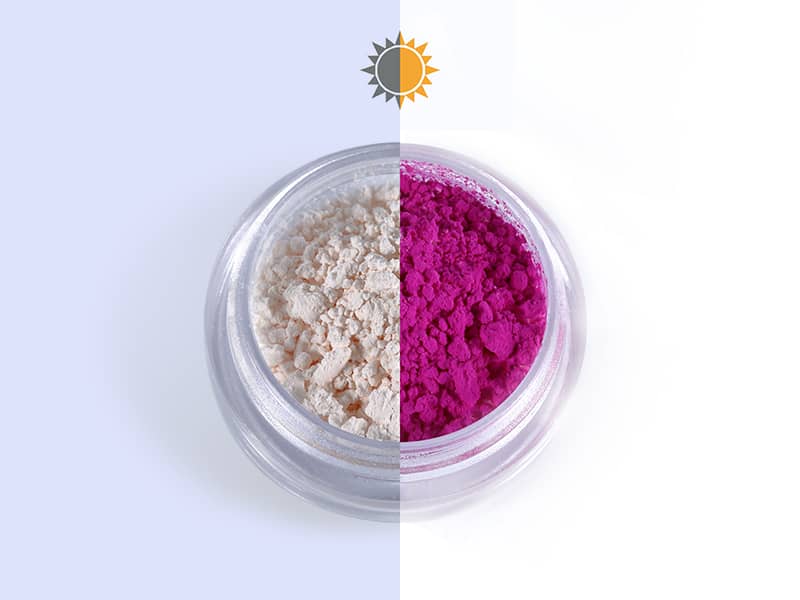
Photochromic Pigments change color in response to UV light exposure, transitioning from a pale or near-colorless state indoors to a saturated color within seconds of UV exposure, then reversing when the UV source is removed. The KPMC series is available in multiple colors with a particle size of 1–10 µm, suitable for inks, coatings, plastics, and cosmetic formulations where a UV-activated color response is required.
Read More
KT-PMC-02-YP is a Yellow/Purple photochromic pigment in the fine 1–10μm particle size range — a UV-reactive organic pigment that appears pale yellow in the absence of UV light and shifts to a deep purple within approximately one second of exposure to direct sunlight or UV illumination.
Read More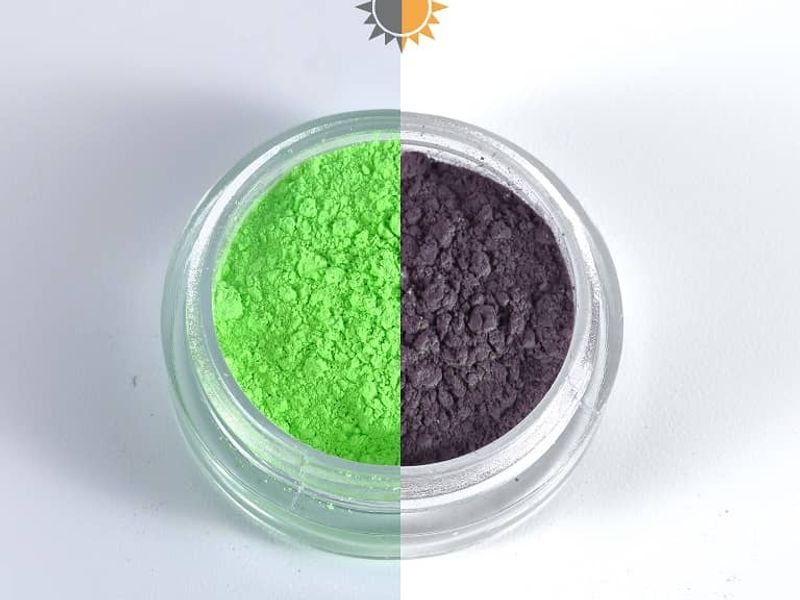
KT-PMC-06-GG is a Green/Grey photochromic pigment in the fine 1–10μm particle size range — a UV-reactive pigment that appears green under standard indoor lighting and shifts to grey when exposed to direct sunlight or UV irradiation.
Read More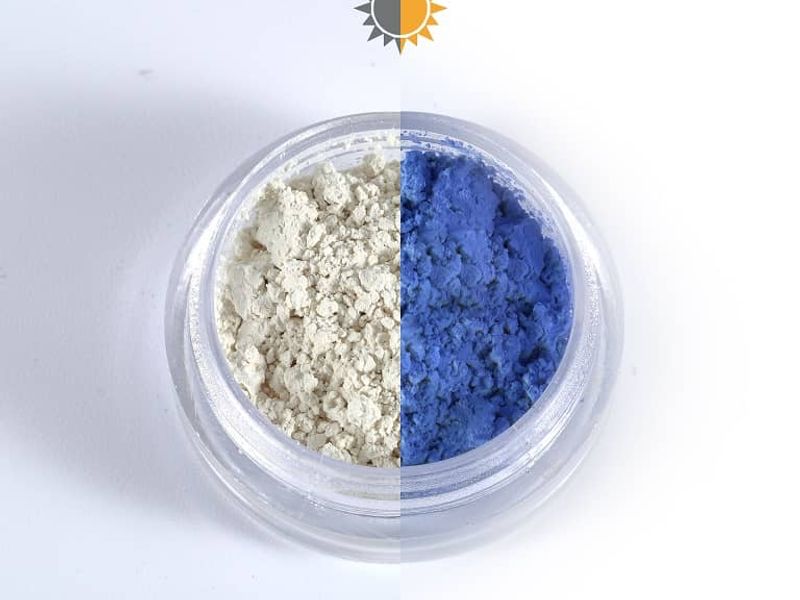
KT-PMC-14-BA is a Blue photochromic pigment in the fine 1–10μm particle size range — a UV-reactive single-color activated grade that appears pale or near-colorless under standard indoor lighting and shifts to a deep blue within approximately one second of exposure to direct sunlight or UV irradiation.
Read More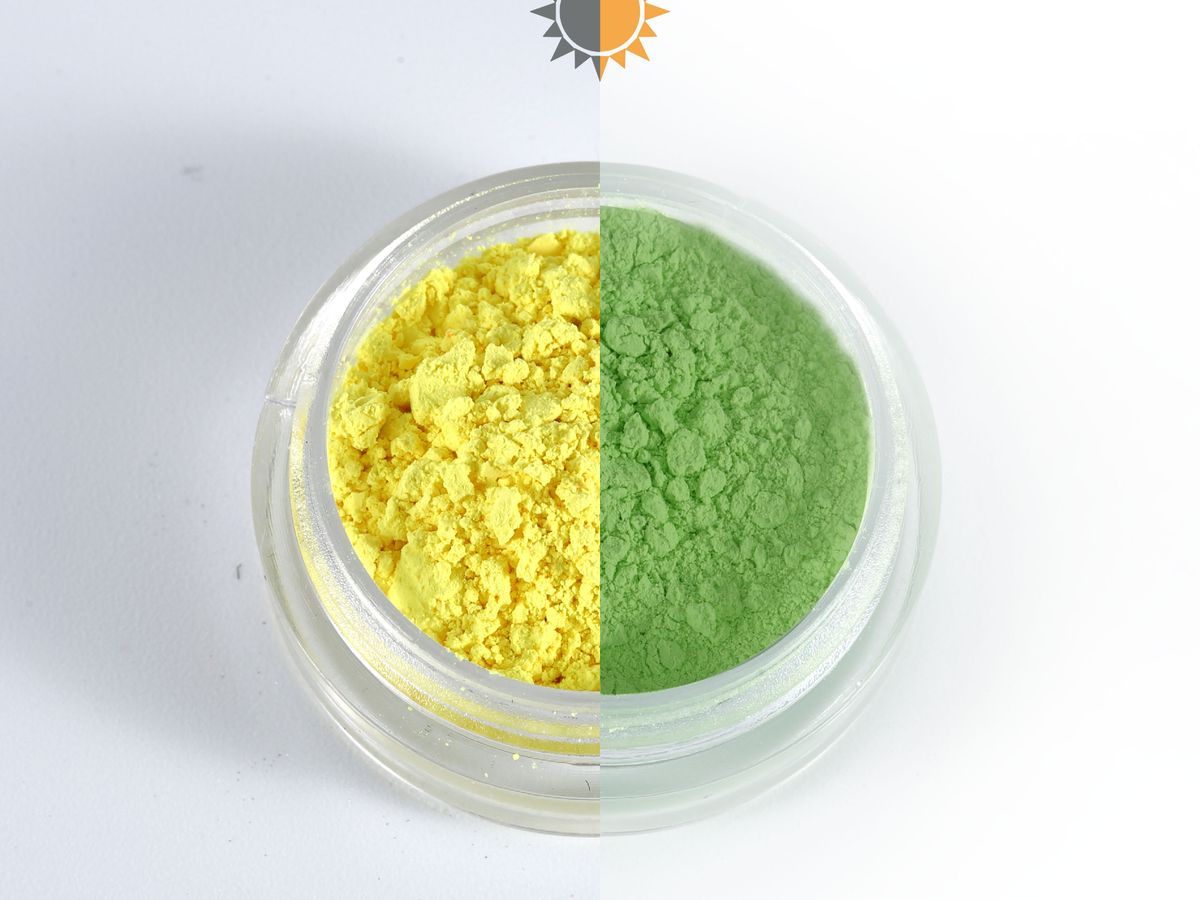
This photochromic pigment shifts from a pale or clear state to a deep, rich color within one second of direct sunlight, then reverses indoors. Fine particle sizing makes it a workable printing pigment for inks, screen printing, and surface effects, with both clear-to-color and color-to-color options across purple, blue, red, green, and more. As a UV activated pigment, it stays dormant until sunlight or UV hits the substrate — no external power, no coating, just light.
Read More
 English
 Français
 Deutsch
 Русский
 Español
 Português