
Leave A Message
If you are interested in our products and want to know more details,please leave a message here,we will reply you as soon as we can.
Cat Eye Pigment Family Guide: Cosmetic, Nail and Ink Grades
Twenty-four cat eye families in one range: the grade label, size window and effect name of each, and why two codes both called Gold are not interchangeable.
Item No. :
3D Cat Eye series — 24 families: KT-3DMG1** / 3DMG2**S / KT-3D-9** / 3D-91*F / 3D-94* / 3D-95* / 3D-93* / 3D-97* & 3D-98* / 3D-9771** / 3D-9776* / 3D-9772*S / 3D-977**S / 3D-M90* / 3D-M91* / 3D-M1** / 3D-M4** / 3D-91** / 3D-M93**D / 3D-911**SS / 3D-9774*Color Effect :
Magnetic cat eye effect — platelets align in a field and the pattern is frozen when the film cures; families range from colour-travel shift blocks to satin, silk, crystal, starlight and flash finishesParticle Size :
Fourteen numeric windows from 1–15 μm to 10–150 μm; the printing-ink and solvent-resistant nail families both sit at 5–15 μm; magnetic chameleon flakes are supplied as irregular large flakes with no numeric windowComposition :
Quoted per grade — CAS and composition details are provided on request for the selected code rather than stated across the rangeBrand :
KolortekMOQ :
Set per family and per pack size; quoted against the selected code, window and target volumeApplication :
Colour cosmetics (18 cosmetic-grade families), solvent-resistant nail systems (3D-91** at 5–15 μm), printing ink (3DMG2**S at 5–15 μm); four unlabelled families are graded per orderThe name Gold appears on more than one product. KT-3D-909 runs 10–40 μm and its family carries no grade label; 3D-959 runs 5–65 μm and its family is marked cosmetic. Same word, different product, different process window. The unit you order is the grade, not the colour name — which is why a colour card on its own cannot produce a quote.
Colour names repeat across families and the window moves with them. Green-Purple appears at 20–60 μm in one family, at 10–60 μm in two others. A colour card tells you what the powder looks like in a jar; it does not tell you which code you need to buy.
How the band forms is a separate question, and the 3D cat eye mechanism page answers it. What that page does not answer is which grade belongs in your quotation. That is the question here.
Three decisions separate a look from a shippable grade: the grade label on the family, the size window, and the effect name. They are applied in that order, because each one removes options that the next cannot restore.
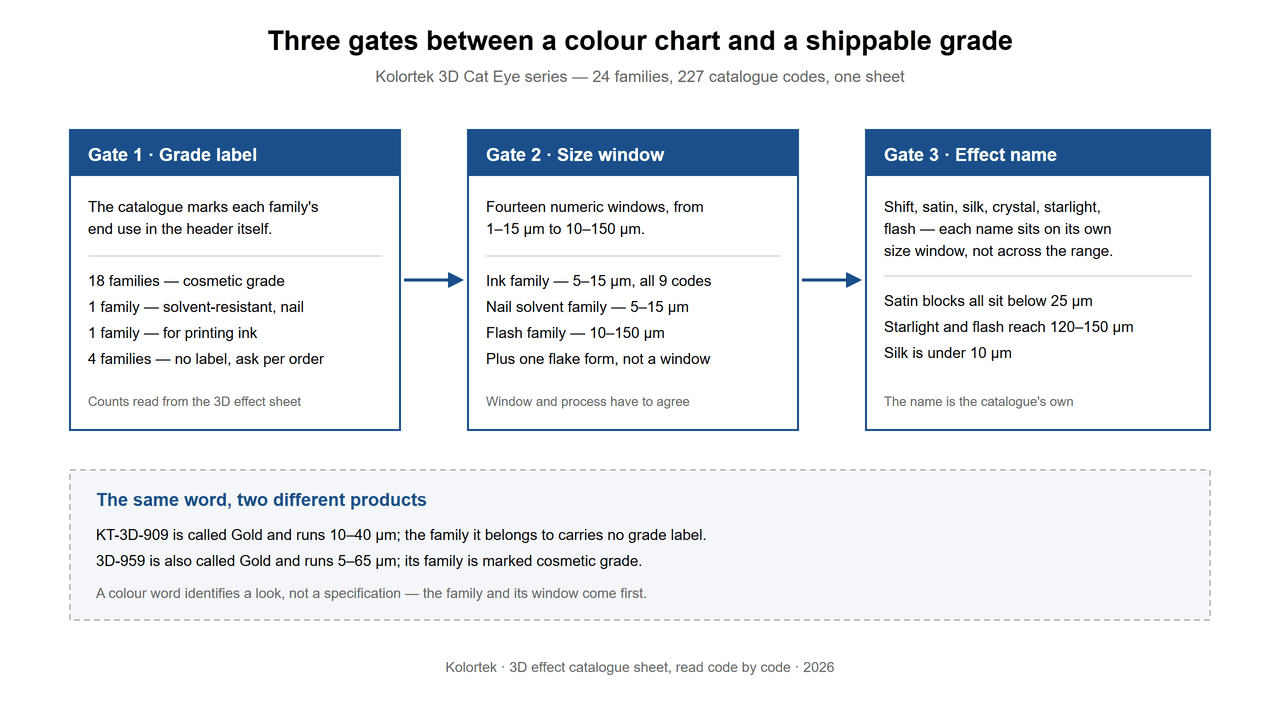
Fig. 1 — The three gates, in the order they have to be applied. The grade label sits in the family header on the catalogue sheet, the size window beside each code, and the effect name in the family name itself.
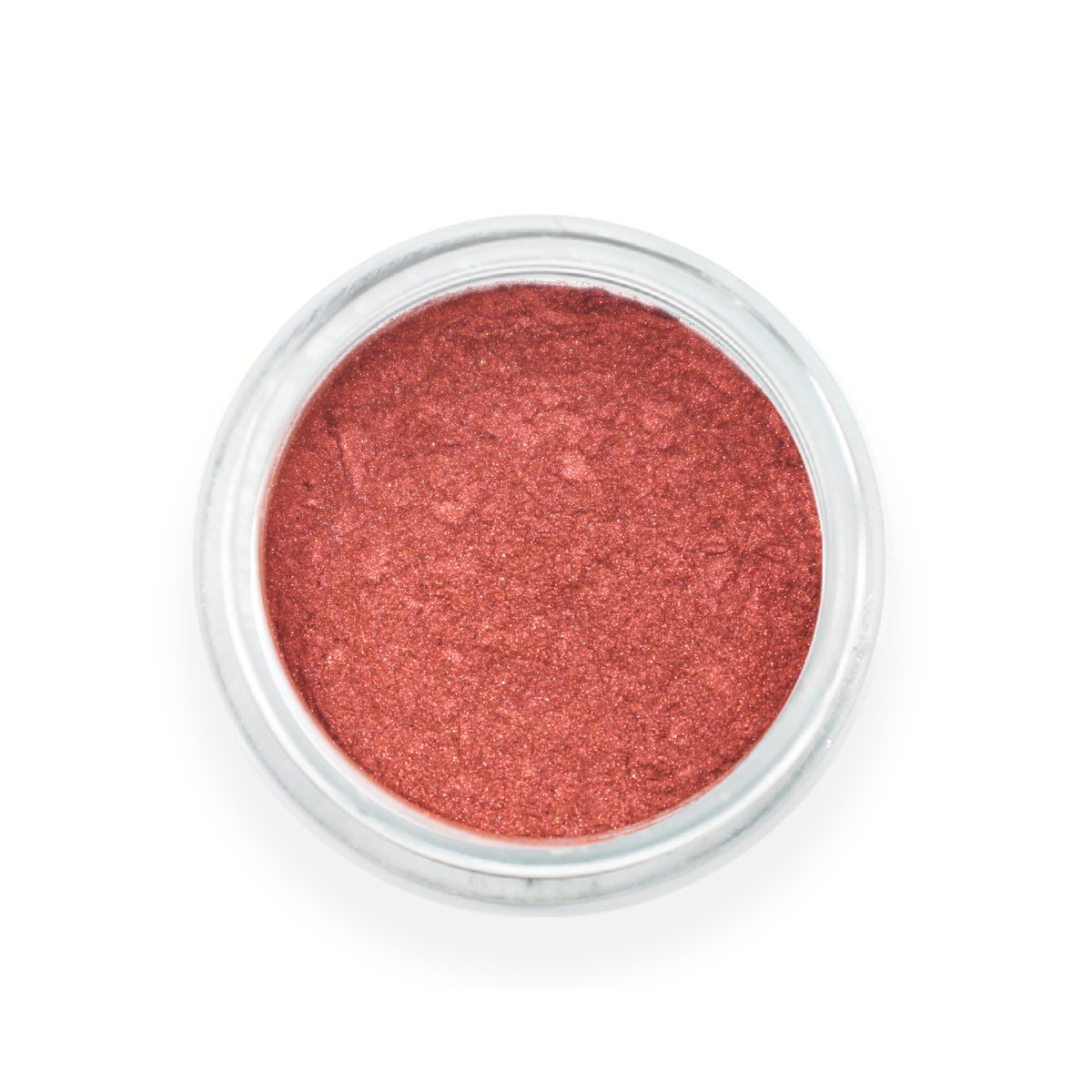
Fig. 2 — A 3D cat eye grade as delivered. The band that makes the eye is produced later, by a magnet over a wet film — it is not in the powder.
The 3D effect sheet marks end use in the family header rather than in a separate column, which is why it is easy to read past. The headers sort into four kinds of marking: cosmetic grade, solvent-resistant nail use, printing ink, and no label at all — and that last group is the one that needs a conversation.
These are the blocks you can quote into a colour cosmetic without opening a grade conversation: 3D-95*, 3D-93*, 3D-97* and 3D-98*, 3D-9771**, 3D-9776*, 3D-9772*S, 3D-977**S, 3D-M90*, 3D-M91*, 3D-M1**, 3D-M4**, 3D-M93**D, 3D-911**SS, 3D-9774*, 3D-M941*, 3D-M942*, 3D-97731** and 3D-M96*. Their size windows still differ, which is the next gate, but the grade question is already closed.
Eighteen out of 24 is worth pausing on, because it means the range was built around the colour-cosmetics market rather than retrofitted to it. If you are formulating pressed powder, cream or a gel colour, start inside this group and treat the rest as exceptions. The cosmetics application pages cover the formulation side.
3D-91** Light Pastel is the only family whose header carries the solvent-resistant nail marking. Its grades all sit at 5–15 μm. If your system is a solvent nail lacquer rather than a UV gel, this is where the sheet points first — and the window is fine enough for a thin coat.
Read that carefully in the other direction too. The header says nothing about how the other blocks behave in a solvent system. That is not a statement that they fail; it is a statement that the sheet does not answer the question. Ask per grade, in your own base. For a solvent system built on a different chemistry, the KT-90518 nail gel grade shows how a non-magnetic effect pigment is specified for the same market.
3D-MG2**S is headed as suitable for ink, and all nine of its codes sit at 5–15 μm. That is the window a thin printed film can actually carry: an ink layer is measured in single-figure microns, so a coarse flake would stand out of the surface rather than lie inside it. Nothing else in the range is labelled for ink.
A few blocks carry no label at all: 3D-MG1**, the magnetic chameleon powders, the magnetic chameleon flakes and the multicolor chameleon cat eyes. They are in the catalogue and they ship. The grade is settled per order rather than read off the sheet, so say what the powder will sit in and the answer arrives on the quotation instead of being guessed from a table.
The windows run from 1–15 μm to 10–150 μm, and one block is sold only as irregular large flakes. The window is the variable a buyer's process cannot negotiate: a screen mesh, a film thickness and a magnet's reach all assume a particle size before anything else is decided.
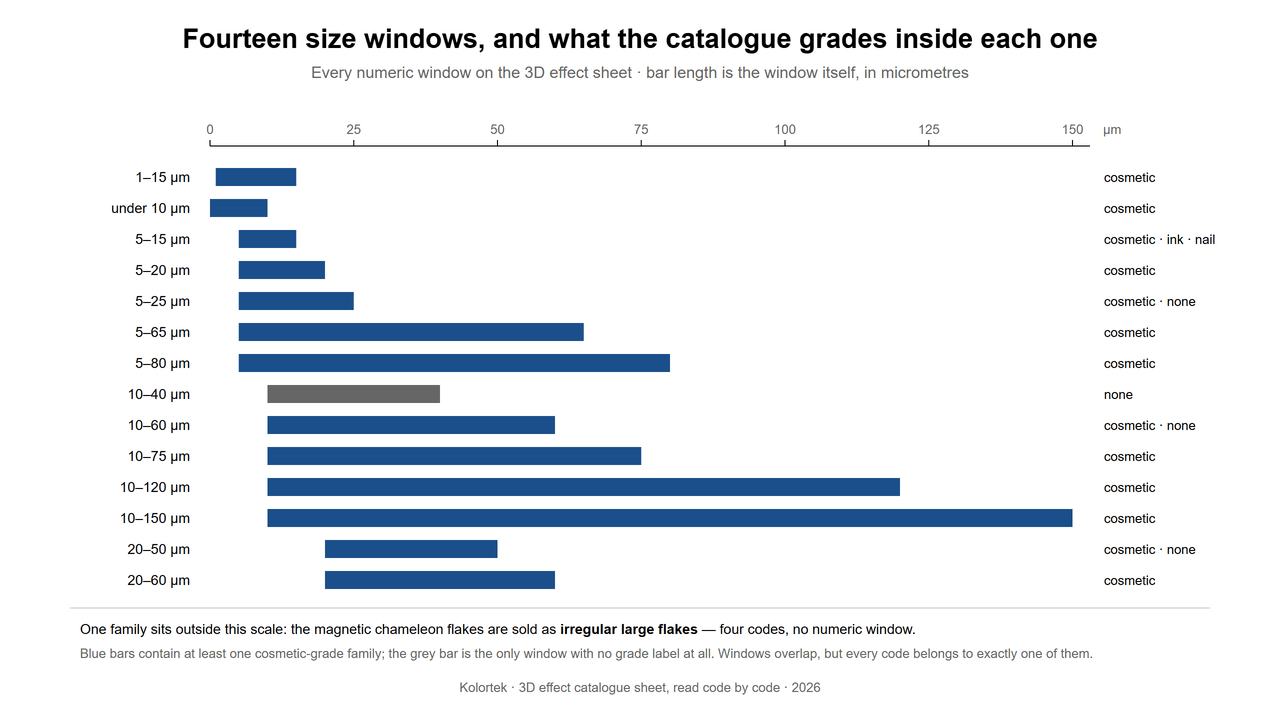
Fig. 3 — Every numeric window on the sheet, with the grade labels that appear inside each one. The bars are the windows themselves, not the particles: a 5–65 μm family spans 60 μm of tolerance, a 5–15 μm family spans ten.
The fine end is where thin films live: several blocks sit entirely below 15 μm, and a couple reach 5–20. A particle cannot hide in a film thinner than itself, so this band is where thin coats, fine detail and printed work are specified. The ink family and the solvent-resistant nail family both land here, at 5–15 μm.
10–60 μm is the most crowded band, which is why a size request on its own rarely narrows the choice. A window that wide tolerates a range of film builds, which is part of why the block with the most codes in it, Color up-1 at 21 codes, lives there. Duochrome stretches to 5–65, Crystal to 10–75 and one multicolor powder block to 5–80.
Starlight runs 10–120 μm and the two flash blocks run 10–150 μm, all three carrying the cosmetic-grade label. At those sizes a particle is large enough to be seen on its own, and the film has to be thick enough to hold it without standing proud of the surface. If your finish is a thin sealer over print, this band is not your shortlist.
The magnetic chameleon flakes sit outside the scale entirely: four codes, sold as irregular large flakes, with no numeric window in the sheet. That is honest rather than convenient — if a customer asks for a specification number, this family does not give you one to quote, and the conversation moves to a sample instead.
The names are the catalogue's own, and each one is attached to a family with its own window rather than to the range as a whole. The table below is the full index as the sheet reads it, grouped by grade label so that it can be read against the first gate.
| Effect block | Grade label | Size window | Pick it when |
|---|---|---|---|
| Magnetic Chromashift | none | 20–50 μm, 5–25 μm (1) | the strongest 3D line on a black base |
| Magnetic Chameleon Powders | none | 10–40 μm, 5–25 μm (7) | a wider size choice inside the magnetic line |
| Magnetic Chameleon Flakes | none | irregular large flakes | visible flakes rather than a smooth field |
| Multicolor Chameleon Cat Eyes | none | 10–60 μm | colour travel inside the eye, not one flat tone |
| Magnetic Chromashift, ink | for printing ink | 5–15 μm | printing rather than coating |
| Light Pastel Cat Eyes | solvent resistant, nail | 5–15 μm | a solvent gel or lacquer system |
| Duochrome Chameleon Cat Eyes | cosmetic | 5–65 μm | the widest band that still carries the cosmetic label |
| Multicolor Chameleon Cat Eyes | cosmetic | 20–60 μm | colour travel inside the eye, not one flat tone |
| Color up, block 1 | cosmetic | 10–60 μm | the widest colour choice in one block |
| Color up, block 2 | cosmetic | 10–60 μm | the same band with a different colour set |
| Color up, block 3 | cosmetic | 20–50 μm | a coarser Color up for a heavier film |
| Luster Satin | cosmetic | 5–15 μm | a satin finish on a thin film |
| Light Satin | cosmetic | 5–20 μm | satin with a slightly wider window |
| Crystal Magnetic Powder | cosmetic | 10–75 μm | a crystalline look and a looser tolerance |
| Starlight Powder | cosmetic | 10–120 μm | the coarsest sparkle in the cosmetic set |
| Light Color Change, M1 | cosmetic | 10–60 μm | a gentle shift rather than a hard arc |
| Light Color Change, M4 | cosmetic | 10–60 μm | the same gentler shift in another palette |
| Multicolor Powder, M93D | cosmetic | 5–80 μm | multicolour across a wide band |
| Solid Color Silk | cosmetic | under 10 μm | the finest satin, minimal texture |
| Fine Satin Multicolor | cosmetic | 5–25 μm | satin and multicolour together |
| Flash Powder, M941 | cosmetic | 10–150 μm | particles large enough to be seen one by one |
| Flash Powder, M942 | cosmetic | 10–150 μm | the same coarse band in another palette |
| Light Color Change, 97731 | cosmetic | 10–60 μm | a gentle shift in the fine-mid band |
| Multicolor Powder, M96 | cosmetic | 1–15 μm | the finest multicolour |
Twelve of the 24 families are shift blocks — the two Chromashift blocks, the two chameleon blocks, the multicolor blocks, Duochrome, the three Color up blocks and the three Light Color Change blocks. Their windows run from 5–65 to 20–50 μm. What separates them is colour travel and code count, not the mechanism: all of them read differently as the piece turns.
Luster Satin at 5–15, Light Satin at 5–20, Fine Satin at 5–25 and Solid Color Silk at under 10 μm are the only families named for a satin or silk finish, and all four sit below 25 μm. The naming is doing real work here: they are not sold as a hard line across the nail, and a buyer who wants that line should not start in this group.
The KT-92275 loose powder is the route to compare against if the brief calls for a cosmetic-grade shift without a magnetic pattern at all.
Crystal runs 10–75 μm, Starlight 10–120 and the two flash blocks 10–150. These are the families where one particle is large enough to be seen on its own. That is the point of the finish and also the reason the film build has to be agreed before the grade is fixed. A different route to a flake-level sparkle is the holographic flake line, which gets its effect from a diffraction structure rather than from alignment.
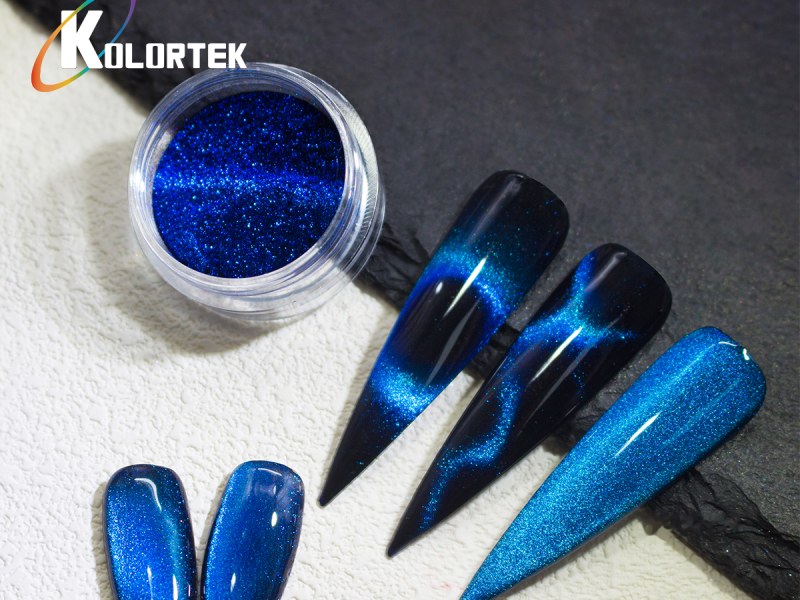
The two photographs below are the same kind of tip, the same white background and the same magnet technique, taken from the same asset set. The first is the 3D-MG1 family at 20–50 μm; the second is Fine Satin at 5–25 μm.
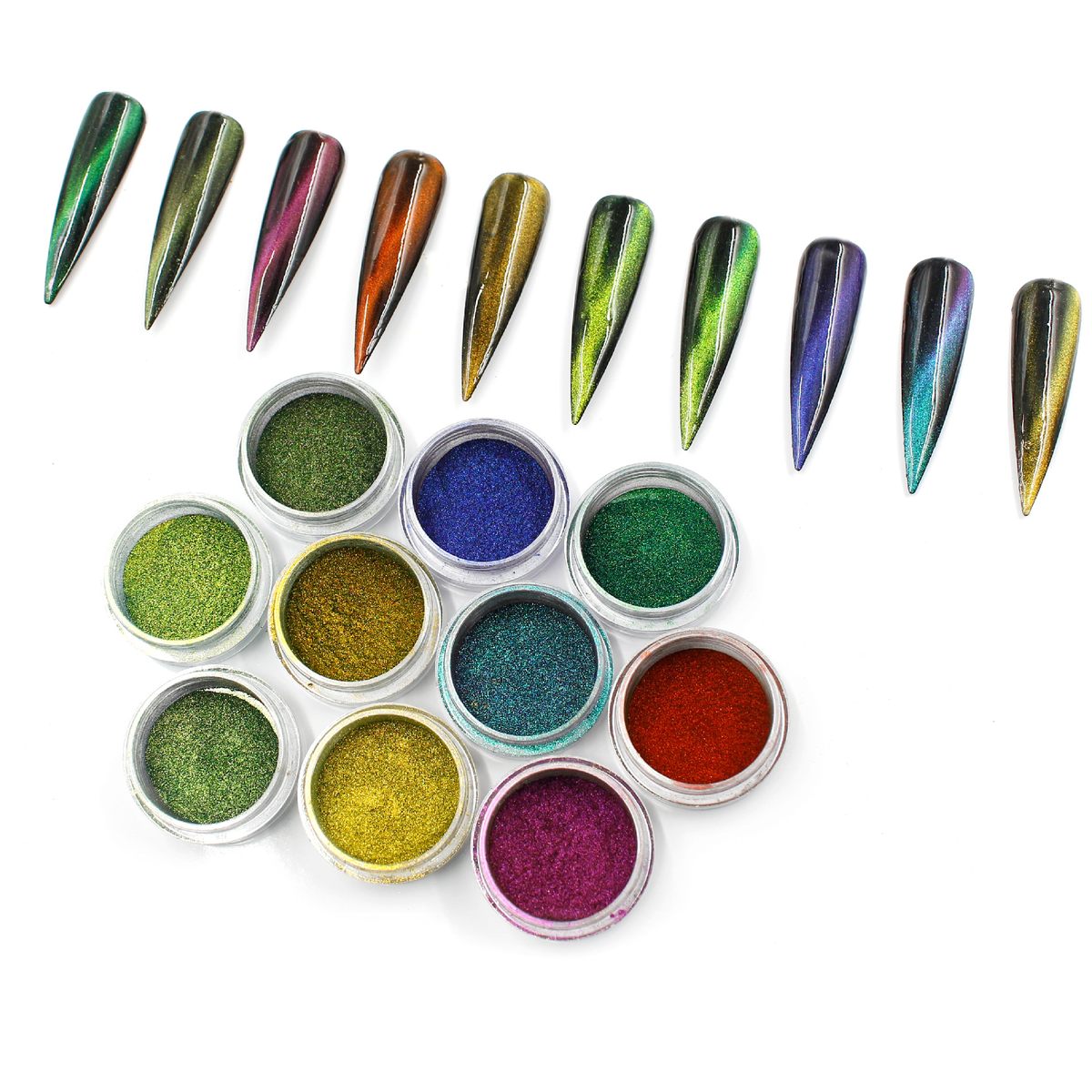
Fig. 4 — The 3D-MG1 magnetic Chromashift family at 20–50 μm, cured on tips above the powders they came from. The band reads as a line you can point at.
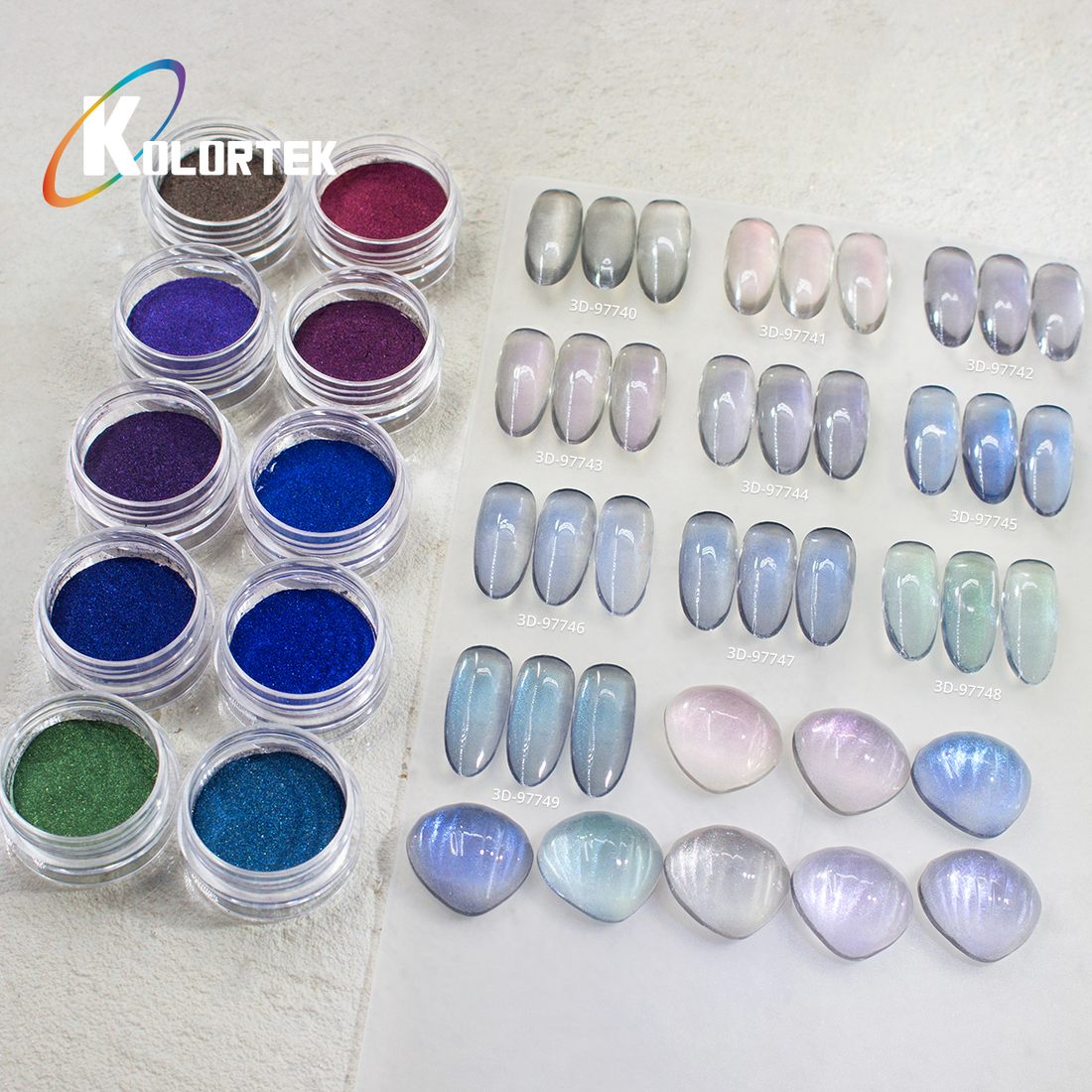
Fig. 5 — Fine Satin 3D-9774* at 5–25 μm, same setup. The codes are printed on the swatch card. The band is present but it reads as a wash rather than a line.
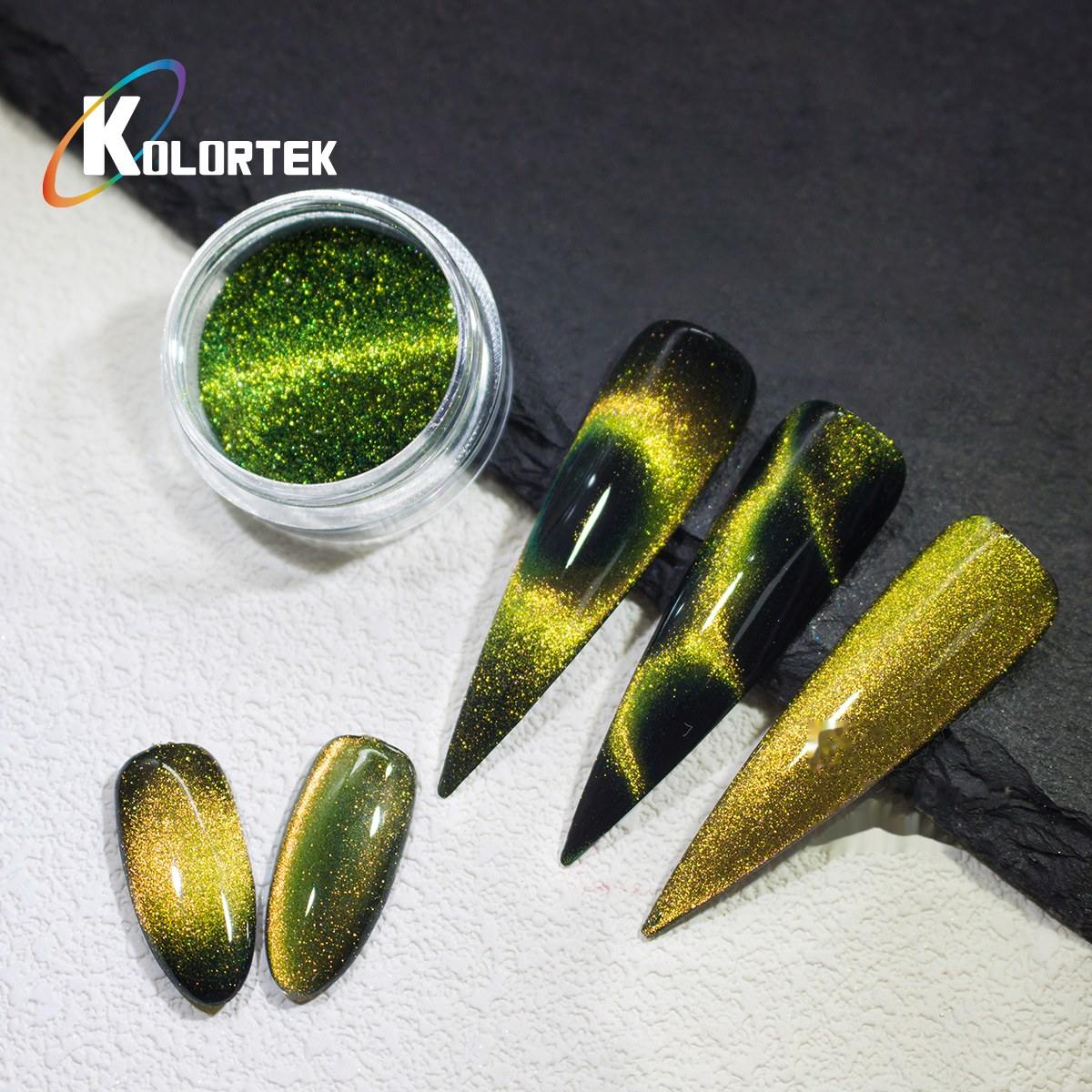
Fig. 6 — One pot of 3D-97715 and five tips coated with it. Every tip carries the same band, pulled in a different direction by the magnet — the powder does not choose the shape.
What the pair proves is narrow and useful: the two families do not look the same on a cured tip, so "cat eye" is not one finish and a colour card cannot tell them apart.
What it does not prove is that your system will reproduce either. Viscosity of the base, the wet film thickness, when the magnet arrives and how long it stays all move the pattern, and none of those are properties of the powder. A photograph settles the choice of family. Only a sample in your own base settles the choice of grade.
MOQ is set per family and per pack size. The cosmetic-grade blocks and the unlabelled blocks do not quote the same way, and a small sample pack is not a production pack. Send the family, the size window and your target volume, and the quotation comes back against that combination instead of against a colour name.
The full collection is in the 3D Cat Eye Magnetic collection download, which lists every grade in the table above.
Production runs under an ISO 9001:2015 certified quality system. For colour cosmetics, open with the blocks carrying the cosmetic label. The declarations your market asks for are provided on request for the specific grade — we do not issue a single statement across the whole range, because the scope depends on the grade and on where the finished product is sold.
Is magnetic pigment the same thing as chameleon pigment?
No. A chameleon pigment changes colour with the viewing angle. A magnetic pigment also aligns in a field, and the alignment is frozen when the film cures, so it adds a pattern that the angle alone does not produce. Several families here do both, which is why the range is split by family rather than by colour.
Which family should I sample first for a UV gel?
If the base is a solvent lacquer, start with the one family marked solvent resistant, 3D-91** at 5–15 μm. For a UV gel, start in the cosmetic-grade blocks and let the coat thickness pick the window: a thin coat points to the fine windows, a built coat gives you room up to 10–60 μm. Tell us both numbers and the shortlist narrows to two or three families.
Why are there two grades both called Gold?
Because the colour word describes a look and the code is the product. KT-3D-909 sits at 10–40 μm in a family with no grade label; 3D-959 sits at 5–65 μm in a cosmetic-grade family. They are not interchangeable, and quoting either one against a brief that said only "gold" is how the wrong material gets ordered.
Can I order a single code in a small pack?
Sample packs are built around the target application. Name the code, the window and the system it will sit in, and the pack that arrives matches the decision you actually have to make rather than the whole range.
Two photographs can tell you that families differ. They cannot tell you which one belongs in your base. Send the application, the coat thickness and the finish you are aiming at, and we will narrow the range to the two or three worth testing.
Twenty-four cat eye families in one range: the grade label, size window and effect name of each, and why two codes both called Gold are not interchangeable.
Read More
3D Cat Eye Magnetic Pigments are nickel-chromium coated silica flake pigments with ferromagnetic properties that allow them to be oriented by an external magnet during the gel or curing phase of a coating. When a magnet is held over the wet surface, the particles align to create a three-dimensional band of reflected light that moves with the viewing angle — replicating the optical character of a cat's eye gemstone. Available in multiple color combinations, they are used primarily in nail gel systems and specialty decorative coatings.
Read More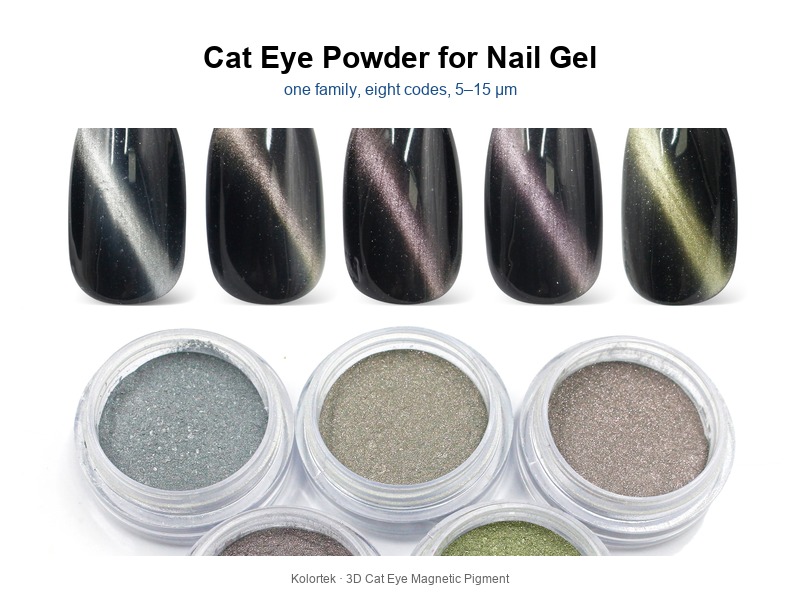
Of 24 cat eye families, one is marked for solvent-resistant nail art: 3D-91**, eight codes at 5–15 μm. Match the powder to your gel before you pick a shade.
Read More
 English
 Français
 Deutsch
 Русский
 Español
 Português