
Leave A Message
If you are interested in our products and want to know more details,please leave a message here,we will reply you as soon as we can.
Nail Art Special Effect Pigments: Matching the Powder to the Gel
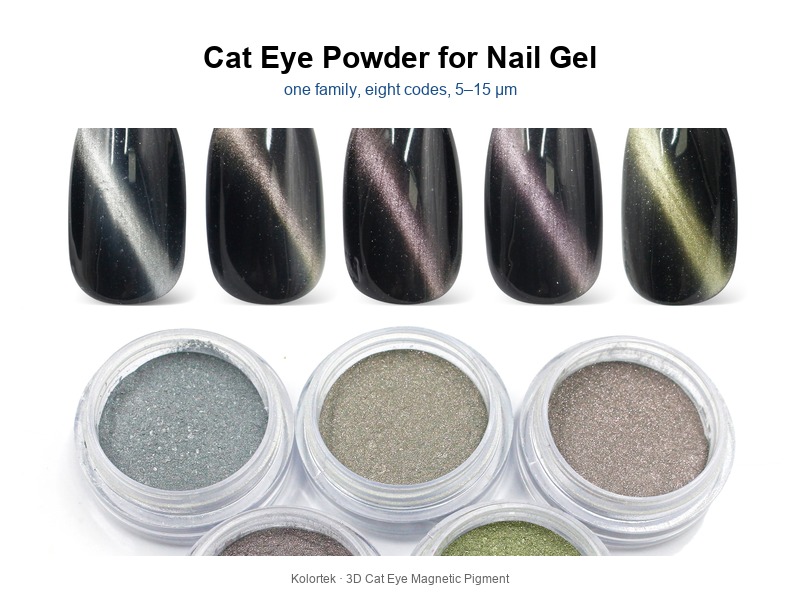
Of 24 cat eye families, one is marked for solvent-resistant nail art: 3D-91**, eight codes at 5–15 μm. Match the powder to your gel before you pick a shade.
The 3D effect sheet holds 24 cat eye families. The catalogue marks exactly one of them for nail art with solvent resistance: 3D Light Pastel Colors Cat Eyes, prefix 3D-91**, eight codes, all at 5–15 μm. Every other family is marked cosmetic grade, printing ink, or nothing at all. If your colour is not among those eight, no line on the sheet will warn you.
Key Takeaways
The sheet records end use in the family header rather than in a sortable column, which is why it is easy to read straight past. Count the headers and the 24 families fall into four groups: 18 marked cosmetic grade, one marked for solvent-resistant nail art, one for printing ink, and four that carry no label at all.
The single nail family is 3D Light Pastel Colors Cat Eyes. It holds eight codes, from 3D-9170 to 3D-9177, and every one of them sits at 5–15 μm. No other family on the sheet carries that marking, and no other family repeats that window with that label.
| Family | Code | Particle size | What the header says | Nail gel fit |
|---|---|---|---|---|
| 3D Light Pastel Colors Cat Eyes | 3D-9170 | 5–15 μm | nail art, solvent resistant | Shortlisted |
| 3D Light Pastel Colors Cat Eyes | 3D-9171 | 5–15 μm | nail art, solvent resistant | Shortlisted |
| 3D Light Pastel Colors Cat Eyes | 3D-9172 | 5–15 μm | nail art, solvent resistant | Shortlisted |
| 3D Light Pastel Colors Cat Eyes | 3D-9173 | 5–15 μm | nail art, solvent resistant | Shortlisted |
| 3D Light Pastel Colors Cat Eyes | 3D-9174 | 5–15 μm | nail art, solvent resistant | Shortlisted |
| 3D Light Pastel Colors Cat Eyes | 3D-9175 | 5–15 μm | nail art, solvent resistant | Shortlisted |
| 3D Light Pastel Colors Cat Eyes | 3D-9176 | 5–15 μm | nail art, solvent resistant | Shortlisted |
| 3D Light Pastel Colors Cat Eyes | 3D-9177 | 5–15 μm | nail art, solvent resistant | Shortlisted |
| Multicolor Powder, M93D | 3D-M93**D | 5–80 μm | cosmetic grade | Not marked for nail |
| Solid Color Silk | 3D-911**SS | under 10 μm | cosmetic grade | Not marked for nail |
| Fine Satin Multicolor | 3D-9774* | 5–25 μm | cosmetic grade | Not marked for nail |
| Magnetic Chromashift, ink | 3D-MG2**S | 5–15 μm | for printing ink | Not marked for nail |
The four contrast rows at the foot of the table are there to show what an unmarked family looks like, not what a failing one looks like. Otherwise the eight rows above would say nothing except that they exist.
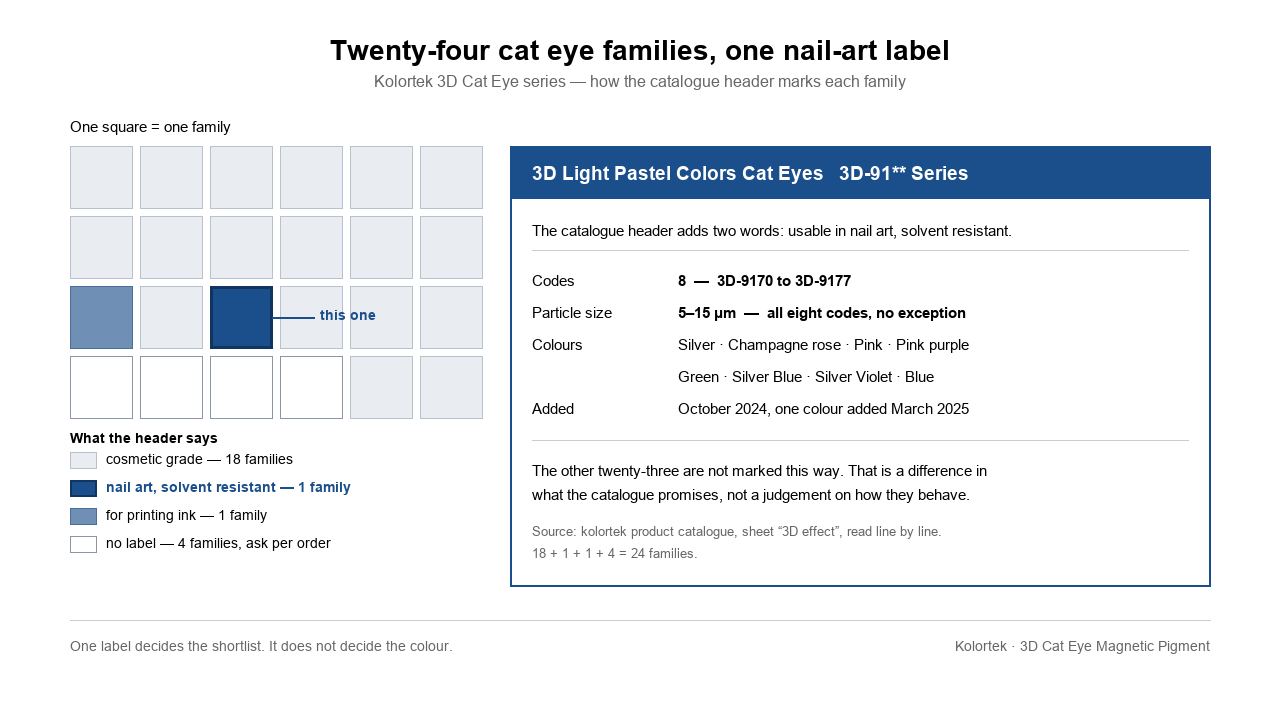
Fig. 1 — All 24 cat eye families on the 3D effect sheet, sorted by the label in the family header. One square is one family; the detail on the right is the only block that carries the nail art marking.
Set the system first, then choose the colour. Most of the enquiries that reach us each week arrive in the opposite order — a shade name first, the base second — and the shade is usually not one of the eight.
Three numbers describe the system. The cured film runs 10–100 μm, as the nail art pigment category sets out. A traditional lacquer carries ethyl acetate, butyl acetate, isopropyl alcohol and acetone. Alignment is made with a neodymium magnet held 2–5 mm above the wet film for 5–15 seconds, then cured at once.
Those three fit together in one window. The magnet acts on a film that is still liquid, so the pigment has to stay suspended long enough to turn and then freeze where it stopped. A powder that settles quickly and a powder the solvent attacks both fail inside the same fifteen seconds, for unrelated reasons.
Bleeding is the failure that reaches the user. A cat eye line that loses intensity is a batch complaint; a shade that migrates into the surrounding gel is a returned pallet, and by then the label on the jar has been blamed rather than the base. How the band itself forms is a separate question and sits on its own page.
Five to fifteen microns is a narrow window, and it does not sit inside the nail film so much as overlap its lower end. The two ranges meet between 10 and 15 μm. Below 10 μm a particle is smaller than the thinnest film the category page quotes; above 15 μm it is larger than that film, which is where this family stops.
Put the other windows beside it and the eight-code limit reads differently. Multicolor Powder 3D-M93**D runs 5–80 μm, Solid Color Silk 3D-911**SS sits under 10 μm, Fine Satin 3D-9774* runs 5–25 μm. The ink family 3D-MG2**S holds the same 5–15 μm window exactly — same numbers, different marking, and the marking is what sets the route.
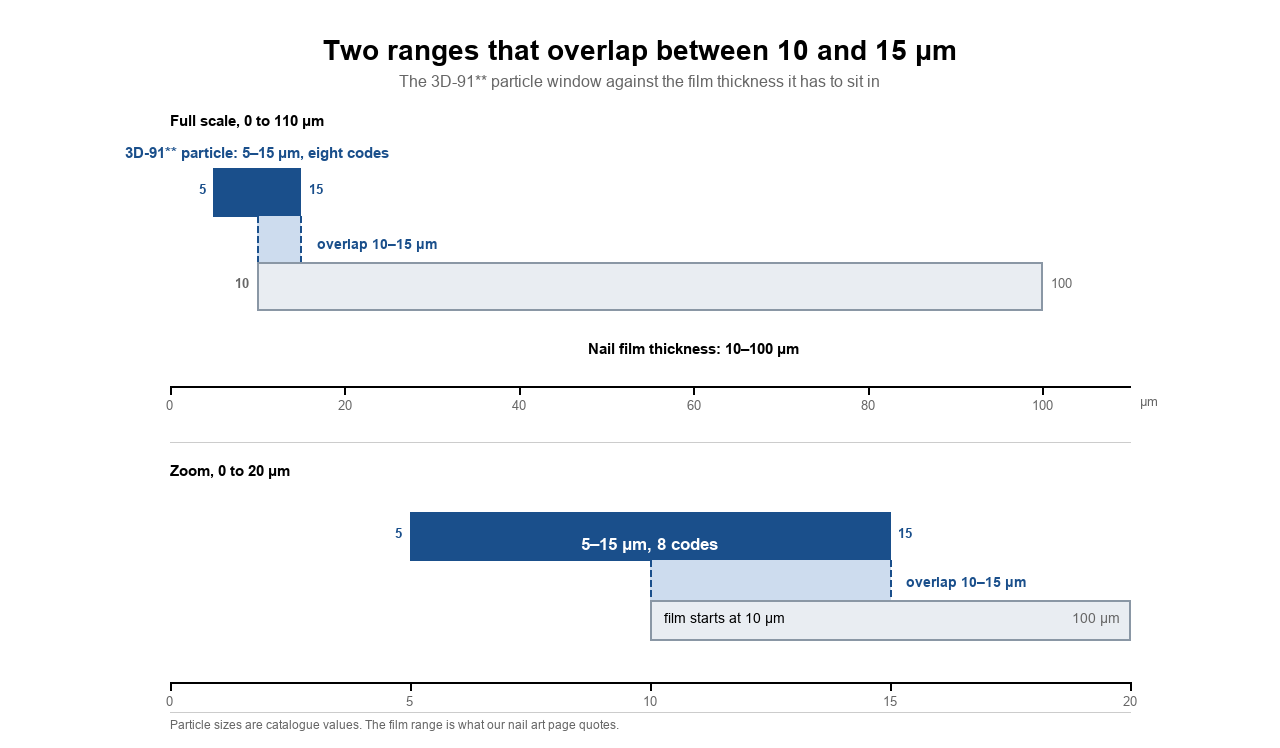
Fig. 2 — The 5–15 μm particle window against the 10–100 μm nail film, at full scale above and zoomed below. The two ranges overlap only between 10 and 15 μm, which is why a thin coat decides the grade.
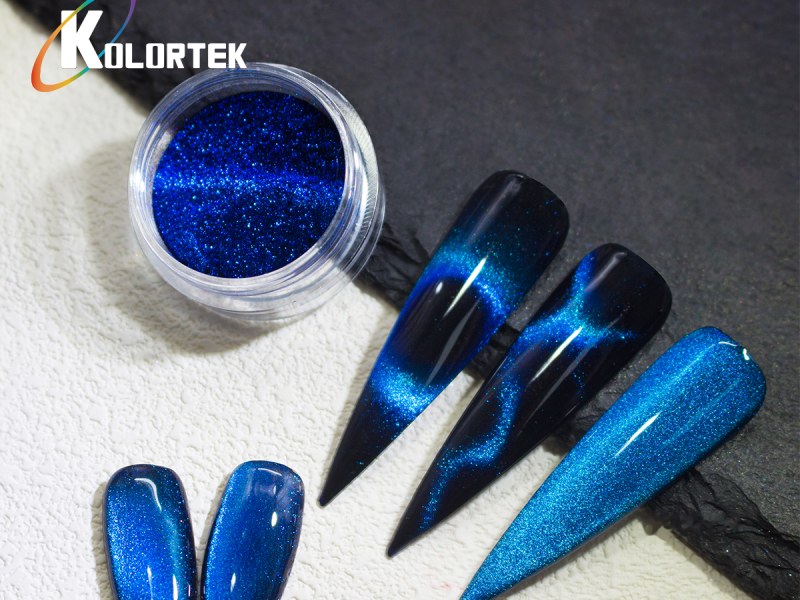
The eight codes carry eight colour names: Silver, Champagne rose, Pink, Pink purple, Green, Silver Blue, Silver Violet and Blue. All of them are light, and the family name says so plainly — Light Pastel Colors. This is not the block to open for a deep or heavily saturated band.
If your target shade is not in that list, three routes are open, and only one of them is quick:
We would rather write eight and be finished than let a buyer plan a season on a colour we cannot back. The eight are the whole list, not a starting point for a conversation about the rest.
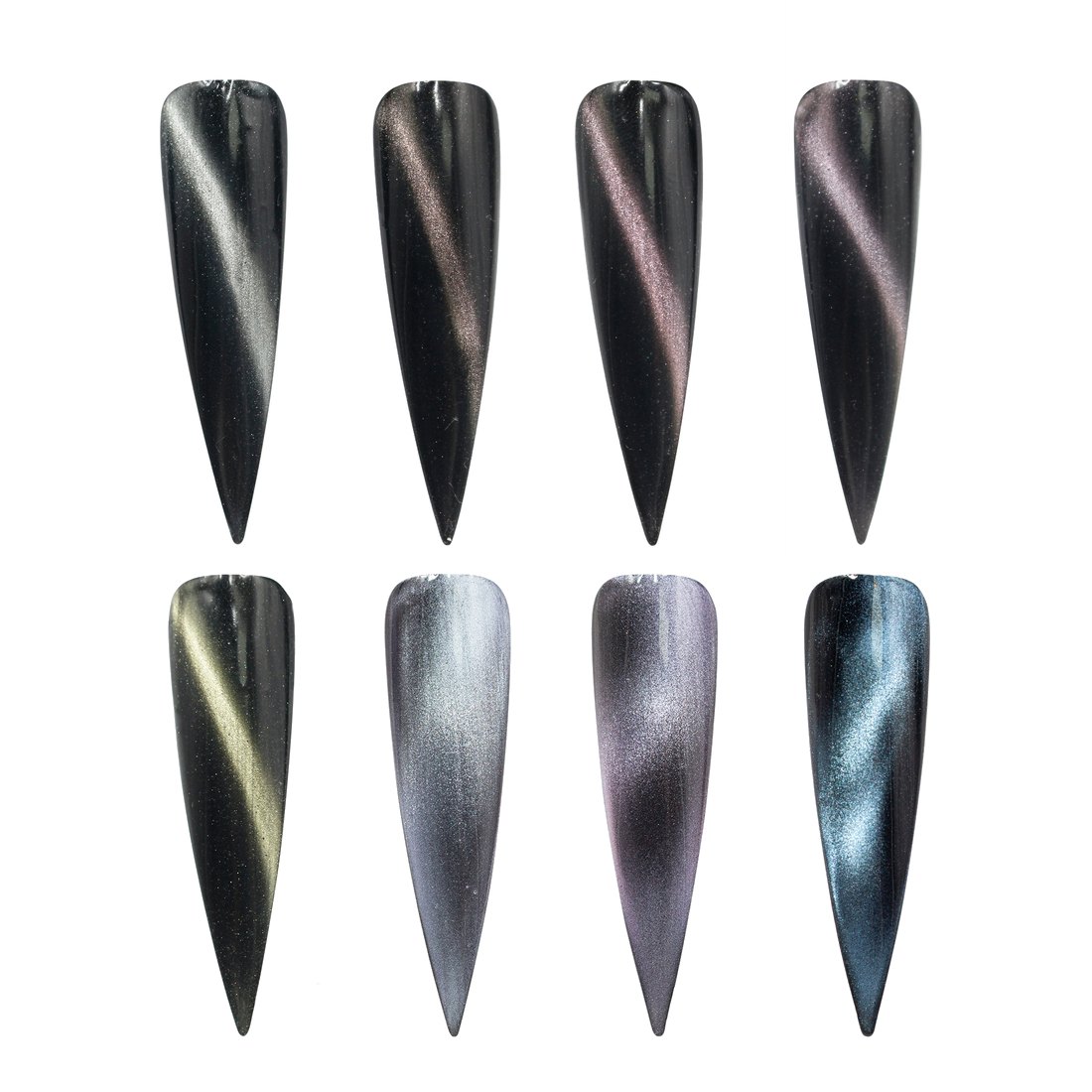
Fig. 3 — The pastel block cured over a black base: eight nails covering the eight colour names the family carries, from silver and champagne rose through pink and green to silver blue, violet and blue.
None of the above makes the other 23 families a wrong choice. It makes them a different answer, and the sheet states which one:
Where the end product is a cosmetic rather than a nail coating, the cosmetics application pages cover the formulation side and the grade questions that come with it. For a nail system that uses no magnet at all, KT-90518 is the non-magnetic comparison in the same market.
Five items settle a sample request in one exchange. Any of them missing turns the reply into a question:
Send all five and the reply names a code. Send three and it names a family, which is where most sample rounds start going backwards.
MOQ is set per family and per pack size, so it moves with the code rather than with the product line. Production runs under an ISO 9001:2015 certified quality system. Where a trial needs to happen before a purchase order, we build a custom sample pack around the application you name.
The full collection is in the 3D Cat Eye Magnetic collection download, which lists every code in the eight rows above alongside the rest of the range.
Halal, Kosher, US FDA registration, SGS, RoHS and REACH documentation are provided on request, against the specific grade and the market it ships to. We do not issue one statement across 24 families, because the scope changes with the family and with where the finished bottle is sold.
The EU cosmetics regulation frames a European launch. The obligations sit with the brand that places the product on the market, which is why we name the framework rather than summarise it.
Can a code outside the eight go into a gel?
Possibly, and we will not tell you it cannot. What we can say is that the sheet makes no nail art or solvent promise for the other 23 families, and we have no solvent-immersion result for them. Test the code in your own base, or ask us to quote the eight instead and save the trial.
Can you make one of the eight in a different colour?
A shade outside the eight belongs to a different family, with a different label and usually a wider window. That changes the answer to the nail question, not just the colour on the swatch. Send the target and we will say which family it lives in before anyone quotes it.
What magnet should I use?
A neodymium magnet held 2–5 mm above the wet film for 5–15 seconds, then cure straight away. We do not publish a strength figure, because the pattern also depends on film thickness and on how long the film sits before it is cured — a number taken out of that context would not transfer to your line.
How do I check solvent resistance myself?
In your own base, with the solvent your system actually carries. Judge the result as migration — colour moving into the surrounding film — rather than as loss of intensity, because the two fail differently and only the first one ruins the nail. We do not put a number on this; a figure from our lab would describe a film we built, not the one you build.
Eight codes is a short list, and the useful part of the work is narrowing it to the two that suit your gel. Name the system, the target colour, the film thickness and the first order quantity, and the sample pack comes back built around that combination rather than around the whole range.
Twenty-four cat eye families in one range: the grade label, size window and effect name of each, and why two codes both called Gold are not interchangeable.
Read More
3D Cat Eye Magnetic Pigments are nickel-chromium coated silica flake pigments with ferromagnetic properties that allow them to be oriented by an external magnet during the gel or curing phase of a coating. When a magnet is held over the wet surface, the particles align to create a three-dimensional band of reflected light that moves with the viewing angle — replicating the optical character of a cat's eye gemstone. Available in multiple color combinations, they are used primarily in nail gel systems and specialty decorative coatings.
Read More
Of 24 cat eye families, one is marked for solvent-resistant nail art: 3D-91**, eight codes at 5–15 μm. Match the powder to your gel before you pick a shade.
Read More
 English
 Français
 Deutsch
 Русский
 Español
 Português