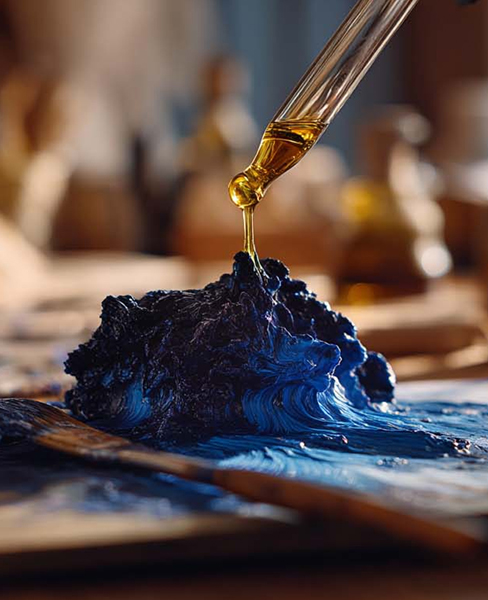
Thermochromic pigment delivers a functional color-change effect — shifting from vivid to colorless or transitioning between two distinct hues in response to body heat — making it one of the more technically demanding ingredients to formulate correctly in nail and cosmetic systems. For nail applications specifically, thermal nail powder has moved well beyond novelty status; it now drives purchasing decisions in gel, dip, and lacquer formats where dynamic visual performance is expected. This article covers how these pigments behave in real formulations, where they create problems, and how to select the right type for your system.
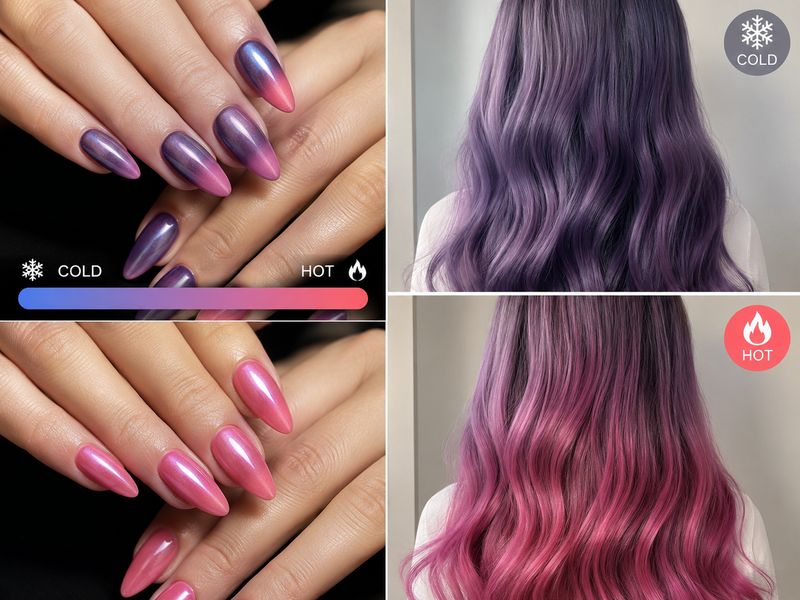
The mechanism is microencapsulated leuco dye chemistry. A color-forming dye, a developer, and a solvent are co-encapsulated — the ratio and melting point of the solvent sets the activation temperature. Below that threshold, dye and developer interact to produce color. Above it, the solvent disrupts that interaction and the color fades.
In practice, this means the color-change behavior is reversible and repeatable — but only within the thermal range the capsule is engineered for. It is not a phase-change pigment in the inorganic sense. The capsule wall is the critical component. Damage it through aggressive milling, high shear dispersion, or incompatible solvents, and the pigment fails permanently.
For nail art, activation temperatures in the 28–33°C range are the most practical. That window aligns with skin surface temperature, so contact with fingers produces a visible shift. Lower activation points (16–18°C) respond to cold water or refrigerated surfaces. Higher points — 45°C and above — are less useful in nail or skin-contact applications unless the intent is a heat-tool activated effect.
Colored-to-Colorless vs. Colored-to-Colored: Which Makes Sense for Your Application
This is the first formulation decision and it has design consequences beyond just aesthetics.
Colored-to-colorless systems give the formulator control through the base coat. The thermochromic layer sits on top; when it clears, whatever is underneath — a solid color, a pearlescent layer, a holographic effect — becomes visible. This creates two completely different looks from one product. The tradeoff: the base coat selection becomes part of the formula. A poor base coat choice undermines the entire effect.
Colored-to-colored systems are self-contained. No base coat dependency. Both states need to be aesthetically viable, which narrows the color palette somewhat. Available transitions include black-to-red, purple-to-blue, green-to-yellow, and orange-to-yellow — all at approximately 31°C activation. These tend to be more forgiving in formulation because the end states are predictable regardless of substrate.
Worth noting: layering both types — a colored-to-colorless thermochromic over a photochromic or pearlescent base — produces a tri-state effect that responds to both temperature and light independently. Technically achievable, but requires careful compatibility testing between systems.
| Type |
Activation Temp Range |
Key Design Consideration |
Common Nail Applications |
| Colored → Colorless |
16–45°C |
Base coat drives the "revealed" state |
Gel, lacquer, dip powder |
| Colored → Colored |
~31°C (most grades) |
Both color states must work independently |
Gel, lacquer, dip powder |
| Liquid Crystal (Mood) |
14–36°C (spectrum shift) |
Water-based; multi-color gradient |
Specialty nail, body art |
| Food Grade / BPA-Free |
~31–32°C |
Required for hair or sensitive-contact use |
Hair, lip-adjacent cosmetics |
The microencapsulated structure that makes thermochromic pigment functional also makes it fragile relative to conventional pigments. Several formulation factors directly affect performance and longevity.
Dispersion method. High-shear mixing — common in lacquer production — can rupture capsule walls. Three-roll mills are generally incompatible. Low-shear paddle or anchor mixing with pre-dispersion in a compatible carrier is the standard approach. The pigment should be introduced late in the mixing sequence, after viscosity has been established.
Solvent compatibility. Standard nail lacquer solvent systems (ethyl acetate, butyl acetate, isopropyl alcohol) are generally compatible. Ketones, particularly MEK, can attack capsule walls depending on the grade. Always confirm with the supplier before scaling. Aqueous gel systems are typically lower risk for capsule integrity, but pH extremes can cause issues.
UV cure conditions. In gel nail systems, photoinitiator selection matters. Some photoinitiators generate localized heat during cure that can partially activate or stress the thermochromic capsules. The practical result is inconsistent color response in the finished product. This is a known challenge — not a dealbreaker, but requires testing with your specific gel base.
Load rate. Thermochromic pigments are opaque at full color state. A 3–5% load in a clear lacquer base is typically sufficient for strong color coverage. Overloading does not improve the effect and increases cost significantly, since these grades carry a higher cost per gram than conventional colorants.
Light stability. This is the most consistent limitation across all leuco dye thermochromic systems. Prolonged UV exposure degrades the dye chemistry. In nail applications, where the product is on the nail for days to weeks and exposed to sunlight, this matters. UV-protective top coats are a practical mitigation. Some grades include UV stabilizers in the encapsulation, which extends service life — confirm the specific grade's UV stability rating before formulating for extended-wear products.
Heat Sensitive Pigment Powder in Broader Cosmetic Formats
Nail is the primary application, but heat sensitive pigment powder shows up in other cosmetic contexts — some more technically straightforward than others.
Lip products. Temperature-responsive lip gloss and lip balm formulations are commercially viable. Lip temperature sits near the activation range for 31°C grades. The challenge here is regulatory: ingredient compliance for lip products is stricter than nails, and the pigment must meet ingestibility thresholds in markets where lip products are regulated as semi-food-contact. BPA-free food-grade grades are the appropriate starting point.
Body and face. Application to skin creates a brief color-change effect as body heat activates the pigment. This works as a novelty in face paint or theatrical makeup, but it is not a sustained effect — once the skin warms the pigment, it stays in the activated state until cooled. The dynamic shift only occurs at the moment of application or when cooled deliberately. Manage expectations in marketing accordingly.
Hair. Food-grade BPA-free thermochromic grades are used in hair color products. The thermal sensitivity makes hair color products that shift appearance with blow-dryer heat or cold water exposure technically possible. Formulation into hair-compatible systems (aqueous, conditioner-based) requires grades specifically engineered for those matrices.
That said, nail remains the format where thermochromic pigments deliver the most consistent, repeatable performance. The product geometry (thin, clear or lightly tinted film over a controlled substrate) is ideal for demonstrating the color-change effect visibly and reliably.
Regulatory and Safety Considerations
Thermochromic pigments are not universally approved across all cosmetic categories in all markets. The encapsulated leuco dye system is not the same regulatory category as an approved cosmetic colorant like a D&C lake or an iron oxide.
In the US, nail products are regulated as cosmetics under FDA, and the color additive requirements apply. Thermochromic pigments in nail are generally positioned as decorative effect additives, not color additives in the regulatory sense — but this distinction should be reviewed with regulatory counsel for your specific market and format.
EU cosmetics regulation (Regulation 1223/2009) requires safety assessment and notification. Thermochromic pigments intended for EU market cosmetics should carry REACH compliance documentation and a safety data sheet reviewed against Annex II and III restrictions. INCI naming for thermochromic components in a finished formulation can be non-trivial — the encapsulation components need to be declared separately from the colorant.
BPA content is a specific watch point. Some older thermochromic encapsulation chemistries involve bisphenol-A as part of the developer system. BPA-free grades exist specifically to address this. For any application that involves skin contact — and particularly lip or mucous membrane proximity — insist on BPA-free documentation.
Combining Thermochromic with Other Effect Pigments
The real creative and technical value of thermochromic pigments in nail art comes from layering systems. A few combinations that formulation teams have found productive:
Thermochromic + pearlescent base. The pearl layer sits below, visible only when the thermochromic layer clears. The shift reveals not just a different color but a different texture and optical depth. Color-shifting or duochrome pearls under a colored-to-colorless thermochromic layer produce particularly complex two-state effects.
Thermochromic + photochromic. Two independent trigger mechanisms in one formulation. Temperature change affects one layer; UV exposure affects the other. The combined effect responds to environmental conditions simultaneously. Compatibility testing between the two systems is essential — they are both microencapsulated and the capsule chemistries should not interact.
Thermochromic + holographic or aurora powder. A holographic layer under a thermochromic topcoat gives the product a standard holographic appearance at rest and reveals a dramatically different look when warmed. This combination has strong commercial appeal in nail art formats because the "before" state is already visually interesting.
In all layered systems, cure compatibility (for gel) and solvent compatibility (for lacquer) across all layers need to be confirmed. Do not assume compatibility between effect pigment systems without testing.
Selecting the Right Grade: A Practical Checklist
Before requesting samples or placing an order, have answers to these questions:
- What is the target activation temperature? (Align with intended use — body contact, cold water, warm water)
- Colored-to-colorless or colored-to-colored? (Base coat design vs. self-contained system)
- What is the carrier system — solvent lacquer, aqueous gel, oil-based, or powder?
- Is BPA-free certification required? (Required for lip, hair, food-adjacent)
- What UV exposure conditions will the finished product experience? (Affects grade selection and top coat specification)
- What shear conditions will the pigment experience during manufacturing? (Dictates dispersion protocol)
- What regulatory market is the finished product targeting? (US FDA, EU, Japan each have different frameworks)
FAQ
Q: Can thermochromic pigments be used in gel nail systems cured under UV or LED lamps?
Yes, but with conditions. The cure process itself can generate localized heat and UV exposure that stresses thermochromic capsules. Grade selection matters — some grades are more resistant to cure conditions than others. Introduce the thermochromic pigment in the color gel layer, not the base or top coat, to minimize direct exposure to cure energy. Always run a small-batch cure test and check for color-shift consistency across the full nail before scaling.
Q: Why does the color change seem weaker after a few weeks of wear?
UV degradation of the leuco dye chemistry is the most common cause. Prolonged sun exposure bleaches the colored state, reducing contrast between the two temperature states. A UV-protective top coat extends service life. If this is a persistent issue across formulations, request UV-stabilized grades — they incorporate UV absorbers within the capsule structure and perform significantly better in extended-wear applications.
Q: Is there a meaningful difference between food-grade and standard thermochromic pigment for nail use?
For nail applications specifically, standard cosmetic-grade thermochromic pigments are appropriate. Food-grade (BPA-free) grades are relevant when the application involves skin contact near mucous membranes (lip products), hair, or actual food-contact surfaces. The food-grade designation also signals BPA-free encapsulation chemistry, which some brands specify for all cosmetic products as a precautionary position. It is not a performance differentiator for nail — it is a safety and regulatory positioning decision.
Q: Can thermochromic pigments be blended with conventional nail pigments like iron oxides or D&C lakes?
Yes. Blending with conventional pigments adjusts the "colored" state appearance and the revealed base color. Iron oxides and D&C lakes are chemically inert toward the capsule chemistry. The practical consideration is opacity: adding conventional opaque pigments to the thermochromic layer will reduce the clarity of the color transition. If you want a strong, readable color change, keep the thermochromic layer relatively clean and control opacity through the base coat instead.
For sample requests, technical formulation support, or grade-specific documentation, contact Kolortek directly at contact@kolortek.com. Batch-to-batch consistency data and compatibility testing protocols are available on request for qualified development projects.

 English
 Français
 Deutsch
 Русский
 Español
 Português