What Are Photochromic Pigments and How Do They React to UV Light?
What Are Photochromic Pigments and How Do They React to UV Light?
Sep 16, 2026
Author
At Kolortek, we collaborate with global partners to deliver innovative pigment solutions that keep pace with evolving market demands. Backed by advanced manufacturing capabilities and stringent quality control, our products are built for consistency, performance, and lasting reliability.
Jerry Wang
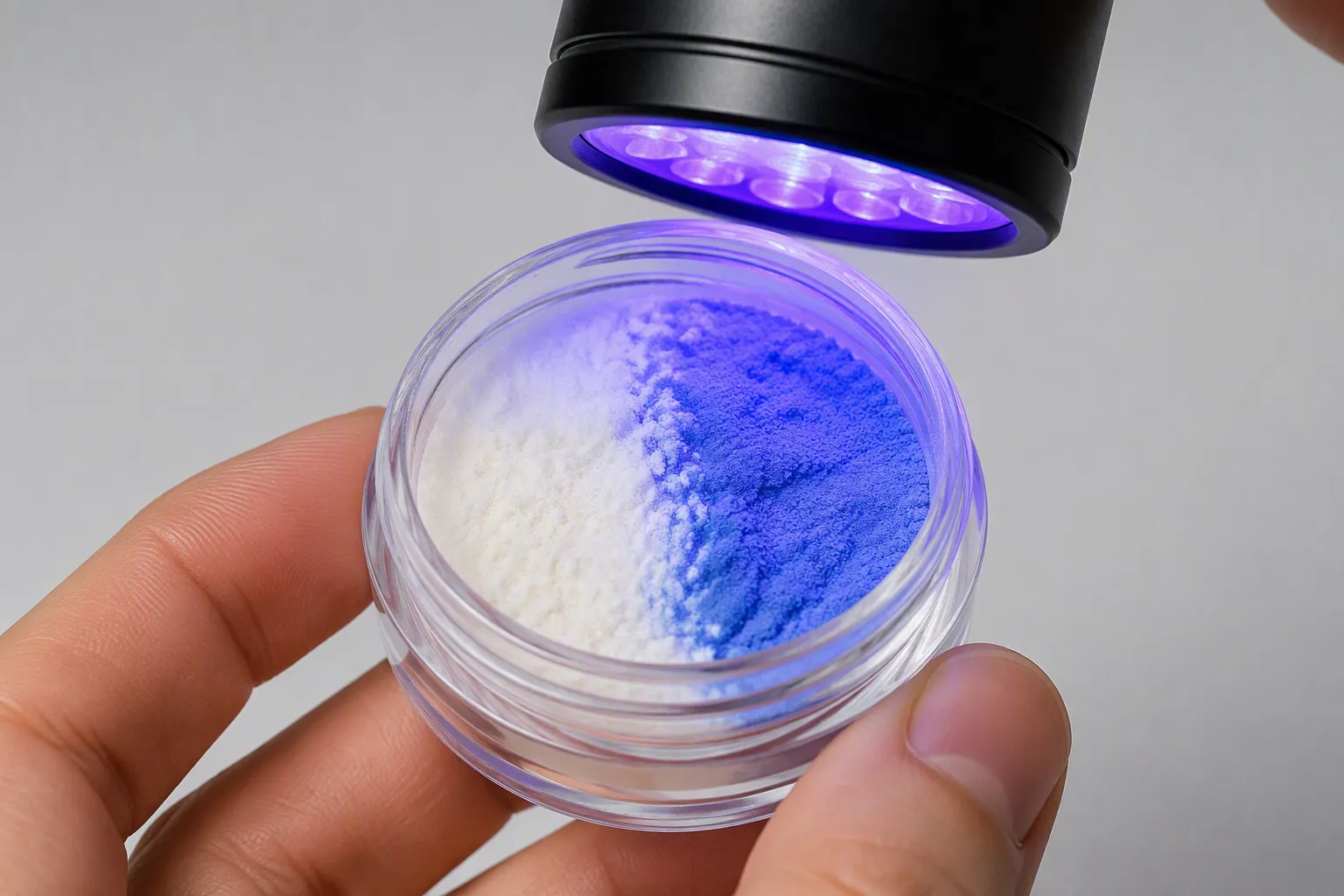
You see photochromic pigments as compounds that reversibly change color under UV light. This color change is a reversible chemical reaction triggered by ultraviolet radiation. When you remove the UV source, the reaction reverses and the pigment returns to its original state. A uv activated photochromic pigment works this way. Kolortek specializes in high-performance photochromic pigments for many UV-reactive applications.
Key Takeaways
Photochromic pigments change color under UV light and return to normal when UV stops.
UV intensity and temperature control how fast and dark the color change happens.
You use these pigments in sunglasses, textiles, and packaging for smart color effects.
You witness a fascinating molecular transformation when a uv activated photochromic pigment meets ultraviolet radiation. The pigment absorbs photons, and this energy drives a chemical change that alters how the molecule reflects visible light. Understanding this process helps you select the right pigment for your application.
The Reversible Chemical Reaction
The color change you observe follows a predictable pattern. The pigment undergoes a chemical change upon UV exposure and returns to its original state when UV is removed. This reversibility makes photochromic pigments valuable for repeated use across countless cycles.
Molecular structural changes due to photon absorption lead to a reversible color shift. When UV light strikes the pigment molecule, ring-opening and ring-closing reactions trigger changes in molecular shape and color. The molecule essentially switches between two forms: a colorless or lightly colored state and a vibrant colored state.
Reversible photochemical reaction: the pigment undergoes a chemical change upon UV exposure and returns to its original state when UV is removed.
Molecular structural changes due to photon absorption, leading to reversible color shift.
Ring-opening and ring-closing reactions triggered by UV light, changing molecular shape and color.
This process happens at the molecular level. You see the result as an immediate color change when you step into sunlight or any UV-rich environment.
Organic vs. Inorganic Pigments
Photochromic pigments fall into two main categories, and each behaves differently under UV light.
Organic photochromic pigments rely on carbon-based molecules. These compounds typically undergo ring-opening and ring-closing reactions when exposed to UV radiation. They offer vibrant color changes and work well in applications like eyewear and textiles. Organic pigments often show faster response times and more dramatic color shifts.
Inorganic photochromic pigments use metal oxides or other mineral compounds. These materials tend to offer greater stability and longer lifespans. They resist degradation from repeated UV exposure better than their organic counterparts. However, inorganic pigments may show slower color changes and more subtle effects.
Your choice between organic and inorganic depends on your specific needs. Consider factors like desired color intensity, response speed, durability requirements, and the environment where the pigment will function.
What Affects the Reaction
Several variables influence how quickly and completely your photochromic pigment responds to UV light. Understanding these factors helps you optimize performance in your application.
The chemical structure of the pigment determines its baseline behavior. Different compounds respond at different speeds and intensities. The surrounding matrix or medium also plays a role. Pigments dispersed in plastic behave differently than those in liquid solutions or coatings.
Light exposure conditions matter significantly. The intensity and wavelength of UV radiation directly impact the reaction rate. Environmental factors like temperature and humidity also affect performance.
UV Intensity and Wavelength
The strength of UV radiation determines how many pigment molecules activate at once. Higher UV intensity means more photons strike the pigment, causing a stronger and faster color change. You see deeper color saturation under bright sunlight compared to hazy conditions.
Wavelength matters because different photochromic compounds respond to specific UV ranges. Most photochromic pigments activate under UVA radiation (315-400 nm). Some formulations respond to UVB (280-315 nm) as well. The peak absorption wavelength varies by pigment type.
You should match your pigment selection to the expected UV conditions. Indoor applications near windows receive different UV exposure than outdoor applications. Testing your pigment under realistic conditions ensures optimal performance.
Temperature and Reaction Speed
Temperature dramatically affects how fast photochromic pigments fade back to their original state. Warmer temperatures accelerate the thermal fading reaction. Cooler temperatures slow it down.
With appropriate temperature control, researchers study the temperature dependence of photochromic fade rate constants. They determine activation energy from an Arrhenius plot of ln k against 1/T. The apparent activation energy emerges using the Arrhenius equation. Sample solutions stay in the dark at 25, 37, and 50 °C, and absorption spectra are recorded at set time intervals. The time-dependent spectral changes are fitted to determine the rate constant k at each temperature. A linear fit of ln k versus 1/T gives the apparent activation energy Ea according to:
$$\ln k = \ln A - \frac{E_a}{RT}$$
where A is the pre-exponential factor, R is the gas constant, and T is the absolute temperature.
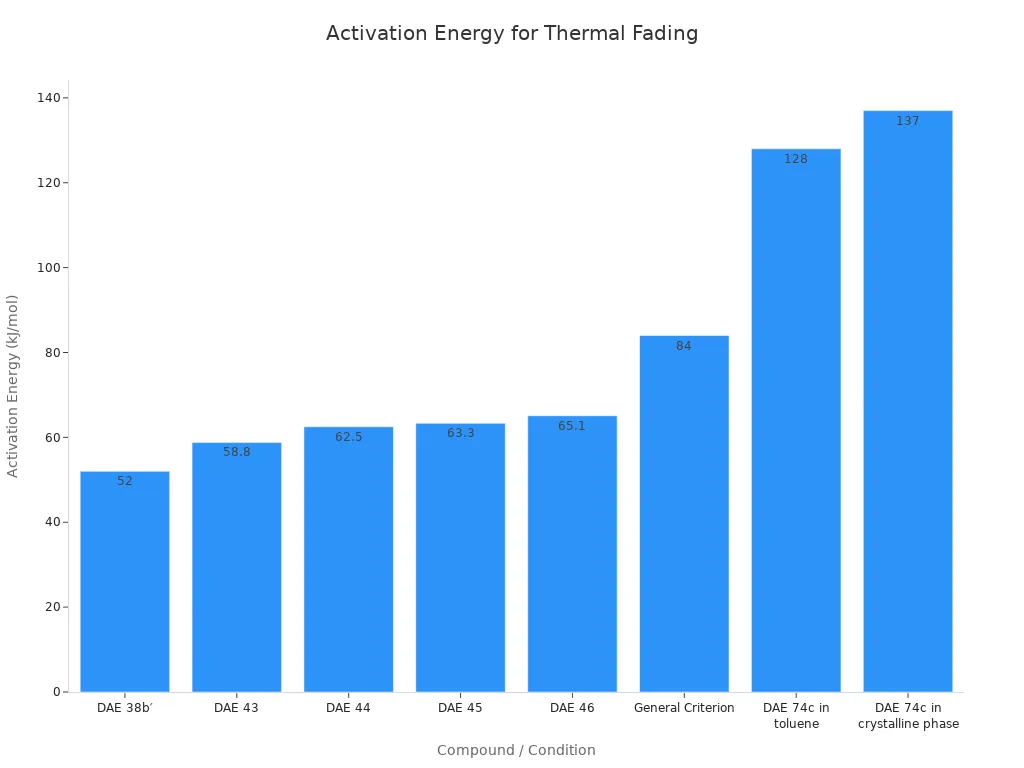
Different photochromic compounds show different activation energies for their thermal fading reactions. The table below shows typical values:
Compound / Condition
Activation Energy (Ea)
DAE 43
58.8 kJ mol−1
DAE 44
62.5 kJ mol−1
DAE 45
63.3 kJ mol−1
DAE 46
65.1 kJ mol−1
DAE 38b′
52 kJ mol−1
DAE 74c in toluene
128 kJ mol−1
DAE 74c in crystalline phase
137 kJ mol−1
General criterion for room-temperature first-order reaction
≈20 kcal mol−1 (≈84 kJ mol−1)
Higher activation energy means the pigment retains its colored state longer after UV removal. Lower activation energy causes faster fading. You can select pigments with specific activation energies to match your desired fade speed.
Where Photochromic Pigments Are Used
You find photochromic pigments in a growing range of products. The versatility of a uv activated photochromic pigment makes it valuable across multiple industries.
Sunglasses and Eyewear
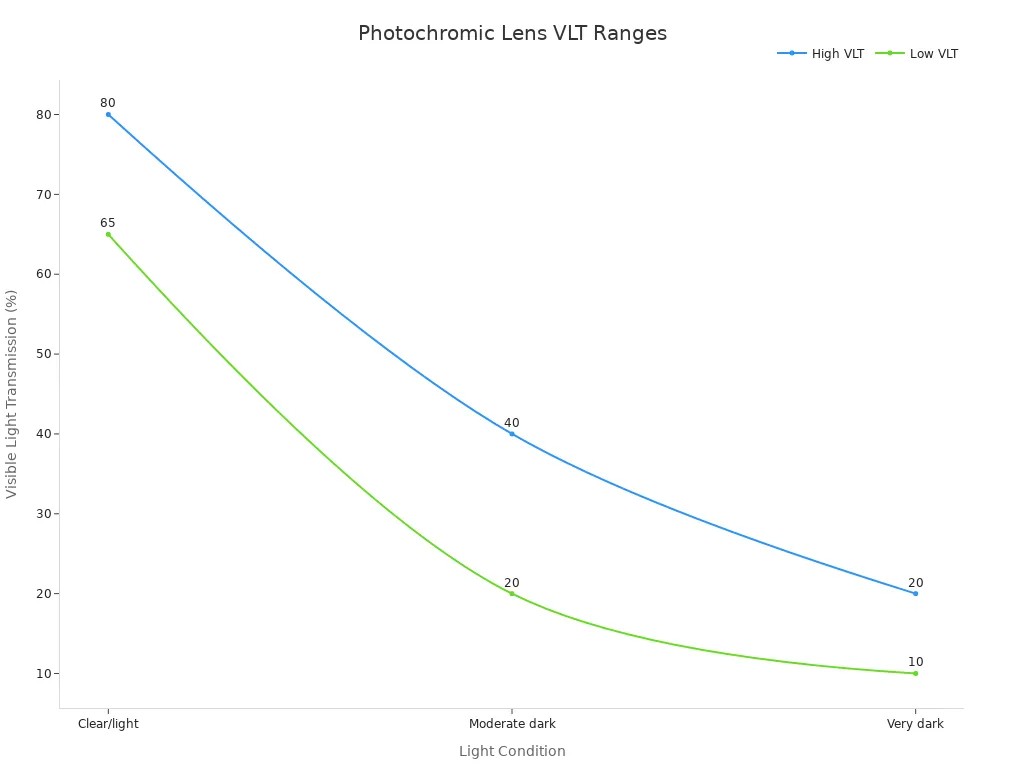
You experience the most common application of photochromic technology in eyewear. Lenses transition from clear to dark based on UV exposure. The table below shows typical visible light transmission (VLT) ranges you can expect.
State
VLT Range
Description
Clear/light state
65–80%
Essentially clear; comfortable in shade, dawn, dusk, or heavily overcast skies.
Moderate dark
20–40%
Good sun protection for partly cloudy days and mixed sun-shade terrain.
Very dark
10–20%
Strong protection for high-altitude, snow, beach, or sustained midday intensity.
A lens rated 15–75% VLT exemplifies a typical wide-range photochromic lens. It goes from fairly dark in full sun to near-clear in low light.
Smart Textiles and Apparel
You see photochromic pigments transforming the textile industry. Medical textiles change color to indicate UV exposure. Sports textiles shift shades under sunlight, combining performance with visual interactivity. Protective clothing uses UV-activated color change for enhanced visibility. Even geotextiles for outdoor engineering projects can change color under UV light.
Packaging and Security Printing
You interact with photochromic packaging through smart labels and indicators. These labels react to UV light to confirm product authenticity or exposure. Security inks provide robust brand protection through overt and covert technologies. Photochromic inks react with the UV component of sunlight and change color, enabling quick product verification. The ink is durable and suitable for packaging, labels, and printed materials. It applies to paper, plastic, and textiles. Custom formulations fit different printing techniques.
Food packaging inks also use this technology. A hidden message on cheese or snack packaging becomes visible under UV light. This confirms freshness or authenticity for the product.
Toys and DIY Applications
You guarantee safety with photochromic pigments that meet international standards. The pigments are non-toxic and non-irritating. Formulations with a high UV sensitivity threshold (350–400 nm) provide rapid and safe color transformation in children's toys.
In the DIY space, you create handmade art that "blooms" with color outdoors. Resin crafts shift from clear to vibrant under sunlight. Handmade soaps and accessories like pendants use these pigments to surprise users.
Kolortek's Photochromic Pigment Solutions
Kolortek delivers high-performance photochromic pigments that meet demanding industrial requirements. You gain access to formulations engineered for fast response, reliable reversibility, and consistent color transformation across many cycles.
Product Strengths and Advantages
Kolortek provides detailed technical data for its uv activated photochromic pigment products. You can review the key performance parameters in the table below.
Technical Parameter
Data Provided by Kolortek
Color change speed
Visible color appears within roughly 1 second under direct sunlight exposure
Fading time
Color fades when UV exposure stops (reversible reaction)
Reversibility
Reversible and repeatable across many cycles
Long-term fatigue
Photochromic response degrades over time (common to all organic photochromic systems)
Influencing factors
UV intensity, ambient temperature, and formulation matrix affect response time and color intensity
Temperature effect
Lower temperatures enhance response intensity; higher temperatures reduce it
Active component (KPMC-12 series)
Avobenzone (Butyl Methoxydibenzoylmethane)
These advantages make Kolortek pigments suitable for applications requiring rapid and repeatable color shifts.
Applications and Customization
Kolortek has deployed custom uv activated photochromic pigment solutions across multiple industrial sectors. You can explore these application areas:
Kolortek tailors pigment formulations to match your specific substrate, processing method, and desired color effect. You receive technical support to optimize performance in your unique application.
You see a uv activated photochromic pigment change color through a reversible reaction. The color returns when UV exposure stops. Organic and inorganic types react differently, and UV intensity and temperature shape the response. Kolortek advances this technology for smarter UV-responsive materials and expanding applications across industries.
FAQ
How long do photochromic pigments last?
You get many color-change cycles from quality pigments. Kolortek formulations resist fatigue well. Performance depends on UV exposure, temperature, and your specific application conditions.
Can you use photochromic pigments indoors?
You activate these pigments with UV light. Indoor lighting often lacks sufficient UV radiation. Near windows or with UV lamps, you see the color change occur.
Are photochromic pigments safe for skin contact?
You find non-toxic formulations available for consumer products. Kolortek pigments meet safety standards for toys and wearables. Always verify compatibility with your intended application.

 English
 Français
 Deutsch
 Русский
 Español
 Português