Cosmetic iron oxides are inorganic mineral pigments for cosmetics that deliver stable, matte color across the full brown-red-yellow-black spectrum — the backbone of skin-tone matching in foundations, blushers, and pressed powders. Unlike organic dyes, they resist fading, tolerate processing heat, and carry a well-established safety profile across US, EU, and Japanese regulatory frameworks. This article covers how iron oxide pigments in cosmetics actually behave in formulation, where surface treatment changes the equation, and how to select the right type for your application.
What "Cosmetic Grade" Actually Means for Iron Oxides
The term gets used loosely, but it has a specific technical implication: cosmetic grade iron oxides are purified to remove heavy metal contaminants — particularly arsenic, lead, mercury, and antimony — to levels that comply with regional limits. This is not automatic. Industrial iron oxides and cosmetic iron oxides share the same base chemistry (Fe₂O₃ for red and yellow phases, Fe₃O₄ for black), but the purification steps and batch testing requirements are fundamentally different.
For formulators sourcing pigments, this distinction matters on two levels: regulatory compliance and skin contact safety. A supplier without COA documentation showing impurity levels below regional thresholds creates downstream liability for the finished product manufacturer.
Worth noting: compliance documentation requirements differ by market. The EU requires conformity with Annex IV of Regulation (EC) 1223/2009. The US FDA regulates iron oxides under 21 CFR 73.2250. Japan's Standards for Cosmetics maintains its own positive list. If you're formulating for multiple markets simultaneously, verify that your pigment supplier can provide market-specific certificates — not a single blanket document.
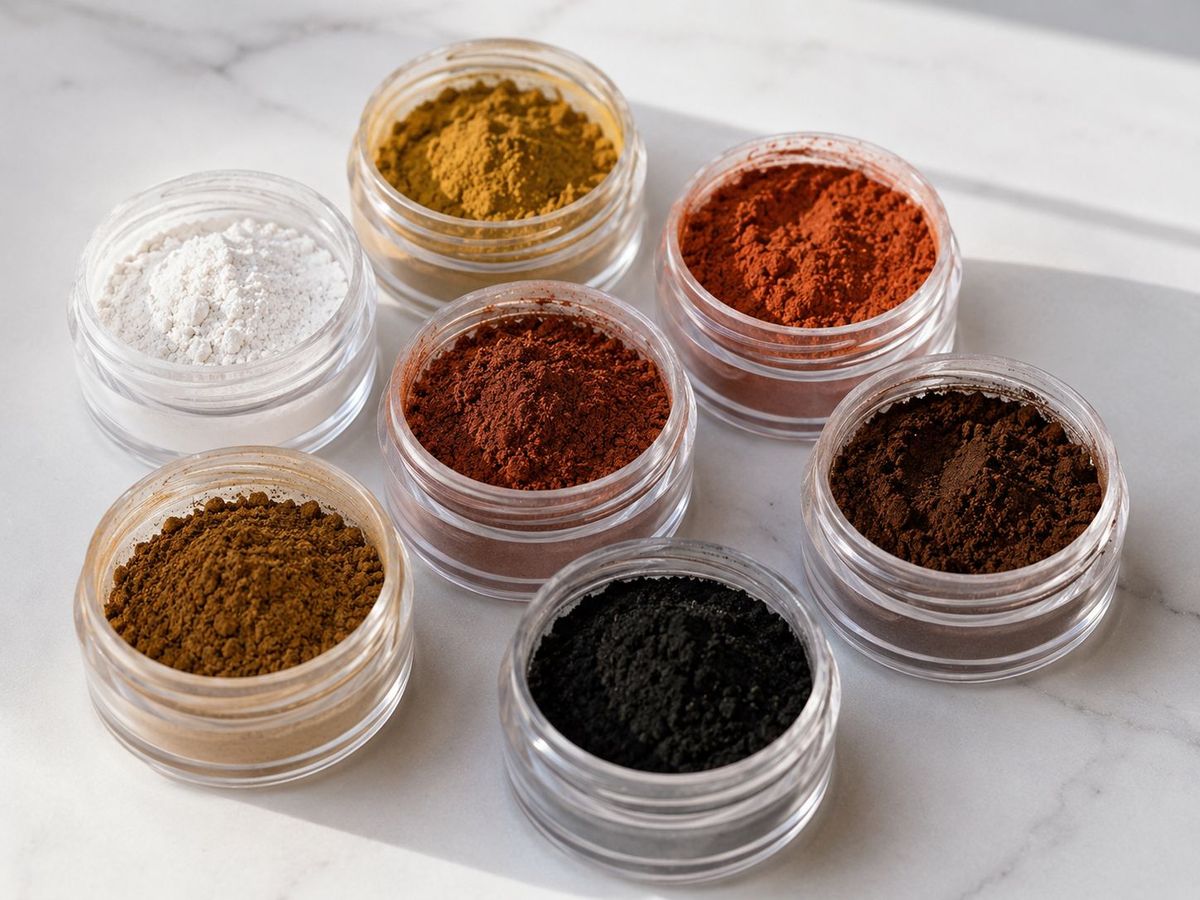
The Core Color Range and How Formulators Use It
Iron oxides cover four primary color categories in cosmetics:
- Yellow iron oxides — warm, ochre-to-golden tones; the primary contributor to light and medium skin-tone foundations
- Red iron oxides — ranging from brick red to deep burgundy; used in blushers, liners, and darker foundation shades
- Brown iron oxides — often blends or specific synthesis conditions; bridging yellow and red for neutral or cool-leaning skin tones
- Black iron oxides — depth and shading; used in mascaras, eyeliners, and as a depth adjuster in foundations
In practice, no single iron oxide shade is used in isolation for foundation formulation. Skin-tone matching is a blending exercise — yellow, red, brown, and black oxides are combined in precise ratios to hit target L*, a*, b* values across a shade range. The predictability of iron oxide color under blending is one of the reasons they dominate this application. They behave consistently. Organic pigments at equivalent concentrations can shift significantly with pH, temperature, or matrix interactions. Iron oxides don't.
They can also function as depth modifiers for other pigment systems. Adding a small percentage of red or brown iron oxide into a pearlescent base, for example, shifts the overall tone without disrupting the optical layering effect. This is common in bronzers and warm-toned highlighters.
Cosmetic Matte Oxides: What Happens at the Skin Interface
Untreated iron oxide particles are irregular in morphology. The surface is rough relative to synthetic micas or talc. This has two direct consequences in a cosmetic formulation:
- Higher oil absorption — rough surfaces entrap more of the liquid phase, which can destabilize emulsions and reduce wear time in oily skin products.
- Variable skin feel — depending on particle morphology and concentration, untreated iron oxides can feel abrasive or drying on skin, particularly in pressed powder formats.
These are real formulation constraints, not theoretical ones. The matte effect delivered by iron oxide pigments for makeup is genuine — the particles scatter light diffusely — but without addressing the surface behavior, achieving that matte finish can come at a sensory cost.
That said, for many applications — loose powders, pressed eye shadows with high binder content — untreated cosmetic matte oxides perform adequately and remain the lower-cost option. The question of whether to use treated or untreated grades is an application-specific decision, not a universal upgrade path.
Surface-Treated Iron Oxides: When the Trade-Off Justifies the Cost
Surface treatment — most commonly with triethoxycaprylylsilane or similar silane coupling agents — addresses the core limitations of untreated iron oxides without altering their color output. The silane layer does two things mechanically: it smooths the irregular surface topography, improving the tactile profile, and it reduces the surface energy of the particle, lowering oil absorption and improving hydrophobicity.
For foundation formulators specifically, this matters. Reduced oil absorption means better dispersion stability in the emulsion phase and improved sebum resistance once the product is applied to skin. In a liquid foundation, an untreated black or red iron oxide with high oil absorption can pull binder from the continuous phase unevenly — creating color inconsistency in the dried film. A treated equivalent behaves more predictably.
Treated iron oxides also disperse more readily in both aqueous and oil phases, which reduces processing time and the risk of aggregate formation. In high-speed dispersion processes, this is a practical efficiency gain.
The limitation: treated grades cost more and require verification that the surface treatment itself is approved for use in the target application (face, eyes, lips have different regulatory constraints in some jurisdictions). Always confirm the treatment chemistry is listed or permitted under the relevant regulation for your product category.
Selecting Between Iron Oxide Grades: A Practical Comparison
| Parameter |
Untreated Iron Oxide |
Silane-Treated Iron Oxide |
| Oil absorption |
Higher |
Significantly reduced |
| Skin feel |
Variable; can be rough |
Smoother; improved sensory |
| Dispersion in emulsions |
Requires more processing |
Easier wetting; faster dispersion |
| Color output |
Full tinting strength |
Slight reduction possible; minimal in practice |
| Hydrophobicity |
Hydrophilic surface |
Hydrophobic; better for W/O systems |
| Best use cases |
Loose powders, pressed shadows, blushers |
Liquid foundations, mascaras, long-wear formats |
| Cost |
Lower |
Higher |
Iron Oxides in Combination Systems: Beyond Standalone Use
Iron oxides rarely operate alone in sophisticated formulations. In pearlescent pigment systems — mica or fluorphlogopite coated with iron oxide layers — the iron oxide serves as both the color source and a contributor to optical interference effects. The result is a warm metallic luster with meaningful concealing power, a combination that's structurally useful in bronzers and skin-tone-matching luminizers.
In color-shifting or chameleon pigment systems, iron oxide can appear as a fixed-color anchor — a substrate component that contributes a base tone while interference layers provide the angular color shift. This architecture requires careful selection of the iron oxide shade, since the base tone becomes visible at high observation angles where the interference effect diminishes.
In practice, formulators working on hybrid products — foundations with a hint of luminosity, tinted primers, skin-correcting products — often combine matte iron oxides with low-loading pearlescent pigments to balance coverage with glow. The iron oxide provides the color body and opacity; the pearlescent adds dimension without washing out the skin-tone correction.
Regulatory Consistency Across Batches: A Procurement Consideration
For technical buyers and procurement managers, batch-to-batch consistency in iron oxides is not a soft requirement. In foundation shade development, the delta E tolerance between approved shade and production batch is often less than 1.0. An iron oxide with variable synthesis conditions — particle size distribution drift, phase composition variability — can push a batch out of tolerance even when total iron content is consistent.
Request spectrophotometric color data (L*, a*, b* values) per batch, not just visual match cards. Vendors supplying COA, MSDS, and TDS documentation alongside batch color data allow for meaningful incoming quality control. This is standard practice for established manufacturers with ISO 9001 quality management systems in place.
Worth noting: Kosher and other specialty certifications may be required for specific market segments or contract manufacturing clients. Confirm these requirements upstream during vendor qualification rather than at the finished product stage.
FAQ
Are cosmetic iron oxides considered natural or synthetic?
Cosmetic iron oxides are classified as nature-identical mineral pigments — they share the same chemistry as naturally occurring iron oxide minerals (hematite, goethite, magnetite), but the grades used in cosmetics are synthetically produced. Synthetic production allows for the purification steps necessary to meet heavy metal limits and the consistency required for color-critical applications. They are not derived from petroleum and are generally accepted in "mineral" or "natural" cosmetic positioning, though this varies by certification standard (COSMOS, NaTrue, etc.). Always verify with your certifying body.
Can iron oxide pigments for makeup be used in lip products?
Yes, but regulatory clearance is application-specific. In the US, iron oxides are FDA-cleared for use in lip products under 21 CFR 73.2250. In the EU, the same Annex IV entry covers lip use. That said, some surface treatments applied to iron oxides — certain silanes or other functional coatings — may not be cleared for lip application in all jurisdictions. When using treated grades in lip products, verify that the treatment chemistry is explicitly permitted for oral-adjacent or ingestion-risk applications in your target market.
What is the typical loading level of iron oxide pigments in foundations?
Foundation formulations typically use iron oxides at combined levels of 1–8% by weight, depending on coverage target, skin tone depth, and the presence of titanium dioxide as a primary opacifier. Darker shades lean toward the higher end of that range and rely more heavily on red and brown iron oxides. Lighter shades use predominantly yellow oxide with small additions of red and black to adjust undertone. These figures vary by formula architecture — full-coverage liquid foundations differ significantly from tinted moisturizers or BB creams.
How do iron oxides interact with titanium dioxide in formulations?
TiO₂ and iron oxides are highly compatible and routinely co-formulated. TiO₂ provides white opacity and UV scattering; iron oxides provide the color correction needed to match the formulation to skin tones. The interaction to watch is dispersion competition in the pigment phase — both are high-density inorganic particles, and poor milling or high-speed dispersion sequences can result in uneven distribution of one or the other, creating color streaking in the finished film. Pre-dispersing each pigment type separately before combining is standard mitigation for this issue in liquid systems.
For technical data sheets, batch spectrophotometric records, or sample requests on specific iron oxide grades — including treated and untreated variants — contact Kolortek directly at contact@kolortek.com. Technical support for formulation development is available for qualified inquiries.

 English
 Français
 Deutsch
 Русский
 Español
 Português