Selecting the right skin safe pigment powder for makeup formulas means navigating overlapping regulatory frameworks, substrate interactions, and application-zone restrictions — not just picking a color. A pearlescent gold that performs beautifully in a lip gloss may be entirely inappropriate for an eye-area formula if its colorant package isn't eye-approved. This article breaks down what actually drives safe, compliant pigment powder for makeup selection: from regulatory categories and cosmetic-grade mica options to trade-offs between effect performance and formulation constraints.
Why "Cosmetic Grade" Isn't a Single Standard
The phrase "cosmetic grade" gets used loosely. In practice, it means different things depending on which market you're selling into and which application zone you're targeting.
The US FDA, EU Regulation (EC) No 1223/2009, and Japan's MHLW all operate with different positive lists for colorants. A pigment approved for general skin use in the EU may not be on the FDA's approved list for lip or eye use. Iron oxide yellows, for example, are broadly approved across major markets — but certain synthetic organic dyes that are permitted in rinse-off formulas may face restrictions in leave-on skin contact applications.
The practical implication: specifying a pigment as "cosmetic grade" without linking it to a specific application zone and target market is incomplete. Your supplier should be able to map each pigment to its regulatory status by zone — face, eye, lip, nail.
The starting point isn't aesthetics. It's application zone. Define where the formula contacts skin before selecting any colorant.
The Core Pigment Categories in Makeup Formulation
Cosmetic pigment powders broadly fall into four functional categories. Each carries different safety profiles, aesthetic outputs, and formulation behaviors.
1. Inorganic Oxides
Iron oxides (yellow, red, black, brown), titanium dioxide, ultramarines, chromium oxide green, and carbon black form the backbone of most color cosmetic systems. They are chemically inert, photostable, and well-tolerated on skin. Cosmetic-grade versions must be filtered of heavy metal impurities — arsenic, lead, mercury — to meet regulatory thresholds. The difference between industrial-grade and cosmetic-grade iron oxide is exactly this purification step. Never substitute one for the other.
Worth noting: ultramarines are not approved for lip use in all markets. Check jurisdiction-specific lists before including them in lip formulas.
2. D&C Lakes and FD&C Lakes
Lakes are water-insoluble forms of certified dyes, precipitated onto an inert substrate. They produce clean, saturated matte color and are widely used in lip products and nail systems. "D&C" designation (Drug and Cosmetic) versus "FD&C" (Food, Drug, and Cosmetic) signals scope of approved use. Some lakes carry food-grade certification, which reflects a higher purity threshold — useful when formulating products that may be ingested incidentally (lip gloss, lip color).
D&C Red 6, 7, 21, 27 are workhorses in lip formulas. FD&C Yellow 5 and 6 Lakes appear frequently in blushers and eyeshadows. Each has a specific approval scope — confirm before use.
3. Cosmetic-Safe Mica and Pearlescent Pigments
Cosmetic safe pigments in the pearlescent category are predominantly mica-based — natural muscovite mica or synthetic fluorphlogopite — coated with titanium dioxide, iron oxides, or tin oxide to generate interference color and shimmer effects. The gold, silver-white, interference blue, and chameleon color-shift effects in eyeshadows and highlighters come from this category.
Synthetic mica (fluorphlogopite) offers practical advantages over natural mica in cosmetic systems: lower heavy metal content, no black spot contamination, higher luster and chroma, and better batch-to-batch consistency. For eye-area formulas especially, the purity argument for synthetic mica is compelling.
The colorant package layered onto the mica substrate matters as much as the mica itself. A pearlescent pigment using a non-eye-approved colorant — even on an otherwise acceptable substrate — is not an eye-safe product.
4. Special Effect Pigments
Holographic, chromashift, fluorescent, and color-shifting pigments introduce significant visual complexity. Their regulatory status is less uniform. Fluorescent cosmetic pigments must be verified formaldehyde-free — this is a hard requirement for skin contact applications. Chromashift and chameleon pigments that are explicitly rated for face, eye, and lip use will carry that designation in supplier documentation; products listed only for "lacquer cosmetics" (nail, industrial) should not be repositioned into direct skin contact formulas.
Thermochromic pigments are a distinct case. Standard thermochromic systems use microencapsulated leuco dye chemistry — not suitable for direct skin contact in most conventional formulations. BPA-free, food-grade thermochromic variants exist and can be used in specific personal care contexts, but formulation constraints are significant.
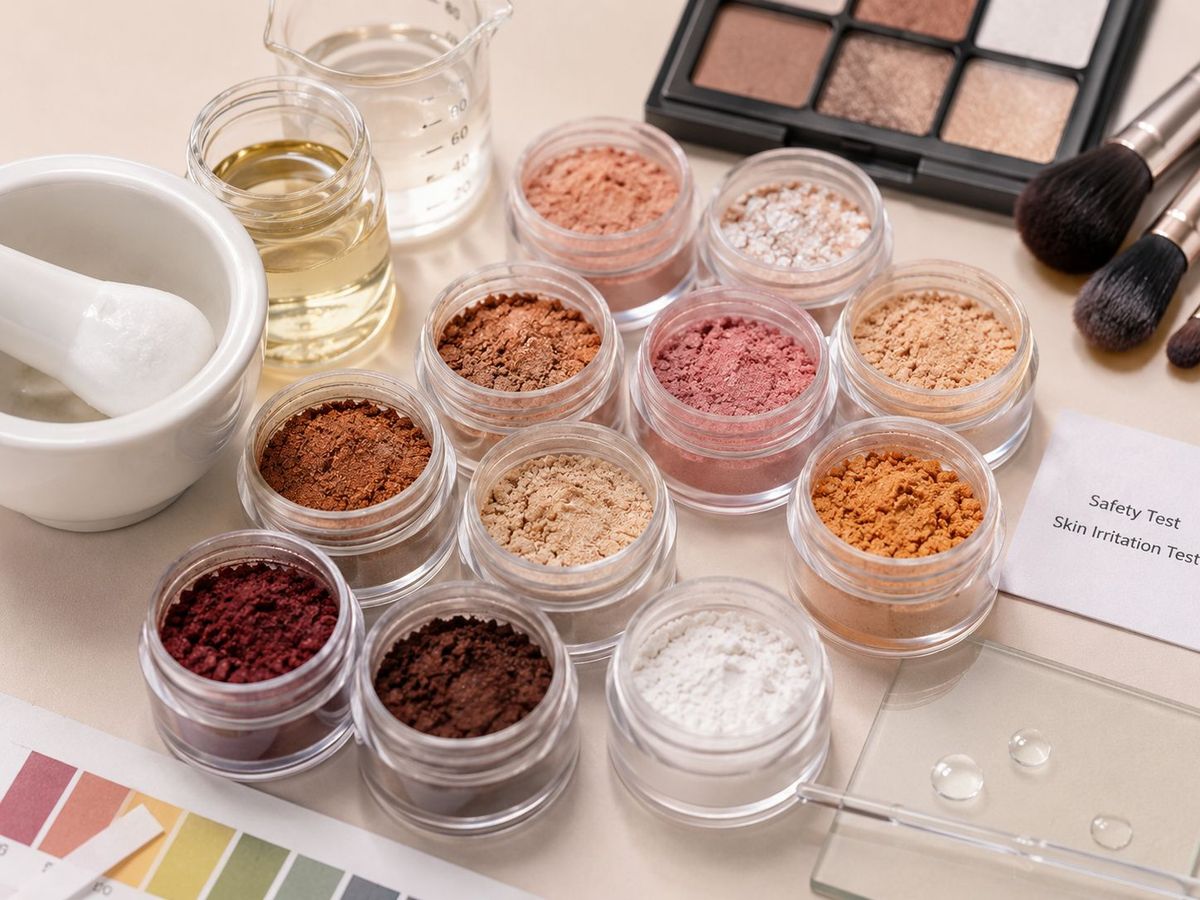
Skin Safe Mica Powder: Natural vs. Synthetic — A Direct Comparison
For formulators deciding between natural and synthetic mica as a base for skin safe mica powder selections, the trade-offs are concrete:
| Parameter |
Natural Mica (Muscovite) |
Synthetic Mica (Fluorphlogopite) |
| Heavy metal content |
Variable; requires purification |
Consistently low |
| Black spot contamination |
Present (mineral inclusions) |
Absent |
| Luster and chroma |
Good |
Higher, more brilliant |
| Batch consistency |
Moderate (natural variation) |
High |
| Temperature stability |
Moderate |
Superior (higher melting point) |
| Cost |
Lower |
Higher |
| Eye-area suitability |
Depends on purification and colorant |
Preferred for eye-area formulas |
| Regulatory status |
Accepted across major markets |
Accepted across major markets |
For high-end eyeshadow palettes and pressed highlighters where visual clarity and color purity are critical, synthetic mica is the rational choice despite the cost premium. For body-area or general skin products where cost matters and visual performance requirements are moderate, natural mica with verified purity is entirely appropriate.
Surface Treatments: What They Do and Why They Matter
Untreated mica and oxide pigments disperse poorly in many cosmetic matrices, absorb oils aggressively, and can feel rough against skin. Surface treatments address each of these directly.
Dimethicone treatment improves skin feel dramatically — it smooths the surface of the pigment flake, reducing friction during application and lowering oil absorption. Silane treatments (triethoxycaprylylsilane, for example) improve compatibility with both polar and non-polar systems, aiding dispersion and substrate wetting. Lauroyl lysine coatings impart a silky, skin-soft texture and are particularly valued in loose powder and blush formulas. Carnauba wax treatment enhances water repellency, useful in pressed powder systems that need to resist humidity.
In practice, selecting a treated versus untreated pigment isn't just a performance call — it affects your entire formulation approach. A dimethicone-treated sericite mica will behave very differently in your oil phase than the same material untreated. Factor this into your vehicle design, not as an afterthought.
Certification Documentation: What to Actually Request
For regulated markets, supplier certifications are not optional. The minimum documentation package for any cosmetic pigment procurement should include:
- Certificate of Analysis (COA): Batch-specific data on purity, heavy metal limits, and physical parameters.
- Material Safety Data Sheet (MSDS/SDS): Handling, storage, hazard classification.
- Technical Data Sheet (TDS): Application guidance, compatibility data, recommended use levels.
- REACH compliance documentation for EU market entry.
- ISO 9001 certification as a baseline quality management indicator.
- Third-party testing reports (SGS, TÜV SÜD or equivalent) for heavy metals, particularly for eye-area or lip-area pigments.
If you're formulating for clean beauty or specific retail requirements, additional certifications — Kosher, cruelty-free, vegan — may be required. These are supply chain decisions as much as formulation decisions.
That said, certification stacks do not replace your own due diligence. Cross-reference pigment INCI names against your target market's colorant positive list independently. Supplier documentation supports your claim; it does not replace your compliance assessment.
Application Zone Reference: Pigment Types by Use Area
| Application Zone |
Permitted Pigment Types (General) |
Key Restrictions |
| Face (general skin) |
Oxides, lakes, mica-based pearls, treated fillers, effect pigments (zone-approved) |
Heavy metal limits; market-specific colorant lists |
| Eye area |
Eye-approved oxides, selected lakes, synthetic mica pearls with eye-safe colorants, eye-approved effect pigments |
Narrower colorant approval list; avoid non-eye-approved dyes even at low levels |
| Lip |
Food-grade or lip-approved lakes, oxides, lip-safe mica pearls, lip-approved effect pigments |
Ingestion risk; ultramarines restricted in some markets; stricter heavy metal limits |
| Nail |
Broad range including effect pigments rated for lacquer; matte pigments; oxides; lakes |
No direct skin mucosa contact; broader colorant options than eye or lip |
Practical Selection Criteria for Formulators and Technical Buyers
When evaluating a cosmetic safe pigment for a specific formula, work through these in sequence:
- Define application zone and target markets first. This determines which colorants are permissible before anything else.
- Verify INCI compliance. The ingredient as listed on your INCI declaration must match the actual material and its approved use.
- Request COA with heavy metal data specific to each batch, not just a generic product spec.
- Evaluate the colorant package on the mica substrate, not just the substrate alone. A pigment is its complete composition.
- Assess surface treatment compatibility with your formulation matrix — oil, water, anhydrous, pressed, loose.
- Request samples and run dispersion trials. Lab-scale behavior in your specific vehicle is the only real data point that matters for formulation decisions.
- Confirm supplier's quality management system produces batch-to-batch consistency. Color cosmetics are visual products — shade variation between batches is not acceptable.
Fillers and Functional Powders: Often Overlooked, Always Important
Cosmetic fillers — boron nitride, silica microspheres, magnesium myristate, silk sericite, synthetic mica powder — are not colorants, but they share the same safety requirements and directly influence how color pigments perform on skin. They affect slip, adhesion, oil control, and the soft-focus visual effect that makes a formula feel luxurious rather than chalky.
Boron nitride, for example, contributes exceptional slip and a skin-smoothing visual effect. Silica microspheres scatter light to reduce the appearance of pores. These functional materials need the same documentation rigor as your colorant pigments — they are skin-contact ingredients in a regulated category.
FAQ
What is the difference between cosmetic grade and industrial grade mica pigment?
Cosmetic grade mica pigments are produced and purified to meet heavy metal limits (arsenic, lead, mercury) specified by regulatory bodies including the FDA and EU Cosmetics Regulation. Industrial grade materials do not meet these purity standards and have not been tested for skin contact safety. Using industrial grade pigments in cosmetic formulas creates both a compliance risk and a genuine safety risk. The distinction is in the purification process and the supporting documentation — not just labeling.
Can the same pearlescent pigment be used in both eyeshadow and lip gloss?
Only if the specific pigment — including its complete colorant package — is approved for both eye-area and lip use in your target market. A pearlescent pigment with an eye-approved TiO2/iron oxide coating on synthetic mica may qualify. One that includes a colorant not on the lip-approved list does not, regardless of how it performs aesthetically. Always verify by INCI composition against zone-specific positive lists, not just the base material.
Are holographic and color-shifting pigments safe for direct skin application?
Some are, some are not — and this is not a category-level answer. Holographic and chromashift pigments designed for nail lacquer or industrial applications are not interchangeable with cosmetic-grade variants. Suppliers who produce both will designate face/eye/lip suitability explicitly in product documentation. If that designation is absent, treat the pigment as not cleared for direct skin contact until documentation confirms otherwise.
What documentation should I require before approving a cosmetic pigment supplier?
At minimum: COA with batch-specific heavy metal data, MSDS/SDS, TDS with recommended application guidance, and REACH compliance documentation for EU supply. Third-party test reports from accredited labs (SGS, TÜV SÜD or equivalent) add meaningful assurance for eye-area and lip-area materials. ISO 9001 certification indicates a quality management system capable of delivering batch consistency — a practical requirement for production-scale formulating. Certifications like cruelty-free and Kosher are additional depending on your brand positioning requirements.
For technical samples, formulation support documents (TDS, COA, MSDS), or application-specific pigment recommendations, contact Kolortek directly at contact@kolortek.com.

 English
 Français
 Deutsch
 Русский
 Español
 Português