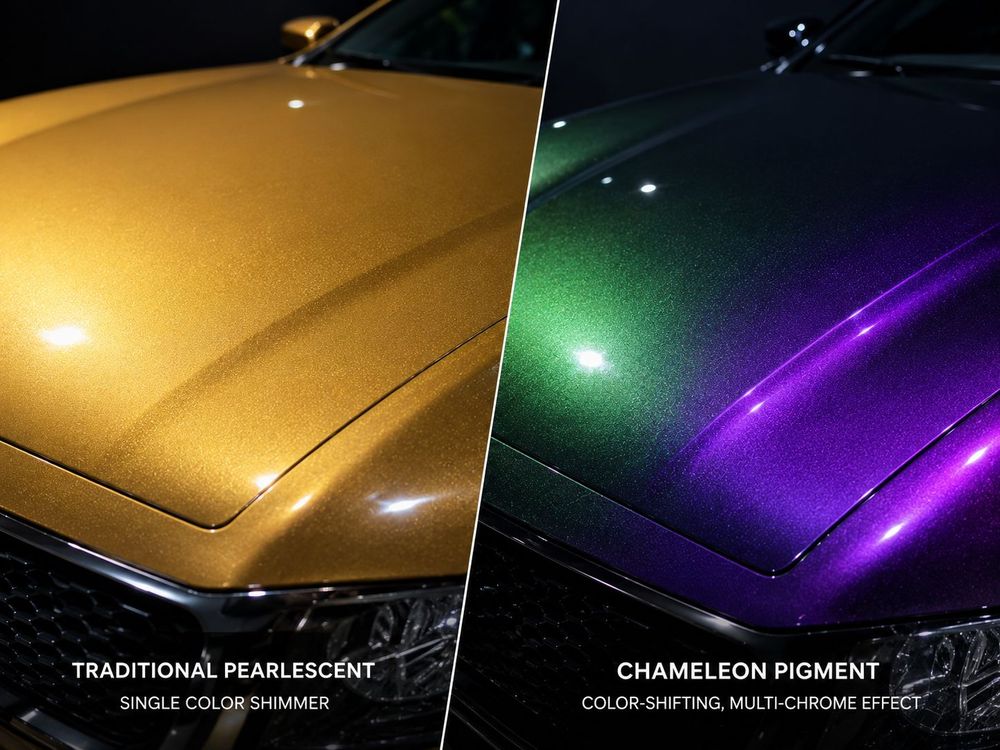
When it comes to the chameleon vs pearlescent debate, the fundamental difference is motion versus stillness. Traditional pearlescent pigments produce a luminous, static shimmer through a single interference coating — beautiful, reliable, and cost-effective. Chameleon pigments, by contrast, use precisely engineered multi-layer interference stacks to generate a dramatic angle-dependent color shift, making this chameleon pigment guide essential reading for any formulator or procurement manager deciding between the two. Choosing the right option is one of the most consequential decisions in effect pigment procurement — get it right and your product dazzles; get it wrong and you've paid a premium for an effect that disappears on the wrong substrate.
Key Takeaways
- Traditional pearlescent pigments create a single dominant hue through thin-film TiO₂ interference — the color is consistent regardless of viewing angle, making them the backbone of packaging, general cosmetics, and industrial coatings.
- Chameleon pigments (goniochromatic pigments) rely on 3–7 alternating metal oxide layers to shift color as the viewing angle changes — a duochrome shifts between 2 hues, while a multi-chrome can travel through 3 or more.
- Substrate color is non-negotiable for chameleon effects: the color-shift phenomenon requires a dark or black background. On white or light substrates, the dramatic shift collapses into a subtle, often disappointing haze.
- Price reflects complexity: traditional pearl pigments can cost as little as a few dollars per kilogram at scale, while chameleon pigments command a significant premium due to precise multi-layer deposition manufacturing.
- Sustainability is reshaping both categories: ethical sourcing pressure is accelerating the shift toward synthetic mica substrates, and EU TiO₂ inhalation classification (Category 2 carcinogen under CLP) is driving demand for TiO₂-free alternatives across both pigment types.
Understanding the Science: How Each Pigment Actually Works
Traditional Pearlescent Pigments: Controlled Interference, One Layer at a Time
A traditional pearlescent pigment is deceptively simple in concept and remarkably precise in execution. At its core, it is a flat, transparent platelet substrate — most commonly natural mica, synthetic mica (fluorphlogopite), borosilicate glass, alumina, or silica — coated with a thin, uniform layer of a high-refractive-index metal oxide, primarily titanium dioxide (TiO₂) or iron oxide (Fe₂O₃).
The color you see is not the result of dye or pigment absorption. It is pure optical physics: multi-layer thin-film interference. When light strikes the TiO₂ coating, some wavelengths are reflected from the top surface while others pass through and reflect from the substrate beneath. These two reflected beams either reinforce (constructive interference, producing a vivid color) or cancel each other (destructive interference). The critical variable is coating thickness. At our lab, we engineer these to nanometer precision: a TiO₂ layer of approximately 120nm produces a gold interference color; push that thickness to around 200nm and the reflection shifts to blue. This relationship between physical thickness and perceived color is why batch consistency demands such rigorous process control — a 10nm deviation can visibly shift the hue.
The result is a luminous, single-hue shimmer. It catches the light beautifully. It does not, however, change color as you move around it.
Chameleon Pigments: Multi-Layer Stacks and the Goniochromatic Effect
Chameleon pigments — also called color-travel or goniochromatic pigments — operate on the same foundational principle of thin-film interference, but with a crucial architectural difference: instead of one coating layer, they use a precisely engineered stack of alternating layers, typically combining TiO₂, Fe₂O₃, and silica spacer layers in sequences of 3 to 7 distinct coatings.
Here is the insight that surprises many formulators encountering chameleon pigments for the first time: the color shift is not a trick of the dye — it is a geometric phenomenon. As the viewing angle changes, the effective optical path length through the multi-layer stack changes with it. Different path lengths produce constructive interference at different wavelengths. The result is that the pigment literally displays a different dominant color depending on whether you are looking at it straight on or at a glancing angle. Our KT-9000 Magic Chameleon Series exploits this precisely. A duochrome variant (3–5 layers) shifts between two colors — for example, green to purple. A multi-chrome variant (5–7 layers) can travel through three or more — gold to green to blue as the angle sweeps.
This is what separates a chameleon pigment from a pearl that merely "looks different in different lights." A well-formulated chameleon effect is an unambiguous, dramatic color transition — one that moves continuously as the object rotates or the observer moves.
The Critical Practical Difference: Substrate Color Changes Everything
One of the most common and costly mistakes we see in chameleon pearl pigment comparison scenarios is a formulator evaluating a chameleon pigment over a white drawdown card and concluding the color shift is weak or nonexistent. It is not the pigment that has failed — it is the substrate.
Traditional pearlescent pigments are relatively forgiving. Their shimmer is visible over both light and dark backgrounds because the single dominant interference color has enough contrast to read on most substrates. Chameleon pigments are fundamentally different. The color-travel effect depends on the underlying substrate absorbing the transmitted light rather than scattering it back. On a black or very dark substrate, the only light reaching your eye from the pigment layer is the reflected interference color — and as the angle changes, you see the shift clearly. On a white substrate, the white base reflects all wavelengths back through the pigment layer, washing out the angular contrast and destroying the goniochromatic effect.
This is not a limitation unique to Kolortek's products — it is a physical reality of how multi-layer interference works. When specifying a chameleon pigment for any application, the first question must always be: "What is the substrate color?" Automotive custom finishes naturally involve a black basecoat, which is one reason that segment has become the dominant market driver for chameleon technology. For cosmetic applications — pressed eyeshadows, nail gels, specialty lip products — the formulator must design the matrix with this substrate requirement in mind from the start.
Where Each Pigment Type Wins: Applications by Segment
Traditional Pearlescent: Volume, Versatility, and Value
The global effect pigment market is projected to grow at a CAGR of 5–7%, and traditional pearlescent pigments remain the dominant volume segment, particularly in plastics (packaging, consumer durables), general industrial coatings, and mass-market cosmetics. Their versatility is unmatched: compatible with acrylics, polyurethanes, epoxies, and waterborne systems, with a particle size range spanning from 1μm (silky, satin finish) to 250μm and beyond (bold, reflective sparkle). Recommended loading levels vary enormously — from 0.5% for a subtle cosmetic sheen to 40% or more in specialty coating applications.
A common misconception is that "pearlescent" means only soft, pale shimmer. In reality, coatings-grade pearlescent grades in the 60–100μm range produce intense, high-chroma metallic-adjacent effects. The effect is static, but it is far from subtle when the right grade is chosen.
Chameleon Pigments: Premium Niches Where Movement Justifies Cost
The commercial case for chameleon pigments is straightforward: in certain applications, the color-shift effect commands a price premium in the finished product that far exceeds the higher raw material cost. Automotive OEM and refinish custom finishes, high-end cosmetics (particularly prestige eye and nail categories), luxury packaging for spirits and perfume, and security printing are the primary commercial homes for these pigments. The KT-9000 series from Kolortek targets exactly these segments, offering a multi-chrome range that competes with established European offerings at a more accessible price point for mid-market and emerging brands.
Chameleon vs Pearlescent: Full Comparison at a Glance
| Feature |
Traditional Pearlescent |
Chameleon (Color-Travel) |
| Visual Effect |
Static luster, single dominant hue |
Dynamic color shift with viewing angle |
| Optical Mechanism |
Single or simple TiO₂/Fe₂O₃ interference layer |
Multi-layer stack (TiO₂ + Fe₂O₃ + SiO₂, 3–7 layers) |
| Substrate Requirement |
Light or dark substrates — flexible |
Dark/black substrate essential for full effect |
| Particle Size Range |
1–250+ μm |
5–250 μm |
| Common Substrates |
Natural mica, synthetic mica, borosilicate, alumina, silica |
Primarily natural mica (KT-9000 series) |
| Key Applications |
Plastics, industrial coatings, cosmetics, packaging |
Automotive custom finishes, luxury cosmetics, security printing |
| Price Point |
Broad range; cost-effective at scale |
Premium — reflects multi-layer deposition complexity |
| Mixing with Absorption Pigments |
Common and straightforward |
Possible with transparent colorants to modify shift range |
| Topcoat Recommended? |
Application-dependent |
Always recommended in automotive/coating applications |
| Shear Sensitivity |
Avoid high shear (platelet fracture risk) |
Avoid high shear (layer structure integrity) |
Expert Insight: What We See in Formulator Mistakes — and How to Avoid Them
At Kolortek, with over two decades of supplying both traditional pearlescent and chameleon series pigments to automotive, cosmetic, and industrial customers, we have observed two recurring formulation errors that consistently undermine results — one for each pigment type.
For chameleon pigments: The single most common mistake is what we call "the white card test failure." A purchasing manager or R&D chemist receives a sample of our KT-9000 multi-chrome, drops it into a white cosmetic base or paints it over a white test card, and reports back that the color shift is "barely visible." They are not wrong about what they observed — but they are drawing the wrong conclusion. We always recommend evaluating chameleon pigments over a black drawdown card or a black masterbatch as the first pass. When we walk customers through this switch during technical support calls, the reaction is consistently one of immediate and genuine surprise. The same pigment that looked flat over white becomes a vivid, sweeping color journey over black.
For traditional pearlescent pigments: High-shear mixing is the silent killer of pearl effects. A customer once escalated a quality complaint insisting our pearlescent grade had lost its luster in their injection-molded plastic component. After reviewing their processing parameters, the root cause was a screw speed and back-pressure combination that was fracturing the platelet structure of the pigment. Pearlescent pigments derive their effect from large, flat, mirror-like platelets. When those platelets are broken into smaller, irregular fragments, the interference efficiency collapses and the result looks chalky rather than luminous. The fix: reduce shear, add the pigment as late as technically feasible in the process, and consider a masterbatch route for plastics applications where the base compounder can control dispersion conditions more carefully.
One additional practical note on chameleon formulation: adding a small percentage of transparent absorption pigment — for example, a transparent red or blue — to a chameleon base can narrow or shift the apparent color-travel range in a controlled way, allowing you to tune the starting color of the shift without destroying the goniochromatic effect. This is a powerful tool for matching a target color specification while retaining the travel effect, and it is one of the more sophisticated formulation moves available to a skilled product developer.
Supplier Selection: What Matters Beyond the Sample
Whether you are sourcing traditional pearl or chameleon pigments, pigment supplier selection deserves the same rigor you would apply to any other critical raw material. The effect pigment supplier landscape includes well-established European players — Merck KGaA with its Iriodin® and Colorstream® portfolios, BASF's Lumina® range for automotive OEM — alongside a growing tier of Asian manufacturers offering cost-competitive alternatives.
For procurement managers considering alternatives to established European suppliers, the practical questions are: Can the supplier provide a cross-reference guide? Do they offer both natural and synthetic mica substrates, giving you flexibility on ethical sourcing requirements? Can they support OEM color-matching or private labeling? At Kolortek, we provide a direct Iriodin®-to-Kolortek replacement guide for formulators making the transition, and our portfolio spans both substrate types — natural mica for cost-sensitive applications and synthetic mica (fluorphlogopite) for brands with clean-beauty or conflict-mineral sourcing policies.
On the regulatory front, two issues are reshaping procurement decisions across both pigment types. First, the EU CLP classification of TiO₂ as a suspected inhalation carcinogen (Category 2) is driving meaningful demand for TiO₂-free effect pigment alternatives — particularly in cosmetic applications where dusty powder handling is routine. Second, the EU microplastics restriction continues to accelerate development of biodegradable alternatives for glitter-adjacent applications. These are not distant regulatory concerns — they are active specification changes happening in formulator briefs today.
Frequently Asked Questions: Chameleon vs Pearlescent Pigments
What is the difference between a chameleon pigment and a pearlescent pigment?
A pearlescent pigment produces a static, single-hue shimmer through a single thin-film interference coating on a platelet substrate. A chameleon pigment uses a multi-layer interference stack (3–7 alternating metal oxide layers) to generate a goniochromatic effect — the perceived color shifts dramatically as the viewing angle changes. The core visual difference is static versus dynamic: pearl shimmers, chameleon travels.
Can chameleon pigments be used on a white substrate?
Technically yes, but the color-shift effect will be severely diminished or invisible. Chameleon pigments require a dark or black substrate to perform correctly — the dark background absorbs transmitted light, allowing only the angle-dependent reflected interference color to reach the observer. On white substrates, back-scattered light overwhelms the angular contrast and the shift effect collapses. Always formulate chameleon applications over dark bases.
How many color shifts does a chameleon pigment produce, and what determines the shift range?
Duochrome chameleon pigments (3–5 coating layers) produce a 2-color shift — for example, green to purple. Multi-chrome variants (5–7 layers) can shift through 3 or more colors, such as gold to green to blue. The number and sequence of color transitions is determined by the specific combination of TiO₂, Fe₂O₃, and SiO₂ layer thicknesses in the interference stack — a relationship governed by optical thin-film physics.
Why are chameleon pigments more expensive than traditional pearlescent pigments?
Chameleon pigments require precise deposition of multiple alternating coating layers, each at a controlled nanometer-scale thickness. Each additional layer adds process complexity, time, and the risk of defect accumulation across the layer stack. Traditional pearlescent pigments require a single, well-controlled TiO₂ or Fe₂O₃ coating, which is a comparatively simpler and faster manufacturing process. The premium for chameleon pigments directly reflects the engineering difficulty of the multi-layer architecture.
Can I switch from a Merck Colorstream or Iriodin product to a Kolortek equivalent, and how do I match the effect?
Yes — Kolortek maintains a direct cross-reference guide mapping Iriodin® and select Colorstream® grades to equivalent Kolortek product series, including the KT-9000 Magic Chameleon range. The most reliable matching approach is to request sample comparisons on your specific substrate and resin system, as goniochromatic effects can read differently depending on film build and substrate color. Our technical team can assist with formulation guidance to achieve equivalent visual output at a more competitive cost.
Are there TiO₂-free alternatives for both pearlescent and chameleon pigments, and why does it matter for cosmetic applications?
Yes, TiO₂-free alternatives exist for both pigment types and are increasingly specified in cosmetic formulations. The EU CLP regulation classifies TiO₂ as a Category 2 suspected inhalation carcinogen, creating regulatory pressure for powder-form cosmetic products where dusty handling occurs. TiO₂-free effect pigments typically use alternative high-refractive-index coatings to generate interference color, trading some brightness for regulatory compliance. Kolortek offers TiO₂-free options within its portfolio for brands with these specification requirements.
The bottom line: Chameleon and traditional pearlescent pigments are not competing versions of the same product — they are fundamentally different tools designed for different visual outcomes. Pearl delivers consistency, broad compatibility, and cost efficiency. Chameleon delivers drama, movement, and premium positioning that can transform how a finished product is perceived in the hand or on the shelf. Understanding this distinction at the specification stage — before the prototype is made, before the substrate is committed — is the single decision that separates a successful effect pigment application from an expensive reformulation. At Kolortek, this is exactly the guidance we provide from the first technical conversation.
Explore the full KT-9000 Magic Chameleon Series and our complete pearlescent pigment portfolio to find the right effect for your application — or reach out to our technical team for substrate-specific recommendations and cross-reference support.

 English
 Français
 Deutsch
 Русский
 Español
 Português