A powder coating can carry effect pigment three ways, and the three do not fail in the same place. Dry blending is the lowest-cost and separates in the electrostatic field. Bonding heats the powder until the flake sticks to the particle. Extrusion protects the surface by destroying the effect. Loading sets the scale: about 10% works on a bench, about 3% survives production.
Three Ways to Put Effect Pigment Into a Powder
A powder coating is not a liquid with pigment dissolved in it. It is a pile of dry resin particles, and the pigment is a separate solid that has to travel with them. Where that pigment sits relative to the resin particle is the whole design question, and only three answers exist: it can sit loose between the particles, it can be stuck onto their surfaces, or it can be buried inside them.
| Route |
Where the flake sits |
Documented failure |
Reclaim usable? |
| Dry blend |
Loose, between the resin particles |
Separates in the electrostatic field; blotchy flats; build-up at the gun |
No — pigment ratio shifts |
| Bonding |
Stuck onto the particle surface |
Cost and throughput; behaves badly under tribo charging |
Generally yes |
| Extrusion |
Buried inside the particle |
The platelet itself is broken during extrusion or grinding |
Yes |
The last column is the one that decides most projects, and it is the one buyers usually ask about last. Reclaiming overspray is not a housekeeping detail in powder coating. It is the reason the process is economically competitive, so a route that quietly makes the reclaim unusable is not a small compromise. It is a change to the operating cost of the line.
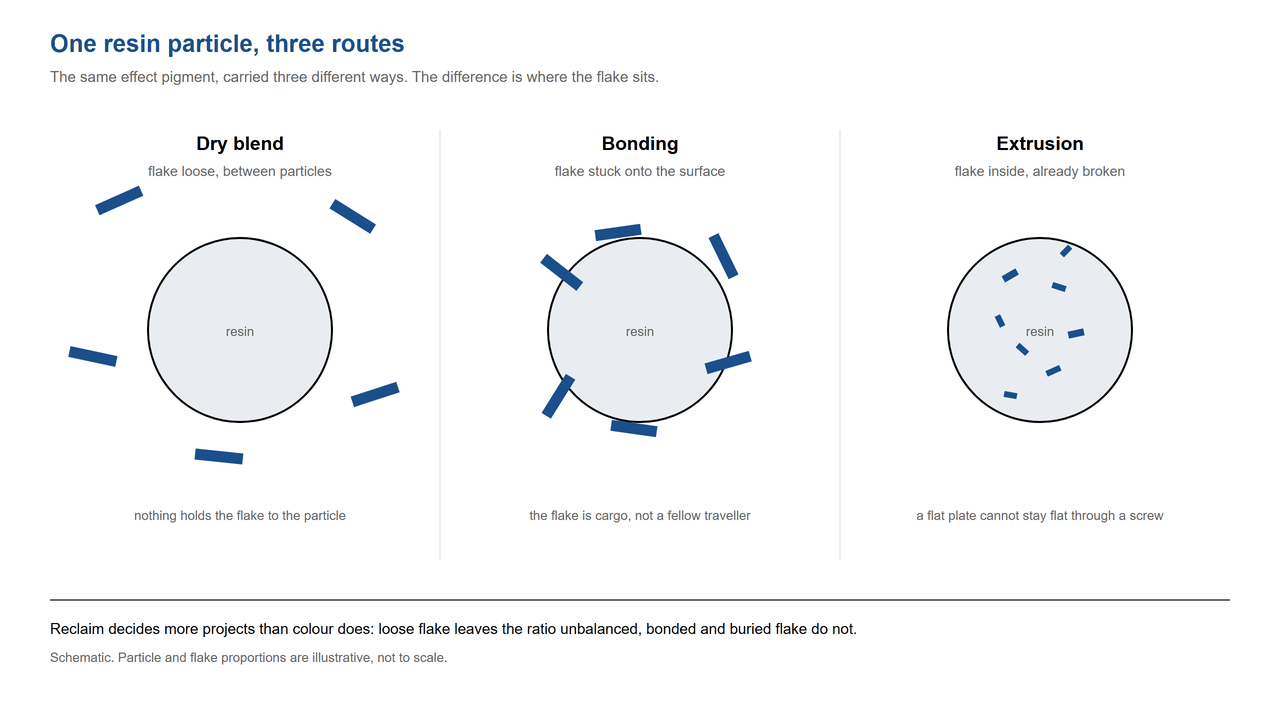
One resin particle, three routes. Left: the flake is loose between particles and can leave. Centre: the flake is stuck to the surface and travels with it. Right: the flake is inside, and has already been broken to get there.
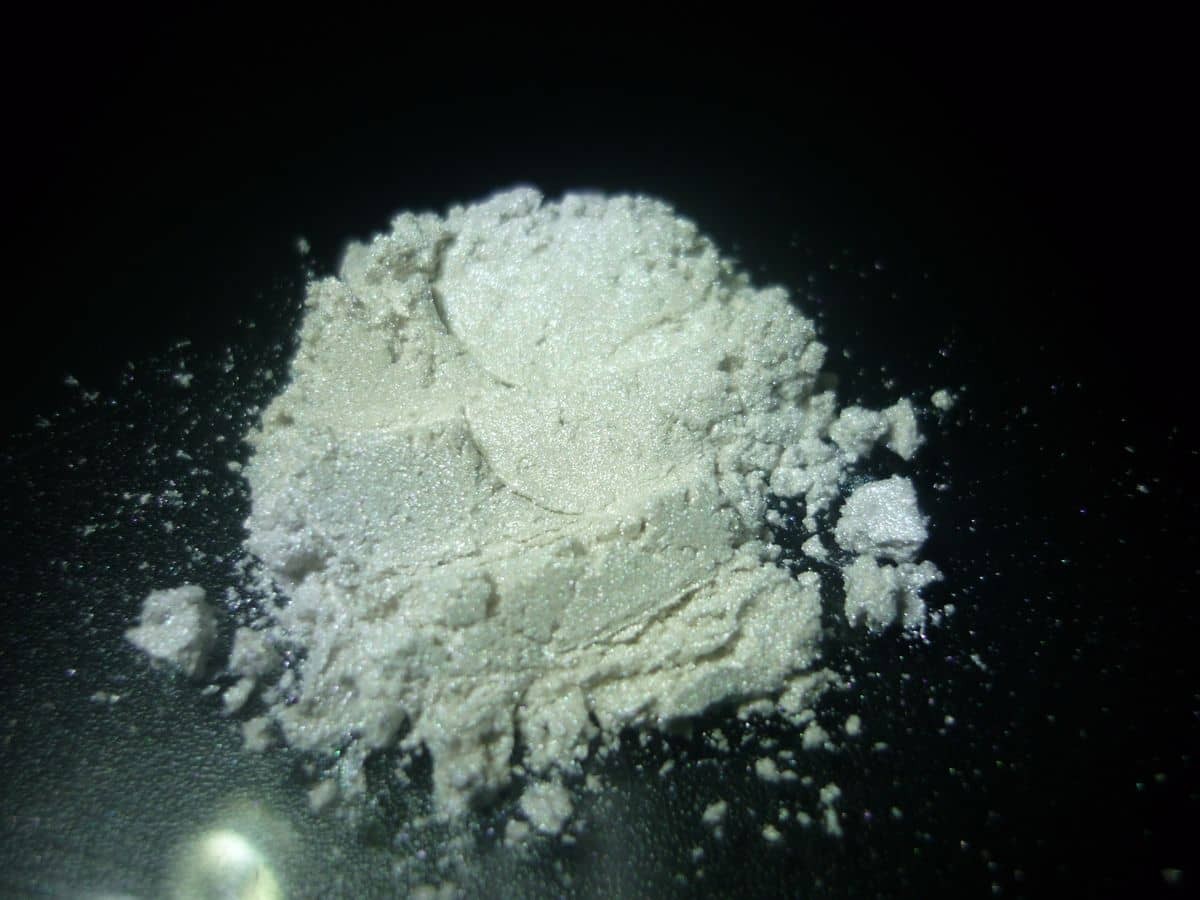
A fine pearl grade in powder form. In powder coating the platelet has to survive extrusion and still lie flat in the cured film.
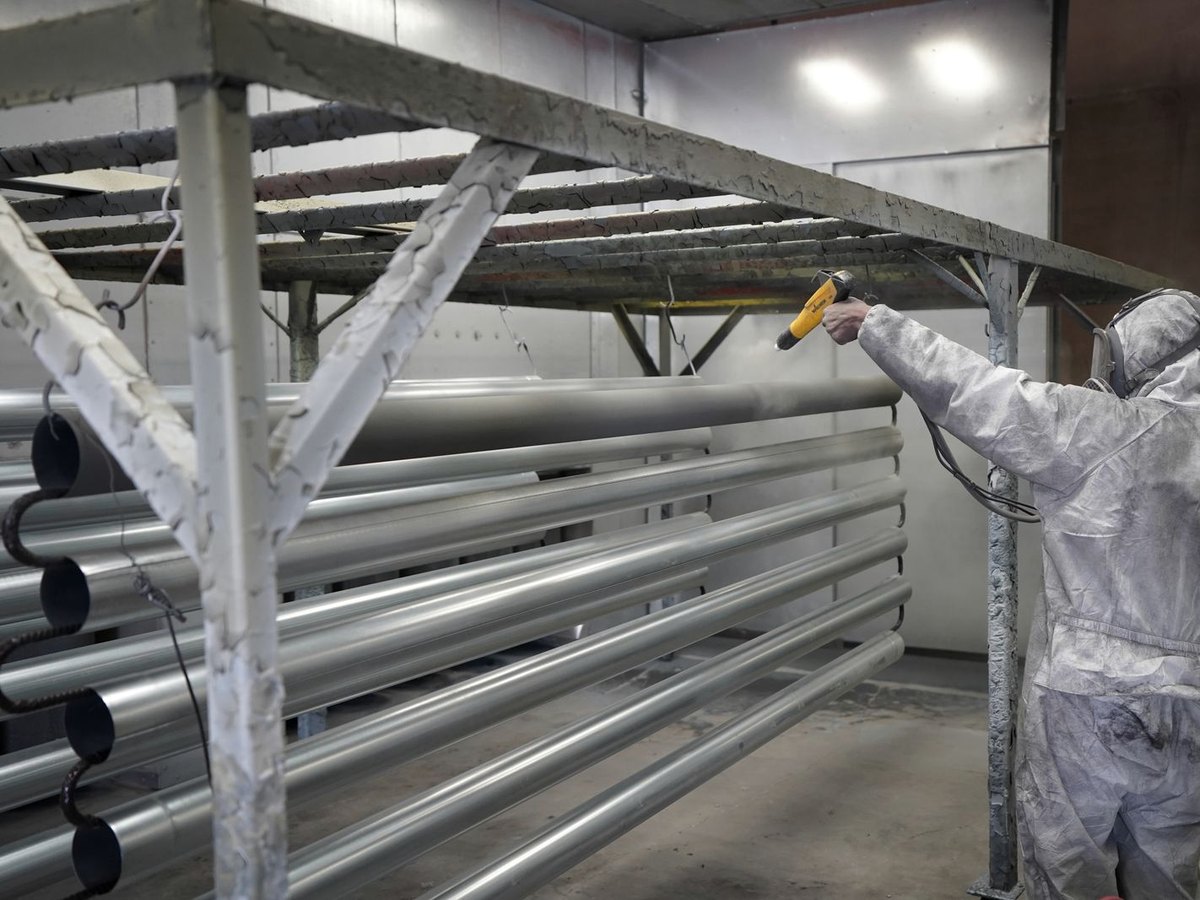
A powder coating booth, not a wet paint line. The gun charges the powder and the part is earthed, so the film builds on the metal rather than on the rack.
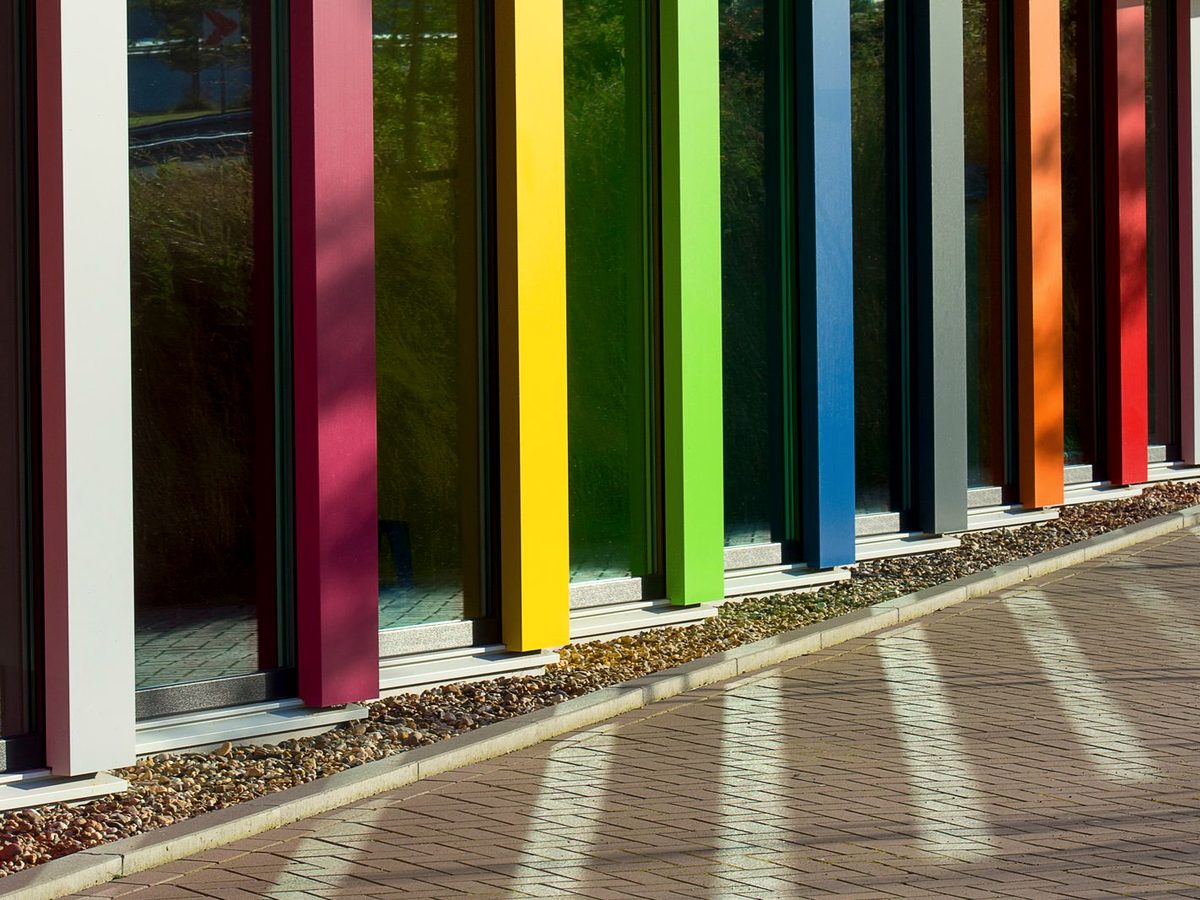
Powder coated aluminium mullions on a glazed facade. The colour lives in the film, and the film has to hold it through years of sun.
Dry Blending Separates, and the Reclaim Is Where You See It
The mechanism is electrical, not mechanical. Mica-based effect pigments are comparatively inert and do not accept a charge the way resin particles do. In the electrostatic field the two populations respond differently and drift apart before they reach the part. Industry write-ups describe this as excessive separation caused by the contrast in electrical properties between the base powder and the flake [1].
You can see the separation on flat panels, where it shows up as blotchiness, and you can see it at the gun, where dry blended material builds up on the hardware and eventually spits a lump onto the surface [1]. Metal loading makes it worse: above roughly 5% aluminium, application behaviour can break down, and free metallic pigment can coat the powder hose from the gun back to the venturi, at which point the powder no longer takes a charge at all [1].
The expensive symptom is the reclaim. Because the two materials separate during spraying, the powder that misses the part no longer has the same pigment-to-resin ratio as the powder that went in. The reclaim ends up with a different ratio, which means a different colour and a different appearance, which means it is close to unusable as a top-up [1]. Powder coating's great economic advantage — that overspray comes back — quietly stops applying.
Transfer efficiency numbers make the cost concrete. With earthing, jigging and line density all optimised, more than 70% of fresh powder typically adheres to the substrate. Push the recycled-to-fresh ratio too high and that figure falls, because overspray carries a higher proportion of fines with different charging behaviour, and the visible consequences run in a chain: less penetration into recesses, poorer flow, film builds below the minimum [2]. Guidance from a powder manufacturer also recommends sieving captured overspray through an aperture of about 150 μm before it goes back in [2].
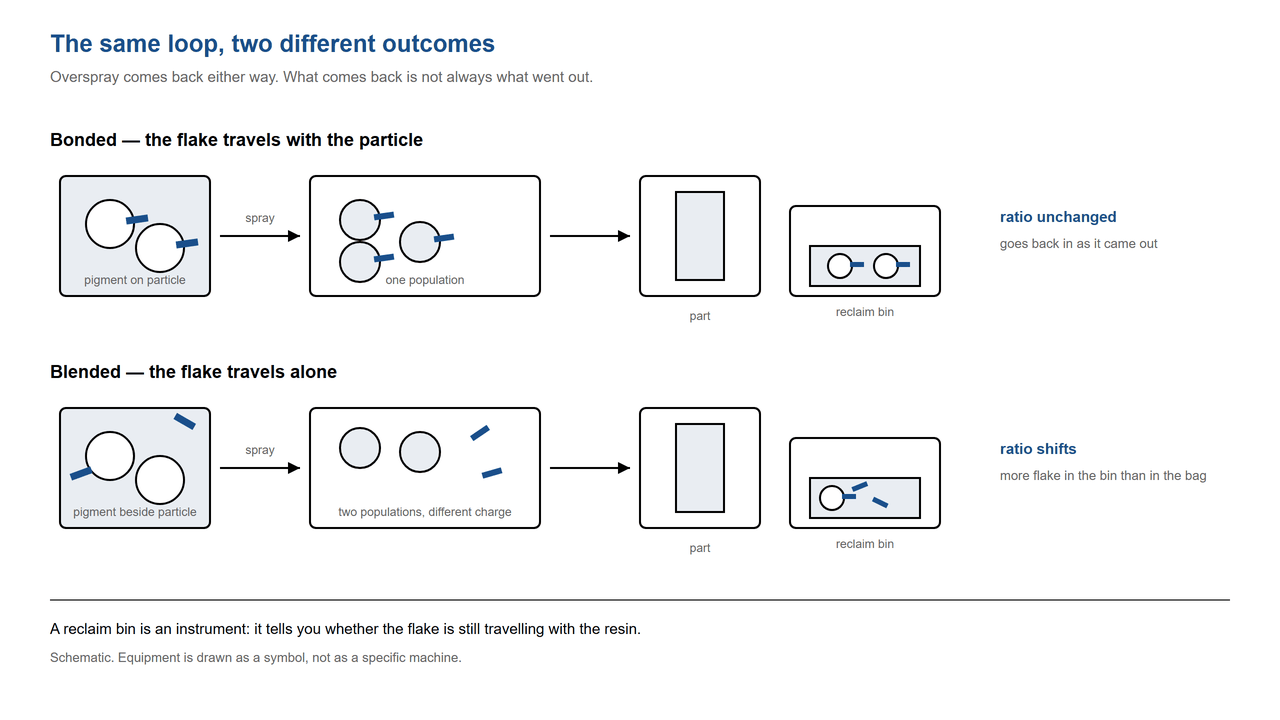
The same loop, two outcomes. When the flake travels with the particle, the reclaim returns at the same ratio it left. When it travels loose, the bin slowly gains flake and the colour drifts.
There is a reason this route survives anyway, and it is worth stating plainly: dry blending is the low-cost way to make a metallic or pearlescent powder. It stays in use for low-volume lines that do not reclaim, for formulations with very low additions, and for parts where colour and appearance are not critical [1]. If your line reclaims and your customer inspects colour, that combination is the one that does not work.
Grade choice interacts with all of this. A coarser flake gives more sparkle and travels through the delivery system more easily, but it is also the one that reads as blotchy when orientation is uneven; a finer grade disperses more evenly and produces a smoother, quieter effect. If you are still choosing between bands, the same reasoning that governs particle size selection for effect pigments in liquid systems applies here, with one addition: in a powder, coarse flake is also the fraction a cyclone is most likely to strip out of your reclaim [2].
Bonding Attaches the Flake to the Particle
Bonding removes the separation by removing the freedom to separate. The powder base and the pigment are blended, then heated to a temperature high enough to soften the surface of the resin particles so the pigment binds to them [3]. The flake is no longer an independent traveller in the field; it is cargo on a particle that already knows how to charge.
The appearance benefit goes beyond reclaim. Once the flake is carried on the surface of the particle and the film levels, the platelets settle more nearly parallel to the coating surface, which is the orientation that produces the cleanest effect [4]. This is the same physics that governs liquid systems: disturb platelet orientation and you change the measured colour, not just the impression of it [5]. It is why the interference itself is worth understanding before you argue about loading — thin-film interference only reads cleanly when the plates are flat and facing the same way.
The costs are real and rarely mentioned in the same breath as the benefits. Bonding works well for corona charging but is a poor fit for tribo, and the process is more expensive than tumbling pigment into powder [3]. It also changes what the reclaim looks like: in the composition categories a powder maker publishes, bonded and kinetic products carry low-to-moderate quality-control risk on recycling, while blended products carry high risk and are recommended for reclaim only with caution [2].
One claim deserves to be retired. A coated aluminium flake is not a bonded flake. Aluminium supplied for dry blending usually carries an inorganic or organic coating for safety reasons, and that coating has only an insignificant effect on electrical behaviour when the pigment is used as a dry blend. What it protects is the manufacture and handling of the neat aluminium — which benefits the powder producer, not the person spraying it [1]. If a supplier offers you a coated flake as a drop-in for bonding, the coating is not doing the work you were told it does.
Extrusion Protects the Appearance by Destroying the Effect
Extrusion solves the separation problem at the root, because pigment compounded into the resin is inside the particle and cannot drift away from it. Nothing separates, nothing builds up at the gun, and the reclaim behaves. That is why extrusion is the default for solid colours and the reason formulators keep trying to make it work for effects.
The effect is where the bill arrives. The laminar structure of a metallic or pearlescent pigment is destroyed during the extrusion or grinding steps used to make powder coatings, and the appearance that results shows reduced lustre [3]. A flake works because it is a flat, parallel-sided optical element; break it and you no longer have that element, you have a coloured particle. The industry's move toward dry blending and bonding was a response to exactly this [3].
Loading is the second half of the story, and it explains a gap that frustrates every formulator who has ever scaled up. In single-application or laboratory conditions, pigment concentrations up to roughly 10% or more can be used. At commercial scale the concentration is limited to around 3%, and above that level the documented problems begin: spray gun clogging and tip build-up, blotchy panels, and colour separation [3]. A bench formula at 8% is not a formula; it is a demonstration.
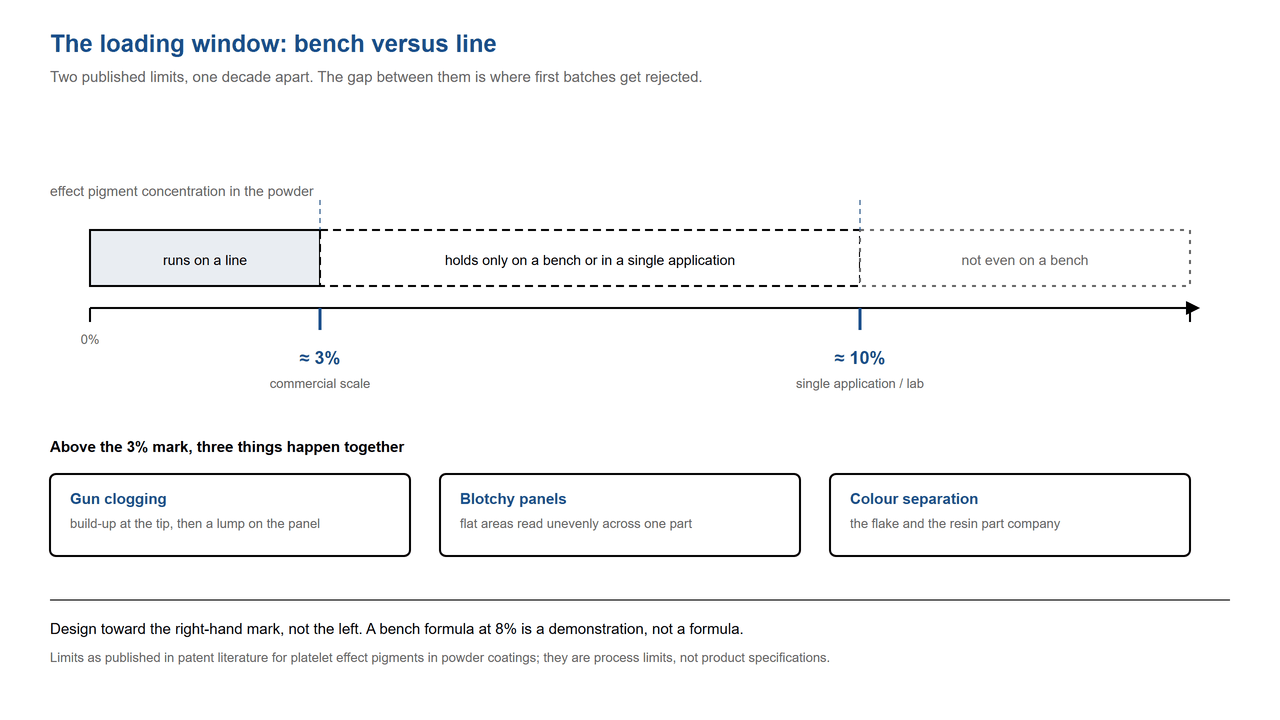
One axis, two marks. About 10% is where a bench trial stops disappointing you. About 3% is where a production line stops clogging. The distance between them is the most common source of a rejected first batch.
What to Put in the RFQ
Everything above collapses into one sentence that you can paste into a request. Write it down and send it with the colour target: state the route — dry blend, bonding or extrusion — and say whether overspray is reclaimed. Those two facts decide which grade is even eligible, and neither of them is a property of the pigment. They are properties of your line.
Then work in one direction. Start from the reclaim question, because it is the only one that cannot be compromised later: if the line reclaims and colour matters, dry blending is out and the argument is between bonding and a lower-effect extrusion grade. Next, set the loading ceiling against your real process rather than the bench — the 3% figure above is a documented commercial limit, not a target to design toward. Only then choose a particle size band, and choose it against the effect you need to see at the distance the part is actually viewed from.
We should be clear about what we supply in this chain. We make the effect pigment that goes into these three routes: pearlescent grades on natural mica, on synthetic mica and on borosilicate glass, plus metallic luster and aluminium ranges. We do not sell a bonded powder, so we are not going to describe a bonding process as if it were ours. What we can do is tell you which of our grades fits the route you have and which particle size band your film can carry.
That last part matters more than it sounds. Our grades run in bands of under 15 μm, 5–25 μm, 10–60 μm and 10–100 μm, and the band is the single specification that most often disqualifies an otherwise correct colour match. For a full view of what each series looks like, the Pearl Pigment Color Cards show the range against each other rather than one swatch at a time, and the pearlescent pigments for coatings page lists the series we hold for this kind of work.
One limitation to end on, because it would be dishonest to leave it out. We do not run a powder coating line. Every number in this article comes from published industry and patent literature, not from our own trials, and we will not quote you a transfer efficiency, a cure window or a chemical resistance result for a process we have not run. Ask us for the pigment, the band and the documentation; run the line trial where the line is. ISO 9001 is certified; other documentation is provided on request.
References
[1] "Modern Metallics." PCI Magazine. https://www.pcimag.com/articles/94305-modern-metallics
[2] "Recycling (reclaiming) Powder Coat Overspray — Tech Advice." DGL International Powder Coatings, 2021. https://dglpowders.com/wp-content/uploads/2021/05/DGL-Recycling-Powder-Coat-Overspray-Tech-Advice.pdf
[3] "Improved powder coating composition and method." EP 1 339 806 B1, European Patent Office. https://data.epo.org/publication-server/rest/v1.2/publication-dates/20051019/patents/EP1339806NWB1/document.pdf
[4] Doll, J.; Venturini, M.; Rohrer, A. "Aluminum Coatings." CoatingsTech, July 2019, p. 34.
[5] Kettler, W. H.; Richter, G. "Investigation on topology of platelet-like effect-pigments in automotive surface-coatings." Progress in Organic Coatings, 1997, 31(4), 297–306. DOI: 10.1016/S0300-9440(97)00087-8

 English
 Français
 Deutsch
 Русский
 Español
 Português