Selecting the right pearlescent mica powder for automotive paint is a formulation decision with direct consequences on visual depth, weatherability, and application behavior — not just aesthetics. The combination of interference-based color travel and metallic shimmer makes these pigments irreplaceable in OEM and refinish coatings alike, from solid body panels to interior trim. This article breaks down how different automotive effect pigment types perform in real paint systems, where each excels, and what trade-offs formulators need to account for before committing to a specification.
Why Mica-Based Pigments Dominate Automotive Coatings
Mica has been the substrate of choice in effect pigments for decades. The reason is structural: natural and synthetic mica cleaves into flat, smooth flakes that orient parallel to the coating surface. That orientation is what creates the flip-flop angle-dependent lightness shift that defines high-end automotive finishes.
Coating the mica flake with titanium dioxide — anatase for softer, warmer tones; rutile for higher durability and UV stability — determines both the optical behavior and the service life of the finish. In automotive exterior coatings, rutile-coated grades are the standard, not the upgrade. Anatase grades are more vulnerable to photocatalytic degradation and should be restricted to interior applications or heavily protected systems.
Synthetic mica (fluorophlogopite) takes this further. It offers higher purity, lower iron contamination, fewer black spots, and better thermal stability than natural muscovite. For white and silver automotive basecoats, the cleaner substrate translates directly into higher brightness and more consistent batch color. The trade-off is cost — synthetic mica grades carry a price premium that matters at production scale.
Interference Pearl Pigment: The Mechanics of Color Travel
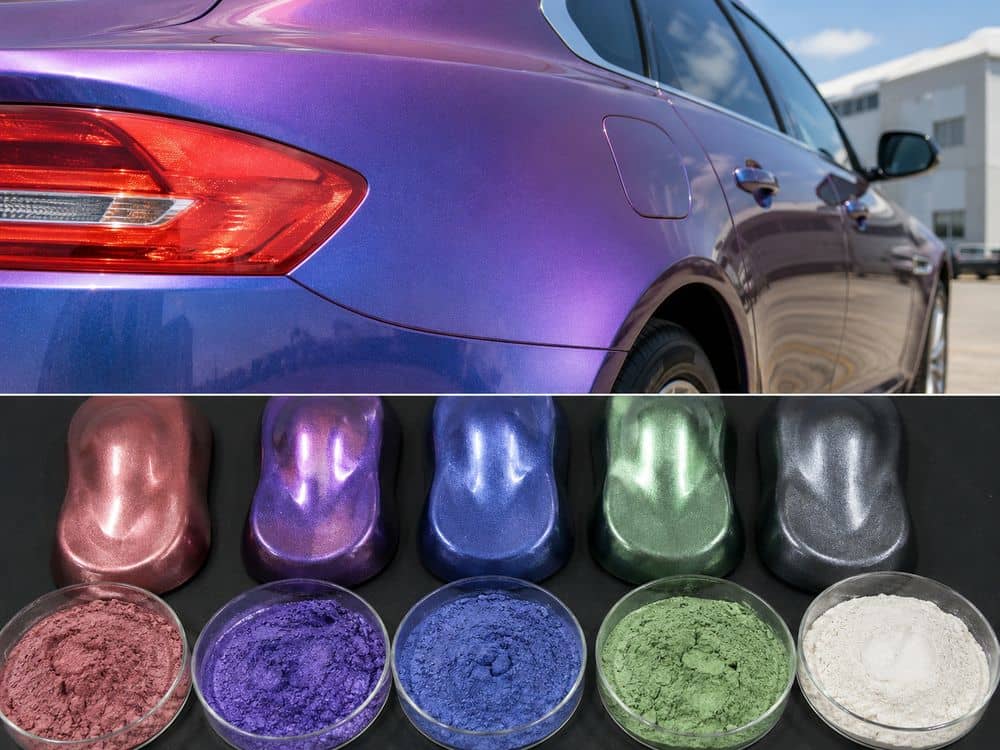
The interference pearl pigment category is where automotive coatings get genuinely complex. These pigments work by growing a thicker TiO₂ layer on the mica flake — thick enough to cause thin-film optical interference. The result: a reflected color that shifts as the viewing angle changes.
On a white or light-colored substrate, interference pigments behave like transparent color washes. On dark substrates, the effect becomes dramatically more visible. This is a formulation constraint that gets underestimated in development: if you're applying an interference blue-pearl basecoat over a white primer, the visual result will be fundamentally different from the same pigment over a black groundcoat. Priming strategy is part of the color specification, not an afterthought.
Interference series pigments — such as gold, red, blue, and green interference variants — require transparent or semi-transparent basecoats to fully express the dual-color effect. Opaque formulations kill the interference character. If covering power is needed, use a tinted primer to carry the color load and keep the topcoat lean on opaque pigments and fillers.
Worth noting: interference pigments paired with aluminum silver paste can produce a finish with simultaneous metallic brilliance and color travel — a combination frequently specified in custom automotive and sports car coatings. The challenge is maintaining flake orientation for both components simultaneously.
Pigment Series Selection: Matching Product to Application
Not every pearlescent mica powder behaves the same in an automotive coating system. The series architecture matters. Here's a practical breakdown:
| Series Type |
Substrate |
Visual Character |
Automotive Use Case |
Key Trade-off |
| Silver White (Rutile) |
Natural / Synthetic Mica + Rutile TiO₂ |
Bright silver, high gloss |
OEM basecoats, refinish |
Less color depth vs. interference |
| Interference Series |
Mica + Thick TiO₂ Layer |
Dual-color, angle-dependent |
Tri-coat systems, premium OEM |
Primer-dependent; poor on white ground |
| Gold Series (Fe₂O₃) |
Mica + TiO₂ + Iron Oxide |
Warm gold, bronze, wine red |
Luxury automotive, custom finishes |
Lower UV stability vs. rutile grades |
| Metal Luster Series |
Mica + Fe₂O₃ Coat |
Warm metallic luster, opaque |
Automotive interior, trims |
Less transparency for layered effects |
| Chameleon / Chromashift |
High-transparent flake + TiO₂ |
Multi-angle color shift |
Color change film, custom paint |
Dark basecoat required; high cost |
| Borosilicate (Dreamstar) |
Borosilicate + TiO₂ + Metal Oxides |
Sparkling, diamond brilliance |
High-end OEM, show cars |
Larger flake; orientation sensitivity |
In practice, single-series formulations are the exception rather than the rule. Most automotive color designers blend across series — interference pearl for color travel, fine silver pearl for brightness baseline, aluminum paste for metallic snap. Getting the ratio right requires iterative testing against a defined panel geometry, not just visual approximation.
Flake Orientation: The Variable That Decides Everything
Pigment orientation is the single largest variable in automotive effect paint quality. Every choice in the formulation — viscosity, solvent blend, binder, application method, flash-off time — either supports or disrupts flake alignment.
Mottling — that irregular blotchy appearance in metallic and pearl finishes — is almost always an orientation problem. Common causes include silicone contamination from substrate or equipment, incompatible leveling agents, fast-evaporating thinner combinations that lock flakes before they settle, and inconsistent spray technique. Switching to multiple thin coats with appropriate flash times between them is usually more effective than reformulation.
That said, orientation aids and suitable leveling agents can meaningfully improve consistency, particularly in spray booth environments where temperature and humidity vary. The important thing is verifying compatibility — some leveling agents interact with the surface treatment on mica flakes and actually destabilize dispersion rather than improve it.
Dispersion method also matters. High-shear mixing will break mica flakes, reducing effective particle size, destroying aspect ratio, and killing the pearlescent effect. For automotive effect pigments, low-shear stirring or manual incorporation is preferred. These are not colorants to run through a bead mill.
Weather Resistance in Exterior Automotive Coatings
For any exterior automotive application, weatherability is non-negotiable. The failure modes are predictable: chalking, yellowing, gloss loss, and in severe cases, binder degradation accelerated by photocatalytic activity from anatase TiO₂.
Rutile-coated mica pigments address the photocatalysis issue at the pigment level. But UV absorbers in the clearcoat system remain essential — the pigment alone cannot fully protect the organic binder beneath it. For basecoat-clearcoat systems, the clearcoat UV package carries most of the weather protection burden. The basecoat pigment selection supports durability but doesn't replace it.
Synthetic mica grades outperform natural mica on weather resistance metrics in accelerated weathering tests. For long-warranty programs — 5-year or 7-year automotive exterior specifications — the performance difference is material enough to justify the cost difference.
Automotive Refinish and Color Change Film: Different Constraints
OEM coatings and refinish coatings are not the same formulation challenge. Refinish systems are spray-applied in uncontrolled environments without baking. This limits binder options, restricts viscosity window, and places higher demands on ambient-cure resin compatibility.
Effect pigments used in refinish need to disperse easily in the available binder systems, settle slowly enough to give working time, and re-disperse cleanly after storage. Rapid settling is a common complaint in mica-containing refinish formulations — increasing the solid content or introducing appropriate anti-settling agents resolves most cases without significant color shift.
Color change film (PPF with pigmented adhesive or tinted cast film) presents a distinct challenge: the pigment must perform within a thin, highly flexible polymer matrix, often PVC or TPU. In this context, fine-particle pearlescent grades and aluminum silver paste with controlled leafing behavior are preferred over coarse-flake interference pearls. Holographic aluminum pastes are also seeing increased interest in this segment for their unique visual signature on vinyl wrap media.
Dosage, Coverage, and the Hiding Power Question
Pearlescent mica powders are semi-transparent by nature. They do not provide hiding power the way titanium white or opaque color pigments do. This is intentional — transparency enables the depth and layering that defines pearl and interference effects.
For automotive systems needing both effect and coverage, the standard approach is a tinted or pigmented primer layer doing the hiding work, with the effect basecoat focusing purely on optical performance. Trying to compensate for poor coverage by adding opaque pigments to an effect basecoat is a formulation mistake — it degrades the pearl effect faster than it improves coverage.
Increasing mica pigment dosage beyond the optimal loading range introduces its own problems: mechanical property degradation, increased viscosity, and potential flocculation. Typical effective loading ranges for automotive basecoats sit between 5–15% by weight depending on the series and particle distribution. Finer particle grades can be used at slightly higher loadings without the same viscosity penalties.
Combining fine-particle and medium-particle grades of the same pigment family is a practical technique for balancing coverage, brilliance, and depth simultaneously — the fines contribute hiding and brightness while the larger flakes drive the sparkle and macro-effect.
FAQ
Can interference pearl pigments be used in waterborne automotive basecoats?
Yes, but the surface treatment on the pigment must be compatible with the waterborne system. Standard mica pearls often carry hydrophobic surface coatings optimized for solventborne systems. Waterborne-compatible grades exist and should be specified explicitly. Using the wrong grade in a waterborne system typically results in wetting failure, agglomeration, or poor flake orientation — all of which are irreversible at the application stage.
Why does my pearlescent automotive finish look different on vertical panels versus horizontal surfaces?
Flake orientation responds to gravity and airflow during application. On horizontal surfaces, flakes settle more uniformly parallel to the surface. On vertical panels, gravitational pull is minimal and spray dynamics dominate — creating slightly different orientation statistics. The visible difference is a normal consequence of the physics, not a defect. Minimizing it requires consistent spray technique, optimized thinner evaporation rate, and viscosity tuning for the specific application angle.
What is the right particle size range for automotive effect pigments?
There is no single correct answer — it depends on the target effect. Fine grades (5–25μm) give smoother, satiny finishes with higher coverage but less sparkle. Medium grades (10–60μm) balance coverage and sparkle, making them the most widely used range for automotive basecoats. Coarse grades (30–150μm and above) deliver high-sparkle or glitter effects but require careful spray equipment selection to avoid filter clogging and uneven distribution.
Is there a meaningful performance difference between natural mica and synthetic mica in automotive exterior coatings?
Yes, measurably so. Synthetic mica (fluorophlogopite) has higher chemical purity, lower iron content, better UV and thermal stability, and a smoother surface that supports more uniform TiO₂ coating. In accelerated weathering protocols, synthetic mica grades consistently show lower yellowing indices and better gloss retention over time. For long-warranty exterior programs, the performance data supports the switch. For interior or short-service-life applications, the cost premium is harder to justify.
For technical data sheets, formulation guidelines, or sample requests across automotive-grade effect pigment series, contact the Kolortek technical team directly at contact@kolortek.com.

 English
 Français
 Deutsch
 Русский
 Español
 Português