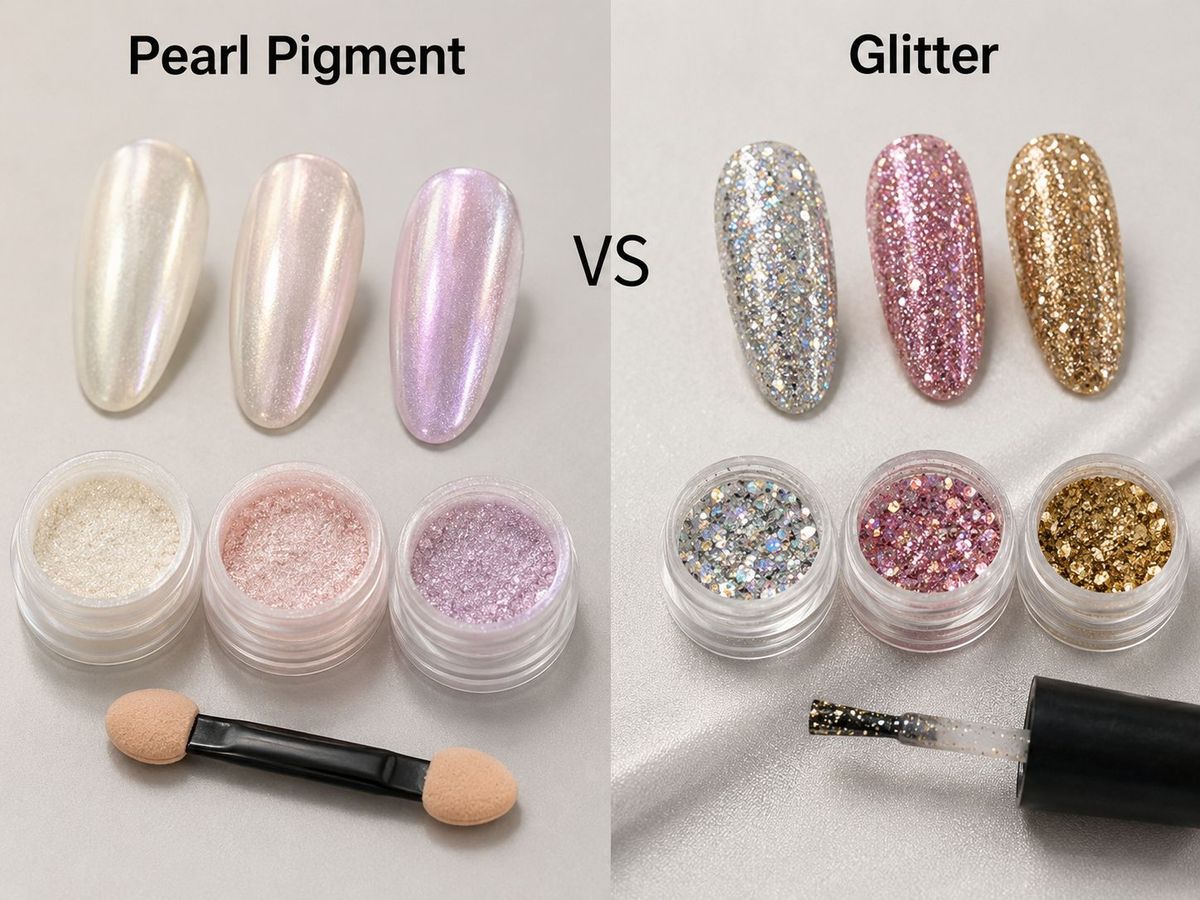
Selecting between pearl pigment and glitter for nail applications comes down to optical behavior, formulation compatibility, and the finish your end product demands — not just aesthetics. Shimmer pigment powder delivers a smooth, continuous pearlescent or metallic sheen by orienting fine flakes within the nail coating, while glitter produces discrete, high-intensity sparkling points that sit on or within the film. This article breaks down how each material behaves in real nail formulations, where they conflict with each other, and how to combine or select between them with confidence.
The Core Optical Difference — And Why It Drives Everything Else
Pearl pigments work through thin-film interference and specular reflection at the flake surface. When mica or borosilicate flakes align parallel to the substrate — as they tend to do in a well-formulated nail lacquer or gel — they collectively produce a coherent, layered optical effect. That's where you get depth, soft-focus shimmer, or the sharp iridescence of an interference color.
Glitter operates on a completely different principle. Each particle is a discrete mirror. Whether it's PET-based, holographic, or biodegradable cellulose, each piece independently catches and reflects light from a specific angle. The result is high-contrast sparkle — visible from across a room — rather than the surface-wide glow you get from pearlescents.
Neither is better. They serve different perceptual outcomes. Knowing which outcome you're targeting is step one.
Formulation Behavior: How Each Behaves in the Nail System
Pearl pigments — whether natural mica-based, synthetic fluorphlogopite, or borosilicate — are typically fine enough to disperse cleanly into nail lacquer, gel base, or dip powder systems. Particle size ranges from under 15μm for satin-finish powders up to several hundred microns for intense sparkle grades. Smaller particles integrate smoothly; larger ones create visible flake texture. Flake orientation during film formation matters significantly: a thicker wet film that dries or cures slowly allows better parallel alignment, which translates to a stronger pearl effect.
Dispersion is usually straightforward. Mica-based pearlescents don't tend to agglomerate badly in low-viscosity lacquer systems. In gel topcoats or gel-polish formulas, you'll want to confirm the specific grade is solvent-stable — some iron oxide-coated series perform better in aromatic or ester solvents than others. Synthetic mica grades generally show higher chemical stability and better resistance to color shift in UV-cure systems.
Glitter behaves very differently in the same systems. Particles are large relative to film thickness — standard nail glitters run from roughly 100μm to 3mm. That means they don't fully embed in thin lacquer films; they sit proud of the surface or require a thick gel layer for encapsulation. In practice, this affects application texture, topcoat adhesion, and long-term chip resistance.
Worth noting: solvent resistance is a real variable with glitter, not a given. Standard PET glitters can tolerate acetone in short exposures but may distort or delaminate under prolonged soak-off conditions. Biodegradable glitters — cellulose or PLA-based — often have different solvent resistance profiles that require testing against your specific gel or lacquer chemistry before committing to a formula.
Particle Size and Its Real Impact on Nail Finish
For pearl pigments in nails, the particle size-to-effect relationship is consistent and predictable:
| Particle Size Range |
Visual Effect |
Typical Nail Application |
| <15μm |
Satin, soft glow |
Nail lacquer, gel color |
| 15–60μm |
Bright shimmer |
Gel-polish, dip powder |
| 60–150μm |
Intense sparkle |
Gel topcoat, chrome powder |
| 150μm+ |
Chunky flake, macro-sparkle |
Nail art, encapsulated gel |
For glitter, size determines whether you're working with a wearable nail lacquer or an art-application product. Fine laser glitters (35–100μm) can integrate into gel systems with acceptable topcoat smoothness. Anything above 500μm is essentially nail art decoration — embedded, not dispersed.
Application Method Matters More Than People Realize
Chrome powder application — rubbing a fine pearl or metallic pigment onto a tacky gel layer — produces mirror or chrome effects precisely because the mechanical action further aligns the flakes parallel to the nail surface. This is a unique use case where pearlescent mica powder behaves more like a surface treatment than a dispersion additive. The results (mirror nails, aurora effects, cat eye effects with magnetic powders) are not achievable with glitter.
Glitter cannot replicate this. Its geometry and scale simply don't allow the flake orientation that produces a continuous reflective surface. If you're developing mirror nail products or chrome-finish gel systems, glitter is not a substitute — it's a different product category entirely.
In practice, many professional nail systems use both: a pearl pigment base for color depth and uniformity, with glitter additions for accent sparkle. The challenge is that large glitter particles can disrupt the smooth film formation that pearl effects require. Layering — pearl in the color layer, glitter in the topcoat or gel layer — tends to preserve both effects better than blending them into a single formula at high loadings.
Regulatory and Safety Considerations for Cosmetic-Grade Use
Nail products applied near the skin and cuticle fall under cosmetic regulations in most markets. This has direct implications for material selection.
Pearl pigments based on mica (CI 77019), titanium dioxide (CI 77891), iron oxides, and similar listed colorants are generally accepted under EU Regulation 1223/2009 and FDA 21 CFR Part 73/74 when supplied at cosmetic grade with appropriate documentation. Synthetic fluorphlogopite is similarly listed. Confirm your supplier provides full compositional disclosure and relevant safety data — batch-level certificates of analysis, REACH compliance, and heavy metals screening are minimum requirements.
Glitter regulation is evolving. The EU microplastics restriction (ECHA SVHC framework) has placed PET-based glitters under increasing scrutiny. Biodegradable alternatives — cellulose acetate, PLA — address environmental persistence concerns but require independent verification of both biodegradability claims and cosmetic safety. For nail systems specifically, check solvent resistance of any biodegradable glitter against your formulation chemistry before scaling.
Holographic glitters introduce additional complexity: the diffractive grating layer in some constructions may use materials not explicitly listed in cosmetic colorant annexes. Verify the full construction, not just the base substrate.
Selecting the Right Nail Effect Pigment Type: A Decision Framework
The selection question is really a series of smaller questions:
| Design Intent |
Recommended Material |
Notes |
| Smooth pearl or satin finish |
Fine pearl pigment (<25μm) |
Silver white, interference, or gold series |
| Mirror / chrome nail effect |
Metallic pearl powder, aurora powder, or aluminum paste |
Applied dry on tacky layer, not dispersed |
| Iridescent / color-shift effect |
Interference pearl, chromashift, or chameleon pigment |
Effect depends on base color; best on dark substrate |
| High-contrast sparkle |
Fine to medium glitter (35–200μm) |
Holographic glitter for rainbow sparkle |
| Nail art / decorative accent |
Shaped glitter, chunky glitter, luxury diamond glitter |
Stars, strips, circles — encapsulation required |
| Cat eye / magnetic effect |
3D cat eye magnetic pigment |
Requires magnet during UV cure |
| Functional effect (color change) |
Thermochromic or photochromic pigment |
Load level and base formulation are critical |
| Sustainability priority |
Biodegradable glitter (cellulose / PLA) |
Verify solvent resistance for your system |
Combining Pearl and Glitter: Where It Works and Where It Doesn't
Blending pearl pigments and glitter into a single formula is technically feasible, but the loading balance matters. At high glitter concentrations, the discrete particles break up the continuous reflective surface that pearl pigments need to produce their characteristic depth effect. The result often looks cluttered rather than luxurious.
A more controlled approach: use pearl pigment as the primary dispersion in the base coat or color coat, and apply glitter as a separate layer — either in a topcoat gel or pressed onto a wet coat before curing. This preserves the visual integrity of both materials. Borosilicate-based pearl pigments, with their larger smooth flakes and high transparency, tend to complement rather than compete with glitter when kept at moderate loading.
That said, fine holographic glitters (35μm range) can be blended directly with pearlescent dispersions at low concentrations without significantly disrupting flake orientation. At that size, the boundary between fine glitter and coarse pearl pigment starts to blur anyway.
FAQ
Can pearl pigments be used in UV gel nail systems?
Yes, but confirm UV stability for your specific grade. Synthetic mica (fluorphlogopite) grades and borosilicate series generally show better stability under UV cure cycles than some natural mica variants with organic dye coatings. Iron oxide-coated and TiO2-coated grades are typically stable. Always run cure inhibition tests — high pigment loadings can screen UV and affect cure depth.
What's the difference between shimmer pigment powder and chrome powder for nails?
Shimmer pigment powder is dispersed into the formula and produces its effect throughout the film. Chrome powder — typically a very fine metallic or aurora pigment — is applied dry onto a tacky uncured gel surface and buffed in. The mechanical rubbing aligns the flakes for a near-mirror reflectivity. They're different application techniques, not just different materials. You can't use a typical shimmer powder as a dry chrome application and expect the same result, and vice versa.
Is glitter safe for use in nail products applied near the cuticle?
Standard PET glitter is not designated as cosmetic grade in most regulatory frameworks — it's approved for nails as a surface application, but not for skin or mucous membrane contact. For nail products with any skin overlap, verify that your glitter supplier provides cosmetic-grade certification and appropriate safety documentation. Biodegradable cosmetic-grade glitter lines with face/lip/nail approval exist and are the more defensible option for products where incidental skin contact is expected.
Do interference pearl pigments work on light-colored nail bases?
Interference pigments — which produce color through thin-film optical effects rather than absorptive color — typically show their characteristic interference color most clearly over a dark or black substrate. On a light or white base, the interference color washes out and the pigment reads as near-white or colorless shimmer. If your formula uses a light base and you want to retain the interference color, increase loading significantly or layer over a dark undertone layer. Alternatively, select an absorptive pearlescent (gold series, metal luster, or multicolor series) that doesn't rely on substrate contrast to show color.
For technical samples, formulation guidelines, or grade-specific documentation on any of the products referenced above, contact the Kolortek technical team directly at contact@kolortek.com.

 English
 Français
 Deutsch
 Русский
 Español
 Português