Sourcing cosmetic mica powder wholesale means navigating a complex overlap of regulatory compliance, optical performance, and supply consistency — decisions that directly affect how your finished product looks on skin. Whether you're building a pearlescent eyeshadow palette or a shimmering lip gloss line, the substrate, coating chemistry, and surface treatment of your mica determine everything from flake orientation to skin feel. This article covers what to evaluate when qualifying a cosmetic mica powder supplier, how different mica grades behave in formulation, and what wholesale procurement actually looks like from a technical buyer's perspective — including where makeup pigments wholesale sourcing typically goes wrong.
Why Mica Selection Is a Formulation Decision, Not Just a Purchasing One
Mica powders are not interchangeable. Even within the same product category — say, a sericite used as a filler versus a coated phlogopite used for pearl effects — the platelet geometry, aspect ratio, and surface chemistry will produce fundamentally different results in a pressed powder or a liquid foundation.
Natural mica (muscovite, phlogopite, sericite) and synthetic mica (fluorphlogopite) sit at opposite ends of the purity spectrum. Synthetic mica carries essentially no heavy metal contamination, offers higher whiteness, finer refractive properties, and significantly better temperature resistance. For leave-on cosmetics and lip-safe formulations, that cleaner profile matters. Natural mica remains cost-effective and performs well in many rinse-off and body applications, but batch-to-batch color consistency requires tighter supplier QC controls.
In practice, the mica base is often only part of the story. Coated mica — titanium dioxide over natural or synthetic flakes — generates the interference and pearlescent effects that define most decorative cosmetic applications. The coating thickness determines the interference color. A thinner TiO₂ coat gives silver-white; progressively thicker layers shift through gold, red, violet, and blue. Understanding this isn't optional for a formulator specifying a supplier's product range.
Grades, Treatments, and What They Mean for Your Formula
When you're reviewing a supplier's mica catalog, the surface treatment column is where you should spend most of your time. Untreated mica has relatively high oil absorption and can feel gritty in skin-contact applications. Treated variants — dimethicone-coated sericite, triethoxycaprylylsilane-treated mica, lauroyl lysine-coated mica — exist to solve specific formulation problems.
| Treatment Type |
Primary Benefit |
Typical Application |
| Dimethicone-treated sericite |
Reduced oil absorption, improved slip |
Pressed powders, foundations |
| Triethoxycaprylylsilane-treated mica |
Hydrophobic surface, better dispersion in oils |
Lip gloss, serum-based products |
| Lauroyl lysine-coated mica / sericite |
Soft skin feel, sebum control, matte effect |
Loose powders, skin care hybrids |
| Carnauba wax-treated mica |
Improved adhesion, natural-origin compliance |
Pressed eye shadows, bronzers |
| Untreated silk mica / silver mica |
Cost-effective filler, mild shimmer |
Body care, soap, basic shimmer formats |
Worth noting: matte sericite and silk mica are often categorized as "fillers," but their optical contribution in a formula isn't zero. Even a matte mica adds a soft-focus effect and modifies the way colored pigments scatter light. Treat them as functional ingredients, not inert carriers.
Regulatory Compliance Across Markets — The Non-Negotiable Baseline
If you're selling cosmetics in the US, EU, or Japan, the regulatory framework for colorants and mineral pigments is not uniform. This creates real sourcing friction. A pigment that's acceptable under EU Regulation 1223/2009 may not appear on the FDA's approved colorant list for a lip-safe application. Iron oxides, ultramarines, chromium oxide greens — all have jurisdiction-specific purity requirements and approved use restrictions.
A credible wholesale supplier should be able to provide documentation that maps their products against these frameworks explicitly. That means COAs with heavy metal content (especially arsenic, lead, mercury, cadmium — controlled in cosmetic-grade mica), REACH compliance data for EU-bound shipments, and MSDS/TDS packages that reflect actual batch specifications rather than generic product descriptions.
For the US market specifically, coated mica products and color additives may require listing under specific FDA color additive regulations. Suppliers with genuine cosmetic market experience will already have this mapped. If they can't answer that question directly, that's a qualification signal worth acting on.
Certifications such as ISO 9001, SGS, TÜV SÜD, and Kosher are minimum indicators of process discipline. Cruelty-free certification is increasingly a brand requirement for Western markets. Batch-to-batch consistency documentation — not just a single COA from qualification — matters more for production stability than any single certification.
What "Wholesale" Actually Covers: Pricing, MOQ, and Custom Capability
The term "wholesale" is used loosely. For mica and cosmetic pigments, the meaningful distinction is between a trading company reselling finished goods and a manufacturer supplying direct from production. Factory-direct pricing removes one or two margins from the chain, but more importantly, direct manufacturer access means you can discuss formulation-level specifications — not just SKU numbers.
That said, price alone is not a sourcing strategy. Key commercial variables worth evaluating:
- Minimum order quantities (MOQ): For specialty treated micas or custom color-matched pigments, MOQs can vary significantly. Lower MOQs are useful for product development; production volumes typically carry better per-kg pricing.
- Color stock depth: A supplier holding 1,000+ stock colors in consistent inventory reduces your exposure to lead times on reformulation or restocking.
- Custom color matching: Duplication of Merck Iriodin-equivalent standards, color trend guidance, and bespoke blending capability are indicators of technical depth.
- Private label / OEM support: Relevant if you're building a branded cosmetic ingredient line or white-labeling finished pigment formats.
- Sample availability: A supplier that makes sample access difficult or charges prohibitively for evaluation samples is not set up for technical buyers.
In practice, the most productive wholesale relationships in this space look less like purchase orders and more like technical partnerships — where the supplier's R&D team can support formulation troubleshooting, suggest surface treatment modifications, or flag regulatory changes that affect your target markets.
Beyond Basic Mica: Effect Pigment Categories Worth Specifying
Formulators sourcing cosmetic pigment wholesale often need more than a base mica filler or a standard pearl. Modern decorative cosmetics increasingly rely on complex optical effects that require specific pigment architectures.
Interference pigments: Coated mica with controlled TiO₂ thickness. On a white substrate, they appear near-colorless; on dark backgrounds, the interference color becomes visible. Widely used in sheer highlighters and skin-tone-adaptive products.
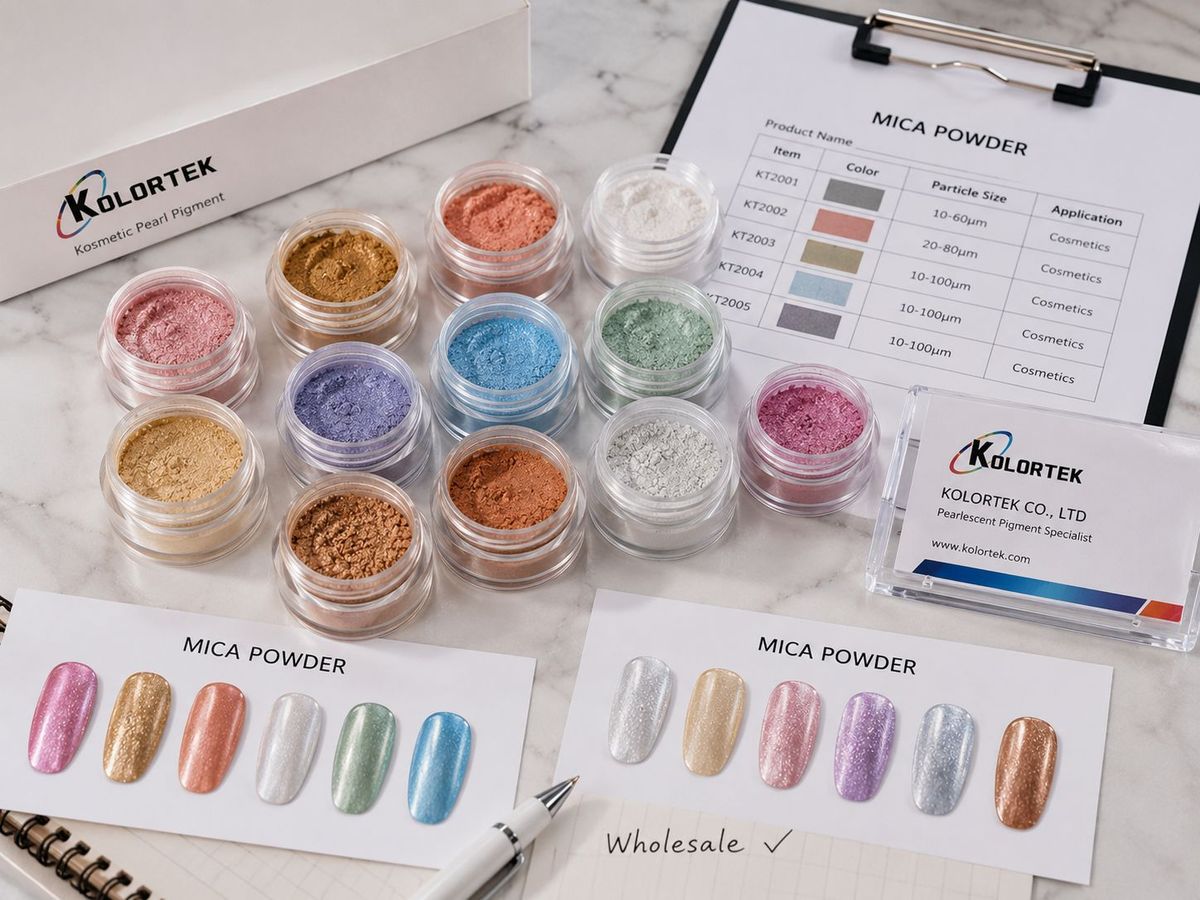
Metallic luster pigments: Higher TiO₂ or iron oxide loading gives strong opacity with a warm or cool metallic reflection. The KT-500 series (natural mica) and KT-7500 (synthetic mica) typify this category — strong concealing property, stable in both chemical and physical environments.
Chromashift / chameleon pigments: High-transparency flake crystals coated with titanium dioxide generate angular color shift — the viewed color changes depending on illumination angle and observation angle. Cosmetic-grade chromashift pigments should carry explicit lip-safe, eye-safe designations with appropriate supporting documentation. Titanium Dioxide Free variants are available for formulations requiring that profile.
Borosilicate-based effects: Calcium-aluminum borosilicate substrates offer a different optical signature than mica — higher transparency, stronger sparkle, and a diamond-like reflection that natural mica substrates cannot replicate. These are frequently used in premium highlighters and top-coat applications.
Holographic pigments: Diffraction grating structures generating spectral rainbow prism effects. Performance is highly substrate-dependent — they read very differently in pressed versus loose powder formats and in different binder systems.
Fluorescent pigments: Convert UV and visible absorbed light into re-emitted fluorescence, producing unusually vivid, high-chroma effects that conventional pigments cannot achieve. For cosmetic use, formaldehyde-free grades with documented safety profiles are the baseline requirement.
Evaluating a Cosmetic Pigment Supplier: A Practical Checklist
When shortlisting suppliers — whether domestic or international — the following criteria separate technically capable manufacturers from catalog resellers.
| Evaluation Criteria |
What to Ask / Verify |
| Regulatory documentation |
COA with heavy metals, REACH declaration, FDA colorant mapping for US lip/eye use |
| Batch consistency |
Multi-batch COAs, Delta E tolerance specifications |
| Application-specific safety |
Lip-safe, eye-safe, face-safe designations per product, not just category |
| Technical support depth |
Formulation guidelines, dispersion recommendations, compatibility data |
| Manufacturing capability |
ISO 9001 certification, production scale, custom coating capability |
| Supply chain reliability |
Stock depth, lead times, export track record across target markets |
| Sample and MOQ flexibility |
Development sample availability, production MOQ tiers |
One additional signal: suppliers with active R&D programs — particularly those collaborating with external research institutes on new coating technologies or surface treatment innovations — are more likely to stay ahead of regulatory changes and market trends than those simply running existing formulations on repeat.
Common Sourcing Mistakes and How to Avoid Them
Specifying by trade name alone. "Pearl mica" is not a specification. Without knowing the substrate (natural vs. synthetic mica, borosilicate), coating type, surface treatment, and applicable market regulations, you have no baseline for supplier comparison or formulation reproducibility.
Qualifying on single-sample batches. A single approved sample doesn't tell you about batch-to-batch color shift. Request multiple production batch COAs and, where possible, physical samples from different manufacturing runs before committing to production volumes.
Ignoring the substrate wetting issue. Mica powders dispersed into oil-based systems behave differently depending on surface hydrophilicity. An untreated mica that performs acceptably in a pressed powder may aggregate badly in a lip gloss base. Specify the application medium upfront and confirm the surface treatment matches your dispersant and carrier system.
Treating compliance as the supplier's problem. Documentation responsibility lives with the brand and formulator. A supplier can provide COAs, MSDS, and regulatory mapping — but the formulator needs to verify that the specific colorant is approved for the specific use (eye area, lip, face, leave-on vs. rinse-off) in each target market. Don't outsource that judgment entirely.
FAQ
What is the difference between natural mica and synthetic mica in cosmetic formulations?
Natural mica (muscovite or phlogopite) is mined mineral material, cost-effective but variable in heavy metal trace content and optical uniformity. Synthetic mica (fluorphlogopite) is manufactured, offering higher purity, improved whiteness, fewer surface defects, better high-temperature stability, and more consistent batch-to-batch performance. For lip and eye applications where heavy metal limits are tightly regulated, synthetic mica carries lower compliance risk.
How do I verify that a mica pigment is safe for lip use?
Lip-safe designation requires that the pigment and any colorants coating it appear on the FDA's approved color additive list (for US market) or comply with Annex IV of EU Regulation 1223/2009, with heavy metal impurities within cosmetic-grade limits. Request explicit lip-safe COA documentation and confirm the colorant INCI name against the relevant positive lists for each target market. Generic "cosmetic grade" labeling is not sufficient for lip applications.
What MOQs should I expect when sourcing cosmetic mica wholesale?
MOQs vary significantly by product type. Standard stock colors and base mica fillers typically have lower entry points suitable for development-phase sampling. Custom color matches, specialty surface treatments, or private label packaging generally carry higher production MOQs. A manufacturer with deep stock inventory — 1,000+ colors — provides meaningful flexibility for early-stage product development without requiring full production commitment.
Can the same mica pigment be used across face, eye, and lip applications?
Not automatically. Application suitability is determined by the specific colorants in the coating, surface treatment chemistry, and the regulatory framework of your target market. A pigment listed as face-safe may contain colorants not approved for eye-area use in the EU. Always verify application-specific compliance on a per-ingredient, per-market basis — and request that suppliers provide this mapping explicitly in their product documentation rather than assuming category-level approval covers all uses.
If you're evaluating suppliers for development samples or need technical documentation mapped against your target markets, contact contact@kolortek.com for direct technical discussion.

 English
 Français
 Deutsch
 Русский
 Español
 Português