Leave A Message
If you are interested in our products and want to know more details,please leave a message here,we will reply you as soon as we can.

Edible glitter and luster dust are used in confectionery, cake decoration, beverages, and specialty food products to add visual shimmer and metallic effects that conventional food colorants cannot produce. Demand for these products has grown alongside the expansion of home baking, artisan confectionery, and premium food and beverage presentation. At the same time, the regulatory environment for food-grade colorant ingredients is tightening — most notably the EU's ban on titanium dioxide (E171) as a food additive from 2022 — creating genuine formulation and sourcing challenges for food manufacturers and decorators. Kolortek's edible glitter range addresses both the standard market and the growing demand for titanium dioxide free alternatives.
Kolortek's Solutions for Food Decoration
| Application Scenario | Recommended Product | Key Reason for Recommendation |
|---|---|---|
| Cake and cupcake decoration — EU market | Titanium Dioxide Free Edible Glitter | Compliant with EU E171 ban; suitable for professional bakeries and confectionery producers supplying the EU market |
| Cake and cupcake decoration — non-EU markets | Edible Glitter (Luster Dust) standard grades | Standard edible luster dust grades; confirm local regulatory requirements for titanium dioxide status in target market |
| Chocolate decoration and coating | Edible Glitter / TiO₂ Free Edible Glitter | Dry application over chocolate surface; grade selection based on particle size appropriate for the desired visual effect intensity |
| Beverage suspension — sparkling wine, cocktails, energy drinks | Edible Glitter fine grades | Fine particle grades provide better suspension behavior in liquid; coarser grades settle faster — particle size is the key selection variable for beverage applications |
| Fondant and sugar paste decoration | Edible Glitter / TiO₂ Free grades | Dry brush or spray application on sugar surfaces; multiple color options available |
| Gel and glazing compound incorporation | Edible Glitter fine to medium grades | Incorporated into warm gel before setting; particle size should be matched to gel layer thickness to ensure visual effect is visible in the final product |
| Macarons and confectionery surface finish | Edible Glitter standard or TiO₂ Free | Applied as dusting powder or in isopropanol paint; confirm that application solvent is food-safe and appropriate for the target product category |
| Commercial confectionery production | Either series — grade confirmed with documentation | Grade-specific TDS, CAS numbers, and ingredient composition documentation available upon request for production compliance records |
Particle Size Selection for Food Applications
| Visual Target | Particle Size Range | Why |
|---|---|---|
| Fine shimmer / satin luster (beverage suspension, fine dusting) | Fine grades | Smaller particles suspend more evenly in liquids and produce a smoother, more diffuse shimmer on dry surfaces; less visible as individual particles |
| Standard pearl luster (cake decoration, fondant, chocolate) | Medium grades | Standard decorative effect; visible shimmer without coarse individual glitter points; most versatile for general cake decoration use |
| Visible sparkle / glitter effect (statement decoration, toppers) | Coarser grades | Individual flake reflections visible; produces a glitter-like appearance rather than diffuse shimmer; settling occurs faster in liquid applications at this size |
| Beverage application | Finest available grades | Suspension time in liquid is particle-size dependent — finer grades remain in suspension longer; evaluate suspension behavior in the specific beverage base during formulation trials |
Product Selection by Regulatory Requirement
| Requirement | Standard Edible Glitter | TiO₂ Free Edible Glitter |
|---|---|---|
| EU market compliance (post E171 ban) | Not suitable if TiO₂ is present as food additive | Formulated without titanium dioxide as a food colorant — relevant for EU market |
| Non-EU markets (US, Asia, etc.) | Confirm local TiO₂ regulatory status in target market | Suitable for all markets including EU |
| Ingredient declaration simplicity | Standard composition | TiO₂-free composition; simpler declaration for EU-compliant products |
| Visual brightness / luster | TiO₂ coating contributes to luster intensity | Alternative colorant system; contact us for visual comparison samples |
| Cost | Standard | Contact us for pricing — alternative colorant systems may vary |
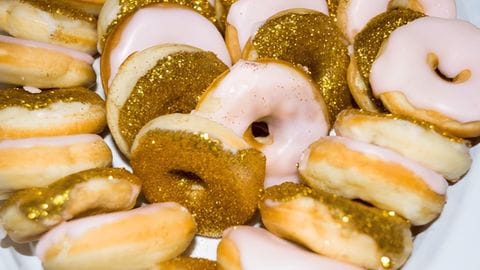
Fondant Cake Decoration — Gold Luster Dust Product used: Edible Glitter (Luster Dust) — gold grade Effect achieved: A warm gold metallic shimmer applied by dry brush over fondant-covered cake surfaces, producing a visible metallic luster visible under standard event lighting without appearing granular or uneven. Formulation note: Dry brush application produces a more diffuse, satin effect; mixing the luster dust with a small amount of food-safe alcohol (such as food-grade ethanol or vodka) and painting with a fine brush produces a more concentrated, metallic appearance in defined areas. The alcohol evaporates leaving the luster dust deposited on the surface.
Sparkling Beverage — Silver Glitter Suspension Product used: Edible Glitter fine grade — silver Effect achieved: Fine silver edible glitter particles in suspension within a clear sparkling wine or cocktail, producing visible light reflections as the particles move in the liquid. Formulation note: Suspension time is a function of particle size and liquid viscosity. Fine grades suspend longer than coarse grades in low-viscosity beverages. Evaluate suspension duration in the specific beverage formulation during development — addition rate and particle size may require adjustment to achieve the desired visual effect duration. The product should be added just before serving in consumer applications rather than incorporated during production if a long shelf life is required.
Chocolate Truffle Finishing — TiO₂ Free Luster Dust (EU) Product used: Titanium Dioxide Free Edible Glitter — rose gold or pearl grade Effect achieved: A pearl or rose-toned metallic finish applied over the chocolate shell surface, providing a premium visual effect compliant with EU E171 restrictions. Formulation note: Apply by dry brush to set chocolate shell — the chocolate surface should be fully set before application to avoid the dust adhering unevenly. For enrobed products, application after the final chocolate pass and before full set provides slightly better adhesion of the luster dust.
Macaron Surface Decoration — Fine Shimmer Dusting Product used: Edible Glitter fine grade — assorted colors Effect achieved: A fine, even shimmer over the macaron shell surface applied by light dusting through a fine sieve, producing a subtle all-over shimmer rather than a visible glitter point effect. Formulation note: Application by sieve dusting at fine particle size produces the most even coverage on curved macaron surfaces. Coarser grades produce a more pronounced sparkle effect but are more prone to uneven distribution when sieved. Test application method and grade combination on the specific macaron shell before scaling to production.
Manufacturing Experience Kolortek has manufactured effect pigments and decorative powders for over 20 years. For food-grade products specifically, this translates into established production controls focused on ingredient purity, batch consistency, and the documentation processes required for food ingredient supply — CAS numbers, composition declarations, and product specifications are standard outputs of the production process, not ad hoc requests.
Product Range — Standard and TiO₂ Free Kolortek's edible glitter range covers both standard luster dust grades and titanium dioxide free alternatives, allowing buyers to source from a single supplier across different market requirements. The TiO₂ free range was developed specifically in response to the EU E171 regulatory change — it is not a repackaged industrial product, but a purpose-developed food-grade formulation. Multiple colors are available in both series.
Technical and Compliance Support Kolortek's technical team can provide ingredient composition data, CAS numbers, and TDS for all edible glitter grades to support buyers' own regulatory review and ingredient declaration processes. Kolortek does not provide regulatory approval determinations — final food safety and compliance assessment is the responsibility of the food manufacturer or brand. However, the technical documentation required to support that assessment is available upon request for all grades.
Edible glitter and luster dust selection depends on application method, target market regulatory requirements, and the specific visual effect required. Whether you need EU-compliant TiO₂ free grades, beverage-suspension fine grades, or standard luster dust for general cake decoration, the right starting point is a sample evaluation under your specific application conditions.
Contact Kolortek to request grade-specific samples, ingredient composition documentation, or technical guidance on grade selection for your application.

 English
 Français
 Deutsch
 Русский
 Español
 Português