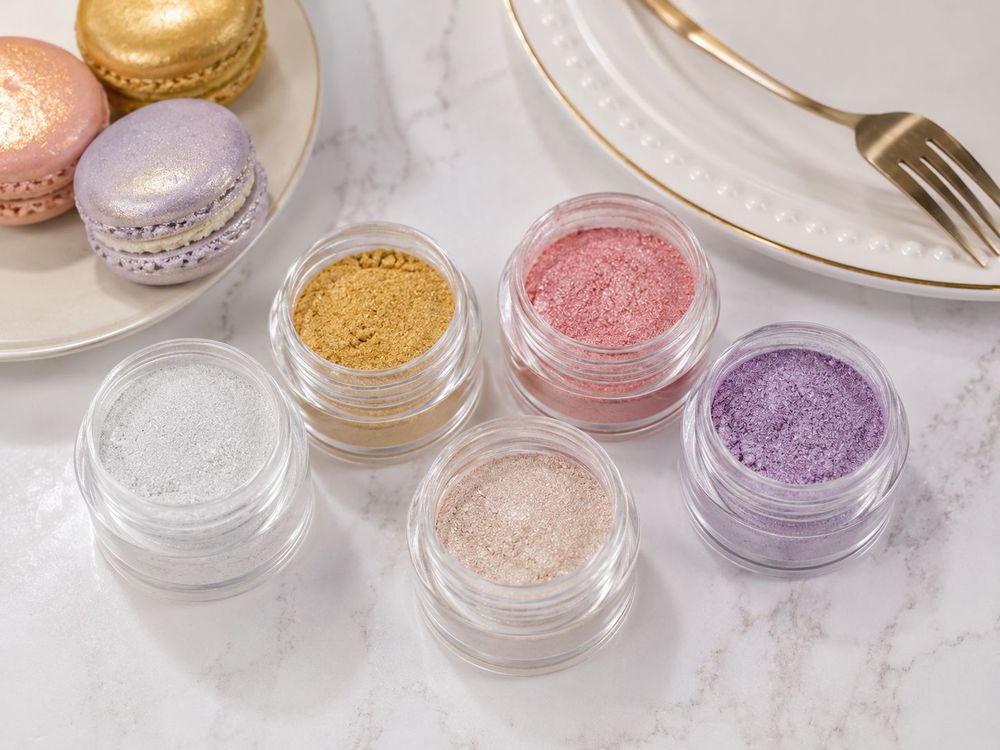
Edible luster dust is a mica-based pearlescent powder used to apply shimmering gold, silver, and color-shift effects directly onto cakes, chocolates, and confections — where visual impact is as deliberate as flavor. For formulators and food decorating specialists, understanding what separates truly food-safe luster dust from non-compliant decorative glitter matters before it ever reaches a finished product. This article breaks down composition, regulatory standing, and practical selection criteria so you can specify with confidence.
What Edible Luster Dust Actually Is
At its core, edible luster dust is a fine pearlescent powder built on a mica substrate — the same mineral platform used in cosmetic and industrial pearl pigments, but formulated and tested specifically for oral ingestion. The shimmer effect comes from the way thin mica flakes orient on a surface and interact with light through their titanium dioxide or iron oxide coatings. When applied to a matte surface like fondant or chocolate, those flakes align and reflect coherently, producing the characteristic metallic or pearlescent appearance.
It goes by several names: pearl dust, sparkle powder, edible glitter, lustre edible dust. The terminology is inconsistent across markets, which creates real confusion at the point of purchase. A product labeled "luster dust" at a craft supply store may not be food-approved at all — it may be a cosmetic-grade material repurposed for decoration. That distinction matters significantly.
In practice, two colorant systems dominate edible luster dust formulations:
- Mica + Titanium Dioxide: The standard architecture. TiO₂ provides white interference and brightness. Widely used, well-characterized.
- Mica + Iron Oxides: Produces gold, bronze, and warm metallic tones. Iron oxides are among the most regulated and accepted colorants globally.
A third variant — titanium dioxide-free edible glitters — has gained traction as regulatory pressure on TiO₂ increases in certain jurisdictions, particularly within the EU. These formulations use alternative interference coatings or iron oxide-only systems to achieve comparable effects without TiO₂.
Is Edible Luster Dust Safe to Eat?
The short answer: it depends entirely on the specific product and its compliance status.
A properly formulated and certified food safe glitter uses ingredients that are either approved food additives or GRAS (Generally Recognized as Safe) materials. Mica itself — specifically synthetic fluorphlogopite or natural muscovite — is approved under EU Regulation (EC) No 1333/2008 as food additive E555 (potassium aluminium silicate) for use in specific food categories. In the US, FDA 21 CFR governs allowable colorants, and mica-based pearlescent pigments used in food contact or direct food application must conform to those listings.
The problem isn't the mica itself. It's what's coated on it, what carrier or binder accompanies it, and whether the manufacturer has actually validated food-grade compliance through third-party testing.
Worth noting: Kosher certification — which requires rigorous ingredient traceability and processing standards — is one credible signal for food-grade rigor. It doesn't replace FDA or EU food additive approval, but it indicates a level of supply chain discipline that matters in food applications.
Non-compliant products — often labeled "non-toxic" rather than "edible" — may use cosmetic-grade mica with colorant packages not cleared for ingestion. Cosmetic iron oxides and food-grade iron oxides, for instance, differ in purity thresholds for heavy metal contaminants. Using cosmetic-grade material on food is not a technicality you can overlook.
Regulatory Landscape: What "Food Safe" Actually Requires
There is no single global standard that governs edible luster dust uniformly. Procurement managers sourcing across regions need to navigate three distinct frameworks:
| Region |
Governing Standard |
Key Requirement |
| EU |
EC 1333/2008 + EFSA opinions |
Positive list; TiO₂ (E171) banned as food additive since 2022 |
| USA |
FDA 21 CFR Parts 73, 74, 82 |
Listed synthetic colorants + GRAS minerals only |
| Global |
Codex Alimentarius |
Reference standard; adopted variably by country |
| Multi-region |
REACH, SGS, TÜV SÜD testing |
Contaminant limits, heavy metals, purity thresholds |
The EU ban on E171 (titanium dioxide as a food additive) since August 2022 is the most consequential recent development for luster dust formulation. Any product destined for EU markets that still relies on TiO₂-coated mica as its colorant mechanism needs to be reformulated or explicitly reviewed. This is exactly what's driving demand for titanium dioxide-free edible glitter variants.
That said, not all TiO₂ use in food context is prohibited globally. US and many Asian markets still permit it under specific conditions. This creates a legitimate formulation fork: one product series for EU compliance, another for broader global distribution.
How Edible Luster Dust Behaves in Application
Understanding the physical behavior of luster dust matters as much as its compliance status. These are not dyes — they are particle-based optical effects, and they behave accordingly.
Dry brushing: The most common application method. Fine particles applied with a dry brush orient loosely on the surface. Effect intensity is moderate; distribution is uneven but naturally aesthetic. Works well on chocolate, fondant, macarons.
Mixed with alcohol or extract: Suspending luster dust in ethanol or food-grade alcohol creates a paint-like consistency. Flake orientation improves slightly; the effect reads as more metallic and continuous. Alcohol evaporates; what remains is a higher-coverage finish.
Suspended in liquid (drinks, glazes): Coarser particle grades (40–200μm range) stay suspended longer and deliver visible shimmer in motion — useful for sparkling beverages, cocktails, and liquid chocolate coatings. Finer grades (<15μm) tend to disperse more uniformly but with less individual flash.
Particle size selection directly affects visual outcome. This is one area where a supplier's technical data sheet should be reviewed carefully — not just the color name. The same gold formulation in a 10–60μm range versus a 40–200μm range will read very differently on the same substrate.
Stability in food matrices is generally strong. Mica-based pigments don't bleed, don't migrate the way dyes do, and hold up well under refrigeration and moderate heat. They are chemically inert in most food environments. That said, prolonged exposure to highly alkaline or acidic matrices can affect the oxide coatings, particularly with certain iron oxide-based products.
Selecting the Right Edible Dust for Your Application
Not every edible dust is right for every application. Here's a practical framework:
| Application |
Recommended Grade |
Key Consideration |
| Cake / fondant (dry brush) |
10–60μm or 40–200μm |
Finer for smooth surfaces; coarser for sparkle effect |
| Chocolate / bonbon coating |
10–60μm |
Good flake adhesion on fat-based surfaces |
| Beverages / cocktails |
40–200μm |
Visible shimmer in suspension; check settling behavior |
| Ice cream / frozen desserts |
10–60μm |
Stability under freeze-thaw; avoid coarse grades that sink |
| EU-market products |
TiO₂-free series |
Mandatory; verify E171 compliance documentation |
Color selection follows standard interference pigment logic: gold and bronze tones come from iron oxide coatings; silver and white tones come from TiO₂ (or its compliant alternatives); vivid colors use additional approved colorant layers. For applications requiring EU compliance, confirming the absence of E171 in any form is a non-negotiable first step in product specification.
What to Ask Your Supplier
When evaluating any edible luster dust source, the documentation burden falls on the supplier. Minimum requirements for a credible food-grade product:
- Full ingredient declaration with CAS numbers
- Applicable food additive approvals (21 CFR, EC 1333/2008, or equivalent)
- Heavy metals certificate of analysis (Pb, As, Hg, Cd at minimum)
- Third-party testing reports (SGS, TÜV SÜD, or equivalent)
- Clear statement on TiO₂ content — especially for EU supply
- Kosher or Halal certification if required by your end market
If a supplier cannot produce these documents on request, the product should not be used in food applications regardless of how it's labeled.
FAQ
Is all luster dust edible?
No. Many products sold as "luster dust" are cosmetic-grade or decorative-only materials. Only products with documented food additive compliance and third-party safety testing should be used in direct food contact or ingestion applications. "Non-toxic" does not mean edible.
Is titanium dioxide-free edible glitter as effective as standard formulations?
For gold and warm metallic tones: yes, because those effects rely primarily on iron oxide coatings anyway. For bright silver or white pearl effects, TiO₂-free alternatives use different interference architectures and may show slight differences in brightness or chroma. Performance is comparable in most decorating applications, but side-by-side evaluation is worthwhile before switching formulations.
Can edible luster dust be used in beverages?
Yes, with the right particle grade. Coarser grades (40–200μm) remain visible in suspension and create shimmer-in-motion effects suitable for cocktails, water-based drinks, and liquid chocolate. Finer grades disperse more evenly but with less flash. Check sedimentation behavior in your specific matrix before committing to a formulation.
What's the difference between edible luster dust and food safe glitter?
The terms overlap but aren't identical. Food safe glitter typically refers to larger-flake formats (50–500μm+) that deliver a visible sparkle or glitter effect rather than a smooth pearlescent finish. Edible luster dust is finer and produces a more continuous metallic or shimmer coating. Both can be food-compliant; the distinction is primarily aesthetic and particle-size based.
For technical specifications, compliance documentation, or sample requests on edible glitter series — including titanium dioxide-free variants — contact contact@kolortek.com.

 English
 Français
 Deutsch
 Русский
 Español
 Português